Answering questions is a cooperative affair. Since questions are usually meant to elicit information, there is not only an obligation for the addressee to answer the question (or at least to acknowledge it), but in addition, this answer needs to be appropriately informative with respect to the requested information (Kiefer, Reference Kiefer and Meyer1988). On the surface, this would seem to be a simple task since questions indicate explicitly what the questioner already knows and what information s/he is seeking. But the context in which the question is asked often plays an important role in determining what is an appropriately informative response. For example, when a referent is given information either from the preceding discourse context (i.e. it has been mentioned before) or from joint visual perception (i.e. both interlocutors visually attend to a referent in the environment), there is no need to present it as new information in the answer, but rather it may be marked as given information. However, when the referent is neither contextually nor perceptually given, the answerer should express it as new information.
Thus, it is the speaker's task to assess the cognitive status of a particular referent in the addressee's mind (e.g. Ariel, Reference Ariel1988; Chafe, Reference Chafe and Li1976; Prince, Reference Prince and Cole1981). When the speaker assumes that something is given information or activated for the listener, then the speaker can refer to it by using a pronoun. However, when something is new information and thus not activated, a lexical noun is required (Gundel, Hedberg & Zacharski (Reference Gundel, Hedberg and Zacharski1993)).
There has not been a great deal of research on children's question answering, and the ways in which they might take the questioner's perspective into account based on (i) the surrounding visually perceptual context, and (ii) the immediately preceding discourse context. With regard to perceptual context, a number of behavioral studies have shown that by around their second birthdays young children can distinguish what they can see from what others can see (Moll & Tomasello, Reference Moll and Tomasello2006), and they even take this into account in their pointing behavior (O'Neill, Reference O'Neill1996). But translating this knowledge into the appropriate use of the many options of referential terms available in most languages – from pronouns to lexical noun phrases to noun phrases with relative clauses – is not straightforward.
Campbell, Brooks & Tomasello (Reference Campbell, Brooks and Tomasello2000) investigated two- and three-year-old children's choice of referring expressions based on whether their communicative partner had or had not previously witnessed an event about which the child was questioned. They found that the children of both ages did not make a referential distinction according to the previous presence or absence of the experimenter. However, this result might have been due to the fact that at the moment when the adult asked the child what had just happened, the referent (involved in the event and expected to be expressed in the answer) was perceptually available to the adult, and therefore the child did not need to remember whether or not the adult had seen the event.
Matthews, Theakston, Lieven & Tomasello (Reference Matthews, Theakston, Lieven and Tomasello2006) investigated children's choice of referring expressions based on the immediate perceptual availability of the referent object to their interlocutor. Children were shown video clips in which characters performed simple actions (e.g. a clown jumping), while the experimenter either sat with the child jointly watching the video or the sat behind the TV without visual access while the child sat by herself in front of the screen. When the adult asked the child to tell her what was happening in the video, three- and four-year-olds (but not two-year-olds) favored more lexically informative noun–verb responses if the addressee could not see what they were referring to. In contrast, when the adult could see the screen, the four-year-olds gave more pronoun–verb responses and the three-year-olds tended to give either pronoun–verb responses or verb-alone responses. These findings indicate that perceptual availability for the addressee has an effect on children's choice of referring expression – but only from the age of three.
With regard to discourse context, in Campbell et al.'s (Reference Campbell, Brooks and Tomasello2000) study, the adult asked the children two different types of questions, one using a full noun for the target referent and one not: ‘What did X do?’ and ‘What happened?’, respectively. Campbell et al. found that even the two-year-olds gave more full noun references in response to the general question than to the specific question, to which the children tended to respond with more pronouns and null references. Similarly, in a study by Wittek & Tomasello (Reference Wittek and Tomasello2005), when German children aged 2 ; 5 were asked a question about a target object (‘Where's the broom?’), they tended to use null references or pronouns to refer to that object (‘On the shelf.’ or ‘It's on the shelf.’). When they were asked more general questions about a target object that revealed no knowledge of that object (‘What do we need?’), they tended to use lexical nouns (‘A broom.’). Given two-year-olds' relative lack of sensitivity to the perceptual availability of referents, both of these studies concluded that young children are more sensitive to a referent's previous availability in discourse than to its perceptual availability in the immediate situation.
The only study to look at both of these factors was one by Matthews et al. (Reference Matthews, Theakston, Lieven and Tomasello2006), although they did so in separate studies. In their second study (the first one was described above), they asked children one and the same question in all conditions (‘What happened?’), but varied whether or not the person asking the question had previously mentioned the referent with a full noun. They found that three- and four-year-olds were likely to give a pronoun–verb response when the character had been named before, but they replied with a lexical noun–verb sentence when the experimenter had not yet mentioned the name. Moreover, the two-year-old children responded with more naming constructions when the referent had not been mentioned previously. Given their finding in the first study, that these same children were poor in taking into account perceptual availability, Matthews et al. also concluded that young children are more sensitive to a referent's previous availability in discourse than to its perceptual availability in the immediate situation.
All of these studies focused on noun phrases and they mainly used a question in order to establish the discourse context. In an attempt to broaden the discourse context, Salomo, Lieven & Tomasello (Reference Salomo, Lieven and Tomasello2010) focused on children's tendency to provide both a noun phrase and a verb in answering predicate-focus questions (‘What is the frog doing?’), which require the provision of information about a target action (and its object, in the case of transitives). They varied across conditions whether the verb and the patient were given or new information from the discourse context preceding the question. Salomo et al. found that the two-year-olds' tendency to provide the verb and the patient in their answer to such questions did indeed depend on the previous context; that is, children answered with a verb and a lexical noun for the patient (e.g. ‘Washing the duck.’) when the patient was new information, but they answered with a single verb (e.g. ‘Washing.’) when the patient was given information. However, in this study, both preceding discourse context and perceptual availability were always the same for child and adult, and so the children could simply rely on their egocentric knowledge and did not need to take the adult's perspective into account.
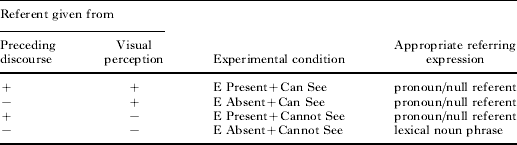
In the current study, therefore, we investigated young children's provision of both verbs and noun phrases in response to predicate-focus questions, but we combined this with a systematic manipulation of the perceptual as well as the discourse availability of the referent to the interlocutor. This situation thus mimicked real life where, typically, both perceptual and discourse availability must be taken into account in answering a question about a current scene. Children were shown three short video clips of scenes in which an agent successively performed three different actions on one and the same patient (e.g. ‘monkey kissing lion’, ‘monkey pulling lion’, ‘monkey stroking lion’). Each of the scenes was described verbally. In order to manipulate discourse context, the primary experimenter was either present or absent during these descriptions. The third scene of the video was the target scene. During the target scene, the primary experimenter asked a predicate-focus question (‘What's AGENT doing now?’). This question was intended to elicit an answer in the form ‘VERB-ing PATIENT.’ In order to manipulate perceptual availability, we varied whether or not the primary experimenter could see the video screen when asking the question. We looked at children's responses to see how they dealt with a previously shared (or not shared) discourse context with the experimenter, as well as simultaneously, with the perceptual availability (or not) of the referent to the experimenter. Full lexical reference is necessary when a referent is newly introduced into the discourse and when it is not perceptually shared; using a pronoun (or null referent) is appropriate when a referent is either perceptually given or given from the preceding discourse or from both (e.g. Chafe, Reference Chafe and Li1976). A schematic overview is given in Table 1.
Overview of the givenness/newness of a referent from shared preceding discourse and/or shared visual perception and the corresponding appropriate referring expression
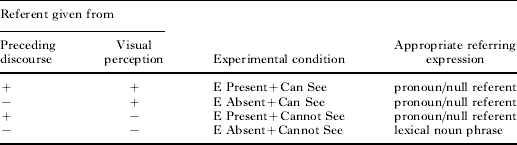
To find out what leads children in their choice of referential expressions, the key conditions are the ones where the referent is given information from either preceding context or from visual perception (i.e. E Present+Cannot See Condition and E Absent+Can See Condition). Do children choose referential expressions on the basis of availability from the discourse context or on the basis of availability from visual perception? We hypothesized that since our manipulation of discourse context was more subtle than that of previous studies (the person who would ask the question later was either in the room or not – with the child experiencing the same verbal input in both cases), perceptual availability might turn out to play a relatively more prominent role than in previous studies.
METHOD
Participants
Sixty-four (31 boys, 33 girls) monolingual young three-year-old (M=3 ; 00·28, range=2 ; 11·04–3 ; 02·26) and 64 (29 boys, 35 girls) young four-year-old (M=4 ; 01·02, range=3 ; 11·02–4 ; 02·28) German-speaking children were included in the study. A further 5 children (2 three-year-olds and 3 four-year-olds) participated but were excluded from analysis because they either did not meet the criterion of providing at least two answers (out of four) (n=3) or because their speech was unintelligible (n=2). The children were tested in a quiet area in their nurseries.
Materials and design
Four short video clips were created showing transitive actions acted out by toy animals. In a pilot test, we made sure that children of this age were able to name the actions and the animals. Each video clip consisted of a sequence of three scenes (two context scenes followed by a target scene) in which an agent successively performs three transitive actions on a patient, e.g. ‘monkey kissing lion’, ‘monkey pulling lion’ (context scenes), and ‘monkey stroking lion’ (target scene). The four target scenes were the following: ‘monkey stroking lion’, ‘frog washing duck’, ‘monkey pushing mouse’, ‘frog hitting teddy’.
The two variables manipulated were: (i) preceding context, i.e. whether the experimenter was present or absent during the context scenes (E Present vs. E Absent); and (ii) perceptual availability, i.e. whether the target scene was or was not perceptually available to the experimenter when asking the question during the target scene (E Can See vs. E Cannot See). We combined these two variables in a 2×2 design, which resulted in four conditions: E Present+Can See, E Present+Cannot See, E Absent+Can See, E Absent+Cannot See.
We applied a between-subjects design. Children were assigned randomly to one of the four conditions. The order of the video clips was counterbalanced.
Procedure
Before the experiment started, the two experimenters (E1 and E2) played a marble game with the children until they seemed comfortable with the situation. E2 then suggested they all watch a film together. The child was seated between the two experimenters and a laptop was put on the table in front of the child. Before playing the videos, E2 explained that they were going to watch a film about a frog/a monkey, and E1 (primary experimenter) got very excited about this and said that she loved frogs/monkeys and would like to watch a film about the frog/the monkey. E1 stated this in each of the four conditions in order to be able to ask the target question later, which includes the agent of the film (‘What is the frog/the monkey doing now?’) also in the E Absent+E Cannot See Condition.
E Present+Can See Condition
Both experimenters sat with the child and E1 described the first context scene saying: ‘Kuck mal! Der Affe küsst den Löwen. Oh! Der Affe küsst den Löwen. Das ist ja lustig.’ (‘Oh, look! The monkey is kissing the lion. Oh! The monkey is kissing the lion. That's fun, isn't it?’), describing each scene twice. Similarly, when the second scene appeared, the experimenter said: ‘Kuck mal jetzt! Der Affe zieht den Löwen. Oh! Der Affe zieht den Löwen. Na, sowas!’ (‘Look now! The monkey is pulling the lion. Oh! The monkey is pulling the lion. Oh wow!’). Right when the third scene started, E1 asked the target question: ‘Oh! Was macht denn der Affe jetzt?’ (‘Oh! What's the monkey doing now?’). When asking the question, the experimenter looked a bit puzzled, pretending not to recognize what was going on in the film. This was done in order to not make the child feel that she was being tested but rather to suggest that the experimenter truly needed the child's help in understanding what was happening.
E Present+Cannot See Condition
Both experimenters sat with the child and E1 described the two context scenes in the same way as reported above. Just before the third scene started E1 sneezed very loudly, got up from her chair and walked around the table pretending to get a tissue out of her bag that was on the floor on the opposite side of the table. From there she asked the target question while the target scene was playing – visible only to the child. Note that E1 was looking at the child while facing the back of the laptop and therefore could not see the screen.
E Absent+Can See Condition
After stating that she loved frogs/monkeys (just as in the conditions described above), E1 made an excuse to leave, saying, for instance, that she forgot to lock the car/that she had to go to the bathroom/that she needed to tell the teacher or the parent that the child would soon be back, and then she left the room. E2 suggested that, since E1 would be gone for a while, she and the child should start watching the film. E2 emphasized that it was a pity that E1 was not here with them, and therefore could not see the film. When watching the film, E2 described the context scenes in the same way as E1 had done in the other conditions. Therefore, the child got exactly the same verbal (and visual) input in all four conditions. Just as the third scene started, E1 entered the room, quickly sat down on her chair next to the child, looked at the screen and asked the test question.
E Absent+Cannot See Condition
After stating that she would love to see a movie about the frog/the monkey, E1 left the room as she did in the E Absent+Can See Condition. However, upon her return to the room at the beginning of the target scene, E1 remained at the door and pretended to search for something in her bag while asking the question. That is to say, E1 could not see the screen.
Note that the table in all conditions was situated opposite the door with the child facing the door. Therefore, E1's presence/absence was emphasized to the child as she could see E1 walking out of/in through the door.
In case the child did not answer the experimenter's question immediately, E1 would repeat the question a maximum of three times while the video was still running.
Coding
We coded the children's utterances for whether the verb was included and for the form of referring expression chosen: lexical noun, pronoun, null reference. In cases where more than one referring expression was used in a response, the most informative one was coded (e.g. ‘He's washing him. Oh, he's washing the duck’ was coded as lexical noun). This coding decision was made because we were interested in whether the child communicated information about the referent to the experimenter in an informative manner. These cases of using more than one referring expression occurred, however, very rarely: only in 5 trials of the three-year-olds and 8 trials of the four-year-olds with no pattern across conditions.
From a total of 512 trials, 65 trials were excluded from the analysis (46 of the three-year-olds and 19 of the four-year-olds) due to unintelligible answers (n=4), unrelated utterances (n=11), utterances before the question was asked (n=3), question repetition (n=9), no answer at all (n=31) or experimenter error (n=7). Therefore, our results are based on 447 answers. In order to assess inter-observer reliability, a random sample of 16 out of the 64 subjects (25%) was scored by a second coder who was blind to the hypothesis. The coders agreed in 96·5% and Cohen's kappa was calculated as κ=0·95.
RESULTS
A total of 99·4% of the children's answers included a verb and this did not differ between conditions. Therefore, in our analysis we focus on the expression of the patient. An overview of the distribution of response types can be seen from Table 2.
Overview of the distribution of different response types

Overall, the four-year-olds showed a tendency to use more lexical nouns to express the patient than the three-year-olds (t(126)=−1·95, p=0·053; independent samples t-test), and the three-year-olds omitted the patient more often than the older children (t(126)=3·377, p=0·001). There was no difference across age with regard to the frequency of pronouns.
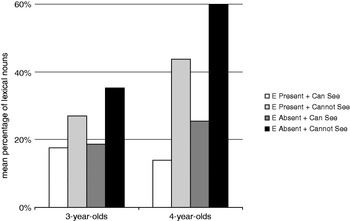
The percentages of the children's choice of referring expressions in each condition are shown in Figures 1–3. To test whether the children were significantly more likely to use an informative referring expression (i.e. a lexical noun) when the experimenter was absent during the preceding context and/or when the video was not perceptually available to her when asking the question (see Figure 1), a 2×2×2 ANOVA (age by preceding context by perceptual availability) was conducted with the mean proportion of lexical nouns expressing the patient as the dependent variable. There was a main effect of perceptual availability (F(1, 120 )=18·108; p<0·001) and of age (F(1, 120)=4·409; p=0·038). Pairwise comparisons showed a tendency for perceptual availability for the three-year-olds (p=0·056), while there was no effect for preceding context. Four-year-olds showed a significant effect for perceptual availability (p<0·001) and no effect for perceptual availability.
Since no interaction between the two factors was found for the four-year-olds, we can furthermore conclude that children at both ages used more lexical nouns in the E Present+E Cannot See Condition (43·8%) than in the E Absent+E Can See Condition (25·5%). That is to say, even though the patient was given information for the experimenter in both conditions (either from the context or from visual perception), perceptual availability seemed to be of greater importance for the children in their use of lexical nouns.
Mean distribution of lexical nouns that were used by the children to express the patient in all four conditions.

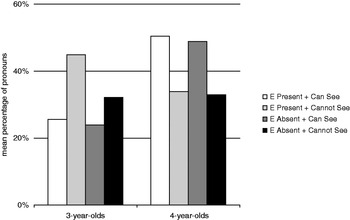
Apart from using lexical nouns, children in both age groups used pronouns quite frequently in order to express the patient (see Figure 2). A 2×2×2 ANOVA (age by preceding context by perceptual availability) revealed a significant interaction between age and perceptual availability (F(1, 120)=5·561; p=0·020). Thus, the older children used more pronouns when the patient was perceptually available to the experimenter than when it was not. However, the younger children surprisingly used more pronouns when the experimenter could not see the patient at the time that she asked the question.
Mean distribution of pronouns in all four conditions.

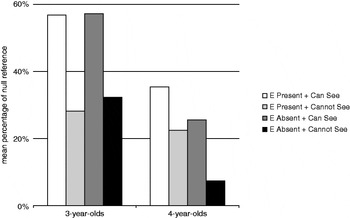
Finally, the children, especially the three-year-olds, often simply dropped the patient (see Figure 3). In order to see whether there is a pattern across conditions, a 2×2×2 ANOVA (age by preceding context by perceptual availability) was conducted with the mean proportion of null referents used as the dependent variable. There was a significant main effect of perceptual availability (F(1, 120)=12·635; p=0·001) and of age (F(1, 120)=12·303; p=0·001). Pairwise comparisons revealed that the effect for perceptual availability was significant for both age groups (p=0·006 for the three-year-olds and p=0·037 for the four-year-olds). Thus, the children dropped the patient much more often when the experimenter could see the video than when she could not, and younger children did so more frequently than older children.
Mean distribution of null referents in all four conditions.

To summarize, when the patient was not perceptually available to the experimenter, four-year-old children used more informative referring expressions (i.e. lexical nouns). They used more pronouns and null references when the patient was perceptually available. The three-year-olds also used more informative expressions (i.e. lexical nouns) when the patient was not perceptually available than when it was. They further used more null references when the patient was perceptually available. Thus, the older children showed an almost adult-like pattern with respect to perceptual availability while the three-year-olds, although showing some sensitivity to perceptual availability, used pronouns inappropriately. With regard to preceding context, there were only tendencies for the four-year-olds to use more lexical nouns and less null references when the preceding context was not available to the experimenter than when it was while there was no effect of preceding context for the three-year-olds.
DISCUSSION
The aim of this study was to investigate the effects of preceding discourse context as well as perceptual availability on children's answers to predicate-focus questions. We found that children at the age of four used more informative referring expressions (i.e. lexical nouns) in order to refer to the patient when the experimenter could not see this patient than when she could, and the three-year-olds showed a tendency in the same direction. Whether or not the experimenter had been present for the preceding discourse context in which the patient was talked about only affected the answers of the four-year-old children. That is, when the experimenter was absent (compared to present) during the films and the patient was therefore new to her, four-year-old children showed a tendency to provide more lexical nouns. The discourse context had no effect on the three-year-olds.
Our results, in terms of children's perspective-taking abilities with respect to visual perception are consistent with the findings of the study by Matthews et al., who found that three- and four-year-old children choose different referring expressions depending on whether the interlocutor can or cannot see the event. Our results for the three-year-old children also agree well with the findings of the corpus study by Skarabela & Allen (Reference Skarabela and Allen2002). They looked at argument realization in the spontaneous speech of Inuktitut-speaking children aged 2 ; 0 to 3 ; 6, and focused on the role of joint attention. They found that referents were largely overtly expressed in the absence of joint attention no matter whether they were discourse-given or discourse-new. And further, in the presence of joint attention, most referents were omitted, again independently of discourse-givenness or discourse-newness. That is to say, children took into account whether they and their mothers were jointly attending to a referent or not, while the givenness/newness of the referent from the preceding discourse context mattered less.
With regard to preceding discourse context, our results are not in line with the findings of previous studies (Campbell et al., Reference Campbell, Brooks and Tomasello2000; Matthews et al., Reference Matthews, Theakston, Lieven and Tomasello2006; Wittek & Tomasello, Reference Wittek and Tomasello2005), which found that children at the age of 2 ; 6 are already sensitive to the preceding discourse. By contrast, in our study, three-year-old children did not take the preceding context into account, and the four-year-olds seem to be just starting to do so. However, in all the previous studies the preceding context was simply the question itself. That is to say, in these studies children referred to a character differently depending on whether or not this character was mentioned in the question (or in the very same utterance with a question in the study by Matthews et al., Reference Matthews, Theakston, Lieven and Tomasello2006). The preceding context in our study was different. We set up a context prior to the question. That is to say, the givenness/newness of the item of interest (i.e. patient) was established in the discourse that preceded the question. Immediately preceding questions almost certainly provide a much stronger discourse context, which can probably be mastered more easily by young children since they only need to keep track of a single and very immediate utterance. In our study, where we used a more neutral discourse context, children could not just rely on the question itself, but additionally had to take into account what had happened before the question was asked. Furthermore, the preceding context was not the only factor for the children to consider in their answers since the perceptual availability of the scene to the questioner was of importance as well. Therefore, the cognitive demands on the children were heavier than in previous studies. This probably explains the difference in findings.
The main finding in our study, which is different from the findings of previous studies, is that the children were sensitive to perceptual context at an earlier age than they were to previous discourse context. One factor may be that preceding discourse by definition always precedes perceptual availability in our study. When the target question is asked, the establishment of discourse context is already in the past, whereas perceptual availability coincides with the present. Therefore, when the question is asked, children only need to check whether the questioner can or cannot see the event and choose a referring expression accordingly. In contrast, in terms of discourse context, children need to ‘remember’ whether the questioner had been absent or present in the (immediate) past. Therefore, children might perform better in terms of perceptual availability since it is situated in the here and now, while the factor of preceding context requires some kind of recall. Related to this, a further possibility is that since perceptual availability coincides with the question, it might ‘override’ anything else, that is to say, children might simply rely on the here and now and not consider what happened before.
This seems to suggest that, while both age groups are in principle sensitive both to the immediate perceptual availability of referents to their interlocutors and to the previous discourse context that establishes whether the object is given or new for the interlocutor (as shown in previous studies), young children rely on perceptual availability when a conflict arises. However, it is clear that children are able to register prior discourse context and to use it appropriately under certain circumstances. Detailing those circumstances and the cues to how they are balanced and integrated during development is of central interest to our understanding how children come to be able to linguistically register the interaction between language use, discourse interaction and shared perceptual context.
APPENDIX
Overview of the four target scenes with their context scenes.
(1) Context (a): Der Frosch füttert die Ente. (The frog is feeding the duck.)
Context (b): Der Frosch kämmt die Ente. (The frog is combing the duck.)
Target: Der Frosch wäscht die Ente. (The frog is washing the duck.)
(2) Context (a): Der Affe küsst die Maus. (The monkey is kissing the mouse.)
Context (b): Der Affe zieht die Maus. (The monkey is pulling the mouse.)
Target: Der Affe schubst die Maus. (The monkey is pushing the mouse.)
(3) Context (a): Der Frosch füttert den Teddy. (The frog is feeding the teddy.)
Context (b): Der Frosch kämmt den Teddy. (The frog is combing the teddy.)
Target: Der Frosch haut den Teddy. (The frog is hitting the teddy.)
(4) Context (a): Der Affe küsst den Löwen. (The monkey is kissing the lion.)
Context (b): Der Affe zieht den Löwen. (The monkey is pulling the lion.)
Target: Der Affe streichelt den Löwen. (The monkey is stroking the lion.)