The world’s largest outbreak of Ebola virus disease (EVD) began in 2014 and significantly affected the West African countries of Guinea, Sierra Leone, and Liberia. As of July 5, 2015, over 27,600 cases had been identified in these 3 countries with an estimated 11,261 deaths, although actual case counts are likely much higher. 1 On September 28, 2014, a patient was admitted to a hospital in Dallas, Texas, with symptoms of EVD. The patient had recently arrived in the United States from Liberia and became the first patient diagnosed with EVD in the United States. This patient and the subsequent cases among health care workers (HCWs) caused widespread public fear of the disease, spurring health systems to prepare for the possibility of an EVD patient presenting to one of their hospitals or clinics. The unique features of EVD (including transmission predominantly in hospitals, not in the community) and the lack of preparedness uncovered by these events illustrated strengths as well as challenges in the US health system’s ability to respond to infectious-disease-related public health threats.
The clinical and epidemiological characteristics of the West African EVD outbreak posed major challenges to the health system. Although US hospitals had emergency management plans and had encountered infectious disease outbreaks such as influenza, Ebola was a rare pathogen largely unfamiliar to US communities. 2 The West African EVD outbreak reached large cities and communities, demonstrating unusual patterns of sudden and unexpected magnitude. HCWs were disproportionately impacted by the outbreak. In July 2014, the proportion of HCW infections peaked at 12% of all reported cases of EVD. 3 Health systems were concerned about challenging clinical management issues including limited diagnostic testing, lack of specific treatment, environmental safety owing to profound body fluid loss, and prolonged infectiousness of patients.
The response of the US health system to the epidemic was to create plans for enhanced early identification and isolation of patients to minimize risks to the public as well as HCWs. The complexity of the operational concerns unique to managing EVD, the significant clinical and public health consequences, and the continuously evolving clinical guidance prompted health systems to develop their own policies and procedures. Health systems in Wisconsin prepared for the possibility of an EVD patient independently and collaboratively. In conjunction with government health agencies at the local and state levels, private health care organizations and entities coordinated their response to protect the public health. This descriptive study outlines the emergency preparedness planning that was used in 2014 by 2 health systems, Aurora Health Care and the University of Wisconsin Hospital and Clinics, that participated in Wisconsin’s response to EVD. Their collaboration with each other as well as with government health agencies is an effective model that could be replicated in similar settings to protect the public from communicable disease threats.
Methods
This descriptive study outlines the emergency preparedness planning and collaborative approach used from September through December 2014 by 2 health systems in Wisconsin. Aurora Health Care (Aurora) is a nonprofit integrated health system serving eastern Wisconsin including 15 hospitals, over 150 clinics, retail pharmacies, and a home health program. 4 As the largest provider of health care services in the state of Wisconsin (total population of over 5.7 million), 5 Aurora annually provides over 6.5 million outpatient visits and over 100,000 inpatient admission in 30 counties. 4 The University of Wisconsin Hospitals and Clinics (UW Health), which includes the academic health care entities of the University of Wisconsin-Madison (physicians, hospitals, clinics, and the School of Medicine and Public Health), is a referral center for the state for complex care including rare infectious diseases. 6 UW Health serves patients at more than 60 clinical locations throughout the state of Wisconsin, including over 28,500 inpatient admissions and almost 2 million clinic visits. 6
Federal, state, and local government public health agencies were part of the collaborative approach in Wisconsin. The US Centers for Disease Control and Prevention (CDC) developed and frequently updated guidance on EVD contact investigation, infection control, and clinical care. 1 The Wisconsin Department of Health Services assisted health systems and local health departments in applying this guidance. 7 Local health departments collaborated with health systems in their jurisdictions to implement EVD guidance. The City of Milwaukee Health Department and others worked with Aurora, whereas Public Health Madison & Dane County and others worked with UW Health.
Observational information was obtained from organizational leaders of the Ebola response teams at Aurora and UW Health. Information on the role of government public health agencies was provided from the City of Milwaukee Health Department, one of the government agencies involved in the statewide collaborative response to EVD. Data included interviews with leaders, comparison of organizational plans, and review of organizational and collaborative team meeting minutes. Common themes and key lessons learned were identified and summarized.
Results
Between September and December 2014, Aurora and UW Health developed emergency preparedness plans for their organizations’ response to Ebola. Both health systems selected the strategic priorities of their plans on the basis of the framework recommended by the CDC: identify possible EVD cases, isolate the patient, and inform the authorities. 1 To achieve their organizational goals, the health systems focused on 3 key areas: develop a robust Ebola response plan, implement rigorous infection prevention practices, and coordinate efforts through public health collaborations. Key actions in each of these areas are described below.
Planning
Both health systems utilized an emergency management process consistent with the 5 steps of the health care system preparedness cycle: plan, organize and equip, train, exercise, and evaluate and improve. 8 The first critical step taken was to establish an organizational response team (referred to as the system team). Both Aurora and UW Health had preexisting emergency preparedness and infection prevention teams that were combined and activated to address Ebola. Each team included leaders, experts, and frontline health care providers from all areas of the organization potentially affected by EVD. Advisory councils that included infectious disease physicians and infection prevention experts supported the system teams.
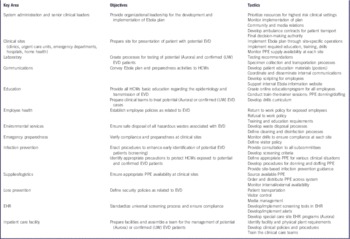
The departments represented on each of the system teams, their specific objectives, and the tactics used to achieve the organizational strategic priorities are described in Table 1. Organizational leadership at both health systems brought together a large, diverse group of stakeholders in their system teams to address several pressing issues: (1) harnessing the electronic health record (EHR) to screen and triage patients with the relevant travel history and symptoms of possible EVD; (2) preparing the sites with education, supplies of personal protective equipment (PPE), laboratory testing, waste management, and training of HCWs; (3) developing a system-wide communication approach; and (4) addressing employee health and human resources related concerns such as work policies. System teams met from daily to weekly during the peak of preparedness planning, from September through December 2014.
Objectives and Tactics for Each Key Area of the System Ebola TeamsFootnote a

a Abbreviations: EHR, electronic health record; EVD, Ebola virus disease; HCW, health care worker; PPE, personal protective equipment.
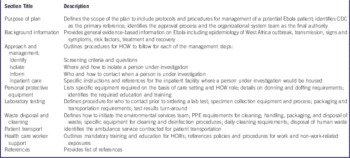
The system teams at Aurora and UW Health each developed a single, standardized Ebola plan that provided operational plans, tactical procedures, and defined roles and responsibilities for their facilities, departments, and physicians. The common elements of the table of contents from the Ebola plans created by Aurora and UW Health are provided in Table 2. Each system began with a comprehensive literature review and followed evidence-based recommendations when available. Detailed procedures for implementing the 3 steps of the CDC framework (identify, isolate, and inform) were adapted to the requirements of each care setting (clinic, emergency department, urgent care center, home health, pharmacy). The plan also included procedures for prevention of EVD transmission through systemic adjustments to education and training of HCWs on PPE, waste disposal, laboratory testing, and patient transport. Aurora created plans for their role as a frontline health care facility and an assessment hospital. UW Health, as a designated treatment center, emphasized protocols for the treatment of patients with EVD. At both health systems, operational leaders were responsible for implementing the procedures identified in the Ebola plan and ensuring compliance at their site.
Ebola Plan: Example Table of ContentsFootnote a

a Abbreviations: CDC, Centers for Disease Control and Prevention; HCW, health care workers; PPE, personal protective equipment.
A rigorous project management approach was taken for writing, reviewing, and disseminating the Ebola plan. To accommodate the rapid pace of change, the plan included separate appendices for all supportive materials, which could be quickly revised and replaced. A single point of control was appointed as the author and owner of the plan to ensure coordination and document control. Prior to distribution, the Ebola plan and all associated forms were vetted through a team of experts including senior clinical leaders, compliance, risk management, and the legal department. Issues unresolved by the system team were referred to the appropriate advisory councils, which would confer with professional colleagues, within and outside the organizations. Final approval of the plan was obtained from senior clinical leaders. The plan was posted electronically, accessible to all HCWs through their respective system’s intranet.
The Ebola plan required frequent updates to align with the rapidly evolving guidance. Each team member was responsible for ongoing monitoring of external references (ie, CDC, Wisconsin Department of Health Services, Occupational Safety and Health Association, and The Joint Commission) and submitting revisions to their respective section of the plan to the single point of control. Maintenance of the plan required continuous review, vetting, and approval before dissemination of the plan to operational leaders for implementation. During implementation of the plan, including training and drills, feedback from frontline HCWs and patients was reported back to the system team. The teams then made adjustments and modifications accordingly.
Infection Prevention Practices
The most significant area of attention during Ebola preparations was on infection prevention practices, including selection and purchase of appropriate PPE. During the initial response to EVD, government public health agencies provided limited guidelines on PPE, which were modified frequently and did not account for the varying levels of exposure risk for HCWs. With the massive requests by health systems nationally, recommended PPE was in short supply, resulting in limited availability of equipment, especially for hoods and powered air-purifying respirators. In early October 2014, Aurora and UW Health collaboratively developed their PPE selection and specifications. Sourcing and obtaining the PPE supplies was a major endeavor conducted by the supply or logistics department at each organization.
As part of their infection prevention programs, Aurora and UW Health created educational programs on Ebola for their HCWs and patients. General education on EVD was provided through online curricula, grand rounds, and a dedicated website on preparedness efforts at each system that was available to all HCWs. Basic infection prevention practices were reiterated to ensure that HCW compliance would meet the criteria necessary for reducing the risk of transmission. Onsite education targeted HCWs in the clinics, urgent care, and emergency departments by use of training materials developed by infection prevention experts. PPE training tools based on existing evidence and expert opinion were created for donning and doffing PPE equipment. Detailed instructions were made available to HCWs through written instructions as well as video demonstrations, which were modified as PPE requirements and guidelines evolved. Education was provided on new human resource policies that were developed to ensure patients and HCWs were protected from unintentional risk.
To ensure compliance with infection prevention practices, train-the-trainer sessions were conducted across both systems, with observation-based competency requirements. Drills were conducted throughout both organizations in emergency departments and treatment center facilities, including partners such as contracted ambulance services and environmental care teams. The limited PPE supply affected the performance of drills. Equipment was reused during the drills to ensure an adequate supply for real patients if necessary. The simulation center at UW Health and Aurora’s assessment facility were used for the core members of the team who would be called upon to treat a patient with EVD.
Collaboration
In response to the limited knowledge, experience, and guidelines regarding EVD, Wisconsin health care organizations began their collaboration in September 2014. The alliance between Aurora and UW Health was facilitated by existing professional relationships between the 2 organizations (including between the authors). Leaders from various departments of each organization conducted conference calls and meetings. Collaboration included the sharing and comparing of recommendations regarding system Ebola plans. CDC guidelines evolved rapidly and at first did not emphasize operational issues pertinent to the care of patients presenting to a hospital. Aurora and UW Health coordinated their plans on the basis of best practices from experienced health systems, review of the literature, and available equipment.
In addition to the collaborative efforts launched between provider organizations, government public health agencies established coalitions involving stakeholders from both public and private health care systems. The Wisconsin Department of Health Services established an advisory council comprising public and private health care providers, emergency medical services, laboratory services, and waste management. This coalition was established to ensure dissemination, coordination, and implementation of national and state guidelines. Both Aurora and UW Health participated in the statewide advisory council. Local health departments participated regularly in web-based meetings organized by the Wisconsin Department of Health Services. The local health departments coordinated with acute care health facilities in their municipal jurisdictions to ensure that these facilities were prepared to care for EVD patients and prevent transmission to HCWs. As an initial effort to ensure that accurate information was available to health care providers, the City of Milwaukee Health Department coordinated a regional symposium of health care leaders from public and private sectors on October 14, 2014. Speakers from local, state, and national organizations provided guidance for health systems to develop their response plans.
Discussion
The US response to the West Africa outbreak of EVD has increased awareness of the need for effective emergency planning among public and private health systems and critical aspects related to infectious disease threats. Soon after the September 9, 2011, attacks, preparedness activities were funded and programs initiated; however, funding has since declined and significant gaps remain.Reference McHugh, Staiti and Felland 9 References and tool kits for hospitals and health systems are limited, because the field of emergency planning has not yet been fully developed through the application of academic research.Reference Lurie, Manolio, Patterson, Collins and Frieden 10 The successful preparedness planning exemplified in Wisconsin by Aurora and UW Health was related to 3 significant strengths: a rigorous infrastructure for planning, strong infection prevention and control programs, and an effective interface between public and private health systems.
Rigorous Infrastructure for Planning
Despite recent experience with public health emergencies, including infectious disease outbreaks, knowledge of and experience with emergency preparedness and capabilities is limited for most health systems. 11 Although Wisconsin has limited experience with major public health threats, both Aurora and UW Health have robust infrastructures around quality, safety, and process improvement, which provided a framework for their Ebola planning. The steps of the theoretical framework of the emergency preparedness cycle outlined for health systems (plan, organize and equip, train, exercise, and evaluate and improve) 8 align with quality improvement processes, including the Shewhart Cycle of plan-do-study-act, 12 as well as project management (initiate, plan, execute, monitor and control, close). 13 With a fast pace of change, timeliness was essential in the decision-making and approval process. The planning for EVD conducted by both systems was successful not necessarily because of the specific planning model used, but because of the tight management of the detailed steps required for execution.
Both systems were able to rapidly develop plans for EVD because of their strong, collaborative infrastructures. The right people were brought to the table immediately. Effective health care coalitions are typified by the presence of key functions, 8 all of which were incorporated in both the Aurora and UW Health system teams. Membership on the team was multidisciplinary, including senior leadership, which ensured that resources and approval were readily available. The team’s purpose was clearly defined: to set strategic directions, identify issues, and assign responsibilities to appropriate expert subcommittees. Ground rules and roles for the system team were established in advance. Roles and responsibilities of the team members were clearly defined, which is a key element often found in successful emergency preparedness. 8 The coordinating function was assigned to a single point of contact to avoid confusion and disorganization. Consensus drove key decisions, incorporating expert opinions from both internal and external sources. With existing infrastructure and processes for quality improvement and project management, hospitals should utilize these assets to efficiently prepare for potential public health threats.
Infection Prevention
The Ebola outbreak highlights the expertise of acute care settings in infection prevention. At both Aurora and UW Health, infection prevention and infectious disease programs were immediately engaged to lead the planning process. When public health agencies were slow to define the applicable requirements, the experiential knowledge from frontline HCWs, including health systems such as Emory and international relief agencies such as Doctors Without Borders, was critical in planning for practical issues of infection prevention, such as PPE. 14 Infection prevention practitioners at Aurora and UW Health translated the guidance from public health experts into practical application for the various levels of response needed in clinics, urgent care units, emergency departments, and intensive care units. However, practical guidance for the use of and availability of effective PPE must be addressed at a national level.Reference Edmond, Diekema and Perencevich 15 Critical care facilities, which deal with infection prevention daily, can provide expert input into public health guidance.
In a poll conducted in October 2014, only 24% of Americans felt confident that their local hospital systems could safely handle a patient with EVD.Reference Riley 16 These fears may not be unfounded. It is well known that compliance is poor with basic infection prevention behaviors such as hand washing and contact precautions in the health care system. 17 The transmission of EVD to 2 HCWs in Texas highlighted this gap between guidelines and practice. On the basis of lessons learned during the 2009 H1N1 outbreak, Aurora and UW Health anticipated critical gaps in HCW compliance with PPE. Both health systems prioritized drills and simulation training; however, even in hospitals with thorough protocols in place, significant errors in executing these protocols occur in simulated scenarios.Reference Barsuk and Barnard 18 Aurora and UW Health incorporated into their drills the components of infection prevention essential to Ebola control, collaborating with ambulance transportation and waste disposal services. Resources for infection prevention, including planning, training, and simulation testing, should be expanded to include health systems as well as public health agencies so that we are prepared for current or future threats.Reference Gostin, Hodge and Burris 19
Collaboration
Collaboration among and between health systems and government public health agencies was a critical element of the response to EVD. Unlike other public health threats from infectious diseases, EVD in the United States was primarily a hospital-based concern. Therefore, acute care hospitals, including intensive care units, played a central role in the planning process in Wisconsin. This included extensive efforts on the part of clinical leaders to scour the literature and to contact existing biocontainment units (in particular, Nebraska and Emory) that had experience in managing patients with EVD in a critical care setting. 14 Collaboration included sharing plans and lessons learned between health systems and translating public health guidelines into practical application by seeking input from frontline HCWs. Local and state health departments encouraged feedback from health systems and incorporated that expertise into public health guidelines supporting the needs of HCWs.
The role of the EHR exemplified the essential need for collaboration to translate public health guidelines into practical application for health systems. When the CDC recommended screening all patients for travel to West Africa, Aurora and UW Health had to incorporate this recommendation into clinical workflows that relied significantly on EHRs. Decisions necessary to implement screening included when, where, who, and how to conduct screening. Each of these decisions had significant implications on patient access, HCW workflow, EHR functionality, data availability, and more. Collaboration between Aurora and UW Health as well as with the EHR vendor led to rapid, effective tools that facilitated standardized screening consistent with CDC guidelines. Further coordination with and use of health care information technology could have a significant impact on identifying, managing, and protecting the public health as well as HCWs.Reference Mandl 20
Conclusion
The current EVD outbreak highlights the challenges and opportunities for public health in the United States in preparing for and responding to emerging threats. The example of 2 health systems in Wisconsin demonstrates the important role that acute care facilities play in public health responses. Hospitals and health systems have expertise in planning and execution using existing infrastructures such as quality and process improvement. Their experience with infection prevention practices, including the practical limitations of PPE and gaps in HCW compliance, should be incorporated into public health guidelines to ensure their usability. The collaborative approach to the planning process should be broad-based, integrating the expertise from health care systems, experienced frontline HCWs (such as international aid workers), technology, and academic researchers. For diseases that significantly affect hospital-based patients and HCWs, health systems will be called upon to actively participate in public health responses that are typically led by government agencies. Together, health systems and government public health agencies should prepare for the next emerging disease transmitted in health care settings, possibly Middle East respiratory syndrome, in order to protect patients, HCWs, and our communities.