




Crossref Citations

This article has been cited by the following publications. This list is generated based on data provided by Crossref.
Keith, Melissa G.
Harms, Peter
and
Tay, Louis
2019.
Mechanical Turk and the gig economy: exploring differences between gig workers.
Journal of Managerial Psychology,
Vol. 34,
Issue. 4,
p.
286.
Weller, Ingo
Hymer, Christina B.
Nyberg, Anthony J.
and
Ebert, Julia
2019.
How Matching Creates Value: Cogs and Wheels for Human Capital Resources Research.
Academy of Management Annals,
Vol. 13,
Issue. 1,
p.
188.
Ryan, Ann M.
and
Derous, Eva
2019.
The Unrealized Potential of Technology in Selection Assessment.
Revista de Psicología del Trabajo y de las Organizaciones,
Vol. 35,
Issue. 2,
p.
85.
Schulte, Julian
Schlicher, Katharina D.
and
Maier, Günter W.
2020.
Working everywhere and every time?—Chances and risks in crowdworking and crowdsourcing work design.
Gruppe. Interaktion. Organisation. Zeitschrift für Angewandte Organisationspsychologie (GIO),
Vol. 51,
Issue. 1,
p.
59.
Clauson, Muriel
2020.
The Cambridge Handbook of the Changing Nature of Work.
p.
555.
Ihl, Andreas
Strunk, Kim Simon
and
Fiedler, Marina
2020.
The mediated effects of social support in professional online communities on crowdworker engagement in micro-task crowdworking.
Computers in Human Behavior,
Vol. 113,
Issue. ,
p.
106482.
Song, Xiaochuan
Lowman, Graham H.
and
Harms, Peter
2020.
Justice for the Crowd: Organizational Justice and Turnover in Crowd-Based Labor.
Administrative Sciences,
Vol. 10,
Issue. 4,
p.
93.
Dutta, Debolina
Mirchandani, Prem
and
Kannan Poyil, Anasha
2021.
Beyond Human Resources - Research Paths Towards a New Understanding of Workforce Management Within Organizations.
Schlicher, Katharina D.
Schulte, Julian
Reimann, Mareike
and
Maier, Günter W.
2021.
Flexible, Self-Determined… and Unhealthy? An Empirical Study on Somatic Health Among Crowdworkers.
Frontiers in Psychology,
Vol. 12,
Issue. ,
Ma, Xiao
Kuem, Jungwon
Hou, Jinghui (Jove)
Khansa, Lara
and
Zhu, Zhuo
2021.
Are All Contributions Equal? Investigating the Role of Community Participation in Crowdwork.
Decision Sciences,
Vol. 52,
Issue. 6,
p.
1282.
Vanhove, Adam J.
Miller, Andrew D.
and
Harms, Peter D.
2021.
Understanding Subpopulations on Mechanical Turk.
Journal of Personnel Psychology,
Vol. 20,
Issue. 4,
p.
176.
Nwafor, Onyi
Ma, Xiao
Hou, Jinghui (Jove)
and
Johnson, Norman
2022.
Online communities and discontinuance of information technology-enabled on-demand workers: Impacts of informal social interactions through dual commitments.
International Journal of Information Management,
Vol. 66,
Issue. ,
p.
102540.
Cameron, Lindsey D.
Chan, Curtis K.
and
Anteby, Michel
2022.
Heroes from above but not (always) from within? Gig workers’ reactions to the sudden public moralization of their work.
Organizational Behavior and Human Decision Processes,
Vol. 172,
Issue. ,
p.
104179.
Wolf, Christine T.
Asad, Mariam
and
Dombrowski, Lynn S.
2022.
Designing within Capitalism.
p.
439.
Caza, Brianna B
Reid, Erin M
Ashford, Susan J
and
Granger, Steve
2022.
Working on my own: Measuring the challenges of gig work.
Human Relations,
Vol. 75,
Issue. 11,
p.
2122.
Retkowsky, Jana
Nijs, Sanne
Akkermans, Jos
Jansen, Paul
and
Khapova, Svetlana N.
2023.
Toward a sustainable career perspective on contingent work: a critical review and a research agenda.
Career Development International,
Vol. 28,
Issue. 1,
p.
1.
Carneiro, Laila L.
Moscon, Daniela C. B.
Dias, Liz M. M.
Oliveira, Stéfanie M. D.
and
Alves, Haiana M. C.
2023.
Digitrab: Reflexões sobre o cenário do trabalho mediado por plataformas digitais no Brasil.
RAM. Revista de Administração Mackenzie,
Vol. 24,
Issue. 2,
Carneiro, Laila Leite
Medeiros, Giulia Tescari
Araújo, Irlan Souza de
and
Abbas, Marian Assolin Abou
2023.
Demandas e Recursos no Trabalho Mediado por Plataformas Digitais: Uma Revisão de Escopo da Literatura.
Organizações & Sociedade,
Vol. 30,
Issue. 104,
p.
110.
Oliveira, Herbert Paolo Salles de
and
Britto, Jorge Nogueira de Paiva
2023.
Gerenciamento e disciplina algorítmica: uma análise focalizada em plataformas de emprego de elevada qualificação.
Economia e Sociedade,
Vol. 32,
Issue. 3,
p.
633.
Carneiro, Laila L.
Moscon, Daniela C. B.
Dias, Liz M. M.
Oliveira, Stéfanie M. D.
and
Alves, Haiana M. C.
2023.
Digiwork: Reflections on the scenario of work mediated by digital platforms in Brazil.
RAM. Revista de Administração Mackenzie,
Vol. 24,
Issue. 2,
I am concerned about industrial and organizational (I-O) psychology's relevance to the gig economy, defined here as the broad trends toward technology-based platform work. This sort of work happens on apps like Uber (where the app connects drivers and riders) and sites like MTurk (where human intelligence tasks, or HITs, are advertised to workers on behalf of requesters). We carry on with I-O research and practice as if technology comprises only things (e.g., phones, websites, platforms) that we use to assess applicants and complete work. However, technology has much more radically restructured work as we know it, to happen in a much more piecemeal, on-demand fashion, reviving debates about worker classification and changing the reality of work for many workers (Sundararajan, Reference Sundararajan2016). Instead of studying technology as a thing we use, it's critical that we “zoom out” to see and adapt our field to this bigger picture of trends towards a gig economy. Rather than a phone being used to check work email or complete pre-hire assessments, technology and work are inseparable. For example, working on MTurk requires constant Internet access (Brawley, Pury, Switzer, & Saylors, Reference Brawley, Pury, Switzer and Saylors2017; Ma, Khansa, & Hou, Reference Ma, Khansa and Hou2016). Alarmingly, some researchers describe these workers as precarious (Spretizer, Cameron, & Garrett, Reference Spretizer, Cameron and Garrett2017), dependent on an extremely flexible (a label that is perhaps euphemistic for unreliable) source of work. Although it's unlikely that all workers consider their “gig” a full time job or otherwise necessary income, at least some workers do: An estimated 10–40% of MTurk workers consider themselves serious gig workers (Brawley & Pury, Reference Brawley and Pury2016). Total numbers for the broader gig economy are only growing, with recent tax-based estimates including 34% of the US workforce now and up to 43% within 3 years (Gillespie, Reference Gillespie2017). It appears we're seeing some trends in work reverse and return to piece work (e.g., a ride on Uber, a HIT on MTurk) as if we've simply digitized the assembly line (Davis, Reference Davis, Gehman, Lounsbury and Greenwood2016). Over time, these trends could accelerate, and we could potentially see total elimination of work (Morrison, Reference Morrison2017).
In order to keep up with (and perhaps survive as a field in) this new era of work, along with prioritizing good measurement and good theory around tech for work (Morelli, Potosky, Arthur, & Tippins, Reference Morelli, Potosky, Arthur and Tippins2017), we need to prioritize keeping I-O psychology theory and measures relevant to the bigger picture of tech-based changes in the world of work. The focal article poses excellent guidelines for asking meaningful measurement questions, but these questions are precluded if the construct in question is not actually relevant to the way that work happens now. Framed differently, this becomes a matter of prioritizing criterion validity alongside construct validity. We should expand our definition of success even further than beyond equivalence with an old test medium (Morelli et al., Reference Morelli, Potosky, Arthur and Tippins2017; Potosky, Reference Potosky2008) to include relevance to this bigger picture of technology ushering in the era of gig work.
So how should we be achieving that, exactly? We need to question our assumptions: Do the same constructs that mattered for work so far matter for gig work? Theory will help shape this self-reflection. In addition to exploring the focal article's three suggested theories for understanding technology's impact on work, I extend this discussion in three ways. First, I examine the intersection of their suggested theories with existing I-O psychology theory [i.e., the basic psychological needs from self-determination theory (SDT), e.g., Deci, Olafsen, & Ryan (Reference Deci, Olafsen and Ryan2017)]. Second, I advance and empirically support a novel theoretical construct (worker seriousness) that can be used to further develop theory for not only how but also why technology-based changes in work impact work outcomes. Last, and most broadly, I propose that we change direction in our evaluation: rather than a “conceptual framework of ‘technology applied to I-O psychology’” (Morelli et al., Reference Morelli, Potosky, Arthur and Tippins2017, p. 635), it's time for us to work on I-O psychology (theories) adapted to technology, with a focus on our relevance in the gig economy. I begin this reverse course by evaluating the focal article's three theories, one traditional I-O theory, and one novel construct in predicting gig worker attitudes and behaviors. Specifically, I test my hypotheses in a gig work population that is popular among I-O psychologists: MTurk Workers (Landers & Behrend, Reference Landers and Behrend2015). To close, I discuss my empirical findings in the context of this commentary.
The Present Study
Past research both theoretically and empirically links the satisfaction of the three basic psychological needs of SDT—competence, autonomy, and relatedness—to a number of work outcomes (Deci et al., Reference Deci, Olafsen and Ryan2017; Van den Brock, Ferris, Chang, & Rosen, Reference Van den Brock, Ferris, Chang and Rosen2016). I chose to examine satisfaction and turnover since these outcomes parallel support for SDT needs satisfaction enhancing in the two key domains of both business success (as may be indexed in turnover) and worker well-being (as in job satisfaction) in traditional work settings (Deci et al., Reference Deci, Olafsen and Ryan2017). However, the question is whether the same three needs matter for gig workers. On one hand, we could theorize that, by their nature, the basic psychological needs of SDT apply to all workers and forms of work, and this would be supported in part by findings supporting that conclusion in many varied contexts (e.g., in sports, Deci et al., Reference Deci, Olafsen and Ryan2017). However, we should consider (a) whether these psychological needs are typically satisfied in gig work and (b) whether this satisfaction (or frustration) matters to the same degree for gig workers as for traditional workers. Although my proposed model incorporates tech-based work as, essentially, a moderator of existing SDT findings, I'm using it not as a “static, contaminating variable” but rather “as a variable that is dynamically influenced by its use” (Morelli et al., Reference Morelli, Potosky, Arthur and Tippins2017, p. 649)—namely, by its use as a platform for serious work (or not). By worker seriousness, I mean the worker's dependence on and treatment of the gig work as a real job and/or as necessary income. Studying worker seriousness as it interacts with the basic psychological needs of self-determination theory provides a way to understand whether and why outcomes are affected by this use of technology as a form of real work.
First, I examine the need for relatedness by considering the social bandwidth of the MTurk platform per Potosky's (Reference Potosky2008) conceptual framework (cf. Morelli et al., Reference Morelli, Potosky, Arthur and Tippins2017). The MTurk platform alone typically has very low social bandwidth, offering rare—if any—opportunities for sharing social information like facial expressions. However, there are a number of off-site forums were workers may share both work and nonwork information with other MTurk workers, increasing their social connectivity (Schmidt, Reference Schmidt2015). Use of these external and often social platforms is characteristic of crowdwork (Ma et al., Reference Ma, Khansa and Hou2016) and is positively associated with worker tenure (Brawley et al., Reference Brawley, Pury, Switzer and Saylors2017). Given the near absence of social connectivity on the work platform itself, I propose that satisfaction of this need is relatively valuable (due to its rarity) for worker satisfaction and retention. However, given that more tenured—and likely more serious—workers use the external platforms more often, perhaps regardless of need frustration, I propose that relatedness need satisfaction is less strongly associated with the two outcomes for serious workers. Such community embeddedness has similarly been found to diminish effects of reward fairness on MTurk workers’ job satisfaction (Ma et al., Reference Ma, Khansa and Hou2016).
I examine competence through a lens of cognitive load and thus draw on the structural characteristics and information processing (SCIP) framework (Arthur, Keiser, & Doverspike, Reference Arthur, Keiser and Doverspike2017). We can view working on the platform as akin to unproctored Internet testing (UIT), in that workers have considerable “degrees of freedom in location choice” (Morelli et al., Reference Morelli, Potosky, Arthur and Tippins2017, p. 645), so we can infer higher demands on selective attention and thus cognitive load. Therefore, using SCIP and given relatively high demands on selective attention presented by platform-based gig work, I propose that competence remains important—compared to traditional work—for satisfaction and retention. However, when workers are highly dependent on their MTurk income, frustration of this need may be less problematic for satisfaction and turnover, given these workers’ stronger motivation to maintain the income despite the frustration.
Last, to examine autonomy need satisfaction—with its inherent tie to how the platform would be used to achieve individual gig workers’ goals—I turn to sociomateriality. I propose that the relatively autonomous nature of work—for example, workers can choose schedules and specific tasks (Brawley et al., Reference Brawley, Pury, Switzer and Saylors2017; Ma et al., Reference Ma, Khansa and Hou2016)—helps accomplish the goals prioritized by the individual worker (e.g., work–life balance, particular types of work tasks) and that this is an attractive characteristic of gig work. Therefore, autonomy need satisfaction should be significantly associated with worker satisfaction and retention. However, I propose that workers who are highly dependent on the platform are, by definition, not driven to the site autonomously, thereby attenuating the association between satisfaction of this need and the outcomes. I propose the following hypotheses:
(1) Relatedness need satisfaction, (2) competence need satisfaction, and (3) autonomy need satisfaction will be significantly and positively associated with (a) worker satisfaction and (b) worker retention, but (c) these relationships will be attenuated as MTurk workers become more serious about their work on the platform.
Method
US-based MTurk workers completed a 16-question online survey for $0.20. Four questions each assessed autonomy, competence, and relatedness needs satisfaction in the work domain (Schultz, Ryan, Niemiec, Legate, & Williams, Reference Schultz, Ryan, Niemiec, Legate and Williams2015). Workers were instructed to focus on MTurk as the “job” and “work” referred to in survey items; this way, items were used without modification. Satisfaction, turnover intention, worker seriousness, and data quality were assessed with one item each (see the Appendix). All items used a seven-point scale ranging from “strongly disagree” to “strongly agree,” except for the data quality item with its “yes–no” options. Of 341 responses, 336 participants endorsed the data quality item and comprised the final sample.
Results
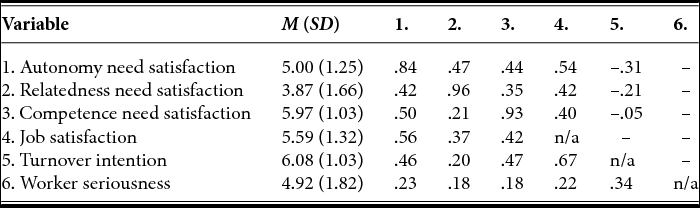
Fit of the three-factor SDT model with covariances estimated between the latent factors was acceptable: χ2(51) = 177.98, p < .001, CFI = .963, TLI = .953, RMSEA = .086 [90% CI = .073, .100]. All items loaded significantly on their respective latent factors, all factors showed acceptable internal consistency reliability, and factor correlations were not significantly different from meta-analytic estimates (Z ≤ .47, see Table 1).
Descriptive Statistics
Notes. Correlations between present study variables reported below diagonal; internal consistency reliabilities reported on diagonal; uncorrected meta-analytic sample-weighted correlations reported above diagonal (Van den Brock et al., Reference Van den Brock, Ferris, Chang and Rosen2016). Higher scores on present study's turnover intention variable indicate lower turnover likelihood, whereas higher scores on meta-analytic turnover intention variable indicate higher turnover likelihood. All correlations in present study are significantly different from zero, p < .001, two-tailed.
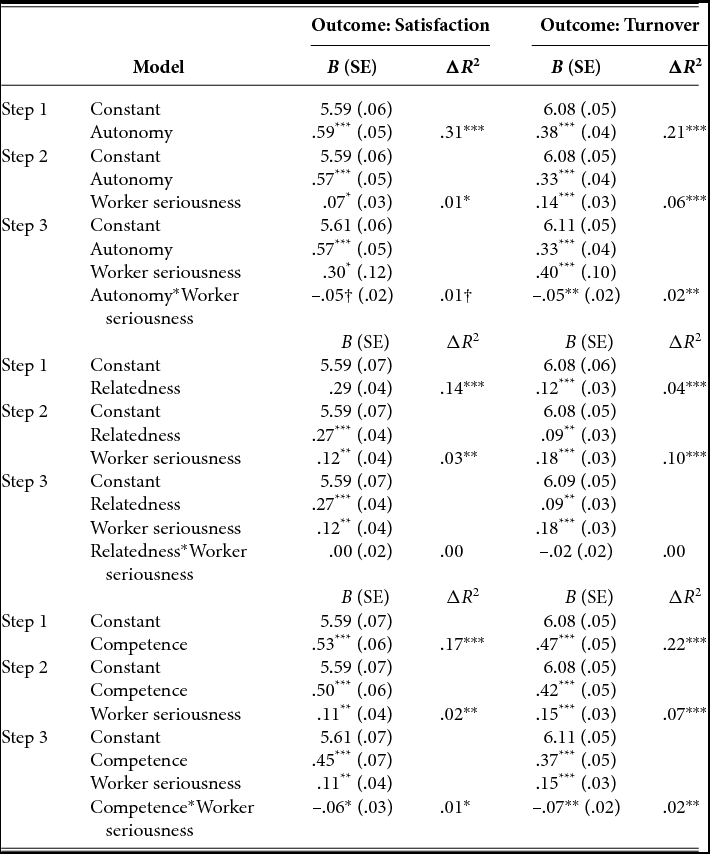
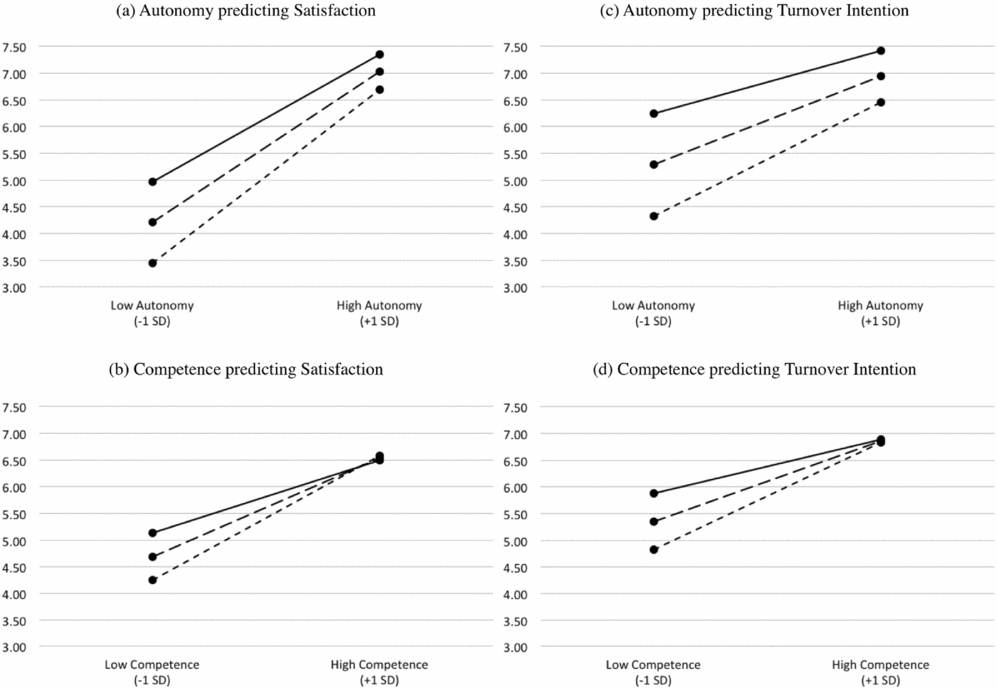
Increasing satisfaction of all three SDT needs was significantly associated with lower turnover intentions and higher job satisfaction, supporting Hypotheses 1a–b, 2a–b, and 3a–b. These findings match meta-analytic relationships, except where I observed a significant relationship between competence and turnover intentions that was meta-analytically nonsignificant (mean weighted r = –.05; Van den Brock et al., Reference Van den Brock, Ferris, Chang and Rosen2016). These relationships remained significant when controlling for worker seriousness. For two of the three SDT needs—autonomy and competence—relationships with both outcomes were at least marginally significantly moderated by worker seriousness, such that relationships with outcomes became less strongly positive (though the relationships remained significantly different from zero) as worker seriousness increased. This supports Hypotheses 2c and 3c but fails to support 1c, given that the relationship between relatedness need satisfaction and both outcomes was not moderated by worker seriousness. See Table 2 and Figure 1.
Predicting Satisfaction and Turnover
Notes. Predictors were mean centered before creating interaction terms and regressing outcomes onto them. ***p < .001, **p < .01, *p < .05, †p < .10.
Illustrations of significant interactions. Solid line represents high worker seriousness (+1 SD); long-dashed line represents average worker seriousness; short-dashed line represents low worker seriousness (–1 SD).
Discussion
Both the acceptable measurement and relevance that we have come to expect of SDT needs satisfaction are generally upheld in the new world of work, but the three needs systematically mattered less for serious gig workers on MTurk. Perhaps serious workers are motivated by other internal drives not studied here, such as intrinsic enjoyment of the work itself (cf. Brawley & Pury, Reference Brawley and Pury2016), or by external forces, such as income (in)adequacy, un- or underemployment, or requiring flexible work arrangements that satisfy other needs, like childcare or disability accommodations (Zyskowski, Morris, Bigham, Gray, & Kane, Reference Zyskowski, Morris, Bigham, Gray and Kane2015). However, the relationships of relatedness with both outcomes were not attenuated by worker seriousness; instead of diminishing the effects of relatedness (Hypothesis 1c), relatedness may be the only need that remains important across levels of worker seriousness. Of the three SDT needs, perhaps relatedness is the most generalizable to gig work, even despite the relatively low bandwidth for many gig work platforms alone to facilitate connections among gig workers. Perhaps the mere fact that gig workers have established multiple, elaborate, peripheral social platforms (see, e.g., Schmidt, Reference Schmidt2015) should be interpreted as a sign of the importance of satisfying this need even (or more so) in an era of isolated digital labor.
Although existing theory did make some valid predictions for the gig economy, there are new, systematic effects that need our attention, such as gig worker seriousness, and a larger goal—relevance to the world of work—that must be addressed. To make this happen, we may need new, ground-up theory development along with scrutiny of current I-O psychology theory using grounded knowledge of technology-based gig workers. Of course, it may be possible to extend some of what we already know mostly as-is, such as existing theories about motivation like SDT, to gig work. Further work should extend the present study's application to the antecedents of needs satisfaction in gig work, with a focus on social context and individual difference factors (cf. Deci et al., Reference Deci, Olafsen and Ryan2017). Like the needs themselves, these antecedents will require renewed consideration for their relevance to gig work: Social context may manifest differently, in the form of MTurk worker forums (Schmidt, Reference Schmidt2015), and individual differences may not work as expected to predict MTurk worker satisfaction and other outcomes (Brawley & Pury, Reference Brawley and Pury2016). Regardless of the selected constructs, as suggested for various tech-based differences in the focal article, we must focus on theory development surrounding gig work in a way that centers on relevant constructs (e.g., relatedness needs satisfaction) rather than on operationalizations that accompany particular work platforms (e.g., MTurk worker forums). This approach will ensure that we develop a science that is relevant to the growing world of gig work.
One specific set of theoretical questions to be addressed will be that of developing brand new theory, such as that of “serious” gig workers. How can we define them? What characteristics distinguish serious versus part-time (or “fun money”) gig workers? Does work-related skill make a difference in choosing to be a serious gig worker, such that high skill is associated with more choice (Spretizer et al., Reference Spretizer, Cameron and Garrett2017), or is highly skilled work just as offshoreable as low-skilled work (Sundararajan, Reference Sundararajan2016)? Future work should start to understand the characteristics that—ideally, independent of any particular gig work platform—distinguish meaningful types of gig workers. Like the focal article's call to identify the meaningful, theory-based differences across forms of technology, we should also do that for gig work platforms, including comparisons of various platforms (e.g., differences in relatedness needs satisfaction on MTurk versus the same on Uber), as well as theoretically based comparisons of these new forms of work to traditional work. Taking this approach will help us answer one very big question: Where does I-O psychology fit in this world of self-assessing, self-developing, and self-hiring workers?
Appendix
Satisfaction: Overall I'm satisfied with working on MTurk.
Turnover intention: I plan to continue working on MTurk regularly.
Worker seriousness: I consider myself a serious Turker (for example, I rely on the site for critical income, work regular hours, multiple days a week).
Data quality: Last question (answer won't affect payment). Were you serious and honest about your responses? (Response options: Yes – my data is good! or Nope)