




No CrossRef data available.
Women and Globalization: A Study of 180 Countries, 1975–2000
Published online by Cambridge University Press: 24 April 2006
Abstract
How do rising levels of international interconnectedness affect social, economic, and political conditions for women? Research on gender and international relations frequently offers clear propositions but seldom submits them to broad, quantitative testing. This article begins to fill that gap. We advance the hypothesis that, on balance and over time, increasing cross-national exchange and communication lead to improvements in women's status and equality. Economic aspects of globalization can bring new opportunities and resources to women. But equally important, globalization promotes the diffusion of ideas and norms of equality for women. In an analysis of 180 countries from 1975 to 2000, employing cross-sectional–time-series regression techniques, we examine the impact of several measures of globalization on women's levels of life expectancy, literacy, and participation in the economy and parliamentary office. International trade, foreign direct investment, membership in the United Nations (UN) and World Bank, and ratification of the Convention on the Elimination of All Forms of Discrimination Against Women (CEDAW), are associated with improved conditions for women.A grant from the Center for Global Peace and Conflict Studies at the University of California, Irvine, supported this research. The authors are grateful for constructive comments from participants in the faculty research colloquium of the Department of Political Science at Brigham Young University. The authors also received helpful suggestions from their fellow panelists at the 2004 Annual Meetings of the American Political Science Association and from the editor of IO, Lisa Martin, and two anonymous reviewers.
Information
- Type
- Research Article
- Information
- Copyright
- © 2006 The IO Foundation and Cambridge University Press
How do rising levels of international interconnectedness affect the social, economic, and political conditions for women? Competing hypotheses are easy to identify. Indeed, research on gender and international relations sometimes offers clear propositions but seldom submits them to broad, quantitative testing. This article begins to fill that gap. We expect to find a considerably mixed picture: some women will benefit from globalization and some will be hurt; the status of women will improve in some respects but not others. Nevertheless, we advance the hypothesis that, on balance and over time, increasing cross-national exchange and communication lead to improvements in women's status and equality.1
We give careful consideration to our choice of terms “status” and “conditions for women” here. Although these terms may connote a passive role for women, we recognize that women actively shape their environments. We argue that favorable conditions in women's lives provide greater opportunity for empowerment. We avoid the terms “equality” and “empowerment” in instances where we can only measure changes for women in absolute terms (not relative to men).
Why should a study focus on the effects of globalization for women and not for other groups of people? First, in assessing the condition of women, we take seriously the basic insight of feminist and gender analysis approaches that the absence of gender in theoretical and empirical research leads to distortion, or even blindness, with respect to ubiquitous social and political phenomena. Second, we note that gender is one of the few modes of differentiation that has social, cultural, political, and economic implications everywhere in the world. As Youngs puts it, all institutions involve the “exercise of power to the advantage of some and the disadvantage of others,” and “gender is a pervasive basis for such differentiations.”2
Youngs 2000, 12–13.
Finally, although numerous social scientists have offered arguments as to the consequences of globalization for women, these propositions have generally been cast at a relatively high level of theoretical abstraction. Some studies include an empirical dimension, usually in the form of ethnographic or case study material. We hope to contribute to these conversations by analyzing quantitative data from about 180 countries. It is not our contention that only statistical methods can answer all the questions—far from it. But quantitative analysis can provide powerful evidence for or against some key propositions.
The first section of the article lays out various theoretical perspectives and draws from them hypotheses that could be assessed through the analysis of systematic data. The second section describes our indicators for the independent variables (dimensions of internationalization), dependent variables (measures of the status of women), and a number of controls. The third section describes our data analysis methods. The fourth section presents the results of the multivariate regressions. The fifth section reports on additional tests to establish the direction of causality between the outcome variables and a key explanatory variable, ratification of the Convention on the Elimination of All Forms of Discrimination Against Women (CEDAW). The concluding section discusses the results and their implications for theory and research.
Theories and Hypotheses
In most political science research on globalization and internationalization,5
We use the terms “globalization” and “internationalization” interchangeably. Both refer to transborder movements of goods, services, capital, people, ideas, information, and symbols. The terms imply that countries are becoming increasingly interconnected through rising levels of cross-border interactions.
See Milner and Keohane 1996, 4; Wade 1996; Greider 1997; Rodrik 1997; Prakash and Hart 1999, 3; and Smith, Solinger, and Topik 1999, 3–9.
Our analysis of the gendered effects of globalization includes two principal dimensions. The first has to do with economic resources and opportunities. The second concerns the spread of norms and ideas regarding the place of women in social, political, and economic life.
Economic Arguments
Economic arguments on the effects of globalization on women fall into two broad groups, one intensely critical and the other basically optimistic, but with reservations and qualifications. From the critical point of view, economic globalization has largely negative consequences for women. Globalization confines women to low-pay, low-status, often part-time jobs that reinforce their subordination and perpetuate the devalorization of women's work in most societies.7
See Enloe 1990, chap. 7; Moghadam 1999; and Mason 1986.
Sassen 1998, chap. 6.
Pettman 1996, 163–67.
Wright 1995, 864.
In addition, the structural adjustment and market liberalization policies that have accompanied globalization are particularly damaging to women. These policies lead to cuts in public-sector jobs that are often disproportionately held by women, undercut social programs that benefit women, and inhibit labor organization by women.12
See Ward 1990; Afshar and Dennis 1992; Benería and Feldman 1992; Elson 1995; and Lorentzen and Turpin 1996, 3–4; and Pettman 1996, 168.
See Lorentzen and Turpin 1996, 5; and Mies 1996, 13.
No scholarship on globalization and women takes an unabashedly positive view. The alternative to the critical position is a qualified one that posits, on balance, economic advantages in the form of greater agency for women in an era of globalization. The primary advantage centers on enhanced prospects for nonhousehold employment. Indeed, globalization, including greater openness to foreign direct investment (FDI), has led to a massive infusion of women into job markets.15
Especially in the lower-income countries, foreign multinationals often make better-paying jobs available to women. Sassen, cited earlier on the negative implications of globalized production, in fact recognizes the mixed impact of globalization for women's jobs: “On the one hand, they [women] are constituted as an invisible and disempowered class of workers…. On the other hand, the access to wages and salaries (even if low), the growing feminization of the job supply, and the growing feminization of business opportunities … alter the gender hierarchies in which they [women] find themselves.”16Sassen 1996, 26.
Many analysts note that improved employment possibilities for women are not an unalloyed good. For instance, Levidow argues that though such offshore production brings women economic benefits, working for foreign manufacturers (in this case in the semiconductor industry) can be alienating and unhealthful and not necessarily terribly empowering.17
In a superb ethnographic study of Thai women who migrated to Bangkok to work, Mills captures that sense of ambivalence. She writes that she expected to encounter much more disenchantment and unhappiness than she found, and that the women felt a real “strength of purpose and sense of personal agency.” Her study balances the difficulties and alienation of factory work against the women's perceptions of empowerment from earning money and living on their own in the city: “They are neither victims pure and simple nor free and unfettered actors.”18Mills 1999, 11.
Thus, at a minimum, with globalization, more women have more options for income-producing employment. More numerous job opportunities mean more ways to get out of unequal relations; these options give women more chances to take their labor and skills elsewhere.19
One of the first places where women benefit from enhanced employment opportunities is the household. Sassen cites extensive research showing that with regular wage work, “women gain greater personal autonomy and independence…. [They] gain more control over budgeting and other domestic decisions and greater leverage in requesting help from men in domestic chores.”20Sassen 1996, 27.
See Gladden 1993; Afshar 1998; and Afshar and Barrientos 1999.
Expanded chances to earn an independent income can provide a foundation from which, over the longer term, to attain enhanced social and political status. As Sassen puts it, “In addition to the relatively improved empowerment of women in the household associated with waged employment, there is a second important outcome—their greater participation in the public sphere and their possible emergence as public actors.”22
Sassen 1996, 27.
In terms of economic outcomes, at the national level, two cross-national studies show that higher levels of economic development are associated with greater degrees of women's equality. Apodaca's research on economic development and women's rights from 1976 to 1990 concludes that “women not only benefit from a larger economic pie, but … their share of that pie increases as the pie enlarges.”23
Apodaca 1998, 11.
Sweeney 2004, 28.
Both Sweeney and Apodaca's cross-national analyses measure outcomes for women via aggregated point scales of women's rights. Yet such measures lose a great deal of information by condensing sets of complex indicators into unidimensional scales, with results that are difficult to interpret. Further, several nations are excluded from both studies because of an absence of data. Sweeney explains that “the data required to develop my measures of economic globalization are missing for a number of developing democracies.” Thus previous studies test the effects of economic forces for a limited set of data-reporting nations, and nonrandom missing data may explain the inconsistent findings. We propose to test the effects of economic globalization and levels of development for a wider set of nations and a longer period of time by selecting the measures with the widest range of nations reporting. We retain the measures in their original form, allowing us to interpret the results in terms of concrete outcomes for women.
Economic changes associated with globalization may also provide the seeds for cultural transformations that improve the conditions of women. In an impressive study of public attitudes toward gender roles in seventy nations, Inglehart and Norris argue that economic growth is only part of the story; substantial changes in social norms, beliefs, and values are also necessary to bolster women's roles in society and politics. They find that industrial and postindustrial nations are more likely to support gender equality than agrarian nations. More supportive attitudes toward women's equality then provide a more fertile soil for the concrete policies that help women to gain equal rights and opportunities.25
We argue that the more positive, albeit ambivalent, view is more persuasive. To the extent that economic globalization expands the work opportunities available to women and increases their independent earnings, it improves their physical quality of life and creates additional options for them in their households as well as in social life. We hypothesize that trade and FDI will have differential effects for women. To the extent that trade enhances economic growth generally, it will improve physical quality of life (measured by life expectancy) and literacy. But trade may also displace employment in local industries, reducing employment opportunities for women. Inward FDI, in contrast, is more likely to create new jobs, many of which will be available to women. Certainly women often retain the bulk of unpaid domestic work, resulting in a double burden. In addition, depending on the cultural, class, and family contexts, not all women will benefit from paid employment. Yet, importantly, independent economic resources and opportunities give women more choices and the agency to pursue their collective interests.
Diffusion of Norms and Ideas
International interactions, in addition to whatever economic or material purpose they have, inevitably depend on, and work to diffuse, norms and ideas. Cross-border interactions always rely on a basis of shared norms. The more transnational activity people engage in, the more they absorb ideas and norms prevailing in international society. In other words, we posit a socialization effect. Socialization is a process through which actors learn the ideas, values, and norms of the social contexts in which they interact.26
Eckstein 1988, 791.
To the extent that a country internalizes norms and ideas diffused through cross-national interactions, it incorporates those norms and ideas into its domestic policies, laws, and institutions.29
It is the relationship among international interactions, socialization, and internalization that leads us to hypothesize a link between a country's level of integration in international society and the political, economic, and social condition of its women.The key question then becomes, which norms and ideas in international society have a bearing on the status of women? In recent decades, a number of international conferences, conventions, and declarations have promoted a variety of norms and ideas designed to improve the lot of women. They address health, nutrition, and physical quality of life; personal security; employment and income; participation in politics and government; and social status. Of course, increased attention to women's rights (as much of the discourse has been framed) in international forums did not simply emerge on its own. It has been the product of “a form of feminism with an internationalist orientation.”30
Internationalist feminism has been the work of a broad range of women's activist and advocacy groups that have pressured both national governments and international organizations.31 Links among local, national, and international women's groups have created “transnational issue networks … that can exchange information, ideas, and political support.”32 In this section, we summarize the interactions among two major international governmental organizations, the United Nations (UN) and Word Bank, and transnational issue networks that have promoted the diffusion of ideas and norms supporting improvements in the status of women.From its inception, the UN has addressed issues concerning women. In the late 1940s and 1950s, the UN established a Commission on the Status of Women,33
and sponsored a Convention on the Political Rights of Women. After a long lapse, the UN declared a “Decade for Women” (1976 to 1985) and held a series of international conferences on women: in 1980 (Copenhagen), 1985 (Nairobi), and 1995 (Beijing). The conferences established a Bill of Female Rights; addressed violence against women and women's health, employment, education, and poverty; and culminated in 1995 with the Platform for Action. UN conferences on women have served as “lightning rods that have helped to channel the collective buzz of ideas and energy emanating from the global women's movement into prescriptions for and commitments to policy action at the level of nation-states.”34True and Mintrom 2001, 48–49.
The UN conferences also fostered the growth of a transnational feminist movement.35
Nongovernmental organizations (NGOs) held meetings parallel to the UN conferences. Attendance at the NGO forums grew considerably over time—from 1,000 in 1975 to 30,000 in 1995.36 These grassroots connections complement and support the connections made among official governmental delegates.The increasing number and activism of women's NGOs ensured that other UN conferences and specialized agencies would also address the gender dimension.37
For example, since the early 1980s, under the rubric of Women in Development, the UN Development Program has considered the impact of its programs and policies on women.38See Kardam 1991; and Goetz 1997.
See Tinker 1999, 99; Higer 1999; and Miller 1999.
Finally, the UN's heightened awareness of gender inequality spurred its General Assembly to adopt the Convention on the Elimination of All Forms of Discrimination Against Women (CEDAW) in 1979, calling for government action on several policies designed to support women, such as maternity leave and access to childcare.40
Although many nations did not ratify it, including the United States, CEDAW became the main international legal document on women's rights.41 Its existence created a source of legitimacy with which women could justify their claims to their national governments.42Case study evidence demonstrates the substantial effects of CEDAW for women's equality. For example, in Pakistan, the adoption of CEDAW has sparked new debate over women's roles, invigorated the women's movement, pushed the government to establish an autonomous National Commission for women, and marked a “definite paradigm shift in women's access to power … albeit slowly and in limited quarters.”43
Weiss 2003, 589.
Celik 2004, 3.
See Rojas 2001; and Brysk 2005.
The World Bank has also addressed women's issues. Although the Bank appointed an advisor on Women in Development in 1977, the Bank paid little attention to gender issues before the 1980s.47
Kardam 1991, 64–81.
Hafner-Burton and Pollack 2002. A number of regional organizations have also adopted programs and policies to promote gender equality and mainstreaming. The European Union (EU) and the Organization of American States (OAS) are notable examples. On the EU, see Hoskyns 1996; Ellis 1998; Elgström 2000; Pollack and Hafner-Burton 2000; Cichowski 2001 and 2002; and Jupille and Caporaso 2001. On the OAS, see Meyer 1999.
In sum, international organizations have actively articulated and diffused transnational norms of gender equality. In so doing, they have empowered women's groups and organizations, which can use international treaties and declarations to pressure their governments to live up to their commitments in the area of gender equity and to pursue domestic reforms.50
Tinker 1999, 101.
The Variables
We operationalize our outcome variables for women's quality of life and equality much as the UN gender indexes51
Gender-related Development Index (GDI) and the Gender Empowerment Measure (GEM). For a more detailed discussion of the multidimensionality and resulting difficulties of creating one generalizable and quantitative measurement for the “status of women,” see Mason 1986.
We focus on four measures that are differentiated by gender and widely available for the largest number of states during the 1975–2000 period. These include female life expectancy at birth, female illiteracy rate for age fifteen and above, female percentage share of the workforce, and female percentage share of seats in parliament. We do not explore measures of women in particular segments of the workforce, specific educational attainment, or female wages, because there are too many missing observations for worldwide analysis during the period studied here. To avoid possible sample biases related to missing data, we restrict our analysis to the indicators with the most widespread coverage.52
Often countries with missing data in cross-national studies are disproportionately from small and/or lesser developed nations.
Worldwide analysis where nation-states are the unit of analysis for three of the dependent variables studied here (life expectancy, illiteracy, and labor force participation) could not be completed with data collected annually since 1975. The use of five-year intervals coincides with data reporting and collection cycles for many small and/or developing nations. In cases where an observation for these three dependent variables was missing, we looked at available data for the year previous or the year that followed as a substitute to maximize observations. Given that indicators of life expectancy, illiteracy, and labor force participation are not subject to any significant year-to-year volatility, the small number of cases where this method of replacement was used does not create any substantive measurement issues.
Quality of life and status: Dependent variable descriptive statistics

The first dependent variable, female life expectancy at birth, has been and continues to be the primary measure for any study of physical quality of life.54
Life expectancy should reflect the effects of other potential indicators of physical quality of life (nutrition, caloric intake, clean water, access to doctors and clinics, and so on). However, these factors have been difficult to disentangle, as they are mostly collinear with, and explained by, national levels of development.55See Rodgers 1979, 343; and Ram 1998.
Rodgers 1979 indicates that the effect of income on life expectancy is present at the national, local, and even individual level. This research indicates the use of national levels of income in addition to measures for the distribution of income (Gini coefficients) provides the best estimates. However, measures for the distribution of income are not available for a large enough number of countries and years to be used in a time-series global sample.
In 2000 the lowest levels of female life expectancy at birth in the world (about forty years) were found in Mozambique and Namibia—two nations dealing with severe HIV/AIDS epidemics.57
We account for observations where more than 5 percent of the population is estimated as HIV positive as an “excluded” category in the multivariate models. Given the emergence of the virus during the period of this study it is easier, and more reliable, to isolate nations and years where the virus is known not to be present at high levels as measured here. In nations where more than 5 percent of the populations is estimated to be HIV positive, there is often imperfect measurement of exact levels among the entire population and this is even more challenging over time. Thus statistically it is easier to isolate observations where the epidemic is known not to be most severe. Although it would be preferable to have HIV rates for both males and females, this data does not exist for the set of countries studied here. Where these estimations are made in the medical literature, they are typically based on samples of specific populations (for example, prostitutes or intravenous drug users) that are unrepresentative of men or women as a whole.
We expect that nations that become more open to international trade and investment and more involved in international organizations—including ratification of CEDAW—will have higher female life expectancies. We also have expectations about areas where female life expectancies may be lower. Although global life expectancies for both men and women have generally been increasing on a convergent pace,58
one factor countering these changes is the emergence of HIV/AIDS. The impact of HIV/AIDS has been most severe in Sub-Saharan Africa.59 Given existing research on these factors, we expect females in nations with lower levels of development and higher rates of HIV/AIDS to have lower life expectancies.The next outcome variable is education, measured here by the percentage of those age fifteen or older who are illiterate. As Stromquist notes, “The ability to write and read in an increasingly technological society is a fundamental need.”60
Stromquist 1990, 95.
We expect that, in general, countries that have become more open to international trade and investment and more involved in international organizations—including ratified signature of CEDAW—will have lower levels of female illiteracy. Government inaction is one of the primary factors related to illiteracy.61
Ibid., 104.
Whereas life expectancy is strongly related to development, illiteracy has only been weakly related to levels of national income; variation is more often related to cultural differences that have historically affected women disproportionately.62
Ahmed 1992, 33. However, reductions in illiteracy often do have beneficial impact on national incomes (Carceles 1990).
Although it is noted that these changes have occurred from relatively low levels of female literacy to begin with. United Nations Development Programme 1995, 29.
Ibid., 32. Emphasis in the original.
Women's workforce participation is another condition that may favor enhanced status for women. In the language of his times, Engels noted that “the first condition for the liberation of the wife is to bring the whole female sex back into public industry.”65
Engels [1884] 1942, 66.
Semyonov 1980 demonstrates that income inequality is decreased by increasing participation of women in the labor force.
Many of the countries with the highest levels of female participation in the labor force are current or former communist or Marxist states such as Cambodia, Latvia, Vietnam, Estonia, Russia, and Belarus. Developing nations such as Ghana, Tanzania, Burundi, and Rwanda also have high levels of female participation in the labor force. On average, national female participation rates in the labor force have increased from 34 percent in 1975 to 40 percent in 2000.
Once again, we expect international integration to be central to explaining these gains. Existing cross-national research indicates that increasing levels of female participation in the labor force have in part been driven by industrialization and development,68
See Belloc 1950; Collver and Langlois 1962; and Wilensky 1968.
Cooney 1975. Increasing female life expectancies supported by economic development may be a small and emerging factor for female participation in the labor force as well. See Clark and Anker 1993, 502. As gender gaps in life expectancy increase, and larger proportions of women are widows, women are remaining in the labor force for longer periods, into their senior years.
Some of these norms explicitly prohibit female participation in some parts of the labor force (for example, Islamic nations governed by Shari'ah or Islamic law) while others have indirect impacts. For example, the Roman Catholic Church defines marriage in its Code of Canon Law as being “ordered to the good of the spouses and the procreation and education of offspring” (Coriden, Green, and Heintschel 1985, 740). Catholic Church doctrine forbidding abortion and dissuading any form of birth control other than observance of fertility cycles indirectly implies that married women will likely spend a significant portion of their childbearing years having and raising children. The Catholic Church forbids sexual relations outside of marriage, so the only officially acceptable alternative to this doctrine is life-long abstinence. Although Catholics may ignore these edicts, we would expect that, ceteris paribus, at the margins predominantly Catholic nations would have lower levels of female participation in the labor force.
As Inglehart (1990 and 1997), has shown, higher development countries often have more “postmaterialist” and tolerant attitudes, which may reflect greater levels of acceptance of women in the workplace as compared to lesser developed nations with traditional norms, often reinforced by religious doctrine and tradition.
Our final dependent variable is the percentage share of women serving in national parliaments (or the lower house of bicameral legislatures). Women's parliamentary presence marks achievements in attaining political power and has policy consequences for women's daily lives. In a study of industrialized nations, O'Regan finds that countries with higher proportions of women in parliament are also likely to have stronger employment and wage protection policies.74
Further, women's numerical representation may also empower women as citizens in making claims on their government. Schwartz argues that numerical representation brings constituents into the political process by uniting them as a political group.75 Research on political participation in the United States shows that where women run and are elected, women are more politically engaged.76See High-Pippert and Comer 1998; and Atkeson 2003.
In 2000 the countries with the highest levels of female representation in parliament (approximately 35 percent and above) were located in northern Europe. There are also a number of historical cases where women have occupied comparatively large shares of parliamentary seats in Marxist/communist states, although they were not democratically elected (for example, Romania in 1985, Cuba in 1990, Albania and Vietnam in 1975, and the USSR in 1980, where approximately a third of parliamentary seats were held by women). On average, the female shares of national parliaments have grown worldwide since 1975 from 5 percent to 11 percent in 2000. When one restricts the sample to nations generally considered somewhat “democratic” by the measure of Freedom House scores, the increase is even more noticeable, starting at 5 percent in 1975 and advancing to 14 percent in 2000.
We expect many of the factors related to higher female levels of labor force participation will also be related to greater representation in parliament. In addition, we expect nations with longer histories of female suffrage and those with electoral rules designed to enhance women's representation in national legislatures to have more parliamentary seats occupied by women.77
We use a variable for female suffrage in all models as a partial measurement of the emergence of women's movements. Although incomplete, this represents one of the few cross-national measures that can consistently serve as a milestone.
See Lakeman 1994; Duverger 1955; Rule 1987; Rule and Zimmerman 1994; Norris 1993 and 1996; Beckwith 1992; Matland 1993; and Matland and Studlar 1996.
We also expect that countries where more women participate in the labor force have a larger pool of women prepared to run for office.81
See Oakes and Almquist 1993; Rule 1987; and Reynolds 1999.
Many of the largest Protestant denominations provide for more equal opportunities for women within their practice of faith. See O'Brien and Palmer 1993, 29. Unlike Catholic and Eastern Orthodox Christianity, some Protestant denominations ordain women to the clergy and some also serve as bishops. The cultural significance of women leading churches that for centuries were patriarchal may be of symbolic importance. There is also evidence of religious switching among women seeking leadership roles within religion. Perl 2006 has found that a disproportionate number of female Protestant clergy in the United States are converts from Catholicism.
Reynolds 1999. Certainly other explanatory factors may be at work here. Importantly, gender quota legislation for parliaments may encourage greater representation of women. However, enforcement of these policies varies greatly across the few nations who have adopted them. Furthermore, the strength and nature of the women's movement should improve women's representation in politics. Yet measuring women's movements cross-nationally is difficult, and the measures that do exist (see Weldon 2002) are largely static in nature.
Although we have already discussed many of the potential explanatory factors for which we have expectations, there are a few that require more specific discussion—development, level of democracy, and membership in international organizations. In empirical cross-national studies, GNP per capita is one of the primary measures of levels of national income and development. Given our analytical goals, it is crucial to include a variable measuring economic development over time to distinguish between the effects of development and those of socialization on our outcome variables. GNP per capita is by no means a perfect measure of national wealth but it is the most widely available and widely used.84
We use GNP per capita after natural log transformation because we expect the initial gains of increasing GNP per capita will be greater than those at higher levels—a curvilinear effect well known to cross-national economic and social analysis. We also test the untransformed measure to ensure the best-fitting application is used. These same theoretical guidelines and analytical procedures are used for all other natural log–transformed variables used in our models.
We use GNP per capita calculated by the Atlas method. This is the most widely available data. Although some prefer to use purchasing power parity (PPP) conversions these data are not as universally available for a global set of countries during the 1975–2000 period. We have chosen to avoid problems of sample bias that are potentially more severe than any reliance on Atlas over PPP.
Although GNP per capita is the most widely available measure of development, it is not uniformly available. GNP data do not exist for many former and current Marxist/communist nations or for a small number of nations undergoing periods of turmoil.86
Including some of the years of communist rule in the USSR, Yugoslavia, Romania, Poland, Hungary, Bulgaria, Afghanistan, Vietnam, North Korea, Albania, and Cuba. To a lesser extent, periods of crisis are also related to missing GNP per capita observations. For example, the World Bank does not report GNPs for Afghanistan, Liberia, and Somalia in the year 2003.
We conducted exploratory missing data analyses for each dependent variable by estimating models in which nations without GNP per capita observations were observed with dummy variables (with GNP per capita observations set at 0). In most cases the nations measured by the dummy variables were associated with outcomes similar to moderately low GNP per capita nations. These models were exploratory and intended to give an understanding of what we might expect from the largest sample. Effects on other independent variables in these models were unremarkable.
The measure of authoritarianism used here is the combination (sum) of the Freedom House measures of political and civil freedom, ranging from a low score of 2 (complete democracy or presence of freedom) to 14 (complete autocracy or lack of freedom). We expect that women (as well as men) living in democratic systems will experience a higher quality of life. Elections allow for popular pressures to be more efficiently communicated, which may in turn encourage the state to provide adequate health care and education. Democratic systems also entail greater accountability of government officials who fail to provide these services. Similarly, democracy might also produce laws and policies that reduce barriers to women's participation in the labor force.
With respect to the connection between democracy and women's political representation, there are competing hypotheses. On the one hand, it may be easier for women to get elected (or appointed) to “rubber-stamp” or powerless parliaments. On the other hand, authoritarianism may negatively affect women's representation. Waylen reasons that authoritarian regimes are often built on more traditional, gendered bases.88
However, many of the formerly communist regimes, largely built on egalitarian ideologies in general, had high levels of women in national legislatures. Paxton finds democracy negatively impacts women's representation.89 Without the regime-mandated gender quotas, the former communist regimes of Eastern and Central Europe certainly witnessed a fall in women's numerical representation in the first democratic elections. To explore these hypotheses we estimate models for both the full set of countries and for the set of democratic countries only.90We include all parliaments—without respect to how they are formed—assuming that these positions of national leadership are important indicators of status whether seats are filled by appointment or by free and fair election. To make the analysis comparable to other studies that have focused only on elective states we present a restricted democratic state model where the combined Freedom House score is 8 or lower.
We had hoped to be able to measure the separate impacts of UN and World Bank membership. However, multicollinearity and fixed-effects modeling prevents the use of separate dummy variables. Furthermore, because nearly all countries have become members of both organizations by the year 2000, the most important variation is in the length of membership. We expect that the more long-standing members of the UN and World Bank will be more likely to have absorbed international norms associated with each. We measure these histories with a single measure by adding the years of membership in both organizations.91
We include time that a nation may have spent as a territory within a UN member state (for example, former Soviet Republics). An alternative measure excluding this time for these nations does not significantly alter the results.
Methods
We use cross-sectional time-series regression techniques that take into account the specific nature of the panel data used here. Given that the number of national panels (N = 180) is much larger than the number of observations over time within the panels (T = 6), fixed-effects estimations are used, as recommended by Stimson for situations where N > T.92
Stimson 1985. Widely used time-series cross-sectional (TSCS) regression techniques—ordinary least squares with panel-corrected standard errors—introduced by Beck and Katz are inappropriate for the type of data used here (Beck and Katz 1995, 635).
The primary risk is underestimated standard errors, which would lead to artificially high t-scores and possible mistakes in inferring that factors are statistical significant when they actually are not.
For each series of models we estimated Breusch and Pagan's (1980) Lagrange multiplier test as modified by Baltagi and Li (1990), which indicated a preference for random effects or fixed-effects estimators over OLS. We then also performed Hausman's (1978) specification test indicating a preference for fixed-effects estimators over random-effects.
Thus fixed-effects models are the preferred method of estimation for our data.95
Johnston and DiNardo note that even when random-effects models are preferred, the use of fixed-effects estimators would still provide consistent parameter estimates. See Johnston and DiNardo 1997, 403.
Random-effects models constrain each nation to the same intercept. Fixed-effects modeling effectively sets nation-specific intercepts for n-1 cross-sections.
Johnston and DiNardo 1997, 399. Random-effects estimations are usually biased in overstating the effects of observed independent variables, whereas fixed-effects tend to understate their importance. See Johnston and DiNardo 1997, 403.
Specifically, we expect differences in predominant religions to affect illiteracy rates as well as the percentage of women in the workforce and parliament. Measuring religious affiliation is both simple and complicated. It is complicated in that precise estimates of religious adherence for a global sample over time are nonexistent. It is simple in that the relative stability of religious affiliation within countries makes it possible to estimate baseline predominant religions with existing data sources. Even those nations without a “majority” religion in the population have relatively stable patterns of religious affiliation over time.98
Barrett, Kurian, and Johnson 2001. Uganda and Zambia shift during the 1975–2000 period between what one could refer to as “mixed faith” (religious pluralism, that is, no religious faith achieves 60 percent) to “mixed Christian” (Catholic + Protestant above 60 percent). Bosnia and Herzegovina and Chad shift from “mixed faith” to Islam.
Exploratory random-effects estimations indicated that the factors varying over time that are identified in these models as important (that is, statistically significant) are consistent with the results of the fixed-effects estimations. The primary difference is that the random-effects models include time-invariant measures for religion and country size (area) that are also shown to be of some importance.
Although we cannot examine these theoretically plausible cross-national effects, we can examine the hypotheses most central to our research. Our data representing openness to trade and foreign investment, and participation in particular international organizations and agreements does vary over time and we have argued that, ceteris paribus, these will be related to more positive outcomes for women.
Table 2 lists the definitions and sources of the variables used in the analyses presented here. We structure each model around a set of baseline control measures along with the theoretical variables of interest related to global integration. We assume that changes in development, democracy, and Marxist/communist systems may all be related to outcomes for women. Additionally, we include a variable measuring the number of years since the adoption of female suffrage in national elections as a baseline indicator of the history of women's rights movements within democracies.100
For this measure and the UN/World Bank membership years, we use natural log transformations as we expect the cultural changes brought about by these events are most evident in the years closest to the change being made (membership or adoption of voting rights) with diminishing returns over time as the associated beneficial norms become part of the general culture.
This is not possible for the female percentage of the labor force or parliament seats estimations, as the male percentage for each is simply the inverse of the female percentage.
We also estimated models where the dependent variables were female-male differences, ratios, and changes to these ratios. The limitation of all of these procedures is that they remove important information about the actual levels of life expectancy and illiteracy that are central to the understandings of quality of life. For example, a woman in a country with female life expectancies that are higher than males and even advancing disproportionately higher may still wish she were living in a nation where female life expectancies are more similar to males if female life expectancy in her country is fifty years and in the other country it is seventy-five. Thus even positive changes in female-male ratios or differences may still lead to outcomes that would be considered comparatively poor in absolute terms.
Variable definitions and sources

Results
The results for models of levels of female life expectancy and illiteracy are presented below. Two models for each dependent variable are shown in Table 3. The only difference between these two models is that the second includes a control for the male level of the dependent variable.103
Estimations were first made in Stata using the “xtreg, fe” command. For these estimations the intercept represents the average value of the fixed effects (Gould 2001). Stata “xtreg, fe” does not report many important regression diagnostics—namely multicollinearity diagnostics, Durbin-Watson scores, coefficients for the fixed-effects (country dummy variables) or adjusted R-squares including the fixed effects. We use SPSS regressions with country dummy variables (n − 1, as well as n with suppression of the intercept) to obtain this information—resulting in identical coefficients, standard errors, and levels of statistical significance.
Female life expectancy and illiteracy

Female Life Expectancy at Birth
Assessing the measures of global integration in Model 1, we find that women in countries with higher levels of trade have longer life expectancies at birth. For example, the results indicate that, ceteris paribus, females in countries where trade is 77 percent of gross domestic product (GDP) have life expectancies at birth that are eight months longer than females in states where trade measures 54 percent of GDP.104
For easier discussion of examples, the estimated effects of all variables that are transformed by natural logarithm (ln) are converted back to actual observed values. It is important to note the distribution of the product of the coefficient and the natural log transformed observations is nonlinear; estimated changes between lower value observations produce larger effects than changes between higher value observations. To illustrate the effects of changes in specific independent variables, we compare the 1975 average (for all countries) to the 2000 average for all countries. In the example of trade/GDP ratios, for instance, 54 percent is the average for all countries in 1975, and 77 percent is the average for all countries in 2000. The other illustrations follow the same pattern.
Women in nations that have signed and ratified CEDAW (that is, the cedaw high variable) have higher levels of female life expectancy at birth than those in nations who have not signed or ratified. The effect is equivalent to more than nine months of additional life expectancy and is statistically significant. Controlling for all other factors in the model, women in nations that have signed CEDAW but not ratified it (that is, the cedaw low variable) have female life expectancies that are indistinguishable from nations that have not signed CEDAW. We also control for nations that have ratified CEDAW but also entered reservations about some aspect of the agreement; female life expectancy is not affected by treaty reservations.105
By the terms of the convention, CEDAW reservations cannot be incompatible with the object and/or purpose of the agreement. Other nations may challenge a reservation made on these grounds. Articles 2 (removing discriminatory laws and enacting legal prohibitions against gender discrimination) and 16 (equal rights for women in marriage and family life) are the focus of many reservations on the basis of cultural or religious incompatibility. These are then often challenged by other CEDAW participating nations.
Among the baseline control variables, as expected, higher levels of GNP per capita are associated with higher levels of female life expectancy. Nations with more income to devote to medicine and health infrastructure tend to produce longer life spans among women.106
As well as lower levels of infant mortality, which are of course important determinants of life expectancy at birth (that is, the number of years, on average, an individual can expect to live at birth given current age-specific death statistics). Although postinfancy life expectancy rates could add additional insight, these are not as widely available and would have led to a smaller and less “global” set of nations for analysis.
In Model 2 we control for the male level of life expectancy for each observation as a means of assessing changes for women relative to men. As noted, this introduces some endogeneity, as outcomes for men and women are strongly related; both are largely explained by and responsive to similar factors.107
Like the cross-national fixed-effects, the measure for male levels of life expectancy is a control feature. Introducing these variables helps account for the N × T structure of the data in the absence of a completely or highly specified explanatory model. Although these control variables do a significant amount of the work (as measured by the overall adjusted R-square) they do not actually “explain” anything. Thus some argue that including such controls produces “models of ignorance” (Meier et al. 2001). The controls are useful in accounting for omitted theoretically important variables but always require one to consider whether the cure is worse than the disease (Johnston and DiNardo 1997, 399) in terms of increased multicollinearity with the theoretical and/or other control variables, the inability to include time-invariant theoretical variables, and the resulting large losses of degrees of freedom. For our data, the fixed-effects control measures allow us to accomplish the goal of accurately estimating the importance of factors that change over time within countries during the 1975–2000 period; controlling for male levels of the dependent variable allows us to draw some inferences regarding the factors that are more uniquely beneficial to women. We also estimated models controlling for time—either with a continuous year variable or dummy variables for t − 1 years (that is, two-way fixed-effects). However, at that point regression diagnostics indicate that the cure becomes statistically fatal in that the collective control measures explain nearly everything but of course nothing in substantive terms. It is of little use to understand variations in the dependent variables in terms of country i being country i in year 1, year 10, and so on. Adding a control for year introduces additional multicollinearity and instability and leaves little room for the theoretical variables to “do their work” in explaining changes over time within panels. There is of course no insight in understanding “things get better (or worse) with time” when year is an overpowering proxy for the processes and events that are actually leading to changes. Also, unlike other studies where two-way fixed effects may make some theoretical sense, we have no reason to assume that any of our dependent variables are actually affected by time alone. We do anticipate changes occurring with advances in development but we already control for this by including a standard measure of GNP per capita in each model. The absence of a control variable for time means that we cannot rule out some potential alternative explanations that display a trend over time. However, the variables included in the models do measure the two most important (and theorized) time-related processes, development and socialization. We therefore believe that the risk of omitting an alternative, time-trending explanatory variable is small.
The results of Model 2 indicate that as life expectancies for men increase by one year, female life expectancies increase by one year and three weeks. Additionally, controlling for male levels of life expectancy, females in countries where trade is 77 percent of GDP have life expectancies at birth that are one month longer than females in states where trade measures 54 percent of GDP. FDI also emerges as a factor but the effect is negative and small. Controlling for male levels of life expectancy, women in nations where FDI inflows are 4 percent of gross fixed capital formation (GFCF) have life expectancies that are slightly more than two weeks longer than women in nations where FDI inflows are 20 percent of GFCF.
CEDAW ratification is no longer statistically significant after controlling for male life expectancy. However, CEDAW is a statistically significant predictor of improving life expectancy outcomes for both women and men.108
This was confirmed by duplicating Model 1 for male life expectancy. However, this remains an unexplained correlation and establishing causation would require further analysis beyond the scope of the data collected here. It is possible that CEDAW and life expectancy outcomes are both explained by an omitted factor.
Female Illiteracy
Moving up the hierarchy of needs, we present models for female illiteracy, where coefficients should be interpreted keeping in mind that positive signs represent negative outcomes (higher illiteracy) and negative signs represent positive outcomes (lower illiteracy).
In Model 1, among the global integration variables, countries that have signed and ratified CEDAW, that are more open to trade, and that have longer histories of membership in primary international organizations (UN and World Bank) tend to have lower levels of female illiteracy. States that have ratified CEDAW have female illiteracy rates that are 3.6 percentage points lower than nations that have yet to ratify the agreement. Countries that have signed CEDAW but not yet ratified it and countries that have ratified but logged a reservation to the agreement show no statistically significant change to female illiteracy.
Countries that become more open to the international system in terms of greater movement of goods and services across borders are more likely to have lower levels of female illiteracy. Controlling for all other factors in the model, a country that trades 54 percent of GDP is expected to have female illiteracy rates 0.8 percentage points higher than one that trades 77 percent of GDP. Furthermore, membership and participation in international organizations that have encouraged norms of gender equality are associated with positive effects on women's literacy. For example, a nation that has been a member of the United Nations and the World Bank for thirty-five years (that is, seventy years of collective membership) is expected to have female illiteracy rates that are 5.7 percentage points lower, on average, than nations that have been members of these international organizations for only twelve years each (that is, twenty-four years collective membership).
A result running counter to expectations is that nations more open to investment (those with higher FDI inflows as a percentage of GFCF) have slightly higher levels of female illiteracy. This may be a result of increasing foreign capital creating labor demands that draw women into the labor force before completing education.109
Another hypothesis is that foreign investment is seeking out the lowest labor costs and thus targets less developed areas where illiteracy rates are higher.
As noted in the literature, levels of development, as measured by GNP per capita, are not consistently related to lower levels of illiteracy among women, as lesser-developed countries have made significant gains in literacy while some midlevel development countries have not.110
Results from the fixed-effects estimations indicate that, ceteris paribus, higher national incomes are associated with slightly higher levels of illiteracy during the 1975–2000 period. However, the effect is equivalent to less than 1 percentage point for the average change in GNP per capita for the panel between 1975 and 2000. The highest-income nations with the highest levels of illiteracy are all in the Middle East or North Africa (primarily oil producing states). For example, in 2000 Zambia had a GNP per capita of approximately $310 and a female illiteracy rate of 28.9 percent. In this same year Saudi Arabia had a GNP per capita of $7,230 and a higher female illiteracy rate, 33.0 percent. Also in 2000, some of the former Soviet republics with comparatively low GNP per capita had some of the lowest female illiteracy rates in the world (for example, Tajikistan, Moldova, Armenia, Belarus).Controlling for all other factors, higher levels of authoritarianism are associated with slightly lower levels of female illiteracy. The estimated difference between the most authoritarian states and the least authoritarian states is equivalent to a 3.3 percentage point difference in illiteracy rates. This finding is in part related to patterns of democratization during the 1975–2000 period. Some of the former Soviet republics have remained relatively authoritarian and have low levels of female illiteracy, whereas some other countries that have become more democratic during the period—many in Asia and Africa—have yet to reduce female illiteracy rates significantly. There are also a few long-standing outlier democracies that continue to have comparatively high levels of female illiteracy (for example, Papua New Guinea, and India). The female illiteracy rate is 3.9 percentage points higher in states that are ruled by communist or Marxist regimes. A longer history of female voting is associated with lower levels of illiteracy.111
It is also apparent that in many nations the extension of female suffrage led to more educational outreach and lower levels of illiteracy to ensure that all members of the electorate were able to cast an “informed” vote. It is also true that an increase in educational opportunities for women predated both the extensions of the suffrage and the women's movements that sought this reform. In this regard, lower levels of female illiteracy might have been a historical precursor to successful women's movements, and thus some of the causality of this relationship likely flows in the opposite direction as well.
Once again we estimated a second model controlling male levels of illiteracy. The coefficient for male illiteracy indicates that for every 1 percentage point increase in the proportion of men being considered illiterate, the percentage for female illiteracy increases by 1.1 percentage points. With the introduction of this variable, the signs for several coefficients—including those for GNP per capita, authoritarianism, and years of female suffrage—actually shift direction. However, this is in large part because of the overwhelming nature of the fixed-effects controls and the inclusion of a partially endogenous male illiteracy variable that together explain all but 1 percent of the variance in female levels of illiteracy. The coefficients for the trade ratio variable and length in membership in the UN and World Bank remain consistent in direction albeit with weaker estimated effects. Again, these results in no way alter the findings in Model 1, which estimate the effects of globalization on women's illiteracy in absolute terms.
Female Participation in the Labor Force
Results for the global integration variables (see Table 4) indicate important associations with membership in international organizations and agreements that support the empowerment of women. Controlling for all other factors in the model, signing and ratifying CEDAW is associated with an increase in women in the workforce of 2 percentage points. Countries that have ratified CEDAW with reservations are associated with an additional 0.7 percentage point increase. This result may be an indication that some of the nations that have entered reservations are making more genuine attempts to implement the treaty within their specific contexts.112
Many of the long-term postindustrial democracies have logged reservations that are specific to existing policies: Australia (maternity leave, exclusion of women from combat); Austria (night work); France (right to choose a family name); Ireland (custody of children, social security more favorable to women); and Luxembourg (hereditary transmission of the crown). Among those that have ratified without reservation are some nations with questionable implementation and human rights issues such as Afghanistan, Burundi, Haiti, Liberia, and Rwanda. There are also a number of nations that have made broad and apparently contradictory reservations. For example, Bangladesh does not agree that they are bound to condemning and eliminating discrimination (Article 2) because this would conflict with Islamic law.
Female participation in labor force and female representatives in parliament

As expected from existing cross-national research findings, higher levels of GNP per capita are associated with larger percentages of women in the workforce. Changes in the supply of the potential female labor are also a factor.113
Increases in the female percent of the population of course also represent declines in supply of the available pool of male labor.
In Model 2 we attempt to understand the indirect influence of one of the other dependent variables—female illiteracy—on the female percentage of the labor force. We do so with some caution as the female illiteracy variable has more missing data than the labor force variable, reducing the number of countries available for analysis from 163 in Model 1 to 146 in Model 2. Thus the sample is slightly altered. We hypothesized that decreasing illiteracy rates would lead to increasing participation of women in the labor force; the results support that proposition. This implies that the factors identified as related to lowering levels of female illiteracy (Table 3) are also indirectly associated with increasing the number of women employed in the workforce.114
We do not attempt to present a formal path analysis because of the limitations caused by the listwise missing data for the dependent variables.
Female Representatives in Parliament
The model for the share of seats in parliament held by women (the lower house in bicameral legislatures) is presented in Table 4 and includes two sets of estimations. The first includes all countries—those with democratically elected parliaments and those with assemblies that are not freely and fairly elected or that are shaped entirely by executive appointment. The second model is restricted to observations where nations are considered democratic (as measured by Freedom House).
For all countries, increasing foreign investment and ratified signature of CEDAW are both associated with more women serving in parliament. An increase in FDI as a percentage of GFCF from 4 percent to 20 percent is associated with an increase of 0.6 percentage points in women's share of parliamentary seats. Ratifying CEDAW is associated with an increase of 2.1 percentage points. Higher levels of development are also associated with larger shares of parliamentary seats held by women. This may reflect a modernization effect through greater acceptance of gender equality norms among high GNP per capita nations. Although rarely elected in free and fair elections, communist or Marxist states have had female representation in parliament that is 5.3 percentage points higher than in other states. In nations using PR allocation rules, the percentage of women in parliament is 3.4 percentage points higher. More women in the labor force is positively associated with more women in parliament. For example, increasing female labor force participation from 32 percent to 40 percent is associated with a 2.9 percentage point increase in the percentage of parliamentary seats held by women. Once again, this provides evidence of indirect path connections between the models for women's levels of illiteracy, labor force participation, and representation in parliament.
When the same model is restricted to democracies only, a few changes are evident.115
The “authoritarianism” measure remains in the model even though it is restricted to democracies, because this is a continuous scale that still measures differences in authoritarianism even among democracies. Also, the communist/Marxist variable drops out of the regression because none of those states have been considered democratic by Freedom House.
The coefficients for GNP per capita and female share of the labor force are slightly larger among democracies. Proportional representation in democracies has no relationship with the share of parliamentary seats won by women. However, it is important to note that in a fixed-effects model, this coefficient most accurately represents those democratic countries that have dropped or adopted PR electoral systems at some point during the 1975–2000 period.116
The proportional representation variable is time-invariant for nations that have not made changes and this cross-sectional aspect is already accounted for in the fixed-effects modeling. For this same reason, we do not include a measure of country size (kilometers-squared) in these models even though it is strongly associated with varying levels of trade and proportional representation. In estimations where area is included—capturing the set of nations where area has changed during the period—a statistically significant effect emerges only in the models for women in parliament and only then with prohibitively high levels of multicollinearity with the measures of proportional representation and trade (nations increasing in size having larger percentages of women in parliament). Area has no effect on the statistical significance of the global integration measures.
Testing Direction of Causality
For each dependent variable, CEDAW ratification is related to more positive outcomes for women.117
We also tested CEDAW variables that measured the amount of time since ratification that performed similar to the simple CEDAW dummy variables. For easier discussion and interpretability we use the dummy variable however, in the long-term it may be more useful to use a CEDAW years measure such as the one used here for the UN and World Bank to account for variations in the time that nations have had to implement the convention and for wider socialization to occur. For the time frame of this study and the relative newness of CEDAW, this was not an important distinction. The difference between the dummy variable and time measure was most prominent in models of female life expectancy. This is not surprising as one might expect the longest lag time for changes to this outcome measure after CEDAW ratification, as opposed to outcomes for literacy, workforce participation, or parliamentary representation.
To test for this possibility we analyze the data for 1975—before CEDAW was in existence. We isolate those nations that would ratify the convention between 1980 and 1985 with a dichotomous dummy variable. We then use this dummy variable, cedaw prospective, as an explanatory variable in simple OLS models for each dependent variable. If the countries that ratify CEDAW share certain characteristics, the cedaw prospective variable will capture them. If those common characteristics lead to both CEDAW ratification and better outcomes for women on the dependent variables, then the cedaw prospective variable will be statistically significant in the models.118
Even a nonspecialist's knowledge of world affairs and a quick review of the list of nations that initially ratified CEDAW would quickly dispose of the notion that these were just the collection of “progressive” nations.
Natural experiment: The influence of prospective CEDAW ratification on the dependent variables, 1975

In all but one of the models, the cedaw prospective measure does not emerge as a statistically significant predictor. Thus early participation in CEDAW cannot simply reflect domestic environments already favorable to women in terms of life expectancy, female participation in the labor force, and the percentage of seats in parliament held by women.
There is only one partial exception. The cedaw prospective measure is a statistically significant predictor of female illiteracy (p = .04). The set of nations that ratified CEDAW between 1980 and 1985 did have comparatively lower female illiteracy rates. However, these simple OLS models are underspecified without the country dummy variables used in the fixed-effects cross-sectional time-series models. Adding just one set of potentially important cross-sectional variables—measuring predominant religion—causes the cedaw prospective variable to lose statistical significance. The influence of religion, circa 1975, is as expected, with Islamic countries having systematically higher levels of illiteracy (as noted, there has been improvement since). Predominantly Catholic and Buddhist countries had noticeably lower levels of female illiteracy and these countries were much more likely to ratify CEDAW during the 1980–1985 period (76 percent and 60 percent ratifying, respectively) and Islamic nations were much less likely to do so (27 percent ratifying).119
Predominance is measured as 60 percent of the population or more affiliated with a particular faith. The excluded category includes all nations without a predominant religion or a religious faith that is not predominant in any other nation.
One other result of note is that longer histories of membership in the UN and World Bank are associated with lower levels of female participation in the labor force. Yet, once again, when one controls for religion this effect is no longer present and the anticipated result emerges. Catholic countries, on average, have among the longest histories of membership in these organizations and are also associated with lower levels of female participation in the labor force in 1975.
A further confirmation of these results comes through the use of Event History Analysis (EHA), specifically Cox Proportional Hazards Models, as presented in Table 6. Here we are able to place the ratification of CEDAW as a dependent variable (failure = ratification) and test the relationship with other primary variables (independent and dependent) that may have affected decisions to ratify during the 1980–2000 period.
Event history analysis: Cox regressions for ratification of CEDAW, 1980–2000

These models largely confirm the results of the OLS regressions for 1975, as the hazard ratios for three of the four dependent variables are not statistically significant predictors of CEDAW ratification between 1980 and 2000. In addition, ratios of female to male levels of life expectancy and illiteracy do not predict CEDAW ratification (Model 2). However, these estimations indicate that nations with more women in parliament are more likely to have ratified CEDAW. This makes some sense as ratification usually involves the approval of a legislature and those legislatures with larger numbers of women might be expected to be more supportive of CEDAW. Yet, interestingly, when one restricts the analysis to democracies only (Model 3), this relationship is no longer statistically significant. Thus it is women in largely nondemocratic parliaments that are essential to the statistical significance of this relationship.
The impact of women in parliament for the entire set of nations also does not hold up with the addition of independent variables that might be expected to be related to ratification.120
Any historical variable, measured in years (for example, women's voting years, UN and World Bank membership) are converted to dichotomous variables as nations “leave” this type of estimation on ratifying CEDAW. Using historical measures may lead to misleading, and even counterintuitive results, as nations not ratifying, and staying in the panel for more observations, will continue to accumulate years on these measures. Of course in the real world nations do not “disappear” on ratifying CEDAW.
In short, the model deploying the cedaw prospective variable and the event history analysis, taken together, refute the notion that CEDAW ratification and favorable outcomes on at least three of the four dependent variables are both the product of other underlying factors. For the one dependent variable for which there is some evidence of endogeneity, the causal mechanism is somewhat to be expected and does not preclude that causality flows in both directions. This assertion is strengthened by the indirect linkages between improving levels of literacy that lead to increases in labor force participation of women, which in turn influence representation in parliament.
Conclusion
The evidence presented in our analysis shows that global norms and institutions make a difference for the quality of life and status of women. We have found that more often than not, when domestic cultures are more open to international influences, outcomes for women improve, as measured by health, literacy, and participation in the economy and government. Membership in the UN and World Bank, along with international trade and investment activity, are frequently associated with improved outcomes for women. But the most consistently important factor across models is ratification of CEDAW. Participation in this agreement has played a role in increasing female levels of literacy, participation in the economy, and representation in parliament. Further, our analysis confirms that the effects of CEDAW are independent; ratification of CEDAW and positive changes for women on the dependent variables cannot be attributed to underlying domestic factors. Finally, with respect to life expectancy and illiteracy, our models show that at least some forms of international integration not only produce absolute gains for women but also contribute to greater equality vis-à-vis men.
In examining the “rising tide” of changes in women's roles around the world, Inglehart and Norris argue that cultural change is necessary for institutional change, which ultimately brings improvements in women's lives.121
We concur: changes in attitudes and values are key to women achieving greater equality. Yet our analysis suggests that this process is not unidirectional. In a mutually reinforcing manner, changes in institutions can alter culture. Participation in international organizations and treaties designed to promote women's equality can shape national attitudes. In this way, institutions such as CEDAW may act as mechanisms for change.Finally, though our findings do support the conclusion that, on balance, expanding international ties open the way to improvements in the quality of life and status of women, they in no way imply that globalization is good for all women everywhere. Where international trade and investment erode traditional local economies or degrade the environment, women as well as men suffer. When transnational enterprises create new jobs in one country, they may well eliminate them in another, diminishing economic opportunity and standards of living. But our initial proposition seems to hold up: increasing international exchange and communication create new opportunities for income-generating work and expose countries to norms that, in recent decades, have promoted equality for women. International norms and institutions can, at a minimum, give women one more source of leverage in pressing for domestic reforms. Advocates of equality for women at the national level can insist that their governments measure up to international standards and commitments. Because our findings have these practical implications for political bargaining over women's issues, future research may shed light on the national processes behind these large-scale shifts. By moving between the aggregate level and in-depth studies of particular cases, it may be possible to more fully draw out some of the mechanisms behind these relationships, including the role of women's groups in leveraging policy changes from international agreements such as CEDAW.
References
REFERENCES
Afshar, Haleh, ed.
1998.
Women and Empowerment: The Politics of Development.
Basingstoke, England:
Macmillan.
Afshar, Haleh, and
Stephanie Barrientos.
1999.
Introduction: Women, Globalization, and Fragmentation. In
Women, Globalization, and Fragmentation in the Developing
World, edited by
Haleh Afshar and
Stephanie Barrientos,
1–17.
New York:
St. Martin's.
Afshar, Haleh, and
Carolyne Dennis, eds.
1992.
Women and Adjustment Policies in the Third World.
Basingstoke, England:
Macmillan.
Ahmed, Manzoor.
1992.
Literacy in a Larger Context.
Annals of the American Academy of Political and Social
Science
520 (March):32–35.Google Scholar
Apodaca, Clair.
1998.
Measuring Women's Economic and Social Rights
Achievement.
Human Rights Quarterly
20 (1):139–72.Google Scholar
Atkeson, Lonna Rae.
2003.
Not All Cues Are Created Equal: The Conditional Impact of Female
Candidates on Political Engagement.
Journal of Politics
65 (4):1040–61.Google Scholar
Baltagi, Badi, and
Qi Li.
1990.
A Lagrange Multiplier Test for Error Components Model with
Incomplete Panels.
Econometric Reviews
9 (1):103–107.Google Scholar
Banks, Arthur S.
2000.
Cross-National Time-Series Data Archive.
Binghamton, N.Y.:
Databanks International.
Barrett, David,
George Kurian, and
Todd Johnson.
2001.
World Christian Encyclopedia: A Comparative Study of Churches and
Religions in the Modern World.
Oxford:
Oxford University Press.
Beck, Nathaniel, and
Jonathan Katz.
1995.
What to Do (and Not to Do) with Time-Series Cross-Section
Data.
American Political Science Review
89 (3):634–47.Google Scholar
Beckwith, Karen.
1992.
Comparative Research and Electoral Systems: Lessons from France and
Italy.
Women & Politics
12 (4):1–33.Google Scholar
Belloc, Nedra Bartlett.
1950.
Labor-Force Participation and Employment Opportunities for
Women.
Journal of the American Statistical Association
45 (251):400–10.Google Scholar
Benería, Lourdes, and
Shelley Feldman, eds.
1992.
Unequal Burden: Economic Crises, Persistent Poverty, and
Women's Work.
Manchester, England:
Manchester University Press.
Bernard, Jesse.
1987.
The Female World from a Global Perspective.
Bloomington:
Indiana University Press.
Bongaarts, John, and
Griffith Feeney.
2002.
How Long Do We Live?
Population and Development Review
28 (1):13–29.Google Scholar
Breusch, Trevor, and
Adrian Pagan.
1980.
The Lagrange Multiplier Test and Its Applications to Model
Specification in Econometrics.
Review of Economic Studies
47 (1):239–53.Google Scholar
Brysk, Alison.
2005.
Global Good Samaritans? Human Rights Policy in Costa Rica.
Global Governance
11 (4):445–66.Google Scholar
Carceles, Gabriel.
1990.
World Literacy Prospects at the Turn of the Century: Is the
Objective of Literacy for All by the Year 2000 Statistically
Plausible?
Comparative Education Review
34 (1):4–20.Google Scholar
Celik, Yasemin.
2004.
The Effect of the CEDAW on Women's Rights in Turkey.
Paper presented at the 100th Annual Meeting of the American
Political Science Association, Chicago, September.
Cichowski, Rachel.
2001.
Judicial Rulemaking and the Institutionalization of EU Sex Equality
Policy. In
The Institutionalization of Europe, edited by
Alec Stone Sweet,
Wayne Sandholtz, and
Neil Fligstein,
113–36.
Oxford:
Oxford University Press.
Cichowski, Rachel.
2002.
Women's Transnational Activism and the Evolution of European
Sex Equality Policy. In
Women's Activism and Globalization, edited by
Nancy Naples and
Manisha Desai,
220–38.
New York:
Routledge.
Clark, Robert, and
Richard Anker.
1993.
Cross-National Analysis of Labor Force Participation of Older Men
and Women.
Economic Development and Cultural Change
41 (3):489–512.Google Scholar
Clark, Roger,
Thomas W. Ramsbey, and
Emily Stier Adler.
1991.
Culture, Gender, and Labor Force Participation: A Cross-National
Study.
Gender and Society
5 (1):47–66.Google Scholar
Collver, Andrew, and
Eleanor Langlois.
1962.
The Female Labor Force in Metropolitan Areas: An International
Comparison.
Economic Development and Cultural Change
10 (4):367–85.Google Scholar
Cook, Chris, and
Whitney Walker.
2001.
The Facts on File World Political Almanac: From 1945 to the
Present.
New York:
Checkmark Books/Facts on File.
Cooney, Rosemary Santana.
1975.
Female Professional Work Opportunities: A Cross-National
Study.
Demography
12 (1):107–20.Google Scholar
Coriden, James A.,
Thomas J. Green, and
Donald E. Heintschel, eds.
1985.
The Code of Canon Law: A Text and Commentary.
New York:
Paulist Press/Canon Law Society of America.
Cortell, Andrew P., and
James W. Davis Jr.
1996.
How Do International Institutions Matter? The Domestic Impact of
International Rules and Norms.
International Studies Quarterly
40 (4):451–78.Google Scholar
Cortell, Andrew P., and
James W. Davis Jr.
2000.
Understanding the Domestic Impact of International Norms: A Research
Agenda.
International Studies Review
2 (1):65–87.Google Scholar
Cotter, David A.,
Joan M. Hermsen, and
Reeve Vanneman.
2001.
Women's Work and Working Women: The Demand for Female
Labor.
Gender and Society
15 (3):429–52.Google Scholar
Darcy, R.,
Susan Welch, and
Janet Clark.
1994.
Women, Elections, and Representation.
Lincoln:
University of Nebraska Press.
Dau-Schmidt, Kenneth G.
1996.
Dividing the Surplus: Will Globalization Give Women a Larger or
Smaller Share of the Benefits of Cooperative Production?
Indiana Journal of Global Legal Studies
4 (1):51–58.Google Scholar
Duverger, Maurice.
1955.
The Political Role of Women.
Paris:
UN Economic and Social Council.
Eckstein, Harry.
1988.
A Culturalist Theory of Political Change.
American Political Science Review
82 (3):789–804.Google Scholar
Elgström, Ole.
2000.
Norm Negotiations: The Construction of New Norms Regarding Gender
and Development in EU Foreign Aid Policy.
Journal of European Public Policy
7 (3):457–76.Google Scholar
Ellis, Evelyn.
1998.
European Community Sex Equality Law.
Oxford:
Oxford University Press.
Elson, Diane, ed.
1995.
Male Bias in the Development Process.
Manchester, England:
Manchester University Press.
Engels, Friedrich.
[1884] 1942.
The Origin of the Family, Private Property and the State.
Reprint, New York:
International Publishers.
Enloe, Cynthia.
1990.
Bananas, Beaches & Bases: Making Feminist Sense of International
Politics.
Berkeley:
University of California Press.
Finnemore, Martha.
1993.
International Organizations as Teachers of Norms: The United Nations
Educational, Scientific, and Cultural Organization and Science
Policy.
International Organization
47 (4):565–97.Google Scholar
Freedom House.
2003.
Annual Survey of Freedom Country Scores 1972–73 to
1999–00. Available at 〈http://www.freedomhouse.org/ratings/index.htm〉.
Accessed 23 January 2006.
Gladden, Kathleen.
1993.
Women in the Global Economy: A Case Study of Garment Workers in
Colombia.
Michigan State University, Women and International Development
Program
Working Paper 236.
Goetz, Anne Marie, ed.
1997.
Getting Institutions Right for Women in Development.
New York:
St. Martin's Press.
Gould, William.
2001.
Interpreting the Intercept in the Fixed-Effects Model.
StataCorp. Available at 〈http://www.stata.com/support/faqs/stat/xtreg2.html〉.
Accessed 23 January 2006.
Greider, William.
1997.
One World, Ready or Not: The Manic Logic of Global
Capitalism.
New York:
Simon & Schuster.
Hafner-Burton, Emilie, and
Mark A. Pollack.
2002.
Mainstreaming Gender in Global Governance.
European Journal of International Relations
8 (3):339–73.Google Scholar
Hausman, Jerry.
1978.
Specification Tests in Econometrics.
Econometrica
46 (6):1251–71.Google Scholar
Heston, Alan,
Robert Summers, and
Bettina Aten.
2002.
Penn World Table Version 6.1.
Philadelphia:
Center for International Comparisons at the University of
Pennsylvania.
Higer, Amy J.
1999.
International Women's Activism and the 1994 Cairo Population
Conference. In
Gender Politics in Global Governance, edited by
Mary K. Meyer and
Elisabeth Prügl,
122–41.
Lanham, Md.:
Rowman & Littlefield.
High-Pippert, Angela, and
John Comer.
1998.
Female Empowerment: The Influence of Women Representing
Women.
Women & Politics
19 (4):51–66.Google Scholar
Hoskyns, Catherine.
1996.
Integrating Gender.
London:
Verso.
Inglehart, Ronald.
1990.
Culture Shift in Advanced Industrial Society.
Princeton, N.J.:
Princeton University Press.
Inglehart, Ronald.
1997.
Modernization and Postmodernization: Cultural, Economic, and
Political Change in 43 Societies.
Princeton, N.J.:
Princeton University Press.
Inglehart, Ronald, and
Pippa Norris.
2003.
Rising Tide: Gender Equality and Cultural Change Around the
World.
Cambridge:
Cambridge University Press.
International-Parliamentary Union.
1995.
Women in Parliaments 1945–1995: A World Statistical
Survey.
Geneva:
International-Parliamentary Union.
International-Parliamentary Union.
2003.
Women in National Parliaments. Available at 〈http://www.ipu.org/wmn-e/world.htm〉.
Accessed 23 January 2006.
Joachim, Jutta.
2003.
Framing Issues and Seizing Opportunities: The UN, NGOs, and
Women's Rights.
International Studies Quarterly
47 (2):247–74.Google Scholar
Johnston, Jack, and
John DiNardo.
1997.
Econometric Methods.
New York:
McGraw Hill.
Jupille, Joseph, and
James Caporaso.
2001.
The Europeanization of Gender Equality Policy and Domestic
Structural Change. In
Transforming Europe: Europeanization and Domestic Change,
edited by
Maria Green Cowles,
James Caporaso, and
Thomas Risse,
21–43.
Ithaca, N.Y.:
Cornell University Press.
Kardam, Nuket.
1991.
Bringing Women In: Women's Issues in International
Development.
Boulder, Colo.:
Lynne Rienner.
Keck, Margaret E., and
Kathryn Sikkink.
1998.
Activists Beyond Borders: Advocacy Networks in International
Politics.
Ithaca, N.Y.:
Cornell University Press.
Koh, Harold Hongju.
1998.
The 1998 Frankel Lecture: Bringing International Law Home.
Houston Law Review
35 (3):623–81.Google Scholar
Lakeman, Enid.
1994.
Comparing Political Opportunities in Great Britain and
Ireland. In
Electoral Systems in Comparative Perspective, edited by
Wilma Rule and
Joseph Zimmerman,
45–53.
Westport, Conn.:
Greenwood Press.
Levidow, Les.
1996.
Women Who Make the Chips. In
Women, Work, and Gender Relations in Developing Countries: A Global
Perspective, edited by
Parvin Ghorayshi and
Claire Bélanger,
43–56.
Westport, Conn.:
Greenwood.
Lorentzen, Lois Ann, and
Jennifer Turpin.
1996.
Introduction: The Gendered New World Order. In
The Gendered New World Order: Militarism, Development, and the
Environment, edited by
Lois Ann Lorentzen and
Jennifer Turpin,
1–12.
New York:
Routledge.
Mason, Karen Oppenheim.
1986.
The Status of Women: Conceptual and Methodological Issues in
Demographic Studies.
Sociological Forum
1 (2):284–300.Google Scholar
Matland, Richard E.
1993.
Institutional Variables Affecting Female Representation in National
Legislatures: The Case of Norway.
Journal of Politics
55 (3):737–755.Google Scholar
Matland, Richard E., and
Donley T. Studlar.
1996.
The Contagion of Women Candidates in Single-Member District and
Proportional Representation Systems: Canada and Norway.
Journal of Politics
58 (3):707–33.Google Scholar
Meier, Kenneth J.,
Warren S. Eller,
Robert D. Wrinkle, and
J. L. Polinard.
2001.
Zen and the Art of Policy Analysis: A Response to Nielsen and
Wolf.
Journal of Politics
63 (2):616–29.Google Scholar
Meyer, Mary K.
1999.
Negotiating International Norms: The Inter-American Commission of
Women and the Convention on Violence Against Women. In
Gender Politics in Global Governance, edited by
Mary K. Meyer and
Elisabeth Prügl,
58–71.
Lanham, Md.:
Rowman & Littlefield.
Mies, Maria.
1996.
Women, Food, and Global Trade.
Bielefeld, Germany:
Institut für Theorie und Praxis der Subsistenz.
Miller, Alice M.
1999.
Realizing Women's Human Rights: Nongovernmental Organizations
and the United Nations Treaty Bodies. In
Gender Politics in Global Governance, edited by
Mary K. Meyer and
Elisabeth Prügl,
161–76.
Lanham, Md.:
Rowman & Littlefield.
Mills, Mary Beth.
1999.
Thai Women in the Global Labor Force.
New Brunswick, N.J.:
Rutgers University Press.
Milner, Helen V., and
Robert O. Keohane.
1996.
Internationalization and Domestic Politics: An Introduction.
In
Internationalization and Domestic Politics, edited by
Robert O. Keohane and
Helen V. Milner,
3–24.
Cambridge:
Cambridge University Press.
Moghadam, Valentine.
1999.
Gender and Globalization: Female Labor and Women's
Mobilization.
Journal of World Systems Research
5 (2):367–88.Google Scholar
Murphy, Josette.
1997.
Mainstreaming Gender in World Bank Lending.
Washington, D.C.:
World Bank.
Naples, Nancy, and
Manisha Desai, eds.
2002.
Women's Activism and Globalization.
New York:
Routledge.
Nelson, Barbara, and
Najma Chowdhury.
1994.
Women and Politics Worldwide.
New Haven:
Yale University Press.
Norris, Pippa.
1993.
Conclusions. In
Gender and Party Politics, edited by
Joni Lovenduski and
Pippa Norris,
309–30.
London:
Sage Publications.
Norris, Pippa.
1996.
Legislative Recruitment. In
Comparing Democracies: Elections and Voting in Global
Perspectives, edited by
Lawrence LeDuc,
Richard Niemi, and
Pippa Norris,
184–216.
London:
Sage Publications.
Oakes, A., and
Elizabeth Almquist.
1993.
Women in National Legislatures: A Cross-National Test of
Macrostructural Gender Theories.
Population Research and Policy Review
12 (1):71–81.Google Scholar
O'Brien, Joanne, and
Martin Palmer.
1993.
The State of Religion Atlas.
New York:
Touchstone.
O'Regan, Valerie.
2000.
Gender Matters: Female Policymakers' Influence in
Industrialized Nations.
Westport, Conn.:
Praeger.
Paxton, Pamela.
1997.
Women in National Legislatures: A Cross-National Analysis.
Social Science Research
26 (4):442–64.Google Scholar
Perl, Paul.
2006.
Are Former Catholic Women Over-Represented Among Protestant
Clergy?
Sociology of Religion
66 (4):359–80.Google Scholar
Pettman, Jan Jindy.
1996.
Worlding Women: A Feminist International Politics.
New York:
Routledge.
Pollack, Mark A., and
Emilie Hafner-Burton.
2000.
Mainstreaming Gender in the European Union.
Journal of European Public Policy
7 (3):432–56.Google Scholar
Prakash, Aseem, and
Jeffrey A. Hart.
1999.
Globalization and Governance: An Introduction. In
Globalization and Governance, edited by
Aseem Prakash and
Jeffrey A. Hart,
1–24.
London:
Routledge.
Prügl, Elisabeth, and
Mary K. Meyer.
1999.
Gender Politics in Global Governance. In
Gender Politics in Global Governance, edited by
Mary K. Meyer and
Elisabeth Prügl,
3–16.
Lanham, Md.:
Rowman & Littlefield.
Ram, Rati.
1998.
Forty Years of the Life Span Revolution: An Exploration of the Roles
of “Convergence,” Income and Policy.
Economic Development and Cultural Change
46 (4):849–57.Google Scholar
Reynolds, Andrew.
1999.
Women in the Legislatures and Executives of the World: Knocking at
the Highest Glass Ceiling.
World Politics
51 (4):547–72.Google Scholar
Rodgers, G. B.
1979.
Income and Inequality as Determinants of Mortality: An International
Cross-Section Analysis.
Population Studies
33 (2):343–51.Google Scholar
Rodrik, Dani.
1997.
Has Globalization Gone Too Far?
Washington, D.C.:
Institute for International Economics.
Rojas, Roberto.
2001.
Los Derechos Humanos en la Política Exterior
Costarricense.
Revista Costarricense de Política Exterior
1 (1):5–14.Google Scholar
Rule, Wilma.
1987.
Electoral Systems, Contextual Factors, and Women's Opportunity
for Election to Parliament in Twenty-Three Democracies.
Western Political Quarterly
40 (3):477–98.Google Scholar
Rule, Wilma, and
Joseph Zimmerman.
1994.
Electoral Systems in Comparative Perspective: Their Impact on Women
and Minorities.
Westport, Conn.:
Greenwood Press.
Sandholtz, Wayne, and
Mark M. Gray.
2003.
International Integration and National Corruption.
International Organization
57 (4):761–800.Google Scholar
Sassen, Saskia.
1996.
Toward a Feminist Analytics of the Global Economy.
Indiana Journal of Global Legal Studies
4 (1):7–42.Google Scholar
Sassen, Saskia.
1998.
Globalization and Its Discontents.
New York:
New Press.
Schwartz, Nancy L.
1988.
The Blue Guitar: Political Representation and Community.
Chicago:
University of Chicago Press.
Semyonov, Moshe.
1980.
The Social Context of Women's Labor Force Participation: A
Comparative Analysis.
American Journal of Sociology
86 (3):534–50.Google Scholar
Sforza, Michele.
1999.
Globalization, the Multilateral Agreement on Investment, and the
Increasing Economic Marginalization of Women.
Washington, D.C.:
Preamble Center.
Simmons, Beth.
2004.
International Law Compliance and Human Rights.
Paper presented at the 45th Annual Meeting of the International
Studies Association, Montreal, Canada, March.
Singh, Ajit, and
Ann Zammit.
2000.
International Capital Flows: Identifying the Gender
Dimension.
World Development
28 (7):1249–68.Google Scholar
Smith, David A.,
Dorothy J. Solinger, and
Steven C. Topik.
1999.
Introduction. In
States and Sovereignty in the Global Economy, edited by
David A. Smith,
Dorothy J. Solinger, and
Steven C. Topik,
1–19.
London:
Routledge.
Standing, Guy.
1989.
Global Feminization Through Flexible Labor.
World Development
17 (7):1077–95.Google Scholar
Stienstra, Deborah.
2000.
Dancing Resistance from Rio to Beijing: Transnational Women's
Organizing and UN Conferences 1992–6. In
Gender and Global Restructuring, edited by
Marianne Marchand and
Anne Sisson Runyan,
209–24.
London:
Routledge.
Stimson, James.
1985.
Regression in Space and Time: A Statistical Essay.
American Journal of Political Science
29 (4):914–947.Google Scholar
Stromquist, Nelly P.
1990.
Women and Illiteracy: The Interplay of Gender Subordination and
Poverty.
Comparative Education Review
34 (1):95–111.Google Scholar
Sweeney, Shawna E.
2004.
Global Transformations, National Institutions, and Women's
Rights: A Cross-National Comparative Analysis.
Paper presented at the 100th Annual Meeting of the American
Political Science Association, Chicago, September.
Tinker, Irene.
1999.
Nongovernmental Organizations: An Alternative Power Base for
Women? In
Gender Politics in Global Governance, edited by
Mary K. Meyer and
Elisabeth Prügl,
88–104.
Lanham, Md.:
Rowman & Littlefield.
True, Jacqui, and
Michael Mintrom.
2001.
Transnational Networks and Policy Diffusion: The Case of Gender
Mainstreaming.
International Studies Quarterly
45 (1):27–57.Google Scholar
UNAIDS: Joint United Nations Programme on
HIV/AIDS.
2003.
UNAIDS. Available at 〈http://www.unaids.org〉.
Accessed 23 January 2006.
United Nations.
1988.
Compendium of International Conventions Concerning the Status of
Women.
Doc. No. ST/CSDHA/3. New York:
United Nations.
United Nations.
1999.
United Nations Women's Indicators and Statistics
Database.
Wistat Version-4, CD-ROM. New York:
UN.
United Nations.
2003.
Convention on the Elimination of All Forms of Discrimination against
Women: States Parties. Available at 〈http://www.un.org/womenwatch/daw/cedaw/states.htm〉.
Accessed 23 January 2006.
United Nations.
2005.
Growth in United Nations Membership, 1945–2005.
Available at 〈http://www.un.org/overview/growth.htm〉.
Accessed 23 January 2006.
United Nations Conference on Trade and Development.
2005.
Foreign Direct Investment Database. Available at 〈http://www.unctad.org〉.
Accessed 23 January 2006.
United Nations Development Programme.
1995.
Human Development Report 1995.
New York:
Oxford University Press.
United Nations Development Programme.
1999.
Human Development Report 1999.
New York:
Oxford University Press.
United Nations Division for the Advancement of
Women.
2005.
Convention on the Elimination of All Forms of Discrimination against
Women. Available at 〈http://www.un.org/womenwatch/daw/cedaw/〉.
Accessed 23 January 2006.
United Nations Programme on HIV/AIDS.
1998.
The United Nations on the Impact of HAIV/AIDS on Adult Mortality
in Sub-Saharan Africa.
Population and Development Review
24 (3):655–58.Google Scholar
Wade, Robert.
1996.
Globalization and Its Limits: Reports of the Death of the National
Economy are Greatly Exaggerated. In
National Diversity and Global Capitalism, edited by
Suzanne Berger and
Ronald Dore,
60–88.
Ithaca, N.Y.:
Cornell University Press.
Ward, Kathryn, ed.
1990.
Women Workers and Global Restructuring.
Ithaca, N.Y.:
ILR Press.
Waylen, Georgina.
1996.
Gender in Third World Politics.
Boulder, Colo.:
Lynne Rienner.
Weiss, Anita.
2003.
Interpreting Islam and Women's Rights.
International Sociology
18 (3):581–600.Google Scholar
Weldon, S. Laurel.
2002.
Protest, Policy, and the Problem of Violence Against Women: A
Cross-National Comparison.
Pittsburgh:
University of Pittsburgh Press.
Wendt, Alexander.
1999.
Social Theory of International Politics.
Cambridge:
Cambridge University Press.
West, Lois A.
1999.
The United Nations Women's Conferences and Feminist
Politics. In
Gender Politics in Global Governance, edited by
Mary K. Meyer and
Elisabeth Prügl,
177–93.
Lanham, Md.:
Rowman & Littlefield.
Wilensky, Harold.
1968.
Women's Work: Economic Growth, Ideology and Social
Structure.
Industrial Relations
7:235–52.Google Scholar
Wilson, Chris.
2001.
On the Scale of Global Demographic Convergence
1950–2000.
Population and Development Review
27 (1):155–71.Google Scholar
World Bank.
2000.
The World Development Indicators 2000.
Washington, D.C.:
World Bank.
World Bank.
2006.
Member Countries. Available at 〈http://web.worldbank.org/WBSITE/EXTERNAL/EXTABOUTUS/0,,contentMDK:50004946∼menuPK:271153∼pagePK:34542∼piPK:36600∼theSitePK:29708,00.html〉.
Accessed 23 January 2006.
Wright, Shelley.
1995.
Women and the Global Economic Order: A Feminist Perspective.
American University Journal of International Law and Policy
10 (2):861–87.Google Scholar
Youngs, Gillian.
2000.
Embodied Political Economy or and Escape from Disembodied
Knowledge. In
Political Economy, Power and the Body: Global Perspectives,
edited by
Gillian Youngs,
11–30.
Houndmills, England:
Macmillan Press.
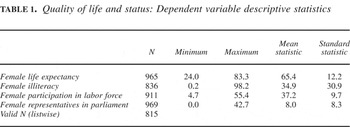
Quality of life and status: Dependent variable descriptive statistics
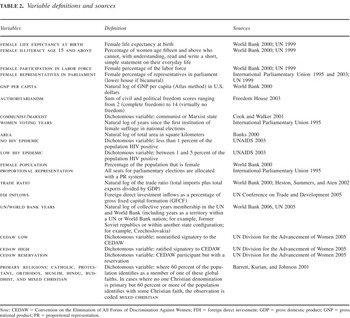
Variable definitions and sources
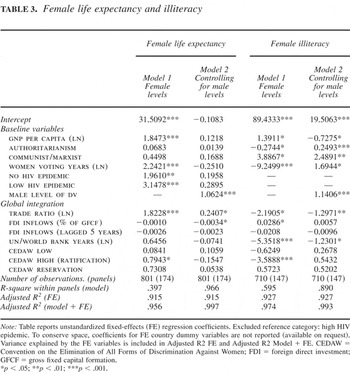
Female life expectancy and illiteracy
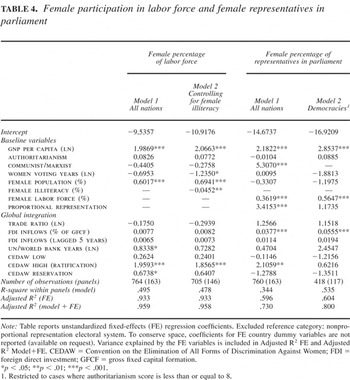
Female participation in labor force and female representatives in parliament
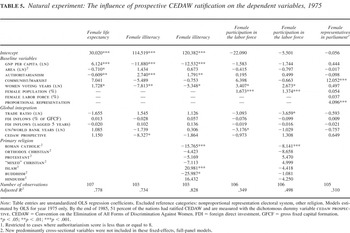
Natural experiment: The influence of prospective CEDAW ratification on the dependent variables, 1975
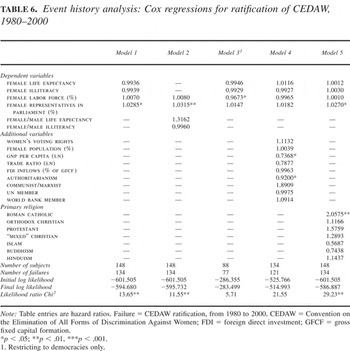
Event history analysis: Cox regressions for ratification of CEDAW, 1980–2000
 You have
Access
- 125
- Cited by