1. Introduction
The concept of institutional complementarities has been widely used by political economists to explain the persistence of cross-national institutional variations over time. The concept has been criticized, however, on the grounds that it offers too rigid a conceptualization of the socio-economic system, and therefore cannot explain change (e.g. Blyth, Reference Blyth2003; Hay, Reference Hay and Coates2005; Howell, Reference Howell2003). In response, scholars have demonstrated that institutional complementarity does not preclude change and under certain circumstances is capable of explaining it (Amable, Reference Amable2016; Aoki, Reference Aoki2001; Crouch, Reference Crouch2005; Crouch and Farrell, Reference Crouch and Farrell2004; Deeg and Jackson, Reference Deeg and Jackson2007; Streeck, Reference Streeck2005). However, even among those who regard the concept as essential for understanding the dynamics of national political economic systems, open questions remain regarding the mechanisms by which complementarities interact with the political aspects of institutional change.
The debate over the role of complementarities versus power is particularly intense among students of social welfare regimes. Esping-Andersen and Korpi, for example, claim that the expansion or retrenchment of welfare regimes is based on the relative bargaining power of workers vis-à-vis employers (Esping-Andersen, Reference Esping-Andersen1990; Korpi, Reference Korpi2006). Others suggest that inter-class alliances drive the formation and change of social welfare institutions. Those alliances are shaped by institutional complementarity between the production regime and the social welfare regime (Estevez-Abe et al., Reference Estevez-Abe, Iversen, Soskice, Hall and Soskice2001; Iversen, Reference Iversen2005; Kapstein and Milanović, Reference Kapstein and Milanović2003; Kathleen, Reference Kathleen, Hall and Soskice2001; Mares, Reference Mares2003; Pierson, Reference Pierson and Pierson2001; Swenson, Reference Swenson2002). This line of research is reinforced by theoretical and historical studies that explore how social welfare, and especially unemployment insurance, is causally linked to labor productivity and economic openness (Acemoglu and Shimer, Reference Acemoglu and Shimer2000; Hiscox, Reference Hiscox2001; Rodrik, Reference Rodrik1998).
Until now, the debate on the role of complementarities in shaping welfare regimes has cited this mechanism to explain the persistence of institutional structures. It is argued that actors resist change, given the advantages they gain by maintaining existent institutions. This article examines the hypothesis that under certain conditions when institutional incoherence prevails, actors will advocate institutional change in the belief that changing one institution (e.g. the welfare regime) will create a positive spillover that benefits the performance of another (e.g. the production regime). In other words, when actors attribute policy problems to the lack of complementarity, they will advocate institutional changes based on their expectations of complementarity.
This mechanism of change, as we shall argue below, can explain the historical enigma of social protection expansion in late-developing open economies. Studies have shown that in late-developing and emerging economies, the expansion of social protection coincides with labor force liberalization and liberalization of trade (Boyer, Reference Boyer2014; Chan, Reference Chan2008; Kwon and Holliday, Reference Kwon and Holliday2007). It seems unlikely that the coupling of the two processes can be explained by class-oriented political economic theory because if strong labor organizations have the capacity to promote welfare, they are likely to resist liberalization. We argue that the concept of actors' expectations of complementarity can shed light on this puzzle by explaining how liberalization incites social protection expansion, through the formation of inter-class coalitions and the emergence of inter-industry conflicts.
To test this hypothesis, the article examines the enactment of unemployment insurance (UI) law in Israel. This law was adopted in 1972 after more than two decades of employing a combination of full employment policy and relief work programs. Here we will explore the idea that the process was driven more by the actors’ perceptions of the complementarity between UI and liberalization strategy than by the demand of workers for more social protection. Israel was chosen as a case study because despite being a late-developing country, it has been exposed to European policies and social welfare practices. Thus it would be expected to embrace UI, which was widespread in Europe. Moreover, during the period in question, the Israeli Labor party was a dominant actor in the political economy. Therefore, given the fulfillment of those scope conditions, one would expect the Israeli case to validate the inter-class power-oriented theory of welfare regimes. This article will demonstrate that despite favorable scope conditions, the historical evidence provides a firm basis for rejecting the “equivalency premise” (Swenson, Reference Swenson2002) that sits at the core of the power resource theory of welfare (Korpi, Reference Korpi2006).
2. A theory of welfare expansion in late-developing open economies
The economics of inter-class coalitions
There is little doubt, argues Esping-Andersen, that “left-party power is decisive for de-commodification, full employment efforts, and general social democratization” (Esping-Andersen, Reference Esping-Andersen1990: 137–138). Therefore, he concludes, “parliamentary class-mobilization is a means for the realization of the socialist ideals of equality, justice, freedom and solidarity” (Esping-Andersen, Reference Esping-Andersen1990: 12). More recently, Walter Korpi formulated the power resource theory (PRT), according to which the welfare regime reflects the current “class-related distributive conflict and partisan politics” (Korpi, Reference Korpi2006: 168). Among scholars of welfare regimes, the PRT is considered the “most successful theory explaining why similar industrialized market economies have developed such varying systems for social protection” (Rothstein et al., Reference Rothstein, Samanni and Teorell2012: 1).
The popularity of the PRT has also turned it into a paradigmatic reference point for those who contested it. Karl Polanyi was among the first scholars to challenge the equivalency premise, arguing that “mere class interest cannot offer … a satisfactory explanation for any long-run social process” (Polanyi, Reference Polanyi2001: 160). In recent years, a growing number of scholars challenged the PRT on the ground that the conflict between workers and employers is not “etched in stone” (Pierson, Reference Pierson and Pierson2001: 7) and that “capitalists and workers sometimes agree, and sometimes do not agree, about egalitarian policies” (Swenson, Reference Swenson2002: 11–12). Therefore, Swenson leveled criticism against the PRT on the ground that it posits “a practical equivalence of interests among like classes in different countries, and equivalence of conflict across their respective class divide” (Swenson, Reference Swenson2002: 8).Footnote 1 Critics of the equivalency premise do not offer an alternative general theory of welfare politics, but they emphasize that “who wins and who loses from these [welfare] policies varies not only across countries but also over time” (Kapstein and Milanović, Reference Kapstein and Milanović2003: 1). The PRT approach is challenged on the ground that it makes too strong an assumption regarding labor force homogeneity of interests and the role of intra-class coalitions (solidarity). Contrary to this assumption, alternative approaches underline intra-class tensions and inter-class alliances as mechanisms of social change (Nijhuis, Reference Nijhuis2009). There is also a growing recognition that state actors have the capacity to shape social conflicts rather than merely respond to them (Martin and Thelen, Reference Martin and Thelen2007; Pierson, Reference Pierson and Pierson2001: 5).
This article focuses on the politics of welfare in late-developing open economies. Countries of this type experience strong external pressure to liberalize the economy, enhance labor productivity and boost their external competitiveness. Economists Acemoglu and Shimer argue that under certain conditions the introduction of UI will have a positive impact on labor productivity because, without it, workers are likely to take “low-productivity jobs that are easier to obtain” (Acemoglu and Shimer, Reference Acemoglu and Shimer2000: 1196). Estevez-Abe, Iversen, and Soskice further argue that skill formation is critical not only for employers but also for the state, which seeks to improve the national competitive (Estevez-Abe et al., Reference Estevez-Abe, Iversen, Soskice, Hall and Soskice2001: 146).
The link between trade and welfare is also addressed by Dani Rodrik, who finds that open economies, which are exposed to global markets, are characterized by a high level of public expenditure. Rodrik explains this correlation by the argument that “societies seem to demand (and receive) a larger government sector as the price for accepting larger doses of external risk” (Rodrik, Reference Rodrik1998: 2). The theory of Open Economy Politics (Hiscox, Reference Hiscox2001) predicts that in economies where factors of production are specific to industries, the costs (and benefits) of economic openness will not be distributed evenly among all sectors, and therefore inter-industry conflict is likely to overshadow the conflict between workers and employers. For example, if the labor force is split between skilled and unskilled workers, an inter-class conflict between low- and high-skilled workers is likely to arise in respect to liberalization.
This economic analysis has decisive implications for the political economy of welfare in late-developing open economies. Whereas the PRT predicts that a strong labor organization would give rise to a more generous social welfare regime irrespective of changes of the production regime, the principle of institutional complementarities predicts that a liberalization process is likely to be correlated with social welfare expansion. The mechanisms linking the two processes, however, are yet to be discussed.
Complementarities and change
The conventional concept of institutional complementarity is based on the idea that “national systems possess an overall internal congruence” (Crouch and Farrell, Reference Crouch and Farrell2004: 32–33), which implies that “one institution functions all the better because some other particular institutions or forms of organization are present” (Amable, Reference Amable2000: 647). This definition implies that complementarities refer to material, measurable and quantifiable interactions between institutional domains (e.g. Hall and Gingerich, Reference Hall and Gingerich2004; Hall and Soskice Reference Hall and Soskice2001; see also Deeg and Jackson, Reference Deeg and Jackson2007: 165), and that actors shape their interests in keeping with those measurable and quantifiable relationships. When the existing institutional structure serves their goals, they resist change. Complementarities thus contribute to the stability of national economic systems by “increasing the value of that institution to actors” (Deeg and Jackson, Reference Deeg and Jackson2007: 167).
If the existence of complementarities contributes to stability, the logical question is whether the lack of complementarity – due to institutional failure or incoherence – can explain change. The answer to this question is not straightforward. Institutional incoherence is a situation in which institutional elements “give contradictory signals to agents” (Crouch and Farrell, Reference Crouch and Farrell2004: 32–33), or the institution consists of “conflicting and even contradictory logics” (Streeck and Thelen, Reference Streeck, Thelen, Streeck and Thelen2005: 20). This situation results in poor macroeconomic performance and therefore creates a pressure for change (Amable, Reference Amable2016: 93). The question is whether this pressure moves the system chaotically or in the direction of new forms of complementarities.
Scholars who study complementarities share the view that transition from one institutional equilibrium to another must involve creative processes of social learning, problem solving or experimentation (Deeg and Jackson, Reference Deeg and Jackson2007: 164; Streeck, Reference Streeck2005: 364). Aoki offers a particularly detailed conceptualization of those processes (Aoki, Reference Aoki2001, Reference Aoki2007).
Aoki defines an institution as “a shared system of beliefs” about the rules of the game. Contrary to the more conventional materialistic definition, he defines complementarity as a situation in which agents’ “choices are parametrically affected by prevailing rules of action choices (institutions) in other domains.” Therefore, “interdependencies of institutions across domains” are likely to arise (Aoki, Reference Aoki2001: 208). Amid an exogenous shock or an internal crisis, agents question the relevancy as well as the utility of their own “subjective game models” and the system enters a “general cognitive disequilibrium” (Aoki, Reference Aoki2001: 239–240). In this condition, actors engage in social learning, problem solving and experimentation.
Drawing on this notion of complementarity, we argue that at times of institutional failures, actors’ problem-solving activity is guided by their perceptions of complementarity. This mechanism implies that if actors operating in one institutional domain believe that an institutional change in a neighboring domain could increase their payoffs, they use their resources to trigger a change in the neighboring domain or mobilize actors with specific resources in the neighboring domain. The end result is a parallel change in the two institutional domains.Footnote 2
This conceptualization can explain how an institutional change in the production regime – liberalization – can trigger a change in the welfare regime – social protection expansion. If actors who are expected to benefit from liberalization believe that a more generous welfare system would improve the performance of the liberalized economy, they will use their resources to trigger social welfare expansion and/or mobilize other actors for the same purpose.
The political economy of complementarity
However, actors’ beliefs and perceptions are not sufficient to explain change. An institutional change requires the consolidation of political coalitions.
The first generation of comparative capitalism literature highlighted the microeconomic factors and the performance of the institutional system (see Nölke, Reference Nölke2016: 145). More recent studies complemented this approach by demonstrating the political aspects of institutional change and continuity (Amable, Reference Amable2016; Hall and Thelen, Reference Hall and Thelen2009: 20).
To analyze the interaction between economic institutions and political factors, it is convenient to distinguish between two levels of political analysis: the level of the social groups and the level of political actors (Amable, Reference Amable2016). Social groups consist of unorganized aggregations of individuals, and, through the democratic political system, they can construct a social bloc. The social bloc can either stabilize a regime or push for a change. In both cases, the social bloc has a preference for certain types of complementarities. From the perspective of social groups, “two institutions are complementary when their joint presence reinforces the group or protect their interests” (Amable, Reference Amable2016: 94), and therefore they are likely to support them.
Political actors are organized entities that use their resources to promote specific interests, objectives or ideologies. Political actors include political parties, whose power and purpose are shaped by the dominant social groups they represent (Amable, Reference Amable2016: 95). However, there are also non-partisan political actors such as state actors (government ministries), labor unions, and private businesses. As the interests of political actors are more centralized, they can form coalitions on the basis of overlapping interests or political economic exchange.
An analysis of institutional change, therefore, must trace the process at three levels: the institutional, the social, and the political. Whereas the basic premise of the PRT is that change must originate at the social level, when the interests or resources of social groups change, our approach suggests that change can originate at any of the three levels. The more interesting scenario for our purposes is when a shock or crisis at the institutional level triggers a process that ends up in a political and/or social change.
The contribution of the complementarity approach is that it conceptualizes those processes of change, which cannot be explained by the PRT alone. In those cases, the existence of complementarity gives rise to new patterns of political coalitions and social blocs. Hence, as Amable reminds us, the resulting coalitions are “historically specific” rather than following general and universal patterns (Amable, Reference Amable2016: 95). It is the task of historical research to trace how new patterns of complementarities give rise to new types of coalitions in different historical contexts.
3. The case of Israel
Israel serves as a useful case study for examining institutional complementarity as a mechanism of change. Israel lagged behind other parts of the world in embracing UI. In the 1950s and 1960s, the Israeli government introduced relief work programs to fight unemployment. The welfare regime in this period was defined as “clientelistic” (Gal, Reference Gal2010) or “residual” (Rosenhek, Reference Rosenhek2002), implying a low level of social protection. During the austerity period – often referred to as the recession policy – from 1965 to 1967, the government began granting benefits in response to high levels of unemployment even before it became a matter of law. In 1969, the Ministry of Labor and Ministry of Finance reached an agreement on the passage of a UI law, followed by the appointment of a committee whose recommendations were approved by the Knesset – the Israeli parliament – in 1972.
The question we will discuss below is whether the displacement of relief work programs by UI was driven by inter-class conflict, as predicted by the PRT, or by the actors’ perceptions of complementarity and conflict between high- and low-skilled workers, as the alternative theory predicts.
Some researchers have offered explanations for the enactment of the UI law that are consistent with the PRT. Haim Barkai (Reference Barkai1998) and Menahem Hoffnung (2006) attribute the UI legislation to the success of the Black Panthers, the social movement of Mizrahi Jews that sparked public awareness of social divisions. Using a similar line of argument, Michael Shalev argues that the social upheaval of the time threatened the legitimacy of the political regime: “At stake was not only the political survival of the ruling Labor Party but also the state's ability to legitimate Zionism's ‘melting pot’ rhetoric” (Shalev, Reference Shalev, Mau and Veghte2007: 204).
Without dismissing the crucial impact of the Black Panthers on Israel's political economy, our view is that they are not behind the enactment of UI. First, there is the matter of timing: the Black Panthers movement burst onto the scene in January 1971 (Hoffnung, Reference Hoffnung2006: 27). The Knesset approved the UI law in March 1972, but the report of the commission, which formulated the law, was submitted in 1970 and discussed by the Knesset Labor Committee that same year.
More generally, public demand for change cannot explain why the government responds in one particular way and not another. As will be shown below, many of the workers who protested during the recession period – 1965 to 1967 – demanded a return to full employment over UI. Any explanation of the enactment of UI must thus address why UI was preferred. As Crouch and Farrell put it, to explain a change of practices, one has to show “how ‘one-best-way’ solutions become established” (Crouch and Farrell, Reference Crouch and Farrell2004: 35).
Another angle is offered by Michal Koreh, who writes that after the Six-Day War the Ministry of Finance advocated the introduction of social insurance to finance Israel's growing defense budget (Koreh, Reference Koreh2015, Reference Koreh2017). The merit of Koreh's argument lies in identifying the state's interest in expanding social security. It also highlights the central role of the Ministry of Finance as an essential veto player: the approval of the ministry was necessary for the enactment of the UI law. However, as shown below, the Ministry of Finance became an active actor in promoting the UI law only in August 1969, after the Minister of Labor, Yosef Almogi, presented his new plan for social insurance, including UI.
A full explanation of the path to UI, we argue, must trace the long-term process that made UI a legitimate, rational, and appropriate solution to different types of policy problems. Employing the notion of actors’ perception of complementarity, we argue that amid the external shock of the creation of the European Economic Community (EEC), the Israeli political economy entered a period of cognitive disequilibrium and transition. Certain actors – primarily state actors – believed that the EEC created new threats and opportunities that increased the costs of the full employment policy as well as the expected benefit from export-led liberalization. Soon those policy entrepreneurs became aware of the inconsistency between the new growth strategy and the old welfare practices of relief work programs. Throughout the decade, a growing number of actors, which had an interest in export-led liberalization, opted to substitute the relief work programs with UI on the basis of their perceptions of complementarities between liberalization and UI.
Gradually, the “old” coalition supporting the mix of full employment and relief work – which included the center-left parties, the labor union, the Ministry of Labor, and the Ministry of Finance – disintegrated, and a “new” coalition, supporting the policy mix of export-led liberalization and UI, was formed. Historical findings show that the leaders of the new coalition included the right-wing liberal parties and the governor of the Bank of Israel, who were also active in pushing for liberalization. This article documents the period of transition, during which the center-left parties and the social democratic parties shifted rightward, and the ideological gap with the right-wing liberal parties practically disappeared. Also, academic economists and social welfare experts played a role in legitimizing the UI as a more market-compatible welfare instrument.
The rightward shift of the political system, has been accompanied by a social change. During the 1960s, the socio-economic disparities between low-skilled and high-skilled workers deepened, and therefore inter-industry cleavages became more dominant than inter-class conflicts. This process has partly been the result of an overall rise in the standard of living but mainly the result of liberalization. Hence, export-led liberalization triggered a feedback effect in which growing socio-economic disparities and the rise of the Israeli middle class provided further political support to this process, as well as to the substitution of relief work programs with UI.
Therefore, we conclude that those processes cannot be explained on the basis of the PRT, which assumes that institutional changes are triggered by a change in the balance of power between workers and employers. Rather, it was the actors’ perceptions of complementarity, triggering an institutional change, that created a socio-political feedback effect.
4. Methodology
The analysis below traces the transition from relief work to UI on three levels. First, we drew up an accounting of the actors’ perceptions of complementarity between UI and export-led liberalization from the early 1950s to 1972. The actors in question were the Ministry of Finance, the Ministry of Labor, the Bank of Israel, the private sector, and the Histadrut labor union. Based on detailed and extensive archival research, we tracked down the positions of each actor regarding the anticipated impact of UI on government economic objectives. Primary sources consisted of the minutes of the Labor Movement Economic Council and other documents from the Labor Movement archive (28 files from 1953 to 1972), minutes of the Labor Committee of the Knesset (8 files, 1971–1972), minutes of the Economic Ministerial Committee (12 files, 1964), the Labor Ministry's journal, Labor and Social Security (1954–1969), and newspaper coverage.Footnote 3
The second level of analysis studied the political aspect of transition from relief works to UI. First, we traced the positions of political parties on full employment, export-led liberalization, and UI from the early 1950s to 1972. Parties were categorized in four groups: right-wing liberal parties,Footnote 4 center-left parties,Footnote 5 left-wing social democratic parties,Footnote 6 and left-wing communist parties.Footnote 7 On this level of analysis, we surveyed the protocols of the Israeli parliament, the Knesset, searching for evidence of parliamentary activity related to UI.
Finally, we analyzed the impact of export-led liberalization and the austerity policy on the structure of the labor force. Using firsthand and secondary sources, we were able to show that export-led liberalization deepened inter-industry cleavages that were manifested in growing inter-industry wage gaps, and increased the risk of unemployment for low-skilled workers. The data, we argue, support the hypothesis that the transition to the policy mix of liberalization plus UI benefited high-skilled workers.
5. Unemployment insurance and export-led liberalization
From 1953 and until the end of the 1950s, the government of Israel implemented a full employment policy which consisted of expansionary fiscal and monetary policies, intervention in the allocation of credit (financial repression), and a controlled labor market in which labor force allocation and wages were partly controlled by the state (Krampf, Reference Krampf2018; Levi-Faur, Reference Levi-Faur2001; Shalev, Reference Shalev1992). The government's intervention in the labor market also included on-the-job training programs and relief work programs (Doron and Kramer, Reference Doron and Kramer1992; Gal, Reference Gal1997; Rosenhek, Reference Rosenhek2002). Although social security was minimal, workers were protected from market forces through the government's full employment policy, and therefore the demand for social protection was low (Krampf, Reference Krampf2013).
A trigger for change in Israel's macroeconomic strategy was the creation of the EEC in 1958 (Krampf, Reference Krampf2015, Reference Krampf2010; Mandelkern, Reference Mandelkern2016; Navon, Reference Navon2016). As European countries were Israel's key trade partners,Footnote 8 Israeli policymakers perceived the EEC as a protectionist organization that would detrimentally impact on Israeli exports (Rom, Reference Rom1964) and therefore constituted a threat to its strategic interests (Lifschiz, Reference Lifschiz1959). The government responded in three complementary ways. It initiated a diplomatic campaign aimed at persuading the EEC countries to accept Israel as a member or alternatively to grant it a special status (Pardo, Reference Pardo2013). Second, it unleashed a set of measures to liberalize the economy so as to be able to join the GATT agreement, which it actually joined in December 1961 (Greenberg, Reference Greenberg2011: 212). Third, it took measures to boost Israel's external competitiveness by liberalizing the labor force and increasing economic exposure to international competition.
In October 1964, the Ministry of Finance prepared an austerity plan aimed at encouraging export. Pinhas Sapir, the Minister of Finance, explained that “export is becoming more difficult” and something must be done (MEC, 1964c: 27). The governor of the Bank of Israel, David Horowitz, supported this approach, arguing that the economy suffered from “over-employment, over-investment and over-consumption, which decreases export” (MEC, 1964a: 7). The austerity plan was presented as a “necessary condition for the advancement and maintenance of export” (MEC, 1964b: 41). The prime minister also supported the austerity policy as vital for the export industry (Greenwald Reference Greenwald1972; Shalev, Reference Shalev1992).
The change in Israel's macroeconomic strategy in the 1960s is well documented in the literature. The key question here is the extent to which this change shaped actors’ perception of the respective effectiveness of work relief programs and UI. We argue that liberalization created a “cognitive disequilibrium” (Aoki, Reference Aoki2001: 240) due to inconsistency between the liberalization strategy and the relief work programs.
In the early 1960s Giora Yoseftal, who served as Minister of Labor in 1960–1961, declared that the government was shifting from “full employment” to “full natural employment” as well as curtailing relief work benefits in order to “fully exhaust the employment capacity of the natural economy” (Yoseftal, Reference Yoseftal1960: 4). Yigal Allon, who entered office in 1962, stated that “factories are not expected to employ more workers than needed for the proper performance [of the business]” (Allon, Reference Allon1962: 17). It is essential, he explained, to “relieve businesses of redundant workers and allow other businesses to hire them” (Allon, Reference Allon1962: 17).
In the spring of 1966, after the enactment of the austerity policy, Sapir and Allon established an Inter-ministerial Committee on Labor Mobility, one of the purposes of which was “enabling workers to shift to export industries” (Summary and Recommendation, 1966). The committee report stated that “universal” – state-level – pension fund and health insurance were prerequisites for labor mobility in order to safeguard workers’ social rights when changing jobs. The report also recommended establishing a loans fund for workers seeking to switch jobs (Mobility, 1967).
This labor mobility report, to our knowledge, was the first official document prepared by the Israeli authorities to acknowledge a causal link between social insurance and labor mobility. However, the idea itself was not new. Back in 1962, David Horowitz, the governor of the Bank of Israel, pointed out that relief work programs “tend to become dangerously unproductive.” He therefore recommended creating “a reservoir of unemployed [workers] whose subsistence is ensured, so the economy would have room for maneuver in order to increase productivity” (quoted from Doron and Kramer, Reference Doron and Kramer1992: 130). Horowitz also stated that the success of the austerity policy depended on the enactment of UI law. “If we want to implement recession policy … we need leeway.” Unemployment insurance “will provide the economic policy with the necessary leeway” (Davar, Reference Davar1966).
Horowitz was among the actors who publicly acknowledged the complementarity of UI and a liberalized labor force. In the early 1960s, however, this was a minority view. In contrast to Horowitz, Yigal Allon, the Minister of Labor (1962–1968) was among the fiercer opponents of UI, insisting that the government should provide employment. Allon envisaged relief work “as a kind of unemployment insurance in the special conditions of the country” (Allon, Reference Allon1962: 4), as it enabled the government to regulate the labor force and move workers from “services” to “productive industries” (Allon, Reference Allon1963: 84). Therefore, Allon's opposition to UI was coupled by a demand for full employment. “We must adopt natural full employment [policy],” he told the Labor Movement Economic Council, a forum that included key government members and the Histadrut management (LMEC, 1967: 11).
In 1966, facing growing public pressure to address the issue of unemployment, the Minister of Finance presented his Three-year Plan: 1967–1969. Israel's “two major economic problems are the import/export gap and unemployment,” he wrote (Economic Council Secretariat, 1966). The plan sought to reduce joblessness by adopting an export-led development strategy. Even if successful, however, the adjustment period would have been long and the social costs high. Therefore, the Three-year Plan, we argue, was an expression of the cognitive disequilibrium, as it tried to combine the “old” idea of full employment and the “new” idea of export-led liberalization. The plan thus failed to provide a solution for the short term, and the public continued to press for social measures to alleviate unemployment. In response, Allon, with the backing of Sapir, established a committee to study the issues and draw up a proposed bill of guaranteeing employment and insurance against unemployment. The committee was headed by Moshe Bar'am of Mapai.
Archival documents show that the committee members and invited experts were deeply divided on the subject of UI legislation.Footnote 9 Supporters of UI included Aharon Efrat of Mapam, who headed the Histadrut's Social Protection Department; Ruth Klinov, an economist at the Hebrew University; Yisrael Katz, dean of the Hebrew University Social Work Department; and the governor of the Bank of Israel. Opponents argued that the government should provide jobs and only grant unemployment benefits as a last resort, as a public service and not insurance. This group included Berl Reptor, head of the Histadrut Employment Office and a member of Ahdut Ha'avoda (Party Bureau, 1968), the Coordinating Bureau of Economic Organizations, which represented the employers,Footnote 10 and Moshe Bar'am, the committee chair. The committee report supported the opponents, and confirmed that it was “the state's responsibility to guarantee employment and prevent unemployment.” However, when the state was unable to provide jobs or relief work, it was obligated to pay unemployment benefits (Bar'am, Reference Bar'am1968).
The debate among the committee members illuminates a critical fact, namely, the perceptions of actors regarding the link between UI and full employment. Hypothetically, UI could have been adopted together with full employment. In the specific historical context discussed here, opponents of UI were concerned that supporting the law implied reneging on the state commitment to provide jobs. Therefore, the left-wing parties opposed the legislation.
The recommendations of the Bar'am committee were not adopted by the government, most likely due to the opposition of the ministry of finance and the prime minister, which were concerned by the cost of UI.
In March 1969, following the death of Levi Eshkol, Prime Minister Yosef Almogi of Mapai was appointed Minister of Labor. In a meeting of the Labor Movement Economic Council, he unveiled a new “social protection package,” which included a state-level pension fund, a state-level health fund, and universal and compulsory UI. He claimed that UI would make it possible to “lower [production] costs and achieve higher labor mobility … If the workers know … there is a fund which all workers can join … it will eliminate the fear and increase labor mobility” (LMEC, June 11, 1969).”
In August, the Ministry of Finance and the National Insurance Institute exchanged letters on the subject of state-level social insurance (Koreh, Reference Koreh2017: 7). By that time, the economy had bounced back from the recession for exogenous reasons associated with the occupation of the West Bank. Under these circumstances, the creation of a UI fund was expected to soak up purchasing power from the public (Raphael, Reference Raphael1969).
The support of the Labor and Finance ministries was the clincher. In March 1970, Almogi appointed a new committee on UI, this time headed by an academic, rather than a politician or bureaucrat as in previous years. Within less than six months, the committee handed in its report, recommending the enactment of UI “as insurance rather than a service.” It was proposed that UI be funded by both the workers and employers, that the fund's reserves be loaned to the government, and that unemployment benefits be proportionate to the wages (Bar-Yosef, Reference Bar-Yosef1970).
Throughout the 1960s, as we have shown, state actors justified their support of UI on the grounds that the prevailing policy instrument – relief work programs – was inconsistent with the government aim of increasing labor mobility, productivity, and the external competitiveness of the economy, whereas UI would be effective in this regard. Moreover, opposition to UI was not justified by liberal arguments, but by social democratic concerns: opponents argued that such legislation would undermine the government commitment to full employment, which was in the best interest of the workers.
A survey of key indicators suggests that the government strategy was quite successful in terms of industrial export and labor productivity. During the period from 1961 to 1972, the volume of industrial export grew at an annual average rate of 15.9%, more than 6% above the average annual GDP growth rate. The volume of agricultural export grew at an annual average rate of 6.8%, 3% below the annual GDP growth rate.Footnote 11 During the same period, labor productivity grew at an annual average rate of 6.3% (Bergman and Marom, Reference Bergman and Marom1998). This period of rapid expansion of industrial export and productivity increase terminated in 1973, with the outbreak of the Yom Kippur war.Footnote 12 Two factors can explain this change. First, after the war, Israel received massive financial aid from the US, which relieved the pressure to increase external competitiveness. Second, in the first half of the 1970s the number of Palestinian workers entering Israel from the West Bank and the Gaza Strip grew significantly, providing Israeli employers with cheap labor (Semyonov and Lewin-Epstein, Reference Semyonov and Lewin-Epstein1987).
5. Party politics
Actors’ perceptions of complementarity may explain their motivation but not their capacity to induce change. Formal legislation in democratic regimes requires the consolidation of party coalitions. Here we look at the views of the political parties on UI, full employment and export-led liberalization from the 1950s to 1972.
The policy mix of full employment and relief work programs during the 1950s was the result of solid consensus in the center-left political bloc, which consisted of Mapai and Ahdut Ha'avoda–Poalei Zion (henceforth, Ahdut Ha'avoda). In 1953, the center-left parties opposed UI and advocated relief work programs. This position was challenged by the left wing – Maki and Mapam – as well as the liberal right, represented by Herut. These parties submitted proposals and motions in the Knesset pushing for UI, which were rejected by the coalition parties.Footnote 13
In the early 1960s, the center-left bloc experienced a growing internal split between those who advocated export-led liberalization and those who adhered to full employment policies. Levi Eshkol, who served as Minister of Finance (1952–1963), led a rightward shift in economic strategy that was supported by non-partisan actors such as the Bank of Israel and professional economists (Kleiman, Reference Kleiman1981). For a while, Eshkol's market-oriented approach was counter-balanced by Sapir, the Minister of Trade and Industry, and the Histadrut. However, when Ben Gurion resigned in 1963, Eshkol replaced him as prime minister and Sapir took over the Ministry of Finance. From then on, Eshkol and Sapir coordinated their socio-economic positions and led the transition from full employment to export-led liberalization. However, Eshkol and Sapir – both Mapai members – faced opposition from the other center-left party, Ahdut Ha'avoda, led by Yigal Allon, whose socio-economic approach was left of Mapai (Greenberg, Reference Greenberg2011).
In the 1960s, the voice of Mapam, the social democratic party, grew feeble on socio-economic issues. The party did not submit a single bill proposal or motion on UI, whereas Maki and a new communist party, Rakah, submitted three.Footnote 14 In January 1966, Mapam took a bold step, joining the government of Eshkol and Sapir after an absence of four years and supporting its austerity policy. Its leadership justified the decision by the need to fight against religious legislation (Al Hamishmar, 1966). Hence, from the mid-1960s the communist left was marginalized – as before – and the social democratic left prioritized human rights issues over socio-economic.
During this time, liberal right-wing parties became more significant players as an alternative to the center-left than they had been previously. Herut increased its power from 8 seats (out of 120) in 1951 to 17 in 1965. Moreover, in 1965 Herut merged with the Liberal Party to form Gahal – the center-right bloc – and the Independent Liberals. Both Gahal and the Independent Liberals participated in the Eshkol/Sapir austerity government together with Mapam.
In response to the consolidation among the liberal right, Mapai, Ahdut Ha'avoda and Mapam merged in 1969, forming the center-left Alignment bloc – Ha'ma'arach. By that time the difference between the two blocs – Gahal and Ha'ma'arach – on socio-economic policy was marginal and they did not have a problem joining the unity government that enacted the UI law. When Golda Meir presented her government in December 15, 1969, the party promised to legislate nation-level pension, health and unemployment insurance schemes (Al Hamishmar, 1969).
When the UI bill was brought to the Knesset, it was embraced wholeheartedly by Gahal. Yoram Aridor, a member of the party, explained that his camp, the “liberal-national school,” had advocated UI for years, whereas the “conservative-socialist school,” the Labor Party, had opposed it. From his perspective, the enactment of the UI law was a victory for the liberal-national camp (Knesset, March 15, 1971, 7th Knesset, Session 166, p. 1824). Moshe Sneh, a member of the Communist Party, Maki, supported the bill but portrayed it as “liberal-bourgeois.” A true socialist law, he argued, would institutionalize the state's commitment to employment and unemployment benefits, whereas the current law “let the workers insure themselves” and did not align with the “intellectual world of the socialist labor movement” (Knesset, March 15, 1971, 7th Knesset, Session 166, p. 1845).
Tracing the positions of the political parties, we see inconsistency with the PRT on two counts: First, UI was perceived as a substitute to full employment rather than an addition. Therefore, certain actors from the center-left believed that it was in the workers’ interest to return to full employment rather than introducing UI. Second, the UI law was designed as social insurance rather than a service the state was obliged to provide. Both points support our hypothesis that the UI law was not the outcome of the workers’ demand, but rather an initiative of political actors situated at the center-right, who saw it as an efficiency-enhancing institutional element in a liberalized market economy.
6. A new social bloc
There is broad agreement among scholars that during the 1950s and the 1960s the segmentation of the labor force deepened along social, economic, ethnic and geographic lines (Gutwein, Reference Gutwein2017; Shalev, Reference Shalev1992; Svirski and Bernstein, Reference Svirski and Bernstein1980). The literature portrays a split between the low-skilled workers in labor-intensive industries, most of them new immigrants from Arab countries (Mizrahi Jews) living in development towns on the periphery, and the professional and high-skilled workers in highly paid, high-productivity jobs in the private and public sectors, mostly “old-timers” of European origin (Ashkenazi) living in the big cities.
However, studies also show that during the 1950s socio-economic disparities were held relatively narrow by the government's full employment policy, the relief work programs, and wage control. According to Bareli and Cohen, the government and the Histadrut regulated wage levels in the public and private sectors to prevent widening of the socio-economic gaps between high-skilled (professional academic workers) and unskilled workers (Bareli and Cohen, Reference Bareli and Cohen2018: 233). This claim is consistent with Shalev's argument that the full employment policy was successful in the 1950s because the Histadrut helped the government restrain the wage demands of professional and academic workers (Shalev, Reference Shalev1992: 208, 210). An official Histadrut document presented by Svirski and Bernstein (Reference Svirski and Bernstein1980, 14, fn. 1) confirms that the organization took action to prevent wage hikes in the academic sector in the 1950s. Amir Ben Porat argues that in the 1960s, the wage differential between academic and unskilled workers grew due to the “industrialization process” (Ben Porat, Reference Ben Porat1999: 146).
The “suppression” of socio-economic disparities by the government had two implications. First, most workers were dependent on the government and were part of the social bloc that stabilized the political economic regime. Second, workers at the top of the socio-economic structure had an incentive to oppose the government strategy and seek refuge in the right-wing liberal parties.
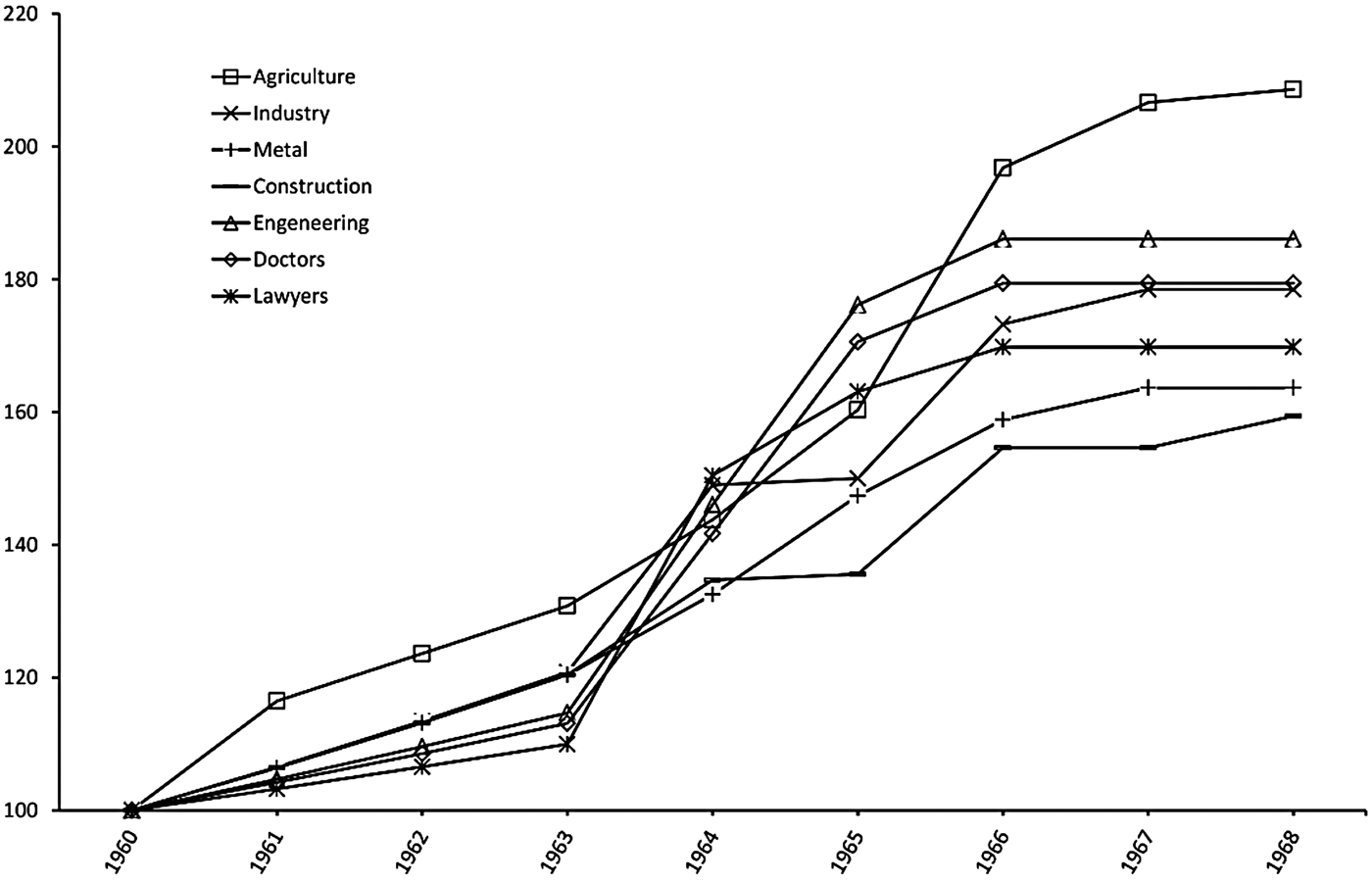
Figure 1 presents the differentials of nominal wages of superior permanent workers in selected industries between 1960 and 1968. Whereas until 1963, the rise of nominal wages in all industries and skill levels was almost identical, from 1964 the wage differential grew. The data confirm the hypothesis that academics – engineers, lawyers and doctors – benefited from the liberalization process much more than the low-skilled workers – construction and metal workers – and that the new policy increased the social disparities.
Nominal wage increase in selected sectors, 1960–1968 (1960 = 100): nominal wages of superior and permanent workers in each industry

The data complement the above analysis by showing that the rightward shift of center-left parties was coupled with the emergence of the middle class, which created a new dominant social bloc. The data also support our claim that the liberalization triggered a political feedback mechanism, in which the process of institutional change, which was driven by actors’ expectations of complementarity, created the political conditions that enabled its continuation and deepening.
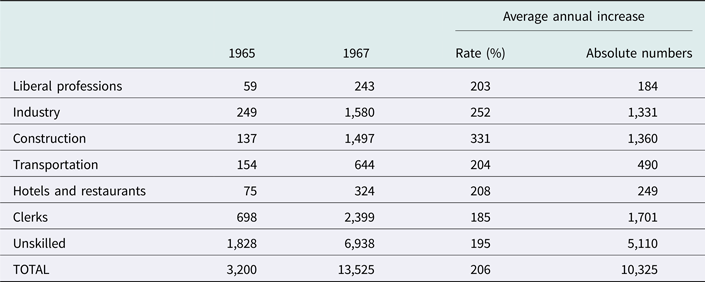
In addition to growing wage gaps, the new policy also affected the exposure of different social groups (high- and low-skilled workers) to the risk of unemployment. Whereas the national average for unemployment in 1967 was 10%, the rate in development towns reached 16 to 20%. Unemployment in the Arab population was even higher.Footnote 15 Moreover, data of monthly registered unemployed by industry between 1965 and 1967 show the number of unemployed among construction workers, in absolute numbers and percentage points. For the unskilled, industrial workers, and clerks, unemployment was not significantly higher than among free professionals, but the difference in absolute numbers is striking (Table 1).
Monthly registered unemployed by industry/skill

Source: Calculated from Central Bureau of Statistics Annual Report, 1969: 279, Table J/21.
The low-skilled workers benefited least from the liberalization policy in terms of wages, and they also paid the highest cost in terms of social protection. Moreover, the expectation, if the government abandoned the full employment policy, was that unskilled workers would not benefit from UI to the same extent as the high-skilled workers. Rather, skilled workers coping with short periods of unemployment would be the beneficiaries.Footnote 16 Therefore, we argue that low-skilled workers had a very good reason to resist change and insist on full employment without UI.
This explains why the Histadrut, as the representative of the workers, was split over the issue of UI. Aharon Efrat of Mapam, who headed the Histadrut Social Security Department, was among the most active supporters of UI, whereas Berl Reptor of Ahdut Ha'avoda, who headed the Histadrut Employment Office, opposed it. Reptor informed the Histadrut special advisory committee on UI that Mapai had conducted a survey among the Workers’ Councils – the local branches of the Histadrut – and most were against such legislation: “The public says ‘I want a job, and if there are no jobs, I want relief work – not charity [lechem chesed]’” (Histadrut, 1967: 3). Reptor argued that UI would push thousands of unskilled workers out of the workforce. People who are borderline welfare cases need training, not UI, he contended (Histadrut, 1969: 9).
Reptor's rationale for rejecting UI, as we see here, had a solid socio-economic basis. Given the situation prevailing in 1967, there were grounds for assuming that UI would not serve the interests of the working class as a whole, but more likely those of high-skilled workers, who were already beneficiaries of the liberalization policy.
7. Discussion and conclusion
This article sought to establish that actors’ perceptions of complementarity shape institutional change and affect the pattern of coalition formed among political actors and social groups. If this is the case, the PRT alone cannot explain the process of change. The article employed this approach to explain the enactment of the UI law in Israel. We claimed that the enactment of UI in Israel was not the result of the demand of workers for more social protection, as the PRT predicts, but the result of perceptions of dominant actors that UI was consistent with their interest in boosting Israel's exports, its external competitiveness, and labor productivity. Over time, liberalization triggered a political feedback effect, in which high-skilled workers, who benefited from liberalization and were expected to benefit from the UI law, provided a further political support for this change.
One may argue that a simple power-based analysis of the intra-class conflict between high-skilled and low-skilled workers would have been sufficient. Such an argument would signify that the rising middle class – which benefited from the liberalization process and the UI – was the primary actor initiating the process. Such an argument is supported by the fact that right-wing liberal parties have advocated liberalization and UI legislation since the 1950s. However, this power-based argument would have to assume that the middle class was an active actor that was capable of mobilizing political support. The historical findings demonstrate unequivocally that the middle class was a passive rather than an active social group. In other words, the creation of the middle class as an active political actor was the product of the process, and therefore it could not have been its prime mover. Therefore, to explain the rightward shift of the center-left parties, one must find an alternative explanation to the power-based one. The article shows that the notion of actors’ perceptions of complementarity can offer an explanation for this change.
The analysis of the case of Israel can shed light on other cases in which late-developing open economies go through a liberalization process. In such economies, markets are highly regulated for various purposes, and therefore the demand for social protection is lower than in already liberalized economies. When those countries are liberalized due to external factors, they are likely to go through a Polanyi-like double-movement: liberalization coupled with welfare expansion. In this type of country, therefore, the explanatory power of the PRT is likely to be weaker than in liberal, advanced economies.
Author ORCIDs
Arie Krampf, 0000-0001-8725-254X.
Acknowledgement
I would like to thank the editor and the two external readers for their productive comments, to Professors John Gal and Dani Filc for commenting on earlier drafts of the research, and to the discussants and participates at the SASE conference (Kyoto, 2018) and at the Annual Conference of the Israeli Association for Economic History (Herzlia, 2017) for their comments.