

Bond markets have provided the most important part of the international financing for emerging countries since the nineteenth century. The lack of rating and strict regulatory procedures rendered the risk pricing of such assets very complex and many of these sovereign debts ended up in default. The willingness to keep their reputation intact has been presented as one of the main reasons state honour their debtsFootnote 2 along with fear of military intervention (Mitchener and Weidenmier Reference Mitchener and Weidenmier2005), trade sanctions (Rose Reference Rose2005), bondholders' association pressure (Esteves Reference Esteves2007) or supersanctions (Mitchener and Weidenmier Reference Mitchener and Weidenmier2010). Historically, the magnitude of the sanction ranged from the imposed commitment to pledge a given revenue for debt reimbursement to a loss of control of the debtor's fiscal apparatus or, in the most extreme cases, to gunboat diplomacy. This heavy-handed approach could only be conceived for countries from the periphery, and imperialist motives played a major role in these sanctions. However, the ‘entanglements of finance and imperial rivalry’ which ‘were once a staple of the scholarly literature have lately slipped from view’ (Ivanov and Tooze Reference Ivanov and Tooze2011).
Imperialism has mostly been analysed in the framework of colonialism. Ferguson and Schularick (Reference Ferguson and Schularick2006) suggest that belonging to the British Empire allowed colonies to borrow at preferential rates. Accominotti et al. (Reference Accominotti, Flandreau, Rezzik and Zumer2010) show, however, that the ‘benefits’ from belonging to the empire were unequally distributed and in some case were more a burden than anything else. Many countries from the periphery were also subject to forms of imperialism. French lending to the Balkan countries was indeed for a long time conditional on the obtainment of concessions from the borrowing country (Feis Reference Feis1930). Financial support was so important that listing of foreign sovereign debt on the Paris stock exchange was subject to the approval of the French finance and foreign affairs ministers. This double agreement was required because acceptance or refusal could significantly affect the relationship between France and the other country (Boissière Reference Boissiere1925, pp. 173-4). At the turn of the century, the massive presence of Russian loans on the Paris stock exchange reflected the Franco-Russian alliance (Landon-Lane and Oosterlinck Reference Landon-Lane and Oosterlinck2006).
Concessions could take various forms ranging from diplomatic support to preferential trade agreements. To obtain funds, Bulgaria was forced to relinquish part of its fiscal sovereignty by accepting to pledge as collateral some specific streams of revenue. The demands made by bondholders led in turn to political tensions, some parties firmly opposing this loss of sovereignty. Diplomatic relations between France and Bulgaria shaped the latter's ability to tap the French capital market (Ivanov and Tooze Reference Ivanov and Tooze2011).
This article focuses on interwar Romania, a country from the European periphery with strong cultural ties with France and for which geopolitical considerations were likely to play a much more important role than pure economic logic. Cultural proximity and the French desire to maintain its financial prestige facilitated Romania's sovereign borrowing on the Paris stock exchange. To determine the market's perception regarding the importance of diplomatic ties to guarantee reimbursement, returns on Romanian bonds traded in Paris were analysed. If access to capital markets is in part dependant on diplomatic relations and politics, any news showing a closer cooperation between France and Romania could increase the perceived likelihood of reimbursement.Footnote 3 The article is structured as follows. Section I outlines the historical background of Romania during the interwar period. Section II presents data and methodology. Section III discusses our empirical results. Section IV concludes.
I
Interwar Romania is an ideal candidate for the study of foreign sovereign debts. The proximity to France, as well as its economic potential, allowed Romania to collect important amounts of foreign capital during the interwar period. A third of the Romanian public debtFootnote 4 was negotiated in Paris for a total close to 1.02 billion French francs. Even though Romania was characterised by a desperate need for foreign capital due to an archaic organisation of its productive, credit and fiscal systems, bondholders had in fact several reasons (economic, political and probably psychological) to believe that Romania would manage to pay back its debts.
On the economic side, Romania's exports of cereals and oil could lead investors to believe that its debts were sustainable. The postwar ‘international oil fever’ created a particularly attractive situation for Romania. Oil production rose spectacularly during the interwar period, from 968,000 tons in 1918 to 7,770,000 tons in 1934, giving Romania the sixth place among the world's producers (Hitchins Reference Hitchins1994). The importance of this natural resource became obvious at the Paris Peace Conference in 1919 with negotiators taking a particular interest in the oil reserves and oil supply. After 1925 oil was discovered in several parts of the world. Romania's oil exports suffered dramatically from the US overproduction. By the mid 1930s Romania's production largely exceeded its refining capacities, forcing it to sell crude oil on a distressed market (Pearton Reference Pearton1971, pp. 157-8). As a result of the Depression, Romania was forced to impose foreign-exchange restrictions (1932), import controls, a moratorium on its foreign debts (1933) and eventually clearing agreements. The clearing agreement dramatically changed trading patterns, leading to an increase in exchanges with Germany (Pearton Reference Pearton1971, pp. 178-9). Between 1934 and 1938, Germany was the first buyer of Romanian oil with a share of 37 per cent of the exports. This situation not only guaranteed a regular oil supply to Germany but it also tightened the economic relationships between the two countries as almost 27 per cent of the Romanian imports were coming from Germany.
Geopolitical and psychological considerations played a crucial role too. During World War I, Romania had opened a new front against Austria-Hungary. This front provided a relief to the Allies as it diverted part of the Central Powers forces from the other fronts. However, the military campaign proved disastrous as two-thirds of the country soon fell under enemy control. After the war, these actions provided Romania with a strong capital of sympathy in France. Furthermore, Romania used a Latin language, an element which generated closer ties with France. In fact, the French–Romanian trade relationships could hardly be explained by economic considerations (Hoisington Reference Hoisington2009). French imports of Romanian agricultural products were dependant on the harvest in France, while the Romanian oil was competing with American and Middle Eastern oil on the French market. French political and cultural influence was strong enough during the first part of the interwar period to explain Romania's continuous demand for French investments and the financial sacrifices accepted when selling Romanian oil to France.Footnote 5 By the end of the 1930s, however, Germany had managed to have the upper hand.
Romania's geographic location, close to Germany and next to the Soviet Union, rendered the relations with Romania of crucial importance to France. Following World War I, victorious Romania reintegrated Transylvania, Banat, Bukovina and Bessarabia. On the political side, interwar Romania was characterised by acute political instability. In 1925, the heir to the throne, Carol, was forced to renounce his rights following numerous scandals, and his son Michael became king at the age of 6 in July 1927. After a short exile in France, Carol came back to Romania, with the support of the ruling National Peasant Party, to reclaim the throne. He was crowned king under the name Carol II in June 1930. Political troubles remained, with no less than 25 different governments within the decade 1930-40. Fascist and nationalist parties (League of National-Christian Defence (LANC) and the Iron Guard) gained more and more ground. Despite his aversion to these parties, Carol II appointed Octavian Goga from the LANC as prime minister in December 1937. After a short-lived attempt to rule as a dictator, Carol II relinquished power to Armand Călinescu in March 1939, an ally of France and Great Britain and firm opponent of Nazi Germany. Following Călinescu's assassination by members of the Iron Guard, and despite Carol II's attempts to keep Romania neutral, the country shifted towards the Axis. In September 1940, a fascist government took over, forcing Carol II to abdicate, and led the country to officially join the Axis in June 1941.
II
The data were collected from the Cours Authentiques des Agents de Change and consist of monthly prices of Romanian and French government bonds traded on the Paris stock exchange between 31 December 1920 and 31 December 1939.Footnote 6 More specifically, we use the market prices and financial characteristics of two Romanian bonds, the 4 per cent 1905 redeemable consol (rente) and the 4 per cent 1929 (unification) consol, and of one French government bond, the 5 per cent 1920 bond. This choice is motivated by three reasons. First, bonds had to be traded during the entire time period under study. For the Romanian sample, because of conversions and debt unifications, none of the bonds lasted for that long. Therefore, bonds which covered the largest part of this period were chosen. Second, bonds characterised by particular financial features were voluntarily eliminated. Third, we selected bonds with similar financial characteristics but also bonds representative of their respective group of securities. The Romanian 4 per cent bonds provide the same nominal, semi-annual coupon. They have similar maturities (40 years for the 1905 bond and 41 years for the 1929 bond) and both are the result of former debt conversions (the 1905 consol)/unifications (the 4 per cent 1929 consol). They represented, on average, up to one-third of the total market capitalisation of the Romanian bonds negotiated in Paris.Footnote 7 Furthermore, the 4 per cent 1905 consol gave birth to the 4 per cent 1929 rente following the 1928 Paris debt unification agreement. This guarantees the continuity in our sample since both are used. From the sample of French government bonds, the 5 per cent 1920 consol appeared to be the closest, in terms of technical characteristics, to our Romanian bonds: it is a redeemable, semi-annual coupons bond, with a maturity of 60 years. This bond represented a share varying between 10 and 25 per cent of the overall market capitalisation of French sovereign bonds.
The yields to maturity of these bonds (over the period stretching from December 1920 to March 1929 for the 4 per cent 1905 consol and from April 1929 to December 1939 for the 4 per cent 1929 consol) allowed the calculation of the spread with respect to the benchmark (the 5 per cent 1920 bond). For each bond, the data needed for the computation of the yields were collected from the documents provided when the bonds were issued.
Many studies have attempted to determine which events, at the time of their occurrence, were perceived as crucial by the financial markets. Capital market data offer significant advantages when one wishes to assess the perceived importance of given events when they happened. Financial markets are known to have a high predictive power and market actors have an incentive to take note of all relevant information since they would be penalised if they did not assess the situation properly (Frey and Waldenström Reference Frey and Waldenström2007). Willard, Guinanne and Rosen (Reference Willard, Guinnane and Rosen1996) analyse structural breaks on greenback gold prices during the US Civil War. This methodology has subsequently been applied to a vast number of wars or conflicts such as World War II (Frey and Waldenström Reference Frey and Waldenström2004; Oosterlinck Reference Oosterlinck2003) or the Israeli–Palestinian conflict (Zussman et al. Reference Zussman, Zussman and Nielsen2008) but also to analyse market anticipations regarding regime change (Flandreau and Oosterlinck Reference Flandreau and Oosterlinck2011).
To determine the events which at the time were perceived as important, we follow the methodology developed by (Bai and Perron Reference Bai and Perron1998, Reference Bai and Perron2003a, Reference Bai and Perron2003b) to detect the number and location of potential structural breaks in time series.
We use the following general model subject to m breaks (m + 1 regimes):

where y t represents the observed, dependent variable, i.e. yields spread, z t (q × 1) is the vector of covariates, u t is the disturbance at time t, δj is the corresponding vector of coefficients and the indices (T 1, …, T m) are the unknown breakpoints. The estimation allows us to detect simultaneously the unknown regression coefficients and the breakpoints on T available observations. This corresponds to a pure structural change model, where all the coefficients may change, with no constraints regarding the variance of the disturbance term, i.e. breaks in the variance are allowed provided they occur at the same dates as those in the parameters of the regression. The algorithm uses the principle of dynamic programming, where the computation of estimates of the breakpoints uses the global minimisers of the sum of squared residuals (Bai and Perron Reference Bai and Perron2003a). More specifically, the different estimators result from applying OLS segment by segment, without constraints among them. The sums of computed squared residuals are stored and the dynamic programming evaluates the partition which achieves a global minimisation of the overall sum of squared residuals. Convergence of the estimation is obtained under a large set of assumptions (precluding variables with autoregressive unit root, however). It allows different distributions both for the regressors and the errors, as potential serial correlation and/or matrix robust heteroscedasticity are taken into consideration and corrected in order to obtain consistent estimators.
The test statistics for multiple potential breaks include a supF test of no structural break, i.e. m = 0, versus m = k breaks, based on the global sum of squared residuals minimisation which is equivalent to maximising an F-test with spherical errors. The asymptotic distribution is dependent on the choice of the trimming parameter ɛ while imposing a minimal length h of a segment, i.e. ɛ = h/T. First, Bai and Perron (Reference Bai and Perron1998) propose two tests, called double maximum tests, of the null hypothesis of no structural break against an unknown number of breaks, UD max and WD maxFootnote 8 and provide critical values for ɛ = 0.05, 0.10, 0.15, 0.20, and 0.25 (with the corresponding maximum number of breaks, i.e. 5, 3 and 2 respectively). Second, Bai and Perron (Reference Bai and Perron1998) also introduce a test for l versus l + 1 breaks, i.e. sup F T (l + 1|l), that is applied to each segment containing observations from T i−1 to T i, i = 1,…, l + 1. The model with l breaks is rejected in favour of a model with l + 1 breaks whenever the overall minimum value of the sum of squared residuals is larger than the sum of squared residuals of the l + 1 breaks model. Again, critical values are provided for different values of the trimming parameterɛ. Finally, the information criteria used to select the dimension of the model are the classical ones, i.e. Bayesian Information Criterion (BIC) and the modified Schwartz criterion (LWZ). However, given certain well-known weaknesses of these two criteria,Footnote 9 Bai and Perron's method suggests using a sequential application of the sup F T (l + 1|l) test using the sequential estimates of the breaks.
We apply this breakpoint detection procedure on the spread between the Romanian and the French government bonds. This spread is a measure of relative credit risk characterising Romanian bonds as all the ‘systematic’/market risk is encapsulated in the French bond yield. The spread therefore captures the Romanian bonds' ‘specific’ risk, sensitive to economic, monetary, political and diplomatic events mainly affecting interwar Romania and its relations with the other European countries, most particularly France.
Once the number and the location of the breaks are identified, we turn back to historical evidence in order to find potential explanations and provide insights into the potential factors that impact upon the Romanian sovereign bonds.
Even though this methodology has been applied in many contexts, it is worth mentioning its positive points and limitations. On the positive side, the use of quantitative contemporaneous data allows the capture of perceptions of actors at the time the events occurred. In this respect, the methodology overcomes a potential ex post bias (where researchers would look for events known ex post to have played an important role). The use of financial data also presents the advantage of reflecting investors' expectations. Indeed, if actors are rational, they trade in function of their expectations regarding the future as any divergence from this approach would lead to expected losses.
Despite these strong points the methodology also reveals some flaws. First of all, financial data only reflect the opinion of the part of the population wealthy enough to invest. Second, and most importantly, the approach may lead to over-interpretation and omission. In the first case, there is the danger of providing an interpretation which is in fact not the cause of the break. Once a breakpoint is econometrically isolated, there may be a strong temptation to try to find an explanation at all costs. The use of the press may mitigate this issue, but one should keep it in mind when interpreting the results. Indeed, many movements on the stock exchange cannot be attributed to a fundamental cause. On the other hand, major events may not appear in the analysis if they coincide with other events leading to opposite price reactions. This would, for example, be the case in wartime if victory in a battle was closely followed by a defeat in another one.
III
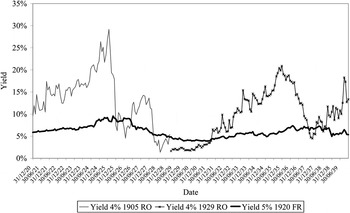
Figure 1 shows the evolution of the yields to maturity of our three bonds. The interwar years are one of the richest periods in terms of political, economic, monetary and financial events. It is therefore almost impossible to be exhaustive when discussing the different events that may help explain the evolution depicted in Figure 1. We therefore focus on what we consider to be the most representative timeline for interwar Romania.
The evolution of the yields to maturity of the 4 per cent 1905 and 4 per cent 1929 Romanian consols with respect to the 5 per cent 1920 French government consol

The devastations produced by World War I induced significant capital needs in Romania. Romania ended the war with vast amounts of different currencies in circulation and rampant inflation (Mouré Reference Mouré and Flandreau2003). One major consequence was an increase in interest rates at the beginning of the 1920s. Romania's position on the international capital markets was made worse by the suppression of commercial foreign private debt services as well as those imposed by the Treasury bills issued between 1918 and 1921. To restart the economy, the country needed a unified currency, the end of inflation and the establishment of a budgetary equilibrium (Pearton Reference Pearton1971, p. 102). The monetary unification was eventually realised in August 1920. It was, however, badly prepared as the required fiscal and monetary policies had not been set into place.Footnote 10
On the political side, Romania was, at the beginning of the 1920s, dominated by the Liberal Party. Promoting a ‘by ourselves’ policy, the Liberals wanted to share as little power as possible with foreign investors and ensure Romanian control of industry and natural resources. To guarantee this control they implemented a system to use public finances for these industries coupled with protectionist policies. These restrictions on foreign capital had a negative impact on the perceived risk of Romanian bonds. Finally, even though the Romanian political system was de jure a parliamentary democracy, de facto, it was a perfect mirror of the Romanian society. The king had extensive powers reinforced by the new constitution of 1923. He was allowed to interpret the laws voted by the parliament through his right to issue regulations. The parliament and the government were intimately linked since the party in power was ‘conducting’ the new elections and usually managed to ensure that it had a comfortable majority.
From an economic perspective, and following the example of other European countries, the Romanian government tried to stabilise money circulation and chose to revaluate the Romanian currency through a deflation process. Two monetary conventions between the finance ministry and the Romanian National Bank were signed in May 1925. These conventions were meant to eventually make the financing of the public deficits by the Bank disappear. A liquidation fund for this debt was created. The functioning of the National Bank was restricted so as to increase its gold reserves and the general money coverage. However, the desired monetary consolidation was never reached: not only was the government unable to supply the liquidation fund, but it also continued to incur new debt financed by the National Bank. The difference from the previous situation was purely technical: instead of issuing Treasury bills, it contracted current account advances. The monetary circulation was not even reduced by the amount of the liquidation fund: the National Bank used these funds to sustain the Romanian currency exchange rate abroad. None of the stated objectives was reached. On the contrary, the continuous price increase contributed to a depreciation of the leu, both internally and externally, and the trade balance recorded high variations over time. Following the estimations of the National Bank of Romania, the depreciation coefficient of the leu was equal to 40.24 in 1925 with respect to 1913 and reached its maximum in 1926, when the Romanian currency depreciated by 42 times compared to its prewar level.Footnote 11
Romania's capacity to borrow abroad was influenced by its position regarding the debts it had to take over following the partition of the Austro-Hungarian Empire. Reaching an agreement with creditors was a protracted process. In June 1923, all successor states, with the exception of Romania, agreed on a repartition of the former Austro-Hungarian debt (Moore and Kaluzny Reference Moore and Kaluzny2005). In November 1925, the first payments were made. Instead of taking a general standpoint, Romania preferred to sign a series of bilateral agreements with its creditors.Footnote 12 On one hand it showed willingness to repay, but on the other hand it restricted payments since a bilateral agreement was needed. This position changed in 1927 when Romania wished to float an international loan. The Banque de France insisted on a general settlement before any negotiation could take place. The need for external finance proved stronger and led to a general agreement and a £38 million loan in 1929 (Moore and Kaluzny 1925).
On the political scene, the prince's relationship with a Jewish mistress led to several scandals. Ion Bratianu, the Romanian prime minister at the time, considered the sensual prince a menace to the country (Boisdron Reference Boisdron2007, p. 35). Prince Carol's renunciation of the throne in December 1925 marked a real turning point. The second half of the 1920s also marked the end of seven years of political rule by the Liberal Party (Boisdron Reference Boisdron2007, p. 26). Pressure from the National Peasant Party became more acute following the death on 20 July 1927 of King Ferdinand, who continuously supported the Liberals' policies, and the death on 27 November 1927 of Ionel Bratianu, the Liberals' leader who insured the party's unity and designed its direction. The Liberal government was accused of unconstitutional practices and the public manifested their dissatisfaction with its authoritarian administration and sectarian economic policies. As a result, Vintila Bratianu, who succeeded his brother as head of the Liberal Party and prime minister, resigned in November 1928Footnote 13 (Sandu Reference Sandu2008, p. 219). After the elections of December 1928 the National Peasant Party won almost 78 per cent of the seats compared to the 6.5 per cent won by the Liberals.
On the diplomatic side, one of the main goals of French diplomacy after World War I was to guarantee France's future security. For the French government the likelihood of a new conflict with Germany would drastically diminish if France could count on Allies surrounding Germany (Girault and Frank Reference Girault and Frank1988, p. 102). French diplomacy relied on a series of alliances with countries that had benefited from the Treaty of Versailles. By the spring of 1921, French diplomacy had concentrated its effort in Central and Eastern Europe by supporting the members of the little Entente (Czechoslovakia, Romania and Yugoslavia) and Poland (Sandu Reference Sandu1995). Romania held a particularly interesting position as French troops under the leadership of General Berthelot had contributed to the restoration of the country in 1918. General Berthelot, viewed as a hero in Romania, expected the country to be a long-term and reliable ally (Girault and Frank Reference Girault and Frank1988, p. 58).
The diplomatic relations between France and the Eastern Allies led to several concrete measures. On the financial side, France lent substantial amounts to the Allies as military expenditure (60 million francs to Czechoslovakia, 400 million to Poland; see Clavert Reference Clavert2004). Alliances were confirmed in a series of conventions and joint military discussions between France, Poland and Romania in April 1924 (Dessberg Reference Dessberg2006). Despite these achievements, Romania was still wary of France's attitude regarding Bessarabia. Bessarabia had been granted to Romania following the Treaty of Versailles. The Soviet Union however, wanted a plebiscite to take place, hoping that the population would favour joining the union. France recognised Romanian rights to Bessarabia in 1924, insisting at the same time that in no way would France intervene in the event of a Russo-Romanian conflict regarding this territory (Dessberg Reference Dessberg2006).
The French recognition of the Soviet Union in October 1924 fuelled fears in Poland and Romania. Both countries worried that France would let them down in the event of a Russian invasion. French diplomats were much more concerned with the discussions with Germany regarding the latter's recognition of its western borders (Dessberg Reference Dessberg2006). These discussions led to the signing of the Treaty of Locarno in October 1925. The Rhineland Pact, in which Germany recognised its borders with Belgium and France and renounced military action against these countries, was key in this treaty (Girault and Frank Reference Girault and Frank1988). In parallel, France signed two additional treaties with Poland and Czechoslovakia to reaffirm its commitment to support them in case of trouble.
By its geographical position and because of its long-standing disagreement with the Soviet Union regarding Bessarabia, Romania was likely to face war. In the spring of 1928, Romania appeared isolated at a time of tension with the Soviet Union (Boureille Reference Boureille2006). Following its recognition of the Soviet Union in 1924, France had shown a reduced interest in its Central and Eastern European alliances. The Treaty of Locarno opened a period of relative appeasement and France focused more on the consequences of the treaty for its common border with Germany than on its relationship with Romania. Even though a treaty with Romania was signed on June 1926, the French foreign minister, Aristide Briand, minimised its scope (Dessberg Reference Dessberg2006). Despite an apparent disaffection with Romanian affairs, French diplomats were still trying to secure their influence in Romania. The negotiations related to the 1929 loan highlight the importance of financial matters in terms of diplomacy. Under the cover of financial help, France and Great Britain were in fact vying to extend their sphere of influence in Romania. The memoirs of the governor of the Banque de France, Emile Moreau, are crystal clear in this respect (Moreau Reference Moreau1954, p. 503): the British were in fact trying to prevent the French from playing any meaningful role in the stabilisation of the leu. For Moreau the French influence in central Europe as a whole was at stake (Moreau Reference Moreau1954, p. 505) and there was a risk of seeing Great Britain replace France's influence in the Little Entente (p. 511). To secure French influence in Romania, the Banque de France engaged in a series of missions near the National Bank of Romania from 1928 to 1933. French ‘money doctors’ were sent to help in the implementation of a sound monetary and financial system in Romania (Mouré Reference Mouré and Flandreau2003; Costache et al., Reference Costache, Torre and Tosi2010).
At the end of August 1928, international diplomacy gave birth to a new treaty. France had negotiated with the USA for the signature of a bilateral pact which would mark the agreement, of each party, to renounce the use of force as a political tool. Uncomfortable with only a bilateral pact, Frank Kellogg, Aristide Briand's US counterpart, suggested broadening the scope of the treaty by transforming the bilateral pact into a multilateral one. On 28 August 1928 the representatives of 15 countries signed the Briand–Kellogg pact which was meant to ‘outlaw war’ (Girault and Frank Reference Girault and Frank1988, p. 151). In this context, Romania's concerns were twofold. On the one hand, it wished to avoid any potential Soviet action in Bessarabia. On the other hand, the government was willing to put an end to the claims of border revisions supported by Hungary and indirectly sustained by Mussolini. Therefore, Romania made its signature of the Briand-Kellogg pact conditional upon the position of the Little Entente members, as was expressed during their conference in Bucharest, in June 1928. Eventually, Romania signed the treaty for the renunciation of war on 4 September 1928.
The Briand–Kellogg pact attracted particular attention in Eastern and Central Europe because it led the Soviet Union to propose a protocol to Poland and Lithuania based on this pact (Miloiu Reference Miloiu2004). By limiting it to only two countries, Moscow was perceived as willing to divide its neighbours. The Polish press even went as far as depicting the proposal as a faked Eastern Locarno. Romania wished to conclude a ‘Central Europe Locarno Treaty’ (Michalopoulos Reference Michalopoulos2011). Eventually, the Soviet Union stressed its willingness to include all countries wishing to join in the protocol. Romania, Poland, Estonia and Latvia finally ratified the protocol in Moscow on 9 February 1929. The Romanian foreign minister, G. G. Mironescu, presented this as an achievement, suggesting that the protocol had given ‘the Kellogg pact a special regional efficiency’, hoping it would evolve in ‘a true Eastern European Locarno’ (Miloiu Reference Miloiu2004, p. 70).
Internal political changes as well as international diplomatic achievements had a positive influence on the evolution of the Romanian bond yields, which experienced a decreasing trend. This favourable evolution was brutally stopped by the onset of the Great Depression. Romania was entirely dependent on exports of raw material to honour its sovereign debt. The dramatic fall in prices of raw material, the sudden and significant interest rate changes and the protectionist measures introduced by creditor countries rendered the Romanian debt unsustainable (Ureche-Rangau Reference Ureche-Rangau2008). The required amount was almost equal to the trade balance excess in 1930 and 1931. After 1932 the trade surplus was insufficient to cover the Romanian public debt annuity, while the ratio of debt service/exports increased from 18 per cent in 1930 to almost 29 per cent in 1932. In addition, the 1931 banking crisis in Central Europe also hit Romania. Bank runs and panic reached their apogee in October 1931 when one of the biggest Romanian private banks, Marmorosch, Blank & Co., declared bankruptcy. An important confidence crisis followed, with currency circulation and the foreign exchange market getting completely out of the control of the Romanian central bank. Negotiations opened in Paris, in December 1932, following a keynote address by the Romanian government to bondholders' associations stating that because of the length and gravity of the crisis, the success of financial and monetary reforms was conditional upon a rescheduling of the foreign debt service.
A first agreement reducing debt payments was concluded on 18 February 1933. Redemptions of the unified consoles of 1929 and the government consolidation loan of 1922 were first suspended until the end of March 1935 (potentially even March 1936). Meanwhile, the service of the two Monopolies House loans remained under discussion. As soon as an agreement was signed, the Romanian government insisted that these debt service reductions were significantly below Romania's needs that they would allow neither budget equilibrium, nor monetary transfers abroad. The Romanian government kept the option to initiate other rounds of negotiations for a new debt relief if the total amount of public revenues over the first five months of 1933 was lower than predicted or if the trade balance did not provide enough foreign currency for the debt service. In view of the large-scale strikes experienced in the country (Boisdron Reference Boisdron2007, pp. 61-2), expectations could not have been very high in this respect.
On 15 August 1933, Romania stopped all payments corresponding to the Monopolies House loans. Several reasons might have motivated such an extreme decision: (1) to force bondholders to ask for new negotiations and be ready to accept larger haircuts; (2) to provide a signal about the necessity for Romania to benefit from new trade facilities; (3) to decrease Romanian bond market prices to facilitate market buy backs; (4) to provide an answer to the different criticisms of governmental policy, by making a decision that would be welcomed by public opinion.Footnote 14 Finally, an agreement with bondholders' associations was reached in December 1933. This agreement started a whole set of debt rescheduling and renegotiation agreements that characterised the rest of the 1930s.
Following the debt agreements of 1934, expiring on 31 March 1937, negotiations between the Romanian government and bondholders' associations reopened in December 1936. A particularly important new debt agreement was signed on 1 March 1937. Despite the existence of the debt relief introduced by the 1934 agreements, the Romanian government decided once more, in August 1935, to stop the debt service payments. Negotiations were then engaged on a country-to-country basis. An agreement, mainly concerning trade arrangements, was concluded with France on 6 February 1936 and the debt service resumed in June. The signing of the 1937 debt service agreement gave a signal of the Romanian government's good faith. Indeed, the agreement marked a change from the extreme position expressed between 1931 and 1934. At the time, a series of laws were passed which distinguished agricultural and ‘urban’ debts. This distinction was meant to introduce the idea that debts could be paid by a party other than the debtor himself. This desire to offload the debt on someone else was at the time accompanied by drastic debt reductions.
In terms of diplomacy, the year 1934 marked a turning point. On 9 February 1934 Greece, Turkey, Romania and Yugoslavia signed the Balkan Pact. Signatories wished to guarantee a geopolitical status quo, thus avoiding territorial disputes. Even though the pact signalled a willingness to limit future wars between members, the absence of major players in the region (Bulgaria, Italy and Soviet Union) indicated its limitations. The other significant change in diplomatic terms was the normalisation of relationships with the USSR. In June 1934, both foreign ministers of the USSR and Romania pleaded for ‘normal diplomatic relations’ between their countries (Michalopoulos Reference Michalopoulos2011). Before the end of the year, diplomatic relations were restored. This in turn led to a cooling in the Polish–Romanian relationship. Poland indirectly warned France and Great Britain of the change in the balance of power. Tensions between Poland and Romania mounted, without however leading to a real break between the countries.
On the political side, Romania was dealing with recurrent instability, and experienced no less than nine different governments between 1937 and 1940. The 1937 parliamentary elections were Romania's last free elections. The joint pressure of the right-wing organisations and the dictatorial tendencies of Carol II provoked the collapse of the multi-parliamentary regime and the instauration of the short-lived royal dictatorship in 1938 (that lasted until 1940). The 1923 constitution was abolished in February 1938 while the dissolution of all political parties was decreed in March of that same year. The year 1938 was also marked by vigorous measures against the Iron Guard; the majority of its heads and preeminent members were arrested, killed or escaped abroad. By the end of 1939, Carol was forced to admit failure to obtain mass support for the royal dictatorship and tried to propose reconciliation with Liberals and the National Peasants on the pretext of defending territorial integrity following the Nazi–Soviet pact of August 1939. His attempt to create a genuine national front in November 1939 remained unsuccessful, which allowed the resurgence of the Iron Guard and the reconciliation with the right-wing movements in April 1940.
Finally, at the international level, after the French recognition of the Soviet Union, Romania's position was further altered by the dissensions within the Little Entente. By the end of 1936, major tensions with Czechoslovakia were made public (Boisdron Reference Boisdron2007, pp. 146–7). From then on, Romania became more and more isolated, rendering it easier prey for its enemy. These events may explain the change in the evolution of the Romanian sovereign yields, which experienced an increasing trend.
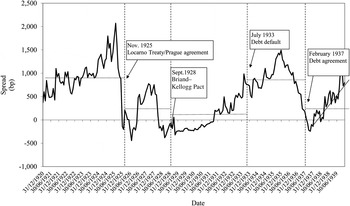
Regarding the comparative evolution of the Romanian and French bond yields, Figure 1 also shows that except for three rather short periods (1926, April 1928 to September 1931 and August 1937 to January 1938, i.e. roughly five years out of the total 19-year period), the yields of our Romanian bonds were systematically and significantly above the yield of the French bonds. Romanian bonds were thus perceived as riskier than their French counterparts. Figure 2 illustrates the resulting yield spread.
The yield spread

For the first subperiod with a negative spread, i.e. 1926, one explanation might be found in the confidence crisis that France experienced at the time. This crisis was fuelled by the monetary crisis of the French franc and the huge scandal of the falsified balance sheets of the Banque de France, which were made public in April 1925. Beginning in March 1924, the bank had manipulated its weekly balances in order to report a lower amount of notes in circulation (Mouré Reference Mouré2002). This episode significantly affected the French consol market prices. Investors probably rebalanced their portfolios to include other financial assets, namely foreign sovereign bonds, such as the Romanian ones. Their price could therefore have increased, accompanied by an opposite evolution of their yields.
In 1927, in a context of renewed confidence and increased capital inflows, the interest rates on the French market, particularly for long-term investments, started decreasing. This evolution was supported by the legal stabilisation of the French franc in 1928. The Romanian bond yields followed the same trend. The unified rentes issued after the Paris agreements in 1928, among them the 4 per cent 1929 consol, presented some particularities regarding the payment of their ‘theoretical annuities’,Footnote 15 which contributed to further lowering their yields to maturity. The banking crises in Central and Eastern Europe in September 1931 (panics and bank runs) put an end to the decreasing trend in yields, even more pronounced in the case of the Romanian bonds.
Finally, Romanian bonds benefited from the short-lived monetary and financial crisis experienced by the French economy, combined with good economic prospects in Romania during the second half of 1937. As a result, the spread again became negative.
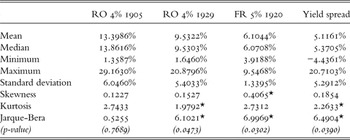
Table 1 summarises the basic descriptive statistics of the three individual yields and the spread. As expected, the yields of the two Romanian bonds are highly variable compared to those of the French 5 per cent 1920 bond. The mean and maximum yields are significantly higher for the 4 per cent 1905 and 1929 Romanian consols than those recorded by the French rente. Moreover, their standard deviations are also superior. The different tests for equalityFootnote 16 (in means, medians and variances) all reject the null hypothesis (p-values equal to 0.0000). The yields are all positively skewed (even though only the French rente shows significant skewness) and platykurtic (significant kurtosis only for the Romanian 4 per cent 1929 consol) while the Jarque-Bera test of normality points out that the French and the 4 per cent 1929 Romanian consols are non-Gaussian. The spread is also rather volatile; it varies between a minimum of −4.44 per cent (July 1926) and a maximum as high as 20.71 per cent (July 1925), with a mean value (in monthly terms) around 5 per cent and a comparable volatility, i.e. 5.29 per cent. The spread is positively skewed (albeit non-statistically significant), platykurtic and non-normal.
Descriptive statistics

* denotes significance at the 5% confidence level.
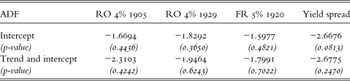
Before looking for potential breakpoints in our series of yields spread we first perform an Augmented Dickey-Fuller test (ADF) to check for the presence of unit roots. Results are presented in Table 2. They are strictly similar, independent of whether one considers the model with intercept only or with both intercept and trend: for all the series (yields and spread), the null hypothesis of a unit root cannot be rejected.
ADF test results

These results allow the search for breakpoints in the yields spread. The spread is preferred in order to eliminate the ‘common’ factors potentially affecting all sovereign bonds quoted on the Paris stock exchange market. Estimations were also conducted on the Romanian yields alone. Breakpoints found in this instance were similar to those found using the spread.Footnote 17
We estimateFootnote 18 three versions of the general model presented in (1), namely
◯ a pure structural change model in mean as follows:
(2)
◯ a structural change model in mean and trend, i.e.
(3)◯ the latter model including also the lagged dependent variable in the right-hand side of the equation, i.e.:
(4)



The choice of the second model is motivated by the results of the ADF tests. Indeed, results highlight the presence of a unit root in the versions with intercept only and with intercept and trend. Finally, as our series of spreads shows significant autocorrelation up to lags as high as thirtyFootnote 19, we also estimate the breakpoint model with the lagged dependent variable, i.e. equation (4).
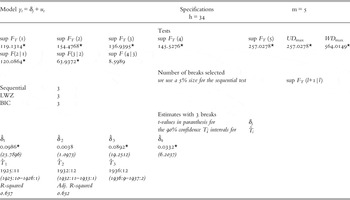
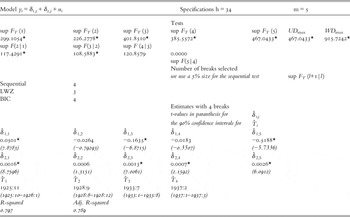
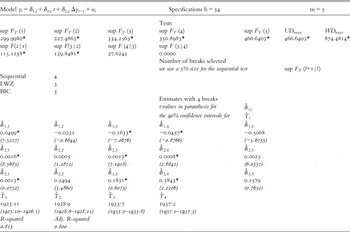
Results are provided in Tables 3, 4 and 5 for a trimming parameter of ɛ = 0.15 and a maximum number of breaks equal to 5, which corresponds to segments with a minimum lengthFootnote 20 equal to 34.
Results for the pure break model in mean

*denotes significance at the 5% confidence level.
Results for the pure break model in trend and mean

*denotes significance at the 5% confidence level.
Results for the pure break model in trend and mean with lagged dependent variable

*denotes significance at the 5% confidence level.
No matter which specification is used, both the supF tests and the double maximum tests (UD max and WD max) of no break, allow rejection of the null hypothesis at the 5 per cent conventional risk level. There is thus at least one breakpoint in our yield spread series. Regarding the exact number of breaks and their location, the first specification, i.e. equation (2), finds three breaks on the basis of three criteria (BIC, LWZ, sequential procedure), while the two other specifications select four breaks. Indeed, the value of the supF(4|3) test in specification 1 allows rejection of the presence of a fourth break; however, its value is not far from the critical one, which equals 9.41 at the 5 per cent confidence level corresponding to a new break (at the exact location of the supplementary break obtained in models 2 and 3). The second and third specifications suggest four breaks, at the same locations. Moreover, the explanatory power of the chosen models increases if we compare the three different models in terms of both R-squared and adjusted R-squared values. Finally, the confidence intervals around the break dates narrow with the inclusion of different explaining variables. Therefore the results of only the third specification will be discussed.Footnote 21
The first break falls in November 1925.Footnote 22 In just a few months, the spread between the Romanian and the French yields dropped dramatically. Different factors may explain this decline. On the economic side, investors may have expected the monetary stabilisation to succeed. Indeed, even though the stabilisation attempt is nowadays viewed as unsuccessful, investors might have expected a positive outcome, which in turn would have increased the likelihood of reimbursement. This argument may also be sustained by the fact that the revaluation of the Romanian currency at its prewar parity had been pending since the monetary unification in 1920 and was finally implemented in 1925. Nonetheless, the official 40 per cent required monetary coverage in metal introduced by the monetary conventions of 1925 was absent from the very beginning. Indeed, approximately 56 per cent of the official metal stocks of the National Bank of RomaniaFootnote 23 consisted of the Romanian gold stock in Moscow despite the fact this stock had been seized by the Soviet authorities. Alternative sources of positive news for holders of Romanian bonds may also explain the positive result. Regarding Romania's internal political life, markets might have viewed positively the news of Carol's renunciation of the throne in December 1925. The political removal of an heir with a tarnished reputation might have contributed to the decrease in Romania's political risk and, hence, of the cost of its debt.
Romanian bond prices must also have been influenced by the ratification, during the three last months of 1925, of the different debt agreements, particularly those concerning Romania's fraction of the Austro-Hungarian prewar debts and Romania's war debts. Concerning the prewar debts, Romania signalled a change towards recognising the binding nature of a debt. The war debt agreements removed a barrier to Romania's access to the capital markets (particularly American) combined with a debt relief conceded by the major creditors. This could only improve investors' perception regarding the Romanian sovereign risk.
On the international side, the period of the break also coincides with one of the most important treaties signed in the aftermath of World War I: the Treaty of Locarno signed in October 1925. Even though the Treaty of Locarno was at first perceived as bad news by the French Allies in Central and Eastern Europe, for French bondholders it was probably understood in a much more positive way. Eventually, it led to the signing of a Franco-Romanian Treaty in June 1926. The terms of the treaty have since been extensively analysed. The vague terminology could indeed be interpreted as France's wish not to commit itself too firmly (Dessberg Reference Dessberg2006). It nonetheless led to firm protest both from Warsaw and Moscow.
As pointed out earlier, the breakpoint methodology suffers from the drawback that once a break is identified one has to look for potential explanations. In the case of this break, competing theories may be discussed. If economic reasons may be ruled out, the effect of the Treaty of Locarno and the Austro-Hungarian bilateral debt agreement could both explain the sharp change observed. If one refers to the traditional view regarding Locarno (it was more favourable for France and Western Europe than for its Allies in Central and Eastern Europe), then one would probably consider the diplomatic success of the bilateral debt agreements as the main motive for spread reduction. The break date coincides with the signature of the Prague agreement. Even though Romania refused to sign this treaty, it is likely that bondholders did not view this position as sustainable in the long run and therefore considered the Prague agreement as good news.
The second break took place in September 1928.Footnote 24 In a context of renewed tensions with the Soviet Union and changes of the French policy towards its interests and borders in Western Europe, the Romanian position was extremely fragile and all news indicating a reduction in the likelihood of a conflict in Eastern Europe could only be perceived as positive by bondholders. The signing of the Briand–Kellogg pact in August 1928 might have provided such a positive signal. The general appeasement may have been interpreted by the market as good news. It may have seen as representing a reduction in the likelihood of a war in which Romania would be involved.
National political events may also explain this second break. The Romanian change of government in 1928 may have been interpreted positively by foreign investors. While the political Liberal doctrine was synthesised by the motto ‘by ourselves’, the newly elected members of the National Peasant Party adopted a policy of ‘open doors’ encouraging foreign investments. Their motivation came partly from the realisation that domestic sources of capital were insufficient, but also from the desire to destroy the economic power accumulated by the Liberal financial and industrial oligarchy. Moreover, the positive outcome of the protracted negotiations regarding the issue of a new Romanian loan with the support of the Banque de France must also have had an impact on French investors' perceptions. Indeed, the discussions between the Romanian government and the Banque de France regarding the stabilisation of the Romanian currency and its prerequisite, an international loan, had already started in 1927. Despite the French agreement on the matter, the success of the whole operation was conditioned on American participation. After a long hesitation due to the lack of trust in the Romanian administration, the FED announced its financial support to the central bank credits in December 1928.
Finally, following the December 1928 elections, the newly elected Romanian government, led by Iuliu Maniu, asked for French technical support to implement the required financial reforms in Romania in preparation for the stabilisation of the leu. In July 1928 an inquiry led by Charles Rist had started in Bucharest. The remarks made by the group of experts were quickly rendered public, giving the impression that the French government would act diligently in favour of its bondholders. This in turn led, in the 1930s, to protests in the Romanian press, accusing France of interference in its internal affairs (Boisdron Reference Boisdron2007, p. 30). In this case, the reduction in the spread could thus be linked to a form of French imperialism. By ensuring that French ‘money doctors’ would advise the National Bank of Romania, the French government confirmed its influence in the country while at the same time signalling France's willingness to seriously consider the fate of French nationals who were holders of Romanian bonds.
The third, negative, break detected in July 1933Footnote 25 is a consequence of the Romanian sovereign debt default. The confidence interval covers the period between February and August 1933. The first debt rescheduling agreement with the French bondholders was signed on 18 February 1933, and on 15 August 1933 the Romanian government decided, unilaterally and unexpectedly, to stop payment of part of its external debt service. From this point on, the spread grew gradually to the second largest maximum of almost 1,500 bp in December 1935. The roots of this structural change are definitely economic. However, political decisions are not totally out of the picture in this case, as the temporary debt moratorium decided in August 1933 was certainly also politically motivated. As early as 1931, some of the king's advisors had already suggested suspending coupon payment in protest at French interference (Boisdron Reference Boisdron2007, p. 31). If one turns to the first specification of the model (Table 3), the break falls when the Romanian government first asked for a debt rescheduling. In this case bondholders would have reacted more to the rescheduling than to the default. In both cases the break would be linked to economic news. If one favours the first specification then the break coincides with the rescheduling; if one favours the third one it coincides with the default. In the latter case this might indicate that bondholders were ready to ‘forgive’ a rescheduling but not a default for countries from the periphery.Footnote 26
The fourth break is dated February 1937.Footnote 27 The Romanian default paved the way for a long series of debt renegotiations and agreements. Of particular importance, the one signed in March 1937 changed the negative impression created by the different measures the Romanian government had implemented over the previous years. For bondholders, the suspension of laws which revoked most creditors' rights could only be perceived as positive.
Even though the overall spread experienced a clear reduction immediately after the break, it soon went through a trend reversal and started to move upwards. Hence, following market operators' anticipations at that time, the positive reversal in the spread, e.g. the decrease, was perceived as very temporary, while the long-run perspectives were clearly negative. Indeed, the global picture at the beginning of 1937 was rather gloomy. First, Romania suffered from acute internal political instability. This instability was surely followed with interest by French bondholders, particularly in a context characterised by the ascent of extreme-right political forces in several European countries. Second, renewed international tensions and the fragility of the Romanian position in the context of discussions between the European powers, regarding a potential reshaping of the existing frontiers, probably played an important role in Romania's perceived political risk. Eventually, bondholders may have expected the outbreak of a war in which Romania would either be defeated or side with France's enemies.
IV
This article assesses the relative importance of economic, political and diplomatic news on sovereign bond pricing. The analysis relies on the estimation of structural breaks in the spread between the French and Romanian bonds during the interwar period. Interwar Romania is a perfect example of a country for which diplomacy and politics played a crucial role. The results highlight four major breaks. Two of them are linked to economic news. More precisely, bond prices reacted to (re)negotiations regarding the sovereign debt service and reimbursement. The other breaks are, however, attributed to events related to international relations and diplomacy. For the first break, two competing theories may be suggested. The break might reflect the perceived decrease in the risk of war due to the signing of the Treaty of Locarno. It is, however, more likely linked to the multiplication of bilateral agreements pertaining to the distribution and reimbursement of the former Austro-Hungarian debt. For the second break, the successes of French diplomacy might explain the positive returns. Indeed, the break coincides with the beginning of the French ‘collaboration’ with the Romanian National Bank. The close control exercised by the French mission over Romanian public finance was reassuring for French holders of Romanian bonds. Alternatively, the signing of the Briand–Kellogg pact, another success for French diplomacy, may have led agents to revise downward their expectations that Romania might become engulfed in a conflict.
This article confirms that the market prices of sovereign debts are also influenced by diplomatic relations and politics. News showing a closer cooperation between the country issuing the debts and the country where the debts are traded seems to be incorporated by market operators into their prices as reflecting a change in the perceived likelihood of reimbursement.