


INTRODUCTION
Rubber (Hevea brasiliensis), a major plantation crop, provides multiple advantages to the growers and to the society as a whole. In the world, rubber is cultivated in 12.7 million ha in 22 countries (Anon, 2015). In Sri Lanka, it occupies 132 904 ha covering 18 administrative districts, representing three major agroclimatic zones, viz. Wet (WZ), Intermediate (IZ) and Dry Zones (Anon, 2013). At farmer level, it provides a permanent source of income. Despite smallholder farmers tend to grow rubber within their different sets of priorities, rubber cultivations of the plantation companies are met for profit maximization. Obviously, level of profit maximization depends on how efficiently rubber plantations are managed. Among the approaches taken, harvesting for high yields is in the top. Higher yields above the potential are not sustainable in long run affecting the healthiness of rubber trees. The most obvious effect is the Tapping Panel Dryness (TPD) due to ceasing the latex generation process (d'Auzac et al., Reference d'Auzac, Jacob and Chrestin1989). Nevertheless, taking a reasonable level of risk on tree health, some planters demand shorter lifespan for rubber with intensified tapping than presently recommended 30 years. It is expected to gain the income within a shorter time period under the principle of that money today is worthier than money tomorrow. In this context, overall yield harvested during the lifespan could be compromised to some extent but higher level of overall profitability is expected. Nevertheless, there is a practical ceiling in reducing the lifespan since the tree should attain certain girth, i.e. ca. 50 cm, which takes ca. 6 years to commence harvesting with presently available techniques.
The common approaches in estimating the lifespan of timber plantations (e.g. Maximum Sustainable Yield in Forestry, Forest Rent Model and The Faustmann Rotation Model etc.) are not applicable for rubber (Hyytiäinen and Tahvonen, Reference Hyytiäinen and Tahvonen2003). The principle applied in those models is to cut the forest when the rate of change of timber value is equal to interest rate. Since benefits of rubber plantations are mainly from latex and the period of harvesting latex is largely determined by the availability of bark to tap, the above principal is not applicable for rubber plantations. Technical feasibility of managing tapping thereby time period that bark can be carefully consumed has determined the present lifecycle of the rubber.
Although in general, intensified harvesting means harvesting techniques met for higher yields than usual, in theory, it refers only the physical intensity of harvesting. On this ground, tapping intensity can be increased either by increasing the harvesting frequency (i.e. reducing the time gap between two tappings, e.g. daily instead of alternate day harvesting) or the cut length (Vijayakumar et al., Reference Vijayakumar, Gohet, Thomas, Xiaodi, Sumarmadji Rodrigo, Thanh, Sopchoke, Karunaichamy and Mohd. Akbar Md.2009). Though not recommended, the former is applied in any stage of harvesting; however, the latter has been confined to the last stages of rubber crop by introducing an additional tapping cut when bark consumption is not a matter of concern. Increase in tapping intensity, particularly the frequency, results in increase in labour use hence harvesting cost. Therefore, yield stimulants (e.g. ethylene) are used to increase yields without increasing the physical tapping intensity. Instead of any increase, tapping intensity is recommended to decrease with yield stimulants with the objectives of reducing the labour use and tapping cost (Rodrigo et al., Reference Rodrigo, Kudaligama, Fernando and Yapa2011). Nevertheless, new tapping systems with gaseous stimulation (with ethylene) such as RRIMFLOW, G-Flex etc. have emerged to obtain high yields (Rodrigo and Kudaligama, Reference Rodrigo and Kudaligama2009; Sivakumaran Reference Sivakumaran1991).
Despite the development of different tapping systems to obtain high yields with reduced costs and growers’ interest to obtain quick returns from rubber cultivation, no investigations to date have been carried out to ascertain the feasibility of reducing the lifespan of rubber cultivation in financial terms. Financial analyses conducted on different tapping systems have been confined to demonstrate the worthiness of particular tapping system/s (Soumahin et al., Reference Soumahin, Obouayeba and Anno2009; Reference Soumahin, Obouayeba, Dick, Dogbo and Anno2010). In investigating potential reduction in the lifespan, different intensification plans are to be considered. Those could be based on the approaches in operation at present as those are what basically rubber growers need. Therefore, the present study was aimed to assess the financial viability of reducing the lifespan of rubber cultivation under three principal ways of intensified harvesting. In this context, the focus was given to evaluate the potential use of Intensified Harvesting throughout the Total harvesting Period to obtain a part or full amount of yield lost due to shortening the lifespan (IHTP), Intensified Harvesting only during last 6Years on a standard basis (IH6Y) and Intensified Harvesting at last ¼ of harvesting Period (IH¼P). Whilst the average field conditions in Sri Lanka with prevailing market prices for commodities were taken for the study, sensitivity analyses were performed for varying market rates of key commodities (i.e. rubber price and wage rate) and tree density within a sensible range.
MATERIALS AND METHODS
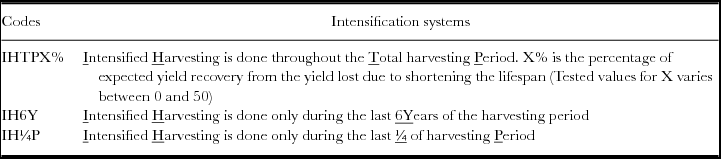
The presently advocated lifespan comprises 6 years of immature phase and 24 years of harvesting. Rubber tree usually gives its maximum yield at about 13 years after planting or 7 years after the commencement of harvesting. Further, last 6 years of harvesting (i.e. before felling the tree) is generally intensified (Nugawela, Reference Nugawela, Tillekeratne and Nugawela2001). At present, virgin bark of the tree is tapped for 12 years (Nugawela, Reference Nugawela, Tillekeratne and Nugawela2001) and therefore, reduction of lifespan below 18 years may not be practically justifiable. By setting a reasonable range of 18–30 years for the lifespan assessment, financial viability of rubber cultivation was tested under different scenarios, i.e. intensification schedules. Using the discount rate of 10%, cost and income components in different years were brought together through the analysis of Net Present Value (NPV) which was the determining factor of financial feasibility. Benefit: Cost Ratio and Internal Rate of Return were also assessed only for the critical levels. Scenarios of intensification schedules were basically under three systems described early, i.e. IHTP, IH6Y and IH¼P (Table 1). Nevertheless, within IHTP, there are several levels of intensification for higher yield (i.e. from 0% to a maximum of 50% of the expected yield loss due to shortening the lifespan is obtained throughout the tapping period in addition to the normal yield). The scenario, IH6Y generally followed usual way of intensification where last six years of harvesting was devoted for higher yields. Intensification usually begins with the theoretical 150% calculated intensity for 3 years, 200% for next 2 years and 400% for the last year (Nugawela, Reference Nugawela, Tillekeratne and Nugawela2001). Associated yield increase is not as high as the theoretical value and therefore, it was assumed to have 40, 75 and 100% yield increase per tree, respectively. It may not always be possible to have such 6 years of intensified tapping for high yields particularly when the tree lifespan is short. Therefore, considering the fraction of time period given for intensified tapping under present lifespan, i.e. 6 out of 24 years (¼), another scenario was developed (IH¼P) allowing proportional intensification period corresponding to the harvesting period. However, in financial estimations, it is convenient to consider whole year intensification periods; therefore, lifespans tested under IH¼P were limited to 18, 22 and 26 years with the intensification periods of 3, 4 and 5 years, respectively. Under these systems, different levels of yield increases (i.e. 40, 75 and 100%) and time periods were allocated on monthly basis considering the fractional time allocation under conventional 6-year intensification period (i.e. 1/2, 1/3 and 1/6 of intensification period for 40, 75 and 100% yield increase, respectively).
Description of the codes given to the different intensification scenarios tested under reduced lifespan of rubber cultivation.

In the scenarios given, the revenue of rubber was mainly from latex and selling the tree at the end of lifespan. Considering the average market rates prevailed in 2013, value of latex was taken as US$ 3.1/kg and tree as US$ 19.2 at 30 years. Tree value under reduced lifespan was determined based on the time course variation of biomass, i.e. 2.5% annual decline from the value given at 30 years (Munasinghe et al., Reference Munasinghe, Rodrigo and Gunawardena2014). Latex yield under different stages of growth was determined based on the yield curve given for the clone RRIC 100 under average growth conditions in Sri Lanka (Munasinghe et al., Reference Munasinghe, Rodrigo and Gunawardena2014). Further, income from scrap rubber harvested was included to the revenue from latex yield on the basis of 5 g per tree per tapping with the price US$ 2.0 kg−1.
Being a plantation crop, quantities of cost components used in rubber cultivation have been standardized, and most estates adhere to the same set of inputs, i.e. on labour and material inputs. This had been the base of previous studies (Samarappuli and Wickramaratne, Reference Samarappuli and Wickremaratne1997a,Reference Samarappuli and Wickremaratneb) and therefore, the same was used in the present study to obtain the quantities of labour and material required for the cultivation. The market rates prevailed in 2013 were used for costing with the values of US$ 5.3 for a labour day and US$ 0.2 for kg of fertilizer. Costs on transport (US$ 12 ha−1 year−1) and general administration (US$ 192 ha−1 year−1) were obtained from the values recorded in Dartonfield estate, Agalawatta.
Sensitivity analyses for the change in rubber price, wage rate of workers and number of trees remained in the field (i.e. tree stand per hectare) were performed under the above mentioned three intensification scenarios. Having several levels of intensification, sensitivity analyses in the IHTP scenario was limited to the 15% intensification level which was identified as the best under general circumstances. In the case of rubber price, up to 50% decrease and increase from the present level was entertained. Wage rate does not usually decline with time; hence, only the increase in wage rate up to 50% was considered. Obviously, the average number of trees available per hectare at any stage of growth is less than the expected level. Having rubber growers promoted to have the expected tree stand, the shortening the lifespan was tested at the expected and 50% of the expected level of tree stand.
RESULTS
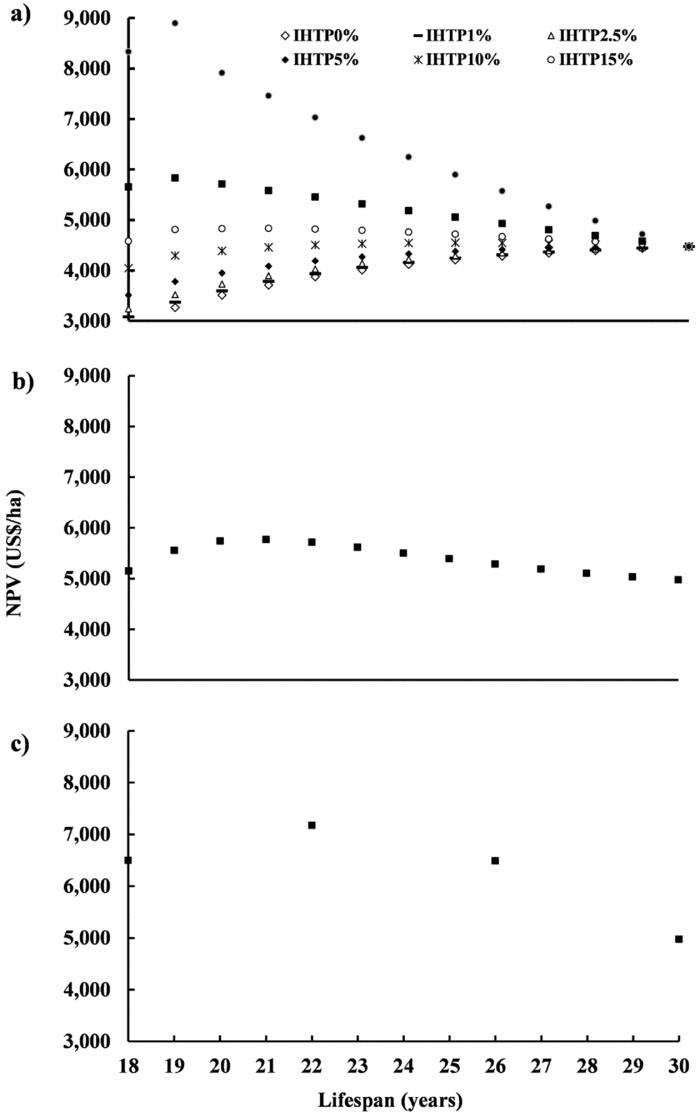
The NPV of the rubber cultivation for the traditional 30-year lifespan was US$ 4,474.5 ha−1. In the scenarios of IHTP0%, IHTP1%, IHTP2.5% and IHTP5%, reduction of lifespan resulted in decrease in NPV (Figure 1a). The highest decrease in NPV was shown in IHTP0% and the rate of decrease declined with the increase in yield recovery from IHTP0% to IHTP5%. On average, with the reduction of lifespan, NPV decreased by US$ 125.1, US$ 116.2, US$ 102.8 and US$ 80.4 ha−1 year−1 in IHTP0%, IHTP1%, IHTP2.5% and IHTP5% scenarios, respectively. From IHTP10% onwards, NPV increased with the reduction in lifespan of the tree to a certain level and then tended to decrease. In IHTP10% and IHTP15%, the highest NPV was recorded at 25 and 21 years of lifespan, respectively whilst that in IHTP25% and IHTP50% was at 19 years. NPV values recorded at 18 years of lifespan (i.e. the shortest lifespan tested) of IHTP15%, IHTP25% and IHTP50% were higher than those recorded at 30 years.
Variation of Net Present Value (NPV) at different lifespans under the scenarios of (a) intensified harvesting throughout the total harvesting period (IHTP) with different levels of yield recovery, (b) intensified harvesting only during last 6 years of the harvesting period (IH6Y) and (c) intensified harvesting at last ¼ of harvesting period (IH¼P). Descriptions of the codes for intensified scenarios are given in Table 1.

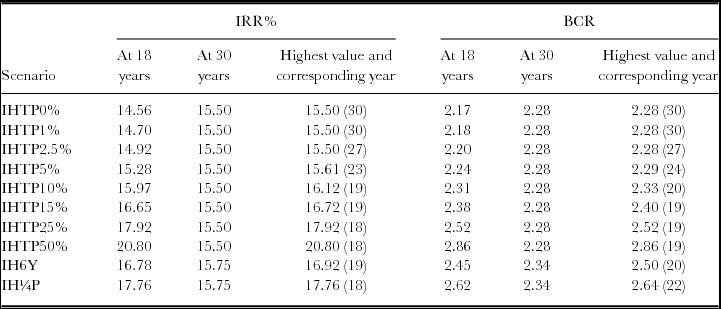
The IRR was 15.5% at 30-year lifecycle and this was the best value for the scenarios of IHTP0% to IHTP2.5% (Table 2). In other scenarios of IHTP, the highest value of IRR was recorded at reduced levels of lifespan. The greater the yield recovery, lower the lifespan with highest IRR.
Internal Rate of Return (IRR) and Benefit Cost Ratio (BCR) of the different intensification scenarios tested. Descriptions of the codes for intensified scenarios are given in Table 1.

Depicting the trends of IRR, the highest BCR was recorded at 30-year lifespan in the scenarios of IHTP0% to IHTP2.5%. Also, higher values of BCR were recorded at reduced lifespans of other yield recovery levels of IHTP (Table 2). From the yield recovery levels of 5% to 50%, the lifespan recorded with highest BCR decreased from 24 to 19 years.
When the intensified harvesting was practised to obtain increased yields during last 6 years (IH6Y), NPV tended to increase with the reduction of the lifespan. The highest NPV was recorded at 21 years (Figure 1b). The NPV at 18 years of lifespan was higher than that of traditional 30-year cycle. The highest values of IRR and BCR were recorded at 19 and 20 years of lifespan, respectively (Table 2). Values of IRR and BCR at the lowest tested lifespan, i.e. at 18 years, were higher than those at the traditional lifespan of 30 years.
If the intensified harvesting was done during last ¼ of harvesting period (IH¼P), the highest NPV was observed at 22 years of lifespan (Figure 1c). The lowest NPV was at 30-year cycle and the difference between the lowest and highest values was ca. 44%. Moreover, NPV at 18 years was 31% higher than that at 30 years. IRR also increased from 30 to 18 years of lifespan with the highest values at 18 years (Table 2). Similar to the NPV, the highest BCR was recorded at 22 years of lifespan and BCR at 18 years was higher than that at 30 years.
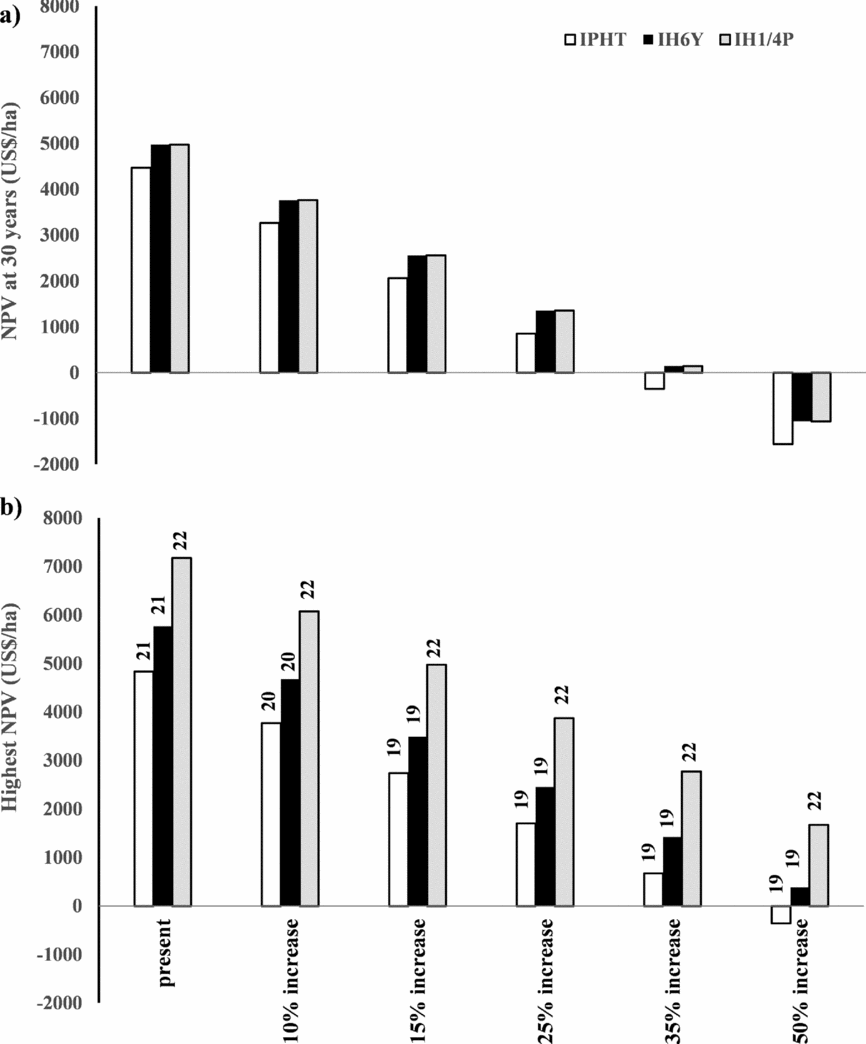
With the drop in rubber price in the scenario of IHTP (under 15% yield recovery), NPV value improved throughout with the reduction in lifespan up to 18 years (Figure 2). In case of 35% price drop or more, NPV was always negative. Despite negative NPV in 30-year lifespan with 25% drop in rubber price, NPV was highest and positive in 19-year lifespan. Even with 10 and 15% drop in rubber price, the highest NPV was recorded in 19-year lifespan. With any increase in rubber price, NPV improved and also, the highest value recording lifespan increased from 21 years in present price to 27 years in 50% increase in rubber price.
Sensitivity of financial worthiness in rubber cultivation to latex price under different intensification scenarios. (a) Net Present Value (NPV) at 30-year lifespan and (b) the highest NPV under reduced lifespan with the corresponding year on top of each bar. Descriptions of the codes for intensified scenarios are given in Table 1.

Price drop affected the NPV in both scenarios of IH6Y and IH¼P and the highest NPV was recorded within the range of 19- to 21-year lifespans in IH6Y and 18- to 22-year lifespans in IH¼P (Figure 2). Price increase under the IH6Y scenario up to 25% has given the highest NPV in 21-year lifespan and in the case of 35 and 50% price increase, the highest NPV was recorded in 22-year lifespan. In the scenario IH¼P, the highest NPV was recorded in 22-year lifespan, with the price increase from 10 to 50%.
Except in IH¼P, wage rate increase has also resulted in giving the highest NPV in lower levels of lifespan than in 30 years (Figure 3). In the case of IHTP with 15% yield recovery and IH6Y, the highest NPV was recorded in 20-year lifespan with 10% wage increase and in 19-year lifespan with 20 to 50% wage increase. In the scenario of IH¼P, the best NPV was in 22-year lifespan with any increase of wage rate.
Sensitivity of financial worthiness in rubber cultivation to wage rate under different intensification scenarios. (a) Net Present Value (NPV) at 30-year lifespan and (b) the highest NPV under reduced lifespan with the corresponding year on top of each bar. Descriptions of the codes for intensified scenarios are given in Table 1.

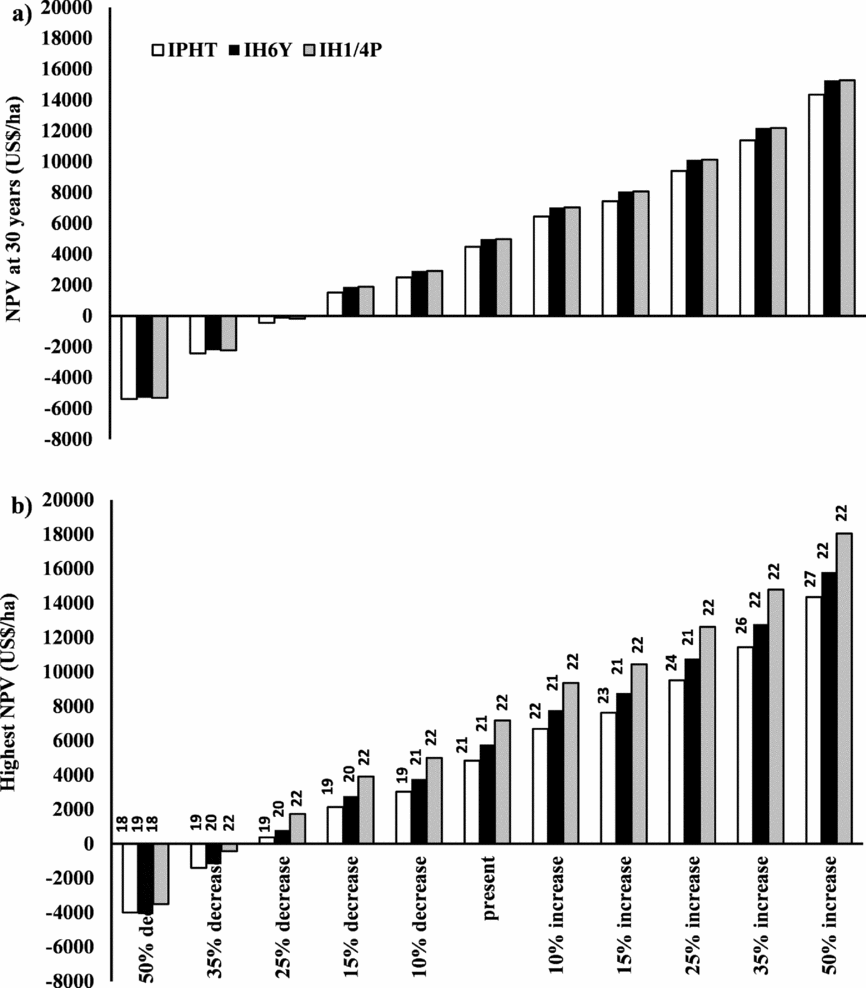
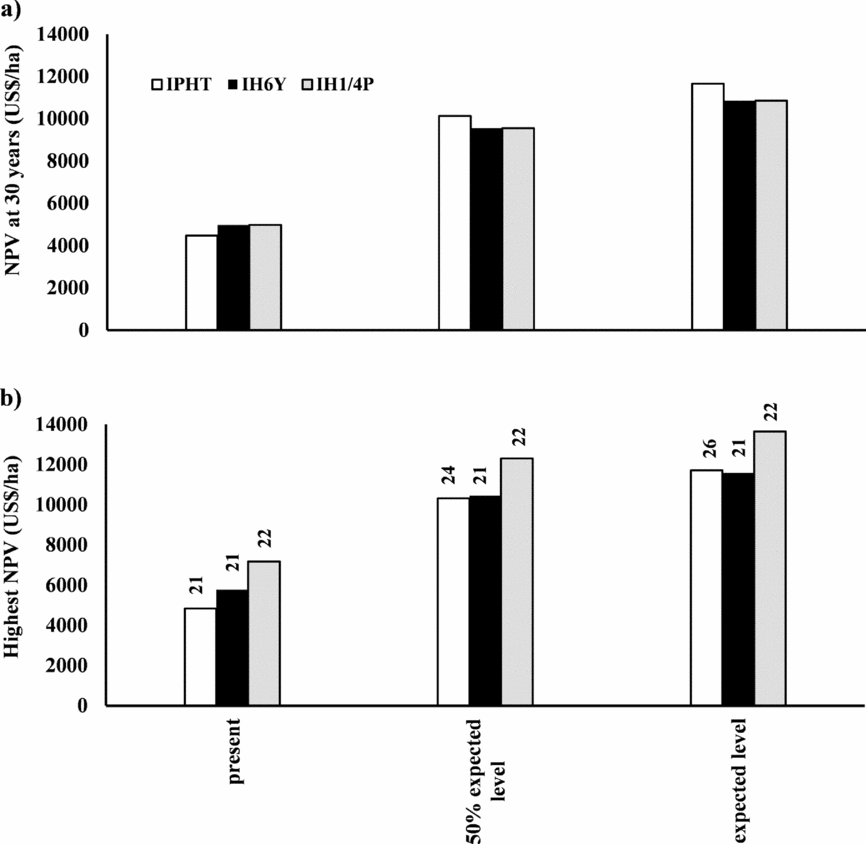
In achieving the expected tree stand or its 50%, NPV improved over two-fold in three scenarios tested. In the scenario of IHTP with 15% yield recovery, the lifespan associated with highest NPV increased from 21 years at present to 26 years at the expected stand (Figure 4). However, under IH6Y scenario, the best NPV was with 21-year lifespan in any case. Also, the best NPV under IH¼P remained at 22-year lifespan.
Sensitivity of financial worthiness in rubber cultivation to tree density under different intensification scenarios. (a) Net Present Value (NPV) at 30-year lifespan and (b) the highest NPV under reduced lifespan with the corresponding year on top of each bar. Descriptions of the codes for intensified scenarios are given in Table 1.

DISCUSSION
Discounting procedure in economic analyses is often criticized as it would undermine the privileges of generations to come. However, in present day context, NPV has become a powerful tool in the determination of financial viability of projects. Rubber cultivation is basically an agri-business, hence assessment of its NPV with reasonable discount rate appeared to be the best option to determine its financial viability. BCR also provides similar results as in NPV since the discounting procedure is same in both cases. However, the precision of NPV is higher due to greater level of its numerical resolution. Therefore, although BCR was also used in this study, NPV was the principal determinant of critical levels. IRR shows the crucial discount rate which determines the financial viability of the project (i.e. the discount rate at which NPV becomes zero). However, the highest IRR does not always reflect the highest overall profitability. Considering the practicality in the present study, it would be a useful tool to determine the interest rate for anyone who lends/borrows funds for rubber cultivation.
Under the present average yield profile, any reduction in lifespan reduces the NPV hence will not be accepted. Analyses on the recovery of yield lost due to shortening of the lifespan showed that at least 10% of yield recovery is required to reduce the lifespan making the rubber cultivation financially viable. Greater the recovery of yield, higher the NPV achieved and therefore larger the potential for reducing the lifespan. Under the usual circumstances, 10% yield recovery allows to reduce the lifespan up to 22 years with no financial loss (as shown by NPV). For the scenarios IHTP15%, IHTP25% and IHTP50%, 18 years of lifespan is financially more viable than 30-year cycle. However, it is worth to investigate on the year providing the highest level of financial viability under such intensification scenarios. For the scenario IHTP10% and IHTP15%, the highest level of NPV was given at 25 and 21 years of lifespan, respectively whilst that for IHTP25% and IHTP50% was at 19 years. This should be the theoretically best target if the lifespan is going to be reduced. Obviously, higher BCR and IRR values at reduced lifespans over those at 30-year cycle further support this view.
Superficially, 10% yield recovery (i.e. the minimum level associated with reduction of lifespan for higher NPV) appeared not to be a serious issue; however, greater the reduction period of the lifespan, higher the absolute amount of yield to be recovered. For instance, reduction of 1 year in lifespan (i.e. lifespan of 29 years) requires the recovery 10% of 30th year yield (ca. 0.26 kg per tree in 23 years ≈ 11.3 g year−1). When the lifespan reduces to the minimum level with no financial loss, i.e. to 22 years, 10% of last 8 years’ yield is to be recovered (ca. 2.29 kg per tree in 16 years ≈ 143.1 g year−1. N.B. This is about 12.7 times higher than pervious case). Although any lifespan could be selected with other higher rates of recovery in yield lost, i.e. IHTP15%, IHTP25% and IHTP50%, the practicality of higher options with shorter lifespan is dubious. Yield recovery of 50% at 19 years of lifespan which gave the highest NPV, requires 38% annual yield increase during the 13-year harvesting period and so appears to be rather difficult task. Obtaining higher yields above the potential level of the tree affects its health leading to TPD, a symptom showing no latex in the bark (d'Auzac et al., Reference d'Auzac, Jacob and Chrestin1989). Considering the practicality in latex harvesting, two options are available, i.e. either low level of yield recovery with higher level of reduction in lifespan or vice versa. Among the low level of yield recovery scenarios, either 10% yield recovery with 25-year lifespan or 15% yield recovery with 21-year lifespan seems practicable hence could be selected depending on growers’ interest.
Intensification of harvesting for a limited period at the verge of uprooting the tree is found to be more practical than the intensification over the whole harvesting period as the former does not provide sufficient time for tree to show the adverse effects. Obviously, intensification during last 6 years has been a common practise in Sri Lanka. Also, overall profit given in the rubber cultivation by these systems has been higher than that of the throughout intensification plan (as shown by the value of NPV). Under these systems, lifespan could be reduced even up to 18 years without compromising the NPV and the highest NPV was recorded at 21-year lifespan. Therefore, this would be a practically possible and financially viable option for rubber growers. If 18 years is to be practised, intensification should begin from 13 years of age, i.e. 8 years after the commencement of harvesting. At this stage, rubber trees are generally tapped on the second virgin base panel (BO-2). Therefore, tapping for latex on renewed bark will be limited only for a short period.
If the intensification is done for ¼ of the harvesting period, the overall intensification period declines with the reduction of lifespan. The lifespan of 18 years was more financially viable than 30 years and the highest NPV was shown at 22 years. As shown in the methodology section, intensification is involved in several steps of transitions hence unlike 6 years, ¼ of harvesting period demands for intensification where tapping system changes in the middle of the year. Since such middle year changes in intensification schedules seem rather complicated, rubber growers may develop different year-round intensification plans under shorter lifespans to obtain required amount of latex yields.
In general, intensification during last stage of tapping did not largely change the best lifespan and remained in the range of 19 to 22 years with the change in rubber price, wage rate increase and achieving the expected tree stand per hectare. Therefore, those systems were found to be rather stable. However, if intensification is practised throughout the tapping period, rubber price and tree stand per hectare are to be the critical factors affecting the best lifespan. Any decline in rubber price reduces the best lifespan and it is vice versa with price increase. For instance, with 50% price decrease and increase (i.e. rubber price at US$ 1.5 and 4.6 kg−1, respectively), the best lifespan would be at 18 and 27 years. Obviously, wage rate increase has a negative effect on the overall profitability and but did not largely affect the best lifespan in any intensification plan.
Higher latex yields required for shortening the tree lifespan can be obtained by several means of intensification. Increase in overall tapping cut length per each tapping, decrease in time gap between two tappings and the application of yield stimulants are the presently available techniques. However, those should be carefully planned as rubber tree cannot withstand highly intensified harvesting systems in long run. In particular, sufficient time gap should exist between two tappings for latex generation. In the attempts of over harvesting the tree with intensified tapping, greater level of TPD trees (i.e. trees that cannot provide latex when tapped) have been observed (Rodrigo et al., Reference Rodrigo, Kudaligama and Samarasekera2006). This effect could be or could not be reversible with the correction of tapping system. However, even without intensified tapping, incidence of TPD exists and exact cause and practical solution for the TDP are still under investigation. Any techniques could practically be applied if the intensified harvesting is done only during the last stage of harvesting period, i.e. in IH6Y and IH¼P. However, reduction in time gap between two tappings (increase in tapping frequency) is not be suitable for long-term intensification as it would lead to higher incidence of TPD. Also, it results in high tapping cost associated with more labour inputs. Yield stimulant play an important role here; however, judicious application of yield stimulants is still required. Yield stimulants are generally in two forms, either gaseous (ethylene) of liquid (ethephon). Considering the cost of the application technique and long-term experience (Rodrigo and Kudaligama, Reference Rodrigo and Kudaligama2009), the latter is proven to be the best way to obtain required higher yields associated with reduced lifespan. In general, stimulants are applied with low frequency in tapping which requires less labour hence reduction in the overall cost (Rodrigo et al., Reference Rodrigo, Kudaligama, Fernando and Yapa2012). More importantly, no increase in TPD, instead a decrease, has been recorded where low frequency tapping systems were adopted with ethephon applications (Obouayeba et al., Reference Obouayeba, Soumahin, Okoma, Boko, Dick and Lacote2011).
One would expect to provide more fertilizer to the rubber tree for obtaining higher yields in intensified harvesting. Nevertheless, intensive use of fertilizer does not always support high yields as it is only one component of growth needs. Intensification for high yields expands the sink effect to some extent. However, in the rubber tree, only a portion of available latex is harvested during the lifetime (i.e. the latex available in the bark of tree trunk) and latex in the branches, roots etc. is never harvested and wasted at the uprooting of the tree since there is no any practical means to harvest them. When obtaining high yields with stimulants or increased tapping cut length, latex is harvested from an increased area of the bark. Also, rubber is hydrocarbon; hence, with high yields, only a minute amount of nutrient is taken out in the form of latex.
Although economic lifespan of the rubber tree can be reduced to some extent even with the highest levels of tree density and rubber price tested, higher density and rubber price comparatively increase the lifespan with highest NPV, particularly in IHTP scenario. Both these factors contribute to obtain high income with no much increase in costs. Therefore, the profit margin in producing rubber has a great deal in deciding the best lifespan for rubber cultivation in long run. If rubber plantations can be maintained for longer duration with no reduction in number of rubber trees when rubber prices are high, it would be worth to extend the lifespan. When rubber prices are low and rubber plantation has a lot of casualties with reduced number of trees, the best option would be the replanting to assure a healthy plantation for the future. However, intensified tapping can be practised to harvest more rubber latex before uprooting for replanting.
In summary, the present study shows that lifespan of rubber plantations could be reduced for improved financial viability. Rubber growers could select a suitable system to match their requirement. Labour availability and convenience are some other factors (not tested in this study) to be considered from growers’ end. Considering only the financial aspects, few systems can be identified. Among the systems which require intensifying tapping throughout the harvesting period, IHTP10% and IHTP15% could effectively be used to reduce the lifespan depending on the ground conditions and market prices for commodities. In obtaining required yield levels pertaining to these systems, the best option will be the stimulated low-frequency systems which minimize the risk on TPD and reduce cost increasing overall profitability further. A lifespan of 19–22 years is the best for IH6Y whilst 22 years for IH¼P. Although risk on TPD is not a big issue in these systems, the stimulated low-frequency tapping systems are still important here for cost reduction.
The present assessment was confined to theoretical grounds; hence, the selected systems of reduced lifespan should be tested in limited scale or validated with existing reliable data sets, if any, before any large-scale adoption. Further, the financial aspects were considered here and so, economic analyses with an extended assessment on environmental factors such as carbon values and soil erosion will be beneficial in designing the national policies.