Neonates with univentricular anatomy and physiology who undergo Stage I Norwood Palliation are at significant risk of low cardiac output syndrome, which may be primary or associated with unbalanced systemic and pulmonary perfusion. These patients depend on a single ventricle to supply both systemic and pulmonary blood flow, and are also vulnerable to the inflammation and vascular dysregulation associated with cardiopulmonary bypass. Following the Norwood procedure, neonates are typically treated with a combination of afterload-reducing agents and beta- and alpha-adrenergic agonists to balance pulmonary and vascular circulation while at the same time supporting the myocardium. Maintenance of a balanced systemic-to-pulmonary blood flow ratio with the use of systemic vasodilators such as phenoxybenzamine and milrinone is advocated as a therapeutic cornerstone for these neonates.Reference Hoffman, Tweddell and Ghanayem1, Reference De Oliveira, Ashburn and Khalid2 Perhaps it is for this reason that the use of Arginine Vasopressin in this patient population is traditionally discouraged, although not studied enough.
Arginine Vasopressin, a neurohypophyseal hormone secreted by the pituitary gland, is known to act on V1 receptors and causes smooth muscle-mediated vasoconstriction.Reference Thibonnier3 The efficacy with which it vasoconstricts has led one group to recommend Arginine Vasopressin for hypoxaemia in post-operative Norwood patients as a means of increasing pulmonary blood flow.Reference Mastropietro, Clark and Delius4
However, the actions of Arginine Vasopressin are not merely restricted to the vasculature. V2 and V3 receptors in the renal collecting duct are stimulated by Arginine Vasopressin to reabsorb urea, sodium, and water.Reference Zingg5, Reference Schafer and Hawk6 At higher concentrations, Arginine Vasopressin also stimulates oxytocin receptors, which have an extracellular domain similar to V1 receptors. Stimulation of cardiac oxytocin receptors, which are localised in all cardiac chambers, leads to production of atrial natriuretic peptide.Reference Gutkowska, Jankowski and Lambert7 Finally, purinergic receptors also bind Arginine Vasopressin. Vascular purinergic receptor activation leads to the production of nitric oxide synthase and vasodilation.Reference Boarder, Weisman and Turner8 Purinergic receptors are also present in the heart and coronary arteries, although there are conflicting data regarding the activation of these receptors.Reference Zenteno-Savin, Sada-Ovalle and Ceballos9–Reference Mei and Liang11
We hypothesise that the adjunction of Arginine Vasopressin, via its multiple mechanisms of action, may be well suited to improve the haemodynamics and oxygen delivery in single ventricle patients status post-Norwood Palliation in whom traditional therapy with inotropes and systemic vasodilators fails.
Materials and methods
The Colorado Multiple Institution Review Board approved this retrospective study, which was carried out in accordance with the ethics standards laid down in the Declaration of Helsinki (1964). The records of all neonates who underwent Norwood Palliation and received Arginine Vasopressin post-operatively at our institution during the time period from November, 2007 to October, 2010 were studied. Arginine Vasopressin was started in patients with evidence of worsening perfusion despite an escalation of inotropes and vasoactive medications. Neonates were excluded if Arginine Vasopressin was initiated while the patient was simultaneously receiving mechanical support.
The electronic medical record of each patient was examined for demographic data as well as details of the surgical repair itself, including the type of intervention (Sano versus classic Norwood operation), bypass time, aortic cross-clamp time, and circulatory arrest time. Post-operatively, haemodynamic, ventilatory, and laboratory data were recorded at pre-selected intervals of 1 hour before Arginine Vasopressin initiation and 1, 2, 3, 4, 6, and 24 hours after Arginine Vasopressin was started. The data for all time points, specific to each patient, were then compared. The hourly mean quantity of Arginine Vasopressin administered was recorded in addition to the total amount of Arginine Vasopressin over the 24-hour period as well as the total duration of Arginine Vasopressin therapy. In addition, the amount of inotropic support per patient was calculated for each interval above using the inotrope score previously described by Wernovsky and determined by the formula Dopamine + Epinephrine × 100.Reference Wernovsky, Wypij and Jonas12 Haemodynamic data recorded included heart rate (unless being paced), blood pressure, and urine output. If patients received any furosemide during the study period, this was also recorded to better interpret the urine output. In addition, during this time period, it was our standard practice to monitor post-operative regional perfusion in Norwood patients with two site Near-Infrared Spectroscopy Monitoring (Somanetics, Troy, Michigan, United States of America). Cerebral and somatic regional saturations are monitored and these data were included for evaluation whenever available. Echocardiograms, if obtained prior to the initiation of Arginine Vasopressin, were also evaluated. Ventilatory data included the Fraction of Inspired Oxygen and minute ventilation as determined automatically by the mechanical ventilator (Dräger Medical AG & Co. KG, Lübeck, Germany) or calculated based on rate multiplied by tidal volume.
Finally, neonates in our institution are routinely given 30 milligrams per kilogram of methylprednisolone pre-operatively (in two doses, 8 hours apart before going on cardiopulmonary bypass). If neonates also required hydrocortisone for hypotension post-operatively, this was recorded.
Laboratory data evaluated included serum lactate, arterial pH, PaO2, PaCO2, systemic oxygen saturation, mixed venous saturation (sampled in a Peripherally Inserted Central Catheter with the tip in the innominate vein), serum creatinine, blood urea nitrogen, and serum sodium levels. In addition, the quantity of sodium bicarbonate administered to the patients was also recorded as a total at both the 6 and 24-hour periods to aid in better interpreting changes in the pH. At the discretion of the cardiac intensivist, patients whose serum sodium decreased below 125 millimolar per litre may have been given 3% hypertonic saline. The number of patients receiving the latter was also recorded. Given the retrospective nature of the study, not all patients had these measurements obtained at the precise times pre-selected as mentioned above. For the 1 hour pre-Arginine Vasopressin initiation time, we accepted values up to 60 minutes before the 1 hour pre-level and up to 30 minutes before starting Arginine Vasopressin. For all of the remaining levels, we allowed a 30-minute window on either side of the pre-selected time.
Statistical analysis was performed using Prism 4 (GraphPad Software, San Diego, California, United States of America). All data were evaluated by a Paired t-test. Statistical significance was established at p less than 0.05.
Results
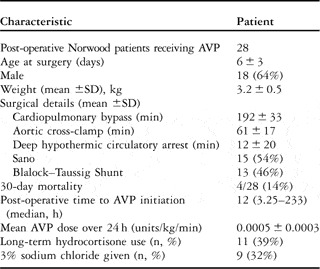
During the study period, 29 neonates with single ventricle physiology underwent the Norwood procedure and also received Arginine Vasopressin. There was one patient who was started on Arginine Vasopressin while on mechanical support and was excluded. The demographics for the remaining 28 patients are recorded in Table 1. In all, 54% of the patients had a Sano operation and 46% had a classic Norwood operation. Complete laboratory and haemodynamic values were not available for all patients at all time points. The number of patients with available data for each analysis is shown in Tables 2, 3, and 4.
Demographics of neonates on Arginine Vasopressin after the Norwood procedure.

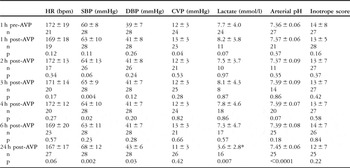
Haemodynamic effects associated with Arginine Vasopressin.

n refers to the number of patients with data at each time point
All p-values are compared to the 1 h pre-Arginine Vasopressin time point
Data are given as mean ± standard deviation
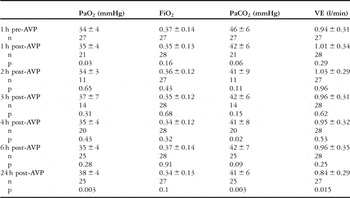
Ventilatory effects associated with Arginine Vasopressin.

n refers to the number of patients with data at each time point
All p-values are compared to the 1 h pre-Arginine Vasopressin time point
Data are given as mean ± standard deviation
VE is the minute ventilation
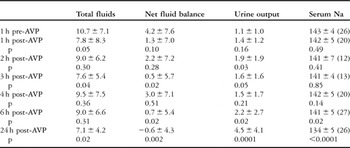
Fluid balance and Arginine Vasopressin.

All 28 patients had fluid balance data; not all patients had serum sodium levels at the time points sampled and the n is given in parentheses
Data are provided as mean ± standard deviation
All p-values are in comparison to the 1 h pre-Arginine Vasopressin time point data
At the time of Arginine Vasopressin administration, 28 of 28 (100%) patients were already on both milrinone and dopamine; 19 of 28 (68%) patients were also on epinephrine. In our service, it is standard practice to give a dose of hydrocortisone considering adrenal insufficiency as a possible aetiology of refractory hypotension. All patients received at least one “test” dose of hydrocortisone prior to the initiation of Arginine Vasopressin. There were 35% of patients who received hydrocortisone for more than 24 hours and were subsequently tapered off it as an empirical protective measure. Echocardiograms were obtained prior to Arginine Vasopressin initiation in 9 of 28 (32%) patients. In all available studies, the Attending Echocardiologist interpretation was “normal systolic systemic ventricular function”. No patient had both a pre- and post-Arginine Vasopressin echocardiogram to compare changes related to Arginine Vasopressin. Nevertheless, one of the arguments to justify the use of Arginine Vasopressin was the fact that the cardiac function was normal, hence justifying an attempt to modulate vascular tone.
The initial dose of Arginine Vasopressin was always 0.0003 units per kilogram per minute with a subsequent dosing range of 0.0001 to 0.0012 units per kilogram per minute. The mean dose over the 24-hour period studied was 0.0005 plus or minus 0.0003 units per kilogram per minute. The median time to initiate Arginine Vasopressin was 12 hours after the patient arrived at the Cardiac Intensive Care Unit from surgery with a range of 3.25 hours to 10 days. The median total administration time of Arginine Vasopressin was 3 days with a range of 10 hours to 11.3 days.
Early phase
Haemodynamic effects (Table 2)
Within 3 hours of Arginine Vasopressin administration, there was an increase in systolic blood pressure from 60 plus or minus 8 to 65 plus or minus 9 millimetres of mercury (p = 0.004). The systolic blood pressure remained elevated at four hours (64 plus or minus 10, p = 0.02). This increase did not come at the expense of worsening tachycardia or inotrope score. Diastolic blood pressure was unchanged over the first 6 hours of Arginine Vasopressin. The central venous pressure, as measured by a central venous cannula in the internal jugular vein or femoral vein, increased from 12 plus or minus 3 to 13 plus or minus 3 millimetres of mercury (p = 0.04) in the first hour following Arginine Vasopressin administration. Subsequently, the central venous pressure returned to 12 millimetres of mercury and did not change significantly for the rest of the study period. The initiation of Arginine Vasopressin was not associated with a worsening of biochemical markers of perfusion over the first 6 hours of the study; at 4 hours of Arginine Vasopressin therapy, the arterial pH had a trend towards increasing (7.36 plus or minus 0.06 versus 7.39 plus or minus 0.07, p = 0.07). Over the first 6 hours, the mean dose of sodium bicarbonate administered per patient was 0.7 plus or minus 1 milliequivalent per kilogram.
Ventilatory effects (Table 3)
There was a slight increase in the PaO2 after one hour of Arginine Vasopressin therapy from 34 plus or minus 4 to 35 plus or minus 4 millimetres of mercury (p = 0.03). More pronounced was the trend towards a decrease in PaCO2 from 46 plus or minus 6 to 42 plus or minus 6 millimetres of mercury (p = 0.06) after 1 hour of therapy. This change became significant after 4 hours of Arginine Vasopressin therapy when the PaCO2 decreased to 41 plus or minus 8 millimetres of mercury (p = 0.02). Despite the reduction in PaCO2, it is notable that there was no significant change in minute ventilation over the first 6 hours of Arginine Vasopressin therapy.
Fluid balance (Table 4)
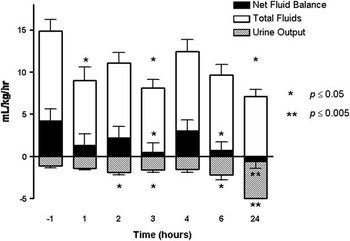
The early phase of Arginine Vasopressin administration was characterised by marked changes in patient fluid balance (Fig 1). Within 2 hours of Arginine Vasopressin infusion, the mean urine output increased from 1.1 plus or minus 1millilitre per kilogram per hour to 1.9 plus or minus 1.9 millilitres per kilogram per hour (p = 0.03). This increase was significant again at 3 hours (1.6 plus or minus 1.6 millilitres per kilogram per hour, p = 0.05) and 6 hours (2.2 plus or minus 2.7 millilitres per kilogram per hour, p = 0.02). This improved diuresis was not associated with an increase in overall fluid administration. Rather, there was a decrease in total fluids from 10.7 plus or minus 7.1 millilitres per kilogram per hour to 7.8 plus or minus 8.3 millilitres per kilogram per hour within 1 hour of Arginine Vasopressin administration (p = 0.05); this decrease was again significant at 3 hours post-Arginine Vasopressin (7.6 plus or minus 5.4 millilitres per kilogram per hour, p = 0.04). Similarly, overall net fluid balance became less positive within 3 hours of Arginine Vasopressin administration, from 4.2 plus or minus 7.6 millilitres per kilogram per hour to 0.5 plus or minus 5.7 millilitres per kilogram per hour (p = 0.02). At 6 hours after Arginine Vasopressin was started, the mean net fluid balance had decreased to 0.7 plus or minus 5.4 millilitres per kilogram per hour (p = 0.002). In conjunction with the fluid balance changes, serum sodium decreased from 143 plus or minus 4 millimolar per litre to 141 plus or minus 5 millimolar per litre after 6 hours of Arginine Vasopressin exposure (p = 0.01). The mean dose of furosemide administered over the 6-hour period per patient was 0.7 plus or minus 0.9 milligram per kilogram.
Fluid movement in relationship to initiation of Arginine Vasopressin. Patient fluid movement in response to AVP. Time “0” (not shown) is the time at which AVP was initiated. All p-values are compared to the pre-AVP time data.

Regional oxygen saturation
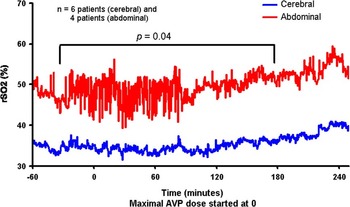
Despite regional oxygen saturation monitoring (Fig 2) becoming standard practice since the study period, the recording of these values in the electronic medical record was not standardised throughout the whole study period. There were nine patients who were found to have intact records with regional oxygen saturation recordings every 30 seconds for varying amounts of time around the initiation of Arginine Vasopressin (3–24 hours). All the nine patients had cerebral monitors; seven also had anterior abdominal monitors. In this small subgroup of patients, there was no significant change noted in the regional saturations around the time of Arginine Vasopressin initiation.
rSO2 in relation to maximal dosing of AVP. Regional oxygenation values in nine post-operative Norwood patients with the set point (time “0”) equal to the maximal AVP dose rather than the time of AVP initiation. p-value as shown in the graph.

Late phase
Haemodynamic effects
The systolic blood pressure continued to be increased through the 24-hour end of the study (68 plus or minus 12 millimetres of mercury, p = 0.002). The diastolic blood pressure also increased at 24 hours from 39 plus or minus 7 to 43 plus or minus 6 millimetres of mercury (p = 0.03). There was a trend towards decreased heart rate at 24 hours with a mean of 167 plus or minus 17 beats per minute (p = 0.06). The central venous pressure was unchanged from the baseline. Likewise, the inotrope score was also unchanged. At 24 hours, the arterial pH had improved from 7.36 plus or minus 0.06 to 7.45 plus or minus 0.06 (p less than 0.0001). Over the entire 24-hour period, the mean dose of sodium bicarbonate administered was 1.6 plus or minus 2.9 milliequivalents per kilogram. Serum lactate decreased from 7.7 plus or minus 4.0 to 3.6 plus or minus 2.8 millimolar per litre (p = 0.007). Other biochemical markers of perfusion, including central venous saturation, serum creatinine, blood urea nitrogen, and liver function tests, were not sampled with sufficient frequency to allow for any comparisons among the patient population.
Ventilatory effects
The Fraction of Inspired Oxygen remained unchanged at approximately 0.37 plus or minus 0.14 throughout the 24 hours of Arginine Vasopressin therapy. Despite this, there was an increase in PaO2 by 24 hours from 34 plus or minus 4 to 38 plus or minus 4 millimetres of mercury (p = 0.003). Similarly, there was a reduction in PaCO2 from 46 plus or minus 6 to 41 plus or minus 6 millimetres of mercury (p = 0.003), despite a reduction in the minute ventilation from 0.94 plus or minus 0.31 to 0.84 plus or minus 0.29 litres per minute (p = 0.015).
Fluid balance
The decrease in fluid administration and increase in urine output seen in the early phase of Arginine Vasopressin therapy were continued at 24 hours (Fig 1). Mean urine output increased to over 300% of baseline (4.5 plus or minus 4.1 millilitres per kilogram per hour, p = 0.0001). Fluid administration remained lower than pre-Arginine Vasopressin levels (7.1 plus or minus 4.2 millilitres per kilogram per hour, p = 0.02). Net fluid balance was negative at 24 hours (−0.6 plus or minus 4.3 millilitres per kilogram per hour, p = 0.002). The decrease in serum sodium at 6 hours was greater by 24 hours, reaching values of 135 plus or minus 5 millimolar per litre with a range of 123–143 millimolar per litre (p less than 0.0001). There were 35% of patients who received at least one infusion of 3% hypertonic saline for hyponatremia during their intensive care unit stay. The total 24-hour dose of furosemide was 3.8 plus or minus 3.2 milligram per kilogram.
Discussion
This study indicates that Arginine Vasopressin, when administered to post-operative Norwood patients with evidence of hypoperfusion, as an adjunct to inotropic, lusitropic, and vasodilator drugs, is associated with an early improvement of blood pressure without any increase in heart rate or other inotrope requirements. Within 24 hours of therapy, the improvement in blood pressure is accompanied by decreased lactate and increased arterial pH. Thus, Arginine Vasopressin appears to be not only well tolerated in this patient population but also associated with markers of improved systemic perfusion. The increased systemic perfusion did not, however, come at the cost of severe pulmonary-to-systemic flow inequalities. On the contrary, there was a concomitant improvement in PaO2 and a decrease in PaCO2 irrespective of changes made to the ventilator.
More striking than the elevation in blood pressure is the increase in urine output with a concomitant decrease in fluid administration that develops soon after Arginine Vasopressin is started. We speculate that the selective vasodilatory and vasoconstrictive properties of Arginine Vasopressin may lead to an increase in fluid in the intravascular compartment. Alternatively, or even in conjunction, Arginine Vasopressin may also be associated with a decrease in capillary leak. Animal models have indicated that Arginine Vasopressin decreases pulmonary oedema and pulmonary capillary permeability.Reference Rostron, Avlonitis and Cork13 Regardless of the mechanism involved, an overall negative fluid balance is an important outcome in these patients who often return from the operating room with an open chest and may progressively develop diffuse capillary leak.
Despite the positive haemodynamic effects and changes in fluid balance associated with Arginine Vasopressin in this study, there remains a discrepancy between our anecdotal experiences with this drug, both with single ventricle and biventricular physiology patients, and our findings reported in this study. For some patients, Arginine Vasopressin has acted as an apparent “salvage” drug when dramatic increases in traditional inotropes and vasodilators fail to improve patient haemodynamics. This subset of Norwood patients appears to have a pronounced haemodynamic improvement following Arginine Vasopressin administration. Despite the mean numbers above not necessarily demonstrating this marked improvement, a closer look at the data reveals that approximately 10 of 28 (35%) Norwood patients experienced a decrease in their lactate by 18% within 1 hour of Arginine Vasopressin therapy. This group of 10 patients also included four with mixed venous saturation data 1 hour before and after the initiation of Arginine Vasopressin, all four of whom experienced an increase (although not statistically significant) in this metric. Interestingly, none of these 10 patients were among the limited number of patients with complete regional oxygen saturation data, perhaps explaining the lack of change seen in those measurements.
This study was not designed to determine the characteristics of this so-called “early Arginine Vasopressin responder” group. However, there may be some support for this concept based on a recent study by Mastropietro et al.Reference Mastropietro, Rossi and Clark14 That study seems to divide congenital cardiac surgery patients into two groups, one of which is incapable of mounting an adequate Arginine Vasopressin increase following cardiopulmonary bypass. Perhaps our Arginine Vasopressin responder group consists of patients with a similar “relative” Arginine Vasopressin deficiency.
Another explanation for the difference between our anecdotal experience with Arginine Vasopressin and the reported results may lie in the dose of Arginine Vasopressin used. Choong et alReference Choong, Bohn and Fraser15 administered a maximal Arginine Vasopressin dose of 0.002 units per kilogram per minute after starting from 0.0003 units per kilogram per minute in their evaluation of Arginine Vasopressin for paediatric septic shock. Similarly, 21 of 29 (72%) patients in this study were increased over 24 hours from the starting dose of 0.0003 units per kilogram per minute; 9 of 29 (31%) patients were given more than double the starting dose of Arginine Vasopressin over the study period. The differences between the “early” and “late” phases of haemodynamic response in this study may be simply a matter of titrating Arginine Vasopressin to the correct dose. We did not look at the evaluation of effect at maximal dosing of Arginine Vasopressin in this study as potential confusion may arise between Arginine Vasopressin effect and the general trend towards resolution from low cardiac output syndrome over time. However, if the available regional oxygen saturation data taken from the “non-early-Arginine Vasopressin responders” are replotted around the maximal dose of Arginine Vasopressin (six cerebral saturations and four abdominal saturations), there is a significant improvement in the abdominal saturations (41 plus or minus 16% versus 47 plus or minus 14%, p = 0.04) and a trend towards improvement in the cerebral saturations at 180 minutes (Fig 2).
Hyponatremia was associated with Arginine Vasopressin administration in our patients. This may be due to the free water reabsorption seen with stimulation of the V2 receptors by Arginine Vasopressin. The broad question of hyponatremia, particularly for developmental consequences, remains unanswered in this population. Further studies are warranted on hyponatremia and both short-and long-term outcomes in Norwood patients.
This study follows others documenting the use of Arginine Vasopressin (or an analogue) in children following cardiac surgery.Reference Mastropietro, Clark and Delius4, Reference Mastropietro, Rossi and Clark14, Reference Rosenzweig, Starc and Chen16–Reference Matok, Rubinshtein and Levy18 To date, it is the largest reported sample of single ventricle patients undergoing the Norwood procedure to receive Arginine Vasopressin. This study differs from previous ones in several important ways: first, the median time to initiate Arginine Vasopressin (12 hours) was much earlier. This difference may be important in that our patients may have achieved a negative fluid balance quicker than those of Mastropietro et al,Reference Mastropietro, Clark and Delius4 given that Arginine Vasopressin is associated with decreased fluid administration and increased urine output. In addition, patients in this study were simultaneously treated with Arginine Vasopressin and milrinone as opposed to stopping milrinone as described by Lechner et al.Reference Lechner, Hofer and Mair17 This difference in practice may be significant in that our patients continue to receive the benefit of milrinone's lusotropy, inotropy, and some degree of pulmonary vasodilation. It would also appear that our institutional bias is to start Arginine Vasopressin earlier rather than escalating to higher dose conventional vasopressors. The patients reported by Lechner et alReference Lechner, Hofer and Mair17 were not started on Arginine Vasopressin until they had a mean inotrope score nearly twice as high as our patients. Regarding this difference, we would argue that early initiation of Arginine Vasopressin, if it prevents an increase in inotropes and myocardial oxygen consumption, as in our patients, would also help prevent the toxicities to the myocardium associated with high-dose vasopressors. We are not stating that vasopressin should replace milrinone by any means, but we do believe that its adjunction to the latter might be useful in some patients. Rosenzweig et alReference Rosenzweig, Starc and Chen16 included a single Norwood patient in her study as well; interestingly, this patient weaned quickly on vasopressors over 8 hours. Unlike our patients, it does appear that the author's total cohort had an excellent urine output (3.9 millilitres per kilogram per hour) before Arginine Vasopressin was initiated with no significant change following administration. Given the differences in age and underlying defects, it may be that her overall cohort is too distinct from ours to make comparisons.
Our results are similar to those of Matok et al,Reference Matok, Rubinshtein and Levy18 who report on three patients receiving Arginine Vasopressin following the Norwood procedure. The authors do not specify the results of those patients, but their total cohort has an increase in urine output and decrease in serum lactate after 24 hours of the Arginine Vasopressin analogue, terlipressin.
The limitations of this study are those of a single-institution, retrospective, descriptive study. In addition, there was no protocol for the administration of Arginine Vasopressin among the intensivists. Several patients did not have laboratory values obtained within the accepted time window. For this reason, analyses on central venous saturation (four patients) or serum blood urea nitrogen and serum creatinine (four patients) could not be performed. In addition, within the time period assessed, the surgical technique varied, and some patients had a Sano procedure while others had a classic Norwood procedure with a modified Blalock–Taussig shunt. Despite these confounders, however, it does appear that patients in both groups did respond in a similar manner with Arginine Vasopressin administration.
Conclusions
In post-operative neonates following Norwood palliation of single ventricle physiology, Arginine Vasopressin administration is temporally associated with an early increase in systolic blood pressure and urine output as well as a decrease in total fluid administration. Arginine Vasopressin administration, over a longer period of infusion, is associated with increased systolic and diastolic blood pressure as well as decreases in lactate and increases in arterial pH with similar further negative fluid balance. Patients also experienced a decrease in serum sodium during Arginine Vasopressin therapy. Prospective randomised studies are required to better evaluate Arginine Vasopressin in this population, including mechanism of action, identification of responder characteristics, dosing, indications, and safety. The latter should include a comprehensive documentation of analysis of cerebral and somatic regional oxygen saturations, mixed venous saturations (measured in the innominate vein), and biological markers of tissue perfusion and serial echocardiograms (as normal or hyperdynamic cardiac functions may support a stronger argument to use the drug) in Norwood patients receiving Arginine Vasopressin, in order to better characterise the need and response to the drug.
Acknowledgements
We would like to acknowledge Robert Friesen, MD, for his editorial assistance and Suhong Tong, MS, for her support with statistical evaluation. No financial support was provided for this paper.