1. Introduction
Social scientific knowledge in a country is by and large influenced by the existential situation of the nation to which social scientists belong; such is the obvious case with the International Relations studies in South Korea. For most Koreans, their homeland is physically and psychologically surrounded by the world super powers. Even though the perceived weight of different neighboring countries varies from scholar to scholar and over time, this perception has driven Korean scholars to relentlessly endeavor to understand the dynamic regional order. Then, we combine external and internal elements for shaping Japanese international relation studies (JIRS) in Korea: the former focuses on the impact of developments in the real world on the discipline, and the latter refers to the allegedly inherent telos of science (Wæver, Reference Wæver1998: 691).Footnote 1
Interestingly enough, Japanese studies in Korea took a different path from those of Western academia. Indeed, it was one of the hottest issues in Asian studies in the West for at least 50 years until the 1990s. Particularly, Japan's economic strategy had been crystallized as the Japanese model which replaced the idealist alternative of socialism, and became a pragmatic alternative to the Anglo-Saxon model. In a similar vein, Korean scholars followed the international academic trends of watching, learning, and evaluating Japan. The fever of Japanese studies in the West, then, seemed to decline in the 1990s in step with the shrinking of Japan's economic power and the rise of Chinese power. Rozman (Reference Rozman2002: 153) points out that Japanese studies in America are going the same way as Russian studies. In contrast, Japanese studies in the Republic of Korea (ROK) did not recede even in the early twenty-first century. The number of Korean books on Japanese politics has surpassed that of Japanese ones on Korean politics (Lee, Reference Lee2002). The number of Korean students of Japanese language was 910,957 in 2006, the largest share among the world. In Inoguchi (Reference Inoguchi, Ticker and Wæver2009)'s words, ‘one hundred flowers come into blossom’, could be applied to express the expanding interests in Japan in Korea.
This study traces the major arguments and discourses in JIRS. Next, we study the JPS community in Korea. This examination posits sub-questions: what are the peculiar features of JIRS, what are the important factors that might be shaping the studies, and what are the real dynamics surrounding the JIRS? In this sense, this paper is a more integrative effort to examine Japanese studies in South Korea than previous researches.Footnote 2
2. Expansion of focusing Japan in Korean academia
Japan in the post-Cold War period in Korea
Since the end of the Cold War, the Korean international relations (IR) community in general has been strongly concerned with the dynamically changing regional order that has been shaped and reshaped by the increasing threat of North Korea, the incessant influence of the US, and the rapid rise of China. These challenges have stimulated IR specialists to focus on all historic and present-day events in the Korean peninsula. Recent Korean IR has been highly concentrated on the Korean peninsular. Because of its critical role in the peninsula, as might be expected by observers, studies on the US have also prevailed, and those on China have rapidly increased in line with its rise. Meanwhile, studies on Europe have not diminished because of the upsurge in interest both in the German unification as a guide for the unification of the peninsula and in the European integration in which Korean scholars hope to find clues to solve their own security and economic issues.
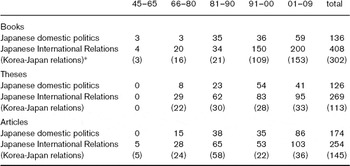
What has happened in the studies on Japan? First, we examine the quantitative expansion of JIRS (Table 1).Footnote 3 In proportion to the increase in researchers, the digital data from the National Assembly Library indicate a sharp growth in all areas of books, theses, and articles, particularly since the 1980s, in proportion to the increase in researchers. There is a sharp contrast in domestic politics and international relations in Japanese studies. The former experienced a slow increase in the numbers of books and articles and even a decrease in theses, while the latter experienced a significant increase in the numbers of books, theses, and articles.
Domestic politics and international relations in Korean JPS (1945–2009)

Note *Numbers in brackets refer to Korea-Japan relations within JIRS in each category.
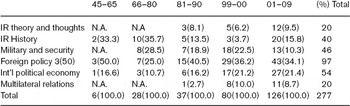
Second, we also examined the research fields of individual articles (Table 2).Footnote 4 Interestingly, few JIRS articles dealt with IR theory. Even the 12 articles from the same subfield for the last decade examined the perceptions and norms, not the Western style IR theories. On the other hand, while the military and security studies were reduced, foreign policy analysis has made great strides over the past two decades. The ratios of the former were 18.9%, 22.5%, and 10.3% in the 1980s, 1990s, and 2000s, whereas the latter were 40.5%, 36.2%, and 34.1%, respectively.
Research fields of Korean JIRS (1945–2009)

The increases in all types of publications from the 1990s, together with the intense interests in foreign policy, reflected the highly volatile situations of the bilateral relations since the end of the Cold War. The new high uncertainty in the post-Cold War provoked a related scholarly sense of duty to investigate and provide a detailed explanation.
Discourses about Japan
We examine some major arguments under the three themes of Japan and Korea, Japan and the superpowers, and Japan's national identity. Although the Korean IR community is largely concerned with the threat of North Korea and the rise of China, scholars have also examined Japan as a meaningful variable in regional stability, especially the bilateral relation between Korea and Japan. Japan's relations with the superpowers is also important topic as these relations significantly influence the regional order. Lastly, the scholars’ inquiries expanded to include an examination of Japan's national identity in order to present a fundamental definition of the country.
Korea and Japan. As discussed above, the relation between Korea and Japan is the most important issue. Yoon, the former Minister of Foreign Affairs, has a realist view and explains the necessity of Japan to South Korea. The Korea-Japan bilateral relationship is a key factor in overcoming the Hobbesian order of East Asian security and economy (Yoon, Reference Yoon2002: 349). If Yoon's argument tilts toward Japan, Moon (Reference Moon and Suh2005: 33) presents a more balanced position. He argued that South Korea is fundamentally a peninsula country, which needs to pursue harmonization between the continental and ocean powers. Without considering the geographical reality of South Korea, the hardened triangle of ROK–Japan–US could be a shortcoming. This stresses the importance of finding a strategic gluing point between the two, based on Japan's understanding of South Korea's geographical reality.
In addition to the strategic approach toward Japan, others have agonized over how to connect the past Japan to Japan today. Historically, Japan and Korea have had a very unusual relationship. Rozman (Reference Rozman2002: 11–12) aptly ascribed the intricate relationship as stemming from the following distinctive historical experiences: ‘(1) Apart from Taiwan, which was handled in a milder way, Korea suffered the longest under Japanese rule, (2) Korea experienced the most extreme assimilation measures, (3) Korea has made these experiences with Japan a more important part of its national identity than any other country, and (4) by virtue of their proximity, economic dependency, and cultural or linguistic similarities, Koreans feel the most threatened’ The historical elements explain the high sensitivity of Koreans to these past issues in their research.
Since the early 1990s, Korean scholars have covered the historical issues. They seem to agree with the emergence of Japan's neo-nationalism. The intensified dispute over Dokdo (Takeshima in Japanese) triggered academic research over the historical background. Kim (Reference Kim2008) argued that the problem of Dokdo dominium was not just a territorial issue but actually stemmed from the disagreement between the two countries during the diplomatic normalization talks in 1951–64. In a similar vein, Lee, Won Deok (Reference Lee2007) pointed out that the tributes to the Yasukuni shrine by the Japanese Prime Ministers, particularly by Koizumi, resulted in an emotional standoff between Korea and Japan because he did not pay any attention to the bilateral relationship, which eventually hindered the bilateral cooperation, especially over the North Korean nuclear issue. A few studies underlined the action–reaction and escalation of feelings of antagonism in the bilateral relations, and eventually criticized both governments. These researchers do not believe that this degenerating relationship is unavoidable. This reflects the different horizons between scholars and politicians. As the relationship is politically exploited in both countries, especially in domestic politics, the scholars are strongly concerned about these differences.
Japan and the super powers. In largely focusing on the functioning of the formal alliance between Japan and the US, scholars have made contrasting observations. Some have argued that the relationship is not robust, unlike public expectation, whereas others emphasized its solidness. Kang (Reference Kang2009) highlighted the difference in Japan's role in the alliance system. During the Cold War the US freely made use of Japan's military base, while Japan contributed to the US containment policy against the Soviet Union by reinforcement of Japan's Self Defense Forces. In the post-Cold War era, the bilateral security system did not work well, as shown in the Gulf War of 1990, when Japan provided 13 billion dollars to the US without dispatching any military forces. In contrast, Lee, Ki Wan (Reference Lee2007) emphasizes Japan's new military strategy in the post-Cold War era, which was actually shaped by the changed domestic power structure. For example, parliament legislated a series of military acts designed to reinforce the alliance system: ‘the Contingency in Surrounding Areas Act’, ‘the Special Measures of Law on Terrorism’ in 2001, and the ‘three defense laws’ in 2003.
As generally expected, Korean scholars have been strongly concerned about the Japan–China relations because the new power structure created by the two appeared to have crucial implications for the peninsula. First, many studies consider the Japan–China relationship to be similar to the Korea-Japan one since both relationships are significantly influenced by the past. This line of argument emphasizes that historical issues, such as the Nanjing massacre, the history textbooks, and territory are likely to lead to the eventual development of military rivalry. Second, the studies examined in Suh (Reference Suh2004)'s literature review tended to argue that Japan's China policy has shifted from an economically oriented engagement strategy based on official development assistance (ODA) and investment to a more politically oriented one. That is, Japan seeks co-engagement with the US by transforming the balancing/containment-oriented alliance into a complex alliance, on the one hand, while also seeking, on the other hand, to develop a strategy that binds China into a regional institution. Lee and Kim (Reference Kim2008), meanwhile, mentioned that the rivalry stemmed from relative power relations and trust. After comparing the East China Sea case with the partially successful regime governing the Caspian Sea resources, they explain that regime building in the East China Sea lags behind badly.
In addition, Korean scholars mostly believe that the passage to an Asian regionalism has been retarded and will be tough. Nonetheless, scholars have reached a consensus that the Asian financial crisis, an unexpected consequence of reckless globalization, triggered the ideas of regionalism. At that time, they positively evaluated Japanese economic and financial assistance as an important element for stability and prosperity throughout Asia. For example, Japan's ODA for North Korea will promote the Japan–North Korea relationship, which could be an important option for peace in East Asia (Park, Hong Young, Reference Park2007). Others have also traced the wide variety of Japan's active performances, such as the Comprehensive Economic Partnership in East Asia (CEPEA), the Chiang Mai initiative, and the Asia Bond Market initiative.
Japan's free trade agreement (FTA) strategy has also been investigated comprehensively. Park, Chang Gun (Reference Park2007) describes Japan as considering the creation of an East Asian FTA (EAFTA), which will further unite East Asia's disparate and diverse economies by connecting Southeast and Northeast Asia. However, not all the studies predicted a bright future for Asian regionalism. According to Lee, Myon Woo (Reference Lee2007), most Japanese tend to focus on the functional approach, while many Chinese focus on building an integral economic entity and multilateral security institution. In a similar vein, Kim, Kee Seok (Reference Kim2006) also argued that China's fast economic growth and growing economic weight in the world presented an obstacle to East Asian regional cooperation. In this situation, the two big powers are formulating real politics such as the enhancement of nationalism and militarism in pursuit of a superior position.
Japan's national identity. Three variables have strongly influenced the important inquiries in Japanese studies: (1) how to perceive Japan, (2) how to measure Japanese power, and (3) how to interpret Japan's identity. These inquiries have spawned the following specific research agendas: Japan as Eastern or Western? Japan as super or middle? Japan as special or normal? Of course, these inquiries have been urgent and important issues in the academic debate in last two decades. Thus, the fact that the academia in both Korea and Japan share common concerns implies that Korean academia is highly sensitive to Japanese trends. Nonetheless, the results of their studies do not necessarily coincide.
First, the identification of Japan as either Eastern or Western is a crucial research agenda, especially in the post-Cold War period. The agenda strongly reflects the variable of the changed international environment. The retreat of the rigid dichotomist ideological stand-off of the Cold War created more multiple spaces for Japan to move toward the East. Korean has formulated increasingly complicated foreign policies toward Japan. Although it no longer regarded Japan solely as a capitalist ally, in Korean academia there is large uncertainty in how to perceive Japan: Can we really perceive Japan as Eastern? How much has Japan moved toward the East? Trust and suspicion are intertwined. Then, the issue of Japan as Eastern or Western delineated the question of whether Japan is a Friend, Competitor, or Enemy. In this sense, the research agenda inevitably incorporated the approaches of constructivist IR theory.
Sohn (Reference Sohn2007) differentiated Japan's regional identities in history. Modern Japan invented and conceptualized toyo (the Orient) as a civilizational space. A civilizational toa (the Far East) was then mixed with the space of the yellow race. By the end of the 1910s, toa emerged and envisioned a critical space of culture as opposed to civilization. Dai-toa (the Greater East Asia) representing this new reality was conceptualized as a geopolitical Lebensraum. The study showed the transformation of identity from friend to enemy. Park (Reference Park2004) also argued that prewar Japan was mainly characterized by the hostile regional identity (enemy) through which it considered East Asian countries as objects of occupation and domination, rather than that of cooperation on an equal basis, in order to survive in the West-dominated hostile international system. Studies on the past history of Japan focused on its negative aspects as an Asian power.
From a different perspective, studies emphasized that contemporary Japan, unlike modern Japan, was identified as Eastern rather than as Western. Song (Reference Song2002) argued that Japan moved its position toward being a member of Asia. This is a new Asianism in Japan which differed from the old Asianism. Choi and Shin (Reference Choi and Shin2008) examined the Japanese top decision makers’ perceptions about Asia. Their study showed that Japan's foreign policy in the 1990s maintained its interest in East Asia in spite of the territorial issues and the reinforcing of the Japan–US alliance. Jin (Reference Jin2008) explains the reason why Japan began to tilt toward Asia. Facing the new challenge of the shrinking Asian markets after the Asian crisis, Japan had to act to rejuvenate the Asian economy in order to recover from its own recession.
Second, the assessment of Japanese power as super or middle is another crucial agenda. This strongly reflected the change in Korean foreign policies due to the stubborn continuation of the Cold War-like military stand-off in the Korean peninsula despite the end of the Cold War from the global dimension. Thus, any change of Japanese power could be an important variable for South Korea. This inquiry investigates the question of whether the increase in Japanese power had a positive impact or not. Thus, scholars prefer a realist perspective to a liberal or constructivist approach. Most studies in this subfield have argued that Japan carefully sought political power in the region, despite its economic recession. Kim, Jin Ki (Reference Kim2006) argued that Japan actively began to seek influences commensurate with its international status, and, particularly, tried to initiate the restructuring of the Asian financial order by enhancing multilateralism. Japan's military posture is a vital issue for all Koreans. Scholars believe that Japan is more sensitive than Korea to the rise of China, and have become more alert to the uncertainty in the region. Nonetheless, they, unlike the public, generally do not regard this military expansion as leading to regional hegemony.
Third, the definition of Japan as special or normal is also a provoking issue. The agenda itself is strongly influenced by Japanese public discourse, which has been strongly concerned with such crucial national agenda as constitutional revision. The highlight of the discourse was the shift from special state to normal state. Park (Reference Park2006) juxtaposed two contrasting theories in Japan: normal state theory and global civilian power theory. According to him, the development of two theories actually resulted from the change of Japan's self-identity from an international system follower to a constructor. In spite of the plural identities, he concluded that Japan is tending to follow the road to a normal state.
Distinctive features in discourse. The discourses are characterized by the reality of Korea's situation, which is characterized by national divisions and soul-searching for appropriate regional roles. First, JIRS concentrated more on problem-solving prescriptions for current affairs than on theorizing about regional relations in East Asia from purely a scientific point of view (Choi, Reference Choi2008). The strong focus on current events and hot topics is likely to lead to the growth in the dominant position of foreign policy analysis, and, despite their open attitude to US theories and Japanese methods, to few incentives on theorizing and relatively weak nationalist wishes for their own theory. Given the real world problems, it might be said that theory is commonly viewed as a luxury that can ill be afforded, otherwise its function makes abstract, generalizable knowledge less interesting, but concrete, specific, situational analysis with a policy angle more valuable (Tickber and Wæver, Reference Wæver, Tickner, Tickner and Wæver2009: 335–6).
Second, the discourses also strongly reflect the so-called ‘realistic nationalism’ that still prevails in intellectual trends. There exist multiple epistemologies of the traditional anti-Japanese sentiments, the realistic view on Japanese international behaviors, and the underlying intellectual predisposition on geopolitics concerning the Korean peninsula. Faced with new international challenges mainly from economic globalization, regional economic integration, the resurgence of East Asian nationalisms, and security instability, a new intellectual landscape is being formed in which the existing realist paradigm stands at the center, in front of the liberalist and constructivist ones.
3. The internal dynamism of the Japanese politics studies community
Who study JIRS and how are they organized?
The Korean studies of JIR with their social scientific research styles and methods have been developed as an area of study, i.e. a subfield of JPS, since the late 1970s. We address several distinctions in the development of the community of Japanese studies of political science in Korea. First, the scholars’ academic backgrounds vary. There are diverse opinions about IR studies in Korea. Moon and Kim (Reference Moon and Kim2002: 64) state that ‘it may well be said that South Korea is an intellectual colony of the American IR community, lacking its own community in which indigenous theoretical models are being developed’. But, Kim (Reference Kim2005: 13) opposes by saying that the Korean studies on Japanese politics stand their own ground and reveal their sufficient creativity, despite being influenced by the US and Japanese IR communities. On the other hand, the weak scholarship in East Asia, lacking robust theoretical orientation, is also noted. As Inoguchi (Reference Inoguchi, Ticker and Wæver2009: 97) puts it, ‘in Taiwan and Korea, in contrast [to Japan], the discipline is more a product of a 1960s state-initiated effort self-consciously modeled on the US and therefore leading to a structuring of the disciplinary landscape more similar to the US’. However, Han (Reference Han1999: 23–4) emphasizes that the Korean community of Japan studies is mainly composed of three groups, those who studied in American, Japanese, and domestic universities, leading to their non-hierarchical and pluralistic research orientations.
Second, internal power in the community of JPS/JIRS is largely vested, not in the rulers of the discipline as in the US, but in the loosely integrated, flexible aggregate of individual members, particularly surrounding the national association, i.e. The Korean Association of Contemporary Japanese Studies (KACJS).Footnote 5 National associations and individual leaders of the discipline in a more organizational or personal capacity were important in countries such as Japan and Korea in which the discipline is relatively well organized at a national level, but do not operate primarily through the publication-merit model (Tickner and Wæver, Reference Tickner, Wæver, Tickner and Wæver2009: 333). The current situation, however, is slightly different from this view. The retirement of those who obtained their Ph.D.s mainly in the US universities gave rise to a power vacuum that is going to be filled with multiple research bases at the university level, and the publication-merit model began to operate under the strengthened assessment systems at academic institutions.
Third, the diversified educational backgrounds of JPS community members widened the horizon of the research areas, even while simultaneously increasing the probability of disciplinary disintegration. According to the address book of the KACJS in 2009, the largest group of members (42%) obtained their Ph.D.s from Japanese universities, followed by the US (26.3%), and Korean (14.3%). This high ratio of studying abroad has undoubtedly been of great advantage in absorbing the advanced intellectual properties of the Japanese and the US, to enjoy an equal, open relationship among members, and to share research outcomes through the association's biannual bulletin, The Korea Journal of Japanese Studies. However, it also imposes several structural constraints by hampering an independent agenda-setting different from that of the US and Japan, and by delaying the development of creative theories and methodologies.
Fourth, the high concentration of Ph.D.s at universities, or university-oriented job-hunting among Ph.D.s is likely to confine intellectual exchanges to the arenas of their own, to make academic debates less vigorous than those of the West, and to render the community less penetrable to non-academic actors such as civil servants, journalists, and businessmen. The association has astonishingly few non-university members: just 20 think-tank researchers, three civil servants, and one politician among the identified 133 members. This university-centered orientation results in part from the well-known Korean social tradition of high respect for academics, and in part from the chronic imbalance between the massive supply of Ph.D.s and the relatively limited social need outside universities, and in part from the fewer intellectual exchanges with other research communities.
Community underpinnings and growth
The expansion and diversification of JIRS are closely related to the community underpinnings of the university system, research fund, and language and professional trainings. This is because the ways in which practical tasks are performed by scholars and their everyday conditions influence the work that is done based on those organizational and institutional questions (Wæver and Tickner, Reference Wæver, Tickner, Tickner and Wæver2009: 21).
The first is the highly segmented institutional arrangement of universities where various kinds of undergraduate department, graduate school, and research institutes coexist without any centripetal force. Japanese language is taught in many departments of undergraduate level such as Japanese language and literature, Japanese area studies, IR, political science and diplomacy, and history.Footnote 6 A higher level of Japanese studies programs is provided by the existing graduate schools such as political science, Japanese language and literature, and also by the newly established schools of international studies. In addition, many universities have their own Japan research institutes, including the Institute of Japanese Studies at Kookmin University, the Center for Japanese Studies at Korea University, the Institute for Japanese Studies of Seoul National University, the Japan Center at Dongseo University, and the Japan Center in the Institute of East and West Studies at Yonsei University.
However, two shortcomings originating from this institutional configuration should be remedied. Although scholars participate in or organize some joint research projects, their individual-based activities have not produced many meaningful outcomes because of the lack of comprehensive, interdisciplinary, collaborative works. In addition, the intellectual activities at universities have been constantly striving for funds in order to keep their institutes running and feed their Ph.D.s into untenured posts. Academia must integrate these dispersed forces into certain organic entities, such as a close research coalition among scholars.
Second, scholars, both individually and collectively, are under a lot of pressure to attract research funds. While only weakly backed by their universities with relatively few endowments, they depend almost exclusively on the state sector through the NRF (ex-Korea Research Foundation), and partially on Japanese public and private funding.Footnote 7 The approval rate in applications for NRF funding is approximately 25%. University institutes are subjected to the law of survival of the fittest in the fierce race for money. Prestigious universities have a great advantage in reaching that goal. They have better facilities, richer human resources, wider social connections, bigger political influences, and stronger know-how than small and medium-sized competitors. Recently, the institutes of Kookmin University, Korea University, and Seoul National University gained access to unprecedented, massive fund programs of five hundred million to one billion won per a year on long-term bases. However, this growing dependency on governmental money is likely to give birth to reduced academic autonomy, to make them much more vulnerable to external factors, and, more importantly, to regulate themselves in selecting research agendas friendly to government research policy.
Thirdly, there is an imbalance of professional training for JIR at university. The Park Chung-hee government laid a route by formally choosing Japanese language as the new second foreign language in the high school curriculum. According to Japan Studies in South Korea published in 1989 by the Japan Foundation, many Japan-related classes were open in eight national universities, 33 private universities, 11 colleges, and 23 graduate programs. However, the current situation is more complicated. Japanese language education, a barometer of the future of JIR, is decreasing in undergraduate courses mainly because of the relative decline of Japan's economy, while it is flourishing in primary and secondary education due to the attractiveness of Japanese animations, games, J-POP, movies, and its relative ease of learning. However, the total number of students of Japanese is still increasing due to different motivations such as business opportunities, cultural attractiveness, access to the advanced technologies, and traditional emphasis on foreign languages (Im, Reference Im2009: 127–41). On the other hand, non-language/literature subjects covering Japanese politics, economy, society, and culture are not appropriately assigned (Jin, Reference Jin and Jin2007: 23–4). Among others, the heavy dependency on foreign Ph.D.s has weakened domestic graduate programs which are merely overproducing many unemployable Ph.D.s.
4. The Japanese politics studies community and Korean society
The real worlds as shaping forces of JPS/JIRS
The Korean IR community shows dynamic interaction between academia and the real political world. As Moon and Kim (Reference Moon and Kim2002, 46) mentioned, the IR specialists exercise significant social, political, and policy influences through their consulting and advising, media commentaries, and, especially, their active participation in government and party politics. The JIR specialists identifying themselves as Japanese politics specialists also have closer relationships with real politics than the other IR specialists, except for in one field: South–North relations. Of course, the relationships between academia and society, especially the state sectors, are clearly not one-way roads. While the academia's influences are direct and individual, the strong state with its huge funds, agenda-setting capability, and other resources exerts its influence in indirect, institutional, sophisticated, and long-term ways.
The interactions between the JPS community and Korean society can be divided into two sub-questions: (1) How do external factors such as international and domestic environments affect the studies? (2) How does the JIRS in turn influence the real social, political, and international worlds? Complex arrangements of external factors are needed to systemically explain the first question, which is dealt with in this section, and the second question in the following section.
Above all, both the international and domestic environments facing a country matter first. The quest for certainty and the desire to find a sure way of avoiding fiascoes and traumas was even more burning in the realm of social sciences, precisely because the social world is one of conflict and because national history had entailed civil and foreign wars (Hoffmann, Reference Hoffmann1977: 46). As aforementioned, the past and present experiences of the peninsula deeply affect the sense of geopolitics and power politics. The strengthened military role of Japan resulted in increased interests in Japan. Economic globalization, regionalization, and the recent frictions among East Asian nationalisms increased the spread of the liberalist and constructivist paradigms. As a result, a new landscape in general IR studies is being formed in which the existing realist paradigm stands at the center, in front of the liberalist and constructivist ones.
The nature of the JIRS has been further complicated by its past and present relationships with Japan. Multiple external factors, such as the shadow of history, Korea-Japan relations, Korea's relative international political and economic status with Japan or vice versa, have driven the studies to take excessively sensitive views on Japan's real intention. Until the mid-1970s, the anti-Japanese nationalism of Korean academia had led to the development of strong and moral criticisms against Japan's annexation and its brutal colonial rule. The second generation armed with the alleged ‘real’ Korean perspectives courageously launched pragmatic research on bilateral economic cooperation, Japan's economic modernization since the Meiji Restoration, and the US–Japan military alliance, while since the 1990s the third generation have remained concerned with Japan's strengthened militarily posture and have tried to overcome the traditional nationalism and nation-state, and to regard Japan as a partner for East Asian solidarity, sharing common social systems and values (Kim, Reference Kim1999; Han, Reference Han2002).
Nevertheless, although they did not merely follow governmental policies toward Japan, their efforts have closely mirrored those of the political, bureaucratic, or business interests during each period (Jin, Reference Jin and Jin2007: 24). In fact, past Korean governments to a certain extent have tried to turn Japan-related issues to their advantage. The Syngman Rhee government formulated a national policy of both anti-Communism and anti-Japanese sentiment in the 1950s, while even the pro-Japanese, Chun Doo-whan government in the 1980s remained vigilant against Japanese distortion of history textbooks as well as its growing move toward remilitarization. Besides, the Roh Moon-hyun government's intense fury in the spring of 2005 against Dokdo, Koizumi's continuing tributes to the Yasukuni shrine, and the history textbook issue ignited by the right-wing intellectuals, bitterly confused many observers who had once dreamed of a friendlier, more constructive relationship after the 2002 Soccer World Cup. These fluctuations of Japan policy directly led to the increasing JIR research on the related issues.
In addition, the regime shift, particularly the transition from authoritarianism to democracy since the mid-1980s, has also played a crucial role in JIR studies. As Inoguchi (Reference Inoguchi, Ticker and Wæver2009: 94) accurately argued, the framework imposed by the Cold War, in combination with the domestic setting under authoritarianism or state developmentalism, acted to confine the studies into a narrowly focused and fixed field of research that was solely policy relevant. Democratization has enhanced the academic community as well as civil society, and played a pivotal role in widening its research areas, including the policy failures in the normalization process, political and economic collisions between conservative ruling parties of two sides, issues on war victims, and other non-traditional issues.
In general, the interferences, or involvement, of the Korean government in JIRS have taken various, largely indirect paths. Every government has adopted aggressive research promotion policies such as the establishments of nine graduate schools of international studies of the Kim Young Sam government in the early 1990s, the Brain Korea 21 (BK 21, since 1999 with the total budget of 360 billion Korean Won) project of the Kim Dae-jung government, the New University for Regional Innovation (NURI, from 2004 to 2008 with 140 billion), and the Humanities Korea (HK, since 2007 with 40 billion per year) of the Roh Moo-hyun government, and the World Class University (WCU, since 2008 with 825 billion) of the Lee Myung-bak government. Pouring huge resources into these projects may not necessarily fulfill the government's original expectations, but it is surely building an academic infrastructure despite the limited number of beneficiaries. The industrial development strategy of ‘selection and concentration’ has been realized here too. Most universities depending solely on state funding are invariably facing, or will be facing, a funding crunch (Behera, Reference Behera, Tickner and Wæver2009: 148).
The more important aspect of the involvement is that the state sector has almost exclusively led the national agenda-setting. In most cases, politicians have initiated several forward-looking policies, while both the academia and mass media have tended to remain passively mobilized, or have joined those political attempts. For example, the Kim Young Sam government's decision to hold the joint Soccer World Cup games with Japan, and the joint research programs on history since the mid-1990s had been largely dependent on the presidents’ strong policy initiatives or governmental projects. At the top of the list was the Kim Dae-jung government's Japan policy initiative. He was one of the most aggressive presidents since Park Chung-hee in pushing the engagement policy toward Japan with all his soul and might. He agreed to the Korea-Japan Joint Declaration in 1998, daringly brought in the opening-door policy for Japanese pop culture, and instigated joint military exercises with the Japanese Maritime Self-Defense Force (JMSDF) (Park and Chi, Reference Park and Chi2010: 151). Then, how have the academia tried to thrive under the strong Korean state? We further examine this issue in the following section.
Finally, public opinion on Japan-related issues has been closely related with the intellectual predispositions and traditions of the academia. In fact, the pro-Japanese, Park Chung-hee government began to aggressively develop close political and economic ties with Japan following the diplomatic normalization. With the expansion of his bold economic modernization strategy, Koreans developed an interest in the nation-state building conducted by Japan, as well as in its marvelous economic recovery. Despite these relatively positive conditions, the anti-Japanese sentiments among the people have hindered the development of Japanese studies. The prolonged normalization talks reproduced the sentiments on such an enlarged scale that it led to not only fierce public demonstrations against the normalization, but also an anti-Japanese mood in academia. Korean scholars who were very sensitive to avoid being regarded as pro-Japanese had to develop strong self-defense attitudes by consciously escaping or refusing to study Japan (Lee, Reference Lee1968; Han, Reference Han1999: 21; Kim, Reference Kim1999: 56). The victims of the past Japanese colonial rule tried to erase Japan from their minds, and thus excluded it as an object of their research or as a partner for exchange (Han, Reference Han1993: 6–7).
The anti-Japanese sentiments are declining, but remain strong in the academia, even if the JPS community has tried to understand Japan from a relatively objective, analytical angle and overcome the deeply engrained nationalism. In the mid-1980s, a prominent Korean scholar of humanities mentioned that, ‘it is almost impossible to talk about Japan in Korea without being roused by nationalistic passions, which may be justifiable in the Korean context of history and politics, but is definitely no help to any objective learning’ (Kim, Reference Kim1986: 16). These nationalistic passions have arisen largely because of the repeating pattern in Korea's history, which has continued even until the present. Moon and Suh (Reference Moon and Suh2007: 41–8) argued that, ‘on the political front, concerns about China's rise have been muted while anger is often directed against Japan and America . . . The “masses” can be easily mobilized under the banner of nationalism to denounce another country, thereby undermining the chance for community building in the region’. Particularly, the role of the mass media as well as politicians, most notably those of major newspapers, has been crucial for the mass mobilization by calling public attention to small details in Japan's domestic politics, such as conservative politicians’ comments on territorial or history issues, and by reproducing anti-Japanese nationalism (Ji, Reference Ji2004: 13).
The JPS community and political engagement
The final, but quite challenging question concerning the interaction between the academia and the real worlds is whether the JPS community members’ involvements in the real social, political, and international worlds are influential or not. In other words, it deals with the Korean JIRS functioning as an independent variable in three significant ways. The first is that, in comparison to its neighboring countries, Korean scholars enjoy higher expectedness, better social position, wider media exposure, and greater political leverage. This kind of higher status has resulted from various social and historical experiences such as the Confucian tradition of academism, social passion for learning, social needs for importing advanced foreign knowledge, training state elites, close relationships among the academia, business, and state, and positive participation in the political movements, including periodical proclamation on the current state of affairs.
In turn, the JPS members assume that they are expected to provide detailed information on Japan's economy to enlighten the general public, explain what is happening in its politics and foreign policy, propose how to solve the urgent bilateral problems, and fulfill the alleged demands of the times. However, their influence on public opinion toward Japan is relatively restricted in terms of arousing new, constructive opinions regarding the Japan issue. When certain conflicts arise, scholars appear on TV debates and contribute their columns to newspapers. However, under the strong public anger directed against Japan, it is very difficult to steer a middle course between the two extremes of love and hate, or firm and soft, or conservative and progressive. The problem is not simply that of overcoming past emotions and viewing things as they are, but of developing among Koreans the ability to maintain to true objectivity, not only in the entangled affairs of the relations but also in our habit of thinking (Kim, Reference Kim1986: 8).
The second way is relating how scholars influence the official government policy. Although the government has led the national agenda-setting, it remains anxious to preserve greater policy autonomy from the public opinion. Furthermore, the Japan issue has been so politicized that it has brought down past governments in legitimacy crises. The diplomatic turmoil related to these sensitive issues has encouraged governments to engage Japan specialists in policy making processes as advisors, consultants, or policy makers. This kind of employment practice is very familiar to the government as well as the public because the government has frequently appointed distinguished or competent university professors as Cabinet members, as ambassadors, or as presidential aides in the Blue House.Footnote 8 Under the presidential system, they are expected to expand and sophisticate the policy philosophy of the president, while not being influenced by political, business, or social interests considered inappropriate by the president.
If so, how do scholars act in the policy process? They apparently attained higher governmental positions vis-à-vis actual authority through their strong, personal links with some powerful politicians, but the real power for both policy initiation and implementation seems to be more vulnerable to outside political pressures than that of the other Cabinet members of ex-bureaucrats and politicians due to their weaker political and organizational backgrounds. They have constantly tried to gain the president's trust in order to maintain their positions. On the other hand, many others who are not involved in the government are likely to be divided into two extremes of pro and con on governmental policy.
Finally, the third way comprises the transnational academic activities of the JPS members. Academic exchanges between Korea and Japan have been massively expanded since the 1990s. Many conferences, symposiums, scholar exchange programs, and short-term and long-term visits are arranged almost daily. There are, however, both negative and positive aspects. On the one hand, a kind of epistemic community has been formulated among scholars of both sides since the late 1990s. They agree that both countries share core basic values such as democracy, human rights, alliance with the US, the need to construct a future-oriented relationship, and, above all, the prevention of nationalism from being misused for short-term domestic political gains.
On the other hand, the adversaries also form an unintended partnership, which refers to the dynamic pattern of action–reaction among nationalists that actually strengthens and legitimizes the internal position of nationalist groups in each country by utilizing others’ rhetoric and presence, and, ironically, functions to strengthen and legitimize nationalist groups in the other country as well (Im, Reference Im2005). For example, hard-line, right-wing nationalists in Japan, including politicians, scholars, and journalists, have expanded their political support by contriving artificial threats from outside, and have engaged in repeated provocative blunders despite public outcry from Seoul and Beijing. Such populist moves instantly produce outbreaks of fierce nationalist movements, and offer rich nutrients to hard-line nationalist groups in the neighboring countries. This unintended partnership of mutual foes, i.e. members of the Japanese Society for History Textbook Reform (Tsukuru-kai) and Korean hard-line nationalist intellectuals, fosters a vicious cycle of national identity clashes, while the majority of Japanese specialists lacks sufficient instruments to prevent them from abusing the resulting nationalism.
5. Conclusion
In spite of the intimacy, importance, and frequency of the Japan–Korea relationship, the coverage of Japan's international position by Korean academia remained largely limited until the 1990s. Since the end of the Cold War, however, Korean JIRS has witnessed quantitatively an astonishing explosion as well as qualitative diversification. The peculiar features of Korean JIRS studies, such as the policy-oriented research style, the still prevailing realistic nationalism in its intellectual worlds, and the vigorous interaction between academia and politics are the results of the convergence of the internal and external political environments, institutional structure, and intellectual predispositions.
First, the historical legacies of the peninsula have deeply engraved the power and influence of geopolitics in the minds of Koreans. It is no wonder that Korean JIRS specialists are entrenched in international power politics, and that they are likely to demonstrate their uncomfortable feelings toward the Japanese nationalist moves and assertive attitude. Second, the changes of domestic politics and foreign policy in both countries also played an important role in shaping intellectual and research agendas. The regime shift from authoritarianism to democracy and the prosperity of civil society in Korea contributed to the expansion of academic communities. Nevertheless, these structural factors are not sufficient on their own to explain the full picture of the JIRS since 1990s. The fluctuations of the bilateral relations also enriched their academic marketplace. Third, despite the new intellectual trends such as the growing number of foreign Ph.D.s, the formidable intellectual traditions, i.e. the anti-Japanese sentiments and political realism, remain deeply rooted in the academia. In addition, the repeating pattern of the Japanese right-wing forces in justifying Japan's past actions strongly affects the Korean researchers’ conscious and unconscious research paradigms. Last, the very close relationship between the intellectual community and the government has also shaped the JIRS. In addition to the persistently increasing influence exerted by the Korean government on the universities by providing huge R&D budgets, the JPS/JIRS community members actively involved in the real social, political, and international worlds also exert considerable influence.
We expect the Korean JIRS to continuously expand, and become further diversified and more dynamic. The community, however, needs to overcome some hurdles for its further development. The highly unstable international politics of Northeast Asia have induced an unexpected side-effect, i.e. the increased involvement of the Japanese government in the Korean peninsula. Consequently, the Korean scholars have been watchful for suspicious developments in Japan. The other aforementioned variables, such as internal and external political environments, institutional structure, and intellectual predispositions, will persist for the foreseeable future. Nevertheless, without sincere efforts, this favorable situation for the JIRS community might prevent the scholars from achieving a true degree of professionalism as represented by the development of indigenous theoretical models beyond the dominating historical approach, securing the relative autonomy of the community from politics, freeing themselves from any historical legacy, and generating more constructive intellectual exchanges both within and across the communities. The primary issue for the community is to overcome the principle of existential determination.
About the authors
Sangjoon Kim is associate professor in the Department of Political Science at Yonsei University. His recent publications include ‘Globalization and Individuals: the Political Economy of Educational Expansion in Korea’, Journal of Contemporary Asia, 40(2) (2010) and ‘Dividing Seabed Hydrocabon Resources in East Asia: A Comparative Analysis of the East China Sea and the Caspian Sea’, Asian Survey, 45(5) (2008), co-worked with Yusin Lee.
Seung-won Suh is associate professor (political science) in the Department of Japanese Language and Lliterature at Korea University. He was professor in the Faculty of Law at Kanto Gakuin University, Japan. His recent publications include Nihon no Keizai Gaiko to Chugoku (Japan's Economic Diplomacy and China) (Keio University Press, 2004, received 2005 Ohira memorial award), Korea at the Center (M.E. Sharpe, 2006, co-worked with Chung-in Moon), and The United States and Northeast Asia (Rowman & Littlefield, 2008, co-worked with Chung-in Moon). He is also co-editor of Japan Review 2010 (Moon Books, 2010).