Hospital water and water-related devices are an important reservoir for transmission of pathogens such as Legionella spp, other gram-negative bacteria, and nontuberculous mycobacteria.Reference Kanamori, Weber and Rutala 1 Ice machines serve as a source of potable water and ice for patients, visitors, and hospital personnel. Ice machines have been linked to the transmission of Legionella pneumophila, Reference Graman, Quinlan and Rank 2 Mycobacterium chelonae, Reference Iroh Tam, Kline and Wagner 3 and Enterobacter cloacae. Reference Kanamori, Weber and Rutala 1 In addition, we recently recovered genetically related carbapenem-resistant A. baumannii isolates from a hospital ice-machine water-outlet chute and drain, the hands of a nurse, and stools of 3 patients.Reference Kanwar, Domitrovic and Koganti 4 These findings suggest that contaminated ice machines could serve as a reservoir for dissemination of multidrug-resistant gram-negative bacilli.
Although contaminated ice machines have been linked to pathogen transmission, few data are available on the frequency and sites of contamination of ice machines in healthcare facilities. Moreover, the mechanisms by which microorganisms might be transferred from contaminated ice machines to patients are unclear. Therefore, we conducted a culture survey of ice machines in multiple healthcare facilities and investigated potential mechanisms for dispersal of microorganisms from contaminated ice machines to patients.
METHODS
Multicenter Survey of Ice Machine Contamination
We conducted a point-prevalence culture survey of all ice machines in inpatient areas of 5 hospitals and 2 nursing homes in Cleveland, Ohio. Each of the facilities had protocols for intermittent (ie, weekly or monthly) cleaning and disinfection of ice machine drain pans and chutes, but none monitored the frequency or quality of cleaning. Prior to collection of cultures from the ice machines, we visually assessed the drain pans for presence of standing water, ice cubes, grime, and a slime layer suggestive of biofilm formation. The water- and ice-outlet chutes were assessed for presence of visible grime, and the area around the ice machine was assessed for splattering of water. We used BD Culture Swabs (Becton Dickinson, Franklin Lakes, NJ) premoistened with phosphate-buffered saline to sample the ice-machine drain pan, the water-outlet chute, and the ice-outlet chute; swabs were applied with a single swipe across the center of drain pan or to the distal 2.5 cm of the water- and ice-outlet chutes. For a subset of the ice machines, 100 mL ice and water samples were cultured. The Cleveland VA Medical Center Institutional Review Board approved the study protocol. For the remaining facilities, the infection control departments approved the collection of samples for culture.
Observations of Ice Machine Use
To obtain information on how ice machines are routinely used, we observed ice machine use by hospital staff, visitors, and patients at all 5 hospitals. At each hospital, 4 observations were made at 4 ice machines on different wards. We evaluated whether the ice- or water-outlet chutes or the drain grilles were contacted by hands or by the cup or other containers used for water or ice collection. We assessed whether ice or water continued to fall into the drain pan after containers were filled, and we sought to determine whether water was dispersed during use of the ice machines.
Investigation of Potential Mechanisms for Dispersal of Microorganisms From Ice Machines
To investigate potential mechanisms for dispersal of microorganisms from ice machines, we studied 5 ice machines with drain-pan and/or chute contamination. To eliminate the contamination of the areas to be evaluated for dispersal, the drain-pan grille, the anterior surface of the ice machine, and the countertop adjacent to the ice machine were cleaned thoroughly with 7.5% hydrogen peroxide. After cleaning, 2 users collected ice and water into a cup using their usual methods. Then, BD Culture Swabs were used to obtain cultures from the countertop, the ice-machine grate, the bottom half of the cup, and the hands of the operators after cleaning and again after operation of the ice machine.
To further assess the potential for dispersal from contaminated ice-machine drain pans and chutes, we conducted experiments with the 5 contaminated ice machines using a fluorescent tracer. To assess dispersal from the drain pan, we applied 0.5 mL fluorescent lotion (Glitterbug, Brevis, Salt Lake City, UT) to the bottom of the drain pan directly below the ice-dispensing chute. The same 2 users were asked to collect ice and water from the ice machines using their usual technique. After operation of the ice machines, a black light (Ultra-Light UV1 by Grizzly Gear, SCS Direct, Milford, CT) was used to identify sites that were contaminated with the fluorescent lotion. Similar experiments were conducted in which the inner distal surface of the ice chute was contaminated with the fluorescent lotion and the black light was used to assess transfer of fluorescent lotion to the ice.
Microbiology
Swabs were plated onto MacConkey and Sabouraud dextrose agars for recovery of facultative gram-negative bacilli and Candida spp, respectively.Reference Piedrahita, Cadnum, Jencson, Shaikh, Ghannoum and Donskey 5 , Reference Nerandzic, Cadnum, Pultz and Donskey 6 The number of colonies recovered was recorded as <10, 10–100, or >100 per plate. Isolates of gram-negative bacilli were tested for carbapenem resistance by agar disk diffusion based on Clinical and Laboratory Standards Institute (CLSI) guidelines.Reference Biemer 7 All colonies consistent with Candida spp and a subset of colonies of gram-negative bacilli were subjected to identification using matrix-assisted laser desorption/ionization time-of-flight (MALDI-TOF) mass spectometry.
RESULTS
Overall, swab samples from 64 ice machines in 5 hospitals and 2 nursing homes (range, 3–16 samples per facility) were cultured. Of the 64 ice machines, 63 (98%) had separate water and ice dispensers, 29 (45%) were located on medical units, 19 (30%) were located on surgical units, 11 (17%) were located on intensive care units, and 5 (8%) were located on combined medical-surgical units. Figure 1 shows a typical ice machine and examples of the findings observed. In visual assessments of ice machines prior to culture collection, 63 (98%) had stagnant water in the drain pan, 24 (38%) had ice blocking the drain, and 22 (34%) had water dripping when not in operation. Many of the ice-machine drain pans had visible grime and a slime layer. Of 64 ice machines, 17 (27%) had visible water dispersal onto surrounding countertops or the floor.
Images of a typical ice machine, including sites of contamination. A, ice machine; B, drain pan with drain and drain-pan grille; C, ice cubes blocking the drain; D, layer of grime on the inside and outer rim of an ice chute; E, slime layer on the side (yellow arrow) and bottom (red arrow) of the drain pan; F, swab showing grime recovered after swabbing the bottom of a drain pan.

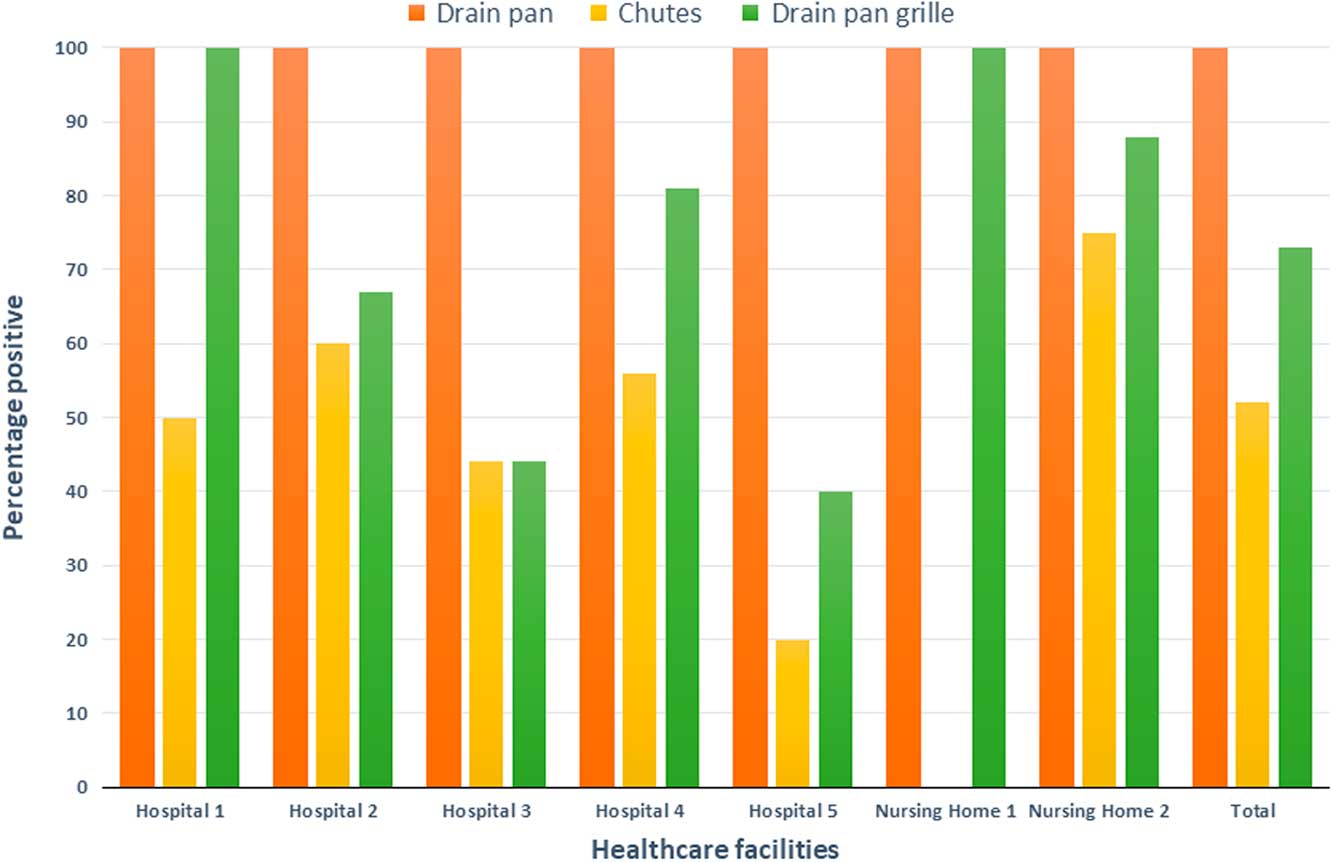
Figure 2 provides a summary of the culture results for the drain pans, ice and/or water chutes, and drain-pan grilles. Gram-negative bacilli and/or Candida spp were recovered from 100% of drain pans, 52% of chutes, and 72% of drain-pan grilles. The frequencies of contamination were similar for the different facilities. The number of colonies recovered was higher for the drain pans; 60 of 64 (94%) had >100 colonies of gram-negative bacilli, and 20 of 64 (31%) had >100 colonies of Candida spp for the chutes and drain-pan grilles. All had <100 colonies of gram-negative bacilli and Candida spp. Of 91 colonies of gram-negative bacilli subjected to identification, 55 (60.4%) were Enterobacteriaceae, 24 (26.4%) were Pseudomonas spp, 5 (5.5%) were Serratia spp, 4 (4.4%) were Stenotrophomonas maltophilia, and 3 (3.2%) were Acinetobacter spp. Of the 91 isolates, 7 (7.7%) were resistant to carbapenems, including 4 isolates of Stenotrophomonas maltophilia and single isolates of Klebsiella pneumoniae, Acinetobacter baumannii, and Enterobacter cloacae. Supplemental Table 1 provides a summary of the organisms identified, stratified by the site of culture collection. Supplemental Figure 1 provides a summary of the Candida spp that were isolated from ice machines; the most frequently recovered species were Candida parapsilosis and Candida lusitaniae. All cultures of water and ice from 15 ice machines were negative.
Percentage of positive cultures for gram-negative bacilli and/or Candida spp from 64 ice machines in 7 healthcare facilities.

We recorded 20 observations of ice machine use for 18 individuals, including 13 nurses (72%), 2 nursing aides (11%), 2 physicians (11%), and 1 patient (6%). Of the 20 observations, 9 (45%) included touching the ice and/or water chutes with bare hands while collecting ice or water. For all 20 observations, ice continued to dispense as the cup was removed by the user, resulting in ice falling directly into the drain pan or onto the drain pan grille and then into the drain pan. Falling ice contacted the user’s hands during 10 of 20 observations (50%). Water continued to dispense for a few seconds after cup removal in 3 of 20 observations (15%), resulting in water falling into the drain pan.
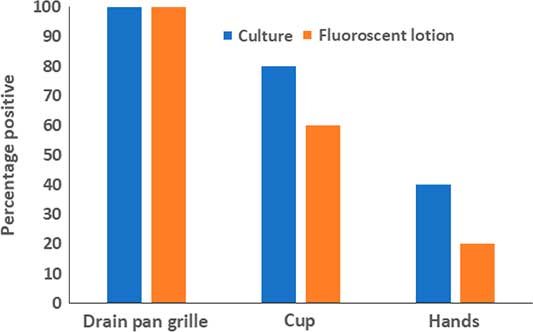
For the 5 contaminated ice machines included in the assessment of dispersal of microorganisms, all cultures of the cup and the ice-machine drain-pan grille were negative after cleaning with hydrogen peroxide disinfectant. After operation of the ice machine, cultures of the drain-pan grille, the bottom half of the cup, and the hands of the user frequently yielded gram-negative bacilli or Candida spp (Figure 3). All positive cultures from hands, drain-pan grilles, and cups yielded organisms that were also recovered from the drain pain. Organisms recovered included Enterobacter cloacae, Acinetobacter baylyi, Enterobacter asburiae, Candida parapsilosis, and Candida tropicalis. For the same ice machines, separate experiments with fluorescent lotion demonstrated frequent dispersal of lotion to the drain-pan grille, the cup, and hands (Figure 3). These observations confirmed that ice cubes that passed through the open slots in the grille caused splattering when they landed directly in contaminated water at the bottom of the drain pan; such splattering could often be felt on the hand holding the cup. In addition, the placement of a thin layer of fluorescent lotion inside the distal ice-exit chute resulted in the transfer of fluorescence to ice cubes exiting the chutes. Supplemental Figure 2 shows pictures demonstrating dispersal of fluorescent lotion from the ice-machine drain pain or ice-exit chute.
Percentage of sites with positive cultures for gram-negative bacilli and/or Candida spp or evidence of dispersal of fluorescent lotion from the bottom surface of the drain pan after the operation of the ice machine. In total, 5 ice machines were tested.

DISCUSSION
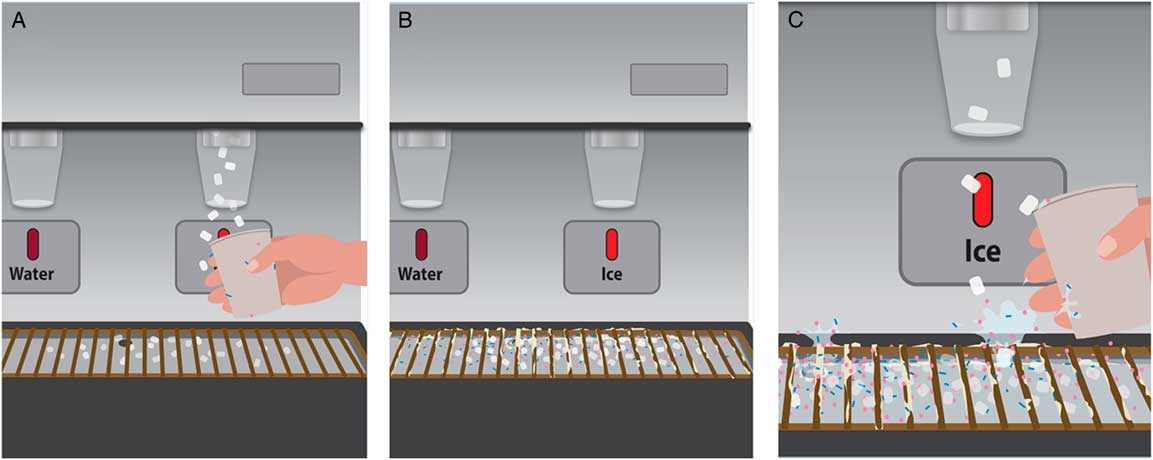
Contaminated ice machines have been implicated as a source of pathogen transmission, but the frequency of contamination and the mechanism of dispersal of pathogens has been unclear. In a survey of multiple healthcare facilities, we demonstrated that the drain pans, ice and water chutes, and drain-pan grille were often contaminated with Candida spp and/or gram-negative bacilli. We observed that the hands of individuals using ice machines often contacted the ice or water chutes or falling ice, suggesting a potential route by which personnel might transfer pathogens to ice machines. Moreover, we demonstrated a mechanism by which contamination of ice machines could contribute to the spread of pathogens. Stagnant water was frequently present in the drain pan of ice machines, creating favorable conditions for growth of bacteria and Candida spp. During operation of the ice machine, ice often fell through the grille, resulting in splattering of water. Cultures confirmed the dispersal of contaminated water from the drain pan to the drain-pan grille, cups, and the hands of those using the ice machine. We also demonstrated the potential for contamination of the inner surface of the ice chute to result in contamination of ice cubes exiting the chute. Figure 4 provides a proposed sequence of events by which ice machines become contaminated, the pathogens colonize the ice-machine drain pan with biofilm formation, and these pathogens are subsequently dispersed during operation of the ice machine.
Proposed sequence of events leading to microbial contamination of and dispersal from ice machines. A, transfer of microorganisms to a noncontaminated ice machine by a user with contaminated hands; B, growth of microbes in the moist drain pan with formation of biofilm; C, ice falling through the grille results in splashing with dispersal of microbes to the from the drain pan to hands of users, cups, and the drain-pan grille. Blue and pink figures represent microbes.

Our findings suggest that the mechanism of dispersal of pathogens from ice machines is analogous to the mechanism of dispersal from contaminated sink drains.Reference Kotay, Chai, Guilford, Barry and Mathers 8 We have demonstrated that Candida spp also frequently colonize hospital sinks and are similarly dispersed.Reference Jencson, Piedrahita and Donskey 9 Although ice machines have not been linked to Candida infections, our finding of frequent Candida spp contamination suggests the potential for these devices to serve a source for transmission. Notably, the microbial flora of the ice machines sampled in the 7 study facilities may not be generalizable to other hospitals and may depend on the local prevalence of antibiotic-resistant organisms.
Effective strategies to prevent dispersal of microorganisms contaminating ice machines need to be developed. Regularly scheduled cleaning of ice machines has been recommended and may be beneficial in reducing the burden of microbes such that dispersal is reduced.Reference Kanamori, Weber and Rutala 1 Optimal standardized approaches for cleaning ice machines need to be developed, acknowledging that ice machines will never be completely sterile. Intermittent application of disinfectants such as bleach or acetic acid has been reported to be effective in reducing contamination of sink drains.Reference La Forgia, Franke, Hacek, Thomson, Robicsek and Peterson 10 , Reference Stjarne Aspelund, Sjostrom, Olsson Liljequist, Morgelin, Melander and Pahlman 11 Another approach might be to modify the design of ice machines. For example, the shallow drain pan on many ice machines may increase the risk for dispersal in comparison to a less shallow design that would better contain splattering water.
ACKNOWLEDGMENTS
Financial support: This work was supported by a Merit Review grant (grant no. 1 I01 BX002944-01A1) from the Department of Veterans Affairs to C.J.D.
Potential conflicts of interest: C.J.D has received research grants from Merck, GOJO, Pfizer, Clorox, and EcoLab and serves on an advisory board for Synthetic Biologics. All other authors report no conflicts of interest relevant to this article.
SUPPLEMENTARY MATERIAL
To view supplementary material for this article, please visit https://doi.org/10.1017/ice.2017.321.