Introduction
Younger-onset dementia (YOD) is defined as a dementia with symptom onset before 65 years of age (Rossor et al., Reference Rossor, Fox, Mummery, Schott and Warren2010). There are approximately 28,000 people with YOD in Australia (Deloitte Access Economics, 2011). YOD accounts for up to 9% of all dementias (Withall et al., Reference Withall, Draper, Seeher and Brodaty2014) and includes a heterogenous range of disorders with the most frequent being Alzheimer’s disease (AD), frontotemporal dementia (FTD), genetic conditions such as Huntington’s disease (HD), metabolic disorders such as Niemann–Pick Type C, and a broad range of other conditions (Loi et al., 2020 submitted; Ferran et al., Reference Ferran1996; Panegyres and Frencham, Reference Panegyres and Frencham2007). The onset of YOD often occurs during middle age, when people are employed, caring for children and older parents, and potentially at the peak of their earning capacity (Withall et al., Reference Withall, Draper, Seeher and Brodaty2014). Early diagnosis is imperative for future planning such as obtaining superannuation and insurance, management of symptoms, and access to treatment trials.
Previous studies have demonstrated that the time to diagnosis in YOD is longer than that for older-onset dementia (OOD). A Dutch study comparing people with YOD to those with OOD reported an additional 1.6 years to obtain a diagnosis in those with YOD (4.4 years vs. 2.8 years, respectively) (van Vliet et al., Reference van Vliet2013). Similarly, an Australian study found that it took on average 2.3 years from symptom onset to first consultation, and 4.7 years to final diagnosis for people with YOD (Draper et al., Reference Draper2016). Factors associated with a longer time to diagnosis have included younger age (van Vliet et al., Reference van Vliet2013), a personal history of depression (Draper et al., Reference Draper2016), and having a dementia other than AD or FTD (Draper et al., Reference Draper2016).
The diagnostic process itself can contribute to diagnostic delays. Two studies published two decades apart reported that people with YOD consulted an average of three clinicians prior to receiving a diagnosis of YOD (Draper et al., Reference Draper2016; Luscombe et al., Reference Luscombe, Brodaty and Freeth1998). People with YOD are frequently diagnosed with a psychiatric disorder in the early stages of their disease due to behavioral changes (disinhibition, impulsivity, and irritability) or psychiatric symptoms (mood disturbance or psychosis) and people with behavioral-variant FTD (bvFTD) are known to present with psychiatric symptoms (Velakoulis et al. Reference Velakoulis, Walterfang, Mocellin, Pantelis and McLean2009). Woolley and others (Reference Woolley, Khan, Murthy, Miller and Rankin2011) reviewed 252 cases of YOD, of which 28.2% had a “new onset” psychiatric diagnosis (within 10 years of dementia diagnosis) and concluded that middle-aged people with a “new onset” psychiatric diagnosis should have an assessment for a neurodegenerative disorder. The mean delay between receiving a psychiatric diagnosis to an accurate dementia diagnosis has been reported to range between 3 years (Woolley et al., Reference Woolley, Khan, Murthy, Miller and Rankin2011) and 10 years (Velakoulis et al., Reference Velakoulis, Walterfang, Mocellin, Pantelis and McLean2009).
Specialist YOD services have been recommended as there are different needs compared to those with people with OOD. Recommendations are two-fold. First, streamlining the diagnostic pathway would mean that people can access appropriate investigations in order to obtain a timely diagnosis. Second, these services need to be flexible, person-centric, and age-appropriate. Thus, YOD-specific concerns such as financial and employment issues, management of comorbid psychiatric symptoms, and the provision of meaningful and stimulating activities can be addressed (Carter et al., Reference Carter, Oyebode and Koopmans2018; Sansoni et al., Reference Sansoni, Duncan, Grootemaat, Capell, Samsa and Westera2016).
The primary objective of the current study was to investigate the time to diagnosis and the factors associated with this time, in people admitted to a tertiary specialist service for diagnostic assessment, who were ultimately diagnosed with YOD. We hypothesized that a longer time to diagnosis would be associated with: (1) younger age at onset; (2) diagnosis other than AD or bvFTD; (3) higher number of specialist consultations; and (4) a psychiatric disorder within 10 years prior to diagnosis. A secondary objective was to investigate the impact of a specialist YOD service on this time to diagnosis.
Methods
Study setting
This was a retrospective cross-sectional study of people admitted to Neuropsychiatry, Royal Melbourne Hospital between 2009 and 2019. Neuropsychiatry is a tertiary specialist diagnostic and assessment service for individuals referred with cognitive, behavioral, and psychiatric symptoms. Approximately, 40% are diagnosed with YOD with the remainder diagnosed with a primary psychiatric illness (e.g. schizophrenia and mood disorder), primary neurological disorder (e.g. Parkinson’s disease), or a variety of neuropsychiatric diagnoses (Loi et al., 2020 submitted).
In 2014, in response to a growing need to provide dedicated specialized services for people with YOD, neuropsychiatry established the Melbourne Younger-Onset Dementia service (MYOD; www.myod.org). MYOD aimed to improve the patient and family experience by reducing diagnostic delay, increasing access to appropriate clinical services, thus improving clinical outcomes. It was anticipated that rapid access to neuroimaging and biomarker testing such as cerebrospinal fluid investigation, as well as multidisciplinary assessments and interventions, would help mitigate diagnostic delay and establish a platform for ongoing management. MYOD also worked with the local hospital neurogenetic service to increase access to genetic counseling was relevant for people with YOD and families. MYOD was developed in collaboration with established community stakeholders, such as Alzheimer’s Australia Victoria (AAV) (now called “Dementia Australia”), in order to provide ongoing education and training for AAV support workers and to facilitate easier access from neuropsychiatry to these community services (and vice versa). These community services included financial support, counseling for people with YOD and families, involvement in groups, and home care services such as personal care.
Clinical assessments
All inpatients receive comprehensive neuropsychiatric assessment including neuropsychiatry, neurology, neuropsychology, social work, speech pathology, occupational therapy, neuroimaging (structural and functional), and blood and cerebrospinal fluid (CSF) biomarkers. This diagnostic process includes the collation of information from multiple sources including family, previous health professionals, and hospital assessments. Diagnoses are made on the basis of multidisciplinary assessments and are based on contemporaneous diagnostic criteria, such as National Institute of Neurological and Communicative Diseases and Stroke and the Alzheimer’s Disease and Related Disorders Association (NINCDS-ADRA) or National Institute on Aging and the Alzheimer’s Association (NIA-AA) for AD (McKhann et al., Reference McKhann2011) and International Consensus Criteria for bvFTD (Rascovksy et al., Reference Rascovksy2011). A comprehensive summary incorporating all information and assessments is provided to referring clinicians.
A detailed description of the neuropsychiatry inpatient population has been previously described (see Loi et al. 2020 submitted). In brief, from 1 January 2009 to 7 September 2019, there were 1097 inpatient admissions for a neuropsychiatric diagnostic workup. A total of 849 individual inpatients remained in the study after the exclusion of repeat admissions (369) of 121 individual inpatients. Of these 849 people, 373 received a final discharge diagnosis of a dementia. We excluded 52 inpatients who had symptom onset over 65 and 15 inpatients whose initial dementia diagnosis was reclassified to a psychiatric diagnosis after follow-up. People with a diagnosis of HD (n = 53) and Niemann–Pick Type C (n = 11) were excluded as these people had known genetic diagnoses at the time of admission. The final study sample consisted of 242 individual people with a YOD diagnosis (22% of the overall 849 individual inpatients).
Data collection
The discharge summaries were examined, and the following information was collected:
1. Demographic information including age, sex, and address. The Accessibility/Remoteness Index of Australia (ARIA) was used to classify where the patient lived (Department of Health, 2011). The Australian Bureau of Statistics has listed five categories of remoteness: major cities, inner regional, outer regional, remote, and very remote. These categories were collapsed into three – major cities; inner regional; and outer regional/remote;
2. Age at symptom onset. The age of the first verified symptom (through patient, carer, or professional information) which could be attributable to a dementia;
3. Time to diagnosis. The time between symptom onset and dementia diagnosis;
4. Number of specialists (“services”) seen following symptom onset. This was calculated as the number of unique specialist opinions (memory clinic, psychiatrist, neurologist, and geriatrician) obtained prior to obtaining a final diagnosis;
5. Cognition. The Neuropsychiatry Unit Cognitive Assessment tool (NUCOG) is a reliable and valid measure of the five domains of cognition (attention, visuospatial, memory, executive function, and language) with a total score of 100. A higher score indicates better cognition (Walterfang et al., Reference Walterfang, Siu and Velakoulis2006);
6. “New onset” psychiatric disorder. This was defined as a psychiatric disorder that was within 10 years of the dementia diagnosis, which is based on Woolley et al. (Reference Woolley, Khan, Murthy, Miller and Rankin2011).
If there was any ambiguity between any of the variables, an additional team member (DV or DE) was asked to evaluate these variables and a consensus was made.
Statistical analysis
Statistical analysis was performed using Statistical Package for Social Sciences (SPSS, Version 26; IBM Incorporation, Armonk, NY, USA) and Jamovi (The Jamovi Project, 2020, Version 1.2). Chi-squared tests of independence were used to compare categorical variables. Student’s independent samples t-tests and analysis of variance (ANOVA) were used to compare continuous data between dementia subgroups. To compare variables between the inpatients pre-MYOD and within MYOD, an arbitrary cut-off was made in 2014, approximately when MYOD commenced.
Multivariable general linear models (GLMs) were used to identify predictors of delay to diagnosis. All predictors were entered in a single block (sex, dementia type, NUCOG score, psychiatric history, age at onset, and number of services consulted prior to diagnosis). Dementia type was dummy-coded using the “AD” category as the reference class. ARIA was dummy-coded using “major cities” category as the reference class. Care was taken to check for statistical assumptions, including non-multicollinearity, lack of autocorrelation, and satisfactory distribution of model residuals.
This study was approved by the local hospital research ethics committee (2016.038).
Results
Demographics (Table 1)
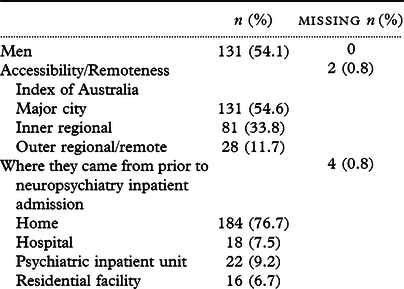
Demographics of 242 inpatients with a diagnosis of YOD

The mean age at the index inpatient admission was 55.7 years (SD = 9.0, range 24–70 years), and 54% of the people with YOD were men. Sixty-five percent achieved secondary education. Over half of the inpatients lived in ARIA-coded “major city,” and approximately, 75% came from home prior to their admission. The majority of people with YOD were Caucasian (91.4%) with the remainder being of Asian (5.7%) and African/Middle Eastern (2.9%) background.
YOD diagnoses and clinical characteristics
Diagnosis
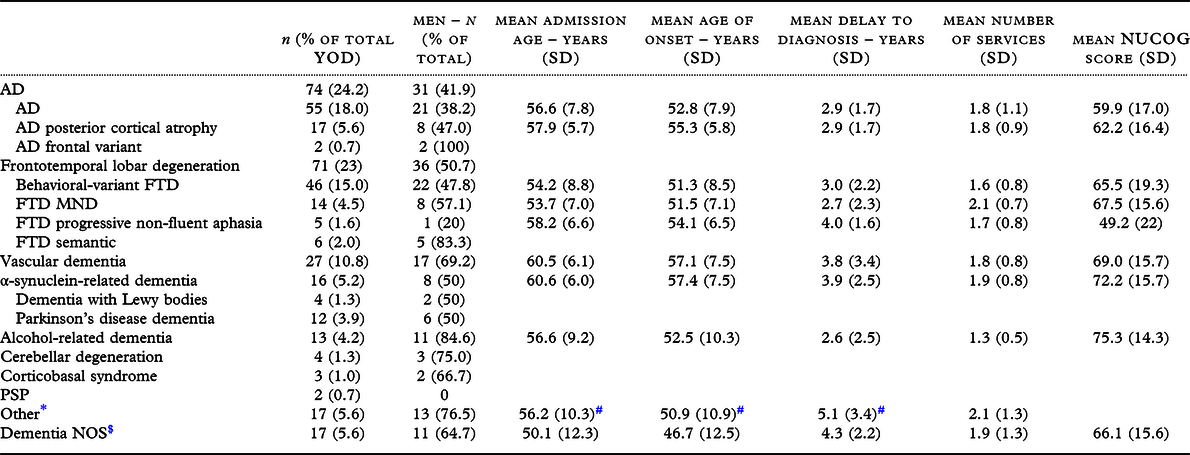
The commonest dementia diagnosis was AD (24.2%), followed by frontotemporal lobar degeneration, FTLD (23.0%), and vascular dementia, VaD (10.8%) (Table 2). AD diagnoses consisted of AD, AD posterior cortical atrophy subtype, and AD frontal variant (atypical AD); FTLD diagnoses consisted of bvFTD, FTD motor neuron disease (FTD-MND), and language-variant FTD (non-fluent aphasia and semantic dementia); α-synuclein-related dementia diagnoses consisted of dementia with Lewy bodies and Parkinson’s disease dementia. “Other dementia” consisted of less common dementias such as adrenoleukodystrophy and dementia related to human immunodeficiency virus and multiple sclerosis.
Details of YOD diagnoses in 242 inpatients

* Includes adrenoleukodystrophy (n = 2), multiple sclerosis (MS) related (n = 2), and HIV-related dementias (n = 2).
# Includes categories of cerebellar degeneration, PSP, corticobasal syndrome as well as adrenoleukodystrophy, MS- and HIV-related dementias.
$ Dementia NOS refers to dementia of which no etiology could be identified.
NOS = not otherwise specified; PSP = progressive supranuclear palsy; VaD = vascular dementia.
Age at onset
The mean age of onset was 52.5 years old (SD = 9.3) and median 54.5 years old (IQR = 48.0–59.0) with a range of 19–65 years. Inpatients with a diagnosis of dementia not otherwise specified had the youngest age at onset (M = 46.7 years, SD = 12.5), compared to people with VaD (M = 57.0, SD = 7.5), α-synuclein-related dementia (M = 57.4, SD = 6.2), and atypical AD (M = 55.3, SD = 5.8; F(9,234) = 2.93, p = 0.03).
NUCOG
The degree of cognitive impairment as measured by the NUCOG was moderate with a mean score of 66.0 (SD = 27.9, range = 16, 98.5). ANOVA demonstrated differences between the dementia types, F(9,192) = 3.02, p = 0.002 with people who had a language-variant FTD (mean NUCOG 49.2, SD = 22) having the lowest NUCOG score compared to those with alcohol-related dementia (mean NUCOG 75.3, SD = 14.3), other dementia (mean NUCOG 78.2, SD = 17.6), p = 0.02; and people with AD (mean NUCOG 59.2, SD = 17) having poorer cognition also compared to those with other dementia (mean NUCOG 78.2, SD = 17.6; p = 0.03).
Number of services
There was a mean and median of two services consulted (IQR = 1), ranging from 0 to 6, and there was no evidence for a difference in the number of services consulted for the different dementia subtypes (F(9,236) = 0.99, p = 0.45).
Psychiatric history
A total of 197 people with YOD had a psychiatric history (82.1%). Overall, 125 (52%) had a “new onset” psychiatric diagnosis (defined as within 10 years of dementia diagnosis), 72 (30%) had a > 10-year psychiatric history, and 43 (17.9%) had no known psychiatric history. There were no significant differences in the proportion of people with YOD within each psychiatric history subgroup between dementia subtypes (χ2(18) = 23.65, p = 0.17).
The effect of the MYOD service
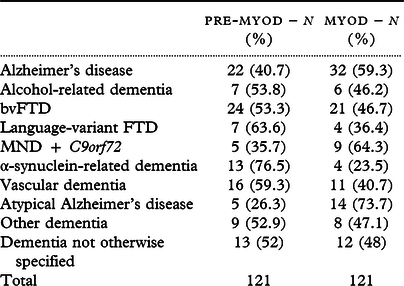
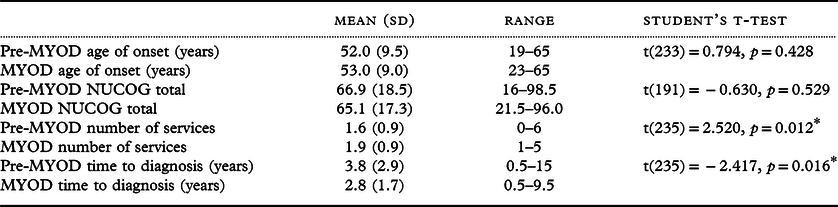
There was no evidence of differences between demographic variables, between inpatients pre-MYOD and within MYOD in terms of sex (χ 2(1) = 2.813, p = 0.09) and ARIA location (χ 2(2) = 4.245, p = 0.12). There was no evidence that the types of dementia seen in the two groups differed (χ 2(9) = 14.142, p = 0.12). There were more people with atypical AD and MND/c9orf72, and fewer people with α-synuclein-related dementias seen in the MYOD group (Table 3). Investigating other characteristics between the two groups revealed no evidence of a difference in age at onset (p = 0.43) or NUCOG score (p = 0.53) (Table 4). There was a difference in the number of services consulted prior to obtaining a dementia diagnosis with mean numbers of services of 1.6 (SD = 0.9) and 1.9 (SD = 0.9) in the pre-MYOD and MYOD groups, respectively (t(235) = 2.520, p = 0.01).
Dementia diagnoses seen in the pre-MYOD and MYOD groups of inpatients

Differences between pre-MYOD and MYOD groups of inpatients

*p<0.05.
Delay to diagnosis
There was a mean of 3.4 years (SD = 2.4) and median of 2.0 years (IQR = 2,4) time to diagnosis across the entire group of 242 people with YOD (range = 0.5, 15 years). There was no evidence for a sex difference in diagnostic delay between men (M = 3.7 years, SD = 2.7) and women (M = 3.1 years, SD = 1.9; t(234) = 1.85, p = 0.07). Similarly, diagnostic delay was comparable between Caucasian (M = 3.4 years, SD = 2.4) and non-Caucasian inpatients (M = 3.7, SD = 2.6; t(234) = 0.06, p = 0.55).
There was no difference in diagnostic delay between people with YOD residing in major cities (M = 3.5 years, SD = 2.5) compared to people from the inner regional areas (M = 3.2 years, SD = 2.2) and those in outer regional/remote areas (M = 3.7 years, SD = 2.5; F(2, 233) = 0.52, p = 0.59).
There was a difference in diagnostic delay within the different types of dementia (F(9,235) = 2.31, p = 0.02). This was found for people with AD (M = 2.9 years, SD = 1.7) and alcohol-related dementia (M = 2.6 years, SD = 2.5) who had a shorter time to diagnosis compared to the “other dementia” group (M = 5.1 years, SD = 3.4).
There was also a significant reduction in time to diagnosis in the MYOD group (M = 2.8 years, SD = 1.7; t(235) = −2.417, p = 0.02) compared to pre-MYOD (M = 3.8 years, SD = 2.9) (Table 4).
Predictors of delay to diagnosis
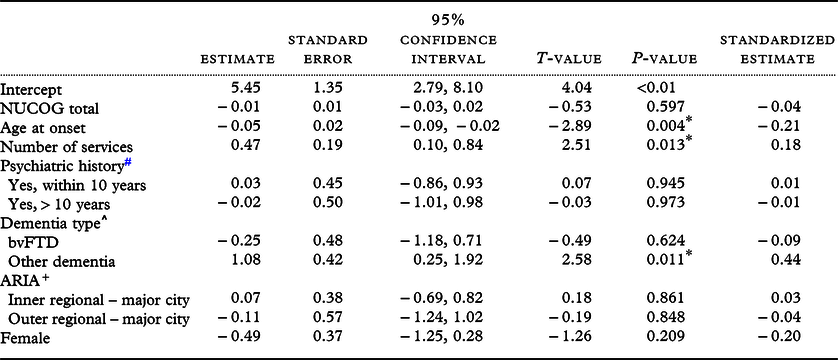
A GLM was estimated using data from the 242 inpatients to investigate the predictors of the delay to diagnosis. The resulting R 2 was calculated to be 15.1%. Predictors were younger age at onset, increasing number of services consulted prior to diagnosis, and having a dementia other than AD and bvFTD. These are shown in Table 5.
GLM model coefficients for time to diagnosis

# Reference class = no psychiatric history; ^ Reference class = AD; + = Reference class = major city.
*p<0.05.
For age at onset, while keeping the other variables constant, 1 year younger in age of onset corresponds with an increase on average of 0.05 years (approximately 20 days) delay in diagnosis (95% CI = −0.09, −0.02). Similarly, for number of services, one additional service consulted, corresponds on average to an increase of 0.47 years (approximately 6 months) in diagnostic delay (95% CI = 0.10, 0.84). A person who will be diagnosed with a dementia other than AD or bvFTD will have an average increase of 0.42 years (approximately 5 months) in diagnostic delay (95% CI = 0.25, 1.92).
Discussion and Conclusions
The objectives of this study were to estimate the time to diagnosis and factors associated with this time in a group of people with YOD who had undergone comprehensive multidisciplinary assessments within the same service over 10 years. We have shown that the time to diagnosis increases by 20 days for every year younger a patient is at symptom onset, by 6 months for each additional specialist/service contact, and by 5 months for rarer diagnoses of dementia. In addition, time to diagnosis was further reduced by 12 months following the establishment of a specialist YOD service. To our knowledge, this is the first study to investigate the time to diagnosis and the factors contributing to diagnostic delays in this way and has significant implications for the establishment provision of specialist YOD services.
Our hypotheses that younger age at onset, dementia type other than AD or bvFTD, and number of services consulted would be associated with increased time to diagnosis were confirmed. The mean time to diagnosis in our YOD cohort was 12 months less than has been previously identified (3.5 years vs. 4.5 years) (Draper et al., Reference Draper2016; van Vliet et al., Reference van Vliet2013).
Our finding that the time to diagnosis was similar in people with AD (2.9 years) and FTD (3.0 years) differs from previous findings that time to diagnosis is greater in FTD compared to AD (Roberson et al., Reference Roberson2005; van Vliet et al., Reference van Vliet2013). Roberson et al. (Reference Roberson2005) compared 177 people with FTD (onset less than 65) with 396 people with older-onset AD and found that the mean time to diagnosis was 4 years and 4.5 years in AD and bvFTD, respectively. Van Vliet et al. (Reference van Vliet2013) reported 4.2 years and 6.4 years for YOD AD and FTD, respectively. There are two major differences between these previous studies and our findings. First, the time to diagnosis for both AD and FTD was lower than other studies, and second, the time to diagnosis of AD and FTD was similar. Our regular use of CSF biomarkers for AD means a more timely and arguably accurate diagnosis of AD, while our psychiatry-run specialist MYOD service maybe more “attuned” to the diagnosis of bvFTD which often presents with psychiatric and behavioral symptoms. The time to diagnosis for VaD in our study (3.8 years) was similar to that found by Van Vliet et al. (Reference van Vliet2013).
We did not find evidence for a difference in time to diagnosis between people with YOD living in metropolitan, regional, or remote locations. It has been noted that the absence of specialized services in rural regions may lead to increased delays in specialist assessment and diagnosis (Luscombe et al., Reference Luscombe, Brodaty and Freeth1998; Sansoni et al., Reference Sansoni, Duncan, Grootemaat, Capell, Samsa and Westera2016). Our neuropsychiatry service has established strong connections with regional and rural mental health services which may have led to a lower threshold for referral. Our referral pathway also prioritizes inpatient assessments for people from regional or remote regions. We did not identify any difference in time to diagnosis between women and men, in contrast with some reports that women are more help-seeking which facilitates earlier recognition and diagnosis (Mackenzie et al., Reference Mackenzie, Gekoski and Knox2006).
There was no relationship between cognitive function at admission as measured by the NUCOG and time to diagnosis; however, others have reported that having a diagnosis of a mild cognitive impairment contributes to increased time to diagnosis (Draper et al., Reference Draper2016). Cognitive symptoms such as memory problems, disorientation, and language changes can be obvious symptoms of a dementia that might lead to earlier presentations. Conversely, people may minimize and place strategies to conceal these symptoms, thus delaying presentation for assessment.
People with YOD often present with psychiatric symptoms (Shinagawa et al., Reference Shinagawa2007; Velakoulis et al., Reference Velakoulis, Walterfang, Mocellin, Pantelis and McLean2009; Woolley et al., Reference Woolley, Khan, Murthy, Miller and Rankin2011) resulting in diagnostic delay (Draper et al., Reference Draper2016; van Vliet et al., Reference van Vliet2011) due to diagnostic overshadowing (Woolley et al., Reference Woolley, Khan, Murthy, Miller and Rankin2011). In our study, for dementias such as AD and bvFTD, while there was a high number of a “new onset” psychiatric diagnoses, this did not significantly affect time to diagnosis, as has been reported by others (Ferran et al., Reference Ferran1996). Certain YODs such as FTD caused by the C9orf72 mutation are recognized to often present with psychotic symptoms (Snowden et al., Reference Snowden2012). More than 80% of our sample had a psychiatric history, and other authors have found that certain psychiatric disorders are associated with dementia in later life (Zilkens et al., Reference Zilkens, Bruce, Duke, Spilsbury and Semmens2014), so considering psychiatric disorders as additional risk factors for dementia might be targets for early intervention. Other reasons leading to longer delay might be a reluctance to seek help and under-recognition by primary care and family (Luscombe et al., Reference Luscombe, Brodaty and Freeth1998; van Vliet et al., Reference van Vliet2011).
Our confirmed hypotheses are consistent with previous studies (Draper et al., Reference Draper2016; Luscombe et al., Reference Luscombe, Brodaty and Freeth1998). AD and bvFTD have been found to be the most frequently occurring YOD (Fujihara et al., Reference Fujihara, Brucki, Rocha, Carvalho and Piccolo2004; Panegyres and Frencham, Reference Panegyres and Frencham2007), and less common dementias would be more difficult to identify. It is not surprising that a greater number of services consulted was associated with a longer time to diagnosis – an additional service led to a further 6 months of diagnostic delay. Our study did not report the types of services consulted, but Draper et al. (Reference Draper2016) did not find a difference in delay depending on the type of specialist seen. Contrary to this, Luscombe et al. (1988) reported that misdiagnosis was more common when the person was seen by a psychiatrist (33% vs. 13%).
The establishment of a specialist YOD service, MYOD, led to a 12-month reduction in time to diagnosis. There are a number of possible explanations for this reduction. First, MYOD provides a specialist YOD service recognized by the local and regional community mental health, and geriatric and neurology services. It undertakes a weekly team meeting when all referrals are discussed to provide rapid triaging. Second, the 8-bed-associated inpatient unit provides continuous, comprehensive “one-stop shop” assessments (neuropsychiatry, neurology, neuroimaging, biomarkers, and other investigations and allied health), which occurs during a 2-week admission. This avoids the delay and missed appointments which might occur if these assessments were to be scheduled separately and at different outpatient/community appointments and locations. Third, as psychiatrists receive many referrals from community mental health services, the diagnostic overshadowing that can occur in people with psychiatric disorders might be mitigated, thus MYOD has a crucial role in facilitating assessments and diagnoses of YOD in people with complex psychiatric and behavioral presentations.
While there were no significant differences in the types of dementias seen in the pre-MYOD and MYOD groups, it is not unexpected that in the MYOD group, there were more inpatients diagnosed with a genetic C9orf72 FTD-MND, as the recognition of this mutation is relatively recent (Khan et al., Reference Khan2012) and access to testing for this would not have been available during the pre-MYOD period. In addition, during the later years, we diagnosed more atypical AD, suggesting that with a mature specialist YOD service, there is better recognition with the less common dementias, and thus earlier diagnosis. People in the MYOD group had been seen on average by more services prior to diagnosis (1.9) compared to the pre-MYOD group (1.6). This finding was counterintuitive given the reduced time to diagnosis in the MYOD group. It is unclear how clinically significant this is but this result suggests additional factors that contribute to time to diagnosis.
There are a number of limitations of this study, which was retrospective in nature and relied on inpatient summaries as the primary source of our data. Our comprehensive assessments and discharge summaries collate all available information on each patient from multiple sources, and as such, we believe are as accurate as possible for retrospective data. Our diagnoses were based on the clinical information and multidisciplinary consensus using available diagnostic criteria, not “gold standard” diagnoses based on neuropathological confirmation. Our study method did not allow for qualitative information about the difficulties and barriers people had with their referral and diagnostic pathway. Further studies should expand on previous findings such as challenges in recognition that something was “wrong” by the families, the people with YOD themselves, and health professionals (Cations et al., Reference Cations2017; van Vliet et al., Reference van Vliet2011). However, there are several advantages of our study compared to previous studies. The referrals people to our service were within a naturalistic “real world” setting, and we had a large sample size with a range of YOD diagnoses.
In summary, our findings of 3.4 years delay from symptom onset to a diagnosis of YOD remain unacceptably long for receiving a dementia diagnosis, especially in a younger population. We have shown that the introduction of a specialist YOD service led to a 12-month reduction in time to diagnosis. We were able to identify a number of factors that contributed to delay in diagnosis – younger age at onset, dementia type other than AD or bvFTD, and number of services consulted. These findings provide strong support for the establishment of a specialist YOD service with efficient and rapid referral processes, thorough diagnostic assessments, provision of training to community services, and post-diagnostic support.
Conflict of interest
There is no conflict of interest to declare.
Description of authors’ roles
SML conceived the idea, designed the study, contributed to data entry, statistical analysis, and writing of the manuscript. SP contributed to the literature review and data entry. CBM contributed to the statistical analysis. AMYG, RM, DE, AE, WK, SF, MW, and DV had intellectual contributions to the manuscript. DV conceived the idea, designed the study, and supervised SML.
Funding
SML was funded by the National Health and Medical Council Early Career Fellowship (GNT1138968) and the Yulgilbar Alzheimer’s Research Program.
All data that support the findings of this study are available on request from the corresponding author.
Acknowledgments
We would like to acknowledge the people with YOD and families who attend the service as well as all previous members of the clinical team.