Introduction
Under optimal nasal breathing conditions, air passes over the nasal mucosa resulting in warming, humidification and cleansing. However, these conditions can be influenced by several factors. Indoor air quality may negatively affect the sinonasal mucosa and is associated with occupational and smoking irritants, which can cause chronic or allergic rhinitis.Reference Higgins and Reh1 To maintain proper nasal functions, the optimal indoor air temperature should be approximately 23 °C with 50 per cent humidity.Reference Fang, Wyon, Clausen and Fanger2 Indoor air is often cleaned to limit the levels of pollutants by modifying temperature and humidity in houses and offices.Reference Fang, Wyon, Clausen and Fanger2 However, the improper maintenance, design and operating of air-conditioning systems in non-industrial indoor areas contributes to an increased prevalence of rhinitis.Reference Wargocki, Sundell, Bischof, Brundrett, Fanger and Gyntelberg3 In Turkey, smoking is prohibited indoors and in common social areas.
Allergic rhinitis is a symptomatic disorder caused by immunoglobulin E-mediated inflammation of the nasal membranes, which is induced by exposure to an allergen or allergens. Allergic rhinitis frequently causes symptoms that include sneezing, nasal obstruction, itching and discharge, and it may also affect coexisting diseases. Diagnosis is based on a detailed clinical history, an otorhinolaryngological examination and epidermal skin tests. T helper 2 lymphocytes secrete cytokines, such as interleukins 3, 4, 5, 13 and 17 and eotaxin (CCL3 and CCL5), which are released from eosinophils and are associated with the symptoms and severity of allergic rhinitis.Reference Gaspar Elsas, Joseph, Elsas and Vargaftig4–Reference Bystrom, Patel, Amin and Bishop-Bailey6
Indoor swimming pools are relatively hot environments (approximately 30 °C) and their humidity ranges between 50 and 60 per cent continuously.Reference Dang, Chen, Mueller, Dunn, Almaguer and Roberts7 Sodium and calcium hypochlorite, which are commonly used as disinfectants in swimming pools, cause irritation of the nasal mucosa and exacerbate the symptoms of rhinitis.Reference Gelardi, Ventura, Fiorella, Fiorella, Russo and Candreva8 Rhinitis is common among athletes, especially swimmers.Reference Belda, Ricart, Casan, Giner, Bellido-Casado and Torrejon9 However, pool workers spend more time in and around swimming pools compared to swimmers and are also exposed to sodium and calcium hypochlorite. A number of studies of swimmers have been performed, but fewer studies have focused on pool workers.Reference Gelardi, Ventura, Fiorella, Fiorella, Russo and Candreva8–Reference Ferrari, Schenk, Mantovani, Papadopoulou, Posenato and Ferrari12
In one study, swimmers had poorer nasal functions compared to runners, but only the post-nasal drip was significantly different between the two groups. The authors concluded that the results supported the existence of swimming-induced rhinitis independent of the atopic status of the athlete.Reference Alves, Martins, Delgado, Fonseca and Moreira10 In a further study, nasal symptoms increased in competitive swimmers and were not related to seasonal allergen exposure in atopic athletes; thus, these symptoms likely resulted from exposure to chlorine derivatives.Reference Bougault, Turmel and Boulet11 Evaporation of airborne trichloramine from pool water can cause eye and nasal symptoms among pool workers and trainers, who spend extended periods of time at swimming pools. The most frequent symptoms are red eyes, a runny nose, loss of voice and cold-like symptoms.Reference Ferrari, Schenk, Mantovani, Papadopoulou, Posenato and Ferrari12, Reference Fantuzzi, Righi, Predieri, Giacobazzi, Petra and Aggazzotti13 These symptoms are due to irritation of the nasal mucosa and can be investigated using nasal cytology. Nasal smears can be assessed easily using light microscopy and can reveal relevant information about the predominant cell types infiltrating the nasal cavity. The dominant cell type allows the identification of the type of rhinitis.
In this study, we used nasal cytology and the skin prick test to evaluate the relationship between swimming pool pollutants and rhinitis in pool workers who had high exposure to indoor pollutants compared to a symptom-free control group.
Materials and methods
The study protocol was approved by the Ethics Committee of the Eskişehir Osmangazi Faculty. All subjects gave their written informed consent. The study was performed at the indoor, half-Olympic size swimming pool of Anadolu University, Eskişehir, Turkey. In total, 27 indoor pool workers were enrolled in the study (group 1). These subjects worked 8 hours per day within the pool area, 6 days per week for over one year. The group comprised trainers, lifeguards and cleaners.
The control group (group 2) consisted of 49 office workers with the same age and sex distributions as group 1. The control group worked in a controlled, air-conditioned working environment.
Exclusion criteria included any sign of infection at the time of the study, a previous history of any chronic disease, pregnancy, use of antihistamines, nasal or systemic steroids, or evidence of leukotrienes in the three months preceding the study.
All subjects were evaluated using a detailed clinical history, an otorhinolaryngological examination and a skin prick test. After obtaining a detailed clinical history from each patient, a skin prick test was performed and a nasal smear was obtained to evaluate rhinitis. Nasal smears were taken from the middle third of the inferior turbinate of each nostril using a cotton swab. The smears were fixed in ethyl alcohol and Wright stain solution was applied for examination by light microscopy (BX53 Upright microscope, Olympus America Inc., Center Valley, Philadelphia, USA). The same histology specialist examined each sample in a blinded fashion. The number of goblet cells, epithelial cells, neutrophils, basophils and eosinophils was counted in each magnified area. Finding one cell in a 10 × magnification field was counted as 1 and finding two cells in that area as 2. Both were considered positive cellular findings. All samples were also checked for dysplasia, metaplasia and atypia.
Pool specifications
The half-Olympic size pool is 25 m long, 16 m wide and 2.25 m deep. It holds 1200 m3 of water, is filtered approximately every 4 hours and has a standard temperature of 26–28 °C throughout the year. All chemical agents, such as liquid and powdered chlorine, used for cleaning the pool are the same in all of the pools provided by the Ministry of Health in Turkey. Daily analysis of the pool water is performed routinely. Deeper cleaning is performed by a pool robot and by means of deep skimmer nets. The pool is open for 11 months a year, 6 days per week.
Statistical analyses
Statistical analyses were peformed using SPSS version 18.0 for Windows (SPSS, Inc., Chicago, Illinois, USA). The Shapiro–Wilk test was used to test data normality. For normally distributed, continuous data, groups were compared using independent sample t-tests; the Mann–Whitney U test was used for variables that were not normally distributed. The general linear model for repeated measurements was used for the intra-group comparisons. The chi-square (χ 2) and exact tests were used to compare categorical variables. A p value < 0.05 was chosen as indicating statistical significance.
Results
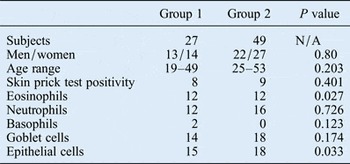
The study included a total of 76 patients: 41 women and 35 men. Both groups 1 and 2 consisted of more women than men. However, there was no significant difference in gender distribution between the two groups (χ 2 = 0.064, p = 0.80, p > 0.05). The groups were also similar with regard to mean age (F = 1.297, p = 0.203, p > 0.05). Group 1 comprised 27 pool workers with an age range of 19–49 years (mean age: 31.33 ± 7.64) and group 2 (control group) comprised 49 subjects with an age range of 25–53 years (mean age: 33.65 ± 6.94). The general characteristics of both groups are summarised in Table I.
Characteristics of the two study groups

N/A = not applicable
Of the 27 subjects in group 1, nasal cytology revealed that 12 (44.4 per cent) had no epithelial cells, 12 (44.4 per cent) had one epithelial cell and three (11.1 per cent) had two epithelial cells. In group 2, nasal cytology revealed that 31 (63.3 per cent) of the 49 subjects had no epithelial cells and only 18 (36.7 per cent) had one epithelial cell. In group 2, no subjects had two epithelial cells. Group 1 had significantly more epithelial cells than group 2 (χ 2 = 6.796, p = 0.033) (Figure 1).
Epithelial cell disturbance in the two study groups.

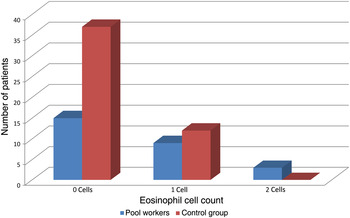
Of the 27 subjects in group 1, nasal cytology revealed that 15 (55.6 per cent) had no eosinophils, nine (33.3 per cent) had one eosinophil and three (11.1 per cent) had two eosinophils. In group 2, nasal cytology revealed that 37 (75.5 per cent) of the 49 subjects had no eosinophils and only 12 (24.5 per cent) had one eosinophil. In group 2, no subjects had two eosinophils. Group 1 had significantly more eosinophils than group 2 (χ 2 = 6.950, p = 0.027) (Figure 2).
Eosinophil cell disturbance in the two study groups.

Dysplasia, metaplasia and atypia were not observed in nasal smears from either group. The number of goblet cells (χ 2 = 3.058, p = 0.174), neutrophils (χ 2 = 1.427, p = 0.726) and basophils (χ 2 = 3.728, p = 0.123) was not significantly different between the two groups.
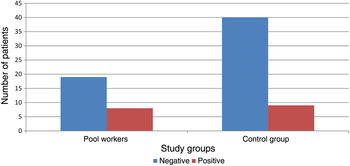
Of the 27 subjects in group 1, 8 (29.6 per cent) had positive skin prick tests, while 9 of the 49 subjects (18.4 per cent) in group 2 had positive skin prick tests to one or more allergens (mostly fungus and mites). The skin prick test results of both groups were not significantly different (χ 2= 0.706, p = 0.401) (Figure 3). All subjects with a positive skin prick test had eosinophils present in their nasal smears. Of the 27 subjects in group 1 with a negative skin prick test (19 subjects), four had only neutrophils and four had eosinophils and neutrophils.
Skin prick test results for the two study groups.

Discussion
Two main causes of allergic and non-allergic rhinitis affecting indoor swimmers and pool workers have been suggested: namely, fungus and mites in the case of allergic rhinitis, and chlorine and its derivatives in the case of non-allergic rhinitis.Reference Gelardi, Ventura, Fiorella, Fiorella, Russo and Candreva8, Reference Goutziana, Mouchtouri, Karanika, Kavagias, Stathakis and Gourgoulianis14–Reference Weng, Weaver, Afifi, Blatchley, Cramer and Chen17
Hypersensitivities to fungus and mites are aggravated by the time spent within the pool area, which leads to cytological changes. The concentrations of chlorine by-products in indoor air, such as trihalomethanes and trichloramine, have been found to be correlated with the concentrations found in the pool water.Reference Bessonneau, Derbez, Clément and Thomas18 Pool water is more polluted in the winter than in the summer; this is due to the number of swimmers and the low air exchange rate in the pool. Indoor air pollution is also related to the size of the swimming pool hall and the volume of water in the pool. Increasing the flow of fresh air in the pool complex or restricting overtime work and the number of swimmers in the pool could reduce the symptoms of rhinitis.Reference Bessonneau, Derbez, Clément and Thomas18
Nasal cytology is easy to perform and can indicate inflammation by identifying the cell types present; it can give accurate and quick results in a short period of time. Eosinophil counts are used for screening allergic rhinitis patients. Therefore, we combined nasal cytology with a skin prick test. Gelardi et al. reported predominantly neutrophilic inflammation and allergic rhinitis in symptomatic swimmers and suggested that this could be prevented by avoiding direct contact with chlorinated pool water.Reference Gelardi, Ventura, Fiorella, Fiorella, Russo and Candreva8 Unlike other reports, in our study, we evaluated the nasal cytology of indoor pool workers who had no direct contact with the swimming pool to assess the indirect effect of the evaporation of airborne chlorine. In contrast to Gelardi et al.Reference Gelardi, Ventura, Fiorella, Fiorella, Russo and Candreva8 we did not find significant numbers of neutrophils in the nasal smears, and considered that this was likely due to the lack of contact between the nasal mucosa and the pool water.
A recent study from Iran showed that 25.61 per cent of a group of 50 allergic patients had nasal smears positive for eosinophils, with the tests showing a sensitivity, specificity, positive predictive value and negative predictive value of 74, 90, 88 and 77 per cent, respectively.Reference Ahmadiafshar, Taghiloo, Esmailzadeh and Falakaflaki19 We found significant epithelial and eosinophilic infiltration in the pool worker group (p = 0.033 and p = 0.027, respectively). A nasal smear is the only method for evaluating the predominant cell types within the nasal mucosa. A nasal smear is not a routine method for detecting rhinitis, but we aimed to investigate the correlation between cell count and skin prick test positivity as one of the markers of allergic rhinitis.Reference Ahmadiafshar, Taghiloo, Esmailzadeh and Falakaflaki19 In our study, all subjects with a positive skin prick test had eosinophils in their nasal smear; thus, allergic rhinitis was more prevalent in indoor pool workers than neutrophilic rhinitis, even though neutrophilic rhinitis has been previously reported in swimmers.Reference Gelardi, Ventura, Fiorella, Fiorella, Russo and Candreva8 In the skin prick test, 29.6 per cent of subjects in the study group and 18.4 per cent in the control group tested positive. Indoor pool workers had a high prevalence of allergies (as determined by comparing the skin prick test and eosinophil count results with the control group). These results are similar to those reported previously for swimmers and athletes.Reference Gelardi, Ventura, Fiorella, Fiorella, Russo and Candreva8–Reference Alves, Martins, Delgado, Fonseca and Moreira10 Swimmers with rhinitis could have concomitant asthma;Reference Gelardi, Ventura, Fiorella, Fiorella, Russo and Candreva8, Reference Ferrari, Schenk, Mantovani, Papadopoulou, Posenato and Ferrari12, Reference Annesi-Maesano, Hulin, Lavaud, Raherison, Kopferschmitt and de Blay20 therefore, indoor pool workers should also be checked for allergic disease of the inferior airway.
• Upper and lower respiratory tract disease occurs in swimming pool workers and users
• We wanted to evaluate the relationship between swimming pool pollutants and rhinitis in swimming pool workers
• Pool workers had significantly more epithelial and eosinophilic cells than the control group
• Indoor pool workers, like swimmers, had severe rhinitis symptoms and eosinophilic nasal cytology likely due to chlorine
Temperature, humidity and exposure to high chlorine levels may affect the symptoms of rhinitis and the nasal cytology of indoor pool workers.Reference Fang, Wyon, Clausen and Fanger2, Reference Gelardi, Ventura, Fiorella, Fiorella, Russo and Candreva8, Reference Belda, Ricart, Casan, Giner, Bellido-Casado and Torrejon9, Reference Bougault, Turmel and Boulet11 This may present as neutrophilicReference Gelardi, Ventura, Fiorella, Fiorella, Russo and Candreva8 and eosinophilicReference Belda, Ricart, Casan, Giner, Bellido-Casado and Torrejon9 infiltration, as we have reported here. Some common working areas have a stronger association with allergic or non-allergic rhinitis,Reference Annesi-Maesano, Hulin, Lavaud, Raherison, Kopferschmitt and de Blay20, Reference Celtik, Okten, Okutan, Aydogdu, Bostancioglu and Ekuklu21 including indoor swimming pools. Working for many hours in an allergic environment, such as classrooms with polluted air (formaldehyde, acrolein and mould species), can lead to allergic rhinitis or asthma.Reference Annesi-Maesano, Hulin, Lavaud, Raherison, Kopferschmitt and de Blay20–Reference Sharma, Deval, Priyadarshi, Gaur, Singh and Singh22 Indoor swimming pools should be added to the list of allergy-inducing working areas; fresh air based cooling systems may be the solution to this problem.
Indoor pool workers, like swimmers, have a high prevalence of rhinitis and eosinophilic nasal cytology, likely due to the presence of chlorine. This could be avoided by adopting temperature, humidity and chlorine concentration standards for indoor pools. Nasal cytology is an easy-to-administer diagnostic test and, like nasal endoscopy, a detailed clinical history and a skin prick test can be used to follow up rhinitis in indoor pool workers.