Introduction
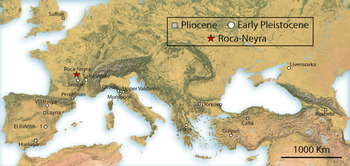
Roca-Neyra is an important Early Pleistocene locality located within the Perrier Plateau area, France (Fig. 1). The Perrier Plateau area contains a continental fluvial sequence and, due to the proximity of the Mont-Dore stratovolcano, includes several volcanic ash and pumice layers interbedded within the sedimentary sequence (Pastre, Reference Pastre2004; Nomade et al., Reference Nomade, Pastre, Guillou, Faure, Guérin, Delson, Debard, Voinchet and Messager2014). Its geological record spans the late Pliocene to the Early Pleistocene and has provided an important fossil assemblage since its initial discovery in the second half of the 19th century. Within the context of their review of late Pliocene and Early Pleistocene sites of France, Nomade et al. (Reference Nomade, Pastre, Guillou, Faure, Guérin, Delson, Debard, Voinchet and Messager2014) have reassessed the chronological calibration for the most important localities included in the Perrier Plateau area, Les Etouaires, Roca-Neyra, La Loubière de Pardines, and Le Creux de Peyrolles, chronologically constrained by 40Ar/39Ar analysis. Roca-Neyra's age has been calibrated as being 2.6 ± 0.2 Ma (Nomade et al., Reference Nomade, Pastre, Guillou, Faure, Guérin, Delson, Debard, Voinchet and Messager2014) and correlates with the Italian Early Pleistocene locality of Montopoli (lower Valdarno basin, Italy; Rook et al., Reference Rook, Cirilli and Bernor2017). Together these two localities mark the lowermost limit of the Pleistocene at the Gauss/Matuyama polarity transition and in turn correlate to the lower limit of Mammal Zone MNQ 16b of the European Land Mammal Age biochronologic scheme (Guérin, Reference Guérin, Lindsay, Fahlbusch and Mein1990; Mein, Reference Mein, Rössner and Heissig1999).
Geographical map showing the locality of Roca-Neyra with the European Plio-Pleistocene localities mentioned in the text. Base map from QGis (https://qgis.org/).

As reported above, four main fossiliferous localities have been identified in the Perrier plateau area: Les-Etouaires (2.77 ± 0.02 Ma), Roca-Neyra (2.6 ± 0.2 Ma), La Loubière de Pardines (slightly younger than Roca-Neyra but older than Saint Vallier) and Le Creux de Peyrolles (1.49 ± 0.01Ma), (Nomade et al., Reference Nomade, Pastre, Guillou, Faure, Guérin, Delson, Debard, Voinchet and Messager2014). The locality of Roca-Neyra was discovered in 1872–1873. Site excavations were led at the end of the 19th and at the beginning of the 20th century, and the collection housed in the Natural History Museum of Basel, at the Faculté des Sciences de Clermont and at the Université Claude Bernard-1, Lyon. The fossiliferous levels are considered penecontemporaneous with the debris avalanches that fossilized the sedimentary sequence of the Perrier Plateau (Nomade et al., Reference Nomade, Pastre, Guillou, Faure, Guérin, Delson, Debard, Voinchet and Messager2014) and the Roca-Neyra fossil locality is constrained within the first two debris avalanches of the Perrier Plateau area. The Roca-Neyra equid assemblage was previously reported by Stehlin (Reference Stehlin1904), who highlighted the presence of an “Hipparion” (not demonstrably of the genus Hipparion s.s., Woodburne and Bernor, Reference Woodburne and Bernor1980; Bernor et al., Reference Bernor, Koufos, Woodburne, Fortelius, Bernor, Fahlbusch and Mittman1996, Reference Bernor, Ataabadi, Meshida and Wolf2016) in the faunal assemblage. Later, the equid assemblage was discussed by several authors, many of whom challenged the presence of “Hipparion” and Equus (Schaub, Reference Schaub1944; Bout, Reference Bout1960; Kurten, Reference Kurten1963; Radulescu and Samson, Reference Radulescu and Samson1967). Finally, the co-occurrence of both genera has been clarified by Eisenmann and Brunet (Reference Eisenmann and Brunet1973), who confirmed the occurrence of “Hipparion” sp. and Equus cf. E. stenonis. The faunal assemblage of Roca-Neyra is consistent with the local stratigraphy and includes the following faunal assemblage: Nyctereutes megamastoide Pomel, Reference Pomel1842, Chasmaporthetes lunensis Del Campana, Reference Del Campana1914, Lynx issiodorensis Croizet and Jobert, Reference Croizet and Jobert1828, Anancus cf. A. arvernensis Croizet and Jobert, Reference Croizet and Jobert1828, “Hipparion” rocinantis Hernández-Pacheco, Reference Hernández-Pacheco1921, Equus stenonis Cocchi, Reference Cocchi1867, Eucladoceros ctenoides vireti Heintz, Reference Heintz1970, Leptobos elatus Pomel, Reference Pomel1853, Gazellospira torticornis Aymard, Reference Aymard1854, ?Procamptoceras brivatense Schaub, Reference Schaub1923, and Gazella borbonica Depéret, Reference Depéret1884 (see Palombo and Valli, Reference Palombo and Valli2004).
The base of the Pleistocene is an event marked by the global environmental change from warm-humid ecosystems to cool-arid conditions. In the fossil record, this event is documented by the inter-continental dispersal of the genus Equus (Lindsay et al., Reference Lindsay, Opdyke and Johnson1980; Azzaroli, Reference Azzaroli1983; Bernor et al., Reference Bernor, Cirilli, Jukar, Potts, Bukhsianidze and Rook2019; Rook et al., Reference Rook, Bernor, Avilla, Cirilli, Flynn, Jukar, Sanders, Scott and Wang2019). In the Mediterranean region, this faunal turnover is recorded in the Early Pleistocene (MNQ16b) sites of Montopoli (Italy) and El Rincón-1 (Spain), where the occurrence of the large stenonine horse Equus livenzovensis Bajgusheva, Reference Bajgusheva [Baigusheva]1978 is reported (Alberdi et al., Reference Alberdi, Cerdeño, López-Martínez, Morales and Soria1997; Azzaroli, Reference Azzaroli2000; Bernor et al., Reference Bernor, Cirilli, Wang and Rook2018b). In Eastern Europe, the Equus event is documented by the occurrence of Equus livenzovensis at Khapry (Azov Sea area, Russia) and Livensovka (Rostov, Russia) localities (Bajgusheva, Reference Bajgusheva [Baigusheva]1978; Azzaroli, Reference Azzaroli2000; Bernor et al., Reference Bernor, Cirilli, Wang and Rook2018b; Bernor et al., Reference Bernor, Cirilli, Jukar, Potts, Bukhsianidze and Rook2019). In Western-Central Europe, this biochronologic event is represented by the locality of Roca-Neyra, where the occurrence of the genus Equus is associated with the three-toed horse “Hipparion.” The species reported in the literature are Equus cf. E. stenonis and “Hipparion” rocinantis (Stehlin, Reference Stehlin1904; Eisenmann and Brunet, Reference Eisenmann and Brunet1973; Palombo and Valli, Reference Palombo and Valli2004).
Here, we revise, describe, and analyze the Roca-Neyra equid sample housed in the Université Claude Bernard-1 in Lyon, with new considerations on the last occurrence of the European “Hipparion” lineages and the Equus dispersal event.
Materials and methods
Part of the Roca-Neyra equid sample is housed in the paleontological collection at the Université Claude Bernard-1 in Lyon, and it is represented by a right calcaneum (UCBL-FSL 211232), a second phalanx of the central digit (UCBL-FSL 211733), a third phalanx of the central digit (UCBL-FSL 211733) of “Hipparion,” and three isolated teeth, probably belonging to the same individual (left p4, m1, and m2; UCBL-FSL 211735) of Equus. Moreover, Eisenmann and Brunet (Reference Eisenmann and Brunet1973) reported two “Hipparion” third metatarsals from Roca-Neyra (MNHN 1948-13-11, and NHMB RN 98; table 2, p. 114). Stehlin (Reference Stehlin1904) preliminarily reported the Roca-Neyra collection housed at the Facultés des Science de Clermont, but unfortunately no data or additional information on this collection have been reported since 1904.
We review the Roca-Neyra equid sample housed in the paleontological collection at the Université Claude Bernard-1, Lyon and compare it to a suite of European, African, and Asian Miocene, Pliocene, and Pleistocene “Hipparion” species, with the North America and Eurasian Plio-Pleistocene Equus species, and with extant Equus grevyi Oustalet, Reference Oustalet1882. The late Miocene–Early Pleistocene “Hipparion” species included in our analyses are: Hippotherium primigenium von Meyer, Reference von Meyer1829 (Höwenegg, Germany; data from Bernor et al., Reference Bernor, Tobien, Hayek and Mittmann1997), “Cormohipparion” africanum Arambourg, Reference Arambourg1959 (Bou Hanifia, Algeria; data from Bernor and White, Reference Bernor and White2009), Cormohipparion sinapensis Bernor et al. in Fortelius et al., Reference Bernor, Scott, Fortelius, Kappelman, Sen, Fortelius, Kappelman, Sen and Bernor2003 (Sinap, Turkey; data from Bernor et al., Reference Bernor, Scott, Fortelius, Kappelman, Sen, Fortelius, Kappelman, Sen and Bernor2003), Eurygnathohippus feibeli Bernor and Harris, Reference Bernor, Harris, Harris and Leakey2003 (Sahabi, Libya; data from Bernor et al., Reference Bernor, Boaz and Rook2012, Reference Bernor, Boaz, Cirilli, El-Shawaihdi and Rook2020), Sivalhippus turkanensis Hooijer and Maglio, Reference Hooijer and Maglio1974 (Lothagam, Kenya; data from Bernor and Harris, Reference Bernor, Harris, Harris and Leakey2003), Sivalhippus perimensis Pilgrim, Reference Pilgrim1910 (Siwalik, Pakistan; data from Wolf et al., Reference Wolf, Bernor and Hussain2013), Cremohipparion mediterraneum Roth and Wagner, Reference Roth and Wagner1855 (Pikermi, Greece; data from Koufos, Reference Koufos1986), Cremohipparion matthewi Abel, Reference Abel1926 (Samos, Greece; data from Bernor et al., Reference Bernor, Koufos, Woodburne, Fortelius, Bernor, Fahlbusch and Mittman1996), Plesiohipparion longipes Gromova, Reference Gromova1952 (Pavlodar, Kazakhstan; data from Eisenmann, Reference Eisenmann2019, https://vera-eisenmann.com), “Hipparion” elegans Gromova, Reference Gromova1952 (Pavlodar, Kazakhstan; data from Eisenmann, Reference Eisenmann2019, https://vera-eisenmann.com), Plesiohipparion longipes (Akkaşdağı and Çalta, Turkey; data from Koufos and Vlachou, Reference Koufos and Vlachou2005), Plesiohipparion houfenense Teilhard de Chardin and Young, Reference Teilhard de Chardin and Young1931 (Houfeng, China; Qiu et al., Reference Qiu, Huang and Guo1987; data from Bernor et al., Reference Bernor, Sun and Chen2015), Plesiohipparion rocinantis Hernández-Pacheco, Reference Hernández-Pacheco1921 (Villarroya, Spain; Zhegallo, Reference Zhegallo1978; Pueyo et al., Reference Pueyo, Muñoz, Laplana and Parés2016; Rook et al., Reference Rook, Cirilli and Bernor2017; data from Eisenmann, Reference Eisenmann2019, https://vera-eisenmann.com), Proboscidipparion heintzi Eisenmann and Sondaar, Reference Eisenmann and Sondaar1998 (Çalta, Turkey; Eisenmann and Sondaar, Reference Eisenmann and Sondaar1998; data from Bernor and Sen, Reference Bernor and Sen2017), “Hipparion” fissurae Crusafont and Sondaar, Reference Crusafont and Sondaar1971 (Layna, Spain; data from Alberdi and Alcalà, Reference Alberdi and Alcalà1999), “Hipparion” crassum Gervais, Reference Gervais1859 (Perpignan, France; data from Eisenmann, Reference Eisenmann2019, https://vera-eisenmann.com) and “Hipparion” rocinantis from the Georgian locality of Kvabebi (Vekua, Reference Vekua1972; data from Eisenmann, Reference Eisenmann2019, https://vera-eisenmann.com). We utilize this broad range of “Hipparion” lineages in order to isolate those “Hipparion” lineages to be the most likely source of the Roca-Neyra “Hipparion” species.
The Pliocene and Pleistocene Equus species considered are: Equus simplicidens Cope, Reference Cope1892 (Hagerman Horse Quarry, Idaho; authors’ unpublished data), Equus stenonis vireti Prat, Reference Prat1964 (Saint Vallier, France; authors’ unpublished data), Equus sp. (Senèze; authors’ unpublished data), Equus stenonis Cocchi, Reference Cocchi1867 (from both Olivola and Upper Valdarno Basin, Italy; authors’ unpublished data) Equus stehlini Azzaroli, Reference Azzaroli1964 (Upper Valdarno Basin, Italy; authors’ unpublished data), Equus suessenbornensis Wüst, Reference Wüst1900 (Süssenborn, Germany; authors’ unpublished data) and Equus grevyi (Kenya, Africa; authors’ unpublished data). The Equus sample from the Early Pleistocene of Senèze is here retained at the genus level (Equus sp.), due to the conflicting opinions about which and how many species are in the fossil locality (for a comprehensive review see Alberdi et al., Reference Alberdi, Ortiz Jaureguizar and Prado1998; Delson et al., Reference Delson, Faure, Guérin, Aprile, Argant, Blackwell, Debard, Harcourt-Smith, Martin-Suarez, Monguillon, Parenti, Pastre, Sen, Skinner, Swisher and Valli2006; Palombo and Alberdi, Reference Palombo and Alberdi2017; Palombo et al., Reference Palombo, Alberdi, Bellucci and Sardella2017; and Eisenmann, Reference Eisenmann2019).
Anatomical nomenclature and osteological landmarks are according to Bernor et al. (Reference Bernor, Tobien, Hayek and Mittmann1997). Morphometric measurements follow Eisenmann et al. (Reference Eisenmann, Alberdi, De Giuli, Staesche, Woodburne and Sondaar1988) and Bernor et al. (Reference Bernor, Tobien, Hayek and Mittmann1997). We undertake morphometric and statistical analyses using bivariate plots, Log10 ratio diagrams (Höwenegg Hippotherium primigenium means used as the Log10 standards; Bernor et al., Reference Bernor, Tobien, Hayek and Mittmann1997) and Principal Components Analysis (PCA).
Eisenmann (Reference Eisenmann, Vrba, Denton, Partridge and Burckle1995), Bernor and Harris (Reference Bernor, Harris, Harris and Leakey2003), Bernor et al. (Reference Bernor, Scott, Fortelius, Kappelman, Sen, Fortelius, Kappelman, Sen and Bernor2003, Reference Bernor, Scott and Haile-Selassie2005, Reference Bernor, Ataabadi, Meshida and Wolf2016, Reference Bernor, Wang, Liu, Chen and Sun2018a, Reference Bernor, Cirilli, Wang and Rookb, Reference Bernor, Cirilli, Jukar, Potts, Bukhsianidze and Rook2019), Bernor and Sen (Reference Bernor and Sen2017), Sun et al. (Reference Sun, Zhang, Liu and Bernor2018), and Cirilli et al. (Reference Cirilli, Zouhri, El Boughabi, Benvenuti, Papini, Bernor and Rook2020, in press) have used Log10 ratio diagrams on postcranial elements to evaluate differences between selected species of “Hipparion” and Equus species and their evolutionary trends. We follow these authors in our analyses of third metapodials and for lower dentitions in the Equus sample. Furthermore, we have extended the statistical analyses also using PCA, using R software through the function prcomp() (R Core Team, 2013).
“Hipparion” bivariate plots have been selected for the following anatomical elements (including the following measurements): third metacarpal and metatarsal (M1 = maximal length; M11 = distal maximal articular width), second phalanx of the central digit (M1 = maximal length; M6 = distal maximal width). “Hipparion” third metacarpal and third metatarsal Log10 ratio diagrams include M1 = maximum length; M3 = minimal width; M4 = depth of the diaphysis at level of M3; M5 = proximal articular breadth; M6 = proximal articular width; M7 = maximal diameter of the articular facet for the third carpal/tarsal; M8 = diameter for the anterior facet for the fourth carpal/tarsal; M10 = distal maximal supra articular width; M11 = distal maximal articular width; M12 = distal maximal keel depth; M13 = distal maximal depth of the lateral condyle; M14 = distal maximal depth of the medial condyle. “Hipparion” third metacarpal and metatarsal PCAs include the following measurements: M1, M3, M4, M5, M6, M10, M11, M12, M13, M14 (same measurements used in Log10 ratio diagrams).
Equus mandibular cheek tooth (tmp4–tmm2) bivariate plots include M1 (maximal length at the occlusal level) and M6 (maximal width at the occlusal level). Our PCA analyses include the previous bivariate plot measurements in addition to M3 (maximal metaconid-metastylid length, the double knot), M4 (maximum length of the preflexid), and M5 (maximum length of the postflexid).
Anatomical elements
dtxP1: deciduous upper first premolar; dtxP2: deciduous upper second premolar; dtxP3: deciduous upper third premolar; dtxP4: deciduous upper fourth premolar; dtxM1: deciduous upper first molar; dtmp1: deciduous lower first premolar; dtmp2: deciduous lower second premolar; dtmp3: deciduous lower third premolar; dtmp4: deciduous lower fourth premolar; dtmm1: deciduous lower first molar; txI1: upper first incisive; txI2: upper second incisive; txP2: upper second premolar; txP3: upper third premolar; txP4: upper fourth premolar; txM1: upper first molar; tmi1: lower first incisor; tmi2: lower second incisor; tmp2: lower second premolar; tmp3: lower third premolar; tmp4: lower fourth premolar; tmm1: lower first molar; tmm2: lower second molar; tmm3: lower third molar; mc3: third metacarpal; calc: calcaneum mt3: third metatarsal; 1ph3: first phalanx of the central digit; 2ph3: second phalanx of the central digit; 3ph3: third phalanx of the central digit; lt.: left; rt.: right.
Repositories and institutional abbreviations
IGF: Sezione Geologia e Paleontologia, Museo di Storia Naturale, Università di Firenze, Italy; L: Livensovka, Russia; MNHN: Muséum National d'Histoire Naturelle, Paris, France; NHMB: Naturhistorisches Museum, Basel, Switzerland; NHML: Natural History Museum, Lyon, France; RN: Roca-Neyra; UCBL-FSL: Université Claude Bernard-1, Paleontological Collection, Lyon, France; USNM: National Museum of Natural History, Washington D.C, USA.
Systematic paleontology
Order Perissodactyla Owen, Reference Owen1848
Family Equidae Gray, Reference Gray1821
Subfamily Equinae Gray, Reference Gray1821
Tribe Hipparionini Quinn, Reference Quinn1955
Genus Plesiohipparion Qiu, Huang, and Guo, Reference Qiu, Huang and Guo1987
Type species
Hipparion rocinantis Hernández-Pacheco, Reference Hernández-Pacheco1921.
Plesiohipparion cf. ?P. rocinantis (Hernández-Pacheco, Reference Hernández-Pacheco1921)
Figure 2
- Reference Eisenmann and Brunet1973
Hipparion sp. Eisenmann and Brunet (not figured).
- Reference Palombo and Valli2004
Hipparion rocinantis; Palombo and Valli (not figured).
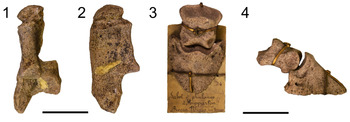
Plesiohipparion cf. P. rocinantis from Roca-Neyra. UCBL-FSL 211232, right calcaneum in cranial and lateral views (1, 2); UCBL-FSL 211733, articulated left second and third phalanges, in cranial and lateral view (3, 4). Scale bars = 5 cm.

Holotype
Unknown.
Lectotype
A lower third/fourth premolar, described in Hernández-Pacheco (Reference Hernández-Pacheco1921) and Alberdi (Reference Alberdi1974), figured in Alberdi (Reference Alberdi1974, fig. 6.4), from La Puebla de Almoradier, Early Pleistocene, Spain.
Description
Figure 2.1, 2.2 illustrates the right calcaneum in cranial and lateral views of UCBL-FSL 211232. This element has a slender morphology with tuber calcaneum being well developed, although it is damaged in the lateral and cranial sides. The tuber calcaneum may not have been completely fused, and therefore this individual may have been a subadult. The central body is narrow, and the distal portion is elongated, whereas the sustentaculum tali for articulation with the astragalus connection is developed antero-posteriorly. In lateral view, the processus coracoideus is well developed.
Figure 2.3 and 2.4 shows the articulated second and third phalanges UCBL-FSL 211733, in cranial and lateral view. The second and third phalanges are articulated with an artificial support. The 2ph3 is a short bone, expanded medio-laterally proximally. The proximal articular surface is inclined from the palmar to dorsal aspect, with the attachment of the ligamentum sesamoideum rectum of the flexor tuberosity being strongly developed. The proximal articular surface has robust swellings for the medial and lateral scar for the ligamentum collaterale of third digit for 1ph3 and 2ph3 articulation. In cranial view (Fig. 2.3), the distal aspect presents the medial and lateral hollowed scars for attachment of the ligamentum collaterale, which binds the second and third phalanges of the central digit. The distal articular facet presents a gentle sinuous curve in dorsal view, angular in lateral view.
The 3ph3 proximal articular surface presents a sinuous curve, as in 2ph3, for the 2ph3 articulation; the processus palmaris and medialis are not elongated. The medial and lateral grooves for attachment of the ligamentum collaterale are placed below the lateral margin of the proximal articulation. The margin of the foot's sole is curled.
Material
Right calcaneum (UCBL-FSL 211232); left second phalanx of the central digit (UCBL-FSL 211733); left third phalanx of the central digit (UCBL-FSL 211733); two third metatarsals MNHN 1948-13-11 and NHMB RN 98, (Eisenmann and Brunet, Reference Eisenmann and Brunet1973; table 2, p. 114).
Remarks
Plesiohipparion rocinantis (following Alberdi, Reference Alberdi1974; Bernor et al., Reference Bernor, Koufos, Woodburne, Fortelius, Bernor, Fahlbusch and Mittman1996, Reference Bernor, Sun and Chen2015; Pueyo et al., Reference Pueyo, Muñoz, Laplana and Parés2016) was initially described by Hernández-Pacheco (Reference Hernández-Pacheco1921) from the Early Pleistocene of La Puebla de Almoradier (Spain), based on a few isolated remains (see Zouhri and Bensalmia, Reference Zouhri and Bensalmia2005). Villalta (Reference Villalta1948) described a new species from the locality of Villarroya, Hipparion crusafonti Villalta, Reference Villalta1948. Pirlot (Reference Pirlot1956) and Forsten (Reference Forsten1968) were the earliest authors to remark about the morphological similarities between H. rocinantis and H. crusafonti. Alberdi (Reference Alberdi1974) considered H. rocinantis Hernández-Pacheco, Reference Hernández-Pacheco1921 to be a valid species, recognizing Villalta's species at the subspecies level, H. rocinantis crusafonti. Alberdi (Reference Alberdi1986), followed by Bernor et al. (Reference Bernor, Koufos, Woodburne, Fortelius, Bernor, Fahlbusch and Mittman1996, Reference Bernor, Sun and Chen2015) and Azanza et al. (Reference Azanza, Morales, Andrés, Cerdeño and Alberdi2016), included H. rocinantis crusafonti in H. rocinantis Hernández-Pacheco, Reference Hernández-Pacheco1921, considering the latter to be the formal name of the species. Qiu et al. (Reference Qiu, Huang and Guo1987), followed by Bernor et al. (Reference Bernor, Koufos, Woodburne, Fortelius, Bernor, Fahlbusch and Mittman1996, Reference Bernor, Sun and Chen2015) and Bernor and Sun (Reference Bernor and Sun2015), recognized this species as being a member of the Plesiohipparion clade. As such, its biogeographic range extends across the Plio-Pleistocene boundary, reported from La Puebla de Almoradier, Las Higueruelas, Villarroya (Alberdi, Reference Alberdi1974, Reference Alberdi1986), Roca-Neyra (France; Alberdi, Reference Alberdi1986; Palombo and Valli, Reference Palombo and Valli2004; present paper), and Kvabebi (Georgia; Vekua, Reference Vekua1972; Alberdi, Reference Alberdi1986).
As reported in the previous description and in the results shown in various morphometrical analyses (Figs. 5.1, 5.2, 7.4, our data, and Eisenmann and Brunet, Reference Eisenmann and Brunet1973) we ascribe this sample to ?Plesiohipparion cf. P. rocinantis. Our results suggest close morphological and morphometric similarities of the Roca-Neyra sample with the species from Villarroya and Kvabebi, and more broadly with the Plesiohipparion clade (see bivariate plots and Log10 ratio diagrams).
Tribe Equini Gray, Reference Gray1821
Genus Equus Linnaeus, Reference Linnaeus1758
Type species
Equus caballus Linnaeus, Reference Linnaeus1758.
Equus cf. E. livenzovensis Bajgusheva, Reference Bajgusheva [Baigusheva]1978
Figure 3
- Reference Eisenmann and Brunet1973
Equus cf. E. stenonis; Eisenmann and Brunet, p. 106, fig. 1.
- Reference Palombo and Valli2004
Equus cf. E. stenonis; Palombo and Valli.
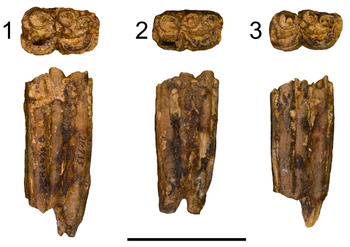
Equus cf. E. livenzovensis from Roca-Neyra. UCBL-FSL 211735, left lower fourth premolar (1); UCBL-FSL 211735, left lower first molar (2); UCBL-FSL 211735, left lower second molar (3). The specimens, probably belonging to the same individual, are represented in occlusal and lingual view. Scale bar = 5 cm.

Holotype
An incomplete skull (L-4) stored in the Ethnographic Museum at Livensovka, Rostov, Russia (Bajgusheva, Reference Bajgusheva [Baigusheva]1978, p. 98, fig. 1).
Description
Figure 3 includes the Roca-Neyra Equus sample, UCBL-FSL 211735 left tmp4 (Fig. 3.1), tmm1 (Fig. 3.2), and tmm2 (Fig. 3.3), probably belonging to the same individual. The left tmp4 is well preserved; the metaconid-metastylid (double knot) are round, separated by a shallow V-shaped linguaflexid; the preflexid is large, and its mesial margin has a long buccally projecting pli; the postflexid is antero-posteriorly elongated, with its mesiolabial margin extending into the isthmus separating metaconid and metastylid. The protoconid and the hypoconid are large, with a small pli caballinid on the mesial margin of the hypoconid. The entoconid is broad. The posterior root is broken.
The left tmm1 (Fig. 3.2) has a damaged labial margin of the protoconid; the metaconid-metastylid (double knot) has a round shape, separated by a V-shaped linguaflexid; the preflexid is narrow, constricted labio-lingually, with a prominent mesio-labial pli; the postflexid is antero-posteriorly elongated, with a worn lingual margin projecting into the isthmus between metaconid and metastylid; the hypoconid is large, with a worn pli caballinid on the anterior margin; the entoconid is broad, with a worn pointed cusp on the postflexid labial margin. Both roots are preserved.
The left tmm2 (Fig. 3.3) is broken on the lingual margin of the double knot, but the rounded shape of metaconid and metastylid are apparent; the metaconid and metastylid are separated by the V-shaped linguaflexid; the preflexid is elongated mesio-distally and constricted labial-lingually; the postflexid is antero-posteriorly elongated, with its mesial margin projecting into the isthmus separating metaconid-metastylid; the protoconid and hypoconid are large, with a diminuitive pli caballinid on the hypoconid mesial margin. The entoconid is broad, with a worn pointed cusp on the postflexid labial margin. The distal root is broken.
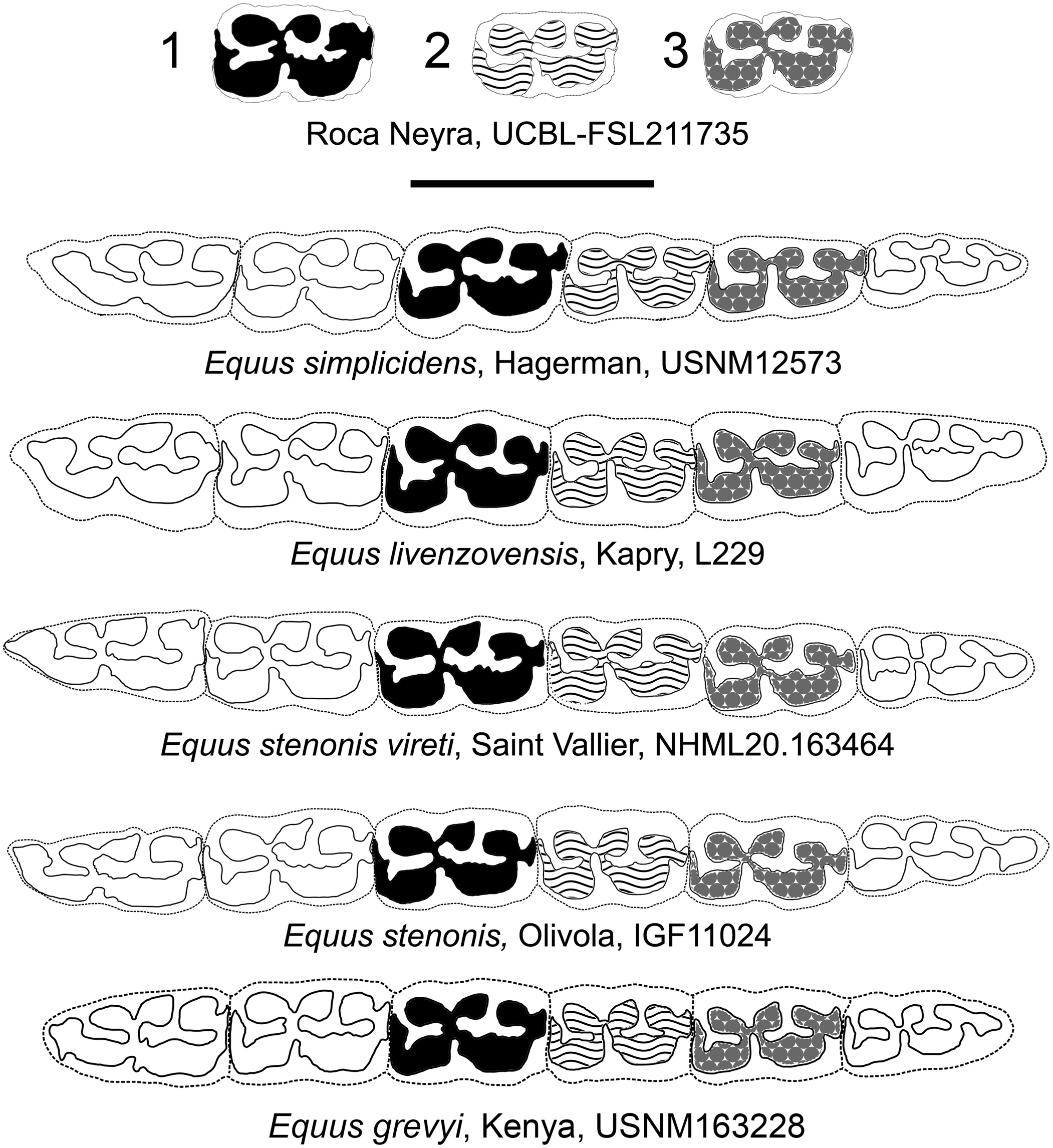
Figure 4 provides occlusal profiles of the Roca-Neyra Equus sample UCBL-FSL 211735 tmp4, tmm1, and tmm2, compared to North American E. simplicidens (Hagerman), European E. livenzovensis (Kapry), E. stenonis vireti (Saint Vallier), E. stenonis (Olivola), and extant African E. grevyi (Kenya) complete lower tooth rows. UCBL-FSL 211735 exhibits a mixture of occlusal features, shared with E. simplicidens and E. stenonis. The round shape of metaconid-metastylid is comparable to E. simplicidens and E. livenzovensis and, on the lingual side, does not exhibit the typical stenonine squared-pointed metastylid shape seen in the samples from Saint Vallier, Olivola, and Kenyan Equus spp. Noteworthy is the presence of a pointed metastylid on the lingual side of E. stenonis vireti, E. stenonis, and E. grevyi. Therefore, due to these morphological features, but in particular the metaconid-metastylid morphology, we ascribe the UCBL-FSL 211735 sample to Equus cf. E. livenzovensis.
Anatomical comparison of the occlusal morphology of Equus cf. E. livenzovensis from Roca Neyra (1–3) with Equus simplicidens, Equus livenzovensis, Equus stenonis vireti, Equus stenonis from Olivola, and the extant Equus grevyi. Black = tmp4, undulating black lines = tmm1, gray circles = tmm2. Scale bar = 5 cm.

Material
Apparently associated left mandibular fourth premolar, first molar, and second molar (UCBL-FSL 211735), figured in Eisenmann and Brunet (Reference Eisenmann and Brunet1973, p. 106, fig. 1).
Remarks
Equus livenzovensis Bajgusheva, Reference Bajgusheva [Baigusheva]1978, is the oldest Equus species in Europe and it is recorded in the type locality of the Khapry area, in the Italian locality of Montopoli, and in the Spanish localities of El Rincón-1 and Huèlago (Alberdi et al., Reference Alberdi, Cerdeño, López-Martínez, Morales and Soria1997; Palombo and Alberdi, Reference Palombo and Alberdi2017). All of these localities have been correlated to the Plio-Pleistocene boundary, 2.6 Ma. The species was erected by Bajgusheva in 1978, based on the Equus sample for the Khapry area, and its validity has been confirmed by Azzaroli (Reference Azzaroli2000). Equus livenzovensis occurs in the Villafranchian Montopoli Faunal Unit (MNQ16b) at the beginning of the Pleistocene. The faunal turnover recorded in the Montopoli Faunal Unit is marked by the disappearance of warm-forest species such as Tapirus arvernensis Croizet and Jobert, Reference Croizet and Jobert1828, Mammut borsoni Hays, Reference Hays1834, Sus arvernensis Depéret, Reference Depéret1890, Ursus minimus Devèze de Chabrioland and Bouillet, Reference Devèze de Chabriol and Bouillet1827, and Stephanorhinus jeanvireti Guérin, Reference Guérin1972, and the first occurrence in the Villafranchian record of Puma pardoides Owen, Reference Owen1846, Mammuthus gromovi Alexeeva and Garutt, Reference Alexeeva [Alekseeva] and Garutt1965, Stephanorhinus etruscus Falconer, Reference Falconer1868, Eucladoceros falconeri Dawkins, Reference Dawkins1868, Gazella borbonica, and Equus livenzovensis (Rook and Martìnez-Navarro, Reference Rook and Martínez-Navarro2010; Cherin et al., Reference Cherin, Iurino and Sardella2013; Pandolfi, Reference Pandolfi2013; Bartolini Lucenti, Reference Bartolini Lucenti2017; Pandolfi et al., Reference Pandolfi, Cerdeño, Codrea and Kotsakis2017, Reference Pandolfi, Popuscu and Codrea2019; Rook et al., Reference Rook, Cirilli and Bernor2017; Bernor et al., Reference Bernor, Wang, Liu, Chen and Sun2018a, Reference Bernor, Cirilli, Wang and Rookb; Cirilli et al., Reference Cirilli, Pandolfi and Bernorin press).
Statistical analysis
“Hipparion”
In order to better determine the taxonomic identity of the Roca-Neyra “Hipparion” sample we compared it to the Plio-Pleistocene European “Hipparion” samples from Layna, Perpignan, Kvabebi and Villarroya. We have utilized the following morphometrical and statistical methodologies: bivariate plots, Log10 ratio diagrams and PCA.
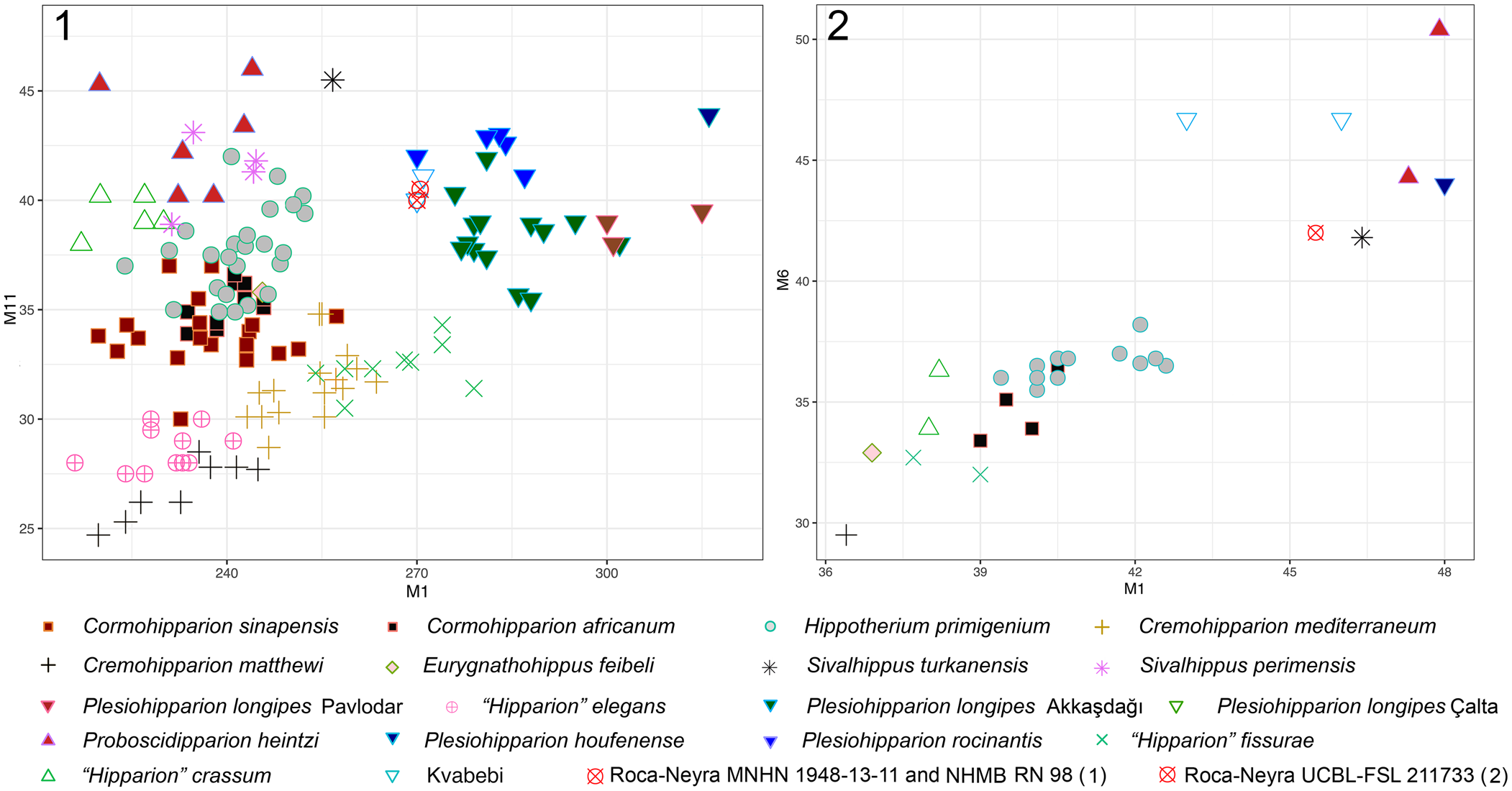
Figure 5 includes bivariate plots for “Hipparion” third metatarsal (5.1) and second phalanx of the central digit (5.2). Figure 5.1 is mt3 maximum length (M1) versus distal articular width (M11). The Roca-Neyra specimens, MNHN 1948-13-11 and NHMB RN 98, plot close to P. rocinantis from Villarroya and “H.” rocinantis from Kvabebi (Georgia, Vekua, Reference Vekua1972), and they also plot close to P. longipes from Pavlodar, Akkaşdağı (Koufos and Vlachou, Reference Koufos and Vlachou2005) and Çalta (Bernor and Sen, Reference Bernor and Sen2017). Plesiohipparion houfenense (data from Bernor et al., Reference Bernor, Sun and Chen2015) is the largest species considered in the plots (Fig. 5.1). A central group includes the primitive late Miocene species H. primigenium, C. sinapensis, and C. africanum. Eurygnathohippus feibeli is included in this sample, whereas Cremohipparion mediterraneum specimens are slightly longer than those of C. sinapensis, and C. matthewi is the smallest and most slender species, plotting close to C. mediterraneum. A second group includes the robust species Sivalhippus perimensis, S. turkanensis, and Proboscidipparion heintzi. It is remarkable that “H.” crassum plots in this group, close to Proboscidipparion heintzi and Sivalhippus turkanensis.
Bivariate plots for third metatarsal (1) and second phalanx of the central digit (2), comparing the Plesiohipparion cf. P. rocinantis from Roca-Neyra with a suite of Miocene, Pliocene and Early Pleistocene hipparions. The source of data is reported in Material and methods.

Figure 5.2 shows maximal length (M1) versus distal width (M6) of the second phalanx of the central digit. Two separate groups can be observed in this plot. The first one, which includes the medium- to small-size species H. primigenium, C. africanum, E. feibeli, C. matthewi, “Hipparion crassum,” and “Hipparion fissurae,” and the second with the larger species S. turkanensis, P. heintzi, and P. rocinantis. In this plot, UCBL-FSL 211733 is located within the larger forms, close to the Kvabebi sample, P. rocinantis and S. turkanensis. Moreover, P. rocinantis from Villarroya is slightly narrower than P. heintzi from Çalta. Hipparion fissurae and H. crassum are included in the medium- to small-size species (H. primigenium, C. africanum, and E. feibeli) with C. matthewi, which remains the narrowest individual of the entire sample.
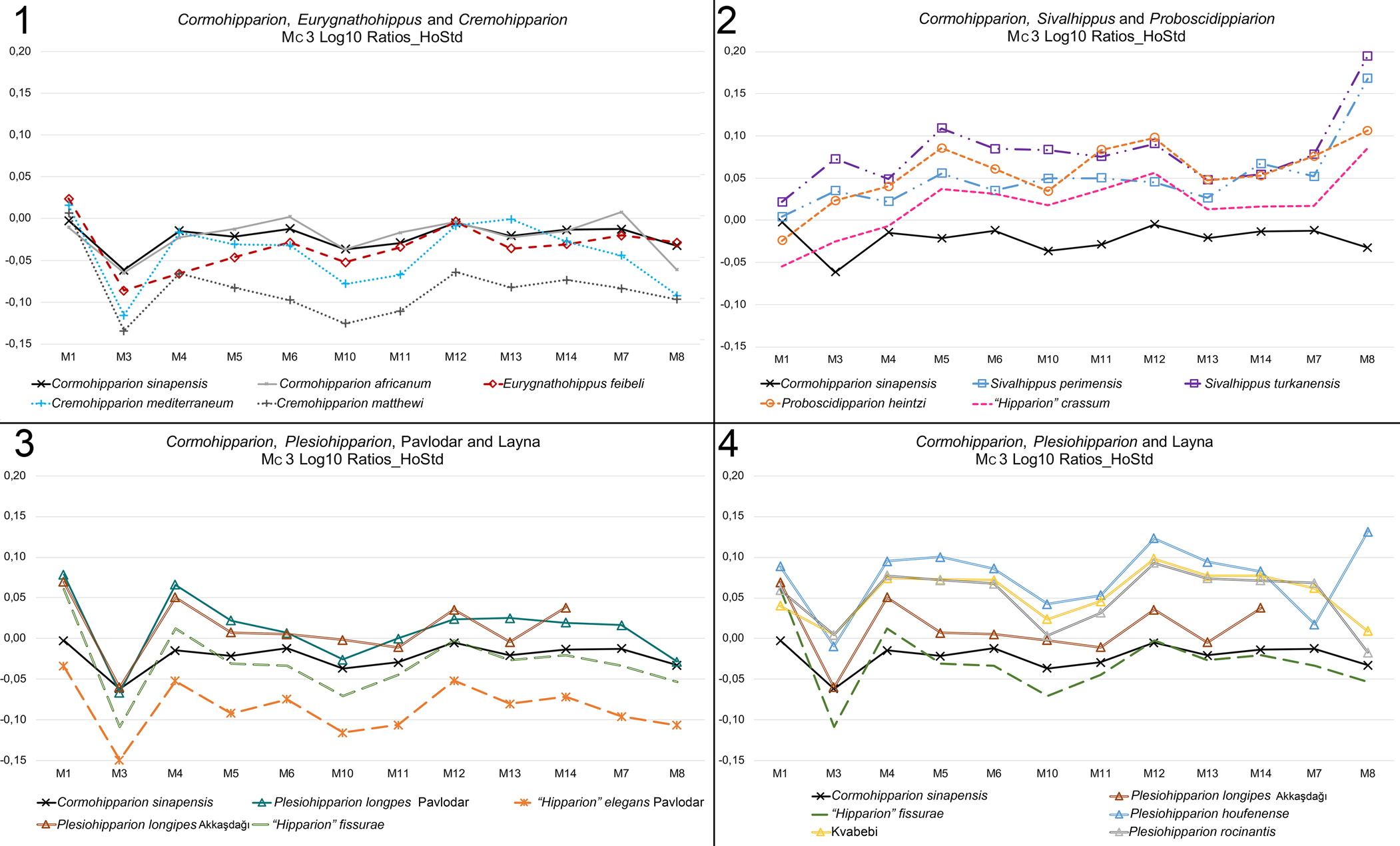
Figure 6 is the mc3 Log10 ratio diagrams using the Höwenegg Hippotherium sample as standard (Bernor et al., Reference Bernor, Tobien, Hayek and Mittmann1997). Figure 6.1 compares species of Cormohipparion, Eurygnathohippus, and Cremohipparion. As previously discussed in Bernor et al. (Reference Bernor, Boaz, Cirilli, El-Shawaihdi and Rook2020), the primitive C. sinapensis and C. africanum are likely ancestral to E. feibeli and C. mediterraneum. Eurygnathohippus feibeli and C. mediterraneum follow the C. sinapensis and C. africanum Log10 line trajectories, even when the morphology is clearly more slender (M3-M10 in E. feibeli and M3, M10, M11 in C. mediterraneum). Cremohipparion matthewi is the smallest and most slender species considered in the analysis, and its trend reflects a plausible origin from C. moldavicum, the sister-taxon of C. mediterraneum (Bernor et al., Reference Bernor, Ataabadi, Meshida and Wolf2016).
Log10 Ratio diagrams analysis for third metacarpal (Hippotherium primigenium from Höwenwgg, Germany used as standard; Bernor et al., Reference Bernor, Tobien, Hayek and Mittmann1997), comparing a suite of Miocene, Pliocene and Early Pleistocene hipparions (1–4). The source of data is reported in Material and methods.

Figure 6.2 plots species of Cormohipparion, Sivalhippus, and Proboscidipparion. Compared to C. sinapensis and the Eurygnathohippus-Cremohipparion species, a different pattern is shown by Sivalhippus and Proboscidipparion. They have a wider, more robust midshaft width (M3) and a relatively shallow midshaft depth (M4), larger values in M5-M10 and M8. Çalta Proboscidipparion heintzi has a robust pattern similar to the Sivalhippus lineage: M1, M3, M10, and M8 are narrower, but the other measurements are included between the S. turkanensis and S. perimensis deviation. We cannot rule out that this similarity is due to convergent evolution within the “Sivalhippus Complex” (Bernor et al., Reference Bernor, Koufos, Woodburne, Fortelius, Bernor, Fahlbusch and Mittman1996). “Hipparion” crassum from Perpignan displays a similar morphological pattern to Proboscidipparion heintzi, albeit with a reduced length and overall size.
Figure 6.3 plots Cormohipparion sinapensis and Plesiohipparion longipes from Pavlodar and Akkaşdağı, with the Pavlodar “Hipparion” elegans and Layna “Hipparion” fissurae samples. Plesiohipparion longipes from Pavlodar and Akkaşdağı exhibits the same pattern, with a slender morphology marked by M1-M3, and an overall similar morphology (even larger M10 in P. longipes form Akkaşdağı and larger M13 in P. longipes from Pavlodar). Noteworthy, the “Hipparion” elegans pattern shows a very similar morphology to “Hipparion” fissurae, even if the latter has generally larger dimensions and a more elongated maximum length (M1), and different morphological aspect of the proximal and distal epiphysis (Alberdi and Alcalà, Reference Alberdi and Alcalà1999).
Figure 6.4 plots species of Cormohipparion and Plesiohipparion with the Layna sample. The Plio-Pleistocene Plesiohipparion species (P. rocinantis and P. houfenense) have generally larger dimensions when compared to the Late Miocene P. longipes from Akkaşdağı, even if their pattern exhibits the same slender morphology (M1-M3) and the same morphology of the distal epiphysis, with wider values in M5, M6, and M13. “Hipparion” rocinantis from Kvabebi shows an identical morphology and pattern to P. rocinantis from Villarroya, and together they are comparable with P. longipes, but with a shorter maximal length (M1), a narrower distal maximal supraarticular width (M10), and a wider distal maximal depth of the lateral condyle (M13). Plesiohipparion houfenense is the largest species in this plot, and its pattern is similar to P. rocinantis. “Hipparion” fissurae is more slender than the Plesiohipparion group, nevertheless its morphology remains intermediate between the Plesiohipparion and Cremohipparion groups.
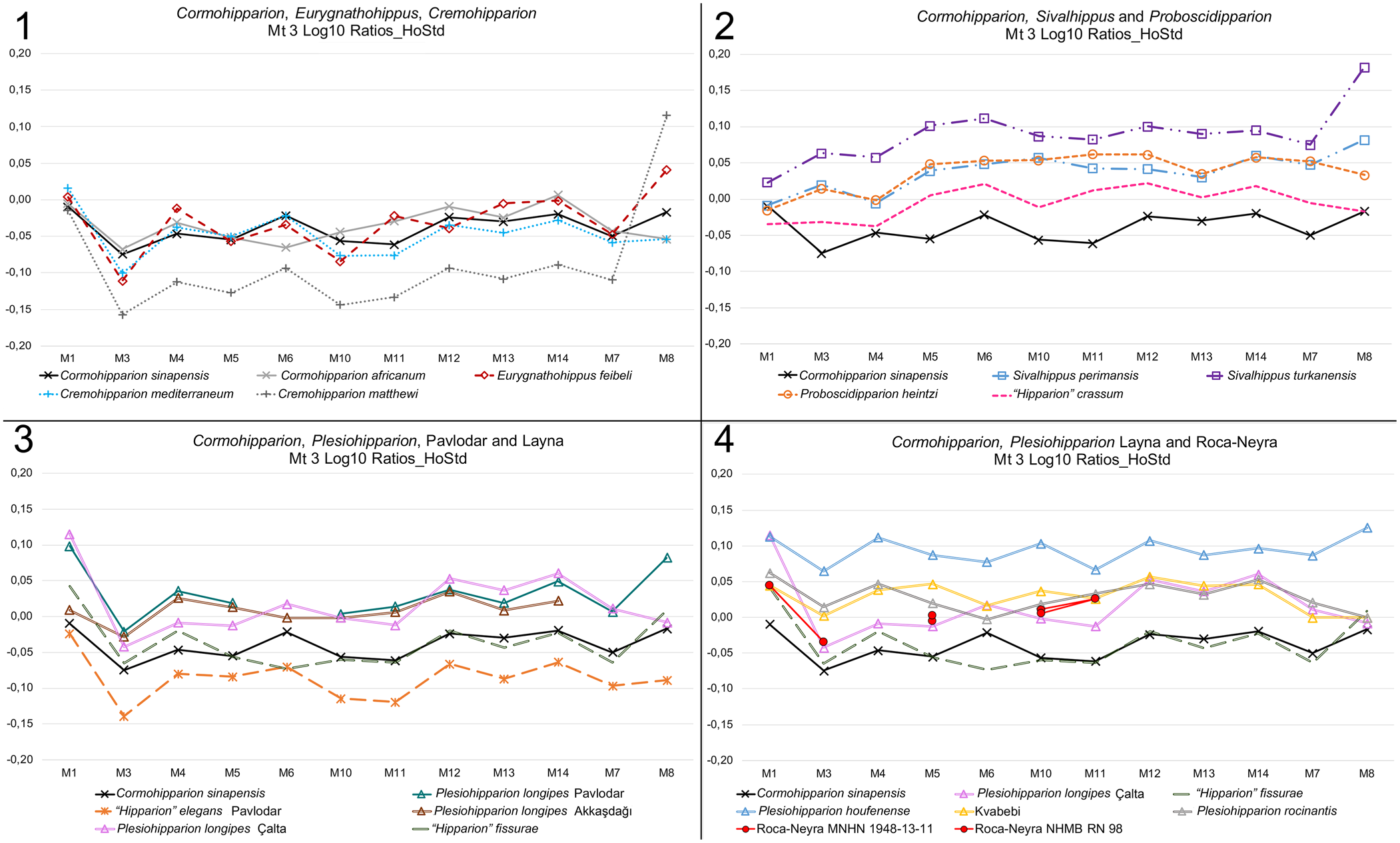
Figure 7 shows the corresponding mt3 Log10 ratio diagrams using the Höwenegg Hippotherium primigenium mean. These plots produce results for each clade that are similar to those calculated for the mc3 Log10 ratio diagrams.
Log10 Ratio diagrams analysis for third metatarsal (Hippotherium primigenium from Höwenwgg, Germany used as standard; Bernor et al., Reference Bernor, Tobien, Hayek and Mittmann1997), comparing a suite of Miocene, Pliocene, and Early Pleistocene hipparions (1–4). The source of data is reported in Material and methods. Plesiohipparion cf. P. rocinantis from Roca-Neyra is included in (4).

Figure 7.1 plots species of Cormohipparion, Eurygnathohippus, and Cremohipparion. The Eurygnathohippus feibeli and C. matthewi morphology is similar to C. sinapensis and C. africanum, even more slender. Cremohipparion matthewi is similar to C. mediterraneum, but smaller and narrower.
Figure 7.2 plots species of Cormohipparion, Sivalhippus, and Proboscidipparion. Sivalhippus turkanensis and S. perimensis have an almost identical pattern, even if the African species shows larger dimensions. Proboscidipparion heintzi exhibits a pattern comparable to S. perimensis. Furthermore, the “Hipparion” crassum trend is similar to P. heintzi, except for a small M10 and its general narrower dimensions.
Figure 7.3 plots species of Cormohipparion and Plesiohipparion with the Pavlodar and Layna samples. As reported in Figure 6.3, P. longipes exhibits an identical morphology to the P. longipes sample from Akkaşdağı and Çalta, even if the P. longipes from Akkaşdağı has a less elongated maximum length (M1). Furthermore, the remarkable similarities between “Hipparion” elegans and “Hipparion” fissurae can be observed, even if “Hipparion” elegans from Pavlodar remains larger.
Figure 7.4 plots species of Cormohipparion and Plesiohipparion with the Layna sample. The P. longipes trajectory (Pavlodar, Akkaşdağı, and Çalta) is likewise found in the Plio-Pleistocene species P. rocinantis and P. houfenense, even if P. longipes from Çalta exhibits a more elongated maximal length (M1) and wider dimension of the proximal articular width (M6). Hipparion rocinantis from Kvabebi has an almost identical morphology to P. rocinantis from Villarroya, whereas P. houfenense is the largest Plesiohipparion species. “Hipparion” fissurae is the slenderest species when compared to the Plesiohipparion group, with a morphology intermediate between the Plesiohipparion and Cremohipparion groups (Figure 6.4). Finally, the two Roca-Neyra specimens (MNHN1948-13-11 and NHMB RN 98; data from Eisenmann and Brunet, Reference Eisenmann and Brunet1973) show morphology and dimensions equivalent to P. rocinantis from Villarroya and Kvabebi, respectively, confirming the evidence presented in the bivariate plots. The Kvabebi material includes skull, maxillary cheek teeth, and mandibular cheek teeth that compare well with Plesiohipparion (see Vekua, Reference Vekua1972).
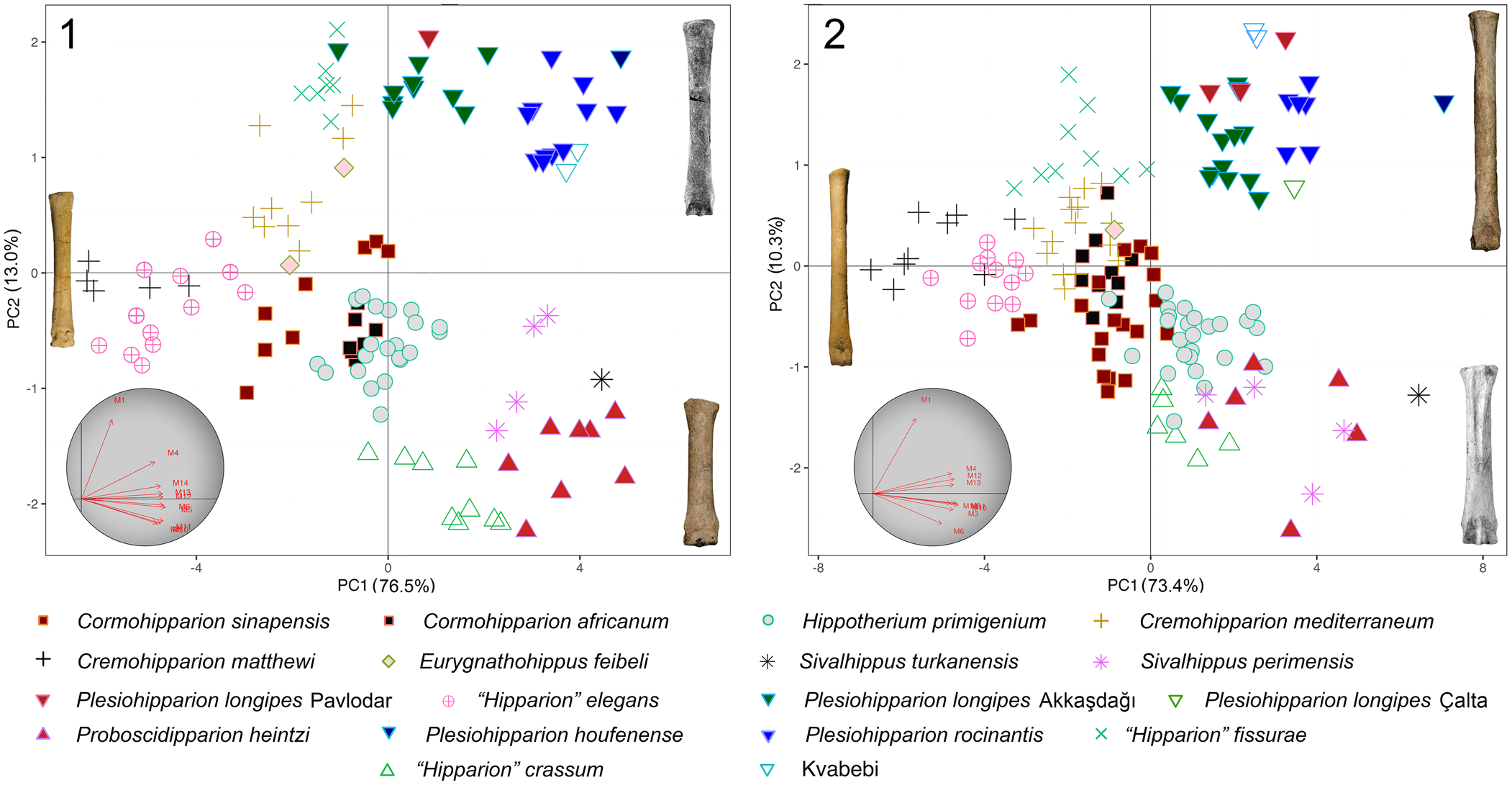
Figure 8.1, 8.2 provides PCAs for mc3 and mt3, respectively. In the mc3 Principal Component Analysis, PC1 and PC2 account for most of the variance with 89.5% (PC1 = 76.5%; PC2 = 13.0%). In mt3, PC1 and PC2 account for 83.7% of the cumulative variance (PC1 = 73.4%; PC2 = 10.3%) (a summary of the variance components is reported in Table 2). In Figure 8.1, 8.2, PC1 indicates a progressively more slender shape from positive to negative values, whereas PC2 indicates a more elongated morphology, from negative to positive values. The results described in the bivariate plots and Log10 Ratios analyses are here confirmed, both in Figure 8.1, 8.2. Three different areas can be described, defined by the following species. A morphologically primitive assemblage represented by the late Miocene species includes H. primigenium, C. sinapensis, and C. africanum, with E. feibeli and C. mediterraneum slightly separated from one another. These are the primitive “Hipparion” morphologies with C. sinapensis, E. feibeli, and C. mediterraneum (see Bernor et al., Reference Bernor, Boaz, Cirilli, El-Shawaihdi and Rook2020). A derived Plesiohipparion group (with larger and more elongated metapodials compared to the primitive European and African late Miocene species), including P. longipes, P. rocinantis, P. houfenense, and the Kvabebi sample, which by these analyses suggests their grouping with P. rocinantis. Another more robustly built mc3 group includes S. turkanensis, S. perimensis, P. heintzi, and “H.” crassum. Cremohipparion matthewi is separated from the entire sample by its small size and slenderness, but shows a relationship to Cremohipparion mediterraneum (also, Bernor et al., Reference Bernor, Ataabadi, Meshida and Wolf2016 related it to C. moldavicum). “Hipparion” elegans plots within the Cremohipparion group, between C. mediterraneum and C. matthewi, and “H.” fissurae plots between C. mediterraneum and the Plesiohipparion group. “Hipparion” crassum plots close to Proboscidipparion heintzi, and this evidence supports its referral to “Proboscidipparion” crassum.
Principal Component Analysis for third metacarpal (1) and third metatarsal (2) on a suite of Miocene, Pliocene, and Early Pleistocene hipparions. Loadings distribution in PC1 and PC2 for third metacarpal (1) and third metatarsal (2) are shown in the biplot diagrams, left lower corner on both graphs. Mc3 images of Cremohipparion matthewi (Sahabi), Plesiohipparion longipes (Akkaşdağı, Koufos and Vlachou, Reference Koufos and Vlachou2005), and Proboscidipparion heintzi (Bernor and Sen, Reference Bernor and Sen2017). Mt3 images of Cremohipparion matthewi (Sahabi), Plesiohipparion longipes (Çalta, Bernor and Sen, Reference Bernor and Sen2017), and Proboscidipparion heintzi (Eisenmann and Sondaar, Reference Eisenmann and Sondaar1998). The complete sample used for this analysis is shown in supplementary table 1 for mc3 and supplementary table 2 for mt3.

Anatomical measurements (following Eisenmann et al., Reference Eisenmann, Alberdi, De Giuli, Staesche, Woodburne and Sondaar1988; Bernor et al., Reference Bernor, Tobien, Hayek and Mittmann1997) of the Roca-Neyra equid sample.

Importance of components of Principal Component Analysis for the “Hipparion” sensu lato sample, Figure 8.

Figure 8.2 (mt3) exhibits the same species clusters shown in Figure 8.1, but packed closer together with slight differences. The variability seen in the “H.” elegans group overlaps with the Cremohipparion group, whereas “H.” fissurae remains intermediate between Cremohipparion and Plesiohipparion. “Hipparion” crassum plots close to the variability seen in the Proboscidipparion-Sivalhippus plots.
Equus
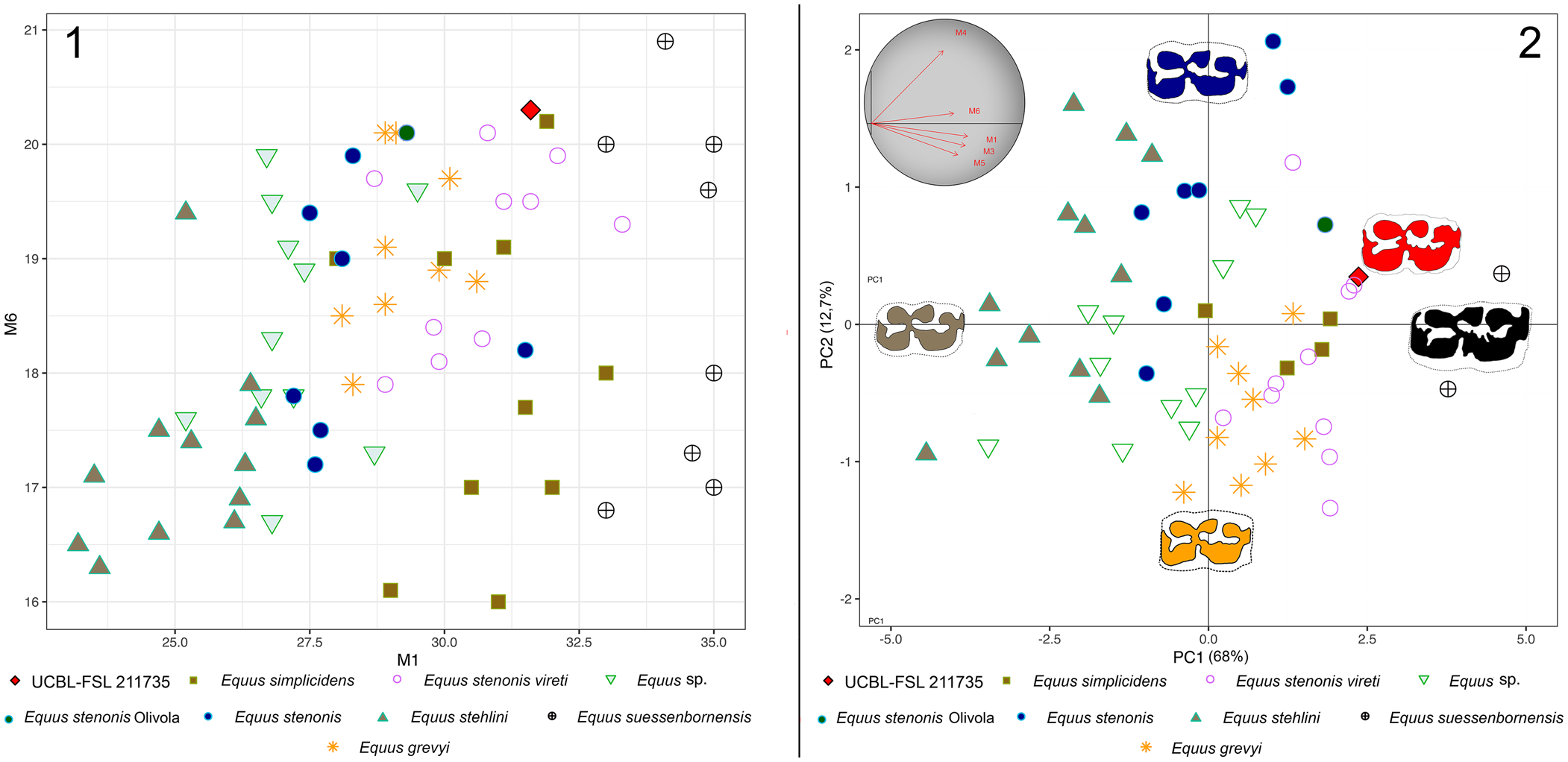
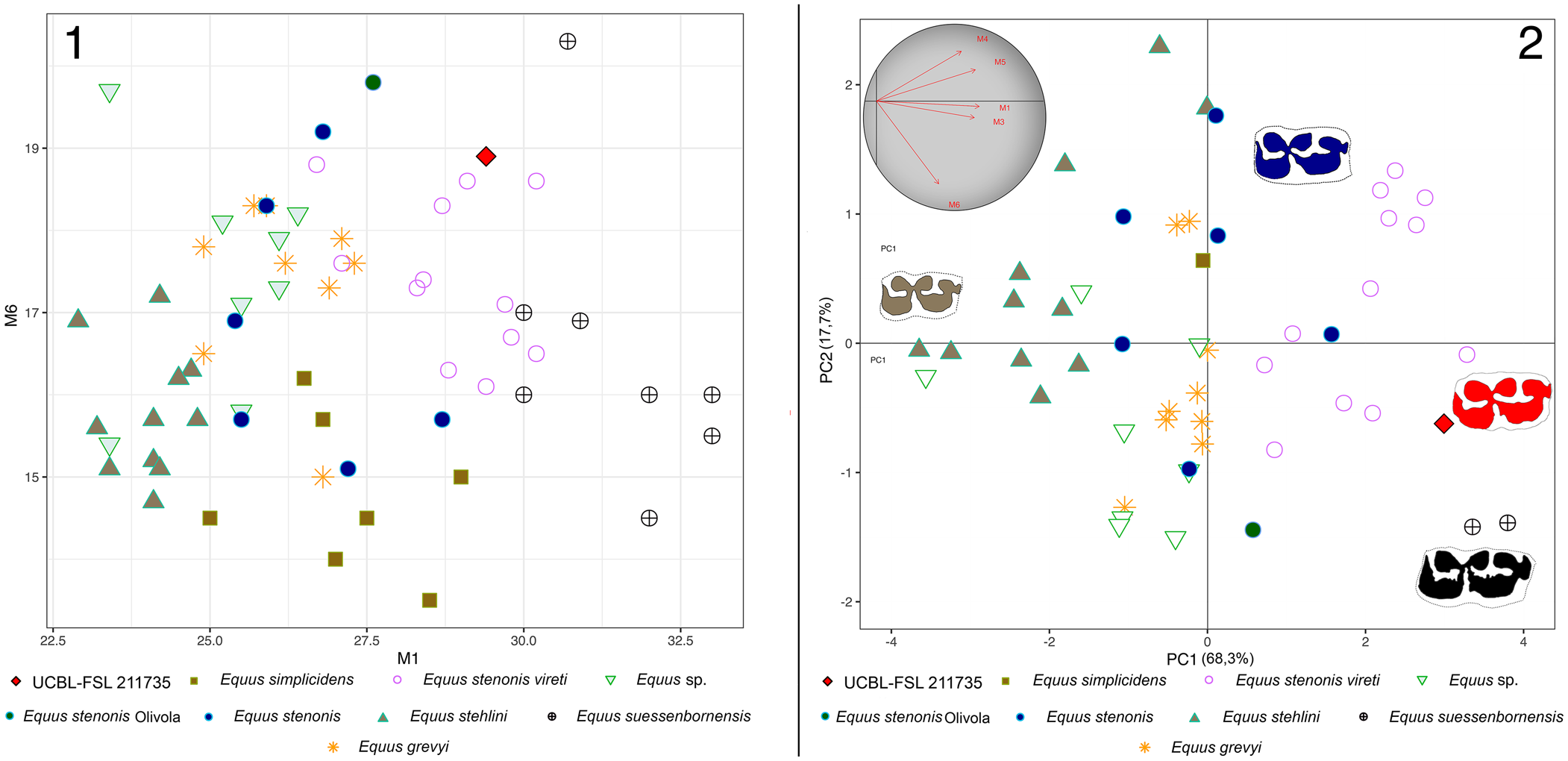
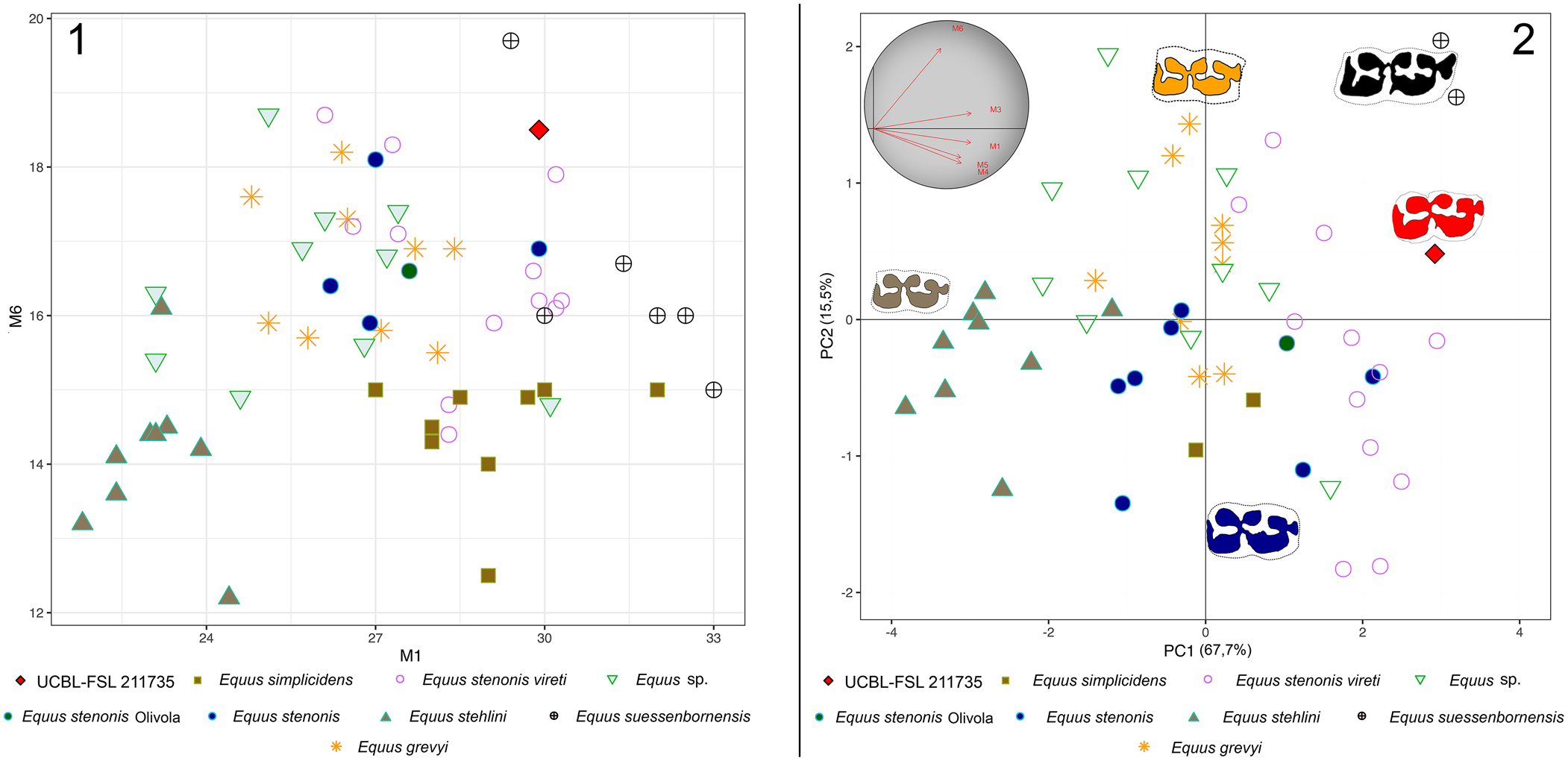
In the Equus sample, statistical analyses are provided through bivariate plots (Figs. 9.1, 10.1, and 11.1) and PCA (Figs. 9.2, 10.2, and 11.2) in tmp4, tmm1, and tmm2. Bivariate plots and PCAs for each element are shown together, to better determine the species clusters.
Lower fourth premolar bivariate plots (1) and Principal Component Analysis (2), comparing Equus cf. E. livenzovensis from Roca-Neyra with a suite of Early Pleistocene Equus and with the extant Equus grevyi. Loadings distribution in PC1 and PC2 are shown in the biplot diagram. Occlusal surface profile of Equus suessenbornensis (black), Roca-Neyra (red), Equus stenonis (blue), Equus stehlini (dark green), and Equus grevyi (orange). The complete database for Principal Component Analysis is reported in supplementary table 3.

Lower first molar bivariate plots (1) and Principal Component Analysis (2), comparing Equus cf. E. livenzovensis from Roca-Neyra with a suite of Early Pleistocene Equus and with the extant Equus grevyi. Loadings distribution in PC1 and PC2 are shown in the biplot diagram. Occlusal surface profile of Equus suessenbornensis (black), Roca-Neyra (red), Equus stenonis (blue), and Equus stehlini (dark green). The complete database for Principal Component Analysis is reported in supplementary table 4.

Lower second molar bivariate plots (1) and Principal Component Analysis (2), comparing Equus cf. E. livenzovensis from Roca-Neyra with a suite of Early Pleistocene Equus and with the extant Equus grevyi. Loadings distribution in PC1 and PC2 are shown in the biplot diagram. Occlusal surface profile of Equus suessenbornensis (black), Roca-Neyra (red), Equus stenonis (blue), Equus stehlini (dark green), and Equus grevyi (orange). The complete database for Principal Component Analysis is reported in supplementary table 5.

Figures 9.1, 10.1, and 11.1 are bivariate plots for UCBL-FSL 211735 tmp4, tmm1, and tmm2, respectively. The measurements plotted are maximum occlusal length (M1) versus occlusal width (M6). In all the bivariate plots, UCBL-FSL 211735 is plotted close to the larger E. stenonis vireti specimens and E. suessenbornensis (Akhalkalaki, Georgia). Equus simplicidens shows an M1 variation comparable to the E. stenonis vireti, E. stenonis from Olivola, and E. stenonis from Upper Valdarno, with a narrower width. Equus sp. from Senèze plots between the E. stenonis group and E. stehlini. Extant E. grevyi overlaps with the E. stenonis group (E. stenonis vireti, E. stenonis Olivola, E. stenonis Upper Valdarno, and Equus sp. Senèze), and in Figures 9.1 and 10.1 overlaps with the largest E. simplicidens specimens.
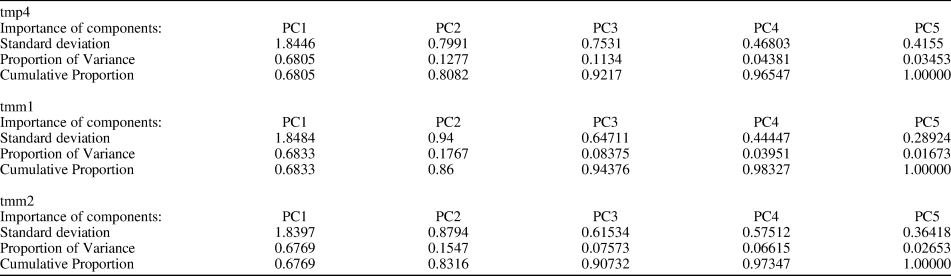
Figures 9.2, 10.2, and 11.2 are PCAs for tmp4, tmm1, and tmm2, respectively. In tmp4 (Fig. 9.2), PC1 and PC2 account the 80.7% of the variance (PC1 = 68%; PC2 = 12.7%). In tmm1 (Fig. 10.2), PC1 and PC2 explain 85.9% of the cumulative variance (PC1 = 68.3%; PC2 = 17.6%). In tmm2 (Fig. 11.2), PC1 and PC2 amount to 83.3% of the cumulative variance (PC1 = 67.9%; PC2 = 15.4%). PC1 segregates species by maximum occlusal length (M1) from positive to negative values, from largest to smallest. PC2 differs among diagrams: in tmp4, it is mainly represented by M4 (maximum length of the preflexid) in positive values and M5 (maximum length of the postflexid) for negative, whereas in tmm1 and tmm2 it is explained by M4-M5 and M6 (maximal width at the occlusal level), which have opposite values (the variance components are reported in Table 3).
Importance of components of Principal Component Analysis for the Equus sample, Figures 9.2, 10.2, 11.2.

Equus simplicidens is always included within the variability of E. stenonis, whereas E. stenonis vireti overlaps the larger portion of the E. stenonis sample. Remarkably, a progressive clustering can be observed through E. stenonis, Equus sp. from Senèze, and E. stehlini, which correlates E. stehlini with Equus sp. (Senèze) instead of the typical E. stenonis samples from Saint Vallier, Olivola, and Upper Valdarno Basin. UCBL-FSL 211735 is plotted outside of any species variability range, and it is always placed between E. stenonis vireti and Equus suessenbornensis. Equus suessenbornensis is the species with the widest dimensions found in the analysis. Finally, E. grevyi once again plots within E. stenonis variability.
Evolutionary and biogeographic implications
Hipparionine lineages
Old World Hipparionini have their earliest occurrence in the lowermost late Miocene of the Vienna Basin Pannonian C, 11.4–11.0 Ma at the base of Mammal Neogene Unit MN9, and it is termed the Cormohipparion Datum (Bernor et al., Reference Bernor, Göhlich, Harzhauser and Semprebon2017; formerly the “Hipparion Datum” of Berggren and Van Couvering, Reference Berggren and Van Couvering1974). Hipparions rapidly diversified across Eurasia and Africa, evolving into several genus-level lineages (Bernor et al., Reference Bernor, Tobien, Woodburne, Lindsay, Fahlbusch and Mein1990, Reference Bernor, Koufos, Woodburne, Fortelius, Bernor, Fahlbusch and Mittman1996, Reference Bernor, Armour-Chelu, Gilbert, Kaiser, Schulz, Werdelin and Sanders2010). Their acme in terms of lineage diversity and abundance was MN12 (7.6–6.8 Ma), followed by a sharp decline by the end of MN13 (5.3 Ma) resulting in the extinction of several lineages, including Cormohipparion, Hippotherium, Hipparion s.s., Sivalhippus (Bernor et al., Reference Bernor, Koufos, Woodburne, Fortelius, Bernor, Fahlbusch and Mittman1996), Baryhipparion (Qiu et al., Reference Qiu, Huang and Guo1987), Shanxihippus (Bernor et al., Reference Bernor, Wang, Liu, Chen and Sun2018a), and Cremohipparion (except a single species in China, C. licenti Qiu, Huang, and Guo, Reference Qiu, Huang and Guo1987). The occurrence of hipparions through the Plio-Pleistocene interval becomes progressively rarer, so that the co-occurrence of “Hipparion” with Equus in the Pleistocene is known from relatively few Eurasian localities.
China retained hipparions into the Pliocene and Pleistocene, including two Asian lineages, Plesiohipparion and Proboscidipparion (Qiu et al., Reference Qiu, Huang and Guo1987; Bernor et al., Reference Bernor, Koufos, Woodburne, Fortelius, Bernor, Fahlbusch and Mittman1996; Bernor and Sun, Reference Bernor and Sun2015). Plesiohipparion has a substantial diversity in the late Miocene–Pleistocene of China, being represented by three species, Plesiohipparion houfenense, Plesiohipparion huangheense Qiu, Huang, and Guo, Reference Qiu, Huang and Guo1987, and Plesiohipparion shanxiense Bernor, Sun, and Chen, Reference Bernor, Sun and Chen2015 (Qiu et al., Reference Qiu, Huang and Guo1987; Bernor and Sun, Reference Bernor and Sun2015; Bernor et al., Reference Bernor, Sun and Chen2015).
Plesiohipparion species have skulls lacking a preorbital fossa and the nasal bones are not retracted. Their cheek teeth are similar to Proboscidipparion, having protocones that are moderately elongate, flattened lingually, and sometimes having a lingual indentation. Overall, they are similar to species of Sivalhippus (Bernor and Hussain, Reference Bernor and Hussain1985; Wolf et al., Reference Wolf, Bernor and Hussain2013). Plesiohipparion lower cheek teeth characteristically have lingually pointed metaconids and metastylids, broad linguaflexids, and very broad ectoflexids penetrating deeply into the isthmus separating metaconid and metastylid of the molars. Third metatarsals are very elongated in Plesiohipparion species.
The Proboscidipparion lineage includes two successive species in China, P. pater Qiu, Huang, and Guo, Reference Qiu, Huang and Guo1987 in the latest Miocene and early Pliocene, and the very large form Proboscidipparion sinense Sefve, Reference Sefve1927 in later earliest to Late Pleistocene (Sefve, Reference Sefve1927; Qiu et al., Reference Qiu, Huang and Guo1987; Bernor et al., Reference Bernor, Qiu and Hayek1989; Bernor and Sun, Reference Bernor and Sun2015). Proboscidipparion has a large skull with an extraordinarily elongate snout that is downturned anteriorly, and strongly to very strongly retracted nasals (Bernor et al., Reference Bernor, Wang, Liu, Chen and Sun2018a).
Proboscidipparion pater has cheek teeth with protocones that are moderately elongated and lingually flattened, complex plications of fossettes, and mostly single pli caballins; maxillary cheek teeth are overall similar to Indian subcontinent Sivalhippus. The lower cheek teeth have rounded metaconids, slightly squared metastylids, and deep linguaflexids that may be V- or U-shaped (Bernor and Sen, Reference Bernor and Sen2017, fig. 2). Proboscidipparion sinense (2.6–1.0 Ma) has maxillary cheek teeth with complex fossette plications, mostly single pli caballins, and protocones that are elongate and flattened lingually, as in P. pater. Lower cheek teeth have elongated tmp2 and tmm3, very elongate and shallow linguaflexids, rounded to pointed metaconids, mostly pointed metastylids, and elongate-deep linguaflexids (Bernor and Sun, Reference Bernor and Sun2015, fig. 4). Some Proboscidipparion sinense maxillary cheek teeth have smaller rounded protocones (Bernor and Sun, Reference Bernor and Sun2015, fig. 5). While strongly divergent in their skull morphology, Plesiohipparion and Proboscidipparion would appear to be closely related and derived from the Indian subcontinent Sivalhippus radiation. And, in fact, Sun et al. (Reference Sun, Zhang, Liu and Bernor2018) identified two species of Sivalhippus in the late Miocene of China—S. platyodus (Sefve, Reference Sefve1927) and S. ptychodus (Sefve, Reference Sefve1927).
The Plesiohipparion lineage arose in Asia at the end of the Miocene, MN 13, and is known from Pavlodar, Russia (Gromova, Reference Gromova1952), Akkaşdağı, Turkey (Koufos and Vlachou, Reference Koufos and Vlachou2005), and Çalta, Turkey (Bernor and Sen, Reference Bernor and Sen2017). Bernor and Lipscomb (Reference Bernor and Lipscomb1991) identified an advanced Plesiohipparion, P. huangheense, occurring with Equus in the Early Pleistocene Turkish locality of Gülyazi (ca. 2.58 Ma). Jukar et al. (Reference Jukar, Sun and Bernor2018) identified a lower cheek tooth row of Plesiohipparion huangheense from 3.5–2.6 Ma Tatrot Formation horizons, India. Jukar et al. (Reference Jukar, Sun, Nanda and Bernor2019) also identified a specimen of Eurygnathohippus sp. in these horizons, marking its first known extension of this lineage outside of Africa.
The early Pliocene locality of Çalta, Turkey includes the occurrence of two Asian Hipparion clades (Eisenmann and Sondaar, Reference Eisenmann and Sondaar1998; Bernor and Sen, Reference Bernor and Sen2017). Eisenmann and Sondaar (Reference Eisenmann and Sondaar1998) recognized two species of hipparions, “Hipparion” longipes and “Hipparion” heintzi. Bernor and Sen (Reference Bernor and Sen2017) recognized these as being referable to the Asian lineages Proboscidipparion heintzi and Plesiohipparion cf. P. longipes. Proboscidipparion heintzi is represented by a juvenile skull with strongly retracted nasals, cheek teeth (deciduous dtxP1-tx4) with short rounded protocones, and txM1 with more elongate protocone flattened lingually. The lower cheek teeth have rounded metaconids and metastylids (again, dptm2-4, tmm1), with the tmm1 having an extremely elongate linguaflexid. While still in their crypts, the permanent mandibular tmi1s are very large. The Çalta P. heintzi has a very short and robust mc3 and a short and massively built 1ph3 akin to Siwalik S. perimensis and African S. turkanensis (Bernor and Harris, Reference Bernor, Harris, Harris and Leakey2003; Wolf et al., Reference Wolf, Bernor and Hussain2013). The Çalta Plesiohipparion cf. P. longipes has a very elongate and slender mt3 and elongate-slender 1ph3.
Forsten (Reference Forsten2002) reported remains of the “Hipparion” crassum “Group” from the Pliocene of Europe. She defined the “Group” as having rounded to rounded-triangular metaconids and metastylids of the lower cheek teeth, and aligned her systematics with Alberdi (Reference Alberdi, Prothero and Schoch1989) who identified this “Group” as her “morphotype 4.” Despite the strong divergence in skull characters of Chinese Plesiohipparion and Proboscidipparion, Forsten suggested that Plesiohipparion is the junior synonym of Proboscidipparion, which created a lasting taxonomic confusion. Plesiohipparion and Proboscidipparion are distinct lineages of generic status, differing profoundly in skull morphology and, we believe, postcranial anatomy (Qiu et al., Reference Qiu, Huang and Guo1987; Bernor et al., Reference Bernor, Koufos, Woodburne, Fortelius, Bernor, Fahlbusch and Mittman1996, Reference Bernor, Sun and Chen2015; Bernor and Sun, Reference Bernor and Sun2015; present paper). Forsten identified “Hipparion” crassum as occurring in France, Italy, Spain, England, Hungary, Bulgaria, Romania, Ukraine, Moldova, Russia, Turkey (including Çalta), Azerbaijan, and China. Hipparions from these localities are united by their occurrence in Plio-Pleistocene horizons and have mixed cranial, dental, and postcranial morphologies.
The “Hipparion” crassum that occurs at Perpignan, France, is 4.1 Ma. (Clauzon et al., Reference Clauzon, Le Strat, Duvail, Do Couto, Suc, Molliex, Bache, Besson, Lindsay, Opdyke, Rubino, Popescu, Haq and Gorini2015). This species shows striking similarities to Proboscidipparion heintzi (Çalta, also ca. 4.0 Ma; Bernor and Sen, Reference Bernor and Sen2017) in its robustly built third metapodials. This evidence has been discussed in the morphometric and statistical analysis (Figs. 5–8). The maxillary cheek teeth have elongated second premolars, complex enamel plications, and short, rounded protocones. The mandibular cheek teeth have rounded to squared metaconids, more pointed metastylids, V-shaped to elongate linguaflexids, and elongate third metapodials. A mandible, Pp208 (Depéret, Reference Depéret1890; Eisenmann, Reference Eisenmann2019; https://vera-eisenmann.com) has an elongate symphysis and tmi1-tmi2 hypertrophied with distinct lingual grooving, and tmp2-tmp4 with deeply extending ectoflexids approaching the isthmus separating metaconid-metastylid. These characters, in particular the short and robust proportions of the mc3s and mt3s, are consistent with a referral to Proboscidipparion crassum. Alberdi and Alcalà (Reference Alberdi and Alcalà1999) referred also the equid sample from the early Pliocene of Dorkovo (Bulgaria), MN14 to Hipparion cf. H. crassum.
Crusafont and Sondaar (Reference Crusafont and Sondaar1971), Alberdi (Reference Alberdi1974), and Alberdi and Alcalà (Reference Alberdi and Alcalà1999) assigned the Layna Pliocene Hipparion to H. fissurae. Domingo et al. (Reference Domingo, Alberdi and Azanza2007, Reference Domingo, Koch, Fernández, Fox, Domingo and Alberdi2013) correlated Layna as being 3.91 Ma, confirming the earlier hypothesis on the age based on rodent remains made by López-Martínez (Reference López-Martínez1989) and Sesé (Reference Sesé2006). In particular, Alberdi and Alcalà (Reference Alberdi and Alcalà1999) described several other Spanish samples wherein “H.” fissurae was identified as occurring from the Pliocene of La Gloria, Villalba Alta Rio 1, Orrios, and La Calera, late Ruscinian MN15. The maxillary cheek teeth from Layna (Alberdi, Reference Alberdi1974, figs. 30, 40, 41, 43; Alberdi and Alcalà, Reference Alberdi and Alcalà1999, fig. 40) have moderately complex plications, weakly developed pli caballins, and protocones that are triangular and oval to lingually flattened. The mandibular cheek teeth have lingually pointed metaconids and metastylids, and mandibular lower third molar has a distally extended talonid. The La Gloria 4 MT3 is very elongate and slender. These characters could suggest a referral to Plesiohipparion, P. fissurae. The morphometric and statistical analyses provided herein have also exhibited similarities with the Pavlodar “Hipparion” elegans and, more broadly, with the Cremohipparion group. These results could suggest that the Layna “Hipparion” could either be a small Eurasian Plesiohipparion or one of the longest limbed Cremohipparion of the Old World. This issue could be resolved if a skull were recovered from any of these localities because of the distinct differences in cranial morphology between Cremohipparion (nasal bones retracted and multiple facial fossae) and Plesiohipparion (nasals not retracted and no facial fossae). However, our results support observations made by Alberdi and Alcalà (Reference Alberdi and Alcalà1999) considering “H.” fissurae a different and valid species, distinguished from Pavlodar “H.” elegans.
Kvabebi 1 and Kvabebi 2, Georgia (Vekua, Reference Vekua1972; Eisenmann, Reference Eisenmann2019; https://vera-eisenmann.com) have two cheek tooth series with elongate tmp2, and remaining cheek teeth with lingually pointed metaconids and metastylids typical of Plesiohipparion suggesting a referral to Plesiohipparion crusafonti, which we consider to be a junior synonym of Plesiohipparion rocinantis. Agusti et al. (Reference Agusti, Vekua, Oms, Lordkipanidze, Bukhsianidze, Kiladze and Rook2009) have suggested a correlation of 3.09 Ma. based on a paleomagnetic chronology.
The Villarroya Hipparion was initially described by Villalta (Reference Villalta1948, Reference Villalta1952) as Hipparion rocinantis and was recognized as resembling North American Neohipparion by Zhegallo (Reference Zhegallo1978) and MacFadden (Reference MacFadden1984). Qiu et al. (Reference Qiu, Huang and Guo1987), followed by Bernor et al. (Reference Bernor, Koufos, Woodburne, Fortelius, Bernor, Fahlbusch and Mittman1996, Reference Bernor, Sun and Chen2015) and Bernor and Sun (Reference Bernor and Sun2015), recognized this species as being a member of the Plesiohipparion clade. The Villarroya Plesiohipparion rocinantis (Alberdi, Reference Alberdi1974) has a skull lacking a preorbital fossa, maxillary cheek teeth with moderately complex plications, small and simple pli caballins, and lingually flattened and labially rounded protocones. The mandibular cheek teeth have pointed metaconids and metastylids with deep, broadly U-shaped linguaflexids; mandibular tmm3 has an elongate talonid. The first phalanges of the central digit are elongated and slender. These are all morphological hallmarks of Plesiohipparion.
These lines of evidence are supported in the morphometric and statistical analyses provided herein, wherein the Villarroya sample is consistently included in the Plesiohipparion group (Figs. 5.1, 6.4, 7.4, 8). Pueyo et al. (Reference Pueyo, Muñoz, Laplana and Parés2016) recently cited the Villarroya “Hipparion” as the last occurring European assemblage in Western Europe, correlating it with the Reunion chron (C2r.1n, 2.128–2.148 Ma). Azanza et al. (Reference Azanza, Morales, Andrés, Cerdeño and Alberdi2016) have challenged this correlation based on faunal evidence, with conflicting data from the micromammal assemblage. As a result, Azanza et al. (Reference Azanza, Morales, Andrés, Cerdeño and Alberdi2016) correlated the Villarroya Mammal Zone with MNQ16b. If this revised correlation is correct, Villaroya, Roca-Neyra, and Sésklo (Athanassiou, Reference Athanassiou2018) could represent the last occurrence of Plesiohipparion in Europe, at the Plio-Pleistocene transition.
Rook et al. (Reference Rook, Cirilli and Bernor2017) described a small fragmentary left txM1 of an “Hipparion” sp. from Montopoli, Italy. While fragmentary, its size and simple occlusal morphology are akin to latest Miocene Cremohipparion sp., as found at Baccinello, Italy (Bernor et al., Reference Bernor, Kaiser, Nelson and Rook2011). There is nothing in the morphology of this small Hipparion that would suggest an affinity either with Plesiohipparion or Proboscidipparion, but still, its generic status remains enigmatic.
The westernmost occurring hipparions come from the Red Crag deposits, Suffolk, England and are believed to be 3.8–2.8 Ma in age (Forsten, Reference Forsten2001). Based on a sample of ~53 teeth from the Ipswich Borough Council Museum (IPSMG), the Natural History Museum in London (BMNH), and the Museum of Comparative Zoology (MCZ), Harvard University, Forsten (Reference Forsten2001) identified two Hipparion taxa, Hipparion sp.-crassum group and Proboscidipparion sp., from the Red Crag. Forsten (Reference Forsten2001, fig. 1) identified eight cheek teeth, including four mandibular and two maxillary cheek teeth, as being Hipparion sp., and two mandibular cheek teeth as Proboscidipparion sp. The two maxillary cheek teeth, a right txP2 (IPSMG R 1939.85.57.5) and a left txM1or txM2 (IPSMG R 1876 4.1) have the following salient features: very complex plications of the fossettes, bifid pli caballins, small rounded (the txP2) to lingually flattened short oval protocone (txM1-2). This morphology agrees with “H.” crassum and we believe is a Proboscidipparion (see Bernor and Sun, Reference Bernor and Sun2015). The lower cheek teeth (Forsten, Reference Forsten2001, figs. 1–4) include a right tmp2 (ISPMG R 1876.4.10), a left tmp3or4 (ISPMG R 1876 4.5), right tmm1or2 (ISPMG R1939.85.57.8), and left tmp3or4 (ISPMG R 1876 4.9) that have broad linguaflexids, rounded metaconids, squared metastylids, and very broad linguaflexids referable to H. crassum, which we believe allied with Proboscidipparion. The two lower cheek teeth referred by Forsten (Reference Forsten2001) to Proboscidipparion sp. are a right tmp2 (ISPMG 1939 85.57.4) and right tmm3 (ISPMG R 1876 4.7). The lower second premolar is very worn, elongated, and with rounded metaconid and squared metastylid and shallow U-shaped linguaflexid. The lower third molar has a rounded metaconid, lingually pointed metastylid, and broad linguaflexid, which compare with Proboscidipparion pater from China (Bernor and Sun, Reference Bernor and Sun2015). In our opinion, the entire Red Crag sample may indeed be a species of the Proboscidipparion clade, and not Plesiohipparion or “Hipparion” sensu lato.
Whereas the North African late Miocene has recorded occurrences of Cremohipparion, Sivalhippus, and Eurygnathohippus, the Plio-Pleistocene only records the hipparion species Eurygnathohippus pomeli (Eisenmann and Geraads, Reference Eisenmann and Geraads2007) (Eisenmann and Geraads, Reference Eisenmann and Geraads2007; Bernor et al., Reference Bernor, Armour-Chelu, Gilbert, Kaiser, Schulz, Werdelin and Sanders2010). In the latest Miocene, a small slender-limbed form Eurygnathohippus feibeli occurred in Kenya, Ethiopia, Libya, and Morocco (Bernor and Harris, Reference Bernor, Harris, Harris and Leakey2003; Bernor et al., Reference Bernor, Armour-Chelu, Gilbert, Kaiser, Schulz, Werdelin and Sanders2010, Reference Bernor, Boaz and Rook2012, Reference Bernor, Boaz, Cirilli, El-Shawaihdi and Rook2020; Cirilli et al., Reference Cirilli, Zouhri, El Boughabi, Benvenuti, Papini, Bernor and Rook2020). In East Africa, Eurygnathohippus feibeli became very rare and was replaced by Eurygnathohippus woldegabrieli Berner et al., Reference Bernor, Gilbert, Semprebon, Simpson and Sileshi Semaw2013 by 4.4 Ma, except at Ekora, Kenya (ca. 4.2 Ma; Bernor et al., Reference Bernor, Armour-Chelu, Gilbert, Kaiser, Schulz, Werdelin and Sanders2010, Reference Bernor, Gilbert, Semprebon, Simpson and Sileshi Semaw2013). Between 3.8 and 2.9 Ma Ethiopia records two Hipparion species, Eurygnathohippus hasumense Eisenmann, Reference Eisenmann and Harris1983 and Eurygnathohippus afarense (Eisenmann, Reference Eisenmann1976) (Eisenmann, Reference Eisenmann and Harris1983; Bernor et al., Reference Bernor, Armour-Chelu, Gilbert, Kaiser, Schulz, Werdelin and Sanders2010). The latest recognized species from Olduvai Bed 1, Tanzania (1.9 Ma) to the 1 Ma. levels of Daka, Ethiopia and Cornelia, South Africa is Eurygnathohippus cornelianus Van Hoepen, Reference Van Hoepen1930, a species with hypertrophied txI1 and txI2 and tmi1 and tmi2 with very high crowns. Other than a single occurrence of Eurygnathohippus from the Indian Tatrot (Jukar et al., Reference Jukar, Sun, Nanda and Bernor2019), the genus was restricted to Africa. Equus first occurs in East Africa at 2.3 Ma (Bernor et al., Reference Bernor, Armour-Chelu, Gilbert, Kaiser, Schulz, Werdelin and Sanders2010).
Equus dispersal
The Equus dispersal into Eurasia was a major biochronologic event marking the lower Quaternary boundary, at 2.58 Ma. Associated with this immigration event was a strong paleoclimatic pulse recorded in terrestrial and marine strata, related to the initiation of a major glaciation pulse in the northern hemisphere (Lindsay et al., Reference Lindsay, Opdyke and Johnson1980; Azzaroli, Reference Azzaroli1983). The Equus Datum can be observed across Eurasia (2.58 Ma in Europe and 2.55 in China), and slightly shifted in sub Saharan Africa at 2.33 Ma (Rook et al., Reference Rook, Bernor, Avilla, Cirilli, Flynn, Jukar, Sanders, Scott and Wang2019).
Equus livenzovensis is the first appearing species in Europe and Western Asia (Caucasus), at ca. 2.58 Ma. Equus livenzovensis was originally recognized by Bajgusheva (Reference Bajgusheva [Baigusheva]1978) based on the cranial and postcranial sample from the Early Pleistocene of Livensovka and Kapry. Azzaroli (Reference Azzaroli1982) first recognized the occurrence of Equus cf. E. livenzovensis in the Montopoli fauna, which has been studied in detail and confirmed by Bernor et al. (Reference Bernor, Cirilli, Wang and Rook2018b). Alberdi et al. (Reference Alberdi, Cerdeño, López-Martínez, Morales and Soria1997) reported the occurrence of Equus livenzovensis from El Rincón-1 (Spain, Early Pleistocene), included in a faunal assemblage that shares many mammalian taxa with the Italian locality of Montopoli. Finally, Alberdi et al. (Reference Alberdi, Ortiz Jaureguizar and Prado1998), Forsten (Reference Forsten1998), and Azzaroli (Reference Azzaroli2000) studied the type E. livenzovensis sample from Khapry, reaffirming its presence in the Caucasus area and validating the species.
Azzaroli (Reference Azzaroli1982, Reference Azzaroli1992, Reference Azzaroli2000, Reference Azzaroli2002) provided a detailed discussion on the origin of Old World Equus. The genus Equus originated in North America, having been derived from Dinohippus, which had already evolved monodactyly (Barrón-Ortiz et al., Reference Barrón-Ortiz, Avilla, Jass, Bravo-Cuevas, Machado and Mothé2019; Bravo-Cuevas and Jiménez-Hidalgo, Reference Bravo-Cuevas and Jiménez-Hidalgo2019; Carranza-Castañeda, Reference Carranza-Castañeda2019). There is no consensus on which species is the earliest known “Equus,” because opinions differ among authors (Eisenmann and Baylac, Reference Eisenmann and Baylac2000; Eisenmann and Deng, Reference Eisenmann and Deng2005; Barrón-Ortiz et al., Reference Barrón-Ortiz, Avilla, Jass, Bravo-Cuevas, Machado and Mothé2019). Bernor et al. (Reference Bernor, Cirilli, Jukar, Potts, Bukhsianidze and Rook2019) have evaluated and supported Azzaroli and Voorhies (Reference Azzaroli and Voorhies1993) hypothesis that North American Equus simplicidens is the most likely source for Old World first-occurring Equus. Equus simplicidens shares many characters with European E. livenzovensis and E. stenonis (see Bernor et al., [Reference Bernor, Cirilli, Jukar, Potts, Bukhsianidze and Rook2019] for a comprehensive morphological review of the Early Pleistocene Equus species) and with the Chinese species E. eisenmannae Qiu, Deng, and Wang, Reference Qiu, Deng and Wang2004, E. qingyangensis Deng and Xue, Reference Deng and Xue1999, and E. sanmeniensis Teilhard de Chardin and Piveteau, Reference Teilhard de Chardin and Piveteau1930 (see Sun and Deng, Reference Sun and Deng2019), which represent the oldest Eurasian Early Pleistocene Equus species (ca. 2.6 Ma). Azzaroli (Reference Azzaroli1982, Reference Azzaroli1992, Reference Azzaroli2002) and Bernor et al. (Reference Bernor, Cirilli, Wang and Rook2018b, Reference Bernor, Cirilli, Jukar, Potts, Bukhsianidze and Rook2019) have stated that Eurasian Old World Equus species could be related to Kenyan Equus koobiforensis Eisenmann, Reference Eisenmann and Harris1983, which is the first species reported in the Early Pleistocene African fossil record.
Our results support observations by Bernor et al. (Reference Bernor, Cirilli, Jukar, Potts, Bukhsianidze and Rook2019) that E. grevyi shares morphologic and morphometric dental features with the ancestral E. simplicidens and the Old World Equus stenonine species. Our analyses on the lower cheek teeth underscore an important evolutionary perspective: there is no significant morphometric difference in the E. simplicidens, E. stenonis vireti, E. stenonis, and E. grevyi lower cheek teeth, and the enamel occlusal morphology of the extant E. grevyi is found in the European fossil species E. stenonis. Furthermore, our analyses of the dental Equus sample from Roca-Neyra highlight the importance of E. livenzovensis, which exhibits mixed features with E. simplicidens and E. stenonis, and, with the support of the morphometric analysis explained in Bernor et al. (Reference Bernor, Cirilli, Wang and Rook2018b), can be considered the primitive species for the radiation of the E. stenonis group. Following Azzaroli and Voorhies (Reference Azzaroli and Voorhies1993) and Bernor et al. (Reference Bernor, Cirilli, Jukar, Potts, Bukhsianidze and Rook2019), it appears that Equus simplicidens is plausibly ancestral to earliest occurring old World Equus, and the earliest Equus was very large (E. livenzovensis), and that in turn Equus stenonis and ultimately Equus grevyi are derived from early “stenonine” Equus spp.
Hipparion-Equus sympatry
The Roca-Neyra equid sample underscores an interesting ecological perspective in the European Plio-Pleistocene faunal turnover: the Hipparion (sensu lato)-Equus sympatric co-occurrence. In Europe, co-occurrence of Equus with “Hipparion” is rare, being represented at Montopoli in Italy (Rook et al., Reference Rook, Cirilli and Bernor2017, Reference Rook, Bernor, Avilla, Cirilli, Flynn, Jukar, Sanders, Scott and Wang2019; Bernor et al., Reference Bernor, Cirilli, Wang and Rook2018b), Roca-Neyra in France (Eisenmann and Brunet, Reference Eisenmann and Brunet1973; Palombo and Valli, Reference Palombo and Valli2004; this paper), Gülyazi in Turkey (Bernor and Lipscomb, Reference Bernor and Lipscomb1991), and possibly in the Khapry area (Eisenmann and Brunet, Reference Eisenmann and Brunet1973; Bajgusheva et al., Reference Bajgusheva, Titov and Tesakov2001). Africa has a protracted co-occurrence of Equus and Eurygnathohippus from 2.3 to <1 Ma (Bernor et al., Reference Bernor, Armour-Chelu, Gilbert, Kaiser, Schulz, Werdelin and Sanders2010). Proboscidipparion co-occurs with Equus up to 1 Ma in China (Qiu et al., Reference Qiu, Huang and Guo1987). Furthermore, the possible youngest occurrence of “Hipparion” in Europe is recorded by the occurrence of Plesiohipparion rocinantis at Villarroya, which recently was estimated by Pueyo et al. (Reference Pueyo, Muñoz, Laplana and Parés2016) to be 2.1 Ma, based on their paleomagnetic interpretation of the section. However, as previously explained, Azanza et al. (Reference Azanza, Morales, Andrés, Cerdeño and Alberdi2016) questioned this age, suggesting a referral to the Mammal Zone MNQ16b. Athanassiou (Reference Athanassiou2018) reported new insights from Sésklo (Greece, Early Pleistocene) with the occurrence of Plesiohipparion cf. P. shanxiense and E. cf. E. stenonis at two different stratigraphic levels, correlated with the Mammal Zones MNQ16b and MNQ17. Athanassiou (Reference Athanassiou2018) has commented that the Sésklo hipparionine population did not occur sympatrically with the genus Equus.
The Eurasian Hipparion Last Appearance Datum (LAD) is more controversial, and it is unlikely to have been synchronous. Our current understanding is that the latest occurrences of Plesiohipparion rocinantis from Villarroya and Plesiohipparion shanxiense from the Shanxi Basin indicate an approximate Early Pleistocene age of 2.0 Ma.
Considering Azanza et al.'s (Reference Azanza, Morales, Andrés, Cerdeño and Alberdi2016) correlation of Villarroya to Mammal Zone MNQ16b, the youngest European hipparions would now appear to have occurred at the Plio-Pleistocene boundary, ca. 2.6 Ma, and not much later in time. This assertion is supported by reported occurrences of European “Hipparion” sensu lato at penecontemporaneous earliest Pleistocene localities of Roca-Neyra, Villaroya, Sésklo, and Gülyazi. These localities all have species of Plesiohipparion recognized by us. The penecontemporaneous Italian locality of Montopoli has an “Hipparion” sp., which we believe is referable to ?Cremohipparion by its size and morphology (Rook et al., Reference Rook, Cirilli and Bernor2017; this paper). In this regard, new research on the Caucasus area could reinforce the biogeographic linkage between European and Chinese species.
Equus-Hipparion sympatry in Europe is represented by the occurrence of multiple residual lineages of three-toed equids, Plesiohipparion, and possibly Cremohipparion: Plesiohipparion huangheense (Gülyazi, Turkey; Bernor and Lipscomb, Reference Bernor and Lipscomb1991), Plesiohipparion cf. P. shanxiense (Sésklo, Greece; Athanassiou, Reference Athanassiou2018), a possible referral Plesiohipparion rocinantis (Kvabebi, Roca-Neyra, and Villarroya; present paper, pending a complete review of the equid sample of these localities), and the enigmatic record from Montopoli (Italy; Rook et al., Reference Rook, Cirilli and Bernor2017; this paper), which could be referred to ?Cremohipparion sp. We have presented evidence that Proboscidipparion is restricted to the Pliocene, represented by the species P. heintzi from Çalta, (Turkey) (Bernor and Sen, Reference Bernor and Sen2017) and P. crassum from Perpignan (France), Dorkovo (Bulgaria), Suffolk (England) (Alberdi and Alcalà, Reference Alberdi and Alcalà1999; present paper), and therefore not recorded as co-occurring with the genus Equus outside China.
In China, Proboscidipparion co-occurs with Equus until 1 Ma (Qiu et al., Reference Qiu, Huang and Guo1987). In Africa, Eurygnathohippus persists until sometime younger than 1 Ma (Bernor and Armour-Chelu, Reference Bernor, Armour-Chelu, Bromage and Schrenk1999; Bernor et al., Reference Bernor, Armour-Chelu, Gilbert, Kaiser, Schulz, Werdelin and Sanders2010), co-occurring with the genus Equus since its FAD at 2.33 Ma (Eisenmann, Reference Eisenmann and Harris1983; Bernor et al., Reference Bernor, Armour-Chelu, Gilbert, Kaiser, Schulz, Werdelin and Sanders2010, Reference Bernor, Cirilli, Jukar, Potts, Bukhsianidze and Rook2019; Rook et al., Reference Rook, Bernor, Avilla, Cirilli, Flynn, Jukar, Sanders, Scott and Wang2019). Clearly, the so-called “Hipparion Last Appearance Datum” was diachronous across Eurasia and Africa, with multiple lineages having become extinct by ca. 1 Ma.
Conclusions
Our review of the Roca-Neyra equid sample and comparisons with other Eurasian Plio-Pleistocene equid assemblages has led to new insights on the taxonomic diversity of Plio-Pleistocene “Hipparion” evolutionary lineages and on the Equus FAD in Eurasia.
As reported in our morphometric and statistical analyses, “Hipparion” crassum from Perpignan (4.1 Ma, Ruscinian, MN15) is referred to the genus Proboscidipparion due its close similarities with the early Pliocene Proboscidipparion heintzi from Çalta (ca. 4 Ma) in its cranial and postcranial morphology.
The European “Hipparion” samples at the Plio–Pleistocene transition (Kvabebi, Villarroya, and Roca-Neyra) have shown a remarkable resemblance to the late Miocene–Early Pleistocene Plesiohipparion species: P. longipes from Pavlodar and Çalta and P. houfenense from Yushe Basin. Furthermore, the Kvabebi, Villarroya, and Roca-Neyra samples may be referred to Plesiohipparion rocinantis due to their morphological similarity. Nevertheless, a revision of the Kvabebi and Villarroya samples would help to clarify the occurrence of multiple Plesiohipparion species in the Plio-Pleistocene Eurasian fossil record.
The Pliocene sample of “Hipparion” fissurae from Layna (3.91, Ruscinian, MN15) remains enigmatic. Its elongate-slender metapodial morphology could suggest a referral to either Plesiohipparion or Cremohipparion, and more information from the skull and dentition are needed in order to determinate its generic assignment. Nevertheless, this study has pointed out the possible relationship between the Layna sample and “Hipparion elegans” from Pavlodar, due their close morphological similarities.
The Montopoli fragmentary cheek tooth remains the most obscure “Hipparion.” Its size and simplicity of occlusal morphology do not match Plesiohipparion and Proboscidipparion, but, given the latest Miocene occurrence of a small Cremohipparion from Baccinello V3, ?Cremohipparion sp. is a plausible referral.
The Roca-Neyra Equus sample is referred to Equus cf. E. livenzovensis, supported by the occlusal morphology of the lower cheek teeth, which includes intermediate features between the North American Equus simplicidens and the European Equus stenonis. The presence of Equus cf. E. livenzovensis at Roca-Neyra confirms the dispersion of this species at the beginning of the Pleistocene in Europe, and the new age proposed of 2.6 ± 0.2 Ma (Nomade et al., Reference Nomade, Pastre, Guillou, Faure, Guérin, Delson, Debard, Voinchet and Messager2014) correlates this locality with the 2.6 Ma sites of Livensovska, Montopoli, El Rincòn-1, and Huélago, where Equus livenzovensis occurs.
The occurrences of the three-toed equid, here referred to Plesiohipparion cf. P. rocinantis, and the monodactyl horse Equus cf. E. livenzovensis at Roca-Neyra, underscore the importance of this locality in Central and Western Europe, allowing us to recognize it as an important crossroad for the transition from the last European Plio-Pleistocene “Hipparion” sensu lato to the first occurrence of the genus Equus.
Acknowledgments
We are thankful to E. Robert (Université Claude Bernard-1) and D. Berthet (Museé des Confluences) from Lyon for providing access to OC for studying the Early Pleistocene equids of Central Europe. Furthermore, we thank E. Cioppi and L. Bellucci (Museo di Storia Naturale dell'Univerisità degli Studi di Firenze, sezione di Geologia e Paleontologia) and the Smithsonian Institution for access to the collections in their care. OC thanks the University of Pisa PhD program and University of Florence (Fondi di Ateneo) for financial support. RLB wishes to acknowledge research funding by NSF EAR grants 8806645, 0125009, 1113175, 1558586; DBI grant 1759882 for the FuTRES database; and support from the Smithsonian Human Origins Program. This is FuTRES publication number 19. Furthermore, we thank V. Eisenmann for her generosity in sharing images and measurements on fossil horses in her public web database, and any other authors who have included available research data. We finally thank M. T. Alberdi and another, anonymous reviewer for their suggestions, which have increased the quality of this manuscript.
Accessibility of supplemental data
Data available from the Dryad Digital Repository: https://doi.org/10.5061/dryad.hqbzkh1dj.