





Introduction
Voting differences between women and men are a well-established finding in the literature on electoral behaviour. Until the late 1970s, women in most Western democracies tended to hold more conservative ideological orientations than men and were therefore more likely to support right-wing parties. From the 1980s onwards, however, this pattern reversed. The so-called traditional gender gap gave way to a modern gender gap, whereby women increasingly adopted more progressive political orientations than men and became more likely to vote for left-wing parties.
This transition, largely driven by generational replacement, has not unfolded uniformly across time and space (Abendschön and Steinmetz Reference Abendschön and Steinmetz2014; Dassonneville Reference Dassonneville2021; Giger Reference Giger2009; Iversen and Rosenbluth Reference Iversen and Rosenbluth2006). This suggests the existence of significant variation across country–election contexts, which the literature has only sporadically addressed, focusing on macrolevel explanatory variables. Indeed, although macrolevel explanations are often discussed implicitly (e.g. Giger Reference Giger2009; Inglehart and Norris Reference Inglehart and Norris2000), only a limited number of studies have subjected them to systematic empirical testing (see Abendschön and Steinmetz Reference Abendschön and Steinmetz2014; Di Landro Reference Di Landro2025; Kedar, Oshri and Halevy Reference Kedar, Oshri and Halevy2024). Moreover, previous works combining individual and macrolevel factors have largely focused on the direct effects of context (such as labour market structures or prevailing societal values) on gendered patterns of voting behaviour. By contrast, comparatively little attention has been paid to the role of political parties and, in particular, to the policy positions they present to voters in their electoral platforms (i.e. party supply). In particular, little is known about whether party positions on key issues have contributed to reorienting women’s and men’s electoral preferences towards the left. This omission is striking, given that most individual-level accounts implicitly assume that parties played a central role in the transition from the traditional to the modern gender gap (Giger Reference Giger2009; Inglehart Reference Inglehart1990; Iversen and Rosenbluth Reference Iversen and Rosenbluth2006). The prevailing argument is that left-wing parties’ policy positions, being relatively more progressive and ‘women-friendly’ (Emmenegger and Manow Reference Emmenegger and Manow2014: 185), are more closely aligned with women’s preferences, thereby attracting female voters while simultaneously and potentially alienating segments of the male electorate (e.g. Kedar, Oshri and Halevy Reference Kedar, Oshri and Halevy2024).
In fact, if women have increasingly shifted towards the left, men have become increasingly over-represented among right-wing and, in particular, radical right parties (Campbell and Erzeel Reference Campbell and Erzeel2018; Coffé Reference Coffè and Rydgren2018; Givens Reference Givens2004). This pattern is often interpreted as the mirror image of women’s progressive realignment. As women’s preferences have moved towards more egalitarian and inclusive policy positions, segments of the male electorate – especially within the working class (Oesch Reference Oesch2008; Oesch and Rennwald Reference Oesch and Rennwald2018; Rydgren Reference Rydgren and Rydgren2012) – have tended to be more receptive to political platforms emphasising cultural and social traditionalism. These platforms often promote nativist and sexist worldviews (Ralph-Morrow Reference Ralph-Morrow2020), while also reinforcing opposition towards minorities and immigration (Bornschier and Kriesi Reference Bornschier, Kriesi and Rydgren2013; Harteveld, Van der Brug, Dahlberg et al. Reference Harteveld, Van der Brug, Dahlberg and Kokkonen2015). From this broader perspective, the modern gender gap could be better understood as the outcome of a dual process of electoral realignment, involving both women’s increasing alignment with the left and men’s growing concentration on the right. Accordingly, just as a modern gender gap has emerged on the left (with women being more likely than men to support left-wing parties) a corresponding gender gap can also be observed on the right, where men are disproportionately represented.
This paper focuses on the left-hand side of this realignment by examining how variation in left-wing party positions shapes the modern gender gap, whereas the dynamics underlying gendered patterns of electoral support for right-wing and radical right parties remain beyond the scope of the present study. In particular, it argues that cross-national and temporal variation in the modern gender gap can be explained, at least in part, by the differences in party supply across different electoral contests. Drawing on rational-choice models of voting behaviour, we first hypothesise that the modern gender gap will be more pronounced in contexts where left-wing parties adopt more progressive positions along two central dimensions of contemporary political competition: the economic and the socio-cultural dimensions. Such positions may align more closely with women’s preferences, thereby increasing women’s electoral support for the left, while at the same time diverging from the preferences of segments of the male electorate, potentially alienating male voters and widening the gender gap in electoral support for left-wing parties. Second, we examine whether these party-supply effects vary across generations, expecting them to be particularly strong among younger cohorts, who have been socialised into a more post-materialist value system and in a context characterised more broadly by modernisation and secularisation.
To this end, the paper utilises a longitudinal dataset that combines individual-level data (European Social Survey [ESS]; Waves 1–10) and party-level data (Comparative Manifesto Project [CMP]) in 19 Western European countries covering a period ranging from 1999 to 2021. A series of multilevel models show that the modern gender gap is indeed amplified in contexts where the party supply of left-wing parties is more closely aligned with the priorities and interests of the female electorate. While demonstrating that party supply matters in general, its effect across different generations is more uncertain.
The paper is organised as follows: the first section reviews the literature on the traditional and modern gender gaps; the next section examines variation in the modern gender gap across time and space and presents the theoretical argument and main hypotheses; we then introduce the data and methods, before presenting the empirical models and discussing the results. The paper concludes with a summary and discussion of the main findings.
From the traditional to the modern gender gap
According to Inglehart and Norris (Reference Inglehart and Norris2000, Reference Inglehart and Norris2003), the history of the voting gender gap can be segmented into three distinct phases. The first phase, often referred to as the traditional gender gap, is characterised by women tending to vote more conservatively than men, a trend that remained prevalent until the early 1980s. This preference for conservative parties among women was attributed to several factors. Up until the 1960s, women were largely excluded from social and economic life outside the home, so their role was mostly confined to the domestic sphere – including child, elderly care, and domestic responsibilities. Being excluded from almost any employment outside the home, women faced significant barriers to fostering a sense of class consciousness. This lack of exposure hindered their awareness of working conditions, income disparities, and the precarious nature of employment. Therefore, their exposure to political issues such as economic redistribution and social rights, typically advocated by left-wing parties and governments, was limited (Lipset and Rokkan Reference Lipset, Rokkan, Lipset and Rokkan1967). Religion represented one of the few social activities they could engage in beyond the domestic sphere, leading them to be exposed to a religious environment and message. As a result, women tended to develop more religious and conservative attitudes than men, which were then translated into a more marked preference for right-wing parties (Campbell, Converse, Miller et al. Reference Campbell, Converse, Miller and Stokes1960; Duverger Reference Duverger1955; Emmenegger and Manow Reference Emmenegger and Manow2014; Inglehart and Norris Reference Inglehart and Norris2000).
The second phase is marked by a gender party de-alignment. Factors such as educational expansion, improved standards of living, and greater access to information paved the way to cognitive mobilisation and consolidation of post-materialist values and feminist ideals across new generations of citizens (Andersen and Cook Reference Andersen and Cook1985; Dalton Reference Dalton1984; Inglehart Reference Inglehart1977; Inglehart and Norris Reference Inglehart and Norris2000; Roig et al. Reference Roig, Aybar and Pavía2024; Togeby Reference Togeby1994; Van Staalduinen and Zollinger Reference Van Staalduinen and Zollinger2024). In turn, these processes have favoured partisan de-alignment and, more generally, greater independence of individuals from traditional social structures (Dalton Reference Dalton1984). As voters became less dependent on traditional societal hierarchies – such as social class, churches, and political parties – their connections to political parties became less structured and more volatile. Regarding the gender gap in voting behaviour, the processes of modernisation and secularisation in Western societies have significantly reshaped women’s political engagement, eroding the historical alignment with right-wing parties. Indeed, newer generations of women, socialised in an era characterised by modernity and post-materialist and feminist values, and with greater access to the labour market, have become less anchored to traditional right-wing loyalties. Rather, they have become increasingly open to a broader range of parties, reflecting their shifting priorities and experiences.
Starting from the 1980s, a new phase emerged where women began to adopt substantially more progressive attitudes – both in economic and social terms – than men, something that was then reflected into a relatively higher likelihood to vote for left-wing parties. This pattern is commonly referred to as the modern gender gap (Abendschön and Steinmetz Reference Abendschön and Steinmetz2014; Giger Reference Giger2009; Inglehart and Norris Reference Inglehart and Norris2000, Reference Inglehart and Norris2003; Langsæther and Knutsen Reference Langsæther and Knutsen2024; Shorrocks Reference Shorrocks2018; Van Ditmars and Shorrocks Reference Van Ditmars and Shorrocks2024). The literature generally attributes the transition from the traditional to the modern gender gap to broad processes of societal modernisation and secularisation of Western societies, with generational replacement allowing the political consequences of these changes to become visible as new cohorts entered the electorate (Dassonneville Reference Dassonneville2021). However, although some scholars emphasise the socio-structural dynamics connected to these transformations, others focus primarily on cultural factors. The first line of research suggests that the shift was largely driven by the changing role of women in society and family life. Traditionally relegated to domestic duties and family affairs, women began to enter the labour market in increasing numbers from the late 1970s onwards. This participation not only allowed them to gain a greater economic independence but also revealed the economic disparities of the job market, including discrimination in pay and working conditions, which left them more economically exposed than men (Sears and Citrin Reference Sears and Citrin1982). Additionally, as women became more integrated into the workforce, they faced discrimination, segregation, and gender inequality, making them more inclined to support left-wing parties that have historically advocated for the most disadvantaged segments of society (Manza and Brooks Reference Manza and Brooks1999). Simultaneously, traditional family structures and gender stereotypes weakened, granting women greater social freedom and independence. However, this decline in traditional structures also exposed women to increased economic precariousness and instability (e.g. risks associated with divorce and single motherhood). In this context, Edlund and Pande (Reference Edlund and Pande2002) have argued that higher divorce rates have heightened the risk of income and social loss for women, making them more attuned to issues related to welfare expansion and the protection of socio-economically disadvantaged groups. Historically, left-wing parties have championed these issues, positioning themselves well to attract the vote of an increasingly progressive female electorate (Di Landro Reference Di Landro2025; Manza and Brooks Reference Manza and Brooks1998).
The second line of research, by contrast, has focused more on broader cultural factors. Scholars in this field emphasise not only the material and situational changes in citizens’ lives but also the transformation of value orientations brought about by secularisation and modernisation (Inglehart and Norris Reference Inglehart and Norris2000; Roig et al. Reference Roig, Aybar and Pavía2024). First, secularisation has diminished the role of religion in people’s lives, thereby reducing its influence on political behaviour. This effect is expected to be particularly pronounced among women, who have historically been more religious and more likely to hold conservative values than men. Additionally, the rise of post-materialist values has led to the emergence of new priorities among citizens, such as civil rights, gender equality, and environmental issues. Some scholars argue that this shift in values is correlated with secularisation; religiosity tends to suppress post-materialist and progressive attitudes (including feminist views) while reinforcing support for right-wing parties (Beckwith Reference Beckwith2000; Shorrocks Reference Shorrocks2018). Conversely, more secularised values are positively associated with voting for left-wing parties. Moreover, rising education levels and changes in family structures – such as lower marriage rates, higher divorce rates, and declining fertility – have increased women’s independence, leading to the development of more progressive political preferences (Carroll Reference Carroll and Mueller1988). This, in turn, has led to a stronger preference for left-wing parties among women compared with men.
The modern gender gap across different contexts
The research strands analysed in the previous section provide valuable insights into the individual-level determinants underlying the transition from the traditional to the modern gender gap in voting behaviour. They highlight how societal transformations driven by modernisation and secularisation have influenced the socio-economic conditions and value orientations of both women and men, providing the necessary preconditions for gender realignment in electoral preferences. However, this same body of literature underscores that the shift from the traditional to the modern gender gap has not unfolded uniformly across all Western countries. Empirical evidence points to significant cross-national variation in the pace and intensity of this transition, as well as in the magnitude of the gender gap itself, suggesting the influence of context-specific factors that warrant further investigation (Abendschön and Steinmetz Reference Abendschön and Steinmetz2014; Campbell Reference Campbell2012; Dassonneville Reference Dassonneville2021; Giger Reference Giger2009; Iversen and Rosenbluth Reference Iversen and Rosenbluth2006; Langsaether and Knutsen Reference Langsæther and Knutsen2024). Abendschön and Steinmetz (Reference Abendschön and Steinmetz2014), in their analysis of European countries, reveal that the most pronounced gender voting gaps are found in countries such as Norway, Switzerland, Sweden, and Denmark, where left-leaning voting among women has steadily increased since the 1990s. Conversely, they note that Ireland remains the only Western European country with a persistent traditional gender voting gap, whereas Portugal stands out as the only country with no significant gender differences in voting patterns since the 1990s. In contrast, the transition to a modern gender gap occurred later in Italy, Luxembourg, Spain, and Finland, where this shift only took place in the 1990s, and a consistent modern gender voting gap became evident only in the 2000s.
When it comes to temporal and cross-national variations, the approaches that focus on individual-level explanations are quite limited. The transition to the modern gender gap in these accounts is largely attributed to processes of social modernisation, which have virtually impacted all Western countries (although to varying degrees and at different paces). This suggests that individual-level explanations alone may not fully explain cross-country and temporal differences, and that contextual factors could be more relevant. A similar critique applies to generational approaches. Although these have proved highly effective in explaining within-country variations in the gender voting gap, generational approaches are less well-suited to addressing differences across countries. This limitation becomes even more apparent when considering that the shift towards more modern and secular societies through generational replacement has been a widespread phenomenon across the Western world (Inglehart Reference Inglehart1977). Consequently, understanding cross-country and temporal differences may require a greater emphasis on contextual and structural factors beyond individual and generational dynamics (Campbell and Shorrocks Reference Campbell and Shorrocks2021).
Empirical research in this area remains nonetheless limited. Existing studies emphasise the importance of contextual variations, both economically and culturally. On the economic side, it is hypothesised that in countries where women are more actively engaged in the labour market, the modern gender gap should be more pronounced. This is because women who are more exposed to the labour market tend to prefer left-wing parties, and a higher number of women in the workforce should amplify the gender gap. From a cultural perspective, Abendschön and Steinmetz (Reference Abendschön and Steinmetz2014) suggest that societies where women are relatively more empowered are more likely to exhibit a modern gender gap. This hypothesis is based on Inglehart and Norris’ (Reference Inglehart and Norris2000) argument, which posits that greater female empowerment is indicative of a more modern and post-materialist cultural environment that encourages women to vote for left-wing parties. Similarly, the level of religiosity in a society can either amplify or diminish the modern gender gap. This perspective is in line with the findings that in predominantly Catholic societies, where religious values exert strong influence, the transition to the modern gender gap is hindered by a cultural foundation deeply rooted in conservative values (Abendschön and Steinmetz Reference Abendschön and Steinmetz2014).
Our argument
What these arguments largely overlook, however, is the role of the political context, and in particular what political parties have to offer. Factors such as party strategies, ideological positioning, and policy agendas may have either facilitated or hindered voting realignment between women and men. In this respect, very few empirical studies have examined the role that political parties might have on the modern gender gap. This is surprising given that both individual and contextual approaches, while aiming to explain different aspects of the transition from the traditional to the modern gender gap, share a common premise: that over time, women have become more inclined to vote for left-wing parties because their social and economic conditions, as well as their values, have been better represented by these parties.
Recent contributions have begun to address this gap by explicitly considering the role of party supply. For example, Campbell and Erzeel (Reference Campbell and Erzeel2018) argue that variations in the gender gap cannot be fully understood without taking into account differences in parties’ ideological orientations and policy appeals, particularly with respect to gender equality. Parties differ in the extent to which they emphasise or promote gender-egalitarian policies, and this variation may influence their capacity to attract female voters. More recently, Kedar, Oshri and Halevy (Reference Kedar, Oshri and Halevy2024) have shown that the reversal of the gender gap in support for left-wing parties is partly shaped by party strategies. Specifically, the adoption of more market-oriented economic positions by social democratic parties, and their convergence with radical right parties towards centrist economic platforms, is associated with the defection of male-dominated manual workers from the left to the right. Similarly, Di Landro (Reference Di Landro2025), drawing on public opinion data from 16 Western democracies, finds that higher levels of female labour-market participation are associated with more left-wing voting among women, but only in contexts where left-wing parties promote gender-egalitarian policies.
This paper aligns with this strand of the literature. There are indeed several theoretical arguments that invite to study in more detail whether and how political parties have contributed to the modern gender gap. The classic rational choice theory of voting behaviour posits that voters choose parties that best represent their preferences and priorities (Downs Reference Downs1957; Riker Reference Riker1962). Voters are thus seen as rational actors who evaluate the different proposals offered by parties, weigh costs and benefits, and make (at the best of their possibilities) informed decisions at the ballot box. This implies that variations in the voting gender gap across countries can be explained not only by demand-side factors (such as changes in social preferences) but also by what is on offer within each party system at each specific election. In the absence of a party supply that responds to societal transformations, these changes may not translate into significant electoral outcomes. In other words, assuming that processes of social transformation and modernisation have affected all Western societies, albeit in different ways and at different paces, the transition from the traditional to the modern gender gap is likely to emerge more strongly when there is a party supply that resonates with the new demands and values carried out by women.
Building on this background, we propose that the magnitude of the modern gender gap is contingent on the extent to which left-wing parties adopt more progressive stances in both cultural and economic terms. Specifically, the modern gender gap is expected to be more pronounced in contexts where left-wing parties effectively address the concerns of the female electorate by adopting ‘women-friendly’ positions. Conversely, in contexts where left-wing parties adopt more conservative positions both in economic and cultural terms, the modern gender gap should be smaller or even non-existent. In this perspective, variation in the size of the modern gender gap is likely to reflect two interrelated dynamics: an increase in women’s electoral support for the left and a potential decline in men’s support for left-wing parties. This expectation is consistent with the literature discussed above, which suggests that women’s growing propensity to vote for left-wing parties is partly rooted in an ideological shift towards more progressive values on both economic and socio-cultural issues. On the economic dimension, women’s greater exposure to labour market inequalities – such as lower pay and lower socio-economic status – makes them more likely than men to support redistributive policies and public spending on social services (Abendschön and Steinmetz Reference Abendschön and Steinmetz2014; Campbell Reference Campbell2012). On the socio-cultural dimension, broader societal transformations, including the rise of secular and post-materialist values and the diffusion of feminist ideas, have made women more sensitive than men to issues related to civil rights and individual liberties, such as divorce and abortion (Inglehart and Norris Reference Inglehart and Norris2000). As a result, more progressive positions adopted by left-wing parties along both dimensions are likely to resonate more strongly with women, while potentially deterring male voters, which may finally result in a wider gender gap in electoral support for the left.
Based on this theoretical framework, we hypothesise that:
H1a The modern gender gap, defined as women’s greater propensity to vote for left-wing parties compared to men, will be more pronounced where and when left-wing parties adopt relatively more progressive economic positions.
H1b The modern gender gap, defined as women’s greater propensity to vote for left-wing parties compared to men, will be more pronounced where and when left-wing parties adopt relatively more progressive socio-cultural positions.
This theoretical argument posits that the modern gender gap should be amplified in those contexts where left-wing parties have adopted more progressive positions, thus matching the preferences and priorities of new generations of women, socialised in a context of modernisation and secularisation. The implication of this argument is that the effect of left-wing party positions on the modern gender gap should be more consequential among younger generations. In this respect, the literature has shown that the modern gender gap has manifested among the boomer and post-boomers’ generations, those who experienced their formative years in a context of deep societal transformations (Dassonneville Reference Dassonneville2021). If this argument is correct, then we should expect that:
H2 The impact of party supply on the modern gender gap should be stronger among the baby-boomer and post-boomer generations than among earlier cohorts.
Data and methods
The data
A combination of data collected at both the individual and party levels is used to test our hypotheses. At the individual level, we use the first 10 waves of the ESSFootnote 1 in 19 Western European countries, covering 85 elections in a period of time of more than 20 years (1999–2021). The list of ESS rounds, along with the corresponding elections covered by each round in each country, is provided in Table A1 of the online Appendix A. The ESS is conducted biannually, and although it is not an electoral survey per se, it covers a large number of countries over a substantial period of time and includes numerous variables, some of which are highly relevant to this study. Furthermore, the ESS employs a consistent methodology for data collection across different countries, enhancing cross-country comparability.
Among other variables, the ESS provides information about respondents’ voting choices in the last general election. However, given its non-electoral nature, the same election may be covered by two consecutive survey rounds. For example, both Wave 5 (2010) and Wave 6 (2012) of the ESS asked British respondents about their voting choice in the 2010 general election. To measure individual voting behaviour, only the survey round closest to the date of the election was retained for each election covered in the dataset. This approach helps mitigate the well-known problems of biased reports of electoral choices in survey data, which typically become more pronounced as the time since the last election increases (Karp and Brockington Reference Karp and Brockington2005).
At the party level, data from the CMPFootnote 2 are used and merged with individual-level data to provide information on both individual voters and the political parties relevant to each election. The methodology used by the CMP, validated extensively in previous literature (Budge and Pennings Reference Budge and Pennings2007; Pennings Reference Pennings2011; Volkens, Bara and Budge Reference Volkens, Bara and Budge2009), employs content analysis of party manifestos to measure the proportion of (quasi) sentences that a party dedicates to a given topic in each election covered by the CMP. The dataset distinguishes between positive and negative mentions on a set of coded issues, enabling us to extrapolate party positions on different topics (see below).
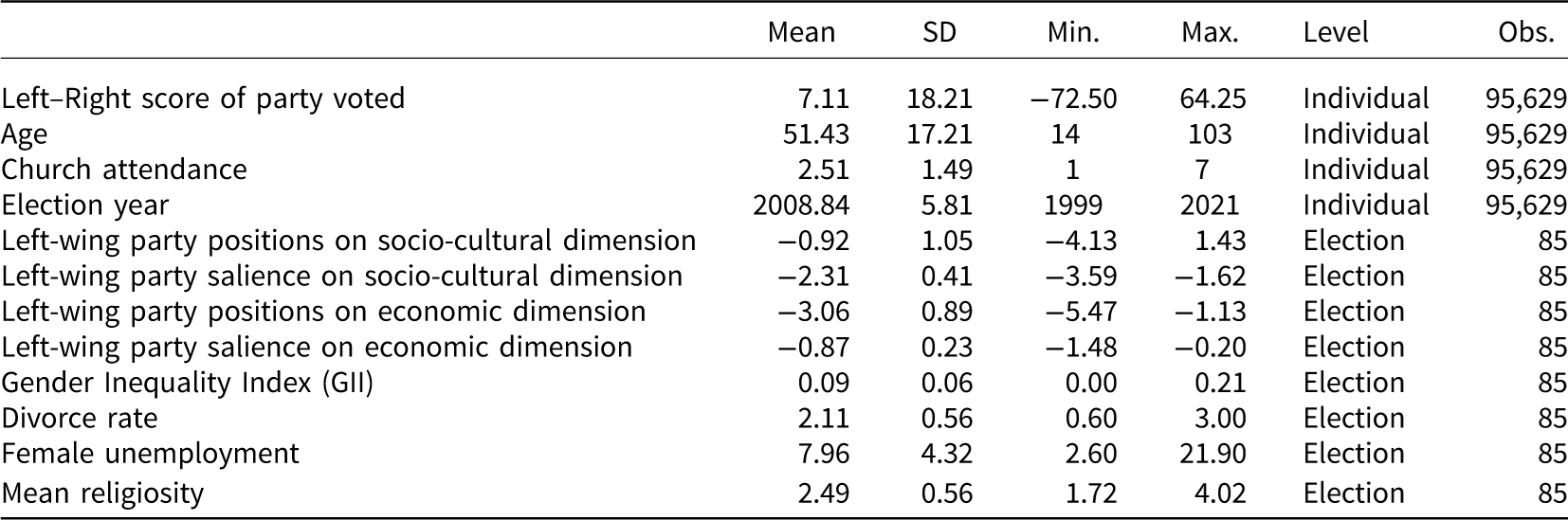
In the following sections, we describe the operationalisation of all variables included in the analysis and present their main descriptive statistics. Frequency distributions for categorical variables are reported in the main text, and descriptive statistics for all numerical variables are presented in Table 1.
Descriptive statistics of numerical variables

Table 1. Long description
A table presenting descriptive statistics of numerical variables. The table has 12 rows and 6 columns. The columns are labeled Mean, SD, Min., Max., Level, and Obs. The rows are labeled with different variables such as Left-Right score of party voted, Age, Church attendance, Election year, Left-wing party positions on socio-cultural dimension, Left-wing party salience on socio-cultural dimension, Left-wing party positions on economic dimension, Left-wing party salience on economic dimension, Divorce rate, Female unemployment, and Mean religiosity. Each row provides the mean, standard deviation, minimum, maximum, level, and number of observations for each variable.
Dependent variable
The dependent variable is the voting choice in the last general election. To facilitate comparability of voting choices across time and space, each party in each country-specific election has been assigned a score reflecting their left-right positioning. The left–right positions of parties are derived from the RILE (i.e., Left-Right) index featured in the CMP. The RILE measure is a well-established additive index that indicates a party’s left/right position (see Laver and Budge Reference Laver and Budge1992). The variable originally ranged from −100 (extreme left) to +100 (extreme right). To ease the interpretation of the findings, the values of the original variable have been reversed so that higher values indicate a preference for a left-leaning party. This measure allows for the construction of a numerical dependent variable that captures the ideological position of the parties voted for by respondents.
Independent variables
To estimate the modern gender gap, the left–right position of the parties voted for by respondents is regressed on a dummy variable for gender (1 = Women; 52% of the sample). The quantity of interest is the predicted difference between women and men in the left–right positioning of the parties they voted for. The key hypothesis posits that the modern gender gap should be amplified when left-wing parties adopt more progressive positions on both socio-cultural and economic issues. To measure these positions, this paper uses two slightly modified indicators suggested by O’Grady and Abou-Chadi (Reference O’Grady and Abou-Chadi2019), which assess party positions on social–cultural and economic issues. These indicators are derived from the CMP data, using the logit method proposed by Lowe, Benoit, Mikhaylov et al. (Reference Lowe, Benoit, Mikhaylov and Laver2011). The socio-cultural indicator is designed to capture parties’ stances on issues such as gender equality, abortion, divorce, and environmental concerns – topics that tend to be of particular interest to a female electorate, as previously discussed. For this indicator, the operationalisation follows O’Grady and Abou-Chadi (Reference O’Grady and Abou-Chadi2019) and is constructed as follows:
 ${\rm{PosSocia}}{{\rm{l}}_{it}} = {{{\rm{log}}\,\left( {{\rm{per}}203 + {\rm{per}}603 + {\rm{per}}605 + .5} \right)} \over {{\rm{log}}\,\left( {{\rm{per}}204 + {\rm{per}}501 + {\rm{per}}604 + {\rm{per}}705 + .5} \right)}}.$
The economic indicator is intended to measure party positions on economic issues, such as redistribution, welfare expansion, and investments in education. For this indicator, we departed a little from the choices made by O’Grady and Abou-Chadi (Reference O’Grady and Abou-Chadi2019); although they distinguish two economic dimensions (the first one including items concerning the desirability of redistribution in principle and the other one including items related to a desire for more or less government spending in welfare and education), we considered these two indicators as part of one single economic dimension of interest. The resulting index has therefore been calculated as follows:
 $\small{{\rm{PosEc}}{{\rm{o}}_{it}} ={{{\rm{log}}\,\left( {{\rm{per}}401 + {\rm{per}}402 + {\rm{per}}414 + {\rm{per}}505 + {\rm{per}}507 + \;{\rm{per}}702 + .5} \right)} \over {{\rm{log}}\,\left( {{\rm{per}}403 + {\rm{per}}404 + {\rm{per}}412 + {\rm{per}}413 + {\rm{per}}415 + {\rm{per}}503 + {\rm{per}}504 + {\rm{per}}506 + \;{\rm{per}}701 + \;.5} \right)}}}.$
Both PosSocialit and PosEcoit represent the positions of party i in election t, respectively, on the socio-cultural and the economic scales. The items in the numerator correspond to right-wing categories of the CMP, whereas those in the denominator correspond to left-wing categories.Footnote 3
As a consequence, higher values indicate more conservative party positions. After estimating each party’s position in each election, the overall position of left-wing parties on the social–cultural and economic dimensions is calculated as the average of the scores of all left-wing parties in each election.Footnote 4 These indicators serve as an overall measure of left-wing party supply on the socio-cultural and economic dimensions in each election (i.e. country-year combination) and are then used as moderators of the gender voting gap.
Alongside gender and party positions, another key variable in the analysis is generational belonging. First, the literature has widely demonstrated that changes in the gender gap are driven by generational replacement. Second, the impact of party supply is hypothesised to be more consequential among younger generations. Following Blais and Rubenson (Reference Blais and Rubenson2013), three different generations are distinguished: pre-boomers, the reference category (born before 1945), boomers (born between 1945 and 1965), and post-boomers (born after 1965). In the sample, pre-boomers account for 25% of respondents, boomers for 38%, and post-boomers for 37%.
Control variables: individual level
In addition to the main predictors, a set of control variables is included at both the individual and contextual levels, which the literature identifies as relevant factors in explaining the transition to the modern gender gap. At the individual level, we control for respondents’ marital status, measured as a binary variable (1 = Married; 57% of the sample). Religiosity is operationalised through church attendance, a variable ranging from 1 (Never) to 7 (Every day), and is included in the models in its original form. As highlighted in previous research, these controls have been recognised as important factors for explaining the gender gap in political behaviour (Edlund and Pande Reference Edlund and Pande2002; Emmenegger and Manow Reference Emmenegger and Manow2014). Education is also included as a categorical variable to represent respondents’ socio-economic status. This variable comprises six categories: primary/less than lower secondary education (13.9% of the sample), lower secondary education (15.1%), upper secondary education (33.9%), post-secondary/non-tertiary education (8.4%), completed tertiary education (28.5%), and other (0.2%). Primary education serves as the reference category in the models. Age is included as a continuous numerical variable.
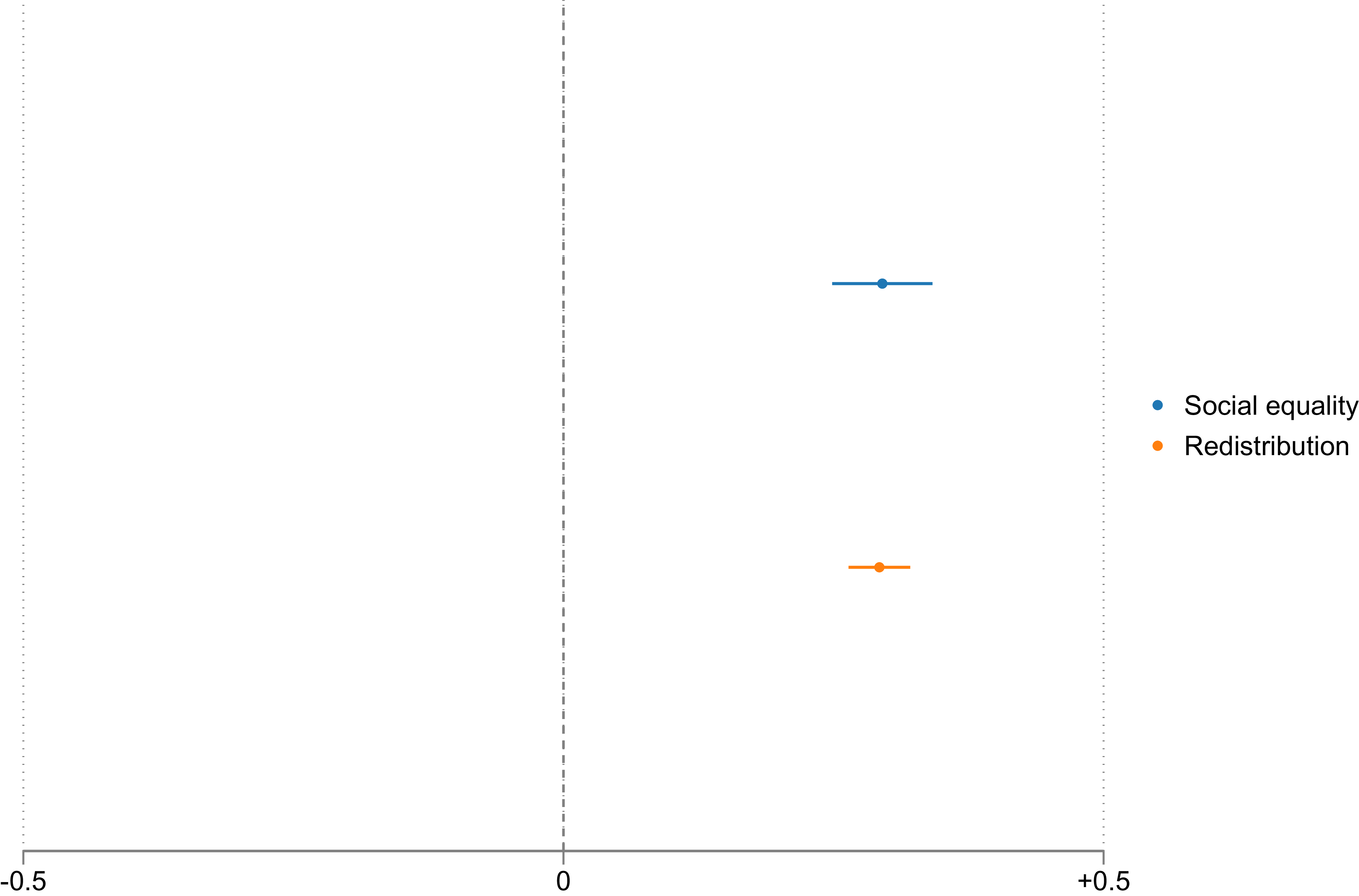
In addition to these background variables, two attitudinal measures are included to capture respondents’ views on economic redistribution and social equality. These controls are particularly important because, in our theoretical framework, we assumed that women are more likely than men to support redistributive and egalitarian policies. This assumed greater support, in turn, should make women more inclined to vote for left-wing parties. The variable measuring attitudes towards economic redistribution is a binary indicator (1 = Support redistribution; 69% of the sample). It is derived from a survey item asking respondents whether they agree or disagree with the statement: ‘The government should reduce income differences’. The original variable is a five-point scale ranging from ‘Strongly Agree’ to ‘Strongly Disagree’. For the analysis, the two agreement categories (‘Strongly Agree’ and ‘Agree’) are recoded as 1, whereas the remaining three categories are coded as 0. Similarly, attitudes towards social equality are captured using a binary variable (1 = Support social equality; 91.6% of the sample). This variable is based on a six-point scale assessing the extent to which respondents believe it is important for every person in the world to be treated equally and to have equal opportunities in life. For this variable, the first three categories (indicating agreement) are combined into a single category coded as 1, whereas the remaining categories are coded as 0.Footnote 5 Additionally, these two dummy variables are used to test the assumption that women are more favourable towards redistribution and social equality than men. To evaluate this, the two variables are regressed on gender using two binary logistic regressions. Together with gender, these regressions included election and country fixed effects to account for temporal and cross-national heterogeneity. The results of these analyses, shown in Figure 1, fully support our assumptions (fully specified models are available in Table B1, online Appendix B).
The effect of gender on support for social equality and economic redistribution (95% Confidence Intervals).

Control variables: contextual level
At the contextual level, we control for several socio-structural factors that may amplify or reduce the modern gender gap. First, to capture the overall socio-economic conditions of women in each country and year, a measure of the female unemployment rate is included. The literature suggests that higher female unemployment amplifies the modern gender gap (Abendschön and Steinmetz Reference Abendschön and Steinmetz2014; Giger Reference Giger2009). In operational terms, the percentage of unemployed women aged 15–64, as provided by Eurostat, is used for each election covered in the dataset.Footnote 6 Second, we consider the socio-cultural context of each country by including two variables: the divorce rate at the time of each election and a general indicator of gender inequalities. The literature posits that higher divorce rates and greater gender equality are associated with a stronger modern gender gap (Edlund and Pande Reference Edlund and Pande2002; Iversen and Rosenbluth Reference Iversen and Rosenbluth2006), as both factors reflect a more modern societal structure. The divorce rate, sourced from Eurostat, measures the number of divorces registered in a given year.Footnote 7 Gender inequality, on the other hand, is captured using the Gender Inequality Index provided by the United Nations Development Programme. This composite index measures gender inequalities on a 0–1 range across reproductive health, political, and economic empowerment and labour market participation, with lower scores indicating greater gender equality.Footnote 8 Third, the religious environment at the time of each election in each country is accounted for by calculating the average level of church attendance using the church attendance indicator provided by the ESS. This variable theoretically ranges from 1 to 7 (higher values indicate a more religious environment) and it is interpreted as an additional indicator of the degree of societal modernisation. Finally, two additional controls are included at the party system level. Specifically, alongside left-wing party positions on economic redistribution and socio-cultural issues, a measure of the overall salience assigned to each dimension in each election by left-wing parties is also included. Using data from the CMP, salience for each of the two dimensions is calculated following the logit method proposed by Lowe, Benoit, Mikhaylov et al. (Reference Lowe, Benoit, Mikhaylov and Laver2011) and already used to estimate left-wing party positions. Specifically, for each dimension, we relied on the same categories used to estimate party positions (see above). We take the logarithm of the ratio between the sum of the mentions dedicated to all the CMP categories included in one specific dimension (either economic or socio-cultural) and the total number of sentences in the manifesto. This yields a measure of issue salience for each party.Footnote 9 Then, to derive an overall measure of salience among left-wing parties in a given election, the salience scores are averaged across all relevant parties.
Modelling strategy
The unit of analysis is the respondent to the ESS surveys. Respondents are nested within each election (i.e. country-year combinations), and elections are nested within countries. Furthermore, the main focal predictors of vote choice are measured at both the individual level (gender, varying across respondents) and the election level (party positions on the socio-cultural and economic dimensions, varying across country-year combinations). Given the nested structure of the data and the numerical nature of the dependent variable, we opted for the estimation of a series of linear hierarchical models with individuals nested in elections and elections nested in countries. This approach allows us to account for the clustering of respondents across different elections and countries and test the effect of election-level variables on individual behaviour. Additionally, a linear term for time is included (i.e. the ESS wave, ranging from 0 to 9, where 0 = ESS Wave 1 and 9 = ESS Wave 10) to account for the possibility of longitudinal correlations due to common trends.
Preliminary evidence
Before turning to the main hypotheses of the paper, we present descriptive evidence on the modern gender gap in our sample. This step serves to establish three essential points: that a gender gap in political behaviour is observable in the data; that its magnitude varies across generations; and that it differs across elections (i.e. country-year combinations). Demonstrating these patterns is crucial, as our hypotheses (and subsequent analyses) rest on the presence of a gender gap that is empirically observable and systematically structured along generational and contextual lines.
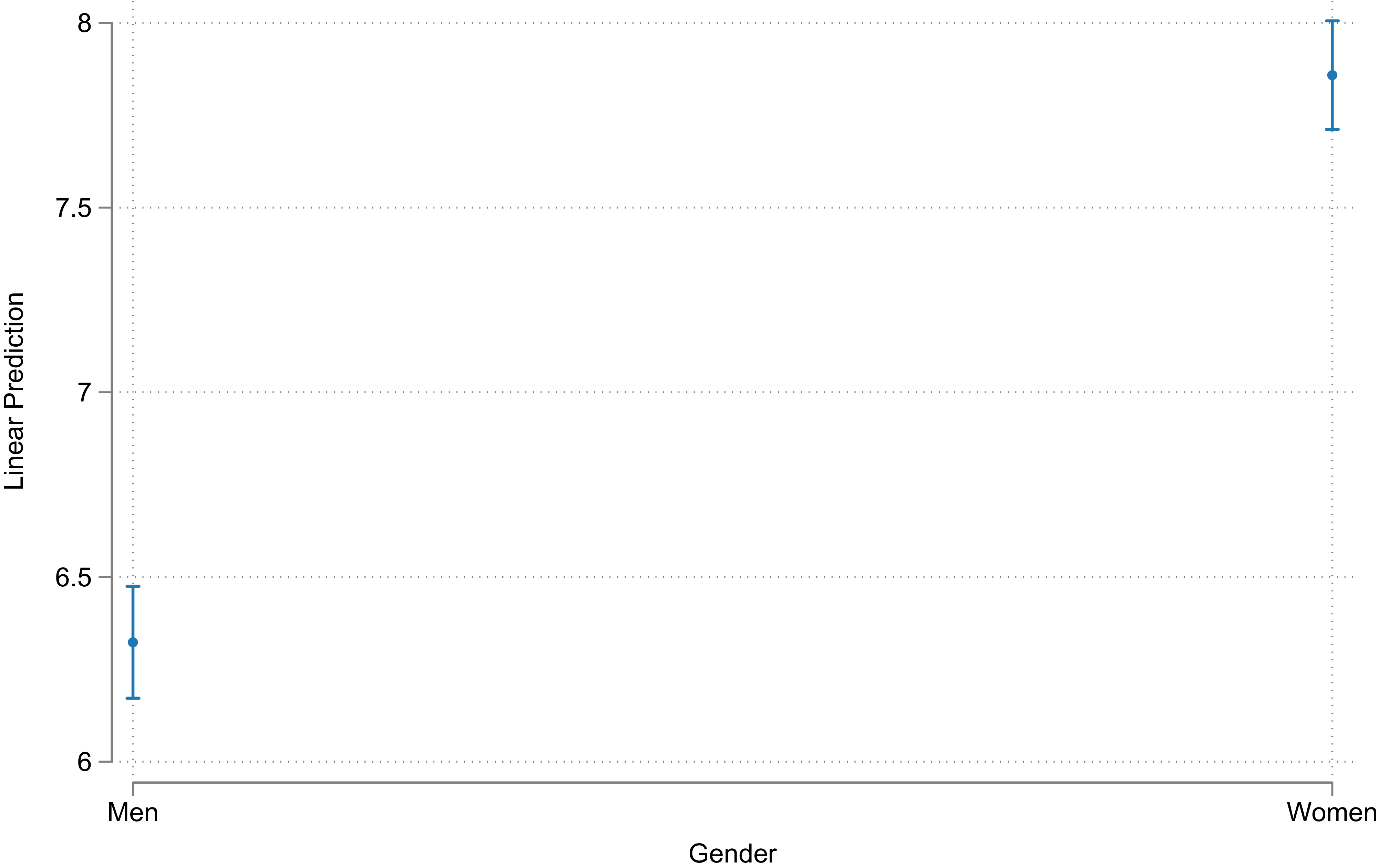
The analysis thus begins with a preliminary assessment of the modern gender gap in Western Europe. Figure 2 shows the predicted values of voting for parties positioned along the left–right spectrum in the 19 countries covered by this study, separately for men and women. These results are derived from an Ordinary Least Squares (OLS) regression model where the dependent variable is the left–right score of the parties voted for by individual respondents (with higher values indicating parties on the left), and the key independent variable is gender. The model was estimated using the pooled dataset, with country and election fixed effects to control for heterogeneity due to unobserved contextual factors. In this basic model, generational differences are also controlled for to account for different patterns of gender voting across different generations (fully specified models are available in Table B2, Appendix B). The data show that, on average, women exhibit a stronger preference for left-leaning parties compared with men. This pattern reinforces the well-established notion in the literature that women have become more progressive than men in their political behaviour.
The modern gender gap in Western Europe (95% CIs).

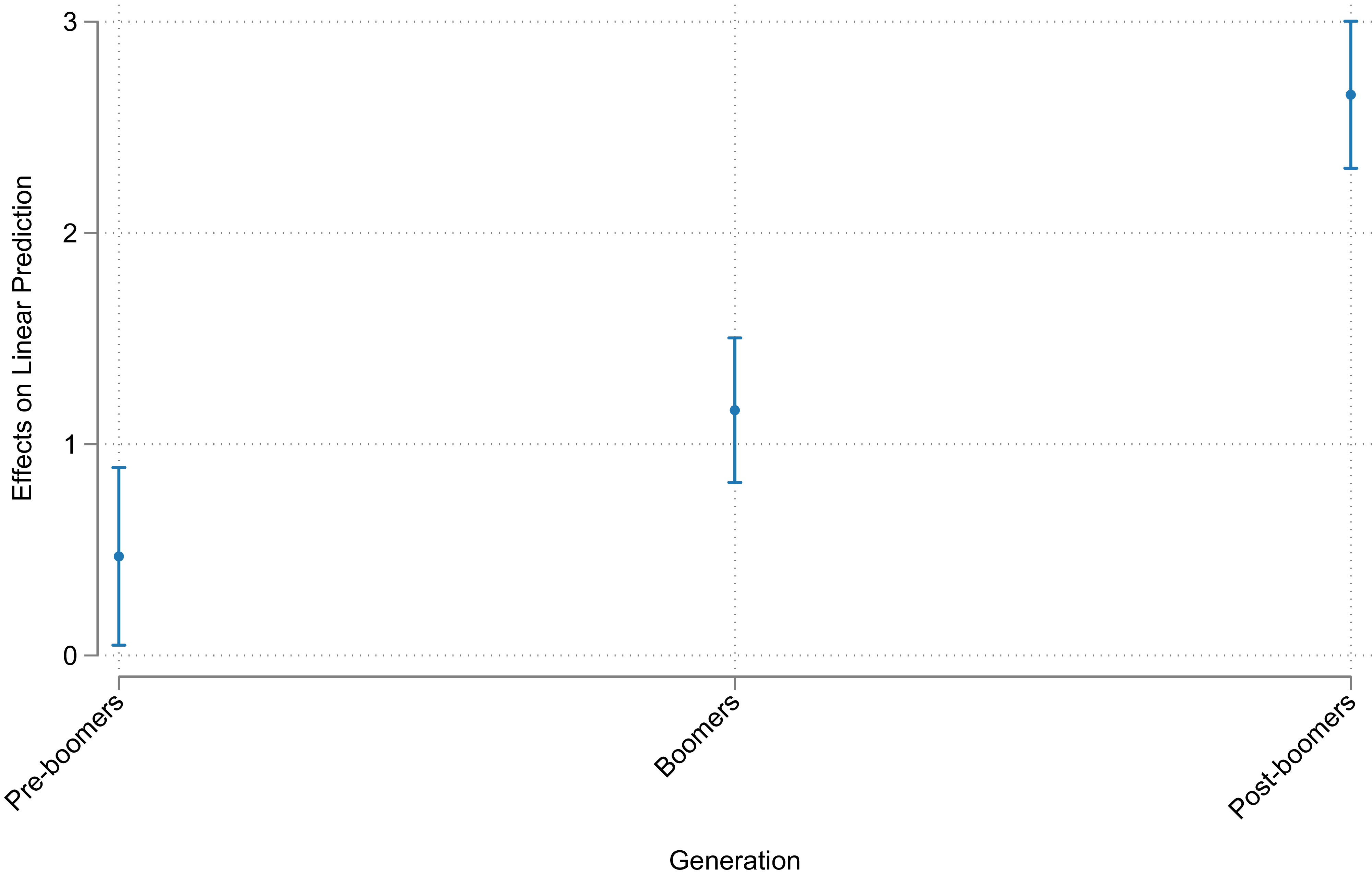
Consistent with the existing literature is also the finding concerning the emergence of the modern gender gap across different generations. Also, in this case, we estimated an OLS regression model, where the effect of gender on voting choice is interacted with generations, while also controlling for country and election fixed effects (fully specified models are available in Table B2, Appendix B). The results of this analysis are presented in Figure 3, which illustrates the estimated gap between men and women in their voting preferences for parties across the left–right spectrum. Positive values in this figure indicate that, on average, women prefer parties positioned further to the left compared with men. Consistent with previous studies, these findings reveal that among the pre-boomer generation, gender differences in voting behaviour are virtually non-existent. However, a clear modern gender gap emerges among baby boomers and becomes even more pronounced among the post-boomer generation, where the divide between men’s and women’s party preferences is most significant. These results highlight the pivotal role of generational change in shaping gendered political alignments, reinforcing the idea that younger generations are driving this electoral realignment.
The modern gender gap across generations (95% CIs).

Although a modern gender gap in voting behaviour has, on average, emerged across Western Europe (with women being significantly more likely than men to vote for left-wing parties, particularly among younger generations), its variation across different contexts is striking. This variability is illustrated in Figure 4, which presents the results of a series of OLS regression models conducted separately for each country–election combination. In these models, the dependent variable represents the left–right position of the parties voted for by respondents, whereas the key independent variable is gender. The findings underscore the extent to which the gender gap in political preferences is shaped by national and electoral dynamics, highlighting important cross-country temporal differences in the strength of this divide. In fact, the figure shows a significant heterogeneity in the pool of elections considered in this study. In some contexts, the modern gender gap does not seem to have emerged at all, even in more recent years, which is the case, for example, in Portugal and Ireland. In other cases, it is observed as a statistically significant gap, but with considerable variability. For example, in Switzerland, the gap is among the most pronounced, whereas in Italy the modern gender gap is relatively mild, similar to Spain. Thus, although a modern gender gap is observed on average, it also exhibits notable variability across time and space. This variability is precisely what this paper aims to explain.
The modern gender gap across different countries and elections (95% CIs).

Main results
How party supply shapes the modern gender gap
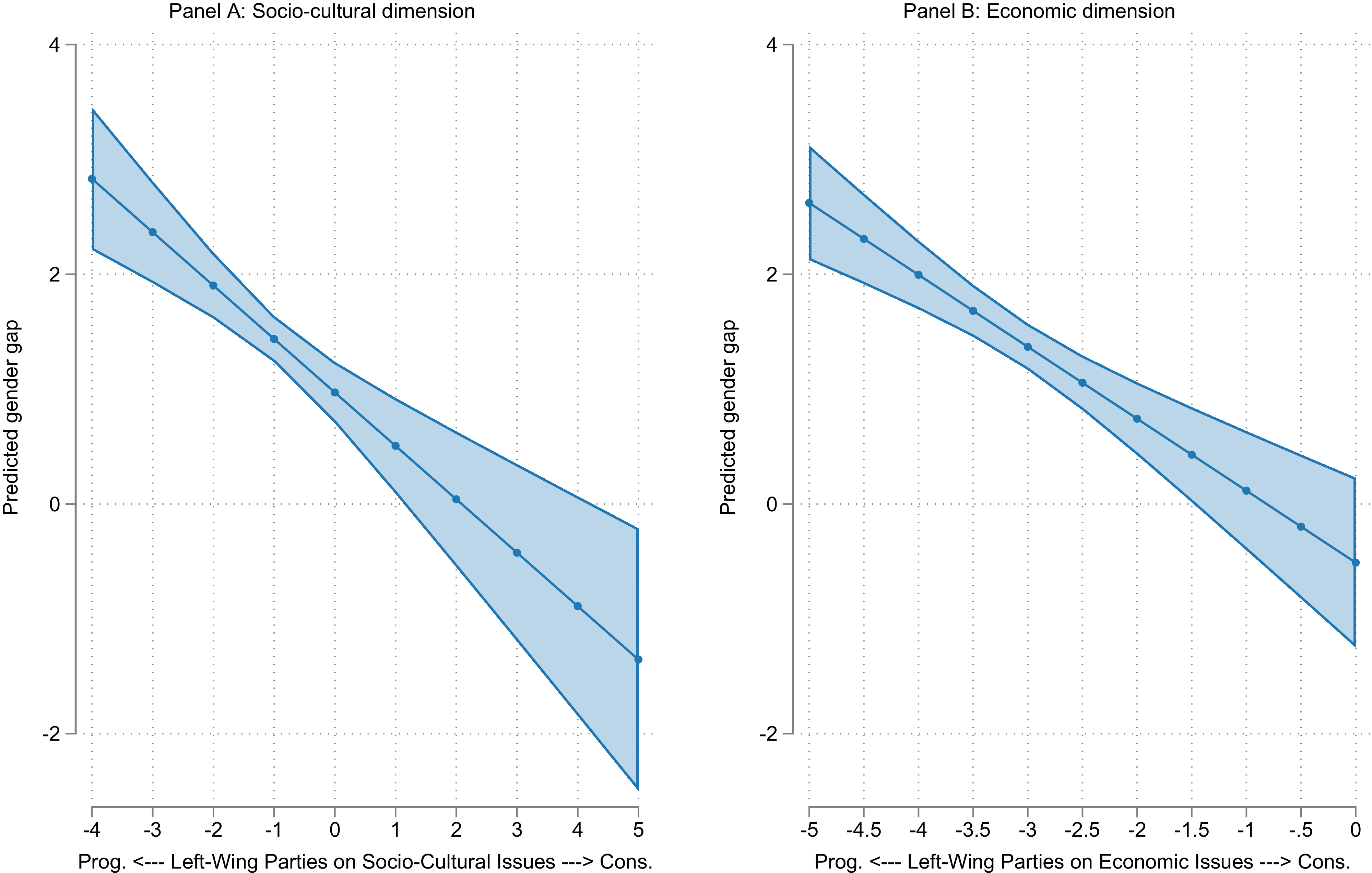
Having demonstrated that the modern gender gap does not manifest uniformly across different contexts and periods, it becomes essential for our analysis to identify which factors might explain this variability. The key expectation here is related to the role of party supply; although women have developed more progressive orientations, making them more likely to abandon traditional right-wing party allegiances, this shift from right to left also requires an available political supply that resonates with women’s demands. In other words, there must be some left-wing political parties within the system that address and articulate issues important to women for them to vote for a left-wing party. We articulated this general expectation looking at two relevant dimensions: an economic one and a socio-cultural one. In both cases, we hypothesised that the modern gender gap should be amplified in those contexts where the left adopts more progressive positions both in economic (e.g. support for redistribution, reinforcement of the welfare state) and socio-cultural terms (e.g. support for social equality, civil rights). We test these hypotheses using a set of linear hierarchical models, which accounts for the particular structure of the dataset (see the Data and Methods section). Although the main quantity of interest remains the modern gender gap, we are particularly interested here in understanding whether, and to what extent, this gap is moderated by the effect of party supply. To do so, gender is interacted with the indicators measuring left-wing party supply on the socio-cultural and economic dimensions. The main results of this analysis are shown in Figure 5, and the fully specified models are reported in Table B3, Appendix B.
The modern gender gap at varying levels of left-wing party positions on the socio-cultural and economic dimensions (95% CIs).

Both Panels A and B of Figure 5 display the predicted gender gap on the y-axis, where positive values indicate that women vote for more left-leaning parties compared with men. The x-axis represents left-wing party positions on the socio-cultural dimension (Panel A) and the economic dimension (Panel B). The findings show that the policy positions of left-wing parties significantly shape the modern gender gap. Specifically, when these parties adopt more progressive stances on both dimensions, the gender gap widens. Conversely, the gap narrows as left-wing parties take relatively more conservative positions. Although this pattern holds for both dimensions, the effect is notably stronger on the socio-cultural dimension than on the economic one, indicating that left-wing parties’ positions on socio-cultural issues play a greater role in shaping gender differences in voting behaviour. Overall, these results support both H1a and H1b.
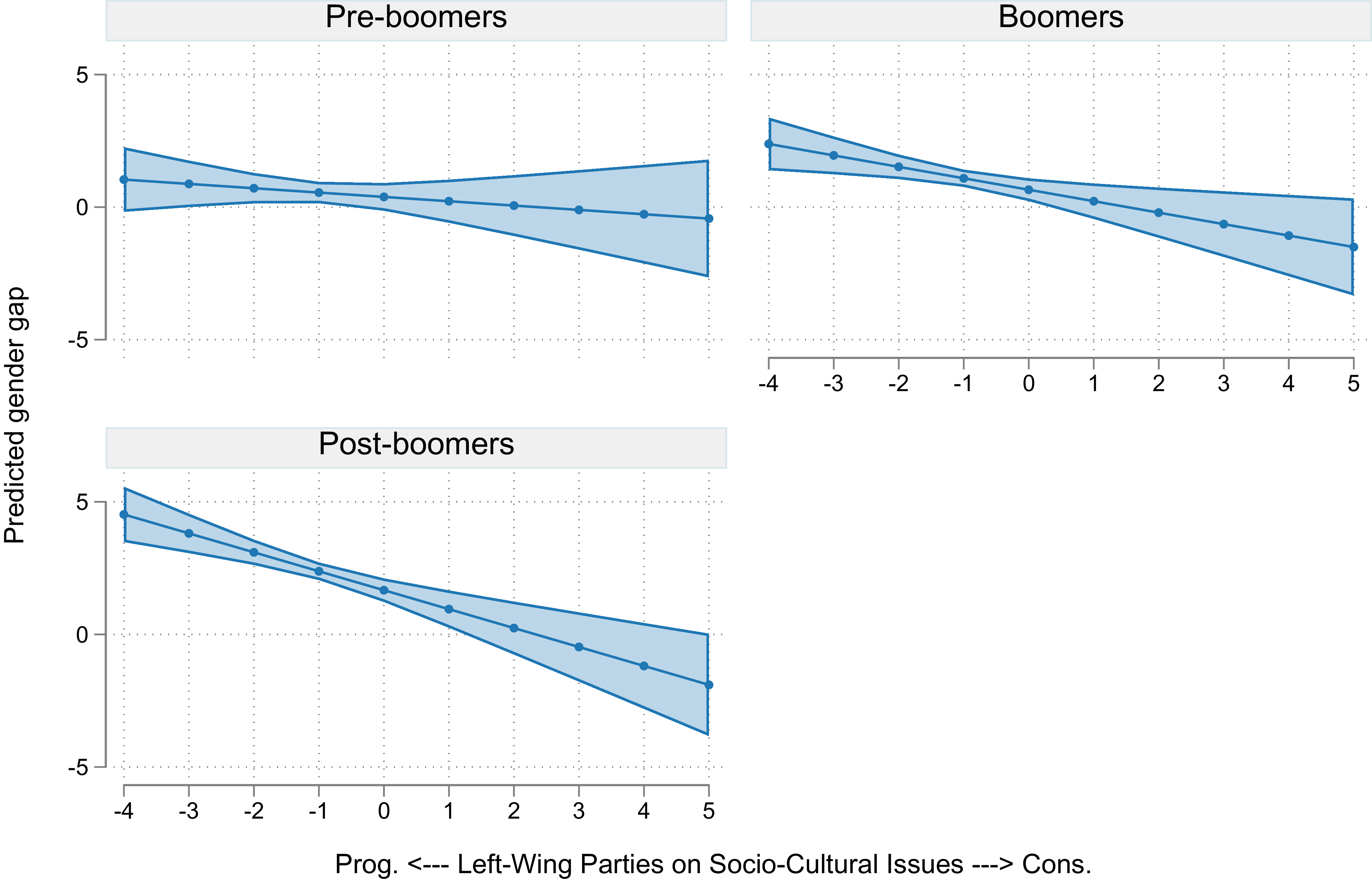
As the shift towards more progressive values – and consequently, a more progressive vote among women – is primarily driven by generational replacement, the impact of party supply on the modern gender gap should be most pronounced among younger generations. This is in line with H2, which is tested in Figures 6 and 7. In particular, a three-way interaction between gender, left-wing party supply, and generations is estimated to examine how the gender gap varies based on left-wing party positions on the socio-cultural (Figure 6) and economic (Figure 7) dimensions across generations (fully specified models are available in Table B3, Appendix B). Looking at Figure 6, no gender gap is observed among the pre-boomer generation, regardless of left-wing party positions on the socio-cultural dimension. In contrast, the modern gender gap emerges among the boomer and post-boomer generations. More importantly, in both generations, left-wing party positions significantly moderate the gender gap: when left-wing parties adopt more culturally progressive stances, the gender gap is robust and significant; however, it disappears entirely as left-wing parties shift towards more conservative positions. Moreover, it is worth noting that the moderating effect of party positions is stronger and more clearly pronounced among the younger post-boomer generation.
The modern gender gap at varying levels of left-wing party positions on the socio-cultural dimension and across generations (95% CIs).

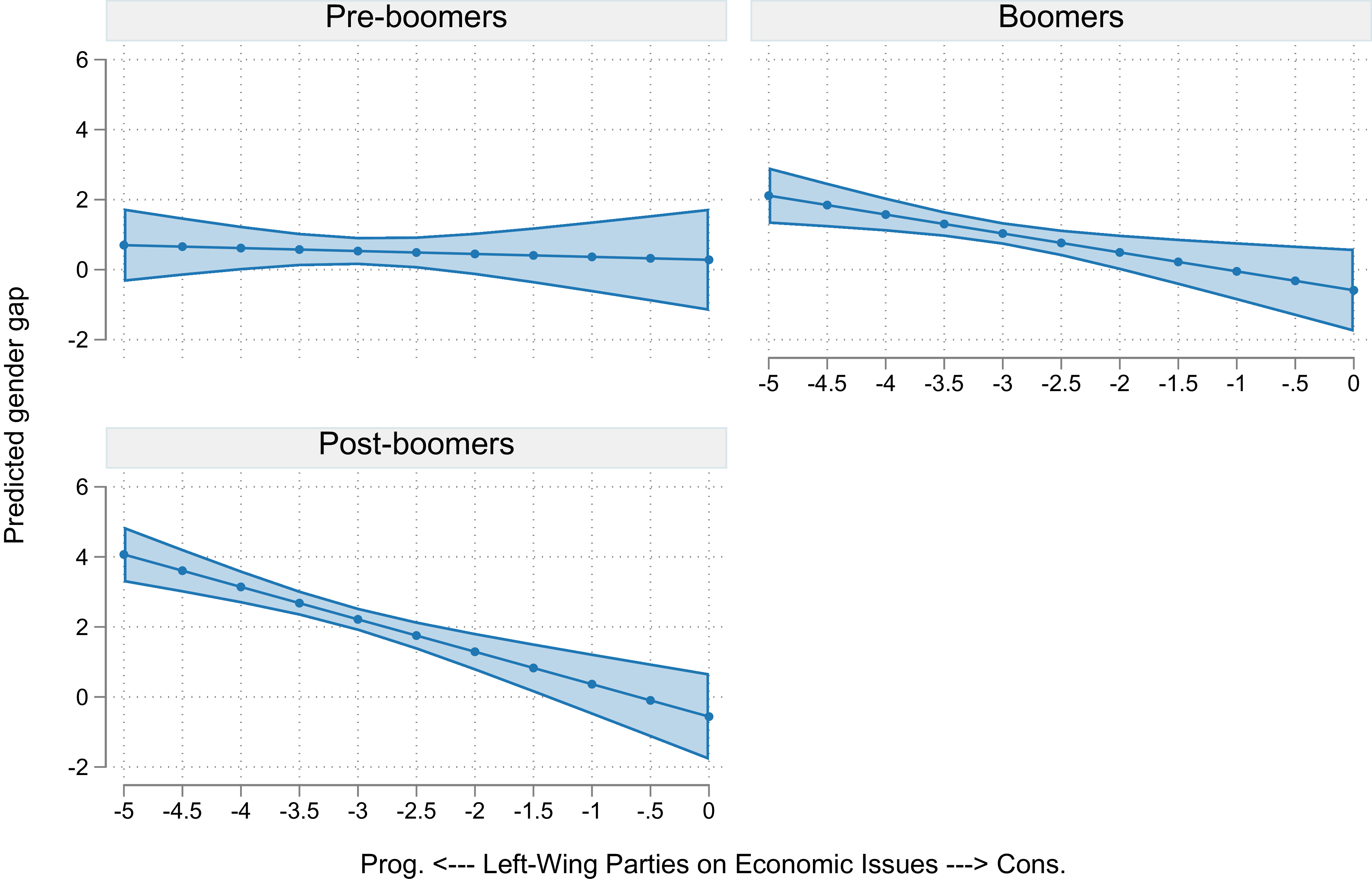
The modern gender gap at varying levels of left-wing party positions on the economic dimension and across generations (95% CIs).

Figure 7. Long description
The image contains three line graphs showing predicted gender gaps across different generations and political positions. Panel A: Pre-boomers. The line graph shows the predicted gender gap on the y-axis ranging from -2 to 6 and the political positions on the x-axis ranging from -5 to 0. The line starts slightly above 0, dips below 0, and then rises slightly again, indicating a slight increase in the gender gap as political positions move from left-wing to conservative. Panel B: Boomers. The line graph shows the predicted gender gap on the y-axis ranging from -2 to 6 and the political positions on the x-axis ranging from -5 to 0. The line starts above 0 and gradually decreases, indicating a decrease in the gender gap as political positions move from left-wing to conservative. Panel C: Post-boomers. The line graph shows the predicted gender gap on the y-axis ranging from -2 to 6 and the political positions on the x-axis ranging from -5 to 0. The line starts above 4 and gradually decreases, indicating a significant decrease in the gender gap as political positions move from left-wing to conservative.
The same pattern holds when examining party supply on the economic dimension. As shown in Figure 7, no gender gap is observed in voting preferences among the pre-boomer generation, regardless of the specific economic positions adopted by left-wing parties. However, the modern gender gap takes shape among the boomer and post-boomer generations, reinforcing the idea that generational dynamics play a crucial role in shaping gendered voting behaviour. Notably, among younger generations, women are significantly more likely than men to support left-wing parties, but only when these parties embrace progressive economic positions. When left-wing parties hold more economically conservative positions, this gender gap vanishes entirely. This finding highlights how party supply actively shapes gendered electoral preferences, with left-wing party positions on the economy acting as a relevant moderator of the modern gender gap. The fact that this effect is particularly strong among post-boomers further suggests that economic progressivism is, in itself, a relevant factor in mobilising the electoral support for the left among younger generations of women.
In summary, data confirm that, on average, women are more likely than men to vote for left-wing parties. However, the ideological positioning of these parties on both the socio-cultural and economic dimensions plays a crucial role in shaping the modern gender gap: the more progressive left-wing parties are, the greater the difference in voting behaviour between women and men. Although this pattern holds across both dimensions, it is particularly the stances of left-wing parties on issues related to social equality, civil rights, and, in general, cultural progressivism that generate the largest gender gap in voting. Moreover, this gap becomes especially pronounced among younger generations. Most importantly, it is within these same generations that the ideological positions of left-wing parties significantly moderate the extent of the gender gap. Overall, these findings provide strong support for hypotheses H1a, H1b, and H2.
Robustness checks
To assess the robustness of our main findings, we re-estimated our models using an alternative specification of the dependent variable. Instead of measuring party positioning on the left–right continuum, a dichotomous variable is employed to distinguish left-wing parties (i.e. parties classified as communist, socialist, and social democratic according to the CMP) from all other parties. A series of multilevel logistic regression models is estimated, accounting for the hierarchical structure of the data, with individuals nested within elections and elections nested within countries. This approach allows us to test whether the key findings hold when using a categorical distinction between left-wing and non-left-wing parties rather than a continuous ideological measure. The results of these analyses (presented in Table C1 and Figures C1, C2, C3, Appendix C) are broadly consistent with the findings discussed earlier. First, these analyses confirm that the modern gender gap widens as left-wing parties adopt more progressive positions, both on economic issues and, most notably, on cultural issues. Second, it is confirmed that on the socio-cultural dimension, the moderating effect of party positions is significantly stronger among younger generations, particularly among the post-boomers. Regarding the economic dimension, the results are more nuanced but still align with previous findings. Specifically, although the moderating effect of party positions remains strong among baby boomers, it is less pronounced among post-boomers. Among the latter, while an increase in the modern gender gap is still observed when left-wing parties adopt more progressive economic stances, there is also a relatively greater indifference to party positions on this dimension. This finding further suggests that younger generations may, in fact, be more sensitive to party positions on the socio-cultural dimension than on the economic one.
In addition to the previous robustness check, a more demanding test is conducted by re-estimating the previous multilevel logistic regressions using the data from the Chapel Hill Expert Survey (CHES) (Rovny, Bakker, Hooghe et al. Reference Rovny, Bakker, Hooghe, Jolly, Marks, Polk, Steenbergen and Vachudova2025) instead of the CMP to operationalise left-wing party positions on the socio-cultural and economic dimensions. Party positions on the economic dimension were measured using the CHES ‘lrecon’ item (economic left–right scale), whereas positions on the cultural dimension were captured through the GAL (Green, Alternative, Libertarian) vs. TAN (Traditionalist, Authoritarian, Nationalist) index. Both measures range from 0 (more progressive) to 10 (more conservative). As in the main analyses, to derive party positions on both the dimensions of interest, we calculated election-level averages for parties classified as socialist, social democratic, and communist, and merged these indicators with the individual-level data.
Unlike CMP data, CHES surveys are conducted at irregular intervals and are not tied to specific elections. To align CHES data with the elections in the dataset, we assign to each election the most recent preceding CHES wave (e.g. CHES 2010 for the 2013 German election). This strategy is necessarily imperfect, as it prevents us from covering all elections without reusing the same CHES wave across consecutive contests – something that would undermine the research design, which relies on variation in party positions across elections.
As a result, some elections cannot be included. For instance, although the 2002 CHES data can be used for the 2002 Dutch election, they cannot be reasonably assigned to the subsequent 2003 election. Since the next CHES wave is only available in 2006, the 2003 election is dropped from the analysis. This leads to a substantial reduction in sample size (from over 95,600 to approximately 73,700 observations) and to the exclusion of four countries and 23 elections, with the results of limiting variability across elections (see Table C2 in Appendix C for the list of countries and elections included in the CHES-based replication). This problem is further exacerbated by the fact that CHES data show, by design, relatively limited temporal variation in party positions (McDonald and Mendes Reference McDonald, Mendes and Laver2001; Krouwel and van Elfrinkhof Reference Krouwel and van Elfrinkhof2014). As a result, the amount of variation available at the election level is further reduced, making it considerably more difficult to detect statistically significant effects (especially in complex multilevel models with three-way interactions, such as those employed in the study). This limitation clearly resonates with previous research arguing that expert surveys are less suitable for longitudinal analyses (Ferreira da Silva, Reiljan et al. Reference Ferreira da Silva, Reiljan, Cicchi, Trechsel and Garzia2023).
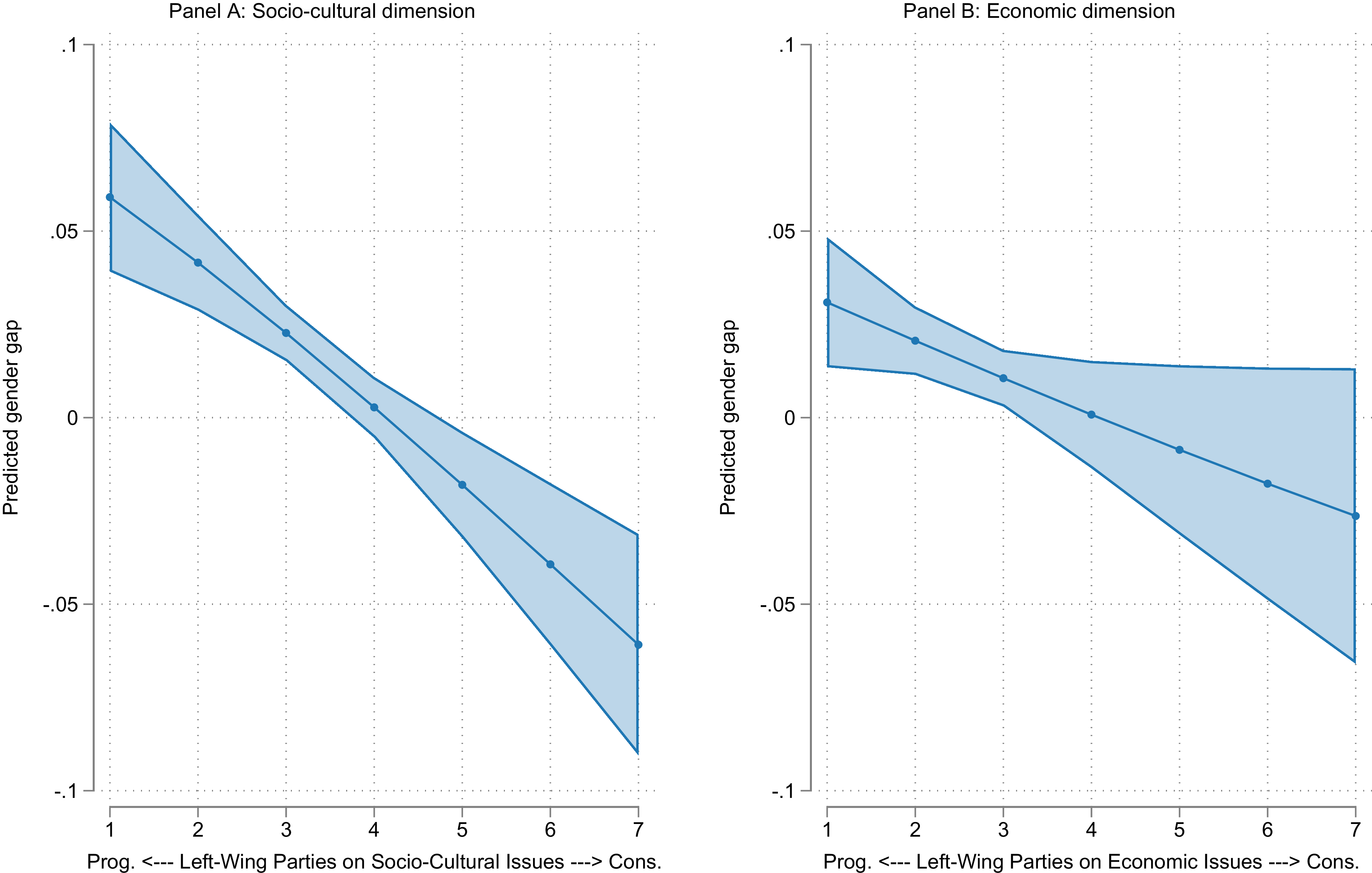
All this given, the main findings regarding H1a and H1b remain robust (fully specified models are available in Table C3, Models R1 and R2, Appendix C). Starting from the socio-cultural dimension, Panel A of Figure 8 shows that when left-wing parties adopt more progressive cultural positions, the gender gap widens substantially, whereas it narrows and becomes virtually non-existent when they adopt more conservative stances. A similar pattern (although weaker) emerges on the economic dimension. As shown in Panel B of Figure 8, more progressive economic positions adopted by left-wing parties are associated with a significantly larger modern gender gap.
The modern gender gap at varying levels of left-wing party positions on the socio-cultural and economic dimensions (95% CIs). Note: Party positions are estimated based on CHES data.

By contrast, evidence regarding generational differences (H2) is less conclusive. CHES-based estimates of the moderating effect of left-wing party positions on the economic and socio-cultural dimensions across generations are presented in Figures C4 and C5 in Appendix C (see also Table C3, Models R3 and R4, for the full model specifications). The results show that more progressive positions on both dimensions are associated with a larger modern gender gap among pre-boomers and boomers. In contrast to the CMP-based analyses, however, we do not observe a stronger moderating effect among post-boomers; for this cohort, the gender gap appears relatively stable across different levels of party positions.
Overall, the evidence presented in this paper points to a robust moderating effect of left-wing party positions on the modern gender gap. Across a range of model specifications and robustness checks, we consistently find that party positions on both the economic and socio-cultural dimensions shape the presence and magnitude of the gender gap in electoral support for the left.
By contrast, evidence regarding generational differences is less conclusive. Although the CMP-based analyses suggest stronger effects among younger generations, this pattern is not consistently replicated across alternative data sources. Although all this inevitably calls for caution in interpreting the evidence concerning generational differences, it is worth noting that CMP data, by capturing greater variation in party positions across time and space, are better suited to our research design. In this respect, the fact that CMP-based results align with the theoretical expectations of this paper is particularly reassuring.
Discussion
Once characterised by a traditional gender gap, the relationship between gender and voting behaviour has evolved substantially over time. Economic and social modernisation in Western societies has promoted more secular and progressive values, especially among women, both on economic and socio-cultural issues. This transformation, driven particularly by younger generations, has led to a realignment in women’s electoral behaviour, shifting support away from traditionally conservative right-wing parties towards left-wing parties. However, the modern gender gap has not emerged uniformly across Western Europe. Its magnitude varies significantly across time and space. In some cases, the difference between men and women in electoral support for left-wing parties remains limited, whereas in others (albeit more rarely) this pro-left tendency among women is not observed at all. Explaining this cross-national and temporal variation was at the core of this study.
Across multiple specifications, the findings consistently show that more progressive party positions on both the economic and socio-cultural dimensions are associated with a larger gender gap in electoral support for the left. At the same time, our analyses indicate that the generational distribution of this moderating effect depends on the party-level data employed. On the one hand, and in line with our expectations, the CMP-based models suggest that the effect is particularly pronounced among boomers and post-boomers; on the other hand, the CHES-based specification indicates that the effect of party supply on the modern gender gap does not vary systematically across generations. Given the reduction in sample size and, most importantly, in variance at the election level when using CHES data, these estimates should be interpreted with caution.
These results have important theoretical and empirical implications across several strands of literature. First, these findings help to explain why the modern gender gap has not emerged consistently across all contexts. The presence of a social group with distinct interests and preferences is not sufficient, in itself, to translate these preferences into stable electoral alignments. Without a political supply that effectively responds to women’s preferences, these demands are unlikely to materialise in the form of consistent partisan support. In this sense, this study highlights the agency of parties (particularly left-wing parties) as a crucial factor in shaping the gender divide in electoral behaviour.
Second, results also carry strategic implications for left-wing parties. The findings suggest that progressive positions on both economic and, especially, socio-cultural issues may offer electoral advantages. In particular, left-wing parties may be able to mobilise not only younger voters (who, despite their progressive leanings, tend to have lower electoral participation rates) but also baby boomers, who still represent a substantial share of the electorate in Western democracies. This finding aligns with Abou-Chadi and Hix’s (Reference Abou-Chadi, Mitteregger and Mudde2021) argument (see also Abou-Chadi, Mitteregger and Mudde 2021) that abandoning cultural progressivism in an attempt to counter the rise of the radical and populist right (whose agenda is often characterised by neoconservative and exclusionary positions) may be a strategic mistake for left-wing parties. Instead, by reinforcing their progressive identity, left-wing parties may be better positioned to consolidate electoral support among younger and female voters (two constituencies that are increasingly central to their long-term electoral viability).
More broadly, our findings also point to several directions for future research. First, the question of whether party supply affects the modern gender gap differently across generations remains open and deserves further investigation. Future research should explore more systematically whether and to what extent party positions influence the gender gap differently across cohorts, possibly using alternative data sources or research designs. Moreover, although the use of CHES data represents a limitation for our research design (because the reduction in the number of elections implies a loss of variance precisely at the level where our theoretical argument operates), the CHES results may also point to cross-context heterogeneity. In some political contexts, party positions may affect the gender gap differently across generations, whereas in others this may not be the case. This suggests a promising avenue for future research focusing more closely on specific countries or elections, to better understand whether and under which conditions party supply shapes the gender gap differently across generations. Future studies could therefore complement cross-national analyses with more context-specific or within-country designs, which may be better suited to capture how party competition interacts with generational political socialisation in different political environments.
Second, the analysis focuses on the role of left-wing party supply without explicitly modelling how it interacts with the positioning of other parties, particularly right-wing parties. Yet the magnitude of the modern gender gap is likely to depend also on the broader configuration of party competition rather than solely on the strategies of a single party family. Future research should therefore examine how competitive dynamics across the ideological spectrum jointly structure gendered voting behaviour.
Third, the literature has shown that the gender gap in support for the left coexists with a corresponding male overrepresentation on the radical right. Whether the mechanisms identified here (particularly the moderating role of party supply) also operate in shaping the gender gap on the right remains an open question. Addressing this issue would allow for a more comprehensive account of contemporary gendered electoral realignments.
Finally, the analysis focuses on broad dimensions of political competition. Although this approach captures the overall structure of party competition, it does not allow us to disentangle the specific issue domains through which party supply may influence gendered voting behaviour. Future research could therefore investigate whether more specific policy areas (such as gender-related issues or welfare policies) constitute the main channels through which parties can shape the electoral alignment of women and men.
Supplementary material
To view supplementary material for this article, please visit https://doi.org/10.1017/S1475676526101819.
Data availability statement
The data and replication materials necessary to reproduce the results presented in this article are available on the journal’s website.
Acknowledgements
We are grateful to Nicolò Conti, Luca Carrieri, Matteo Giardiello, and Vincenzo Emanuele for their comments on previous drafts. We would also like to thank the participants at the 2024 Annual Meeting of the Italian Political Science Association, the 2024 Gender Studies International Conference, and the workshop at the Department of European Social Research, University of Saarland, for their helpful comments. We also thank the editors of the European Journal of Political Research and the anonymous reviewers for their constructive feedback, which helped us substantially improve this article. Any remaining errors are our own.
Funding statement
This research received no specific grant from any funding agency in the public, commercial, or not-for-profit sectors.
Competing interests
The authors declare no competing interests.
Use of AI
AI tools were used solely for language proofreading purposes; they did not contribute to the research design, analysis, or interpretation of results.



 Open access

