Mediation was the principal method of resolving labour disputes under China's planned economy and remained crucial for maintaining industrial peace after the market reform in the 1980s.Footnote 1 In 1993, mediation was formally integrated, along with arbitration and litigation, into a three-part procedural structure. In the decade or so after the implementation of the Labour Law in 1994, however, arbitration and litigation prevailed as the more effective means of settling labour disputes as a result of the government's efforts to promote the rule of law in society, while the role of mediation appeared to be in decline. Numerous dispute cases were brought before arbitration committees and courts, reflecting the rise of workers' legal consciousness and their ability to mobilize the law for their own interests.Footnote 2 Nevertheless, the past few years have seen a resurgence of mediation. Mediation has been highlighted again in the official discourse as an important means of labour conflict resolution.Footnote 3 Not only have many more agencies, such as labour bureaus, trade unions, courts and community organizations, been called upon to play a proactive role in mediating labour disputes, a new institutional arrangement called “grand mediation” has emerged.Footnote 4 This arrangement integrates civil, administrative and judicial mediations into an institutional platform that allows collaborative efforts across local agencies to intervene in labour disputes. Although arbitration and litigation continue to be widely used, mediation has apparently become the preferred method of labour dispute settlement for local governments and has been used aggressively. According to an official report, over 63 per cent of the 1,332,000 labour disputes in 2012 were settled by mediation.Footnote 5
What explains this resurgence of mediation after years of government efforts to promote the use of the law in labour conflict resolution? The prevailing view attributes the resurgence of mediation to the urgent need of the central government to maintain social stability.Footnote 6 Facing mounting social conflicts, the government regards mediation as a flexible, low-cost and widely applicable method of settling disputes and defusing potential “mass incidents.”Footnote 7 Its campaign for grand mediation has triggered widespread local responses, with the development of various forms of mediation in the country. This view sees the resurgence of mediation as being promoted largely from the top-down, with local governments acting as the implementing agents for the centre's project. Echoing this top-down perspective, some scholars of the Chinese legal system also argue that the revival of mediation results from a decision made by the top brass of the judicial institution. According to these scholars, Chinese courts had become increasingly dysfunctional in handling social conflicts. There were too many dispute cases which had overwhelmed the courts, and more importantly, as one study has indicated, “many parties were not satisfied with the results of litigation because of a perceived lack of judicial competence, actual or suspected corruption, the feeling that laws are at odds with local norms, difficulties in enforcing judgments” and “the inability of the courts to provide an adequate legal remedy in the kind of ‘growing pains' cases.”Footnote 8 Consequently, in 2002, the Superior Court and the Ministry of Justice began to promote mediation as a means of tackling the disputes that the courts had failed to cope with effectively.
Obviously, the central government's campaign for mediation is, in the first place, important for the revival of such a practice. However, in this research, we argue that the resurgence of mediation in China is not simply a result of top-down mobilization; the way local authorities responded to the centre's call has also been a crucial contributory factor. Certainly, in the Chinese unitary political system, it is the central government that sets policy agendas and goals and mobilizes local actors to follow. However, as many studies have shown, local actors are not always enthusiastic about the centre's policies. They selectively implement or shy away from some central policies, or are slack and sluggish in implementing others depending on the extent to which the policies are suited to local interests.Footnote 9 Local responses determine how effectively the centre's policies are carried out. What then has motivated local governments to advance mediation? In this study, we will demonstrate that local governments prefer mediation because such a government-directed process can better serve their priorities and interests. In handling labour disputes, local agencies often have multiple considerations, some of which are in conflict. Providing fair and just remedies for disputes, allegedly the aim of the labour laws, is not always compatible with some other goals that are often regarded as more important by local authorities. Mediation allows them to bypass laws and formal procedures and offers them considerable flexibility to resolve disputes in a way that favours their policy priorities and bureaucratic interests. In short, while the centre's campaign has reinvigorated the use of mediation as a chief method of conflict resolution and stability maintenance, the expansion of mediation and its extensive deployment have been driven by local authorities' strong preference for it and their innovation of various mediation mechanisms. Thus, we emphasize that it is necessary to combine top-down mobilization with bottom-up motivation to account for the revival of mediation.
We also argue that paying close attention to local practices can help to highlight the three distinct features of mediation in China. First, there is a strong state presence in mediation: not only is the government the architect of the mediation system and its promoter, government agents (such as labour officials, judges, arbitrators, union cadres) are also the triggers of mediation and, indeed, the mediators per se. The government's policy priority underscores the mediation process. Second, unlike in Western societies where mediation is an alternative to litigation,Footnote 10 labour dispute mediation in China has been installed as a procedure that is de facto mandatory, prior to arbitration and adjudication. It is even enforced during arbitration or adjudication. Third, to serve the goal of stability maintenance as well as the preferences of local authorities, the state-directed mandatory mediation aims more at defusing conflicts than at having justice done. Workers are often forced to settle for a sum that is less than the value of a court judgment. Coerced consent is an integral and legitimate component of the process.Footnote 11
The first section of this paper reviews the developmental trajectory of mediation in China's labour dispute resolution system, and examines how it has re-emerged as the dominant method of conflict resolution since 2006. The second section explores why local authorities prefer mediation to arbitration and judicial procedures. It identifies four factors (economic, political, managerial and bureaucratic) that motivate local officials to adopt mediation aggressively when settling labour disputes. In the third section, we focus on local efforts to practise “grand mediation” and provide a preliminary assessment of workers' responses to it. The paper concludes by assessing the implications of the surge in the use of mediation for labour relations and the labour movement.
The data for this research were collected from two rounds of fieldwork conducted in 2008 and 2012 in five cities in Guangdong province, namely Guangzhou, Shenzhen 深圳, Dongguan 东莞, Zhongshan 中山 and Chaozhou 潮州. To be sure, labour mediation has been widely practised throughout the country, though with variations from place to place. But, the Zhujiang 珠江 (Pearl) Delta region constitutes an ideal site for examining such a practice. It is an area where labour conflicts occur on a daily basis. It is also in these cities that grand mediation has been aggressively carried out. An investigation in Guangdong can therefore provide a window for us to understand the factors leading to the revival of mediation in areas with intensifying labour conflicts. We conducted 32 interviews with judges and officials of the courts, labour bureau officials, local cadres responsible for maintaining social stability, enterprise managers and migrant workers involved in labour disputes, members of labour non-governmental organizations, and lawyers. Besides the interview data, we also collected information from official documents, case files and internet materials, as well as a survey on Guangzhou's migrant workers in 2012.Footnote 12
Labour Mediation in Evolution
Mediation has been used by the Chinese government as a means of controlling labour conflicts since the founding of the People's Republic of China (PRC), but the extent and scope of its employment has varied with the changing socio-economic and institutional contexts. The government has promoted or modulated mediation at different times depending on the problems it faces and wants to tackle.
In the early years of the PRC, mediation was the primary method used to solve labour conflicts and stabilize labour–capital relations because there was no legal institution for regulating labour relations.Footnote 13 As the socialist transformation in 1953 remoulded industry, however, all labour disputes in state-owned enterprises (SOEs) were regarded as “internal contradictions among people.”Footnote 14 However, governmental agencies dealing with labour dispute settlements were abolished. Labour disputes were supposed to be resolved through “thought work” within the workplace or brought to the xinfang 信访 (letters and visits) department. However, growing workplace grievances and sporadic labour unrest in the mid-1950s indicated a deficiency of effective dispute resolution mechanisms.Footnote 15
The market-driven reform inaugurated in the 1980s led to the erosion of the socialist factory system, which gave rise to widespread grievances and complaints from workers. By the mid-1980s, wage reform had exacerbated tensions in the workplace. A rapid rise in labour dispute cases strained the xinfang and propelled the government to rebuild the labour dispute settlement system.Footnote 16 In 1987, the State Council issued a decree stipulating that labour disputes in SOEs should first be mediated by the labour dispute mediation committees inside workplaces before proceeding to arbitration and civil lawsuit. Accordingly, a nationwide network of enterprise mediation committees, which were composed of members from trade unions, employers and workers, was set up, and by 1992, this network covered about 60 per cent of SOEs.Footnote 17 Statistically, over 70 per cent of the approximately one million labour disputes from 1986 to 1992 were mediated by the enterprise mediation committees and 25 per cent were mediated by labour dispute arbitration commissions without being formally recorded, a procedure colloquially known as extra-arbitral mediation (anwai tiaojie 案外调解). Even among the remaining 50,000 or so cases that were formally accepted by arbitration commissions, more than 90 per cent were settled by either mediation or the plaintiff's withdrawal, and only about 10 per cent were arbitrated.Footnote 18 The lack of labour laws explains the significant role of mediation. The immaturity of the arbitrary mechanism also left much space for mediation.Footnote 19 Finally, labour disputes that arose during that period were mainly caused by SOE reform.Footnote 20 Mediation proved to be a more flexible means for state agencies to persuade as well as coerce workers into yielding to the reform measures. However, mediation began to lose its effectiveness in SOEs from 1992, as intensified industrial restructuring caused a dramatic increase in labour disputes that were so complicated in content and scope that enterprise-level mediation committees could no longer handle them effectively.Footnote 21
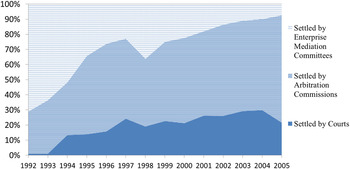
The mid-1990s saw a rapid change in China's economic system with the fast growth of the private and foreign-owned sectors. The number of labour disputes in these enterprises rose dramatically as management at that time was less constrained owing to the absence of labour laws. Also, unlike in the case of SOEs, there were no mediation committees in private and foreign enterprises. In April 1993, eight waves of labour protests occurred in Fujian province within one month, and this alarmed the CCP leadership.Footnote 22 In May 1993, Jiang Zemin 江泽民, general secretary of the Party, commented on the news given in an internal bulletin by the Ministry of Public Security and urged relevant departments to devise a solution to labour unrest.Footnote 23 This development pushed, and indeed accelerated, the government's efforts to rebuild the labour conflict resolution system. Soon after, in July 1993, the State Council formulated the Regulation on Handling Labour Disputes in Enterprises. This new regulation formally set up a dispute resolution system composed of four stages: voluntary mediation, mandatory arbitration, and, in sequence, civil lawsuit and appeal if the disputing parties were unsatisfied with the arbitral result. This system was colloquially known as “one mediation, one arbitration, and two lawsuits” (yitiao yicai liangshen 一调一裁两审).Footnote 24 Consequently, labour disputes began to be channelled through labour arbitration commissions and the courts (see Figure 1), while the role of mediation diminished.Footnote 25 This change reflected the government's general goal of promoting the rule of law in the labour sector as well as in other areas, but it was also due to the fact that there were no mediation committees in private/foreign enterprises.
The Trend in Labour Dispute Settlements, 1992–2005

However, the legal avenues soon were jammed with a huge number of cases, and this strained the limited resources of legal institutions. For example, by the end of 1995, there were 11,292 full- and part-time labour arbitrators.Footnote 26 By 2006, the number of full-time arbitrators had slowly increased to approximately 9,800 and the number of part-time arbitrators had risen to 14,000.Footnote 27 In contrast, the number of labour disputes accepted by labour arbitration commissions had dramatically increased to 502,084 cases, nearly fifty times the number in 1993 (34,159 cases).Footnote 28 Courts were also reportedly overloaded by the overwhelming number of labour dispute cases. This situation led to sluggishness and delays in the settlement process. In Guangdong province, where labour conflict was most fierce, it normally took a year for workers to proceed through the legal channel, and it was not uncommon for labour disputes to take more than 30 months to settle owing to delays caused by bureaucratic ineptitude.Footnote 29 The inefficiencies and slow processes of legal proceedings often frustrated disgruntled workers, forcing them to either follow the xinfang route or take to the streets. Consequently, mediation was brought back as a key means to stabilize labour relations. In October 2006, the Central Committee of the CCP issued its “Decisions concerning major questions in the building of a socialist harmonious society.” For the first time, the Party called for people's, administrative and judicial mediation to be combined in order to resolve disputes at the grassroots level and nip conflicts in the bud.Footnote 30 The Ministry of Labour and Social Security (MoLSS) interpreted the centre's proposal as “prevention first, grassroots first, and mediation first” (yufang weizhu jiceng weizhu tiaojie weizhu 预防为主、基层为主、调解为主).Footnote 31
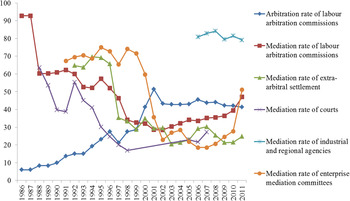
In December 2007, the new Law on Mediation and Arbitration of Labour Disputes was formulated, which reinforces the state's institutional role as the mediator in labour dispute resolution. According to this law, instead of the “one mediation” (by mediation committees) required by the previous system set up in 1993, “triple mediations” (i.e. civil, administrative and judicial) could be conducted before arbitration and adjudication. As part of this change, people's mediation organizations and town-level authorities were given the statutory power to mediate labour disputes. To make the exercise of mediation more extensive and effective, in October 2009, the MoLSS, together with several other departments and the All-China Federation of Trade Unions (ACFTU), jointly released an “Opinion on intensifying mediation of labour and personnel disputes,” which proposed a classified mediating scheme. According to this document, large and medium-sized SOEs should continue to rely on enterprise mediation committees with the help of trade unions; mediatory agencies in township governments and street offices should take care of individual and private enterprises; and in the villages and communities where labour-intensive industries are concentrated and conflicts frequently occur, people's mediation committees should play a major role in mediating labour disputes. The new mediation network apparently enhanced the mediatory capacity of local governments, with the mediation success rate of each agency climbing dramatically (see Figure 2). These agencies mediated about 34 per cent of the 1,287,400 labour disputes in 2010, with 6 per cent being mediated by enterprise mediation committees, 6 per cent by community and village agencies, 17 per cent by township authorities, and 5 per cent by county and district authorities.Footnote 32 The aggregate figure climbed up to 50 per cent in 2011, although the number of labour disputes in this year had grown to about 1,315,000.Footnote 33
Mediation Success Rate Trends, 1986–2011

The primacy of mediation in conflict resolution was further highlighted by the central government, which began to promote “grand mediation” as a national policy formally in 2010. In a circular entitled “Suggestion on properly settling social conflicts by the grand mechanism of prevention and mediation,” the Central Committee for Comprehensive Social Management (zhongyang zonghe zhili weiyuanhui 中央综合治理委员会) explicitly defined mediation as the preferred method in conflict resolution. It called for the establishment of an institutional platform of conflict mediation by integrating the functions and resources of judiciaries, comprehensive management offices, xinfang, relevant government departments, trade unions, the Communist Youth League, and the Women's Federation. Combining people's, administrative and judicial mediation was also emphasized again. Clearly, grand mediation now involved more actors in the mediation process and its scope was significantly expanded. More importantly, the document even set “preventing social instability by proper mediation” as a hard target which carried “veto power” in local leaders' performance appraisals. In other words, failure to mediate properly and handle conflicts effectively can affect a local official's career.
In sum, the use of mediation in China's labour dispute resolution system has experienced ups and downs, reflecting the change in the government's strategic goal of managing labour relations amid specific socio-economic contexts. Its resurgence since 2006 reflects the government's shift away from the judicialization of labour conflict resolution that started in 1995 to a more flexible and less proceduralized strategy. Nevertheless, the resurgence of mediation cannot be explained by top-down mobilization alone. The government's call for the promotion of mediation has indeed created rhetoric and opportunities for the development of local mediation institutions. The extensive and indeed innovative exercise of mediation, however, is also attributable to strong local motivations to use mediation because it serves the multiple interests of local authorities.
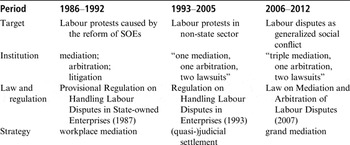
The Institutional Change of China's Labour Dispute Resolution System, 1986–2012

“Mediate First”: Why Mediation is Preferred by Local Authorities
Local governments are at the frontline of maintaining social stability in China. For local authorities in Guangdong, where the manufacturing sectors are concentrated, maintaining stable labour relations is a big challenge. The central government's re-emphasis on mediation provides local authorities with an opportunity to handle labour conflicts with great flexibility. Mediation is preferred because it enables local and grassroots officials to manoeuvre and manipulate to achieve not only the centre's goals but also their own. We identify four “rationales” that drive local authorities to opt for mediation in labour conflict resolution.
Economic rationale
First, like elsewhere in China, local governments in Guangdong province feverishly pursue economic growth and are highly motivated to generate and enlarge local revenues. As local economies in Guangdong rely heavily on foreign investment, maintaining a good environment for foreign capital is a top priority for local governments. Indeed, local authorities and foreign companies have formed an implicit alliance with regard to keeping the labour force in line.Footnote 34 Grassroots authorities also want to ensure that local firms are profitable because a substantial portion of local revenues comes from the rent on collective-owned land and factory buildings paid by local firms. Such income also accounts for the authorities' discretionary money as well as the cadres' bonuses. Workers' “excessive” claims for compensation are thus seen as driving “their ‘gods of wealth’ (caishen 财神) away.”Footnote 35
The economic logic motivates local authorities to prefer mediation over a strict implementation of labour standards. They have strong incentives to depress workers' claims for compensation or to limit the amount of compensation required by the law, and mediation serves this purpose. Local labour bureaus, for instance, rarely apply legal sanctions when handling workers' complaints about employers' breaches of the law as they are afraid that this may hamper business. During an interview, one village cadre in Dongguan explicitly stated that their ultimate purpose in mediating labour disputes is to protect the interests of local companies and to facilitate the investment environment. So, the common practice is to “encourage workers to reconcile with their boss” rather than having them confront each other in court.Footnote 36 The head of the municipal labour bureau in Chaozhou made this point clear: “if we had strictly implemented the existing laws and regulations, all the companies in the area would have gone bankrupt.”Footnote 37 Thus, labour inspection agencies, the affiliates of labour bureaus responsible for ensuring compliance with the labour laws, are restrained from initiating serious investigations into workplaces or punishing the illegal activities of enterprises with fines.Footnote 38
For local officials, a principal advantage of mediation is that it can limit the amount of compensation or persuade workers to withdraw their cases.Footnote 39 In other words, mediation is used to attenuate legal standards in labour dispute settlements and reduce compensation. This is because the mediating process affords local officials considerable discretionary powers to execute laws in a biased way and force through settlements in favour of employers rather than workers.Footnote 40 For instance, according to a regulation in Guangdong province, the baseline for calculating economic compensation is supposed to be 70 per cent of a worker's average monthly wage, but it cannot be lower than the minimum wage.Footnote 41 However, most labour arbitrators will begin by presenting a settlement offer that is equivalent to the minimum wage calculation to workers and then persuade them to compromise by offering extra compensation in steps, which in sum is usually lower than the amount they would have received on the basis of their actual monthly wage. One labour arbitrator in Shenzhen explained that the law is not the absolute rule in resolving labour disputes:
Most of the time, we have to take the unwritten business rules (hanggui 行规) into account. For instance, the working time in foreign trade companies is generally longer than five days, and there is no base wage in the massage business. When calculating overtime fees and other compensations in such cases, strictly following the legal standards is equivalent to going against the business rules, the whole industry, and the expectation of our leaders. We have no choice but to sacrifice a part of the interests of workers to keep the whole industry alive.Footnote 42
Political rationale
The mounting pressure on local officials to maintain social stability has also made mediation a top priority when handling labour conflicts and other contentious issues. One notable development is that courts are increasingly involved in mediation. Since 2009, when the former chief justice of the Supreme Court, Wang Shengjun 王胜俊, proposed “active judiciary” (nengdong sifa 能动司法) as a new guideline for dispute settlement, the courts have been called upon to play an active role in maintaining social stability.Footnote 43 A crucial component of active judiciary is judicial mediation. At a national conference of higher court chiefs, Wang made it clear that “courts at all levels should mediate throughout all stages of case filing … and should set up a comprehensive mediatory mechanism that covers all the issues and the whole process.”Footnote 44 Court officials are required to manage “mass incidents” properly from the offset so that conflicts can be quickly brought under control and defused.Footnote 45
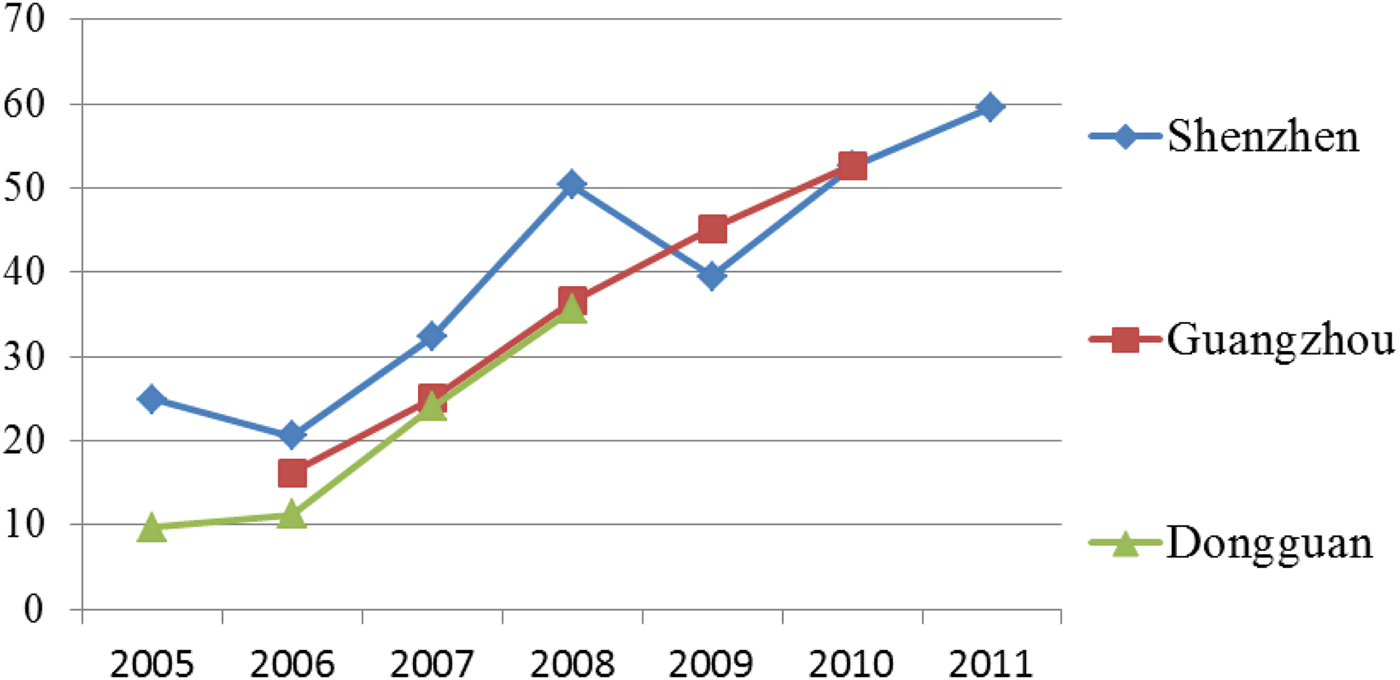
Local courts favour mediation because it provides an alternative means of effective dispute resolution. For years, local courts in Guangdong were overloaded with a soaring number of labour dispute cases. The huge quantity of dispute cases, the cumbersome trial processes, and the poor execution of court decisions, which often led to petitioning, frustrated local authorities concerned with social stability. Local courts, as the “lieutenant of the local government,”Footnote 46 were under great pressure to take a more proactive role in conflict resolution. Mediation offered some distinct advantages for local courts. First of all, it provided local courts with considerable flexibility to settle disputes in a much swifter way. As a process less constrained by formal rules, mediation can bypass legal procedures, allowing “the courts considerable room for maneuver to divide workers and dissolve collective disputes” through various extralegal methods, from persuasion to intimidation.Footnote 47 Even court administrative staff without formal legal training have been permitted to mediate when there has been a shortage of legal personnel to handle numerous cases. The extensive use of mediation apparently speeded up dispute settlements. Moreover, from the viewpoint of the courts, mediation can reduce tensions between adversarial parties as it is undertaken in a closed-door setting and parties can avoid open confrontation. Open trials, in contrast, attract public and media attention and heighten antagonism between the parties involved. A controversial verdict, as some judges have suggested, risks arousing more controversy and even protracted petitions. As a result, the mediation rates of the courts have climbed significantly (see Figure 3).
Mediation Rates of Labour Disputes in Courts in Three Cities
For the same reasons, local labour agencies also opt for the principle of “mediate first, mediate throughout” (tiaojie youxian, quancheng tiaojie 调解优先, 全程调解). As one of the local authority bodies responsible for maintaining stable labour relations, labour bureaus have adopted mediation as a salient mechanism to shorten the time required to settle labour disputes so that further confrontations can be averted. Even though the 2008 law does not require mandatory mediation, de facto mandatory mediation was already practised. For instance, regardless of the type of complaint, all labour disputes in Shenzhen that are channelled into arbitrary proceedings have first to be considered for extra-arbitral mediation before being formally accepted by the labour arbitration commission. If extra-arbitral mediation fails, another round of mediation before formal arbitration (tingqian tiaojie 庭前调解) takes place, with arbitrators being dispatched to workplaces to conduct mediation work. Even when a case has proceeded to the arbitration stage, arbitrators still spare no effort to persuade plaintiffs to reconcile in the arbitration court; this is colloquially known as “mediation during arbitration” (tingzhong tiaojie 庭中调解). Lastly, considering that a controversial verdict might arouse more controversy, an additional mediation procedure after arbitration (tinghou tiaojie 庭后调解) has been set up. This procedure allows plaintiffs to reject the arbitral awards and go back to reconcile for an alternative settlement. The purpose of the procedure is to make sure that workers do not keep on appealing to the courts if they are dissatisfied with the arbitral awards.Footnote 48 These steps in the mediatory procedures were vividly depicted by one labour arbitrator as “dams in the river” to slow down the flow of potential lawsuits.Footnote 49 As one labour arbitrator said in an interview:
Arbitration is relatively easy for us because we do not need to do thought work for both sides. However, the process of arbitration can drag on and on for a long time, and it is likely that workers would take disruptive action during that period. So the government wants us to mediate and solve disputes as quickly as possible and at the grassroots level. We often have to work overnight to solve some thorny disputes.Footnote 50
Although the impartiality of grassroots authorities has been questioned, they cannot completely turn their backs on workers or repress too many workers' complaints given that improper settlements may stir up collective protests. In Dongguan, as a town leader in charge of social stability said, mediation has not only been a solution to disputes but has also been employed as a precautionary measure throughout the whole settlement process to prevent workers from “gathering their fellows” (laoxiang 老乡).Footnote 51
Managerial rationale
Coupled with the economic and political concerns, a managerial rationale of filling the gaps in the existing legal and administrative institutions has also contributed to local authorities' interest in advancing mediation. In fact, not all labour disputes can be channelled into legal proceedings. A large number of labour right infringement cases cannot be handled through formal legal procedures owing to the absence of a legal basis. As an official in charge of xinfang admitted:
Many issues cannot be solved in line with laws. Political wisdom and administrative resources are thus needed to solve them. It is necessary to have some extralegal mechanisms to deal with them. Over 90 per cent of the cases filed to the xinfang office are reasonable, but laws can do nothing about them. So we have to rely on mediation.Footnote 52
For instance, complaints arising from arrears of wages and occupational injuries in underground factories, namely those factories without an official licence or even without a name, cannot be placed as cases on file by either labour arbitration commissions or the courts. Such factories do not offer contracts or any documentation that workers could use to prove the existence of labour relations. Not being officially registered, these factories are not legal entities and cannot be sued as defendants. Thus, most complaints of this type were often brought before xinfang agencies. Through mediation, local labour agencies can compel employers to offer limited economic compensation to appease workers while at the same time prevent the workers from taking disruptive action.Footnote 53 Since the xinfang agencies usually lacked enough manpower to keep petitioners under control, some complaints were transferred to grassroots authorities according to the principle of “territorial jurisdiction” (shudi yuanze 属地原则). As grassroots cadres do not have statutory power or professional experience in labour dispute settlement, mediation is the only viable – and convenient – way for them to redress grievances.
Mediation also provides a remedy for courts to overcome the weak capacity of the legal enforcement system. With limited resources and an overwhelming number of cases waiting to be enforced, the courts began to promote mediation at the enforcement stage. It is common for officials on the executive board of the courts to remind workers of the possible depreciation of their compensation as a result of lengthy judicial procedures and to encourage them to accept a lump sum of cash.Footnote 54 According to one court official in Chaozhou:
[T]he irreconcilable cases are usually the unenforceable ones. Even if they have been adjudicated, they have to be settled eventually through the “reconciliation of enforcement” (zhixin hejie 执行和解). It is more practical for workers to get 50,000 yuan cash than to hold a 100,000 yuan award. The situation becomes more complicated if the boss has taken a “red hat,” either as a people's congress deputy or a member of the political consultative committee. There would be more obstructions to enforcement. Local authorities have to consider their political status when dealing with dispute cases. The worst situation is when the boss has absconded without leaving any assets. That is impossible to enforce. Thus, it is better to keep the cases away from the adjudication procedure if they can be mediated.Footnote 55
A judge echoed the same view:
Many workers come to the court with the expectation that they could get more compensation. But, even if our judgment is in their favour, say, offering them 100,000 as they requested, it means nothing if it cannot be enforced. So, we will make it clear to them that it is in their interest to accept a mediated amount, even one significantly lower than they requested.Footnote 56
Bureaucratic rationale
The centre's campaign for mediation has created a new incentive to motivate local governments to promote mediation. Since 2006, the success rate of mediation (tiaojielü 调解率) and the withdrawal rate of cases (fupanxisulü or cheanlü 服判息诉率或撤案率) have been assigned substantial weight in the performance assessment of courts and individual judges.Footnote 57 Such assessments are directly linked to promotion as well as annual bonuses. In order to reach a high conciliation success rate or even a zero adjudication rate, judges are impelled to push litigation parties to thrash out a mediation deal. To minimize the risk of making misjudgments and triggering labour protests, many judges persistently attempt to mediate with appellants until they agree to withdraw from lawsuits.Footnote 58 According to one judge:
If workers were unsatisfied with the judgment of the courts, some might take extreme actions such as suicide, which would put great pressure on judges … so mediation is less risky and the mediation rate is an important criterion for performance assessment. However, withdrawal of cases is even more ideal, so we will try very hard to persuade workers to withdraw from lawsuits.Footnote 59
For court officials, the enforcement completion rate (zhixingjieanlü 执行结案率) and successful enforcement rate (zhixing biaodi daoweilü 执行标的到位率) are the two top priority targets. In labour dispute cases, some court decisions are hard to enforce, especially when employers are short of cash to pay workers the full amount of compensation ordered by the courts, but a low enforcement rate can negatively affect the courts' performance appraisal. Thus, court officials often aggressively mediate and persuade workers to accept a compensation amount that is significantly lower than the one ruled by the courts. Once workers with no alternative have accepted the “conciliated compensation,” the courts count the case as being “enforced” even though the workers are not fully compensated as the courts originally ordered.Footnote 60 Such a tactic helps to raise the enforcement rate.
The same tactic also serves the interests of labour agencies. For labour arbitrators, the number of cases concluded is a key yardstick for their performance evaluations. Mediation provides a shortcut to settle disputes.Footnote 61 Also, in contrast to the generational substitution of judges in waves of judicial reform,Footnote 62 there are still a significant number of labour arbitrators who lack legal knowledge and professional training.Footnote 63 Effective arbitration in line with labour laws is not an easy job for them; mediation provides a more convenient means for them to get the job done with results that meet the performance assessment requirement. As one labour arbitrator explained:
Most of my colleagues are unprofessional and undereducated in terms of legal knowledge. They rely on mediation because they are incapable of arbitrating. I myself will try to mediate when I feel unconfident about making a proper judgment. Besides, drafting a reconciliation agreement only takes half an hour, while it takes a couple of days to write an arbitral award.Footnote 64
Local Initiatives of “Grand Mediation”
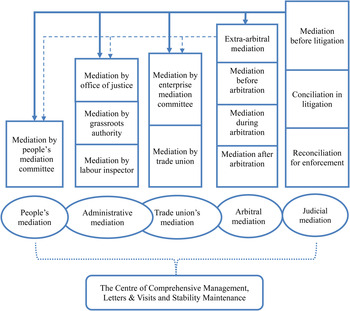
Together, these four rationales motivate local authorities, courts and bureaucratic agencies to promote mediation as the preferred means of settling labour disputes. In the mid-2000s, local governments in Guangdong began to devote particular efforts to setting up multifarious grand mediation programmes. Centres of comprehensive management, letters and visits, and stability maintenance (zongzhi xinfang weiwen zhongxin 综治信访维稳中心) (CCMs) were widely established. Steered by local Party organizations, CCMs provide an institutional mediation network. By integrating trade unions, government agencies (for example, public security bureaus), labour arbitration commissions, people's mediation committees and the courts, a CCM aims to provide a platform for one-stop swift dispute settlement through multifarious mediation channels. Dispute cases can be quickly referred between different mediation channels as needed, and handled through different mediation mechanisms (i.e. civil, administrative or judicial).
Such grand mediation has some distinct advantages for local authorities struggling to maintain social stability. First, it creates an institutional arrangement in which various government agencies share the responsibilities as well as the risks in dealing with labour disputes and other conflicts. All of these agencies are under the same pressure to fulfil the “hard target” of maintaining stability and thus are strongly motivated to cooperate with each other. Cooperation often produces more effective mediation. For example, the labour bureau and the court are two major government actors in labour conflict resolution, and they often collaborate in the process. Judges often appear at the site of a protest first in an attempt to persuade workers to stop their action. As some scholars have found, judges' legal opinions are usually regarded by workers as being more credible than those of officials from other governmental agencies and are therefore more persuasive.Footnote 65 The intervention of judges ensures that many collective labour protests in the streets end up being channelled into the legal process and resolved in an orderly manner. On the other hand, employers are more receptive to advice from the labour bureau to compromise, because the latter's inspection power is more threatening to enterprises. This division of labour between the court and the labour bureau in conflict resolution can sometimes quickly defuse workers' collective protests and steer disputes towards regular mediation mechanisms.
The Grand Mediation of Labour Disputes in Guangdong

The internal bureaucratic coordination permitted by the CCMs also effectuates mediation in defusing some crisis situations. For example, the 2008 financial crisis triggered a wave of bankruptcies in Guangdong at the end of that year. Many owners absconded leaving their workers unpaid. With the Chinese New Year approaching, workers were worried that they would be unable to get their salaries before leaving for their hometowns for the holidays. Radical action took place in many factories. A common way of settling such cases is to sell the factory assets and pay the workers, but this process is long and protracted as it has to go through the proper legal channels and does not bring an immediate end to worker actions. Under the framework of grand mediation, however, local authorities can immediately dispatch labour officials, judges and grassroots cadres to secure a quick “clean up” at the scenes of mass gatherings. Subsequently, the relevant government agencies collaborated and worked out contingency measures and expedited the sale of factory assets in this case so that the workers' salaries could be paid.Footnote 66 The grassroots cadres were responsible for organizing the workers' representatives and the landlords of the factories to auction off production equipment; at the same time, they kept a close eye on the workers to prevent them from seeking assistance from their fellow associations (tongxianghui 同乡会) or taking to the streets in protest.
Furthermore, the cross-departmental collaboration promoted by the CCM also allows local authorities to detect any signs of bankruptcy in certain vulnerable firms. For instance, in Dongguan, the labour bureau pays close attention to whether workers are paid regularly. The foreign trade department checks whether firms' foreign trade order volumes are normal, and even the water and electricity departments monitor the daily running of enterprises through their everyday usage of resources in production.Footnote 67
Grand mediation further satisfies the interests of local bureaucrats since it significantly boosts their performance appraisals in terms of settled case statistics. Cases that have been jointly mediated are counted as “successfully mediated cases” by each department separately in its own work records. Under the framework of grand mediation, courts and labour bureaus network with grassroots mediation agencies, such as people's mediation committees and township or neighbourhood labour protection stations, and refer a large number of cases to them. Grassroots institutions are indeed instrumental in mediating disputes. To ensure that agreements made by disputing parties are valid, the grand mediation mechanism allows agreements to be “approved” by the courts or arbitration committees so that they can become legally binding. All mediated cases are then recorded by the courts and labour bureaus as their own to strengthen their performance assessment index. A leader in a municipal labour bureau summarized two advantages of the “cooperating mechanism”: it reduces the labour bureau's workload by shifting a lot of work to grassroots cadres, and it also enhances the labour bureau's mediation success and settlement rate statistically by including the cases mediated by grassroots cadres.Footnote 68 As a grassroots cadre said in an interview, “what the officials want to borrow from each other is not the substantial power but the statistics. Grand mediation means combining the figures more than merging the powers of separate departments.”Footnote 69
By incorporating grassroots institutions in labour dispute resolution, grand mediation has given street-level bureaucrats a sense of empowerment. In the Guangdong area, many private and foreign enterprises are located in townships. To share the responsibility of coping with labour disputes, local authorities insist that township and neighbourhood offices play a major role in mediation. Township governments have strong incentives to be engaged in mediation as maintaining stable labour relations and a good investment climate serve their best interests. When handling individual labour disputes, grassroots cadres usually pressure workers to accept less compensation so that they can minimize the costs to enterprises and ensure that investors will not be discouraged. Equally, for collective labour disputes, township officials will seek concessions from employers because preventing workers' protests from escalating is also a priority.Footnote 70
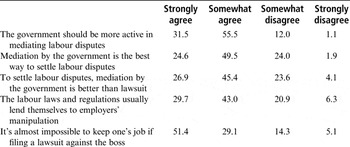
While the extensive use of mediation provides local authorities with the flexible means to defuse labour disputes, workers' responses to mediation are mixed. For workers, litigating is a complicated and cumbersome process. It is not only costly but also time consuming. Often, workers are less able to amass and analyse the information needed for litigation and lack the financial resources for protracted trials. Thus, many workers also prefer mediation, as it can avoid prolonged litigation or arbitration and can bring about quick compensation, although that can be a smaller sum than they expected. Our survey in Guangzhou in 2012 indicates that migrant workers have a strong preference for mediation. About 87 per cent of the respondents expected a more active role from the government in mediating labour disputes, and approximately three-quarters believed that mediation by the government was the best way to resolve labour disputes, especially compared to litigation (see Table 2). However, the workers' preference for mediation stems from their lack of confidence in the legal channels. Nearly 68 per cent of the respondents were worried about their employers manipulating laws and regulations, and over 80 per cent of them were concerned about losing their jobs if they took their employers to court.
The Migrant Workers' Evaluations of Mediation (%)

Source:
Authors' survey of migrant workers in Guangzhou, 2012.
Note:
N = 474. Row entries are proportions.
Another factor that compels workers to accept mediation and its results stems from the fact that the mediators (for example, the arbitrators or judges) are likely to be those who would adjudicate if the mediation fails. Workers are afraid that judges or arbitrators might intentionally make things difficult during adjudication if they refuse to accept the result of mediation.Footnote 71 Mediators often instil a sense of uncertainty about the outcome of a lawsuit in workers and try to persuade them that the mediated outcome is the best possible result. However, as compulsory mediation focuses more on settling disputes than on seeing justice done, it tends to ignore and depress labour standards, thereby frustrating workers who find the conclusions of the mediation unfair. For example, when settling industrial injury cases, government agencies often force workers to accept compensation amounts from enterprises far below what the law requires. Criticism has been mounting that mediation has deviated from the rule of law promoted by the government.Footnote 72
Conclusion
The status of mediation in China's labour dispute settlement system has varied over time. In the early years of economic reform, mediation was promoted as the principal method of resolving labour conflicts. However, the mid-1990s saw a decline in mediation and a transition to adjudication as the principal mechanism for labour dispute resolution as a result of the country's campaign for the rule of law. But, since 2006, the tide has changed again: mediation is once more seen as the primary method of labour dispute resolution, and its extent and scope have been expanded. The revival of mediation in labour dispute settlements reflects a change in the government's strategy for handling labour relations. Compared with the mediation practised in the early years of the market reform period, the grand mediation carried out since 2006 demonstrates a strong institutional enhancement of mediation through the integration of various government agencies. It indicates that, in the face of mounting labour conflicts as well as other kinds of social unrest, the government requires more flexible and effective means and more discretionary powers to maintain stability and even bypass the law and legal procedures.
Nevertheless, while mediation is promoted by the central government, its widespread expansion is driven by local interests. Certainly, local authorities bear immediate responsibility for maintaining social stability and have found that mediation is a useful way to achieve this end. However, as this research has shown, their strong preference for mediation is driven by other specific considerations rooted in their economic and institutional interests. Grand mediation creates new incentives and opportunities for local authorities to develop various forms of mediation and even to extend mediation to the process of arbitration and adjudication. Not only does grand mediation confer on bureaucratic agencies the power to resolve conflicts without having to comply with legal minimums, it goes so far as to legitimize the courts' “non-legalistic approach” to settling dispute cases.Footnote 73 The extensive employment of mediation by local authorities has chipped away at the role of the legal institutions in settling labour disputes.
The resurgence of mediation as a primary route to conflict resolution embodies a fundamental dilemma confronting China's authoritarian regime.Footnote 74 On the one hand, the regime needs to advance the rule of law in order to regulate the market, encourage foreign and private investment, maintain social order, and promote its international image. On the other hand, recurrent social conflicts force the regime to seek all possible means to maintain stability, even at expense of laws. Local governments have taken advantage of the opportunity mediation offers to marginalize laws in order to pursue their own interests as well as meet the demands of the central government. Thus, as a common phenomenon in authoritarian states, political and administrative tactics often and routinely prevail over the rule of law. Indeed, mediation to a large extent has become a soft and indirect form of repression used to defuse social unrest and prevent protests.Footnote 75