Introduction
The international coffee market is undergoing important changes in terms of appreciation and consumption philosophies (Guimarães et al., Reference Guimarães, Catro Junior and Andrade2016). Thus, coffees that stand out for presenting more pleasant flavours and aroma, combined with good agricultural practices, are attracting a large market share (Guimarães et al., Reference Guimarães, Catro Junior and Andrade2016; Lages, Reference Lages2017). These changes denote a new adaptation of the market, with a strong migration towards the consumption of specialty coffees (Guimarães et al., Reference Guimarães, Leme, Rezende, Pereira and Santos2018).
In this sense, knowing the responses of the genotypes for obtaining special coffees, is of fundamental importance for the success of the coffee enterprise, especially in regions considered to be of transition altitude, in view of the changes in genetic matrices in transition zones, that is, more and more high-altitude arabica coffee is prioritized concerning the production of specialty coffees (Avelino et al., Reference Avelino, Barboza, Araya, Fonseca, Davrieux and Guyot2005; Silva et al., Reference Silva, Queiroz, Ferreira and Rufino2016; Sobreira et al., Reference Sobreira, Oliveira, Pereira, Gonçalves and Sakiiyama2016; Tolessa et al., Reference Tolessa, D'heer, Duchateau and Boeckx2017; Zaidan et al., Reference Zaidan, Corrêa, Ferreira and Cecon2017; Worku et al., Reference Worku, Meulenaer, Duchateau and Boeckx2018).
However, the knowledge of agronomic practices, as well as of the best management, that allows us to mitigate the environmental effects in the face of the genotypic expression of the coffee genotypes becomes essential, when the aim is to produce fine coffees (Geromel et al., Reference Geromel, Ferreira, Davrieux, Guyot, Ribeyre, Scholz, Pereira, Vasst, Pot, Leroy, Androcioli Filho, Vieira, Mazzafera and Marraccini2008). Among the management, irrigation stands out for promoting less productive risk, higher productivity and better quality of fruits (Venancio et al., Reference Venancio, Cunha and Mantovani2016), especially when it comes to low altitude areas for the production of arabica coffee (Caldas et al., Reference Caldas, Lima, Rezende, Faria, Diotto and Leite Junior2018).
This response occurs due to the maximization of the potential that the coffee has for the production of photoassimilates when cultivated with conditions suitable for its development (Fagan et al., Reference Fagan, Souza, Pereira and Machado2011). Clifford (Reference Clifford, Clifford and Wilson1985) highlights that the quality of the beans depends on the amount of photoassimilates available during the period of their growth and filling, being the same strongly influenced by the relationships that occur between source and drain, being still weighted by the biotic and abiotic stresses that the plants of coffee are subject (Fagan et al., Reference Fagan, Souza, Pereira and Machado2011).
The overall goal of this study was, therefore, to analyse the response of ten arabica coffee genotypes (Paraíso H 419-3-3-7-16-2; Paraíso MG/H 419-1; Paraíso H 419-3-3- 7-16-11; Paraíso Hybrid; Catuaí 144 SFC; Catuaí 144 CCF; Catucaí 24-136; Catucaí 2-SL; Sacramento MG1 and Oeiras MG-6851), as for the sensory and physical–chemical variables when subjected to two water regimes (rainfed and irrigated) in an area considered to be of transition altitude for the cultivation of arabica coffee, in order to discriminate them as to the potential of producing special coffees in low altitude regions.
Materials and methods
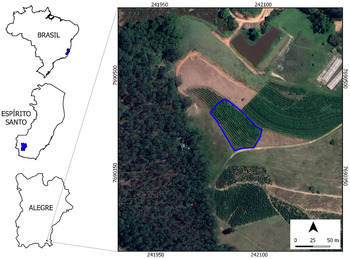
The experiment was conducted in the municipality of Alegre, in the south of the state of Espírito Santo (20°52′07″S and 41°28′43″W), a region typically grown with arabica coffee (Fig. 1). The study area has an elevation of 640 m above sea level, with an average annual rainfall of 1290 mm, with the rainy season being between the months of October and April and the dry season from May to September, in addition, to have an average temperature of 22.3°C.
(Colour online) Map of the geographical location of the experimental area.

The experimental design used was in a split-plot scheme, with ten arabica coffee genotypes (plots), aged seven and two water regimes (subplots), where each experimental unit was composed of three plants in a randomized block design with three repetitions. The spacing adopted was 2.5 m × 1.0 m, totalling a population of 4000 plants per hectare.
The genotypes used were selected due to their agronomic treatments, standing out for being materials with potential for planting in the region under study. The selected arabica coffee genotypes were: Paraíso H 419-3-3-7-16-2; Paraíso MG/H 419-1; Paraíso H 419-3-3-7-16-11; Hybrid Paradise; Catuaí 144 SFC; Catuaí 144 CCF; Catucaí 24-136; Catucaí 2-SL; Sacramento MG1 and Oeiras MG-6851.
The water supply was carried out through two water regimes. The first water regime is characterized by completely dry land, with water entering only during rainy periods. The second, comes from the supply of water by irrigation in the drip system, in order to sustain the plant avoiding severe water stress and in times of high-water demand, being monitored by tensiometers installed in the crop. The determination of the appropriate tension for irrigation was obtained through the characteristic curve of the soil, thus allowing to observe that the values of soil moisture in the field capacity (CC) and at the point of permanent wilt (PMP) were 0 2308 and 0.1561 m3/m3, respectively, proceeding to irrigation when the soil moisture corresponded to the value referring to 70% of the total humidity of the CC.
Agricultural practices (weed control, fertilization, liming, sprouting, etc.) were established according to the needs of the coffee plant and due to chemical analysis of the soil, according to recommendations for the cultivation of arabica coffee plants in Brazil proposed by Sakiyama et al. (Reference Sakiyama, Martinez, Tomaz and Borém2015).
Fruit harvesting and processing
With 80% maturation at the cherry stage, the semi-mechanized harvest of each experimental plot proceeded with the aid of a side harvester. Subsequently, the fruit samples were separated into plastic bags duly identified and immediately sent to the Laboratory of Analysis and Research in Coffee – LAPC, from the Federal Institute of Espírito Santo, Venda Nova do Imigrante campus, where the green beans, buoys were separated and malformed and post-harvest wet processing of fruits giving rise to peeled cherry coffee.
After drying the pulped coffee on a suspended terrace, until it reached 11% moisture, the beans were cleaned by removing the endocarp from the endosperm.
Roasting procedure and sensory analysis
The roasters were conducted using the Laboratto TGP2 roaster, with the aid of the Agtron-SCA disc set. The roasting point of these samples was located between the colours determined by discs 65 and 55. The toasts were made 24 h in advance of the sensory analysis and the grinding respected the time of 8 h of rest after the roasting. All samples were roasted between 8 and 10 min and, after roasting and cooling, the samples remained sealed, according to the sensory analysis methodology established by Specialty Coffee Association (SCAA, 2013).
Sensory analyses were performed in accordance with the official SCA protocol (SCAA, 2013), in line with the methodology proposed by Pereira et al. (Reference Pereira, Guarçoni, Souza, Brioschi Junior, Moreira and Caten2018). Thus, a sample of 8.25 g ground and roasted coffee from each treatment was used, which was distributed in each cup prepared for tasting, in which 150 ml of boiling water were added to the infusion point of 92–95°C, in accordance with the midpoint of the optimal balance graph for obtaining the Golden Cup (SCAA, 2013).
Five cups were used for each sample, and they were tasted by a team composed of six professional tasters (Q-Graders) as proposed by Pereira et al. (Reference Pereira, Guarçoni, Souza, Brioschi Junior, Moreira and Caten2018). The evaluations started when the temperature of the cups reached 55°C, respecting the time of 4 min for tasting after the infusion (SCAA, 2013).
Physico-chemical analysis
The determination of the pH variable was performed using room temperature (25°C) with the aid of a pH meter, according to the AOAC method (1990), with modification. We weighed 5 g of roasted and ground coffee sample, 50 ml of distilled water was added in Erlenmeyer and kept under stirring, on a magnetic stirrer, for 1 h. Subsequently, it was filtered on ordinary filter paper at room temperature and the pH was read, with a pH meter calibrated each time with buffer solutions of pH 4.0 and 6.96. The determination of electrical conductivity and potassium leaching was performed on coffee beans before roasting, based on the methodology recommended by Prete and Abrahão (Reference Prete and Abrahão1996).
In addition, the determination of the soluble solids content was based on the AOAC methodology (1990), with an adaptation. The extract used to determine the soluble solids was obtained from 2 g of roasted and ground beans, in 50 ml of distilled water. The suspension was kept on a mechanical stirrer for 1 h at 150 rpm, then the extract was filtered on filter paper and read using a bench refractometer. The results are expressed as a percentage of water-soluble solids.
Statistical analysis
In order to observe the individual behaviour of the variables, the analysis of (P < 0.05), observing the significant interaction, the genetic materials were compared using the Scott–Knott test (P < 0.05) and Tukey (P < 0.05) for rainfed and irrigated treatments. To group the treatments, thus allowing us to obtain a joint information of the data, the multivariate analysis was performed by the method of canonical variables, using graphical dispersions, using the scores of the first two canonical variables, which explain more than 70% of the total variation available, as recommended by Ferreira (Reference Ferreira2018). The analyses were performed with the aid of the computer program Genes (Cruz, Reference Cruz2013).
Results
The data referring to the analysis of individual variance of the variables demonstrate that there was a significant interaction (P < 0.05) between the genotypes and the water regimes for most of the studied variables (Table 1). However, it was not possible to verify such interaction for the sensory variables: balance, acidity, sweetness, body and finish. However, the study of these variables becomes important, as it allows an understanding of the genotypes' responses, given the simultaneous response of the variables in question. Thus, it becomes possible to select them due to the multivariable responses exhibited, since the joint response of these variables is fundamental to the quality of the coffee tree (Barbosa et al., Reference Barbosa, Costa, Nascimento, Cruz and Oliveira2019).
Summary of the analysis of variance of the physical–chemical and sensory attributes of ten arabica coffee genotypes, subjected to water regimes

*Significant F (P < 0.05); nsnot significant.
It is possible to analyse in Tables 2 and 3 the consequences of the interactions between the different water supplies and the genotypes for overall quality, electrical conductivity, potassium leaching, pH and soluble solids in coffee beans of the species Coffea arabica. The responses of the genetic materials under study to the global quality variable (Table 2) demonstrated that the genotypes Paraíso H 419-3-3-7-16-2, Catucaí 24-137 and Paraíso H 419-3-3- 7-16-11 showed the best performance for the rainfed water regime, whereas for the irrigated water regime the Catuaí 144 SFC and Catuaí 144 CCF genotypes showed the best sensory performance (overall quality). It is also noted that Paraíso H 419-3-3-7-16-2, Catucaí 24-137, Paraíso H 419-3-3-7-16-11 and Paraíso (hybrid) in rainfed presented better quality performance when compared to the irrigated treatment (Table 2).
Averages of the global quality characteristic, electrical conductivity and potassium leaching (K leaching) of ten arabica coffee genotypes subjected to water regimes

Average followed by the same lower-case letters vertically and upper-case letters horizontally do not differ by the Scott–Knott test (P < 0.05).
Averages of the pH and soluble solids characteristic of ten arabica coffee genotypes subjected to water regimes

Average followed by the same lower-case letters vertically and upper-case letters horizontally do not differ by the Scott–Knott test (P < 0.05).
As for electrical conductivity (Table 2), the genotypes Catucaí 24-137, Sacramento MG1, Catuaí 144 CCF, Catucaí 2-SL, Oeiras MG-6851 and Paraíso (hybrid) formed a group of materials that stood out the dry treatment. In an irrigated treatment, however, no statistical difference was observed between the genetic materials under study. Comparing the water regimes, it can be observed that Catuaí 144 SFC and Paraíso MG/H419-1 found higher values of electrical conductivity under irrigation compared to the rainfed regime in this study.
When observing the response of the genotypes to K leaching (Table 2), it is noted that Paraíso MG/H 419-1 and Paraíso H 419-3-3-7-16-11, in the dry treatment, presented the lowest values of this variable, whereas Catucaí 24-137 and Catuaí 144 CCF were those that obtained the highest potassium leach values for the same water regime. However, when the genotypes were provided with irrigation, only Paraíso MG/H 419-1 had lower concentrations of leached potassium.
On the one hand, observing the data presented in Table 3, it is possible to verify that for the dry water regime (rainfed), the soluble solids characteristic provided the formation of three groups of averages, with emphasis on the genotypes Oeiras MG-6851 and Paraíso (hybrid). On the other hand, the responses of the genotypes to the irrigated water regime promoted the formation of five groups of means, with the genotype Paraíso H 419-3-3-7-16-11 as the one with the highest value of soluble solids, whereas the Catucaí genotype 24-137, which presented the lowest values of this characteristic. It is also noteworthy that the genotypes Paraíso H 419-3-3-7-16-2 and Paraíso H 419-3-3-7-16-11 had a higher concentration of soluble solids when irrigated and Catucaí 24-137 under rainfed.
For the pH variable (Table 3), three groups of averages are observed, with a positive highlight for the Paraíso H 419-3-3-7-16-2 genotype, for the rainfed. The irrigated water regime also provided the formation of three groups of averages, with emphasis on the group formed by the genotypes Paraíso H 419-3-3-7-16-2, Paraíso MG/H 419-1 and Catucaí 2-SL. Comparing the behaviour of the genotypes for both water regimes, it is possible to verify that, with the exception of the Sacramento MG1, Catucaí 2-SL and Oeiras MG-6851 genotypes, which did not present significant differences between the treatments, the others showed higher pH values under dry conditions compared to the irrigated regime.
In order to promote a joint evaluation of the genotypes under a simultaneous analysis of the variables, a multivariate analysis was performed, using supervises or canonical variables (Cruz et al., Reference Cruz, Regazzi and Carneiro2012), making it possible to analyse the phenotypic variation of the genotypes, in view of the different water conditions imposed.
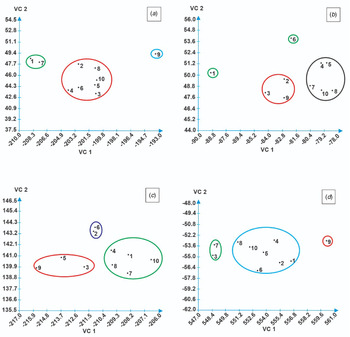
Table 4 shows the eigenvalues and respective simple and accumulated percentages, associated with the first two canonical variables, which were obtained through the scores of the ten treatments. The graphical dispersions of the scores of the first two canonical variables are shown in Fig. 2.
Canonical variables and their respective eigenvalues and simple and accumulated percentages of the total variance

(Colour online) Dispersion diagram in relation to the first two canonical variables of ten arabica coffee genotypes (*), referring to (a) the physicochemical characteristics in the irrigated experiment, (b) physicochemical characteristics in the rainfed experiment, (c) sensory in the irrigated experiment and (d) sensory in the rainfed experiment. (*) (1) Paraíso H 419-3-3-7-16-2; (2) Catuaí 144 SFC; (3) Paraíso MG/H 419-1; (4) Catucaí 24-137; (5) Sacramento MG1; (6) Catuaí 144 CCF; (7) Catucaí 2-SL; (8) Oeiras MG-6851; (9) Paraíso H 419-3-3-7-16-11 and (10) Paraíso (hybrid).

By the analysis of canonical variables, it is possible to verify that the two transformed variables explained 76.2, 89.5, 88.3 and 84.1% of the total variation in the original data, for the physical–chemical and sensory analyses in rainfed and irrigated treatments, respectively (Table 4).
Thus, the dispersion diagram in relation to the first two canonical variables of the ten arabica coffee genotypes for the physical–chemical characteristics in the irrigated experiment (Fig. 2(a)) reveals the formation of three groups through the graphic dispersion of the scores. The first group was formed by the genotypes Paraíso H 419-3-3-7-16-2 and Catucaí 2-SL, another by the genotypes Catuaí 144 SFC, Paraíso MG/H 419, Catucaí 24-137, Sacramento MG1, Catuaí 144 CCF, Oeiras MG-6851 and Paraíso (hybrid) and a third, using the Paraíso H 419-3-3-7-16-11 genotype.
Among the estimated distances for the Y axis (Fig. 2(a)), the greatest magnitude was expressed between Paraíso MG/H 419-1 and Paraíso H 419-3-3-7-16-1, whereas on the X axis a greatest distance occurred between the genotypes Paraíso H 419-3-3-7-16-2 and Paraíso H 419-3-3-7-16-11.
For the physical–chemical characteristics in the rainfed treatment (Fig. 2(b)), the formation of four groups of genotypes can be observed in the dispersion diagram. The first group was composed of Paraíso H 419-3-3-7-16-2, the second by Catuaí 144 CCF, the third group was formed by the genotypes Catuaí 144 SFC, Paraíso MG/H 419-1 and Paraíso H 419- 3-3-7-16-11 and the fourth group by the genotypes Catucaí 24-137, Catucaí 2-SL, Oeiras MG-6851, Paraíso (hybrid) and Sacramento MG1.
Among the estimated distances for the Y axis for Fig. 2(b), it is observed that the greatest magnitude is expressed between the genotypes Catuaí 144 CCF and Paraíso H 419-3-3-7-16-11, whereas on the X axis, this occurred between the genotypes Paraíso H 419-3-3-7-16-2 and Oeiras.
For the sensory characteristics in the irrigated (Fig. 2(c)) and rainfed (Fig. 2(d)) treatments, the genetic materials in studies formed three groups through the graphic dispersion of the scores, and the genotypes of the Paraíso groups were present in the three groups of the rainfed and in two of the three groups in the irrigated treatment. It is also observed that the genotypes of the Catuaí group for the irrigated treatment showed low dispersion among them and greater dispersion among the materials, both located within the same group.
Discussion
The irrigated and rainfed water supplies provided differentiated responses between the arabica coffee genotypes in transition altitude region, and the irrigated regime provided a reduction in the overall quality, in comparison with the rainfed regime for the genotypes Paraíso H 419-3-3, -7-16-2, Paraíso H 419-3-3-7-16-11, Paraíso hybrid and Catucaí 24-137. Thus, it stands out that although Geromel et al. (Reference Geromel, Ferreira, Davrieux, Guyot, Ribeyre, Scholz, Pereira, Vasst, Pot, Leroy, Androcioli Filho, Vieira, Mazzafera and Marraccini2008) and Laviola et al. (Reference Laviola, Mauri, Martinez, Araujo and Neves2007) highlighted that the water deficit negatively affects the formation of quality coffees, the practice of irrigation has not been shown to have the potential to add quality to these genetic materials under the conditions under study.
This response may have occurred due to the phenological characteristics of the plant, justifying it, as highlighted by Caldas et al. (Reference Caldas, Lima, Rezende, Faria, Diotto and Leite Junior2018), due to floral induction and maturation of coffee fruits. Therefore, when the arabica coffee is subjected to the dry water regime, it showed more uniform flowering and fruit maturation compared to the irrigated regime (Caldas et al., Reference Caldas, Lima, Rezende, Faria, Diotto and Leite Junior2018). Corroborating this information, DaMatta et al. (Reference DaMatta, Ronchi, Maestri and Barros2007) further elucidate that irrigation during the seed filling and granation period is beneficial to the coffee drink quality, however the water supply in the vegetative dormancy stage of the flower buds, can provide multiple blooms significantly affecting the quality of coffee fruits at harvest.
Therefore, the response differs from the genotypes for the treatments under study, it may have varied according to the edaphoclimatic conditions of the crop and due to the genetic load of the plant, being even more weighted by the physiological, chemical and biochemical events that occur in plantar coffee, filling the beans more and, consequently, providing a more balanced chemical composition, in order to improve the final quality of the coffee beans (Vaast et al., Reference Vaast, Bertrand, Perriot, Guyot and Gérnad2006; Geromel et al., Reference Geromel, Ferreira, Davrieux, Guyot, Ribeyre, Scholz, Pereira, Vasst, Pot, Leroy, Androcioli Filho, Vieira, Mazzafera and Marraccini2008).
Complementing this information Rodrigues et al. (Reference Rodrigues, Brinate, Martins, Colodetti and Tomaz2017) highlight that the genotypic expression of coffee tends to be better expressed when coffee plants are provided with irrigation. Thus, it can be associated that the quality gains or losses found occurred due to the strong influence that environmental characteristics have on coffee genotypes (Barbosa et al., Reference Barbosa, Costa, Nascimento, Cruz and Oliveira2019). Dessalegn et al. (Reference Dessalegn, Labuschagne, Osthoff and Herselman2008), Kathurima et al. (Reference Kathurima, Gichimu, Kenji, Muhoho and Boulanger2009), Pereira et al. (Reference Pereira, Chalfoun, Carvalho and Savian2010) and Sobreira et al. (Reference Sobreira, Oliveira, Pereira, Gonçalves and Sakiiyama2016) also highlight that the sensory attributes of coffee (aroma, flavour, sweetness, acidity, among others) tend to be highly correlated. Thus, maximizing the expression of the quality of a given attribute significantly affects the response of the other sensory attributes.
In this sense, it can be associated that a possible gain of the irrigation effect in the interaction between genotype and environment can maximize the expression of a certain sensory attribute associated with the coffee drink. However, when this attribute has a loss in quality, losses can also be expected for most of the other attributes.
Another factor that can be associated with the reduction in the quality of these genetic materials may be related to the microclimate changes provided by irrigation. According to Rodrigues et al. (Reference Rodrigues, Brinate, Martins, Colodetti and Tomaz2017), arabica coffee tends to show vegetative gains when provided with irrigation in periods of water deficit. This vegetative gain leads to a lower light incidence in the lower parts of the coffee plant, which consequently tends to maintain humidity inside the canopy, thus providing a particular microclimate for the crop (Araújo et al., Reference Araújo, Partelli, Oliosi and Pezzopane2016).
This particular microclimate resulting from the reduction of solar irradiation and increased humidity inside the crops caused by water supply can provide from uneven maturation of the fruits (Caldas et al., Reference Caldas, Lima, Rezende, Faria, Diotto and Leite Junior2018), to a greater proliferation of microorganisms that can cause the undesirable fermentation of coffee fruits (Alves et al., Reference Alves, Pessoa, Souza, Partelli, Mascon, Silva, Guimarães, Muniz, Pinheiro, Borém and Moraes2018).
In this sense, in addition to the genetic load of the plant (Sobreira et al., Reference Sobreira, Oliveira, Pereira, Gonçalves and Sakiiyama2016; Rodrigues et al., Reference Rodrigues, Brinate, Martins, Colodetti and Tomaz2017), the uniformity of flowering (DaMatta et al., Reference DaMatta, Ronchi, Maestri and Barros2007; Caldas et al., Reference Caldas, Lima, Rezende, Faria, Diotto and Leite Junior2018), adequate climatic condition (Zaidan et al., Reference Zaidan, Corrêa, Ferreira and Cecon2017), physiological parameters and time of seed formation (Vaast et al., Reference Vaast, Bertrand, Perriot, Guyot and Gérnad2006; Laviola et al., Reference Laviola, Mauri, Martinez, Araujo and Neves2007; Geromel et al., Reference Geromel, Ferreira, Davrieux, Guyot, Ribeyre, Scholz, Pereira, Vasst, Pot, Leroy, Androcioli Filho, Vieira, Mazzafera and Marraccini2008), coffee densification (Rodrigues et al., Reference Rodrigues, Brinate, Martins, Colodetti and Tomaz2017) and the action of microorganisms that promote desirable or undesirable fermentation in coffee (Alves et al., Reference Alves, Pessoa, Souza, Partelli, Mascon, Silva, Guimarães, Muniz, Pinheiro, Borém and Moraes2018), are factors that precede the harvest and that can have a direct effect on the quality of the coffee drink and may have directly influenced the responses of the genotypes to the studied treatments, however, these factors need to be better evidenced (Joët et al., Reference Joët, Salmona, Laffargue, Descroix and Dussert2010).
In addition to the sensory characterization of the coffee tree, the physical–chemical characteristics can be useful in understanding the quality, since the sensory analysis is due to Q-Grades, so the real physical–chemical constituents of the coffee sample are not expressed (Molin et al., Reference Molin, Andreotti, Reis, Furlani Junior, Braga and Scholz2008). However, Clemente et al. (Reference Clemente, Cirilli, Malta, Caixeta, Pereira and Rosa2015) highlight that it is not always possible to correlate the results of physical–chemical analyses with those found in sensory analyses. In this context, Pereira (Reference Pereira2017) reports that there is a possibility to summarize large groups of data in order to allow better interpretations of coffee quality.
Thus, it is possible to verify that among the groups of materials with the highest values of electrical conductivity and potassium leaching are genotypes that presented the highest, intermediate and lowest values of global quality. Such behaviour does not corroborate with several studies, which mention that coffees with higher values of electrical conductivity and potassium leaching are related to worse drink quality (Borém et al., Reference Borém, Ribeiro, Pereira, Rosa and Moraes2006; Marques et al., Reference Marques, Borém, Pereira, Alvarenga and Biaggioni2008; Isquierdo et al., Reference Isquierdo, Borém, Cirillo, Oliveira, Cardoso and Fortunato2011; Nobre et al., Reference Nobre, Borém, Isquierdo, Pereira and Oliveira2011; Ribeiro et al., Reference Ribeiro, Borém, Giomo, Lima, Malta and Figueiredo2011, Marschner, Reference Marschner2012).
However, the answers found in Table 2 are justified because, as highlighted by Romero et al. (Reference Romero, Romero and Gomes2003), coffee genotypes tend to have different concentrations of electrical conductivity even when classified in the same category of beverage quality, evidencing that quality cannot be characterized only by the difference between concentrations, but by the possible intervals of electrical conductivity, which correlate with such qualities (Romero et al., Reference Romero, Romero and Gomes2003). These intervals are often controversial and vary between surveys, making conclusive decision making difficult. Even so, this parameter makes it possible to understand the initial state of degradation that a given batch of coffee is found mainly when this variable is associated with other variables that are related to membrane integrity, such as potassium leaching (Nobre et al., Reference Nobre, Borém, Isquierdo, Pereira and Oliveira2011).
In this context, it is observed that although the Paraíso MG H 419-1 genotype for dry and irrigated treatment was not classified as special coffee by sensory analysis, it showed the lowest values of electrical conductivity and potassium leaching. This behaviour makes it possible to associate this genotype as the most promising among those studied, to ensure the quality of the coffee drink for longer periods of storage. Given that coffee beans with better structured, organized and less damaged plasma membranes leach less solutes, which leads to the formation of lower potassium leaching values and electrical conductivity (Malta et al., Reference Malta, Santos and Silva2002), this better structuring provides a greater possibility of storing these coffees for a longer period (Carvalho et al., Reference Carvalho, Afonso, Abreu and Malta2019).
Another parameter associated with the physical–chemical quality of coffee is soluble solids, thus, it is possible to verify that the genotype Oeiras MG 6851 and Paraíso hybrid for the rainfed and Paraíso H 419-3-3-7-16- 11 in the irrigated regime, it was the materials that presented the highest values of soluble solids.
Such behaviour allows us to associate these materials as the most propitious for the industrial sector, given that genetic materials that provide higher concentrations of soluble solids become more promising for the industrial sector of coffee production (Smith, Reference Smith, Clarke and Macrae1985, Sala et al., Reference Sala, Celestino, Amabile, Brige, Fagioli, Veiga, Gonçalves, Delvico, Ramos, Rocha and Thomé2019). Therefore, this parameter is of fundamental importance for the implementation of the body in the drink, promoting greater industrial performance, and the main compounds that provide the formation of this attribute are caffeine, trigonelline, sugars and chlorogenic acids (Pimenta and Vilela, Reference Pimenta and Vilela2002; Sala et al., Reference Sala, Celestino, Amabile, Brige, Fagioli, Veiga, Gonçalves, Delvico, Ramos, Rocha and Thomé2019).
The responses in relation to pH demonstrate that, in general, the dry water regime provided the formation of coffees with pH values higher than that of the irrigated water regime. According to Siqueira and Abreu (Reference Siqueira and Abreu2006), the noticeable acidity in coffee has a great influence on the acceptance of the product by the consumer market, being that it comes from non-volatile and volatile acids that are produced by endogenous routes and by desired and/or unwanted fermentations that occur due to climatic, genetic and microbiological conditions (Martinez et al., Reference Martinez, Clemente, Lacerda, Neves and Pedrosa2014; Pereira et al., Reference Pereira, Guarçoni, Moreira, Brioschi Junior, Marcate, De Sousa, Moreli, Debona and Caten2019).
It is also observed that the pH values varied from 5.60 to 5.89 between treatments and genotypes for both water regimes. This pH variation was higher than the recommended as ideal described by Sivetz and Desrosier (Reference Sivetz and Desrosier1979), whose authors describe that pH ranges between 4.95 and 5.20 do not compromise the palatability of the coffee. However, this commitment to quality was not observed in this study.
The multivariate behaviour of the genotypes for water regimes under study demonstrates, by an initial analysis, an opportunity for further exploration of the heterosis between genotypes of the Paraíso group for the physical–chemical characteristics in both water regimes. This behaviour possibly occurs due to the fact that genetic diversity among arabica coffee genotypes tends to occur even when the different materials are subjected to the same environmental, cultural and climatic conditions (Rodrigues et al., Reference Rodrigues, Tomaz, Ferrão, Martins, Colodetti, Brinate, Amaral, Sobreira and Apostólico2016, Reference Rodrigues, Brinate, Martins, Colodetti and Tomaz2017; Martins et al., Reference Martins, Ferreira, Rodrigues, Colodetti, Brinate, Côgo, Barros, Partelli, Amaral and Tomaz2019). However, it is worth noting that not only genetic distance is a component of heterosis, but also the sum of dominant alleles (Falconer, Reference Falconer1981; Cruz et al., Reference Cruz, Regazzi and Carneiro2012).
Different responses between coffee genetic materials (Coffea canephora and C. arabica) for sensory quality and chemical components were presented by Lemos et al. (Reference Lemos, Perez, Cunha, Filgueiras, Pereira, Fonseca, Ifa and Scherer2019), where the authors attributed such behaviour to the intensity and speed of maturation that the coffee genotypes present, as well as their synthesis capacity to give rise to certain chemical compounds.
The synthesis of these volatile and non-volatile chemical compounds occurs in a complex and delicate way, and this occurrence is strongly dependent on the drying conditions of the coffee, roasting process, geographical origin of the land, genotype used and climatic conditions (Martins et al., Reference Martins, Aparecido, Santos, Mendonça and Souza2015). Thus, the chemical and sensory characteristics of coffee can vary considerably due not only to the genetic matrix used, but with the edaphoclimatic conditions and agricultural management that they are subjected to (Martins et al., Reference Martins, Aparecido, Santos, Mendonça and Souza2015; Sobreira et al., Reference Sobreira, Oliveira, Pereira, Gonçalves and Sakiiyama2016; Barbosa et al., Reference Barbosa, Costa, Nascimento, Cruz and Oliveira2019).
For the sensory characteristics in the irrigated and rainfed treatments, there is an imminent change in the quality conformation for the genotypes of the same group (Paraíso, Catuaí or Catucaí) or who have common descendants. This difference between the quality of the drink may occur due to the possible genetic variability between the coffee genotypes that have different descendants (Martins et al., Reference Martins, Ferreira, Rodrigues, Colodetti, Brinate, Côgo, Barros, Partelli, Amaral and Tomaz2019), as well as for the genotypes that have the Timor hybrid as a common descendant (Viana et al., Reference Viana, Guedes, Mauri, Silva, Castanheira and Gama2018) or Catuaí (Bonomo et al., Reference Bonomo, Cruz, Viana, Pereira, Oliveira and Carneiro2004).
Comparing the behaviour of 28 progenies from crosses between the Timor hybrid and Catuaí red and Timor hybrid and Catuaí Amarelo, Bonomo et al. (Reference Bonomo, Cruz, Viana, Pereira, Oliveira and Carneiro2004) report that there is a great variability among the progenies for the agronomic and physiological parameters of the coffee tree.
Such behaviour can also be observed for the quality of drink analysed in this study. Thus, in addition to the genotypic response that each genotype presents, environmental characteristics have a strong influence on the sensory quality attribute (Barbosa et al., Reference Barbosa, Costa, Nascimento, Cruz and Oliveira2019), given that this variable is a phenotypic characteristic highly affected by the interaction between the genotype and the environment (Cruz et al., Reference Cruz, Regazzi and Carneiro2012).
This characteristic is still weighed by the familiarity that the oldest coffee genotypes (Catuaí, Mundo Novo, among others) have quality homoeostasis when compared to more modern materials, when cultivated with lower intensities of edaphoclimatic and sanitary stresses (Sobreira et al., Reference Sobreira, Oliveira, Pereira, Gonçalves and Sakiiyama2016).
Such information is consistent with that presented in this study, where the coffee tree of the Catuaí group showed better development among the studied materials when grown under irrigation supply conditions, thus suffering minimal edaphoclimatic impacts, when compared to rainfed treatment, where it was not possible to observe such behaviour for the same genotypes.
According to Rodrigues et al. (Reference Rodrigues, Brinate, Martins, Colodetti and Tomaz2017), the supply of water through irrigation promoted greater influence on the phenotypic variation of the genotypes for agronomic and morphological parameters in arabica coffee, thus helping, in the hypothesis that the effects related to the quality of the drink for the conditions under study were significantly affected by the genetic variability expressed by the genotypes due to water supply, as well as by the microclimate modification that irrigation provided to the coffee tree (Araújo et al., Reference Araújo, Partelli, Oliosi and Pezzopane2016) and its association with the possible undesirable fermentation in coffee beans in an irrigated environment (Alves et al., Reference Alves, Pessoa, Souza, Partelli, Mascon, Silva, Guimarães, Muniz, Pinheiro, Borém and Moraes2018).
Conclusions
The supply of water through irrigation provided differentiated behaviour for the sensory and physical–chemical characteristics of the arabica coffee genotypes under study. Among the studied genotypes, Catuaí 144 CCF and Catuaí 144 SFC when irrigated and Paraíso H 419-3-3-7-16-2, Paraíso H 419-3-3-7-16-11 and Catucaí 24-137 in cultivation rainfed demonstrated the most favourable for the production of fine coffees for cultivation at low altitudes.
The genotypes of the Paraíso group also showed great variability for physical–chemical and sensory variables in rainfed and irrigated regimes. Although the genotypes of the Catuaí group showed less variability for the sensory characteristics in both cultivation regimes and for the physical–chemical characteristics in the irrigated regime.
Financial support
This research received financial support from the Coordination for the Improvement of Higher Education Personnel (CAPES); National Council for Scientific and Technological Development (CNPq) and the Espírito Santo Research and Innovation Support Foundation (FAPES).
Conflict of interest
The authors declare there are no conflicts of interest.