Introduction
Several seed-feeding insects reduce yields of cultivated sunflower (Helianthus annuus Linnaeus; Asteraceae) in North America (Charlet et al. Reference Charlet, Brewer and Franzmann1997), but the frequency of occurrence and severity of pests vary. For example, the sunflower moth, Homoeosoma electellum (Hulst) (Lepidoptera: Pyralidae), is generally regarded as the most damaging when significant infestations occur, but because sunflower moth larvae only successfully overwinter in areas with mild winters, serious losses are usually limited to the southern United States of America and Mexico (Beregovoy Reference Beregovoy1985; Martinez Reference Martinez1991). Conversely, the banded sunflower moth, Cochylis hospes Walsingham (Lepidoptera: Tortricidae), is the most consistent insect pest for the production area in North Dakota and South Dakota (comprising >75% of production in the United States of America; National Agricultural Statistics Service 2015) and is a primary insect pest of sunflowers in Canada (National Sunflower Association of Canada 2014).
Following overwintering of larvae in the soil, a prolonged emergence of banded sunflower moth adults can produce high populations for up to two months (Beregovoy et al. Reference Beregovoy, Hein and Hammond1989). Adults oviposit primarily on the involucral bracts of pre-bloom heads, with larvae feeding sheltered beneath bracts before feeding on florets and seeds as they grow. Sunflowers appear unable to compensate for floret-feeding by larvae (Charlet and Miller Reference Charlet and Miller1993), and as larvae mature they consume several seeds each (Charlet and Gross Reference Charlet and Gross1990).
Management of banded sunflower moth often includes a combination of late planting and insecticide use, a strategy that is generally very effective (Prasifka and Hulke Reference Prasifka and Hulke2012). However, there are opportunity costs to both late planting and insecticides as management tools. In general, late planting eliminates the use of hybrids with longer maturity, which can have greater yield potential. Aside from the high direct costs of insecticide application (when aerially applied), beneficial insects may be adversely affected by insecticides applied during bloom, as prescribed for management of banded sunflower moth larvae (Charlet and Busacca Reference Charlet and Busacca1986). For example, pollination by wild and managed bees improves sunflower yields, particularly when conditions during bloom are stressful (DeGrandi-Hoffman and Chambers Reference DeGrandi-Hoffman and Chambers2006).
Along with the costs of late planting and insecticidal management, evidence that wild sunflower species possess significant resistance to banded sunflower moth larvae (Charlet and Brewer Reference Charlet and Brewer1995) has encouraged additional research with H. annuus. Charlet et al. (Reference Charlet, Seiler, Miller, Hulke and Knodel2009) evaluated resistance for H. annuus obtained from the United States National Plant Germplasm System (NPGS) using natural infestations; relative to the 25 interspecific crosses evaluated, several H. annuus entries from NPGS (abbreviated PI for “Plant Introduction” number) were found with equal or lower damage from banded sunflower moth feeding over five years. Additional research on some of these entries found evidence of decreased larval survival, but no chemical or physical cause of the antibiosis could be determined (Chirumamilla et al. Reference Chirumamilla, Knodel, Charlet, Hulke, Foster and Ode2014).
Though resistance to sunflower insects found within H. annuus certainly simplifies breeding compared with working with wild Helianthus Linnaeus (Asteraceae), entries identified by Charlet et al. (Reference Charlet, Seiler, Miller, Hulke and Knodel2009) also bring undesirable traits into development of new inbred lines. For example, most of the resistant PI are open-pollinated varieties that have low seed oil (<35%), low oleic acid (<30%), and lack resistance to sunflower pathogens common in North America (United States Department of Agriculture, Agricultural Research Service 2016), making the breeding process less efficient and more costly. Consequently, it would be preferable to find reduced susceptibility to banded sunflower moth in public inbred lines. Though public inbred lines typically are not considered potential sources of resistance to sunflower insect pests, recent research shows that some of these inbred lines retain physical or chemical traits that provide protection from one or more insect pests (Prasifka et al. Reference Prasifka, Hulke and Seiler2014, Reference Prasifka, Spring, Cook, Palmquist and Foley2015; Prasifka Reference Prasifka2015).
Because of the challenges in breeding with known sources of resistance, a three-year field trial using natural insect infestation was conducted to determine whether significant variation exists for susceptibility to banded sunflower moth in inbred sunflower maintainer lines (the male heterotic group, denoted by “HA”). Resistant PI and unreleased, partially inbred (F6) lines (produced from crosses with resistant PI) were included for comparison to the least-damaged public inbred lines.
Materials and methods
Sunflowers were grown near Casselton, North Dakota, United States of America at North Dakota State University’s Agronomy Seed Farm. This location has had consistent annual populations of banded sunflower moths, and early planting dates were selected in 2013 (16 May), 2014 (29 May), and 2015 (27 May) to maximise potential damage by larval feeding. In all years, treatments (entries) were arranged in a randomised complete block design. Individual plots were a single row, 5.00 m in length with 0.76 m between rows and ≈0.20 m between plants. Totals of 15 (2013) or 16 (2014–2015) inbred maintainer lines were grown with five (2013–2014) or three replicates (2015) per year. Three resistant PI (PI 494859, 170411, and 372259) and 11 unreleased, partially inbred (F6) lines based on a cross with one of two resistant parents (i.e., mixed pollen from PI 170414 and 372259) were also tested, primarily in 2013–2014. Field trials substituted PI 170411 in place of PI 170414. However, within a range of PI (170385–170420) of similar origin (United States Department of Agriculture, Agricultural Research Service 2016), many have similar resistance to feeding by Lepidoptera (Wilson and McClurg Reference Wilson and McClurg1997), which appears related to the strength of the pericarp (Prasifka et al. Reference Prasifka, Hulke and Seiler2014).
No insect management (e.g., insecticide use) was employed, and two additional steps were made to help ensure results reflected host plant resistance (antibiosis or antixenosis) rather than escape from oviposition based on differences in plant maturity. First, pheromone traps were placed adjacent to the field to monitor the population of banded sunflower moth in 2013 and 2014. Second, notes were collected on flowering time for the maintainer lines in 2014 to help determine whether differences in relative maturity helped explain damage observed in maintainer lines.
At crop maturity, five heads per plot were collected and dried. Seed were later threshed by hand and equal volumes of seed (≈15 mL) from all heads in a plot were combined to produce a composite sample of 200 seeds. In 2013, seed samples were scored by counting the number of seed with evidence of banded moth feeding based on the appearance of external damage. For 2014 and 2015, digital X-rays were used to visualise internal damage to seeds (Peng and Brewer Reference Peng and Brewer1995), which improved discrimination of damage by larvae of the banded sunflower moth and the red sunflower seed weevil, Smicronyx fulvus LeConte (Coleoptera: Curculionidae).
Because banded sunflower moth damage to samples was scored as a percentage, with many values below 10%, these data were converted to proportions and square root transformed before analysis. A single, mixed-effects model was used to evaluate the data from 2013 to 2015 (SAS Institute Inc. 2007; PROC MIXED). The model tested whether fixed effects of year, group (maintainer, resistant PI, or unreleased F6 lines), and entry within group (line) affected (the square root of) the proportion of damaged seed. Because of effects of location within fields in previous trials, block was included as a random effect (i.e., replicate within year). Following assessment of main (fixed) effects, additional t-tests and F-tests were used to evaluate least squares estimated means for (i) possible differences between germplasm groups, (ii) the effect of line within each group (SLICE option), (iii) comparison of the least-damaged maintainer line to other maintainers (one-tailed Dunnett’s test), and (iv) comparison of the least-damaged maintainer line to entries in the other groups (two-tailed Dunnett’s test). In addition, a regression was used to test whether inbred maturity (days to peak bloom; from 2014 field observations) predicted the percentage of seeds damaged by banded sunflower moth larvae in 2013–2015.
Results
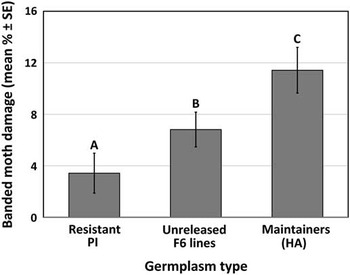
Banded sunflower moth damage was not influenced by year; within the inbred maintainer (HA) lines, mean damage across all 15 or 16 entries was 11–12% for all three years. However, significant effects of group (F=77.06, df1=2, df2=302, P<0.001) and entry within group (F=10.90, df1=27, df2=302, P<0.001) were detected. Comparisons of groups indicated that damage to resistant PI was less than unreleased (F6) lines (P<0.05), which were both less damaged than maintainer lines (Fig. 1). When the effect of entry within group was examined for each group, it was significant for both the maintainer (F=13.27, df1=15, df2=302, P<0.001) and developing inbred groups (F=8.97, df1=10, df2=302, P<0.001); however, significant within-group variation was not detected for the small number of resistant PI tested (three entries; P=0.056).
Seed damage by banded sunflower moth larvae (untransformed means±SE) to three types of sunflower germplasm tested in Casselton, North Dakota, United States of America in 2013–2015. Different letters above columns indicate significant (P<0.05) differences between least squares estimated means for groups.

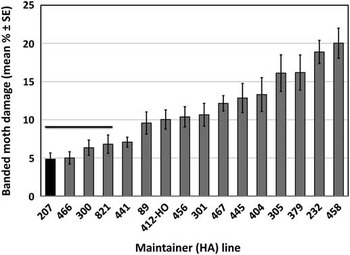
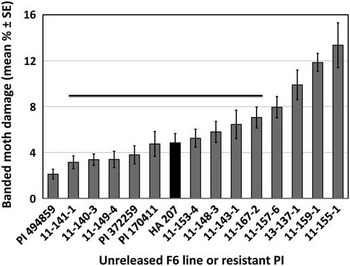
The released maintainer line with the lowest apparent (=numerical) damage, HA 207, received approximately one-quarter the damage of the worst HA lines. With HA 207 used as a control in a one-tailed Dunnett’s test, only three of the other 15 maintainers were similar (Fig. 2). Banded moth trapping data from 2013 show relatively high populations (<100 moths per trap-week) from 17 July to 21 August, a period that began ≈14 days before the start of bloom. More detailed maturity notes from 2014 indicated a range of eight days in onset of bloom for the inbred lines and a regression of larval damage onto days from planting to bloom showed no statistically significant relationship. When compared with individual lines in the other groups using a two-tailed Dunnett’s test, HA 207 appeared intermediate (Fig. 3), but had statistically more seed damage than only one of the 14 other entries.
Seed damage by banded sunflower moth larvae (untransformed means±SE) to 16 inbred maintainer (HA) lines tested in Casselton, North Dakota, United States of America in 2013–2015. Using HA 207 as a control for a one-tailed Dunnett’s test, the horizontal bar spanning over four lines indicates the “best” group of entries (i.e., P>0.05 for entries in the best group) when all least squared means are compared with the control.

Seed damage by banded sunflower moth larvae (untransformed means±SE) to unreleased F6 lines and resistant accessions (PI) tested in Casselton, North Dakota, United States of America in 2013–2015. Using HA 207 as a control for a two-tailed Dunnett’s test, the horizontal bar spanning most entries indicates a statistically similar group (i.e., P>0.05 for entries in the best group) when all least squared means are compared with the control.

Discussion
Comparison of public maintainer (HA) lines to resistant PI and unreleased (F6) lines suggests that maintainer lines are relatively susceptible to damage by banded sunflower moth larvae. However, this comparison also is somewhat unrealistic; resistant PI were selected specifically for low observed banded sunflower moth damage in previous field tests (Charlet et al. Reference Charlet, Seiler, Miller, Hulke and Knodel2009), and the F6 B-lines included were produced by a cross of one of the least-damaged maintainer lines, HA 466, and a resistant PI (either PI 170414 or 372259). Perhaps more surprising was the four-fold range in seed damage by banded moth larvae among maintainer lines. A one-week difference in maturity of the maintainer lines did not appear to influence the amount of damage produced by banded sunflower moth feeding, likely because high adult moth populations lasting five weeks or more overlapped the preferred stages for oviposition (R3 and R4; Schneiter and Miller Reference Schneiter and Miller1981).
When the least-damaged maintainer line, HA 207, was compared with individual resistant PI and unreleased (F6) lines, damage by banded sunflower moth was less than or equal to most of the other entries. The single entry with less damage than HA 207 was PI 494859, an accession with extremely low damage in prior field trials. Though PI 494859 may possess greater resistance to banded sunflower moth than tested maintainer lines, it also has liabilities, including low oil content (33%), low oleic acid (<50%), varied seed appearance, uneven maturity (United States Department of Agriculture, Agricultural Research Service 2016) and apparent seed dormancy (observed in a population derived from PI 494859). As a result, the least-damaged maintainer lines (HA 207, HA 466, HA 300, and HA 821) may be more realistic options for breeding to limit damage from banded sunflower moth while also producing commercially desirable sunflower hybrids.
The conclusion that useful resistance to banded sunflower moth may be present in existing inbred lines is less surprising when referenced to past investigations with other sunflower pests. For example, artificial infestations of sunflower moth larvae onto H. annuus produced large differences in larval survival and seed damage among three inbred restorer lines (Rogers et al. Reference Rogers, Gershenzon, Ohno, Mabry, Stipanovic and Kreitner1987), though this result was not emphasised (in favour of resistance seen in wild Helianthus species). Also, in assessments of resistance to the sunflower midge, Contarinia schulzi Gagné (Diptera: Cecidomyiidae), commercial sunflower hybrids differed in their susceptibility and inbred parent performance helped predict damage to hybrids (Anderson and Brewer Reference Anderson and Brewer1991; Crompton and Brewer Reference Crompton and Brewer2005).
Correlation of inbred and hybrid performance will be a key issue to facilitate breeding for resistance to banded sunflower moth or other sunflower insects. The influence an inbred parent has on the susceptibility of a hybrid depends on the complexity of the inheritance of the resistance trait and importance of dominant gene actions at each locus; this will differ for various insect and crop combinations. For example, in maize (Zea mays Linnaeus; Poaceae), ratings of European corn borer (Ostrinia nubilalis Hübner; Lepidoptera: Crambidae) damage to inbred lines proved a good predictor of damage to testcross hybrids (Kreps et al. Reference Kreps, Gumber, Schulz, Klein and Melchinger1998). Conversely, damage by the western corn rootworm (Diabrotica virgifera virgifera (LeConte); Coleoptera: Chrysomelidae) was not correlated between a diverse set of maize inbreds and the hybrids made with a common parent (Flint-Garcia et al. Reference Flint-Garcia, Dashiell, Prischmann, Bohn and Hibbard2009). Additional research in sunflowers is ongoing to determine the degree to which inbred traits can be used for breeding insect resistance into hybrids.
Acknowledgements
The authors appreciate the help of Janet Knodel and Patrick Beauzay (North Dakota State University) in establishing field plots and monitoring banded sunflower moth populations. Jamie Miller (North Dakota State University) and Tandi Thompson (SB&B Foods Inc.) provided considerable support in assessing damage to field samples. Chris Misar (United States Department of Agriculture, Agricultural Research Service) provided help in planting and also reviewed a previous version of this manuscript.