Introduction
Malaysia has cherished an electoral authoritarianism wherein the ruling coalition seems to be holding multi-party elections regularly, but then restricting competitiveness so as to stay in power. Recently scholars and policymakers have become increasingly concerned about the effect of electronic and physical social capital on Malaysian political transitions due to a stronger opposition and the increasing role of non-governmental organizations (NGOs), accelerated by information and communication technologies (ICTs), particularly the Internet. Participation in voluntary associations, both physically and virtually, is considered as stimulus in changing the political landscape of Malaysia. Since 1968, Malaysians have enjoyed regular elections and political stability. However, a vibrant democracy in Malaysia as elsewhere requires fulfillment of three criteria: extensive political competition, a high level of democratic political participation, as well as guaranteed civil and political liberty. The Malaysian paradox of ‘semi-authoritarian’Footnote 1 rule in a participatory political system has therefore often been labeled by many scholars as ‘semi-democratic’Footnote 2 or ‘quasi-democratic’. Jesudason (Reference Jesudason1995a) also described Malaysia as a ‘syncretic state’, which ‘operates at a multi-dimensional level, mixing coercive elements with electoral and democratic procedures’. Marina Ottaway (Reference Ottaway2003) aptly describes this type of semi-authoritarianism as a ‘political hybrid’, which is an ambiguous system that cannot be easily classified as either authoritarian or democratic, exhibiting at the same time characteristics of both. She added that the current regime appears as democratic rhetorically, but in essence has illiberal or even authoritarian traits to strengthen their status-quo.
This study examines the recent dynamics of social capital, driven by the rapid growth of ICTs and civil society organizations (CSOs), which promote the urge for greater civic engagement, the norm of democratic behavior, and help create a strong opposition coalition. This work also reflects on the rise of Bersih (demand for clean election), Hindraf, and a stronger opposition coalition, which have contributed to recent political transitions that can potentially cause a paradigm shift in the political landscape of Malaysia. Civil society and the public sphere largely lie outside the direct control of the government. The 2008 and 2013 election campaigns in Malaysia clearly mobilized civil society, particularly around issues such as governance, corruption, and authoritarianism to an extent not seen before in Malaysian electoral politics.
The Malaysian government has held regular elections and maintained political stability ever since the racial riots of 13 May 1969. Since then, various voluntary organizations have emerged, but traditionally this kind of growth has created limited political activism in Malaysia due to the strict rules and regulations for NGOs/CSOs. Furthermore, little effort has been made to examine systematically how citizen participation in voluntary associations and the rising political awareness have influenced political changes in recent years at the level of individual citizens. As a result, little is known about how involvement in voluntary associations, and the alternative social media, influences the development of democratic behavior and attitudes among citizens. Furthermore, even less effort has been made to formulate theoretical and empirical explanations about the linkage between citizens’ engagement in voluntary associations and with the alternative media and their reactions to the ideals and practices of an authoritarian-type democracy in the contemporary Malaysia. This study aims to fill such a void in the literature on Malaysian political development in recent years.
Utilizing the concept of social capital, this study examines whether current civic participation, driven by a stronger opposition coalition and NGOs, has influenced recent political development in Malaysia or not. Specifically, the article addresses the following questions: To what extent do ordinary Malaysians get in touch with voluntary associations and alternative media both physically and virtually embodying social capital to have a certain radius of trust, that is, in the circle of people among whom cooperative norms are operative. Does such activism encourage them to strive for political participation which can be reflected in peoples’ changing voting patterns and their increasing support for opposition parties? To explore the answers to these questions, this study analyzes the surveys of UMCEDEL (Centre for Democracy and Election at University of Malaya), which were conducted in 2011 (N = 1,000) and 2012 (N = 1,037). The study examines the changing political scenarios by taking into account three case studies of by-elections held in Permatang Pauh, Kuala Terengganu, and Bukit Gantang immediately after the 2008 general election in Malaysia. The political streams analyzed by UMCEDEL help examine the voting patterns of the voters, taking into consideration the strategies of the parties and also the role of the Internet or alternative media in the three parliamentary by-elections. The three case studies are seen as crucial for an understanding of the role of ICT-driven social capital on changing voting patterns of the citizens in Malaysia.
Conceptualizing social capital and public sphere
The discourse of globalization should not mean the diminishing function of states. Rather, through interaction and cooperation among states, civil society and private sectors, the autonomous and unitary role of the Malaysian state can be ensured. Social capital is essentially an autonomous public sphere where citizens deliberate and exchange ideas driven by civil society and ICTs.
ICTs and social capital are two very broad concepts that can be plausibly linked with each other in a wide variety of ways. ICTs are believed to open up fresh opportunities for weaving new social ties and expanding the formation of social capital (Paxton, Reference Paxton2002). Exploring these multiple relationships between social capital and ICTs is a timely endeavor in this work. Empirical evidence clearly indicates that social capital plays a beneficial role in public participation and the realization of democratic norms (Barber, Reference Barber and Fullinwider1999; Coleman, Reference Coleman1988; Fukuyama, Reference Fukuyama1995). Digital ICT, such as the Internet, has already proved to be fundamental in understanding the impact of social capital on society and politics in a country such as Malaysia. ICT-driven civil society in all its diversity assumes the role of an important agent for building social capital and is recognized as a powerful ally in reaching out to people and providing complementary mechanisms to deliver public goods and initiatives through, for example, awareness-raising and advocacy activities or support for grass-roots and self-help programs (Robertson et al., Reference Robertson, Vatrapu and Medina2010). Social capital also stimulates political participation, civic engagement, and community governance in Malaysia. Ties with friends and colleagues and interlinked organizations of civil society are found to be important building blocks of democratic engagement. At least as important as the mass media, they provide mechanisms to articulate and discuss individual grievances, develop common interests, form political opinions, and mobilize collective political engagement (Fine, Reference Fine2001).
The dynamics of the public sphere and social capital have been debated in many ways in the social sciences. Rarely have they been studied jointly since the advent of ICTs in the context of Malaysian politics. Since the mid 1990s, informatics has led to both media and socio-political revolutions in developed and developing countries, and this work attempts to link together the public sphere, social capital, and ICTs to deepen the analysis of the impact of the Internet or ICTs upon contemporary Malaysian domestic politics and voting patterns. Habermas (Reference Habermas2009) defined the concept of the public sphere as a network for communicating information and viewpoints, where the streams of communication are filtered and synthesized in such a way that they coalesce into bundles of topically specified public opinion. According to Habermas (Reference Habermas2009), associational life is the material from which the public sphere emerges. In fact, such associational life does not necessarily imply only physical proximity, as the classical example of café bars suggests. Bennett and Entman (Reference Bennett and Entman2001) argued that the public sphere refers to areas of informal life, ranging from cafés, Internet chat rooms, online blogs, or any place where the exchange of public opinion is held and where ideas or feelings relevant to politics are transmitted or exchanged openly. Social networking sites closely resemble a contemporary form of the public sphere of Habermas (Reference Habermas2009).
Against the backdrop of the current information revolution, like-minded citizens may be able to gain a voice in public affairs outside the formal political or democratic institutions (Tocqueville, Reference de Tocqueville2001). Tocqueville argues that interactive communication mediated by ICTs represents not merely a two-way process, but also a ‘many-to-many’ channel of sharing, disseminating, relaying, and exchanging information, whether top-down, bottom-up, vertically, or horizontally. Hence, by providing a new technology, such as ICTs, for public forums, the Internet opens up new possibilities for citizen associations. Putnam (Reference Putnam2000) explains that social capital refers to connections among individuals, through social networks and the norms of reciprocity and trustworthiness that arise from them (Putnam, Reference Putnam2000: 19), which enable participants to act together more effectively to pursue shared objectives. A growing literature from the late 1990s has begun to connect the role of ICTs with the concepts of social capital and the public sphere in advanced industrial democracies. Relatively few works, however, have applied the same approach to recent political development in Malaysia
Slater (Reference Slater2012) compared and contrasted the democracies Malaysia and Singapore in his article entitled ‘Strong State in Malaysia and Singapore’ where he highlights the common and distinguishing features of the two political systems. Levitsky and Way (Reference Levitsky and Way2002) discussed the existence of a competitive authoritarian regime in Malaysia. Saravanamuttu (Reference Saravanamuttu2012) argued that since the 2008 general election, Malaysia has been witnessing a two-party system challenging the traditional trend of a dominant party system due to the emergence of Pakatan Rakayat (PR) as a strong opposition coalition. Gomez and Jomo (Reference Gomez and Jomo1999) identified that the UMNO's involvement in money politics became deeply entrenched during the Mahathir era that had negative effects on the rampant corruption and patronage politics in Malaysia. O’Shannassy (Reference O'Shannassy and Hunter2009) argued that the 2008 elections in Malaysia were nothing more than ‘a short-term, regressive, “restorative” moment’. Following the path of Gramsci, O’Shannasy also stated that the 2008 election unleashed few elements of transformation in domestic politics, but Saravanamuttu (Reference Saravanamuttu2012) argued that such a Gramscian analysis might understate significant political developments in the electoral domain that were closer to a reformist turn than an ‘organic’ change in Malaysian politics.
Although formation of a public sphere and social capital through ICTs is a prerequisite for democratic consolidation, the political will and social conditions necessary for its development are not always certain. This uncertainty may arise from the fact that intermediate associations exist in all societies and democracy seems to provide more leeway for such associations to function. The authoritarian regime in Malaysia usually considers these associations as a threat, and attempts to curb the mushrooming of secondary associations. This study explores the recent effect of social capital on political development in Malaysia, driven by the rapid growth of ICTs and the Internet. Political transitions in Malaysia are being mediated by the creation of new public sphere through ICTs and the form of support resulting from the strong opposition and the rising role of NGOs in the country.
Ethnic fragmentation traditionally has signified the formation of social capital in Malaysia, which has been largely shaped by a polarized civil society following the lines of ethnic identity. It is argued that associational activities are heavily restricted and regulated by the government in Malaysia. The Societies Act of 1966 (revised in 1983) defines the relationship between the state and civil society and any organization that has seven or more persons, whether it is a business or a social organization, is required to register with the state. Therefore, the Registrar of Society (ROS) is responsible for monitoring the activities of voluntary associations and is empowered to accept or reject any application to form a new association. The state moved to amend the Societies Act in 1981 to classify NGOs into one of two categories – ‘political’ or ‘friendly’ – in an attempt to exert greater control over civil society. Eventually, the proposed amendment was rejected after a secretariat headed by the Islamic Youth Movement of Malaysia (ABIM), that mobilized 115 CSOs, protested. The rejection resulted in a review of the amendment, after which the government dropped the offending section. Nevertheless, this victory was short-lived and the state then decided to amend the Official Secrets Acts (OSA) to include mandatory jail sentences for journalists and others who revealed materials obtained from government sources. Apparently, this amendment was passed despite heated protest from the National Union of Journalists and other key civil society actors. Due to the applying of the ‘watchful eye’ of the state, associational life and CSOs are characterized as being ‘encapsulated’ (Jesudason, Reference Jesudason1995b). It is therefore evident that the associational activities and functions of CSOs or NGOs have traditionally been strictly controlled and regulated by the government of Malaysia.
Although the Malay community (Bumiputras) has been given special privileges, citizenship for immigrant groups has proven to be complex. The privileges of the Bumiputras were reflected in the New Economic Policy (NEP) of BN in 1971 and were further developed by Prime Minister Mahathir Mohammad in 1990 to formulate the New Development Policy (NDP) and then the New Vision Policy, otherwise known as Vision 2020 (Ooi Kee Beng, Reference Beng, Beng, Saranananmuttu and Guan2008). But, the rights and entitlements are inalienable part of citizenship, whereas the institution of special privileges for the Malay community largely creates a sense of discrimination and inequality in Malaysian society. Hence, the exclusivity and hierarchical structure of CSOs in line with ethnic communities somewhat impeded the formation of cross-cutting civic organizations that could have promoted equality and openness.Footnote 3 Therefore, the advent of cross-cutting, issue-specific CSOs focusing on human rights, consumer issues, the environment, women's rights, and political and civil rights have developed as part of middle-class concern about an action in response to political authoritarianism and undemocratic practices. Thus, despite restrictions, the stronger role of the opposition parties and civil society since the late 1990s would seem to represent clear evidence that civil society and social capital would be able to prosper in Malaysian multi-cultural society.
Information society and ICTs
Economic calculations and considerations have pushed Malaysian policymakers to set out a plan to pave the way to build the foundations for a knowledge-based economy, and the brainchild of Mahathir, the Multimedia Super Corridor (MSC), was therefore born in the mid-1990s. The shift to the IT-led, knowledge-based economy (k-economy) is also in tandem with the wider part of Malaysia's Vision 2020, with the hope that the application of ICT can leapfrog the nation to achieve a fully developed nation (Gupta, Reference Gupta2001). At the same time, this has opened up a window of opportunity for previously marginalized activists, dissidents, and civil society to take their causes to cyberspace, challenging the monopoly of the state in setting the nation's political agenda.
From the 1980s onwards, there has been a dramatic rise in alternative sources of information. The increase in news reports in Malaysia and the growth in Internet users since 2000 are given in Figure 1. Access to alternative information and dissenting opinion has not only been pivotal in allowing individuals to find and adjudicate amongst different accounts of events and news stories, it has also enabled and encouraged individuals to discuss and deliberate on public issues. Under these circumstances, the development and propagation of the Internet throughout the world have resulted in enormous social, political, and cultural changes, and Malaysia is not an exception. The Internet has created a mode of communication that allows for greater information dissemination; it has also created new platforms for voicing opinions, mobilizing people, and organizing communities. It signifies that the Internet has effectively empowered individuals, as well as society as a whole, by supplying diversified sources of alternative information and channels for civic association and engagement which have again reflected on voting patterns and citizens support for political parties.
Growth of Internet users in Malaysia in different years
Source: Malaysian Communication and Multimedia Commission, 2010, Kuala Lumpur.

In order to attract foreign direct investment (FDI), the Malaysian government issued a ‘Bill of Guarantees’, which included a pledge not to censor the Internet. Because of such policy initiatives, online media in Malaysia enjoyed more freedom than the mainstream media. Also, the print media are tightly controlled by the government in various ways. According to the Printing Presses and Publications Act, all print media publication licenses are to be renewed annually. In addition to legal control of the media, a vast number of publishing houses and broadcasters are owned by the ruling parties or business people closely related to them, and currently Malaysia counts only four free-to-air television stations, controlled by Media Prima. A holding company is usually believed to be connected to one of the ruling parties, the United Malay National Organization (UMNO) BN is a coalition of the two main parties i.e. the United Malays National Organization (UMNO) and the Parti Pesaka Bumiputera Bersatu (PBB). Strict government control has generated a mainstream media that tends to take a pro-ruling party stance. Therefore, the party which has been governing since 1957 Malaysia is literally controlling mainstream media (Loh, Reference Loh, Loh and Khoo2002). Against this backdrop, it is argued that the newly emerged Internet platforms and online community represent an important political antidote to media censorship in Malaysian politics, particularly since 1998. The changing mind-set and voting patterns of the citizens is clearly evident in the case of the three by-elections held in 2008–09 in Permatang Pauh, Kuala Terengganu, and Bukit Gantang.
It is of note that opposition leader Anwar Ibrahim has commented on an increasing number of online media, illustrating the fact that the ruling BN has underestimated the power of the emerging online media, which has provided the opposition a new space for political contention. Among the opposition parties that have taken the most advantage of the Internet is the Islamic party of Malaysia called Parti Islam Semalaysia (PAS), which has published its party paper, Harakah, since 1987. To counter the strict government media controls, PAS set up its own Web site, Harakahdaily (http://bm.harakahdaily.net/). This site became incredibly popular among Malaysians, attracting over 140,000 hits during the first year of its inception. Today, Harakahdaily features a broad variety of original news articles that are updated on a daily basis, as well as audiovisual content in the form of its Web TV PAS. Furthermore, this influential online news outlet provides a mobile phone page as well as an English-language service.
CSOs and NGOs that are critical of government employ the Internet to express their political views. For example, the activist group Aliran (http://aliran.com/) created an online platform for its NGO early in the 1990s, which had traditionally been publishing its own monthly magazine entitled Aliran Monthly since 1984.
In April 2012, Prime Minister Najib lifted the rule that forced publications to renew their printing permits annually, but the home ministry still has the power to deny or revoke licences. For this reason, Malaysia's opposition has dismissed the reform pledges as lip-service for the election, and the court ruling could now put pressure on Najib to prove them wrong.Footnote 4 The websites and web platforms are becoming more important to the activists in Malaysian politics and the media in nurturing a virtual social capital.
Recent dynamics of social capital in Malaysia
Social capital is usually meant for networking and learning in different stages, which can bind people to work together on the basis of social trust to accelerate political development for a vibrant democracy. Social progress calls for the accumulation of binding sentiments of trust and reciprocity among different ethnic groups, which can provide the bases for effective collective behavior. In Malaysia, the communitarian organizations continue to play a significant role in representing the interests of their respective ethnic communities, although the politicization of ethnic issues in Malaysia has traditionally thwarted the development of a common point of reference. However, the opposition parties began to challenge the ruling coalition Barisan National (BN, National Front) in the late 1990s. The three most competitive opposition parties in Malaysia are the People's Justice Party (Parti Keadilan Rakyat in Malay or PKR), the Pan-Malaysian Islamic Party (Parti Islam se-Malaysia, or PAS), and the Democratic Action Party (DAP). Even though different opposition parties had their different ethnic orientation, they fortunately managed to hold their coalition together called Barisan Alternatif (BA, Alternative Front) during the 1999 general elections campaign.
All three component parties of the BA (then three parties, after the merger of the two parties) were disbanded after 2004. Thus, the three dominant opposition parties namely PKR, DAP, and PAS formed their coalition again in April 2008 called Pakatan Rakyat (PR). Later the PR played a vital role in political mobilization during the campaigns of the 12th and 13th general elections held in 2008 and in 2013, respectively. However, while maintaining the formal rhetoric of a democracy, the ruling coalition, BN, has been using different techniques to cope with the political challenges coming from the opposition coalition. Nevertheless, the election results of the 12th and 13th general elections did signify a rise of the opposition coalition and civil society to a great extent. The PR coalition was able to win many votes because they offered a new concept of managing interethnic relations and minority groups, which had, up until this point, been monopolized by BN (Ooi Kee Beng, Reference Beng, Beng, Saranananmuttu and Guan2008).
However, at the same time, the political regime tries to move towards greater authoritarianism in order to restore their credibility through different channels and avenues. However, this has led to a situation where in the government frequently seems to lack transparency, particularly in its connections with favored parts of the business elite. It is claimed that the race-card has been exploited by the government, not only to minimize the heightened tensions among the ethnic groups in society, but also to balance internal divisions within UMNO.Footnote 5 Loss of BN's two-third majority in the 12th general election and its poor performance in the 13th general election are all indicative of the declining popularity of BN's regime in Malaysia. Mahathir and other BN leaders claimed that the ‘Chinese Tsunami’ was the major reason why BN performed poorly in the 13th election's outcome. Although it became evident that the Chinese largely supported the opposition coalition and voted for the PR during that general election, the poor performance of BN was believed to be the effect of the ICT-driven ‘urban tsunami’.Footnote 6
Certainly, there is every opportunity for the leaders of the ruling coalition in Malaysia to ‘divide and conquer’ by attacking different elements of civil society for different reasons at different times. There is no doubt that Malaysia's civil society is mostly diverse. It includes not only social and educational organizations, such as those represented by the Siuqui but also NGOs concerned with the erosion of individual liberties, and the broader political movements. The Malaysian government's actions to weaken civil society organizations often generate a backlash that damages support for the government.Footnote 7 Civil society groups have managed to capitalize upon these backlashes and have shown signs of resilience and consolidation through the opposition coalition and Bersih. In recent years, a broad-based coalition of NGOs and individuals have frequently united to present petitions seeking the easing of curbs on peaceful assembly, an end to detention without trial, and the right to assemble and speak freely. The opposition coalition PR has not only become stronger and survived beyond the general election but has also consolidated its potential as a viable political entity. Alternative sources of views and news through ICTs and the Internet, such as the online newspaper Malaysiakini and the PAS newspaper, Harakah, have proven very important to circumventing the governing coalition's control of the print and broadcast media and in rallying the people's outrage at government attempts to exploit events to divide civil society along ethnic lines (Saravanamuttu, Reference Saravanamuttu2012). In fact, numerous websites have formed virtual social capital and have appeared as alternative points of information, and the mainstream pro-government dailies have become objects of derision. This has obviously created a public sphere to form new patterns of social capital in Malaysia
Current political transition and social capital
The 2008 and 2013 elections indicated that the ruling BN could not assume perpetual victory even though the basis of national politics was ethnic in character. Malay's support for the UMNO-BN is not always guaranteed, although the success of BN was due to rural Malay votes and BN's steadfast position in the Bornean states of Sabah and Sarawak. This explained that the voting in 2008 and 2013 still manifested ethnic affiliations in national politics. Also, BN's victory in 2008 was an endorsement of voter's preference for strong government under BN. However, in the 12th Malaysian general election BN lost the two-third majority in the parliament for the first time ever. Also the opposition parties managed to wrestle four states, namely Kedah, Pulau Pinang, Perak, and Selangor and maintained victory in one, that is Kelantan.Footnote 8 The 13th general election also led the opposition to state-level victories in Kelantan, Penang, and Selangor. During this election, the opposition won the popular vote with 51% support, though it could secure fewer seats due to Malaysia's British style first-past-the-post counting system. Prime Minister Najib's coalition won 133 of 222 parliamentary seats which was the narrowest victory since Malaysia gained independence in 1957, and Anwar has since held protest rallies around the nation with his supporters.Footnote 9 The outcome of the 12th and 13th national elections showed that voters seemed to have shifted their trust from the government to the opposition. This was largely due to the growing Internet, web platforms, and alternative media creating virtual social capital.Footnote 10 Even though BN was successful in the political coup that toppled the Pakatan Rakyat state government in Parak, this does not necessarily indicate that there is voter support for the ruling party. This election revealed that the old system of politics with a top-down leadership style could no longer necessarily guarantee a clear electoral majority, thereby legitimating political authority.
Realizing the current socio-political environment with changing public perceptions towards domestic political transition, driven by ICTs and virtual social capital, Najib Razak took a number of drastic steps for reforms through handouts and promotional material in order to regain lost ground. Najib's ‘One Malaysia’ policy has been aimed at reducing ethnic discrimination with emphasis on ethnic harmony and national unity, but he has trouble convincing Malaysians on the ‘One Malaysia’ because there are still different ways of interpreting the slogan.Footnote 11 Najib keeps trying to woo voters back to his ruling BN (National Front Coalition), which has governed Malaysia since independence in 1957. It was considered a bold move by Najib to take the risk to uphold democracy and human rights by repealing the Internal Security Act (ISA) in April 2012, which had been practiced since 1960 and allowed detention without trial or criminal charges under limited and legally defined circumstances.Footnote 12 However, the effectiveness of all the reform initiatives of Najib was believed to bear some fruit for the ruling party in the long run.
The amendment bill to the Election Offence Act 1954 created a degree of tension in domestic politics as the opposition parties were disappointed with the new amendments.Footnote 13 Therefore, the Malaysian Cabinet decided to withdraw the amendments made to the Election Offences Bill on 9 May 2013 after much resistance from opposition lawmakers as well as from BN itself.Footnote 14 The Malaysian authoritarian regime has relied on the remarkable economic dynamism to maintain support of their citizens. Mass prosperity is offered under the authoritarian dominance of the ruling party. But dissidence of any kind, i.e. political, democratic, artistic, was theoretically and practically outlawed by such regimes. Examples of this are the Hindraf and Bersih rallies in Kula Lumpur, which led to unprecedented action by the police. However, domestic politics gained momentum, due in part to the drama of the sedomy trials of Anwar, with intermittent street demonstrations. Moreover, Hindraf or the Hindu Rights Action Force has emerged as a coalition of 30 Hindu NGOs aiming to preserve Hindu community rights and heritage in a multi-racial Malaysia. Hindraf has made a major impact on the changing political landscape of Malaysia after staging the Hindraf rally in 2007 (Noor, Reference Noor2008).
Bersih rallies (rallies of the opposition coalition and NGOs) have been demanding free, fair, and clean elections since 2007, backed by dominant CSOs such as the Bar Council of Malaysia and Suhakam, the Malaysia Consultative Council of Buddhism, Christianity, Hinduism, Sikhism, and Taoism (MCCBCHST), Pertubuhan IKRAM Malaysia (IKRAM), and Islamic Missionary NGOs. They mostly support the rights for a peaceful assembly and a call for electoral reforms in Malaysia.Footnote 15 After winning the 2013 general elections, Najib stands on firmer ground, following years of walking a tightrope between voters demanding change and resistant hardliners and after facing down a challenge from a multi-ethnic opposition. With pressure rising from the multi-ethnic opposition and the CSOs for greater political space, Najib has sought to cast himself as a reformist through limited efforts, such as replacing the security laws, which are widely criticized as tools to stifle dissent. In reality, Prime Minister Najib is believed to have avoided deep reforms and he continues to face challenges illustrated by the flight of ICT-driven urban voters and CSOs who see the UMNO-dominated BN regime as largely a corrupt and a status-quo force. The work of Gomez and Jomo (Reference Gomez and Jomo1999) argued that corruption, collusion, and nepotism still prevail in Malaysia, and major corporate assets are subject to the corrupt practices of rent-seeking cronies, with an implicit blow to the confidence in the Malaysian corporate sector. Combating corruption, overcoming the racial divide, and undertaking electoral reforms have been perceived by the majority of respondents to the UMCEDEL survey as the key challenges facing the current regime's credibility.
Social capital and changing voting patterns
This article argues that ICT-driven social capital has been gradually contributing to the changing voting patterns in Malaysia and takes into account the changing voting behavior of the Malay and non-Malay citizens by analyzing the three by-elections held in the years between 2008 and 2009. During this period, by-elections were held in Permatang Pauh, Kuala Terengganu, and Bukit Gantan. Social capital is an independent variable here measured by the changing voting patterns of the adult voters in these three by-elections.
Permatang Pauh is considered an opposition stronghold as it has been held by the opposition party since the 1999 Malaysian general election.Footnote 16 Kuala Terengganu is considered a marginal constituency since both parties, BN and PAS, have managed to win the seat alternatively since the 1999 Malaysian general election. In 1999, the parliamentary constituency was won by PAS, but BN managed to wrestle the seat in 2004 and maintained the victory in 2008. The Bukit Gantang parliamentary constituency was considered as a stronghold of BN, as it had never been won by the opposition, with the exception of the 2008 Malaysian general election. Interestingly, however, this by-election was held in the midst of the Perak state political crisis following the toppling of the Pakatan Rakyat (PR) by BN as a result of the defection of two state assembly men and a state assembly woman.Footnote 17 Despite the fact that Bukit Gantang was traditionally a BN seat, the PAS was able to win the seat in 2008. It was considered a marginal seat as the margin of majority votes won by the winner of the 2008 election was comparatively small.
The Permatang Pauh parliamentary constituency (P44) has 58,459 registered voters and 490 postal voters. The parliamentary seat has three state constituencies, namely Seberang Jaya (N10) won by BN, Permatang Pasir (N11) won by PAS, and Penanti (N12) won by PKR. The voters’ ethnic composition is made up of 67.60% Malays, 26.30% Chinese, 5.70% Indians, and 0.30% others. The Malay voters were mostly rice farmers, factory workers, small businessmen, and government servants. Since this constituency is a paddy growing area with traditional Malay villages, ‘Malay values’ are widely practiced here.Footnote 18 The Chinese voters were made up of workers in the private sector, shopkeepers, and petty traders, while the Indian voters were mostly factory workers and those working in the private sector. In terms of voter distribution, the state constituencies of Permatang Pasir and Penanti are considered as a Malay majority, while the Seberang Jaya constituency is a mixed seat with a higher percentage of Chinese and Indian voters.
The voters in the Permatang Pauh parliamentary constituency are considered as having a relatively high political consciousness, greatly influenced by the Internet and NGOs. This could be seen from the high percentage of voter turnout in the general elections. In the 13th Malaysian general elections, the voter turnout was almost 82%, while in the by-election, held on 26 August 2008, the percentage was 81.1%. These percentages is much higher than the previous percentage of voter turnout.
The political streams of the three by-elections are used to analyze the voting patterns of the voters, taking into consideration the strategies of the parties and also the role of the Internet and alternative media in these three parliamentary by-elections.Footnote 19 As the three parliamentary by-elections were held in Permatang Pauh, Kuala Terengganu, and Bukit Gantang immediately after the 2008 general election in Malaysia, these seemed to be important for understanding the role of ICT-driven social capital in changing citizens’ voting patterns and voters’ support for political parties. The results of these by-elections clearly show that the opposition is maintaining momentum by drawing increasing support from young voters who are more exposed to ICT-based interaction to form new type of social capital. Thus, the voting trends of young voters are extremely important for both the ruling and the opposition party to assess their fortunes. In the Malaysian elections, voters normally cast their votes based on polling streams, which loosely indicate their age groups. In these elections, young voters are categorized as those aged between 21 and 40, while those over 40 years old are categorized as veteran voters.
Generally, young voters or first-time voters are those who are still at college or university completing their studies or just entering the job market. Being exposed to a more competitive environment and ICT, including the Internet, websites, and online news, which are more critical than the mainstream media, these younger voters are more aggressive in looking for information regarding certain issues, including politics. They are open-minded, and not strictly bound by any political parties or ideological groups.
The emergence of the ‘blog sphere’ and virtual association became the main reference points for younger voters, sidelining the significance of the mainstream media which is traditionally controlled by the government. Based on the information obtained from Election Commission (SPR), the figures for the polling streams representing different state constituencies in the parliamentary elections are normally divided into three or four state sub-constituencies. For example, polling streams 1 to 4 are being used for constituency A while polling streams 5 to 6 for constituency B. Even though the polling streams 5 to 6 have higher figures, the fact is that they still represent the various age groups in polling streams 1 to 4 or 5 to 6 where the highest figures represent the youngest voters.
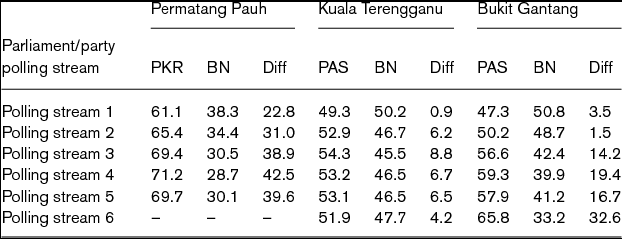
In the Permatang Pauh, Kuala Terengganu, and Bukit Gantang by-elections, the pattern of voters’ support to political parties based on the polling streams show that there was relatively strong support for the government in polling streams 1 and 2 that represented the veteran voters. Meanwhile, in voting streams 3 and 4, representing the middle-age voters and in voting streams 5 and 6 representing young voters, there was the tendency for higher percentage of support to the opposition as the young voters seem to be more exposed to ICTs and virtual social capital than older voters. The pattern of voting according to the voting streams in these three parliamentary by-elections is shown in Table 1.
Support to parties based on voting streams (%)
Note: ** significant at p = 0.01, *significant at p = 0.05.
BN received the lowest support of about 28.7% and 30.1% respectively in polling streams 4 and 5. The young voters in Permatang Pauh gave their solid support to PKR and only gave minimum support to BN.
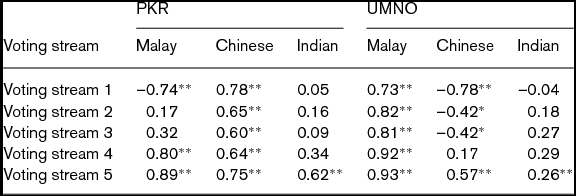
One of the important reasons why PKR received higher support in the Permatang Pauh by-election (Table 2), apart from the trend of young voters supporting the opposition, is the personality of the contesting candidate (see Figure 2). In the by-election, Anwar Ibrahim was a well-known national figure and he was accepted by the locals. But his opponent, Arif Shah Omar Shah, encountered serious bickering in the party in his own constituency which resulted in his failure in the election.Footnote 20 The pattern of voting according to polling streams still showed that relatively older voters tend to give BN the edge while the younger voters showed their solid support to the opposition. Voters in polling streams 1 and 2 still showed their support to BN, even though with a small margin of difference, that is about 0.9% and 6.2% respectively. The young voters in the middle number of the polling streams, namely of 3, 4 and 5 gave a high support to PAS with the percentage of 54.3%, 53.2%, and 53.1% respectively.Footnote 21
Voter's support to political parties and ethnic group in Permatang Pauh Parliamentary by-election: correlation analysis
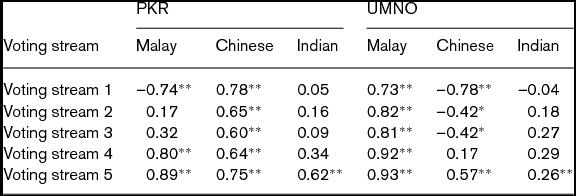
Notes: ** significant at p = 0.01, *significant at p = 0.05.
Support of voters to political parties in the by-election of Permatang Pauh Parliamentary held on 26 August 2008 (%)
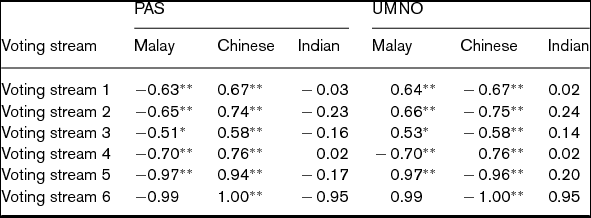
A changing voting pattern was seen in the Bukit Gantang parliamentary by-election held in April 2009. This parliamentary constituency has non-Malay voters of more than 30%. The Chinese make up 26.7% of the voters, the Malays 63.4%, and the Indians 9.7%. In this by-election, the non-Malays continued to give their support to the opposition, even if the candidate was from PAS. Despite the fact that PAS only garnered slightly lower Malay support compared to BN, but with the strong support by the non-Malay voters, the party managed to win the seat (see Table 3).
Support to political parties and ethnic composition in Bukit Gantang parliamentary by-election, April 2009: correlation analysis
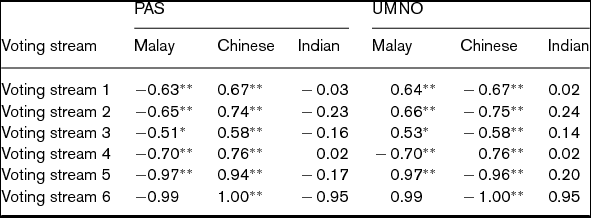
Notes: ** significant at p = 0.01, *significant at p = 0.05.
Apart from achieving Malay support, UMNO failed to obtain the required support from the non-Malay voters to win the seat in Kuala Terengganu. The result of the by-election clearly showed that support from the non-Malay voters was extremely important, particularly when Malay support was almost even, for any political parties to win the seat. The Kuala Terengganu by-election cannot be taken into consideration as it is a Malay-dominated parliamentary constituency with a small percentage of non-Malay voters. With the current trend, it is probable that more than one-third of the 222 parliamentary seats in Malaysia, with non-Malays constituting only 20% voters, are likely to support the opposition in the next general election.
From the voting pattern, the result shows that the opposition party is getting stronger in recent years. The resilience of the opposition party was clearly visible in the parliamentary by-elections, particularly in Permatang Pauh and Bukit Gantang which have been taken here as case studies. In the 2008 and 2013 general elections, the opposition parties, namely PKR, PAS, and DAP, managed to bury their political and ideological differences through Pakatan Rakyat (PR) led by Anwar Ibrahim to compete with BN. At the general elections held in 2008 and also in 2013, the opposition parties managed to win several mixed seats which had been UMNO's stronghold traditionally.
In Malaysia, the 13th general election, held on 5 May 2013, was considered as the most closely contested since the country's independence. Yet it still produced the same result, meaning victory for BN, a political coalition dominated by Prime Minister Najib Razak’s. UMNO and BN only won a historically low 47% of the popular vote, against the main opposition party's 51%.Footnote 22 After the 13th general election in Malaysia, Bersih decided to change tactics and rather than holding rallies set up a self-styled ‘People's Tribunal’ on the 13th general elections to hear evidence in public from anyone who had a story to tell about vote-rigging, vote-buying, intimidation, phantom-voters, or anything else of significance. However, Bersih is nothing but famous NGOs and thus the People's Tribunal has no force in law and no official status. Nevertheless, the resilience of the opposition party was also seen with PAS's victory in the Sungai Limau by-election held on 4 November 2013. BN won with slightly higher votes in the Kuala Besut by-election held on 24 July 2013.Footnote 23 Most of the elections and by-elections held in recent years signify clear evidence of the changing voting patterns among the young voters who have more exposure to ICT and alternative media to form social capital online and offline.
Research findings
It is argued that social capital has a great impact on the changing political landscape in Malaysia. To understand this claim more systematically, this study considered different aspects of political change regarding involvement of citizens’ in physical and virtual CSOs and voter's level of confidence in the alternative social media through ICTs or Internet at the individual level. Social capital cannot be considered as the only force driving the Malaysian people toward or away from democracy and its alternatives; other control and demographic variables play a significant role as well. Against the backdrop of the recent socio-political changes, Malaysian political trends are perceived by the respondents to the UMCEDEL survey differently. In the survey, social network is considered as an independent variable measured by overall physical and virtual participation of voters in voluntary associations or in CSOs through which they express their political opinions in a broader socio-political context. The UMCEDEL survey asked open-ended questions of Malays, Chinese, and Indians about their virtual and physical involvement in voluntary associations or in CSOs, ranging from Internet blog, electronic newspapers, social associations, and media, including facebook, twitter, and chartrooms.
The UMCEDEL survey asked questions to measure level of confidence with three response categories, specifically: (1) high, (2) low, (3) not sure (Figure 3). Only 35% of Malays said that they participate in voluntary associations both online and offline and have a high level of confidence on the alternative media, whereas 50% of Chinese and 46% of Indians are participating in voluntary associations and are very confident in the alterative media online (see Figure 3). Participation of Malays therefore in voluntary associations is less than their Chinese and Indian counterparts. Data analysis shows that Malay young voters tend to get involved more in voluntary organizations or associations than that of traditional voters and become active in the alternative media through the Internet, and mostly they support the opposition coalition. The aforementioned hypothesis calls for the construction of indices measuring the dependent variables of effective and behavioral orientations to political participation.
Involvement of Malaysians in associations and their level of confidence in alternative media (UMCEDEL)
The UMCEDEL survey has thus identified political behaviors, such as voting patterns and support for political parties, through political streams, and in the context of multi-ethnic composition several questions were asked regarding the respondent's involvement in voluntary associations online and offline in order to share political ideas. In assessing attitudes towards the ruling party coalition, BN, and opposing party coalition, PR, the UMCEDEL survey asked multiple open-ended questions of the respondents. UMCEDEL researchers mostly used political streams to analyze voting patterns, taking into consideration the strategy of the political parties and also the role of the Internet or media in the parliamentary by-elections held in Permatang Pauh, Kuala Terengganu, and Bukit Gantang immediately after the 2008 general election in Malaysia. These by-elections seemed to be important for understanding the role of ICT-driven social capital on political development in Malaysia.
Conclusion
The current research findings, however, are limited by the nature and size of the sample obtained. Since the proportions of Chinese, Malays, and Indians are carefully maintained in selecting the sample size, this might explain why there may be potential neutrality in determining recent political and voting trends in order to identify the impact of the ICT-driven social capital on recent political development in Malaysia. One major issue addressed is to determine the fundamental issues being considered and perceived differently by the Chinese, Indians, and Malays in their political activities or in making their voting decisions. The findings of this research also suggest that some political issues were less culturally bound than others. Webber (Reference Webber1969) argues that cultural convergence could result from the homogenizing effect of universal technology or education. The unique industrialization and modernization processes driven by ICTs in Malaysia have given rise to social capital and a public sphere that can potentially force economic and political structures of different cultures to be similar. Webber (Reference Webber1969) also argued that having similar forms of education and economy could foster more uniform techniques or even values. In the Malaysian environment, such factors could have attributed to the convergence or similarities in the perceived political trends in the long run.
The analysis of the UMCEDEL survey reveals that although Malaysian ideological dispositions are based on their inclination to different ethnic groups like being Indians, Chinese or Malays, which do matter significantly on the support for political stability. However, some sort of unity can be seen in diversity while looking at multi-cultural opposition coalition through which people from different ethnic orientation come together to express their common political opinions about corruption, electoral reforms and other socio-economic problems in Malaysia. ICTs, Internet and CSOs have given a common platform creating public sphere where Malaysians can share their political ideas and have freedom of expression on different public policies and programs. William Case (Reference Case2010) has rightly pointed out that pressures for change in Malaysia have not originated at the top elite levels rather they have emanated from common citizens. Therefore, this study argues that the political stance of the Malaysians have been revealed on their changing voting pattern in recent elections.
Malaysian cyberspace and political space continue to develop through a new form of social capital coupled with a series of complex interactions among the state, market and civil society along with new technologies. Nevertheless, the changing political landscape cannot be defined by Internet only. Rather, Malaysia's cyber-politics is embedded in a broader socio-political context, and thus its impacts are also contingent upon the traditional socio-political and structural factors. Malaysia today has entailed many characteristics of democratic norms and yet at the same time the ruling party keeps up its authoritarian practices which seem to be less consistent with democracy (Loh, K. W. 2002). In the wake of the Asian economic crisis, splits within the dominant party like UMNO have fomented expansion in the institutions and activities associated with civil society. The recent political development includes intra-UMNO contestation, federal-state government conflicts, challenges from a competing coalition of opposition parties, fluid but extensive coalitions of NGOs, and a burgeoning alternative media etc.
The government continues to put restrictions on civil and political liberty in domestic politics and potentially can introduce modus operandi to control freedom of expression through ICTs in order to sustain its regime survival by suppressing the voice of the opposition parties and NGOs. But, the phenomena of changing political landscape and recent voting patterns coupled with a strong multi-cultural coalition of political opposition is an interesting point of discussion in this work as it examines the ways in which social and political organizations are becoming more vibrant through ICT-based socio-political activism. An examination of Malaysian changing political scenario and voting patterns in recent years, both as a non-political space of self-identity creation, and as a political space of dissent and community organization, may serve to explore many of the potentials of the social capital and public sphere created by ICTs and particularly the Internet in the development of political awareness. The dynamics of social capital based on civic society and ICTs mean that the incipient online and offline civic engagement as well as fledging public can create a nascent public space for both ‘virtual’ and ‘physical’ civic engagement in Malaysian political development. This kind of public space essentially serves as a precondition for civil society to thrive, which in turn can be considered as the foundation of and a necessary ingredient for democratic transition in Malaysia.
About the authors
Syeda Naushin Parnini is working as Senior Lecturer at the Department of International and Strategic Studies and also Research Fellow at the Centre for Democracy and Election (UMCEDEL), University of Malaya. She has recently published a few books and monographs on democracy and governance in South and Southeast Asia. Her articles have appeared in a number of political science and international relations journals.
Mohammad Redzuan Othman is Professor and Director at UMCEDEL and Dean at the Faculty of Arts and Social Sciences, University of Malaya.
Amer Saifude is Lecturer and Deputy Director of UMCEDEL at University of Malaya.