This article presents findings from two parallel studies of sociolinguistic variation in a phonological feature of Australian Sign Language (Auslan) and New Zealand Sign Language (NZSL). Recent projects undertaken in Australia (Schembri & Johnston, Reference Schembri and Johnston2004; Schembri, Johnston, & Goswell, Reference Schembri, Johnston, Goswell and Lucas2006) and New ZealandFootnote 1 replicated an earlier quantitative investigation into sociolinguistic variation in American Sign Language (ASL) conducted by Ceil Lucas and her colleagues (Lucas, Bayley, Rose, & Wulf, Reference Lucas, Bayley, Rose and Wulf2002; Lucas, Bayley, & Valli, Reference Lucas, Bayley and Valli2001) in order to explore the extent to which internal and external constraints on variation behave consistently across signed languages. In this article, we report further findings about variation in the location parameter in a class of signs that, in citation form, are produced in contact with or in proximity to the signer's forehead or above. In Auslan and NZSL, this set includes signs such as think, name, and clever.Footnote 2 Like signs in the same phonological class in ASL, these are often produced in connected discourse at locations lower than the forehead, either on or near lower parts of the signer's face (such as at the cheek or jawbone), or in the space in front of the signer's face or chest. Here we present an analysis of 2667 tokens of signs from this class in a corpus of data collected from 205 deaf signers of Auslan, and of 2096 tokens collected from 138 deaf signers of NZSL.Footnote 3 In each study, variation in the target location parameter was analyzed in relation to the same set of independent variables. The results indicate that the variation found in the location parameter of these signs as used in both language communities correlates with both linguistic and social factors, as has also been reported for ASL. Despite similarities with the ASL results, however, we find that some of the particular factors at work, and the degree of influence they have on variation in location, appear to differ across these three signed languages. Moreover, our results suggest that lexical frequency also plays a role, a factor not considered in the ASL study.
The article is organized into four parts. First, we provide a brief overview of sociolinguistic variation in Auslan and NZSL and review the previous work on location variation in ASL by Lucas et al. (Reference Lucas, Bayley, Rose and Wulf2002). We then present the methodology used in our studies, followed by a description and comparison of the results. Lastly, we discuss the implications of our findings for the understanding of sociolinguistic variation in signed and spoken languages.
AUSTRALIAN SIGN LANGUAGE AND NEW ZEALAND SIGN LANGUAGE
Lexicostatistical comparison and mutual intelligibility indicate that Auslan and NZSL are closely related varieties of the British Sign Language (BSL) family (Johnston, Reference Johnston, Baker, van den Bogaerde and Crasborn2003), which is historically distinct from ASL (McKee & Kennedy, Reference McKee, Kennedy, Emmorey and Lane2000). Auslan and NZSL have their roots in the signed varieties brought to the colonies in the early nineteenth century by deaf immigrants and teachers of deaf children from England, Scotland, and Ireland and developed locally among successive generations of signing communities that formed initially in and around schools for deaf children and adult deaf missions (Carty, Reference Carty2004; Collins-Ahlgren, Reference Collins-Ahlgren1989; Johnston, Reference Johnston1989). Conditions for the development and use of signed language differed between Australia and New Zealand, mainly because signed language remained a medium of instruction in early Australian schools for the deaf, whereas it was strictly proscribed in New Zealand schools from 1880 until 1979 (Collins-Ahlgren, Reference Collins-Ahlgren1989). Nevertheless, in both countries, signed language flourished as the medium of social interaction between deaf children and adults.
Relatively little research has been conducted on Auslan or NZSL. New Zealand Sign Language was first taught and documented in 1985 (Levitt, Reference Levitt1986), and in 1987, the first curriculum for Auslan teaching was produced (Johnston, Reference Johnston1987). In 1989, doctoral dissertations describing the respective grammatical and lexical characteristics of Auslan and NZSL were completed (Collins-Ahlgren, Reference Collins-Ahlgren1989; Johnston, Reference Johnston1989). These seminal analyses of Auslan and NZSL showed them to have many of the same morphosyntactic characteristics as previously documented signed languages, such as ASL. Dictionaries of Auslan and of NZSL, based on linguistic principles, have also been produced (Johnston, Reference Johnston1989, Reference Johnston1997, Reference Johnston1998; Kennedy, Arnold, Dugdale, Fahey, & Moskovitz, Reference Kennedy, Arnold, Dugdale, Fahey and Moskovitz1997).
Sociolinguistic variation in Auslan and in NZSL
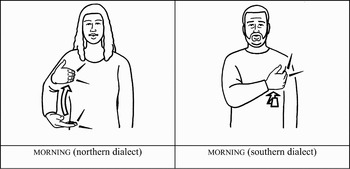
Johnston's dissertation (Johnston, Reference Johnston1989), some of his later research (Johnston & Schembri, Reference Johnston and Schembri1999, Reference Johnston and Schembri2007), subsequent dictionaries of Auslan based on his work (Bernal & Wilson, Reference Bernal and Wilson2004; Johnston, Reference Johnston1997, Reference Johnston1998; Johnston & Schembri, Reference Johnston and Schembri2003), and Auslan teaching materials (Branson, Bernal, Toms, Adam, & Miller, Reference Branson, Bernal, Toms, Adam and Miller1995; Branson, Peters, Bernal, & Bernal, Reference Branson, Peters, Bernal and Bernal1992) discussed sociolinguistic variation in the language and have documented some of the many examples of regional variation in the Auslan lexicon (e.g., morning, see Figure 1).
Regional variants of morning.

Based on the traditional distribution of lexical variation in core areas of the lexicon, such as numbers (especially six to twelve) and colors (e.g., white, blue, green), Johnston (Reference Johnston1989) proposed that Auslan could be divided into two major regional varieties: the “northern” dialect (Queensland and New South Wales) and the “southern” dialect (Victoria, South Australia, Western Australia, and Tasmania). It is possible that these two regional varieties have developed, at least in part, from lexical variation in different varieties of BSL in the nineteenth century (similar lexical variation continues to exist in modern BSL, see Brien, Reference Brien1992), although primary sources documenting signed language use at the time are lacking.
Together with signs, deaf people in Australia also make significant use of the manual alphabet to fingerspell English lexical items (Johnston, Reference Johnston1989). A small-scale study of fingerspelling use in Auslan by Schembri and Johnston (Reference Schembri and Johnston2007) found that deaf signers aged 51 years or older made significantly more frequent use of the manual alphabet than those aged 50 or younger. These age-related differences in fingerspelling usage (also reported for BSL, see Sutton-Spence, Woll, & Allsop, Reference Sutton-Spence, Woll and Allsop1990) reflect the educational experiences of older deaf people, many of whom report that they were instructed using approaches that emphasized the exclusive use of fingerspelling.
In NZSL, there is evidence of regional variation in the lexicon (see Kennedy et al., Reference Kennedy, Arnold, Dugdale, Fahey and Moskovitz1997), associated with three main concentrations of deaf population around historical schools for the deaf in north, central, and southern cities. Age-related variation in the lexicon of NZSL has also been noted (Collins-Ahlgren, Reference Collins-Ahlgren1989; Forman, Reference Forman2003; Kennedy et al., Reference Kennedy, Arnold, Dugdale, Fahey and Moskovitz1997; Levitt, Reference Levitt1986; McKee & McKee, Reference McKee and McKee2007). Natural intergenerational variation was artificially accelerated from 1979 by the introduction of Australasian Signed English, a sign system based mainly on Auslan vocabulary (some of which overlapped with local signs), supplemented by contrived signs to represent English functors (Johnston & Schembri, Reference Johnston and Schembri2007). This system was adopted as the means of instruction in both Australian and New Zealand schools for deaf children in the 1970s (Leigh, Reference Leigh1995). A study of variation in the numeral system in NZSL (McKee, McKee, & Major, Reference McKee, McKee and Major2006) demonstrates age-related change in the lexicon, and a progressive leveling process whereby younger signers use fewer variants than older signers, who display considerable within-group variation. Region and gender were also shown to be associated with numeral variation. Pilot studies of sociolinguistic variation in the use of fingerspelling (Alexander, Reference Alexander2008) and of mouthing spoken English words accompanying signing (McKee, Reference McKee2007), which are common features of contact between a signed and a spoken language (e.g., Boyes-Braem & Sutton-Spence, Reference Boyes-Braem and Sutton-Spence2001; Lucas & Valli, Reference Lucas and Valli1992), also show patterned effects of age and gender in NZSL.
In this article, our focus is on phonological variation. Although other work has discussed or documented sociolinguistic variation in Auslan and NZSL, the research described here represents the first attempt to empirically investigate phonological variation in Auslan and NZSL and its relationship to both linguistic and social factors.
SIGNED LANGUAGE PHONOLOGY: THE PARAMETER MODEL
Since the seminal work of William Stokoe (Reference Stokoe1960), manual signs in signed languages have been analyzed as composed of three main formational elements: handshape, location, and movement. These features may be considered analogous to the parameters of speech production, such as voicing, place, and manner of articulation. Signs are made from the combination of a limited set of parameter values (there appear to be around 37 distinctive handshapes in Auslan, for example), and minimal pairs may be distinguished on the basis of differences in these parameters (Johnston & Schembri, Reference Johnston and Schembri2007). For example, the two variants of morning in Figure 1 both use the same handshape (a bent “B” handshape) and the same movement (a repeated contacting of the body with the fingertips). They differ in location, with the northern dialect variant moving from an ipsilateral location lower on the trunk to one higher, while the southern dialect variant is produced at one location on the contralateral side of the chest.
Although there is debate about the relevance of some additional formational elements (such as the orientation of the hands, see Sandler & Lillo-Martin, Reference Sandler and Lillo-Martin2006) and the nature of minimal pairs (Liddell & Johnson, Reference Liddell and Johnson1989), evidence for the sublexical compositionality of signs is well established, and includes notions of well-formedness of signs shared by native signers (e.g., Johnston, Reference Johnston1989), signed language production errors (known as “slips of the hand”) (e.g., Leuninger, Hohenberger, Waleschkowski, Menges, & Happ, Reference Leuninger, Hohenberger, Waleschkowski, Menges, Happ, Pechman and Habel2004; Newkirk, Klima, Pedersen, & Bellugi, Reference Newkirk, Klima, Pedersen, Bellugi and Fromkin1980), and stages of phonological development in signed language acquisition (e.g., Marentette & Mayberry, Reference Marentette, Mayberry, Chamberlain, Morford and Mayberry2000).
Phonological variation: The location variable
Johnston (Reference Johnston1989:33) observed that phonological variation in handshape, location, and orientation in Auslan might be related to the immediate phonological environment (similar claims for ASL were made by Liddell & Johnson, Reference Liddell and Johnson1989):
Handshape and location and orientation can all undergo significant changes in fluent signing with the immediate phonological environment of a sign influencing, for example, whether handshapes are fully formed or not, or whether they absorb features of previous or following handshapes; whether contact is actually made at locations, simply suggested, not made at all or made at another location altogether, and so on.
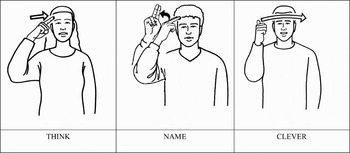
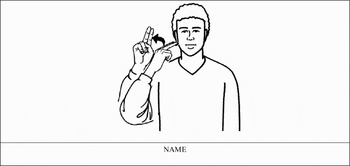
Although Johnston noted that assimilation can occur in all three major parameters, our studies only examine variation in a single parameter—location. More specifically, our investigations of location variation examined this variable in the class of signs that are produced in contact with or in proximity to the forehead, including the signs think, name, and clever (as illustrated in Figure 2). This class of signs includes both signs that primarily act as verbs (e.g., know, not-know,Footnote 4remember, forget, understand, wonder, worry, dream) and signs that generally function as nouns (e.g., mother, name, mind, soccer, girl, germany). It also includes a number of signs that may have an adjectival function (e.g., stupid, clever, tall, yellow, crazy, sophisticated, silly, green). Although produced on or near the forehead in citation form, these signs (as Johnston noted) may be made at lower locations. Their location may vary from the forehead region (i.e., in their citation form) to locations near the eye, on the cheek, at the jaw or at lower locations in the space near the signer's body (as illustrated in Figure 3).
think, name, and clever.

Lowered variant of name.

Our studies replicate the only other investigation of location variation in this class of signs in ASL (Lucas et al., Reference Lucas, Bayley, Rose and Wulf2002). In the original study, Lucas and her colleagues coded 2862 examples of signs from the class exemplified by the ASL sign know (most of which were produced in citation form in contact with or in proximity to the forehead region). These were selected from a corpus of conversational and interview data that was collected from 207 native and near-native deaf signers of ASL in seven sites across the U.S. (Staunton, Virginia; Frederick, Maryland; Boston, Massachusetts; Olathe, Kansas; New Orleans, Louisiana; Fremont, California; and Bellingham, Washington). The corpus included a mix of men and women, both White and African American, from a range of different age groups, language backgrounds, and social classes. Their results suggested that location variation is a classic sociolinguistic variable, influenced by the sex, social class, age, ethnicity, and regional origin of the signer, as well as by the grammatical function (i.e., noun, verb, adjective, preposition, or interrogative) and immediate phonological environment of the target sign (e.g., the location of the preceding sign). We explore the ASL findings in more detail in the following discussion.
The Auslan and NZSL studies had two main aims. First, we wished to improve our understanding of the linguistic and social influences on phonological variation within each language. In particular, we wish to know whether location variation in the class of signs exemplified by think, name, and clever is random, or if the immediate phonological environment is an important influence, as suggested by Johnston (Reference Johnston1989). We are also interested in examining what other linguistic and social factors may influence this variation.
Second, replication of the ASL study enabled a cross-linguistic comparison of location variation in Auslan, NZSL, and ASL to determine whether location variation is indeed systematic and if it is subject to the same kind of social and linguistic constraints in all three signed languages. The results of this comparison will enable to us to begin to develop hypotheses about the kinds of factors involved in phonological variation in signed languages (e.g., we might expect variation in more closely related signed varieties such as Auslan and NZSL to behave in a more similar way than that found in unrelated signed languages, such as Auslan and ASL), and how these compare with those found in spoken languages.
METHODOLOGY
As in the previous work on ASL (Lucas et al., Reference Lucas, Bayley, Rose and Wulf2002), we chose to undertake multivariate analysis of the data using VARBRUL software (for an overview, see Tagliamonte, Reference Tagliamonte2006). Two key principles that guide such research are the principle of quantitative modeling and the principle of multiple causes (Young & Bayley, Reference Young, Bayley, Bayley and Preston1996). The first principle refers to the need to carefully quantify both variation in a linguistic form and the relationship between a variant form and features of its surrounding linguistic environment and social context. The second principle reflects the assumption that no single linguistic or social factor can fully explain variation in natural language use.
We discuss the target signs for our investigation in the next section and outline the social and linguistic factors that are the focus of our study in our discussion of sites, participants, data collection, and coding.
Target signs
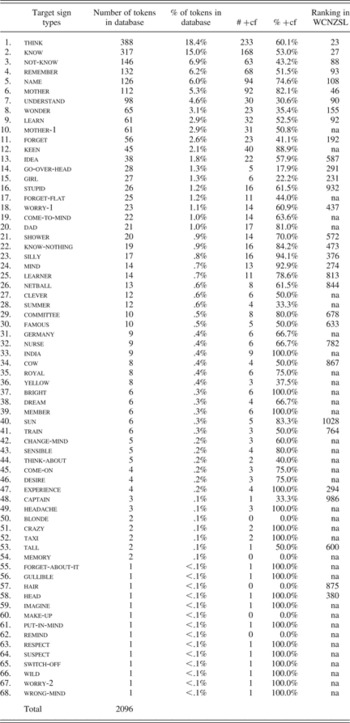
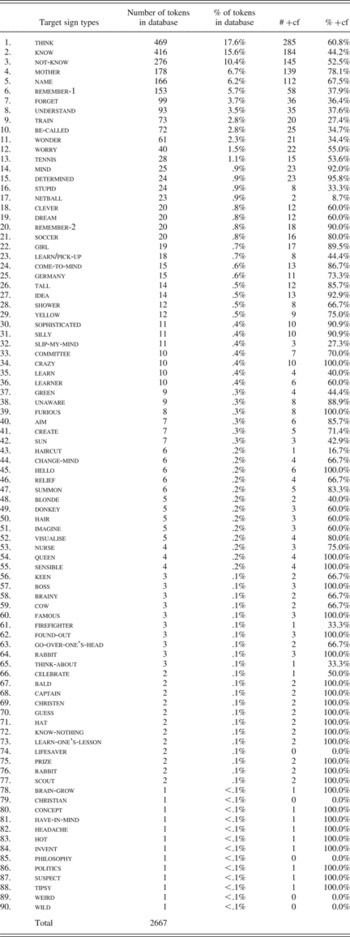
Our data involved the coding of all examples of target signs found in our data, albeit with an upper limit of 15–20 tokens from each participant (see Table 1 for a complete listing of all NZSL target signs and Table 2 for Auslan target signs). In all cases, the target signs were lexical items made in citation form at locations in contact with or in proximity to the forehead region or above, but were believed to vary in location.Footnote 5 The variant forms of these signs (e.g., the two forms of name shown in Figures 2 and 3) clearly have the same referential meaning as the citation form and may be considered two ways of saying the same thing. This makes them an appropriate variable for study using VARBRUL analysis (Bayley, Reference Bayley, Chambers, Trudgill and Schilling-Estes2002).
Target signs in NZSL data

Target signs in Auslan data

The target signs in the NZSL and Auslan study substantially overlapped with each other (due to a high degree of lexical similarity), but differed slightly in criteria from target signs in the ASL study in two ways (Lucas et al., Reference Lucas, Bayley, Rose and Wulf2002). First, we did not include signs that were made in citation form at locations lower than the forehead region. The signs investigated by Lucas and her colleagues included, for example, ASL see (which moves forward from near the eye) and lousy (which moves down from the nose). Second, we also did not include lexicalized compound signs in which the second component was made at a location lower than the forehead. Target signs in the ASL research included ASL believe and remember (in both these signs, the dominant hand moves down from a forehead location to make contact with the subordinate hand). This resulted in a set of signs in Auslan and NZSL that were more homogeneous in terms of location than the set of signs in the Lucas et al. (Reference Lucas, Bayley, Rose and Wulf2002) study.
Sites
As we already mentioned, regional lexical variants in the Auslan and NZSL lexicons have been documented but little is known about the relationship between phonological variation and region. We believed that regional influences may have an impact on location in variation in Auslan and NZSL, as has been found in ASL (Lucas et al., Reference Lucas, Bayley, Rose and Wulf2002). Previously unrecognized regional influences also appear to be at work in phonological variation in Australian and New Zealand English (e.g., Horvath & Horvath, Reference Horvath and Horvath2002). To obtain a representative sample of signed language use, it was necessary to collect data in a number of different sites across each country. In Australia, we selected five communities: Adelaide, Brisbane, Melbourne, Sydney, and Perth. Over half of the entire population of Australia lives in these five state capitals, and demographic studies suggest a similarly large proportion of the Australian deaf community can be found in these cities (Hyde & Power, Reference Hyde and Power1991). These five urban areas are spread across the major regions of the country (Adelaide is in the central part of the south coast of the continent, Perth is on the west coast, and Brisbane, Sydney, and Melbourne cover the northern and southern parts of the relatively densely populated east coast). These cities are also home to the longest-established deaf communities, having traditionally been the sites of residential schools for deaf children (all of which were founded in the nineteenth century, Carty, Reference Carty2004). Another reason we chose to collect data in these five urban areas relates to the size of the deaf communities in these cities. We felt it would be much easier to obtain sufficient numbers of participants from a variety of backgrounds in each city because deaf communities outside these areas of Australia are often particularly small. All data were collected between June 2003 and November 2004.
The Dictionary of New Zealand Sign Language (Kennedy et al., Reference Kennedy, Arnold, Dugdale, Fahey and Moskovitz1997) identifies variants with three major regions—Auckland, Wellington, and Christchurch—and in this study, we likewise focus on three regions that host the largest deaf communities, although data were collected from deaf residents in five actual sites—Auckland (north region), Hawkes Bay, Palmerston North, Wellington (central region), and Christchurch (south region). Nearly two-thirds of the New Zealand population live in these five urban areas, and deaf schools were traditionally located in Auckland, Palmerston North, and Christchurch. For the purpose of analysis, we collapsed three sites into one central region (Hawkes Bay, Palmerston North, and Wellington) because they are in close proximity and associate with each other regionally, and many residents attended the same deaf schools. Data were collected between December 2005 and August 2006.
Participants
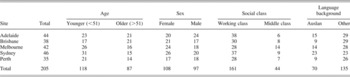
A total of 211 deaf Australians and 150 deaf New Zealanders were filmed. As in previous work on ASL (Lucas et al., Reference Lucas, Bayley, Rose and Wulf2002), we used a judgment sample (i.e., we selected participants to fill preselected social categories) rather than a random sample of the deaf population (for an overview of samples, see Tables 3 and 4). Thus, this number included deaf signers from a variety of backgrounds, with the requirement that all participants had been exposed to signed communication before 12 years of age (over 95% of our Australian and 91% of our New Zealand participants reported that they had first began to sign by seven years of age). We selected in each site both deaf people who had deaf parents (i.e., those who had learned to sign in the home, from birth), as well as deaf people who had hearing parents (e.g., those who learned signed language from their peers at school). Note that only 6.5% of the NZSL participants are native signers compared with 34% in the Australian study. Like Lucas et al. (Reference Lucas, Bayley, Rose and Wulf2002), we did not recruit hearing signers (native or otherwise), nor those deaf people who acquired Auslan or NZSL later in life, either as a significantly delayed first language or as a second language after the successful acquisition of English. This was done to minimize the possible effects on our data of English influence in the signed language use of hearing native signers and deaf second-language learners (Lucas & Valli, Reference Lucas and Valli1992), or of late first-language acquisition in deaf late learners of Auslan and NZSL (for an overview of research on late signers of ASL, see Emmorey, Reference Emmorey2002).
Participants (Auslan)

Participants (NZSL)

To ensure we filmed individuals who were representative of each region, we attempted to focus our recruitment of participants on long-term residents of each city and/or region. For example, slightly more than 90% (n = 194) of our Australian participants had lived 10 years or more in their local deaf communities (i.e., just under 10% had moved to the city in which they were filmed in the last 10 years), and just over 80% (n = 171) were lifelong residents. Similarly, in New Zealand, each participant's region was identified by where they had lived for the preceding 10 years. Participants who had lived continuously in a smaller town or city outside the data collection site were categorized in the closest of the three major regional centers. Exceptions to this were made for individuals who had spent most of their formative and adult years in the location of another large deaf community and moved recently to a smaller town without a sizable signing community, in which case they were identified by their original region. In fact, there are equally good ethnographic reasons for classifying deaf people's regional linguistic affiliation according to the location of the deaf school they attended, which is for the majority of our participants, the primary site of enculturation into a deaf community and acquisition of signed language. However, for comparability with the ASL study methodology, we determined region by the current place of longstanding residence.
Our samples included similar numbers of men and women, as well as a mix of younger and older age groups, and people from both middle-class and working-class backgrounds. We did not, however, select Australian participants on the basis of ethnicity, a social factor that has been shown to be relevant in ASL (Lucas et al., Reference Lucas, Bayley and Valli2001) and in sociolinguistic variation in spoken languages (Fought, Reference Fought, Chambers, Trudgill and Schilling-Estes2002). The ethnic composition of the Australian deaf community is unknown, and it is difficult to obtain information about the incidence of deafness in the immigrant population. The general Australian population is approximately 91% of European origin, with 7% of the population of Asian origin (mainly from East Asia and the Middle East), and another 2% of Aboriginal or Torres Straight Islander background. In the 2001 Census, approximately 28% of the Australian population was born overseas, and 20% used a language other than English in the home. Other than the Anglo-Celtic majority, however, no single ethnic group is predominant, neither in the general population nor in the deaf community. Given this, and the fact that the education of deaf children has never been segregated on the basis of race (unlike the situation in the U.S., see Lucas et al., Reference Lucas, Bayley and Valli2001) and there are no deaf clubs or associations based on ethnicity in Australia, there does not appear to be much evidence of systematic ethnic variation in Auslan.
Ethnicity was a variable we considered in the NZSL project, with the ethnic composition of the NZSL sample being 13% Māori (indigenous Polynesian), and 87% Pakeha (European origin) and others; this is similar to the overall New Zealand population in which Māori make up approximately 15% (Statistics New Zealand, 2001). Māori and Pakeha deaf children have historically attended schools together, and their social networks are strongly interconnected, providing little empirical reason to expect linguistic variation. Current local interest in the construct of Māori deaf identity (Smiler, Reference Smiler2004) and its potential manifestation in the use of NZSL (McKee, McKee, Smiler, & Pointon, Reference McKee, McKee, Smiler, Pointon and Quinto-Pozos2007), as well as the ASL findings on ethnic variation, prompted us to include this as a variable in the study.
Sex or gender are among the most widely used social categories in sociolinguistic research (Cheshire, Reference Cheshire, Chambers, Trudgill and Schilling-Estes2002) and have been shown to play a role in sociolinguistic variation in ASL (Lucas et al., Reference Lucas, Bayley and Valli2001). As a result, we recruited both men and women for our study, although we were more successful at attracting female participants. As a result, both our Australian and New Zealand data overall have a higher number of deaf women than men (97 men and 108 women for Auslan; 60 men versus 78 women for NZSL).
Australian participants were recruited in four different age groups: (1) 15–30 years, (2) 31–50 years, (3) 51–70 years, and (4) 71 years or older. Three age groups were used to recruit New Zealand participants: (1) 15–39 years, (2) 40–64 years, and (3) 65 years or over. Our age categories reflect two possible influences on phonological variation in Auslan and NZSL. First, age-related variation in language is well-documented for both spoken languages (Bailey, Reference Bailey, Chambers, Trudgill and Schilling-Estes2002) and signed languages (e.g., Lucas et al., Reference Lucas, Bayley and Valli2001; Sutton-Spence, Woll, & Allsop, Reference Sutton-Spence, Woll and Allsop1990). Often this age-related variation at any point in time reflects a language change in progress (Labov, Reference Labov1994). Second, the specific age groupings were intended to reflect changes in language policy in the education of deaf children during the twentieth century (similar changes have occurred in the U.S., see Lucas et al., Reference Lucas, Bayley and Valli2001). Participants in the oldest age groups were most likely to have been educated in residential schools for deaf children, often with approaches that emphasized the use of fingerspelling (in Australia) or oralismFootnote 6 (in New Zealand). Signed language may have been used by school children with each other in the dormitories and in the playground, and some instruction in some Australian schools would also have been by some means of signed communication (Johnston, Reference Johnston1989). There are observable differences between the NZSL of this older group and younger signers. For example, the older signers exhibit a greater reliance on English word patterns on the mouth (McKee, Reference McKee2007) and little use of a conventional manual alphabet (Alexander, Reference Alexander2008; Forman, Reference Forman2003).
Like the older group, Australian participants in the 51–70 years category would have been educated in centralized schools for deaf children, although many would have experienced the shift to oralism that occurred in a number of schools after the Second World War. Those in the 31–50 years category would have witnessed major changes in deaf education: the greater use of assistive technology (e.g., hearing aids) and oralism, the move toward Total CommunicationFootnote 7 and the use of Australasian Signed English, the closure of centralized schools for deaf children and the spread of mainstreaming (i.e., integrating deaf children into schools with hearing children).
New Zealand participants over the age of 40 were nearly all educated in residential schools or deaf unit classes that used oralist teaching methods, but which also furnished sizeable communities of signing peers outside the classroom. This generation's signed language use was also potentially influenced by their adult exposure to the Australasian Signed English of younger deaf people and to increasing contact with signed language users of other countries through international travel and deaf immigration into the NZSL community.
Participants in the youngest group (15–30 years of age in Australia and 15–39 in New Zealand) have seen the increasing recognition of their national signed languages by government, but many would have been educated in mainstream settings by teachers using Australasian Signed English. Some of the youngest members of this group would have been educated in bilingual schools using Auslan or NZSL as the medium of instruction.
Because social class is an important factor in many sociolinguistic studies of spoken languages (Ash, Reference Ash, Chambers, Trudgill and Schilling-Estes2002) and was found to be relevant in the previous ASL study (Lucas et al., Reference Lucas, Bayley, Rose and Wulf2002), we recruited individuals from both working-class and middle-class backgrounds in the Auslan study. The definitions adopted here defined working-class individuals as those who were employed in unskilled, semiskilled, or skilled manual jobs (e.g., laborer, factory worker, or plumber) or as semiskilled nonmanual workers (e.g., clerk). Middle-class participants were those, possibly with a university education, who worked in skilled nonmanual jobs (e.g., Auslan teacher) or in professional and/or managerial positions (e.g., manager of a signed language interpreting service). Because university education has only become generally accessible to deaf people in Australia following disability discrimination legislation enacted since the 1980s, we could not always rely on tertiary qualifications as a defining part of our social class classification (this was a key criterion used in the Lucas et al. [2002] study). Numbers of middle-class participants were considerably smaller than working-class participants in all sites, although the largest number of middle-class individuals was found in Melbourne (many of these participants were graduates from La Trobe University where a degree in education with a focus on signed language teaching has been available for some years now).
The NZSL study did not include social class as a factor due to insufficient indicators of class differentiation in the New Zealand deaf population, as measured by occupation or education level. The majority of NZSL users have levels of academic achievement well below the general population and so few are employed in white collar or professional occupations that it would not have been feasible to collect sample sizes adequate for comparison.
Data collection
Data collection procedures in the Auslan and NZSL studies were essentially the same. The researchers worked closely with a deaf fieldworker from each of the sites, who acted as a “contact person” (Lucas et al., Reference Lucas, Bayley and Valli2001). All contact people were deaf and fluent signers (in Australia, only deaf native signers acted in this role) who had lived all or most of their lives in the local deaf community. They worked as paid research assistants and were responsible for selecting other fluent signers who had been exposed to signed communication in early childhood and who had lived for the last 10 years in the same community. They were also responsible for convening the data collection sessions and interviewing selected participants.
At each site, participants were usually convened in groups of two to four, almost always with others of similar age. In the Auslan study, there were 70 groups of two to five participants. All but six of these were composed of both women and men. In the NZSL study, there were 55 groups of two to four participants; 20 of the New Zealand groups consisted of women only, 12 groups of men only, and 23 groups were mixed.
Upon arrival, participants signed a consent form after explanation of the project's purpose and use of the data and filled in a short demographic questionnaire. This was followed by 30–50 minutes of free conversation among group members, without the researchers being present. No hearing people were involved, in order to minimize possible observer effects or influences from English on the data, as documented for ASL by Lucas and Valli (Reference Lucas and Valli1992). As in the original American study (Lucas et al., Reference Lucas, Bayley, Rose and Wulf2002), most participants already knew each other so conversation flowed naturally. In many cases, participants discussed personal experiences (such as recent holidays), shared recollections (such as memories of school), or talked about events in the deaf community (such as birthday parties, weddings, or plans for the Deaflympics in Melbourne). After the free conversation, some participants were invited to stay for an individual interview conducted by the deaf contact person; 147 people were interviewed out of a total of 211 participants in Australia, and 69 out of 138 participants in New Zealand. The interviews asked participants about their family, education, work, commuting between home and work, social life, and patterns of language use in each of these settings. Although a hearing researcher was sometimes present to assist with the filming of the Auslan interviews, the deaf contact person always interviewed the participants. Only deaf people were present in the NZSL data collection.
All participants were filmed in familiar settings, including centers for deaf people, deaf school premises, and deaf homes. Filming sessions in each site were scheduled over a number of days depending on the numbers involved. All participants were compensated for their time.
Data coding
The data from 205 Auslan participants were coded for the purposes of this study (see Table 3). This included data from 199 individuals who reported that their first exposure to signed language occurred before age 7, and six participants who began to sign between 8 to 12 years of age. Data from two participants who reported that they first learned to sign after the age of 12 were not included. The data from the remaining four were not coded for a variety of reasons: one signer did not participate very much in the conversation during the filming session (and thus produced no target signs), another wore a cap during filming (preventing us from being able to fully see his use of signs in the target location), and two other signers did not fit our criteria for fluency in Auslan (as judged by two of the Australian coauthors, both of whom are hearing native signers).
In the NZSL study, data from 138 signers were coded (see Table 4). Data from an additional 12 participants were excluded from coding and analysis as they were found to have acquired NZSL after the age of 12, or learned an overseas signed language first, thus not meeting our criteria.
The aim in the Auslan study was to collect 10–15 tokens of the target variable from each of the 205 participants. We hoped to collect 10 tokens from each signer involved in a conversation (n = 205), and 5 tokens from each participant involved in an interview (n = 147). Thirteen signers, however, did not produce a sufficient number of target signs during the course of the conversation or interview, so we have a much smaller number of tokens from these individuals. This was partly due to the fact that most of our target signs were relatively infrequent and our coding rules were rather strict (as will be described, we coded an upper limit of three tokens containing the same lexical item so as to maximize the mix of lexical items investigated in the study). In some cases then, this made it difficult to collect sufficient examples from those who did not participate very much in the discussion, or (for some participants over 70 years of age) those that used a great deal of fingerspelling. Coding began from the beginning of the videotape, once the conversation or interview had begun. We generally coded the first 10 (in the conversations) or 5 (in the interviews) target signs that were produced by each participant, unless the signer's posture or some other problem prevented us from seeing the signer properly on the videotape. In this case, we may have ignored target signs that we could not code confidently and instead waited until the signer moved into a position in which their signing could be seen clearly before continuing coding.
The NZSL study aimed to collect 12 tokens from each signer in free conversation (n = 138) and 8 tokens from each signer who was interviewed (n = 69). As in the Auslan study, some participants did not produce a sufficient number of target signs during the course of conversation or interview (for similar reasons), and fewer tokens were obtained from those individuals. We coded the first 12 tokens of target signs that occurred in the conversations and the first 8 tokens in each interview.
In coding, we have assumed that the citation form of each target sign was the form from which all other variants are derived. A target sign was coded as a citation form (+cf) if it was produced clearly above the eyebrow ridge, and as a noncitation form (–cf) if it was produced clearly below the eyebrow ridge. A very small number of signs appeared to be produced on the eyebrow ridge itself—these were coded as citation forms.
Many target signs appeared in double-handed form in which the dominant and subordinate hand have the same handshape and location and have identical or symmetrical forms of movement. If the dominant hand was at a location above the eyebrow ridge, but the subordinate hand was not, the sign was coded as a citation form. Double-handed variants of the target signs were coded as noncitation forms only if neither hand was in contact with or in proximity to locations at or above the eyebrow ridge.
To reduce possible lexical effects associated with particular signs, we set a limit on the number of tokens coded with the same lexical item (an upper limit of three tokens with the same lexical item in the conversational data, and two in the interview data). This was necessary because a small number of target signs occurred much more frequently than the others in our dataset (e.g., just 10 signs—think, know, not-know, mother, name, remember, forget, understand, train, and be-called—account for over 77% of all tokens in the Auslan database), and it would have been very easy for the entire study to have been entirely based on data from a handful of very common lexical items.
Research has suggested that word frequency may be implicated in phonological variation and change (Bybee, Reference Bybee2002; Phillips, Reference Phillips1984), because frequent lexical items are known to behave differently than less frequent ones (although note that this is not true of all sound changes, see Labov, Reference Labov2006). For example, highly frequent lexical items in English are produced with a 20% shorter duration than less frequent words in conversation (Bell, Gregory, Brenier, Jurafsky, Ikeno, & Girand, Reference Bell, Gregory, Brenier, Jurafsky, Ikeno and Girand2002). Duration is in turn associated with an increased likelihood of the reduction or assimilation of speech sounds (Thomas, Reference Thomas, Chambers, Trudgill and Schilling-Estes2002). Thus, it appears that high frequency words may undergo greater phonological reduction than low frequency words, and this reduced articulatory effort may be part of a sound change in progress (Bybee, Reference Bybee2002; Dinkin, Reference Dinkin2007; Phillips, Reference Phillips1984).
Table 1 shows the frequency ranking of the entire 68 target signs in the NZSL variation dataset, and their distribution as citation and noncitation forms in our data. The top 10 most frequent target signs shown in Table 1 accounted for over 71% of all tokens coded in the NZSL data analyzed here. Of the 10 most frequent signs in our NZSL data, 7 are verbs and 3 are nouns (including 2 variants of the lexical item mother).
Because it is possible that high frequency signs are also produced with shorter durations and a greater tendency for reduction and assimilation, we opted to test for the effects of frequent lexical items by coding for high frequency versus low frequency lexical items in our data. We coded as “high frequency” items those top 10 most frequent lexical items in the NZSL dataset of 2096 tokens (i.e., the NZSL signs think, know, not-know, remember, name, mother, understand, wonder, learn, mother-1), and a similar set of 10 most frequent lexical items in the Auslan dataset of 2667 tokens (i.e., the Auslan signs think, know, not-know, mother, name, remember, forget, understand, train, and be-called in Table 2).
Note that, although we are using token frequency in our data as the basis for this categorization, this coding decision is also supported by the frequency ranking of these items in the Wellington Corpus of NZSLFootnote 8 (McKee & Kennedy, Reference McKee, Kennedy and Kennedy1999, Reference McKee and Kennedy2006): 9 of these high frequency signs in our NZSL data occur in the list of the top 200 most frequent lexical items in the Wellington corpus. Moreover, because the list is very similar for the Auslan data, most of the high frequency Auslan signs are also high frequency signs in the Wellington Corpus: eight items appear in the top 200. The remaining lexical items that appeared much less frequently in the NZSL and Auslan data were coded as “low frequency” signs.
Tokens were coded for the possible effects of a range of social and linguistic factors on this underlying form, using a coding scheme based on that used in the ASL study (Lucas et al., Reference Lucas, Bayley, Rose and Wulf2002). Linguistic factors included sign frequency, grammatical function, preceding and following phonological environment, and situational variety.
For grammatical function, we coded whether tokens were acting as nouns (e.g., name, mother), adjectives (e.g., yellow, crazy), and verbs (e.g., know, think). Unlike in the ASL study (Lucas et al., Reference Lucas, Bayley, Rose and Wulf2002), there are no grammatical functors (e.g., for, why) produced at the forehead location in Auslan or NZSL. We used a number of semantic and morphosyntactic criteria to decide whether a sign was acting as a noun (e.g., nouns generally refer to people, places or things, act as arguments of a verb and may be preceded by a determiner), verb (e.g., verbs generally refer to actions or states, and act as predicates) or adjectives (e.g., adjectives generally describe a property of a noun, may be used attributively, and may be modified by an intensifier such as very). In some cases, however, it was not easy to determine the grammatical function of a specific sign. In an utterance such as pro-1 name b-e-n “my name is Ben,” the sign name might be acting as either a noun (because the pointing sign glossed here as pro-1 can also act as a possessive determiner poss-1 in Auslan/NZSL) or as a verb (the sign name can sometimes also be used to mean “be called,” although other signs, such as be-called, are also used for this meaning). In such cases, the coders used their native signer intuitions, sometimes in consultation with the project researchers, to make a decision about the role being played by that sign in that specific context.
For the phonological environment, we coded the location of the preceding and following sign, noting whether the sign was made at the level of the signer's head or the signer's body (for our purposes, signs that occurred at the level of the signer's neck or below were coded as being made at body level). Because the majority of the tokens in our data (almost 95% in the analyzed Auslan data, for example) involved a sign in which the hand makes contact with the forehead in citation form, we coded whether the preceding and following sign made contact with the body (and if it did, whether it contacted the head or body, or if the dominant hand contacted the subordinate hand). For a subset of the Auslan data, we also noted whether the target sign was preceded or followed by a sign involving a switch of hand dominance. We found that in approximately 5% of all tokens, the sign before or after the target sign was produced with the nondominant hand. For example, in the phrase pro-1 think pro-2 wrong “I think that you are wrong,” the sign pro-1 (a point to the chest) was produced by one signer with the left hand while the rest of the string was produced by the signer's right hand. We reasoned that because think is the first sign in the string being produced on the right hand, the location of the sign pro-1 on the left hand may have less effect on the location of target sign. Thus, both studies coded for hand dominance switching as an aspect of the phonological environment in case it turned out to be relevant for our understanding of location variation.
We also coded whether the target sign was preceded or followed immediately by another sign, or whether there was a pause before or after it. This was originally coded together with location and contact features of the preceding or following sign, but (following the reasoning adopted by Lucas et al., Reference Lucas, Bayley, Rose and Wulf2002) we created a separate factor group to code whether a sign or a pause preceded or followed the target sign. Pauses in the location and contact factor groups were then coded as not applicable, whereas signs were coded for location and contact. In coding pauses, we grouped together whether the target sign occurred at the beginning or the end of a turn (in which case, the hands moved from or toward their resting position on the signer's lap or on the arm of the chair) or whether the sign was preceded or followed by a discernible hold (i.e., there was a complete stop in the flow of signing). We reasoned that both beginning or resuming motion would involve overcoming the inertia of the hand, for example, and that this may have similar effects on location variation (i.e., physiological principles of economy of effort would predict that noncitation forms of signs may be more common after a pause or hold).
We also coded for situational variation in which the target sign occurred, noting whether the tokens were collected from conversations or interviews. We reasoned that the more structured nature of the interview might have led to a somewhat more formal variety of signing that included a greater use of citation forms.
As already described, we coded for the following social factors: gender (male or female), age (young, mature, older, and elderly), language background (participants with signing deaf parents or with hearing parents), and region. In the Auslan study, we also coded for social class (middle class or working class) and in the NZSL study, ethnicity (Māori, Pakeha).
The Auslan study conducted an inter-rater reliability study in which two coders independently coded the linguistic factors in a subset of the tokens. We compared the coding of the linguistic factors, because only these factors were based on observation of the videotaped data. The coding of social factors were based on the participant's responses to the demographic questionnaires. (This information was simply transferred to the coding sheets and involved little decision making by the coders.) The two coders achieved an inter-rater reliability score of 93%, with all remaining disagreements about coding resolved by correcting errors on the coding sheets that were due to lapses in attention, or by reviewing specific examples on the videotapes. Inter-rater reliability was not investigated in the NZSL study. All coding judgments were made by one native signer research assistant, in consultation with the primary researchers in problematic cases as needed.
Analysis
To facilitate statistical analysis and cross-linguistic comparison with ASL results, the data were analyzed using VARBRUL software. We used Gold Varb 2.1, developed by David Rand and David Sankoff (Reference Rand and Sankoff1991) at the University of Montréal. VARBRUL enables the simultaneous analysis of multiple factors that influence sociolinguistic variation. The application of VARBRUL to the study of phonological variation in signed languages is described in more detail in Lucas et al. (Reference Lucas, Bayley and Valli2001).
RESULTS
The results of the VARBRUL analysis showed that location variation in Auslan and NZSL, as in ASL, is not random but is influenced by a number of linguistic and social factors. Unlike in the ASL data (Lucas et al., Reference Lucas, Bayley, Rose and Wulf2002), however, the noncitation forms of these signs (i.e., those produced at locations on or near the body lower than the forehead region) were less common than the citation forms in Auslan and NZSL. Citation forms account for approximately 55% of the tokens in Auslan (n = 1480) and 57% in NZSL (n = 1202) compared with 47% in the ASL data, while noncitation forms represent 45% of tokens in Auslan (n = 1187) and 43% in NZSL (n = 894), but 53% in ASL.
Linguistic factors
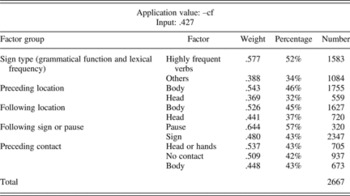
Of the linguistic factors we analyzed, five proved significant at the .05 level: sign type, preceding location, following location, following sign or pause, and preceding contact. The significant linguistic factors for Auslan are shown in Table 5 with their VARBRUL weights (with –cf as the application value), their input probability (the overall likelihood that signers will choose the noncitation form as a percentage), and the overall number of tokens with the relevant factor.
Linguistic factors (Auslan)

Notes: chi-square/cell = 1.01316; log likelihood: –1692.854; all factor groups significant at p < .05.
An early run of the Auslan data showed that both grammatical function and sign frequency were significant. Verbs appeared to favor the noncitation form, but adjectives and nouns appeared to disfavor it. High frequency signs (i.e., the 10 most frequent lexical items) favored –cf, and low frequency items disfavored –cf. Closer inspection of the results, however, indicated some unexpected interaction between grammatical function and frequency. It was clear that only a subset of verbs (the high frequency verbs, i.e., think, know, not-know, remember, forget, understand, and be-called) favored –cf, whereas all the remaining verbs, nouns, and adjectives disfavored –cf. A decision was thus made to combine these factor groups to form a new factor group called “sign type” with all lexical items being classified into one of four groups: (1) high frequency verbs, (2) high frequency nouns and adjectives, (3) low frequency verbs, and (4) low frequency nouns and adjectives. The resulting factor group, sign type, proved to be the first-order constraint. We found that frequent verbs favored –cf (with a factor weight of .577), and all other signs types strongly disfavored –cf (.388).
All the remaining significant linguistic factors reflect aspects of the immediate phonological environment. We found that the preceding location was the strongest of these factors, with preceding signs produced in the body region (i.e., lower than the target sign) favoring –cf (.543), and those in the head region strongly disfavoring –cf (.369). The following location was also important, with similar, although somewhat weaker effects: following signs in the body region slightly favored –cf (.526), and those in the head region disfavored –cf (.441). Whether the target sign was followed by another sign or a pause was significant: signs followed by other signs disfavored –cf (.480), but those followed by a pause strongly favored –cf (.643). Finally, the preceding sign making contact with the body was also important. Preceding signs that involved contact with the subordinate hand or with the head favored –cf (.537), but those that made contact with the body disfavored –cf (.449). Signs with no contact were the nearly neutral reference point (.509).
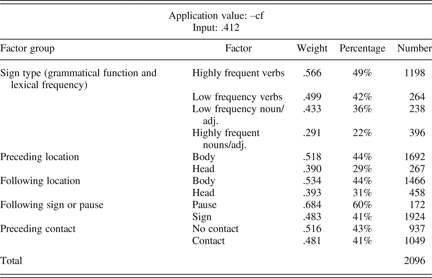
In NZSL, the same linguistic factors were found to be significant and the VARBRUL weightings align quite closely with the Auslan values, as shown in Table 6. Sign type (grammatical function and frequency) had a similarly clear effect on lowering in NZSL. High frequency verbs (i.e., think, know, not-know, remember, understand, wonder, learn) favor –cf (.566), and low frequency verbs neither favor nor disfavor –cf (.499). Nouns and adjectives, both high and low frequency, disfavor –cf (.291 and .433, respectively). This pattern confirms the Auslan finding of an interaction between grammatical function and lexical frequency in influencing phonological reduction.
Linguistic factors (NZSL)

Notes: chi-square/cell = 1.0269; log likelihood: –1319.922; all factor groups significant at p < .05.
Unlike Auslan, the NZSL results show following location to have more effect on lowering than preceding location: following signs made in the body region favoring –cf (.534) and those in the head region strongly disfavoring –cf (.393). Preceding signs in the body region slightly favor –cf (.518), and preceding signs in the head region strongly disfavor –cf (.390). Consistent with Auslan, the presence of a pause following the target sign was associated with lowering: signs followed by other signs disfavor –cf (.483), whereas those followed by a pause strongly favor –cf (.684). Finally, preceding signs that make contact with the body or head disfavor –cf (.481), but preceding signs with no contact slightly favor –cf (.516).
In summary, the following linguistic factors favored citation forms: (a) nouns, adjectives, and low frequency verbs; (b) signs that were preceded or followed by signs made in the head region; (c) signs that were preceded by signs, rather than pauses; and (d) signs that were preceded by signs making contact with the body. The following linguistic factors all favored the lowered (noncitation) variants: (a) high frequency verbs; (b) those signs that were preceded or followed by signs made in the body region; (c) signs that were followed by a pause. The following factors were found not to be significant in either language: whether or not (a) the following sign made contact with the body; (b) the target sign was preceded by a pause, or (c) the target sign involved a switch in hand dominance when compared with the preceding or following sign.
Social factors
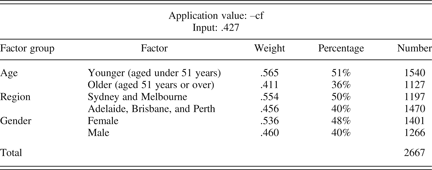
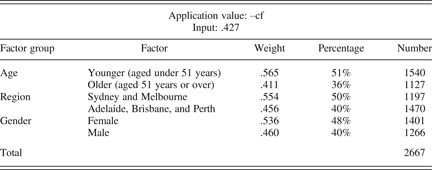
In Auslan, three social factors were significant at the .05 level: age, region, and gender. These are shown in Table 7 with their VARBRUL weights, input probability, and number of tokens.
Social factors (Auslan)
Notes: chi-square/cell = 1.01316; log likelihood: –1692.854; all factor groups significant at p < .05.
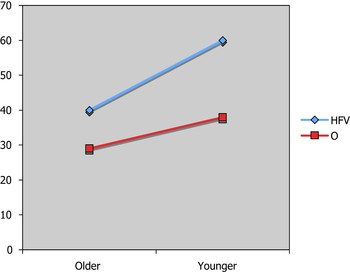
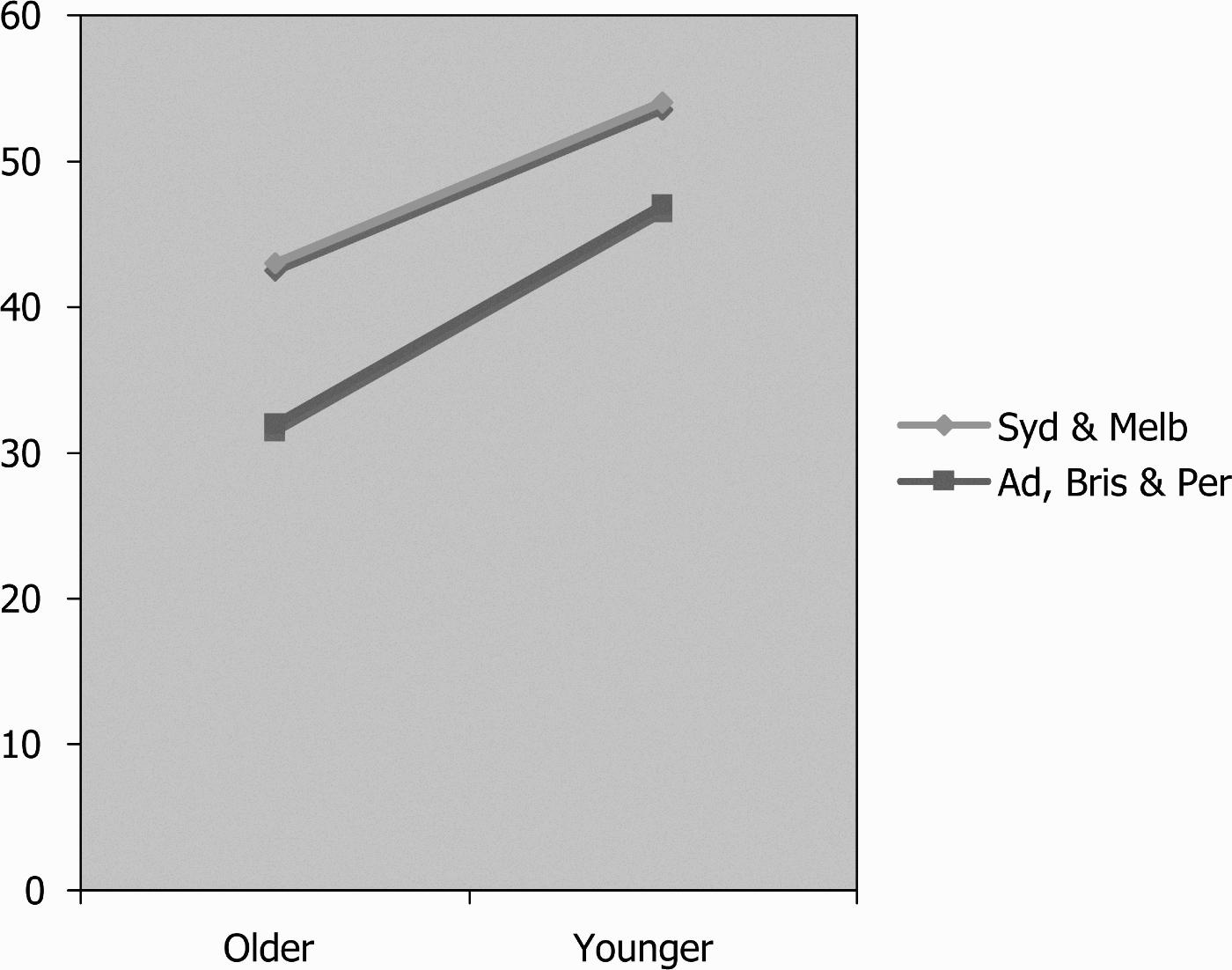
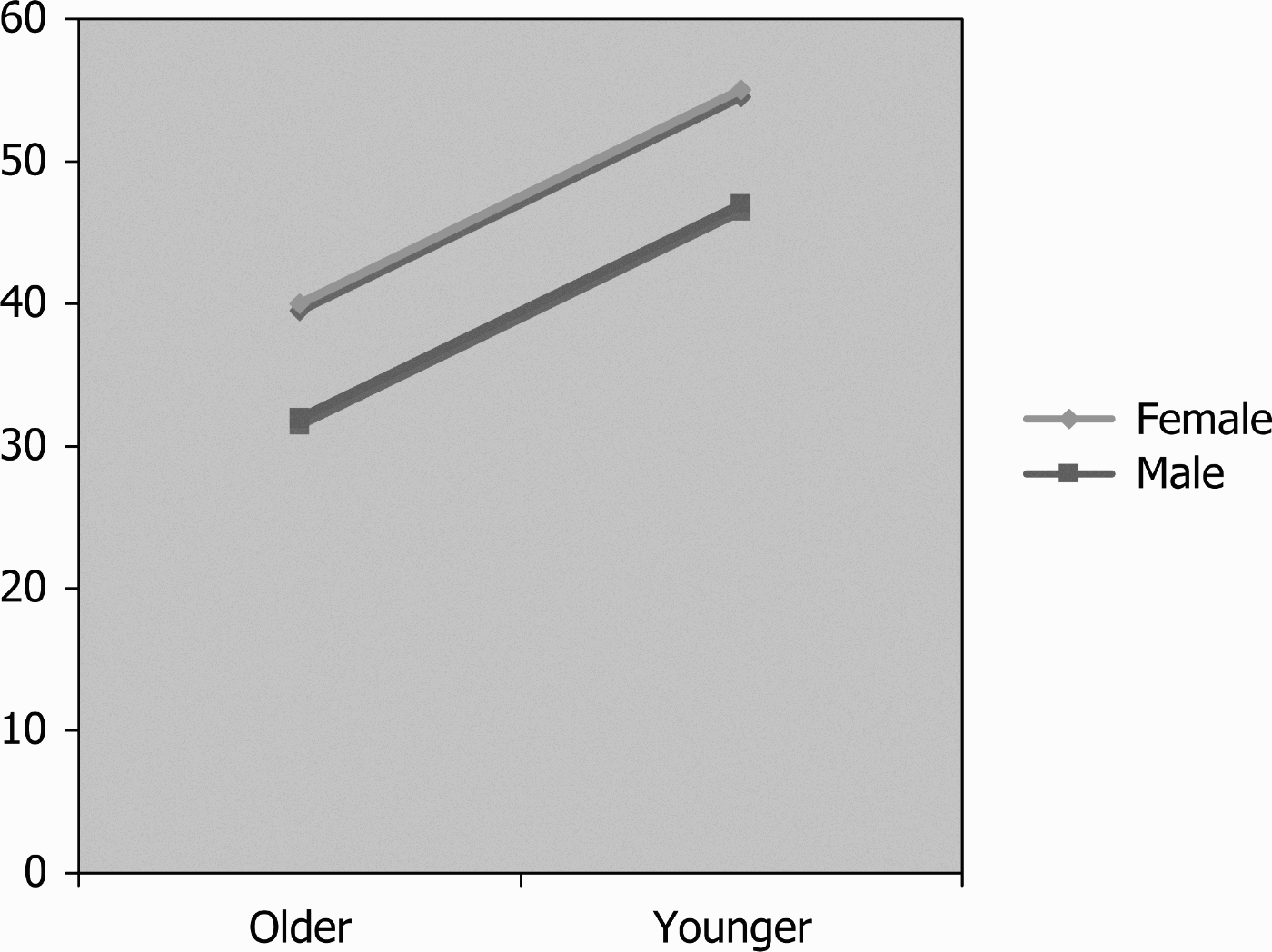
In Auslan, age was the second-order constraint, and the strongest of all significant social factors. Older signers (i.e., those over age 51) clearly disfavor –cf (.411), and younger signers favor the –cf (.565). An early run of VARBRUL showed that people aged 51–70 years and those aged 71+ years all tended to use fewer examples of –cf, whereas those aged 15–30 years and 31–50 years tended to use more; so in later runs, we regrouped these four groups into two (“younger” represents those aged 15–50 years, and “older” those 51 years or over). The next most important constraint was region. Signers in the smaller cities of Adelaide, Brisbane, and Perth disfavor –cf (.456), whereas those in the larger cities of Sydney and Melbourne favor –cf (.554). These two groups result from grouping together these five cities based on patterns found in an earlier run of VARBRUL. Lastly, male signers tend to disfavor –cf (.460), but female signers slightly favor –cf (.536).
In summary, older Auslan signers, signers in smaller state capitals, and men all disfavor the noncitation forms of these signs, but young, female participants from larger cities tend to favor the lowered variants.
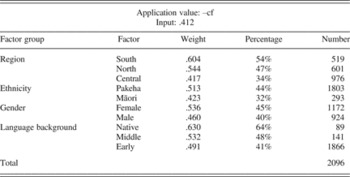
In NZSL, four social factors were significant at the .05 level: region, gender, ethnicity, and language background. These factors are shown in Table 8 with their VARBRUL weights, input, probability, and number of tokens. Region was the strongest social factor. VARBRUL analysis shows that signers from the two largest urban communities, Auckland and Christchurch favor –cf (.544 and .604, respectively), whereas signers from the central region composed of smaller centers disfavour –cf (.417). Gender was significant as well: female signers favored –cf (.536), whereas male signers tend to disfavor –cf (.460). These results correspond with the Auslan pattern that residents of larger urban areas and women are more likely to use a lowered variant.
Social factors (NZSL)

Notes: chi-square/cell = 1.0269; log likelihood: –1319.922; all factor groups significant at p < .05.
Analysis of ethnicity as a social factor shows that Pakeha signers slightly favor –cf (.513) and Māori signers disfavor –cf (.423). Additionally, language acquisition background shows that native signers strongly favor –cf (.630), and those who acquired NZSL in later childhood (between the ages of 7 to 12 years) also favor –cf (.532), whereas early childhood signers (acquired before 7 years old) disfavor –cf (.491). This result should be interpreted with caution, because native signers accounted for only 4% of all tokens and late childhood signers for 7% of all tokens, and the early signers produced most of the tokens.
In summary, NZSL signers from smaller urban areas, Māori signers, and male signers favor the citation forms, whereas signers from larger urban areas, Pakeha signers, female signers, and native signers tend to favor lowered variants. Surprisingly, age was not a statistically significant factor in NZSL, unlike the Auslan study, although the data indicated a trend in the same direction. Language acquisition background appears to have an effect but our small sample of native signers calls for further validation.
DISCUSSION
Our results from both Auslan and NZSL show that location variation in the class of signs formed at the forehead location, exemplified by think, name, and clever, is not random but is simultaneously influenced by a number of linguistic and social factors in these two related signed language varieties. In this section, we shall compare our results with those from the original ASL study, consider the possibility that the lowering of these signs represents an example of language change in progress, and discuss the possible relationship between grammatical function and lexical frequency.
Comparison with ASL results
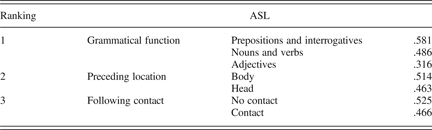
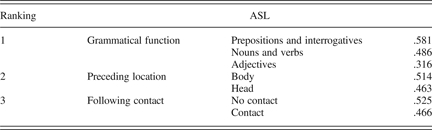
In terms of linguistic and social factors, our results both resemble and differ from the ASL findings. The results for ASL linguistic factors are shown in Table 9. We will discuss here only those factors investigated in all three studies (i.e., preceding and following location, contact with the body, and pauses).
Linguistic factors in ASL
Source: Lucas et al. (Reference Lucas, Bayley, Rose and Wulf2002).
All investigations show that the location of the preceding sign is important, but only in the Auslan and NZSL results do we also see a significant role for the location of the following sign as well. In all cases, adjacent signs produced at the neck or below resulted in the greater likelihood of a lowered target sign. Thus both anticipatory and preservatory assimilation to contiguous segments is at work in Auslan and NZSL, whereas only anticipatory assimilation is found in ASL (it is interesting to note that anticipatory assimilation is the most common form of assimilation in spoken languages as well).
Whether or not an adjacent sign makes contact with the body is also an important factor in all three studies, although Lucas et al. (Reference Lucas, Bayley, Rose and Wulf2002) found it was only significant in the sign following a target sign, whereas our data reveal a role only for the sign preceding a target sign. In addition, the types of influence in each language differ. In the ASL results, preceding signs that make no contact with the body favor the noncitation form, and preceding signs that make contact disfavor it. In the Auslan and NZSL studies, following signs that make contact with the head or subordinate hand disfavor the noncitation form, and those that contact the body favor the noncitation form. It is not clear how to account for these differences, although it may be related to methodological differences in the Australian, New Zealand, and American studies. One weakness in all three studies, however, was that we did not code for variation in contact in target signs themselves (i.e., whether or not target signs that have contact with the body in citation form actually made contact with the body in our data), only whether they were produced in locations other than the forehead region. The results in relation to contact resemble a dissimilation effect, but we would need to know more about the patterns of contact in the target signs to support this analysis.
Lastly, the Auslan and NZSL results also show that whether a sign or a pause follows a target sign is important, with pauses strongly favoring noncitation forms. The results for following location (in which following locations on or near the body rather than the head favored lowering) and for following sign or pause being significant may be related. If the hands are moving away from the forehead region either to produce a sign in the body region or to allow the hands to return to a resting position, then this appears to favor the production of noncitation forms. Thus, our hypothesis that a preceding pause may influence the production of noncitation forms was not confirmed.
Overall, the Auslan and NZSL results indicate relatively more influence from the immediate phonological environment (four significant factor groups) than in ASL (two significant factor groups). There may be two reasons for this difference. It is possible that the influence of phonological factors on location variation is greater in Auslan and NZSL than in ASL, and that the specific details of phonological variation differ from one signed language to the next, as is true of spoken languages. Alternatively, our different findings may reflect different approaches to the investigation of location variation in the two languages. As previously explained, the target signs coded in the Auslan and NZSL studies were all produced in citation form at locations in contact with or in proximity to the signer's forehead, whereas the target signs in the ASL research also included signs made in citation form at locations lower than the forehead, such as ASL see. In particular, Lucas et al. (Reference Lucas, Bayley, Rose and Wulf2002) included lexicalized compounds, such as ASL believe, in which the second component of the sign was always produced at a lower location. This may have had an effect on the types of phonological environment that proved to be significant, particularly those related to the following phonological environment (i.e., following location and following sign or pause).
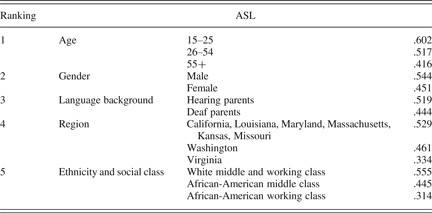
Turning to the social factors in ASL (as shown in Table 10), we find that age was the most significant factor in both the Auslan and ASL results. In both communities, we see younger individuals disfavoring the citation form, and older people favoring it. We also see that regional variation is important, with Auslan, NZSL, and ASL signers in larger urban deaf communities (e.g., Melbourne, Auckland, Boston) disfavoring the citation form, and those in smaller cities and/or deaf communities (e.g., Adelaide, Wellington, Staunton) favoring it.
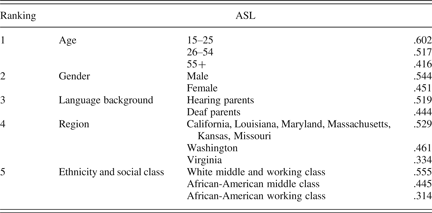
Gender was also important in both sets of results, but it works differently in the Auslan and NZSL data compared with the ASL data. In ASL, female signers tended to be conservative and disfavored the noncitation form, but males favored it. In Auslan and NZSL, however, women favor the noncitation form, and men disfavor it. The ASL results for gender appear to exemplify Labovian Principle Ia, which claims that women use a lower frequency of nonstandard forms than men do when the language change in progress is somehow stigmatized (Labov, Reference Labov1994). Lucas et al. (Reference Lucas, Bayley and Valli2001) pointed out the citation forms of signs in this class are the variants listed in dictionaries, commonly taught in signed language classes and possibly used in more formal situations, and thus the suggestion that they represent “standard” forms seems well-motivated.
Labovian Principle II states, however, that in most examples of language change “from below,” women are more likely than men to innovate or lead the use of new forms (Labov, Reference Labov2001). In the next section, we consider evidence that the lowering of signs in the class of signs exemplified by think, name, and clever represents a language change in progress in Auslan. Thus the fact that women use more noncitation forms in this instance is not surprising in light of Principle II. It may be that in the American deaf community, which might be considered to have a more differentiated social structure than in Australia or New Zealand, the change is stigmatized in some way (i.e., lowering of this class of signs is considered a “lazy” form of signing) and thus women tend to avoid the incoming form because it is perceived as nonstandard usage, whereas the language change in Auslan is not yet widely recognized and thus occurring below the level of signers' awareness. Thus, we may have a change from “above” in the American deaf community, and one from “below” in Australia (Labov, Reference Labov1994).
In ASL, the social factors of language background, ethnicity, and (to a limited extent) social class proved important, whereas language background and social class were not significant in Auslan (ethnicity was not included in the Auslan study, as was already explained). In both NZSL and ASL, language background and ethnicity appeared to be important, but with different effects: ASL signers with deaf parents (i.e., native signers) favored the citation form, whereas signers with hearing parents did not, but the opposite was true in NZSL (remember, however, that numbers of native signer participants were very low in the New Zealand study). Turning to ethnicity and class, White middle- and working-class signers of ASL disfavored citation forms, but African-American working-class signers strongly favored them. African-American middle-class signers also favored the citation form, but not to the same extent as working-class signers. In NZSL, Māori signers favored citation forms, as did African-Americans in general. Thus in ASL and NZSL, ethnic minority signers appear to be more conservative than White signers.
These differing results reflect different sociolinguistic factors at work in the American, Australian, and New Zealand deaf communities. For example, social class differences in ASL location variation and the apparent lack of such differences in Auslan (and the reason it was not included in the NZSL study) reflect the history of educational opportunities for deaf people in these countries. Due to the existence of specialized tertiary educational institutions such as Gallaudet University, deaf Americans have had access to university education for a longer period of time than deaf Australians and New Zealanders have, and this may have allowed more time for a middle class (and middle-class patterns of language usage) to emerge. Lucas et al. (Reference Lucas, Bayley, Rose and Wulf2002) suggested that the results based on ethnicity are not surprising, given other research that suggests that African-American signers tend to use older forms of ASL in general (Lucas et al., Reference Lucas, Bayley and Valli2001), but we have no independent evidence of conservatism in the Māori deaf community in NZSL. Native signers, they suggested, also may be more protective in their attitudes toward ASL and thus more inclined to use what are perceived as more standard forms. This does not appear to be the case for the small number of NZSL native signers, nor the relatively larger sample of Auslan native signer participants with deaf parents (70 individuals compared with 45 in the ASL study). It may be that lowering of signs in these communities has not yet become the focus of any social awareness or stigmatization.
Grammatical function and lexical frequency in signed languages
As we have already discussed, we found grammatical function was significant in an earlier run in both Auslan and NZSL, but that it interacted with another significant factor: lexical frequency. Our findings suggest that it was only a subclass of verbs—the high frequency verbs—that significantly favored noncitation forms in the Australian and New Zealand data. There were no differences based on grammatical function alone, because other types of verbs, nouns, and adjectives all favored citation forms in the same way.
The ASL study (Lucas et al., Reference Lucas, Bayley and Valli2001), however, reports clear differences in the influence of grammatical function on location variation, with prepositions (e.g., for) and interrogatives (e.g., why) clearly favoring –cf, and adjectives (e.g., dizzy) clearly disfavoring it. In their discussion of the relationship between grammatical function and location variation in ASL, Lucas et al. (Reference Lucas, Bayley and Valli2001:146) acknowledged that “as yet unexplored phonological factors may play a role in the patterning of grammatical constraints” on variation in location. Recent research shows that faster rates of target sign production together with target signs occupying initial positions in the phrase are all relevant factors for lowering in ASL (Mauk & Tyrone, Reference Mauk and Tyrone2007), factors that we have not considered here. Lucas et al. (Reference Lucas, Bayley and Valli2001) suggested that the fact that prepositions favor –cf may be related to stress. In spoken languages, prepositions are often unstressed and thus more affected by phonological reduction, so this may equally be true of signed languages. Stress, however, is not yet well understood in ASL or other signed languages (although some work has been undertaken, see Wilbur, Reference Wilbur1990; Wilbur & Schick, Reference Wilbur and Schick1987). As a result, there can be little consensus about how best to code for stress in the kind of naturalistic data used in studies of sociolinguistic variation, and thus it has not yet been attempted.
One variable that Lucas et al. (Reference Lucas, Bayley and Valli2001) did not consider is lexical frequency. This is not surprising, as little information about the frequency characteristics of most signed languages is available, and thus almost no studies of signed language have taken this factor into account (Morford & MacFarlane, Reference Morford and MacFarlane2003). As already mentioned, Bybee (Reference Bybee2002), Dinkin (Reference Dinkin2007), and Philips (1984) noted that high frequency words appear to undergo reduction at a greater rate than low frequency words do, and thus that lexical frequency may be relevant to our understanding of language variation and change. It may be that some of the association between location variation and grammatical function described by Lucas and her colleagues reflects lexical frequency effects. Grammatical function words are much more frequent than many content words. In a small-scale study of the frequency characteristics of ASL reported by Morford and MacFarlane (Reference Morford and MacFarlane2003), 7 of the 10 most frequent lexical items in their minicorpus of 4111 signs are function signs. The preposition for and the interrogative why are also frequent in ASL conversations—they both appear on Morford and MacFarlane's list of the top 37 most frequent signs (these 37 signs represent those lexical items that occur more than four times per 1000 signs in their corpus).
The Auslan and NZSL dataset both lacked functors; however, functors similar to ASL why and for exist in both varieties but are not produced at the forehead location. Instead, we found that high frequency verbs appear to show significantly more lowering. Bybee (Reference Bybee2007) claimed that there is an attested relationship between frequency of use of specific lexical items and generality of meaning and/or polysemy. For example, she explained that verbs (which are often polysemous) have a higher frequency in spoken language discourse. In English, there are more high frequency verbs than nouns and more low frequency nouns than verbs. It may be that our high frequency verbs, such as think and know, are much more frequent in signed discourse than our high frequency nouns such as mother and name, and thus the phonological reduction is relatively greater. Certainly, our data indicate this is the case, as the most common verbs were twice as frequent as the most common nouns. The number of Auslan tokens for think and know, for example, were 469 and 416, respectively, compared with 178 tokens for mother and 166 for name. Further support can be found in data from the Wellington Corpus of NZSL, where think also occurred almost twice as frequently as mother (McKee & Kennedy, Reference McKee, Kennedy and Kennedy1999, Reference McKee and Kennedy2006).
In addition, it may be that repetition of a sign leads to greater phonological reduction. Auslan and NZSL lack a pro-verb, such as English do. Thus, in question and answer sequences (e.g., (a) pro-2 know det man “Do you know that man?”; (b) yes know “Yes, I do”), signers may respond with a repetition of the main verb. This may be less true of nouns, however, because the signer may switch to the use of a pronominal sign to refer back to a referent introduced by a nominal sign. As with speakers, signers may thus economize on articulatory effort when addressees can supplement the signed input with the kind of contextual information provided by repetition (Lindblom, Reference Lindblom, Hardcastle and Marchal1990). Furthermore, frequency strengthens memory representation for lexical items. Experimental studies have shown that participants respond to tasks involving high frequency lexical items more quickly than to tasks involving low frequency words (Bybee, Reference Bybee2007). Thus, recognition of high frequency verbs may occur more quickly, resulting in less need to produce phonologically fuller forms. More investigation is needed, however, to find possible differences in the use and accessibility of higher frequency of signs such as think and know compared with mother and name that can account for our findings.
As with stress, more research is needed into lexical frequency in signed languages before firm conclusions can be drawn, but the Auslan and NZSL results presented here suggest that this factor may be important for an understanding of phonological variation in signed languages. Work on ASL by Mauk and Tyrone (Reference Mauk and Tyrone2007) showed that future studies may also need to take rate of production and phrasal position into account.
Age, sign type, gender, and region
As Lucas et al. (Reference Lucas, Bayley, Rose and Wulf2002) pointed out, the lowering of signs made in the forehead region in ASL appears to be an example of a language change in progress. This claim is based first on the “apparent time hypothesis” (Bailey, Reference Bailey, Chambers, Trudgill and Schilling-Estes2002), which suggests that variation in the linguistic system used by speakers of different ages at a single point in time can indicate a change in progress. Although this rests on the assumption that the linguistic usage of a particular age group will not change as this group grows older, this inference has proven reliable in a large number of studies (Chambers, Reference Chambers1995). It also stems from the fact that the lowering of signs made in the forehead region may reflect a more general pattern in ASL dating back to the nineteenth century. As was first observed by Frishberg (Reference Frishberg1975), ASL signs previously produced in more peripheral areas of the visual field (e.g., help) appear to have moved toward more central areas over time.
We would like to draw on the apparent time hypothesis and the fact that lowering of signs is possibly also a historical process at work in the BSL family of signed languages (e.g., Kyle & Woll, Reference Kyle and Woll1985, pointed to historical evidence showing that the sign maybe in BSL has moved over time from a forehead location to one in neutral space) to suggest that the age variation we have found may also indicate a change in progress in Auslan. When we analyze the Auslan results by sign type and age (as shown in Figure 4), we find that the percentage of both categories of signs in noncitation is higher for younger than older signers, as is clearly shown in Figure 4. The NZSL data indicated a similar trend in younger and older signers, but differences proved not to be statistically significant.
Age and sign type (Auslan): HFV stands for “high frequency verbs” and O is “other,” representing high frequency nouns and adjectives, low frequency nouns and adjectives, and low frequency verbs.

In addition, we find that the pattern of diffusion across the research sites also illustrates a typical spread of language change through a community. Research on the pronunciation of vowels in the American English spoken in large northern cities in the U.S., such as Chicago and Detroit, shows that the standard vowel /æ/ is raising and fronting to /ɛ/ so that bat sounds like bet (Labov, Reference Labov1994). This change (known as the Northern Cities Vowel Shift) has started in these larger, densely populated urban areas. Because of their importance as cultural centers, the change has spread to other parts of the country, but it has not done so all at once. Research has shown that first it spread to moderately sized cities, followed by smaller cities, and finally to rural areas, in a pattern known as “cascade diffusion.”
Similarly, in Auslan and NZSL, we find that when we analyze our results by age and region, we see that both younger and older signers in the larger urban centers use a higher percentage of noncitation forms than younger and older signers in the smaller cities do (see Figure 5 regarding Auslan).
Age and region (Auslan).

Lastly, we find that an analysis of age and gender in the Auslan data (see Figure 6) shows that younger women use more noncitation forms than older women, younger men more than older men, and women use more than men in the same age group. As already mentioned, this is an extremely common pattern in language change.
Age and gender (Auslan).
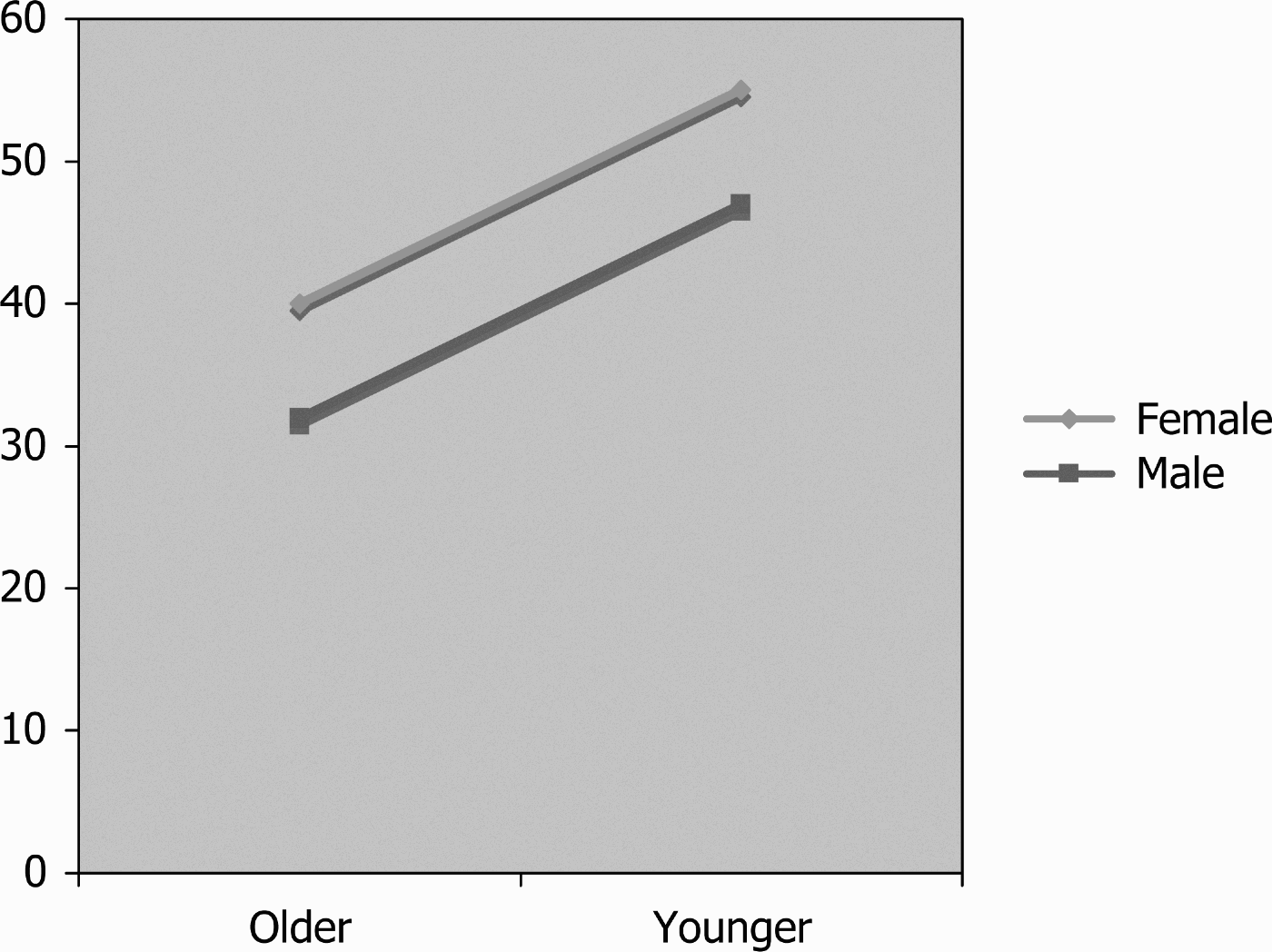
CONCLUSIONS
Our results (drawing on the VARBRUL analysis of data from 205 deaf native and fluent signers in five cities of Australia, and 138 native and fluent signers from five sites in New Zealand) indicate that location variation in the class of signs exemplified by think, name, and clever is a textbook example of a sociolinguistic variable influenced by linguistic and social factors, as has also been reported for this class of signs in ASL. Our findings also resemble many other examples of phonological variation in spoken languages (Chambers, Trudgill, & Schilling-Estes, Reference Chambers, Trudgill and Schilling-Estes2002). Our results strongly suggest that, as has also been proposed for ASL, the lowering of signs made in the forehead region is a language change in progress in Auslan, led by younger signers and those in large urban centers. Unlike the ASL results, we find that this change appears to be led by women, and we do not find evidence that differences in social class correlate with variation in this phonological feature of Auslan. This result may reflect differences in the social structure, history, and language attitudes in the Australian and American deaf communities. Moreover, the linguistic factors indicate a relatively greater role for assimilation in Auslan and NZSL than has been reported for ASL, although this may partly reflect methodological differences between the studies. Lastly, our combined findings suggest a role for lexical frequency working in tandem with grammatical function in Auslan and NZSL, something not previously investigated in any signed language.