


INTRODUCTION
Research on narrative in the last twenty years has underscored its irreducible context- dependency and embeddedness in different contexts (among others see Goodwin Reference Goodwin and Bamberg1997, Ochs & Capps Reference Ochs and Capps2001, Georgakopoulou Reference Georgakopoulu2007, papers in De Fina & Georgakopoulou Reference De Fina and Georgakopoulou2008). Research interviews are among the most common contexts for the collection of narrative data and yet very little attention has been devoted to the analysis of how narratives are generated and managed in such settings. This neglect is all the more surprising if one thinks of the pervasive role of the interview among the qualitative methodologies used by analysts who embrace the narrative turn (e.g. Bruner Reference Bruner1987, Polkinghorne Reference Polkinghorne1988, McAdams Reference McAdams1993), and of the ubiquity of elicited narratives in sociolinguistic investigation (Labov Reference Labov1972a, Schiffrin Reference Schiffrin1996). However, as Atkinson and Delamont (Reference Atkinson and Delamont2006) have underscored, the tendency of many studies is to treat the interview as a kind of transparent context, as demonstrated by the absence of interviewers' comments on many interview transcripts.
It must be noted that attempts to draw attention to the methodological issues related to the use of interview contexts have been repeatedly made in the past and in more recent times. For example, one line of inquiry has dealt with narrative elicitation techniques pointing to their consequences for data collection and analysis (Mishler Reference Mishler1986). Other researchers have focused on interviewers' participation in narratives and/or involvement with their interviewees (Wortham Reference Wortham2001, Bell Reference Bell, Fina, Schiffrin and Bamberg2006). Yet another line of inquiry has dealt with the question of how the researcher/interviewer gets to the interpretation of narrative data (Johnson Reference Johnson2008, Riessman Reference Riessman2008). Finally, arguments have been made in favor of the close scrutiny of the narrative genres that are produced in interview settings (De Fina Reference De Fina2009). To make further progress in this area, analysts should scrutinize all of the different types of research contexts in which narratives are produced in order to understand not only the nature of their data, but also the ways in which narrators, audiences, and the texts that they produce shape, and are shaped by, these particular environments. In this article, I take a step in this direction by focusing on the influence of researcher/informant roles on the types of narratives that are produced and on the ways in which storytelling interactions are managed. In particular, I show that storytelling activities and story types both reflect and shape relations among participants based, among other factors, on their local management of situational and portable identities. I argue that one important methodological consequence of the analysis is that, as noted by many scholars who have debated the relationships between data and research contexts (Cicourel Reference Cicourel1964, Briggs Reference Briggs and Duranti2001, Rapley Reference Rapley2001, Speer Reference Speer2002), all data are irreducibly context-bound in such a way as to make it impossible for analysts to separate the observed from the observer. I also discuss how a treatment of the research event and of storytelling in it as a real interactional encounter can shed light on issues related to the insider-outsider status of the researcher and to the Observer's Paradox (Labov Reference Labov1972b).
THE STUDY
Data for this study come from a research project conducted in 2002 and 2003 among Italian Australians in Melbourne (see Ciliberti Reference Ciliberti2007). The main objectives of the project were to provide insights into the question of whether an Italian identity is “still identifiable as a collection of typical cultural traits” (Cilibertie Reference Ciliberti2007:8) and to observe how it is constructed in family interaction. Seven families were contacted through the city's Italian Circolo and three Italian researchers traveled to Australia in order to collect the data that were later analyzed by a team of investigators. Since the research focused on interactional events in which members of different generations got together, the families were asked to invite the researcher(s) to a convivial occasion such as a Sunday lunch or dinner. The researcher(s) interviewed at least one member of the family to collect biographical and sociolinguistic data and then participated with the whole family in the convivial event, which was video-recorded.
During the event researchers sometimes kept quiet and sometimes asked questions to children and family members. In line with methodological assumptions typical of much sociolinguistic inquiry, investigator neutrality was sought in all possible ways. Thus, the initial expectation was that researchers would be observing the interaction without much participation in an attempt not to change the dynamics of family communication. However, this idea soon turned out to be naïve. The presence of researchers coming from Italy became a central element in the events as family members related to them in all kinds of ways: from offering them food, to telling them stories about their past or present, to asking questions about Italy. In that sense, the researchers became not only impossible to ignore in the data analysis, but a catalyst for the coalescence of a variety of phenomena related to identity negotiation and language use. For example, family members commented on the presence of the camera, asked researchers how they should behave when filmed, inquired on what they were looking for, and invited their children to show off the Italian they knew or had learned at school. In addition, participants were focused on trying to meet presumed researchers' expectations. In sum, as implied in the Observer's Paradox, the interactional event could not have been the same had the researchers been absent.
In particular, reciprocal identity positioning and presentations at different levels turned out to be of central importance. At the level of situational identities (Zimmerman Reference Zimmerman, Antaki and Widdicombe1998:90), reciprocal positioning as researchers and subjects respectively was highlighted in the interactions. Another situational role that turned out to be often implicitly negotiated was the researchers' status as guests of the family. Because of it, a lot of attention was devoted to them, to their appreciation of the food, to the building of a good impression of the family. Yet another aspect of the participants' identities that turned out to be important, and one to which I devote attention in the analysis that follows, refers to their more portable identities in terms of origins or of belonging. Participants implicitly or explicitly negotiated each other's characterization as Italians, regional Italians, Australians, foreigners, and so forth, depending on the case. Such negotiations were clearly foregrounded because of the presence of Italian participant observers. The three researchers were all from Italy but all could speak and understand English. Family members, by contrast, ranged from immigrants who had been born in Italy and had come to Australia as adults and who spoke Italian, English, and dialectFootnote 1 to second generation sons and daughters and third generation children born in Australia—all English speaking but with varying degrees of competence in Italian. Given these different geographic origins and language competences, people positioned themselves in different ways vis-à-vis the researchers, some treating them as country men and showcasing a variety of commonalities, others dealing with them as members of a different culture to which they were to some extent related, but also alien.
An interesting site to explore these positionings is storytelling because of the significance of narrative activity for the construction of interpersonal rapport. Indeed, storytelling was common during these family gatherings. Narratives were told to break the ice, to support arguments, to reconstruct family history, to amuse, and so forth. But the kinds of stories that were told in each event and the way that they were negotiated also indicated the many ways in which discourse is shaped by and shapes relationships among people. Storytelling was a prime site for identity negotiation and rapport creation between family members and the researchers, but it was also a terrain for the negotiation of personal and family identities that were closely correlated with the perception and negotiation of the interviewers' identity. As amply discussed by scholars who have written on identity (De Fina Reference De Fina2003, Bucholtz & Hall Reference Bucholtz and Hall2005, De Fina, Schiffrin, & Bamberg Reference De Fina, Schiffrin and Bamberg2006), identity construction is a dialogic and reciprocal process in which “the other” is as important as the self; the kinds of identities that people present crucially depend on who they understand their interlocutors to be. To illustrate these different positionings and negotiations, I use narratives told in two families that I call the Moretti and the Romano family.Footnote 2
THE MORETTI FAMILY: DIALECTS AND REGIONAL IDENTITIES
The event tape-recorded at the Moretti home was a lunch. The participants were the grandfather, grandmother, one daughter, two sons, and the Moretti's daughter-in-law with their children. I need to clarify here that I refer to members of the first generation as grandparents, to members of the second generation as daughters and sons, and to members of the third generation as granddaughters and grandsons. The researcher was a male from the Veneto region. The Moretti grandparents come each from a different Italian region (the grandfather is from Piemonte and the grandmother from Basilicata). They have been in Australia for more than thirty years, their children and their children's children were born in Australia. The exchanges at the table are mostly in Italian, with some incursions into English. When the researcher is not present, however, the members of the second generation speak to each other in English. The conversation with the researcher revolves around the family, its history, and customs. Since the beginning the researcher is treated as a regular guest as he is invited to sit down and try different foods, but his identity as an investigator is also addressed since the grandfather spontaneously informs him about activities (especially food-related) of Italians in Australia. The narratives told in this event are mainly family anecdotes and reports of traditional activities such as the making of tomato sauce or of wine. There are no travel stories and no narratives about cross-cultural misunderstandings of any kind. In that sense, there is a notable absence of focus on Australian or immigrant identities as possible sites of confrontation and comparison with the researcher. In other words, while situational identities as researcher/participants are made relevant through the continuous information provided to the investigator on the activities of the family and on some characteristics of the Italian-Australian community, potential differences between Italian and Italian-Australian identities are downplayed and identity negotiations happen at a level that is typical of interactions between Italians in Italy, that is, at the level of regional identities. Indeed, part of the storytelling that takes place is devoted to this topic. For example, at the beginning of the lunch G (L's daughter) asks the researcher what city he is from and later S (the grandfather) explains that he is from the Piemonte region. After this, he addresses his granddaughter in a dialect that turns out to be from the Veneto area. This exchange is the source for the telling of three family anecdotes. The original exchange and the three anecdotes are reproduced below.Footnote 3 At the beginning of the transcript S encourages his granddaughter to eat and then L and G talk about giving her another piece of pizza.
(1) La matt
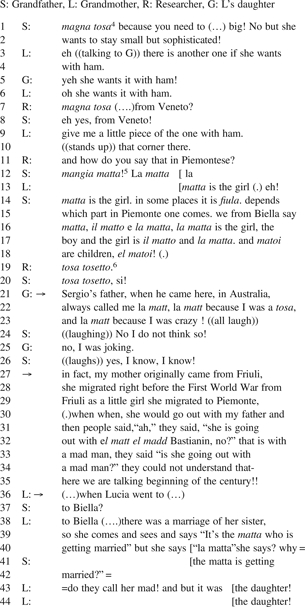
At the beginning of the transcript, S addresses his granddaughter in dialect, telling her to eat (line 1). After a few exchanges between grandmother and daughter (lines 3–6), the researcher (R) asks S if he has spoken in the Veneto dialect and he confirms. So, the researcher asks him now how he would say the same thing in his own Piemontese dialect (line 11). Both S and his wife explain that a “girl” in Piemontese is called matta, which in Italian means “mad”, so this ambiguity is the source of the three related narratives told respectively by the daughter, the grandfather, and the grandmother. The first one (lines 21–26) is a small anecdote, told to make a funny point. On line 21 G recounts that her stepfather's father used to call her matta and she jokes on the reasons why he used to do so: because she was a girl and because she was crazy. Then the father talks about the same ambiguity, but this time the anecdote refers to his mother's relatives who came from a different region of Italy and wondered why their daughter's fiancée was called “mad” (lines 27–35). Finally, L tells a similar anecdote in which a friend of hers tells someone that her sister (“the mad one”) was going to be married (lines 36–42).
There are a number of facts to notice about these narratives: participants have established a symmetrical relationship with the researcher, such that questions go back and forth from him to participants and vice versa and he is not called to take up a prominent role as an interviewer. Second, he is treated as sharing the Italian culture of regionalism so that he is told stories about dialects and regional particularities from the perspective of Italians who see their differences in those terms. The researcher aligns himself to this role. Notable here is also the fact that all of the family members participate in co-constructing both this type of relationship with the interlocutor and the family performance related to it. This is particularly interesting in the case of G, the daughter, who, not only in this conversation but throughout the event, does not take any stance that may stress her difference in terms of language preference or identity claims with relation to her parents. Although her preference for English in conversations with her brothers is an indication of the fact that she is Australian born, as is her more limited command of the Italian language, she always joins in and participates in the family choir attuning herself to the type of conversation that has been established by her parents. The whole event is centered on the performance of a family identity in which the elements that are focused upon are the traditional, but also the collective character of family activities. What is notable here is the absence of references to individual or collective identities as Australian or immigrants and the leveling of differences in terms of belonging to the community of Italians with the interlocutor.
THE ROMANO FAMILY: BEING A FOREIGNER IN ITALY
Participant relations and storytelling events are very different in the second family interaction that I examine below. In this case, we also have the family sitting at the table for a meal. The protagonists are again members of a three-generation family, but in this case all members are Australian born of Sicilian origin. The grandparents speak Italian and Sicilian, which they use with relatives in Australia. The children also speak some Italian, but not the grandchildren. The researchers are two women, one from Florence and the other from Bologna. Here we notice that the positioning between researchers and family members is completely different. Researchers ask questions about language use to family members and sometimes switch into English in order to be better understood. There are moments in the event in which the grandmother and the researchers work on their similarities, and other moments when their differences in terms of macro-identities are clearly stressed. Talk about travel to Italy illustrates these alternations in positioning. At different points in the event, the grandmother (R), and her husband (M) and son (F) tell the researchers (A) and (P) (who was present but does not speak in any of the fragments reproduced) small anecdotes about a trip that they took to Italy. The genre of the travel narrative is very much present in this and other events in this corpus as immigrants use the trope of the trip to Italy as an occasion to make all kinds of connections with their land of origin. At a certain point in the interview there is talk about Italian food, and members of the family notice that in Italy arancini, a typical Sicilian food, were commonly found in the south but not in other parts that they visited. In connection with this R starts telling a narrative of how they found by chance a shop that sold them in Florence. I reproduce the beginning of the narrative below.
(2) Looking for arancini in Firenze

R's narrative started as an illustration of how she and her husband were able to find arancini in Florence, but it turned into an occasion for an exchange in which the researchers position themselves as experts on Italian food matters, thus implicitly assigning the family members the role of foreigners. Notice that the researcher (A) interrupts the telling to ask R what she and her husband mean when they talk about arancini (line 12). When R and M explain that they refer to food items made of rice or spinach (lines 15, 16, 17), A corrects them explaining that the name arancini is wrong for the food items that they were looking for (lines 18–19), that these rice balls in Rome are called supplì (lines 22–23) and that arancini for her are a type of cake eaten in the south. This exchange on the different regional foods goes on for a while in the same way, especially with A, and occasionally the other researcher (P), explaining to M and R how arancini and supplì are made and where they are eaten. Only after this side sequence ends is M able to finish the narrative initiated in line 1, explaining how they had found the small vendor by chance (lines 6, 9–11, 15) and concluding that he considered finding the arancini an “incredible treasure” (line 19). The transcript of this part is reproduced below:.
(3)
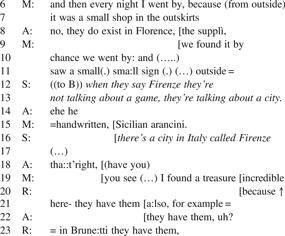
This narrative clearly illustrates how since storytelling is an occasion for different types of reciprocal positioning the latter influence how narratives develop and are understood. Indeed, it is possible that R and M had started telling the story in order to illustrate how they knew and appreciated the traditional food of their region of origin (Sicily). M's final evaluation equating finding arancini with finding a treasure (line 19) would point in that direction. But we also saw that in the course of the storytelling the interviewers (particularly A) aligned themselves as experts on the way regional foods are named and where they can be found in different parts of Italy therefore casting the storytellers as people who do not belong to the culture. Thus, as the narrative unfolds, the interviewers negotiate it more as a story about “foreign-ness” than as a story about attachment to traditions. Indeed, M's evaluation about finding a treasure (line 19) does not find any follow up, and R's next turn (line 20) changes the direction of talk as she starts explaining that arancini are available in Australia. The conversation that develops focuses on different regional foods, and at the end R tells another story about how her mother cooked traditional Italian food (fava bean soup), which induces A to a realignment in which she stresses her similarities with R (they both like fava beans). Due to space limitations, I cannot fully discuss these developments (but see De Fina Reference De Fina and Ciliberti2007 for an analysis). The point is that, contrary to what happened in the interaction with the Moretti family, the identities that were being negotiated in this setting included implicit oppositions between being Italian, Australian of Italian origin, and foreigner.
DISCUSSION
The difference between the positioning between researchers and families in the two cases and the way they relate to the kinds of narratives that get told can be clearly appreciated. In case of the Romanos, we have moments of clear separation between researchers and family members as belonging to different communities, and negotiations occur around this delimitation. In the case of the Morettis, these kinds of differences are not put into play at all, and family members all work to underscore a traditional regional Italian identity. Narratives constitute an interactional occasion for the shaping of this context. In particular they contribute to creating, negotiating, and fostering:
• Situational roles: interviewer/guest/interviewee/host
• Macro roles: Italian, regional Italian, Italian-Australian, Australian, foreigner
The analysis demonstrates a point that many scholars (see Cicourel Reference Cicourel1964, Briggs Reference Briggs and Duranti2001, Rapley Reference Rapley2001, Speer Reference Speer2002) have made: research contexts have a constitutive role in shaping the data collected. In that sense the Observer's Paradox is a reality and researcher's neutrality is most likely an impossible aim. This does not mean, as some have suggested (see Potter Reference Potter and Richardson1996), that research interviews and research data generating contexts should be abandoned altogether. What this data shows is that the status of the researcher is negotiable and negotiated within research situations and leads to very different development depending on the way participants align to each other. Thus, as highlighted in debates about this topic (Naples Reference Naples1996, Reinharz Reference Reinharz and Herz1997, De Andrade Reference De Andrade2000), being an insider or an outsider in a community is a negotiable issue in many research contexts. However, the analysis also illustrates another important point about the interaction between researchers, informants and contexts, that is, that both insider and outsider status for researchers—and therefore also the informants' recognition of their position as “observed”—may provide opportunities for insights into the nature of social phenomena, as long as one is willing to treat research contexts as truly interactional settings. In this case, for example, it is clear that the original objective of observing identity being constructed among the families in their natural setting was unattainable. The presence of the researchers, however, allowed for an appreciation of how relational and negotiable identity categories are and therefore of how abstract the construct “Italian identity” is. Indeed, analyzing these transcripts we learn that immigrants may negotiate a variety of categories that can be related to their origin—from “traditional,” regional identities, to mixed identities as Italian and Australian—and that they may accept or resist being cast as foreigners. These negotiations probably would have never surfaced had the researchers been absent.
APPENDIX: TRANSCRIPTION CONVENTIONS
- ((smiling))
Nonlinguistic actions
- (…)
Inaudible
- (.)
Noticeable pause
- .
Falling intonation followed by noticeable pause (as at end of declarative sentence)
- ?
Rising intonation followed by noticeable pause (as at end of interrogative sentence)
- ,
Continuing intonation: may be a slight rise or fall in contour (less than . or ?); may not be followed by a pause (shorter than . or ?)
- word →
Listing intonation
- -
Self interruption
- =
Latched utterances by the same speaker or by different speakers
- ______
Emphatic stress
- CAPS
Very emphatic stress
- ::
Vowel or consonant lengthening
- [
Overlap between utterances
- → (line)
Highlights key phenomena
- italics
Code-switched utterance from Italian into dialect or English


