Introduction
The Wuhai area, which is situated in the southwest of Inner Mongolia Autonomous Region (Fig. 1A), was in the marginal and deep part of the North China plate during Ordovician time (Feng et al., Reference Feng, Wang, Zhang, Zhuo, Zhang, Hong, Chen, Wu, Chen, Chi and Yang1990, Reference Feng, Bao, Kang, Zhang, Tan, Li, Pang and Zhao1999; Feng et al., Reference Feng, Peng, Jin and Bao2004; Feng et al., Reference Feng, Bao and Zhang1998; Fu and Zheng, Reference Fu and Zheng2001; Li et al., Reference Li, Chen, Li, Wang, Wang and Ma2012). The Ordovician strata of the Wuhai area are biostratigraphically important because of the richness of their macrofaunas and microfaunas (e.g., Lu, Reference Lu1954; Mu, Reference Mu1959; Zhang, Reference Zhang1959; Zhang, Reference Zhang1962; Chen, Reference Chen1976; Wang and Luo, 1984; An and Zheng, Reference An and Zheng1990). These fossiliferous Ordovician strata are nearly 1000 m thick (An and Zheng, Reference An and Zheng1990) and are exposed around the town of Hainan. They represent continuous deposition on the western edge of the North China plate.
Locality map. (A) Index map showing the location of the Wuhai area in the western part of North China. (B) Locality map of the study area. (C) Map showing the distribution of Ordovician rocks and the localities of the study sections in the study area.

Ordovician conodonts of the Wuhai area were first reported by An et al. (Reference An, Zhang, Xiang, Zhang, Xu, Zhang, Jiang, Yang, Lin, Cui and Yang1983), who described seven species from the Klimoli and Wulalike formations. Based on the findings, they made a correlation of Ordovician lithological successions between Wuhai and the North China Platform (An et al., Reference An, Zhang, Xiang, Zhang, Xu, Zhang, Jiang, Yang, Lin, Cui and Yang1983, table 13). Shortly afterward, Wang and Luo (1984) documented in more detail the Ordovician conodonts of the area, and recognized six Ordovician biostratigraphic units from the Zhuozishan Formation to the Sheshan Formation. An and Zheng (Reference An and Zheng1990, p. 29–39) subsequently studied the Ordovician conodonts from the Wuhai area in a comprehensively bed by bed recording of species. Most recently, Wang and colleagues (Wang et al., Reference Wang, Bergström, Zhen, Chen and Zhang2013b; Wang et al., Reference Wang, Bergström, Zhen, Zhang, Wu and Chen2013c) examined the conodont fauna of the Klimoli Formation in the Dashimen Section, which is approximately 20 km south of the town of Wuhai, and distinguished two conodont biozones in the Klimoli. In addition, the Ordovician conodont zonations of the Wuhai area were reported briefly in two other publications (Chen et al., Reference Chen, Zhou, Lin, Yang, Zou, Wang, Luo, Yao and Shen1984; Feng et al., Reference Feng, Bao and Zhang1998). These investigations have greatly improved our knowledge of Ordovician conodonts from marginal areas of the North China plate. However, most of these publications were written in the Chinese language, and the latest taxonomic and biostratigraphic views have not been represented. This makes those studies, which form the basis for the understanding of the Chinese Ordovician conodonts, not widely available or else inaccessible to international researchers. Therefore, we present this taxonomic and biostratigraphic study of this critical area in North China.
During a field survey in August of 2011, limestone samples were collected from two well-exposed sections of the Wuhai area (Fig. 1). These yielded well-preserved conodonts that span the middle Darriwilian to the earliest Sandbian. In the present study, we identify these conodonts and the conodont biostratigraphy, and discuss the paleoecology of this fauna.
Geological setting
The Wuhai area is 430 km southwest of Hohhot (the capital city of Inner Mongolia Autonomous Region) and 140 km northeast of Yinchuan (the capital city of Ningxia Autonomous Region) (Fig. 1B). It is located in a nearly south-north striking intracontinental deformation zone, which starts from the Zhuozishan Mountains to the north, goes along the Helanshan Mountains southward, and ends at the Liupanshan Mountains to the south; to the northwest of this belt is the Alax massif, to the southwest is the North Qilian Orogenic Belt, and the stable North China Plateform is to the east (Darby and Ritts, Reference Darby and Ritts2002; Huang, Reference Huang1992; Zhang et al., Reference Zhang, Li, Liu and Feng2011; Zhang et al., Reference Zhang, Ma and Ren2004).
During Middle to Late Ordovician time, the Wuhai area was located on the west margin of the North China plate, which is one of the largest Early Paleozoic plates in China. The North China plate extends beyond Yinshan Mountains to the north, beyond Helan Mountains to the west, to the Qilian Mountains, Qinling Mountains, Funiu Mountains, and Dabie Mountains in the south, and to the sea in the east. The area of the plate is about 1,200,000 square kilometers, and its general outline looks like an upside-down triangle. According to Feng et al. (Reference Feng, Wang, Zhang, Zhuo, Zhang, Hong, Chen, Wu, Chen, Chi and Yang1990), the main part of North China plate was a flat and stable carbonate platform and was covered by a very broad epeiric sea during the Early and Middle Ordovician. In the Late Ordovician, the carbonate platform was uplifted, nearly all seawater withdrew from it, and an uplifted land of large area, North China Land, appeared. Marine deposits occurred only in a narrow “L-shaped” belt at the west and south-west margins of the North China plate. The west margin of the plate was slope environments, and the slope was likely relatively steep because deep-water shale and sandstone facies belts contact land margins directly; the southwest margin of the plate was also slope environments, but the slope was relatively gentle in that a shallow water small scale carbonate platform developed close to the land margin, and south of the carbonate platform were deep water slopes and basins of the ancient Qinling ocean (Feng et al., Reference Feng, Wang, Zhang, Zhuo, Zhang, Hong, Chen, Wu, Chen, Chi and Yang1990, Reference Feng, Bao and Zhang1998, Reference Feng, Bao, Kang, Zhang, Tan, Li, Pang and Zhao1999, Reference Feng, Peng, Jin and Bao2004).
Ordovician rocks are well exposed and widely distributed in the Wuhai area, and they constitute the main body of the Zhuozishan and Gangdel Mountains around the Wuhai City. The Ordovician System, a sequence of mixed carbonate and clastic facies, of the Wuhai area disconformably overlies the Late Cambrian Gushan Formation and is disconformably overlain by the Early Carboniferous Benxi Formation. After a review of the lithostratigraphic units proposed by Lu (Reference Lu1954), Guan and Che (Reference Guan and Che1955), Mu (Reference Mu1959) and Zhang (Reference Zhang1959), Chen et al. (Reference Chen, Zhou, Lin, Yang, Zou, Wang, Luo, Yao and Shen1984) grouped the Ordovician strata of the Wuhai area into seven formations, namely the Sandaokan, Zhuozishan, Klimoli, Wulalike, Lashizhong, Gongwusu and Sheshan formations in ascending order. This lithostraigraphic scheme has been widely accepted (Wang and Luo, 1984; An and Zheng, Reference An and Zheng1990; Feng et al., Reference Feng, Wang, Zhang, Zhuo, Zhang, Hong, Chen, Wu, Chen, Chi and Yang1990, Reference Feng, Bao and Zhang1998, Reference Feng, Bao, Kang, Zhang, Tan, Li, Pang and Zhao1999, Reference Feng, Peng, Jin and Bao2004; Fu and Zheng, Reference Fu and Zheng2001; Li et al., Reference Li, Chen, Li, Wang, Wang and Ma2012; Wang et al., Reference Wang, Bergström, Zhen, Chen and Zhang2013b, Reference Wang, Bergström, Zhen, Zhang, Wu and Chen2013c), and is also adopted by the present authors.
Lithology
The conodont samples investigated in this study were collected from two sections, the Wolonggang Section and the Hatuke Creek Section (Fig. 1C). These two sections constitute a continuous middle Darriwilian and lowermost Sandbian succession in the study area.
The Wolonggang Section (39°22ʹ02ʺN, 106°52ʹ44ʺE), a wide erosional stream-cut gorge near the Wolonggang transformer substation, is about 8 km south of the town of Hainan. The Klimoli Formation, well exposed along the gorge, consists of 11 beds with a total thickness of 225.68 m (Fig. 2). Its lower two-thirds consist primarily of alternating beds of black marl and calcareous mudstone, occasionally intercalated with thin-bedded packstone as well as medium-bedded wackestone. The upper one-third is dominated by black gray thin-bedded marl, except for the top 11.35 m, which is black graptolitic shale. The rocks strike NE (82°–86°) with a dip of 30°–33°. Wang et al. (Reference Wang, Bergström, Zhen, Chen and Zhang2013b) subdivided the Klimoli Formation (approximately 65 m thick) of the Dashimen Section (=the Hatuke Creek Section of this paper) into two parts: the Lower Klimoli Formation, approximately 43 m thick, which is dominated by limestone; and the Upper Klimoli Formation, approximately 22 m thick, of graptolitic black shale without limestone interbeds. An and Zheng (Reference An and Zheng1990) found both the lithology and the thickness of the Klimoli Formation vary significantly from place to place in the Wuhai area. It is observed that the thickness of this formation ranges from 292 m at the Wolonggang Section to 80 m at Hatuke Creek section, and clay content dramatically increases at the latter section. The Klimoli Formation in the Hatuke Creek Section is, therefore, more condensed, making the Wolonggan Section the better section for biostratigraphic study.
Lithology and stratigraphic distributions of conodont species, and the conodont zonation in the Wolonggang section.
The Hatuke Creek Section (39°28ʹ30ʺN, 106°49ʹ43ʺE) is approximately 6 km northeast of the town of Hainan. The Ordovician rocks crop out along the dry Hatuke Creek to the ridge of a low hill. This more than 250 m Ordovician section contains four lithostratigraphic units: the Zhuozishan, Klimoli, Wulalike and Lashizhong formations. Only strata from the upper part of the Klimoli Formation to the base of the Lashizhong Formation were measured and sampled in the present study (Fig. 3), and they strike 198°–200° and with dips that range from 15° to 40°. The upper part of the Klimoli Formation, which corresponds to the top of the lower Klimoli and the upper Klimoli of Wang et al. (Reference Wang, Bergström, Zhen, Chen and Zhang2013b), displays a gradual lithological transition from marl upward to graptolitic black shale. The overlying Wulalike Formation, whose lower limit is drawn at the bottom of a widespread brecciated packstone, consists of about 40 m of black shale in the lower part and about 100 m, of chiefly greenish yellow silty shale in the upper part. Several layers of thin-bedded marl, which yield a large number of conodonts, intercalate in this formation. At the top, the Wulalike Formation is capped by the sandstone-dominated Lashizhong Formation.
Lithology and stratigraphic distributions of conodont species, and the conodont zonation in the Hatuke Creek section.
Conodont biostratigraphy
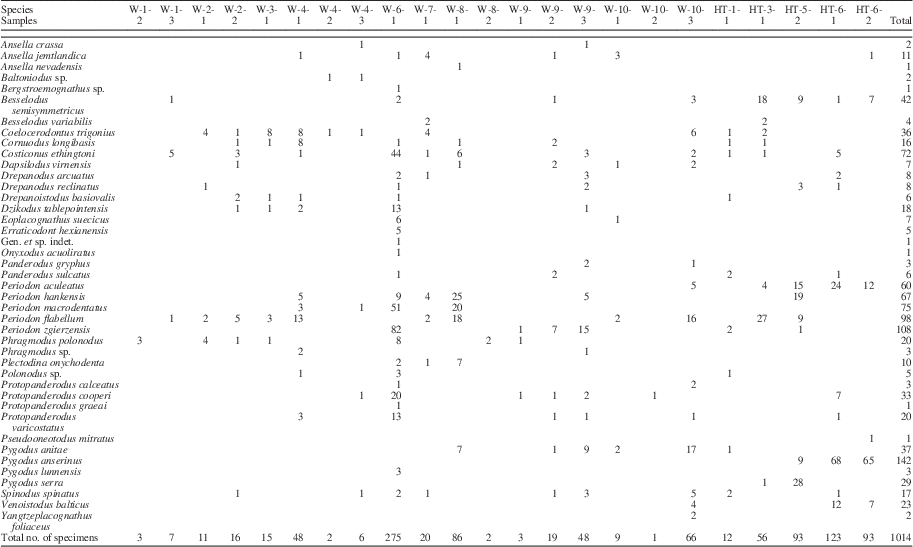
A total of 28 limestone samples were collected from the Wolonggang and Hatuke Creek sections. All samples, which weighed 2.5 kg on average, were treated with diluted acetic acid and heavy liquid to isolate conodonts. Forty-two species belonging to 26 genera were recovered and systematically studied (Table 1). The recovered conodonts are commonly excellently preserved and they occur in large numbers in some samples. Having a color alteration index (CAI) of 1–2, these conodonts show very little, if any, evidence of having been heated.
Distribution of conodont species recovered from 18 samples (headed by W) collected rrom the Wolonggang section, and 5 samples (start with HT) collected from the Hatuke Creek section
Three conodont zones and three subzones can be discriminated in the Wolongang Section (Fig. 2). In ascending order, they are: the Dzikodus tablepointensis Zone, the Eoplacognathus suecicus Zone (including the Pygodus lunnensis Subzone and the Pygodus anitae Subzone), and the Pygodus serra Zone (only the Yangtzeplacognathus foliaceus Subzone). At Hatuke Creek, the following three zones and one subzone (Fig. 3) have been distinguished: the Eoplacognathus suecicus Zone (the Pygodus anitae Subzone), the Pygodus serra Zone, and P. anserinus Zone. Due to available data limitation, the upper or lower boundaries of some of these Zones/Subzones are not precisely defined.
Dzikodus tablepointensis Zone
The lowest of the recognized zones ranges from 26 m to 104 m above the base of the Wolongang Section. The zone index species is associated with 17 other species, including Ansella crassa Bauer, 1994, A. jemtlandica (Löfgren, Reference Löfgren1978), Baltoniodus sp., Coelocerodontus trigonius Ethington, 1959, Cornuodus longibasis (Lindström, 1955), Costiconus ethingtoni (Fåhræus, 1966), Dapsilodus viruensis (Fåhræus, 1966), Drepanoistodus basiovalis (Sergeeva, 1963), Periodon hankensis Stouge, Reference Stouge2012, P. macrodentatus (Graves and Ellison, 1941), P. flabellum (Lindström, 1955), Phragmodus polonicus Dzik, Reference Dzik1978, P. sp. Polonodus sp., Protopanderodus cooperi (Sweet and Bergström, 1962), P. varicostatus (Sweet and Bergström, 1962) and Spinodus spinatus (Hadding, 1913). The name-bearing species, Dzikodus tablepointensis (Stouge, Reference Stouge1984), is a characteristic species of the Darriwilian in Europe (Dzik, Reference Dzik1976; Löfgren, Reference Löfgren1978, Reference Löfgren1990, Reference Löfgren2000b, Reference Löfgren2004; Rasmussen, Reference Rasmussen1991, Reference Rasmussen2001), North America (Stouge, Reference Stouge1984; McCracken, Reference Mccracken1991) , South China (An, Reference An1987; Ding et al., Reference Ding, Chen, Zhang, Cao and Bao1993; Zhang, Reference Zhang1998a), Argentina (Ottone et al., Reference Ottone, Albanesi, Ortega and Holfeltz1999; Ortega et al., Reference Ortega, Albanesi and Frigerio2007; Feltes et al., Reference Feltes, Albanesi and Bergström2013; Mestre and Heredia, Reference Mestre and Heredia2013a), Tarim (Zhao et al., Reference Zhao, Zhang and Xiao2000; Zhen et al., Reference Zhen, Wang, Zhang, Bergström, Percival and Cheng2011b) and New Zealand (Zhen et al., Reference Zhen, Cooper, Simes and Percival2011a). An (Reference An1987) originally established the “Polonodus” tablepointensis Subzone with two subzones (the underlying “Amorphognathus” antivariabilis Subzone and the overlying Eoplacognathus suecicus Subzone) as subdivisions of the “A.” variabilis–“A.” antivariabilis Zone. Subsequently, the “Polonodus” tablepointensis Subzone was excluded from the “A.” variabilis–“A.” antivariabilis Zone (An, Reference An1987) or “A.” variabilis Zone (Ding et al., Reference Ding, Chen, Zhang, Cao and Bao1993) with Dzikodus tablepointensis becoming the index species for the conodont zone underlying the Eoplacognathus suecicus Zone (Zhang, Reference Zhang1998a). Zhang (Reference Zhang1998a) defined the lower boundary of the D. tablepointensis Zone at the last occurrence of Yangtzeplacognathus crassus (Chen and Zhang, Reference Ding, Chen, Zhang, Cao and Bao1993), and the upper boundary at the First Occurrence (FO) of E. suecicus, but the base of this zone is a little higher than the FO of the zonal species. Unlike Zhang’s definition, we place the base of the D. tablepointensis Zone at the FO of the nominate species because of the absence of Y. crassus at the Wolonggang Section. In view of the low conodont abundance under the sample W-2-2 (the FO sample of D. tablepointensis), the lower limits of the D. tablepointensis Zone of the Wolonggang section and in south-central China are probably very close. Zhang (Reference Zhang1998a) correlated the D. tablepoinetnsis Zone with the upper part of Acrograptus ellesae graptolite zone and the Nicholsonograptus fasiculatus graptolite zone, which coincide with the middle and upper parts of time slice 4b of Webby, Cooper, Bergström, and Paris (Reference Webby, Cooper, Bergström and Paris2004). A late Kundan age for the zone was suggested (Zhang, Reference Zhang1998a; Löfgren, Reference Löfgren2004), and this corresponds to the middle part of Stage slice Dw 2 (middle Darriwilian) of Bergström et al., (Reference Bergström, Chen, Gutiérrez-Marco and Dronov2009).
Eoplacognathus suecicus Zone
This zone occupies the interval between about 104m to 185m above the base of the Wolonggang Section. The zonal species, first described by Bergström (Reference Bergström1971), is widely distributed in Baltoscandia (Bergström, Reference Bergström1971, Reference Bergström1983; Lindström, Reference Lindström1971; Dzik, Reference Dzik1976, Reference Dzik1994; Löfgren, Reference Löfgren1978, Reference Löfgren1994, Reference Löfgren2000a; Bagnoli and Stouge, Reference Bagnoli and Stouge1997; Zhang, Reference Zhang1998a, Reference Zhang1999; Rasmussen, Reference Rasmussen2001; Viira et al., Reference Viira, Löfgren, Mägi and Wickström2001), North America (Harris et al., Reference Harris, Bergström, Ethington and Ross1979; Pyle and Barnes, Reference Pyle and Barnes2003), North China (An et al., Reference An, Zhang, Xiang, Zhang, Xu, Zhang, Jiang, Yang, Lin, Cui and Yang1983; An and Zheng, Reference An and Zheng1990; Wang et al., Reference Wang, Bergström, Zhen, Zhang and Wu2014), South China (An, Reference An1987; Ding et al., Reference Ding, Chen, Zhang, Cao and Bao1993; Zhang, Reference Zhang1998a; Wu et al., Reference Wu, Stouge, Li and Wang2010) and New Zealand (Zhen et al., Reference Zhen, Cooper, Simes and Percival2011a). Bergström (Reference Bergström1971) proposed an E. suecicus Subzone that occupies the lowermost part of the Middle Ordovician Pygodus serra zone in Europe. Later, Löfgren (Reference Löfgren1978) established the separate E. suecicus Zone underlying the P. serra Zone in Jämtland, Sweden. Zhang (Reference Zhang1998a) redefined this zone as the interval between the FO of E. suecicus Bergström, Reference Bergström1971 and the FO of Yangtzeplacognathus foliaceus (Fåhræus, 1966), and confined it to the Aserian. Bergström et al. (Reference Bergström, Chen, Gutiérrez-Marco and Dronov2009) dated this zone as the upper part of Dw 2. Zhang (Reference Zhang1998d) subdivided the E. suecicus Zone into two subzones, the lower P. lunnensis Subzone and the upper P. anitae Subzone. The base and top of the P. lunnensis Subzone were defined by the FOs of P. lunnensis Zhang, 1998 and P. anitae Bergström, Reference Bergström1983. The lower and upper boundaries of the P. anitae Subzone were taken as the FOs of P. anitae and Yangtzeplacognathus foliaceus. Such subdivisions have been generally accepted (e.g., Löfgren and Zhang, Reference Löfgren and Zhang2003; Bergström, Reference Bergström2007b; Agematsu et al., Reference Agematsu, Sashida and Sardsud2013; Wang et al., Reference Wang, Bergström, Zhen, Chen and Zhang2013b). The E. suecicus Zone of the Wolonggang Section can also be subdivided into the same two subzones as those were proposed by Zhang (Reference Zhang1998d).
Pygodus lunnensis Subzone
This level is represented by a diverse assemblage recovered from sample W-6-1. Being the most diverse one in the Wolonggang section, this sample includes 26 species, Ansella jemtlandica, Bergstroemognathus sp., Besselodus semisymmetricus (Hamar, 1966), Cornuodus longibasis, Costiconus ethingtoni, Drepnodus arcuatus Pander, 1856, D. reclinatus (Lindström, 1955), Drepanoistodus basiovalis, Dzikodus tablepointensis, Eoplacognathus suecicus, Erraticodon hexianensis An and Ding, 1985, Gen. et sp. indet., Onyxodus acuoliratus Watson, 1988, Panderodus sulcatus (Fåhræus, 1966), Periodon hankensis, P. macrodentatus, P. zgierzensis Dzik, Reference Dzik1976, Phragmodus polonicus, Plectodina onychodenta An and Xu, 1983, Polonodus sp., Protopanderodus caleatus Bagnoli and Stouge, Reference Bagnoli and Stouge1997, P. cooperi, P. graeai (Hamar, 1966), P. varicostatus, Pygodus lunnensis, and Spinodus spinatus. The subzone index is the most distinctive species of this assemblage, along with several other biostratigraphically important species, including Plectodina onychodenta, Periodon zgierzensis, Phragmodus polonicus and Panderodus sulcatus. Although P. lunnensis has previously been reported only from Sweden (Zhang, Reference Zhang1998d; Zhang and Sturkell, Reference Zhang and Sturkell1998; Bergström, Reference Bergström2007b) and Thailand (Agematsu et al., Reference Agematsu, Sashida and Sardsud2013), and was also recorded as Polonodus magnum Albanesi 1998 from Argentina (Albanesi et al., Reference Albanesi, Hünicken and Barnes1998; Ortega, 2007), it is a potentially important age-diagnostic taxon in deep-water Darriwilian bio-realms.
Pygodus anitae Subzone
This subzone is ranging from 128m to 185m above the base of the Wolonggang Section, and is characterized by the occurrence of P. anitae along with 23 other species, including Ansella crassa, A. jemtlandica, A. nevadensis (Ethington and Schumacher, 1969), Besselodus semisymmetricus, Cornuodus longibasis, Costiconus ethingtoni, Dapsilodus viruensis, Drepnodus arcuatus, D. reclinatus, Dzikodus tablepointensis, Eoplacognathus suecicus, Panderodus gryphus (An, 1985), Panderodus sulcatus, Periodon hankensis, P. macrodentatus, P. flabellum, P. zgierzensis, Phragmodus polonicus, P. sp., Plectodina onychodenta, Protopanderodus cooperi, P. varicostatus and Spinodus spinatus. Most concurrent species, including all of the biostratigraphically important species, of this Subzone extend from the underlying P. lunnensis Subzone. Compared to P. lunnensis, its proposed descendent P. anitae has a much wider geographic range, being recorded from Baltoscandia (Bergström, Reference Bergström1983; Zhang, Reference Zhang1998d; Zhang and Sturkell, Reference Zhang and Sturkell1998; Bergström, Reference Bergström2007b) , North China (Wang and Luo, 1984; An and Zheng, Reference An and Zheng1990), Argentina (Ottone et al., Reference Ottone, Albanesi, Ortega and Holfeltz1999; Albanesi and Ortega, Reference Albanesi and Ortega2002; Ortega et al., Reference Ortega, Albanesi and Frigerio2007), Russia (Melnikov, Reference Melnikov1999), Tarim (Zhao et al., Reference Zhao, Zhang and Xiao2000) and New Zealand (Zhen et al., Reference Zhen, Cooper, Simes and Percival2011a). The subzonal species stratigraphically ranges from the upper E. suecicus Zone to the lower part of the Y. foliaceus Subzone of the P. serra Zone (Löfgren, Reference Löfgren1978; Zhang and Sturkell, Reference Zhang and Sturkell1998), but does not co-occur with P. serra. The P. anitae-yielding sample HT-1-1 at the base of the Hatuke Creek Section is included into the P. anitae Zone because no Y. foliaceus has been found in it.
Pygodus serra Zone
P. serra (Hadding, 1913), one of key species in global Ordovician conodont biostratigraphy, was recovered from two samples (HT-3-1 and HT-5-2) in the lower part of the Wulalike Formation of the Hatuke Creek Section and is associated with ten other species, including Besselodus semisymmetricus, B. variabilis (Webers, 1966), Coelocerodontus trigonius, Cornuodus longibasis, Costiconus ethingtoni, Drepanodus reclinatus, Periodon aculeatus Hadding, 1913, P. hankensis, P. flabellum and P. zgierzensis. The Pygodus serra Zone was erected by Bergström (Reference Bergström1971) as coinciding with the stratigraphic range of P. serra, and its upper boundary was defined to the FO of P. anserinus Lamont and Lindström, 1957 and the disappearance of P. serra. Bergström (Reference Bergström1971) further subdivided the zone into five subzones, namely Eoplacognathus suecicus, “E.” foliaceus, “E.” reclinatus, “E.” robustus and E. lindstroemi subzones. Löfgren (1978) amended the lower boundary of this zone to be the first appearance of “E.” foliaceus, with the subzones of this zone only being the upper four subzones. When the co-occurrence of P. serra and its descendent P. anserinus was found in Tarim (Bergström and Finney, Reference Bergström and Finney1999) and Baltoscandia (Bergström et al., 2000), the upper boundary of the zone was defined by the appearance of P. anserinus. Accordingly, the P. serra zone is limited into the interval between the FO of Y. foliaceus and the FO of P. anserinus. As summarized by Bergström (Reference Bergström2007b), this zone has an extraordinarily wide geographic range, being known from numerous localities in Baltoscandia, British Isles, North America, Argentina, Australia, China, and other parts of the world. In China, the P. serra Zone has been extensively reported from North China (Wang and Luo, 1984), South China (An, Reference An1987; Ding et al., Reference Ding, Chen, Zhang, Cao and Bao1993; Wang et al., Reference Wang, Bergström and Lane1995) and Tarim (Zhang and Gao, Reference Zhang and Gao1990; Zhou and Chen, Reference Zhou and Chen1992; Wang and Qi, 2000; Zhao et al., Reference Zhao, Zhang and Xiao2000; Zhen et al., Reference Zhen, Wang, Zhang, Bergström, Percival and Cheng2011b; Wang et al., Reference Wang, Wu and Bergström2013d). This zone was correlated to the lower and middle parts of Dw 3 (Bergström et al., Reference Bergström, Chen, Gutiérrez-Marco and Dronov2009).
Yangtzeplacognathus foliaceus Subzone
The assemblage of this zone recovered from sample W-10-3 at 185m above the base of the Wolonggang section. The accompanying conodonts includes 12 species, namely Besselodus semisymmetricus, Coelocerodontus trigonius, Costiconus ethingtoni, Dapsilodus viruensis, Panderodus gryphus, Periodon aculeatus, P. flabellum, Protopanderodus calceatus, P. varicostatus, Pygodus anitae, Spinodus spinatus and Venoistodus balticus Löfgren, 2006. The Y. foliaceus Subzone (An, Reference An1987; Chen and Zhang, Reference Chen and Zhang1984a, Reference Chen and Zhang1984b; Ding et al., Reference Ding, Chen, Zhang, Cao and Bao1993) was initially recognized as a range zone (An, Reference An1981) in South China. Later, the Y. foliaceus Zone was widely used in the Guniutan Formation of South China (e.g., Zhang, Reference Zhang1998a; Wu et al., Reference Wu, Stouge, Li and Wang2010; Heredia, Carlorosi, Mestre, and Soria, Reference Heredia, Carlorosi, Mestre and Soria2013). Considering that the Y. foliaceus Zone was normally recognized based upon the absence of P. serra beneath the Pygodus anserinus Zone, we adopt the zonal scheme of Baltoscandia and discriminate the Y. foliaceus Subzone in the study area. As mentioned above, the co-occurrence of Y. foliaceus and Pygodus anitae, along with the absence of P. serra suggest a horizon in the lower part of the Y. foliaceus Subzone.
Pygodus anserinus Zone
The zonal species, an important age-diagnostic taxon like its ancestor P. serra, was recorded in three samples (HT-5-2, HT-6-1, and TH-6-2) in the middle and upper part of the Wulalike Formation of the Hatuke Creek Section. Associated species are Ansella jemtlandica, Besselodus semisymmetricus, Costiconus ethingtoni, Drepanodus arcuatus, D. reclinatus, Panderodus sulcatus, Periodon aculeatus, P. flabellum, P. hankensis, P. zgierzensis, Protopanderodus cooperi, P. varicostatus, Pseudooneotodus mitratus (Moskalenko, 1973), Pygodus serra, Spinodus spinatus, and Venoistodus balticus. P. anserinus is a morphologically distinctive species with a stratigraphic range spanning the P. anserinus Zone and the lower A. tvaerensis Zone (Sweet, Reference Sweet1988). Like P. serra, P. anserinus is also a world-wide distributed species. Around North China Platform, P. anserinus has a broader distribution than P. serra along the eastern and southeastern margin. The former species has been recovered from Longxian (Li and Yu, Reference Li and Yu1983; An and Zheng, Reference An and Zheng1990), Wuhai (Wang and Luo, 1984; An and Zheng, Reference An and Zheng1990), and Pingliang (An and Zheng, Reference An and Zheng1990; Finney et al., Reference Finney, Bergström, Chen and Wang1999; Wang, Reference Wang2000; Wang, Bergström, Zhan, and Zhang, Reference Wang, Bergström, Zhen and Zhang2013a; Wang et al., Reference Wang, Bergström, Zhen, Chen and Zhang2013b). Bergström et al. (Reference Bergström, Finney, Xu, Pålsson, Wang and Grahn2000) identified an interval in the basal part of the P. anserinus Zone where P. serra and P. anserinus co-occur. Moreover, P. serra ranges well into the upper P. anserinus Biozone in the Saergan Formation at the Dawangou section of Tarim (Bergström and Finney, Reference Bergström and Finney1999; Zhen et al., Reference Zhen, Wang, Zhang, Bergström, Percival and Cheng2011b). Zhang (Reference Zhang1998d) differentiated two morphotypes of P. anserinus: the early form has denticles of the fourth row developed only on the distal part of the platform; the late form has a well-developed fourth row. Most Pa elements (Fig 9:13-16) of the P. anserinus from HT-6-1 and HT-6-2 are late form, only some (Fig 9:11) from HT-5-2 and a few (Fig 9:12) from HT-6-1 represent the early form. After analyzing the symbiotic relationship between conodonts and graptolites from the Yenwashan Formation at the Huangnitang Section (the GSSP section for the base of the Darriwilian), Zhen et al. (Reference Zhen, Zhang and Percival2009) concluded that a mixture of advanced and primitive forms together with the absence of P. serra and P. xinjiangensis Wang and Qi, 2001 suggests a correlation with the upper part of the P. anserinus Zone. Therefore, the sampling horizon of HT-5-2 is referred to the lower part of P. anserinus Zone which correlates with the upper part of Dw3 (Bergström, 2009), while those of HT-6-1 and HT-6-2 are assigned to the upper part of the P. anserinus Zone that corresponds to the lower part of the Sa1 (lower Sandbian) of Bergström et al. (Reference Bergström, Chen, Gutiérrez-Marco and Dronov2009).
Correlations
The conodont fauna of the Klimoli and Wulalike formations in the Wuhai area are generally similar to the coeval faunas of Baltoscandia (Löfgren, Reference Löfgren1978; Löfgren and Zhang, Reference Löfgren and Zhang2003; Bergström, Reference Bergström2007b), South China (Zhang, Reference Zhang1998a) and Tarim (Zhou and Chen, Reference Zhou and Chen1992; Wang and Zhou, 1998; Zhen et al., Reference Zhen, Wang, Zhang, Bergström, Percival and Cheng2011b). Moreover, the conodont fauna in the present study shares several stratigraphically diagnostic taxa with the coeval faunas of the North China Platform (An et al., Reference An, Zhang, Xiang, Zhang, Xu, Zhang, Jiang, Yang, Lin, Cui and Yang1983; An and Zheng, Reference An and Zheng1990; Wang et al., Reference Wang, Bergström, Zhen, Zhang and Wu2014) and Western Newfoundland (Stouge, Reference Stouge1984; Stouge, Reference Stouge2012). This makes it an effective link for biostratigraphical correlations both regionally and globally. The correlations are shown in Figure 4.
Correlation of the Ordovician conodont zonation of the studied sections with those of North China platform, South China, Tarim, Baltoscandia, and western Newfoundland.
Baltoscandia
Southern Sweden is the most intensively studied area in Baltoscandia for research on Ordovician conodonts. The Ordovician conodont biostratigraphy of Southern Sweden was first summarized by Lindström (Reference Lindström1971) and Bergström (Reference Bergström1971), with only minor changes made by later conodont workers (e.g., Löfgren, Reference Löfgren1978, Reference Löfgren2000a, Reference Löfgren2000b; Zhang, Reference Zhang1998c, Reference Zhang1998d). On the basis of modern multielement taxonomy, the vertical ranges and biostratigraphy of the early to middle Darriwilian conodonts from southern Sweden and the middle Darriwilian to Hirnantian conodonts of Siljan region in south-central Sweden were summarized by Löfgren (2004) and Bergström (Reference Bergström2007b), respectively. These two recent summaries are considered as standard references for Baltoscandian conodont biostratigraphy in this paper. The middle Darriwilian to lowermost Sandbian conodont fauna from the Wuhai area and the Baltic area shows a general similarity on the species level, the Coefficient of Similarity (Bergström, Reference Bergström1990) between them is about 0.42. They share several key species of the genera Eoplacognathus, Pygodus, Yangtzeplacognathus, and Dzikodus, and this allows a relatively straightforward and highly resolved biostratigraphic correlation (Fig. 4). Apart from the Dzikodus tablepointensis Zone, other zones and biozones of Wuhai can be correlated directly with the namesakes. Otherwise, the co-occurrence of D. tablepointensis and E. pseudoplanus (Viira, 1972) had been found both in South China (Zhang, Reference Zhang1998a) and Baltoscandia (Löfgren, 2004), but there are still some differences between these two regions. The earliest occurrence of D. tablepointensis is much lower than that of E. pseudoplanus in South China, however, the situation in Baltoscandia is reversed. Both Zhang (Reference Zhang1998a) and Löfgren (2004) correlated the D. tablepointensis Zone of South China with the E. pseudoplanus Zone of Baltoscandia, except that slightly higher stratigraphic position of the base of the former zone was questionably proposed by Löfgren (2004).
South China
Conodonts from the two sections of the present study show a high similarity with those from the Guniutan and Miaopo formations of South China (Zhang, Reference Zhang1998a), and the Coefficient of Similarity (Bergström, Reference Bergström1990) between the faunas of Wuhai and South China is about 0.52. The following middle Darriwilian and earliest Sandbian conodont zones were established for South China by Zhang (Reference Zhang1998a): the Yangtzeplacognathus crassus, Dzikodus tablepointensis, Eoplacognathus suecicus, Y. foliaceus, Y. protoramosus, and Y. jianyeensis–Pygodus anserinus zones, in ascending order (Fig. 4). The D. tablepointensis Zone therein was subdivided into the Microzarkodina hagetiana and M. ozarkodella subzones (Zhang, Reference Zhang1998a), and such a subdivision is the same as that of E. pseudoplanus Zone in Baltoscandia (Löfgren, 2004). Almost all the important age-diagnostic conodonts recovered from the Klimoli and Wulalike formations are in common with the representative zonal species of South China; hence, the biostratigraphic correlations between them are also comparatively simple. The D. tablepointensis and E. suecicus zones between Wuhai and South China are correlated, but comparisons at the subzone level cannot be made. The P. serra Zone of this study corresponds to the Y. foliaceus and Y. protoramosus zones in South China because both Y. foliaceus and Y. protoramosus (Chen et al., 1983) are present in the Pygodus serra Zone of Baltoscandia (Bergström, Reference Bergström1971; Dzik, Reference Dzik1994). The Y. jianyeensis (An and Ding, 1982) occurs normally within the P. anserinus Zone in South China (An, Reference An1987; Ding et al., Reference Ding, Chen, Zhang, Cao and Bao1993; Zhang, Reference Zhang1998a), and therefore the P. anserinus Zone is equivalent to the Y. jianyeensis–P. anserinus Zone in South China.
Tarim
Zhou and Chen (Reference Zhou and Chen1992), Wang and Zhou (1998), and Zhen et al. (Reference Zhen, Wang, Zhang, Bergström, Percival and Cheng2011b) have studied the Ordovician conodonts of the Dawangou Section in Kalpin area, which is a representative Ordovician section in Tarim and is also an global auxiliary stratotype for the base of the Upper Ordovician (Bergström et al., Reference Bergström, Finney, Xu, Pålsson, Wang and Grahn2000). Strong resemblance of the middle Darriwilian and lowermost Sandbian conodont faunas between Kalpin and Wuhai areas is observable and the Coefficient of Similarity (Bergström, Reference Bergström1990) of these two areas is about 0.42. Most of the identified species in the present report are common to the typical coeval species of Tarim, and this allows a confident correlation between them. According to Zhen et al. (Reference Zhen, Wang, Zhang, Bergström, Percival and Cheng2011b), the conodont zones of Tarim in the studied interval were, in ascending order: the Yangtzeplacognathus crassus, Histiodella holodentata, H. kristinae, Pygodus serra, and P. anserinus zones (Fig. 4). Although it is a pity that no species of Histiodella was discovered in our sections, some other short-ranging conodonts, such as Dzikodus tablepointensis and Eoplacognathus suecicus, of the same age may serve as proxies for the biostratigraphic correlations. In Tarim, the appearance of H. holodentata Ethington and Clark, 1982 is above the upper limit of Yangtzeplacognathus crassus, and Dzikodus tablepointensis ranges from the middle H. holodentata Zone to the appearance of H. kristinae (Zhen et al., Reference Zhen, Wang, Zhang, Bergström, Percival and Cheng2011b), thus the lower Dzikodus tablepointensis Zone of Wuhai should be correlated with the H. holodentata Zone of Tarim. H. kristinae, the index species of the H. kristinae Zone in Tarim, extends stratigraphically from the upper part of Eoplacognathus pseudoplanus Zone (Löfgren, 2004) to the middle part of the E. suecicus Zone in Baltoscandia (Rasmussen, Reference Rasmussen2001). Although no age-diagnostic species had been obtained between the latest appearance of H. kristinae and the first appearance of Pygodus serra in Tarim (Zhen et al., Reference Zhen, Wang, Zhang, Bergström, Percival and Cheng2011b), the H. kristinae Zone may be roughly correlative to the upper part of Dzikodus tablepointensis Zone and the whole Eoplacognathus suecicus Zone of Wuhai. The dominant species of the P. serra and P. anserinus zones in Wuhai, such as Costiconus ethingtoni, Dapsilodus viruensis, Protopanderodus cooperi, Pygodus serra, and P. anserinus, are also characteristic of the contemporaneous conodont faunas in Tarim (Zhen et al., Reference Zhen, Wang, Zhang, Bergström, Percival and Cheng2011b). Consequently, the P. serra and P. anserinus zones of the present study are comparable with the eponymous zones of Tarim.
North China platform
The Ordovician conodonts from Hebei, Shandong, and Henan Provinces of North China have been investigated by An et al. (Reference An, Zhang, Xiang, Zhang, Xu, Zhang, Jiang, Yang, Lin, Cui and Yang1983), Pei and Cai (Reference Pei and Cai1987), An and Zheng (Reference An and Zheng1990), and Wang et al. (Reference Wang, Bergström, Zhen, Zhang and Wu2014). The conodonts of this report are significantly different from the counterparts of the North China Platform, although these regions are geographically close together. Based on the zonations proposed by the four above-mentioned publications, the following middle Darriwilian to early Sandbian zones of the North China platform may be recognized: the Histiodella holodentata–Tangshanodus tangshanensis, Eoplacognathus suecicus, Aurilobodus serratus, Scandodus handanensis, and Tasmanognathus sishuiensis zones, in ascending order (Fig. 4). Among these, the E. suecicus Zone was subdivided into the Plectodina onychodenta and Acontiodus? linxiensis subzones (Wang et al., Reference Wang, Bergström, Zhen, Zhang and Wu2014). Evidently, the zonation of platform facies is mainly based on endemic taxa, and this forms a biostratigraphic barrier to correlate with the contemporaneous successions elsewhere. Conodonts recovered in this study share several long-ranging species with coeval faunas of platform facies, such as Cornuodus longibasis, Ansella jemtlandica (=Belodella rigida of An et al. Reference An, Zhang, Xiang, Zhang, Xu, Zhang, Jiang, Yang, Lin, Cui and Yang1983), Oslodus semisymmetricus (=Dapsilodus compressus sensu An et al. Reference An, Zhang, Xiang, Zhang, Xu, Zhang, Jiang, Yang, Lin, Cui and Yang1983), and Venoistodus balticus (=Oistodus venustus of An et al. Reference An, Zhang, Xiang, Zhang, Xu, Zhang, Jiang, Yang, Lin, Cui and Yang1983). These have such long stratigraphic ranges that they are not useful for correlating the studied sections with zones of platform facies. The significant Darriwilian species, Eoplacognathus suecicus and Plectodina onychodonta, of Wuhai are also characteristic in the Darriwilian conodont faunas of the North China platform, and both of them are index species of the Darriwilian zones in North China platform (An et al., Reference An, Zhang, Xiang, Zhang, Xu, Zhang, Jiang, Yang, Lin, Cui and Yang1983; An and Zheng, Reference An and Zheng1990; Wang et al., Reference Wang, Bergström, Zhen, Zhang and Wu2014). Unfortunately, two stratigraphically important conodonts, Histiodella holodentata and Eoplacognathus pseudoplanus, which were discovered in the platform facies (An et al., Reference An, Zhang, Xiang, Zhang, Xu, Zhang, Jiang, Yang, Lin, Cui and Yang1983; Wang et al., Reference Wang, Bergström, Zhen, Zhang and Wu2014), were not found from our sections. Both E. suecicus and P. onychodonta occur first in sample W-6-1 and may suggest that the base of E. suecicus Zone in the Wolonggang section coincides with the lower boundary of P. onychodonta Subzone of North China platform, and that is a little higher than the base of E. suecicus Zone of the platform facies. Therefore, the E. suecicus Zone of Wuhai is comparable to the P. onychodonta Subzone of E. suecicus Zone in North China platform.
Western Newfoundland
Conodonts of the Table Head, Green Point, and Lower Head formations in western Newfoundland were described by Stouge (Reference Stouge1984, Reference Stouge2012), who established two Periodon-based phylozones and five Histiodella-based subphylozones in the Darriwilian. In successive order, the zones are Periodon macrodentatus and P. zgierensis, the subzones are Histiodella sinuosa, H. holodentata, H. cf. holodentata, H. kristinae, and H. bellburnensis (Fig. 4). The two sections of the present study bear abundant specimens of Periodon, including P. flabellum, P. hankensis, P. macrodentatus, P. zgierensis, and P. aculeatus (Table 1). Unfortunately, no species of Histiodella was discovered. Periodon macrodentatus, the nominate species of the P. macrodentatus zone of Western Newfoundland, ranges from the lower part of D. tablepointensis Zone to the base of P. anitae Subzone at the Wolonggang section. The range of Periodon zgierzensis, the descendant of P. macrodentatus, is restricted to E. suecicus and P. serra zones at our sections. In view of the fact that the lowest subzone of the P. zgierensis Zone is the H. kristinae Subzone (Stouge, Reference Stouge2012), the base of the P. zgierensis Zone is quite likely lower than that of the Eoplacognathus suecicus Zone. Other common taxa between Wuhai and Western Newfoundland, such as Cornuodus longibasis, Protopanderodus cooperi and P. calceatus, are wide-ranging and only a little or no use for correlation. The faunal evidence described above indicate that the D. tablepointensis and E. suecicus zones in the Wuhai area are correlative with the upper part of the P. macrodentatus Zone to the lower part of the P. zgierensis Zone and the upper part of the P. zgierensis Zone in western Newfoundland, respectively. Because both sections of the present study lack species of Histiodella, the comparison at the subzone level between the Wuhai area and western Newfoundland is impossible.
Conodont paleoecology
Two hypothetical ecologic models, the depth-stratification model (Seddon and Sweet, Reference Seddon and Sweet1971) and the lateral segregation model (Barnes and Fåhraeus, Reference Barnes and Fåhraeus1975), of conodonts had been proposed to explain the distribution of conodonts. Sweet (Reference Sweet1988) discussed strengths and weakness to these two hypotheses in detail, and tested them through three practical applications—the Ordovician of Cincinnati Region, the Mississippian of western United States, and the Pennsylvanian of the US Midcontinent. He suggested that either model cannot single-handedly answer the distributional dilemmas of conodonts, and a far better approach in the solution of each biofacies problem is a flexible use of the two models based on the distributional data. Zhen and Percival (Reference Zhen and Percival2003) proposed an ecological model that combined attributes of the vertical and lateral stratification models. This model suggested that the shelf carbonate facies are presumably dominated by shallow-water benthic (or nektobenthic) and that epipelagic forms, deeper water benthic or nektobenthic forms and mesopelagic forms occasionally found in distal platform sediments were mainly introduced by upwelling currents, and faunas of slope facies are dominated by cosmopolitan and widespread species. Zhen and Percival’s model better explains the distributional patterns of pelagic and benthic or nektobenthic Ordovician conodont forms.
As the foregoing brief review shows, North China was within the tropical zones throughout the Ordovician, and can be subdivided into a broad shelf settings and the westernmost slope settings. According to An et al. (Reference An, Zhang, Xiang, Zhang, Xu, Zhang, Jiang, Yang, Lin, Cui and Yang1983), Pei and Cai (Reference Pei and Cai1987), An and Zheng (Reference An and Zheng1990), and Wang et al. (Reference Wang, Bergström, Zhen, Zhang and Wu2014), the middle Darriwilian and earliest Sandbian conodont faunas of the shelf are characterized by abundant endemic species of the genera Rhipidognathus, Plectodina, Tangshanodus, Aurilobodus, Tasmanognathus, etc. Therefore, a shallow and warm water Rhipidognathus–Plectodina biofacies (Sweet, Reference Sweet1988) principally composed of benthic or nektobenthic conodonts can be discerned in the shelf region. However, depositional regimes of the slope are much more complex. It is observable that several allochthonous debris layers (such as the sampling horizons of W-6-1 and HT-3-1) are interbedded within the autochthonous rocks at the Wuhai sections, and this indicates that fossils in the allochthonous beds have been transported. Judging from the excellent preservation and the imperceptible diachroneity of the conodonts obtained from the allochthonous debris layers, the redeposition might occur instantly, and the fossils were probably deposited not too far from their living sites.
As noted above, the conodonts from the two investigated sections are very similar to those from the Guniutan and Miaopo formations of south-central China. Most species in common between them have been found in the Cold and Temperate Domains or deep marginal areas of the Tropical Domains (Zhen and Percival, Reference Zhen and Percival2003), and are broadly accepted to be pelagic and living in cold water. Based on a detailed survey of the relationship between conodont contents and palaeogeographic setting of the Yangtze platform, Zhang (Reference Zhang1998a) distinguished four kinds of depth-dependent biofacies in the Middle Ordovician as follows, from shallow water to deep water: the Periodon, Protopanderodus, “Walliserodus” (=Costiconus of this paper), and Spinodus biofacies. The studied sections are abundant in these facies indices, and this suggests that the Wuhai area shared a similar biological-sedimentary pattern as south-central China during the investigated time interval. Thus, the Middle Ordovician conodont biofacies of south-central China also may be recognized in the westernmost slope facies of North China. The most remarkable difference between these is perhaps that the depth of each biofacies of the later was greater than that of the former, because to achieve the same water temperature as in the high latitudes requires a greater depth in the tropics.
The taxa from the two investigated sections are dominated by the genus Periodon (represents 40.3% of all collected specimens), followed by Pygodus (20.8%), Costiconus (7.1%), Protopanderodus (5.6%), Oslodus (4.5%), Coelocerodontus (3.6%), Phragmodus (2.3%), Venoistodus (2.3%), Dzikodus (1.8%), and Spinodus (1.7%), whereas remaining genera account for 10%. There are clear variations in the taxonomic diversity and relative frequency of genera in the conodont fauna through the stratigraphic successions. Although species of the genera Periodon, Protopanderodus, and Costiconus comprise high proportions separately in the biota, it is worth noting that the abundance of each genus shows a irregular stratigraphic distribution, and the numbers of elements belonging to these three genera reach their prominent peaks all in the sample W-6-1 (Table 1). It should also be noted that the sample W-6-1 was collected from a storm-generated layer (bioclastic packstone), which means the abnormal abundance of the three facies-indicating genera in this sample was caused by the intermingling of fossils removed from the shallower water. Hence, we conclude that the Periodon, Protopanderodus and Costiconus biofacies are shallower than the ancient sea depth of Wuhai (Fig. 5). Spinodus spinatus, another facies indicator, shows a regular stratigraphic occurrence through the two investigated sections (Table 1). This taxon was interpreted as mesopelagic and to be restricted to platform edges or to adjacent deep-water basinal environments (Zhang, Reference Zhang1998a). The abundance of Spinodus spinatus in our sections apparently has not been affected by the mixture of shallow water conodonts, and this suggests Spinodus spinatus most likely inhabited this environment (Fig. 5). Therefore, a Spinodus biofacies is recognized in the studied sections. This conclusion is in agreement with the Ordovician paleo-tectonic regimes distinguished in the North China (Feng et al., Reference Feng, Bao and Zhang1998).
Middle Darriwilian to earliest Sandbian conodont biofacies in North China and its relation to paleo-tectonic regimes. Basic map of paleo-tectonic regimes is modified from Feng et al. (Reference Feng, Bao and Zhang1998). (A) Rhipidognathus—Plectodina biofacies, (B) Periodon biofacies, (C) Protopanderodus biofacies, (D) Costiconus biofacies, (E) Spinodus biofacies. The black spot denotes the depth zone of the study area.
Conclusions
The conodont biostratigraphy and biofacies of the Klimoli and Wulalike formations of the Wuhai area in Inner Mongolia, North China, were investigated. The middle Darriwilian and earliest Sandbian conodont faunas of this area comprise species typical of the cold/deep water fauna known from Baltoscandia, South China, and Tarim. The presence of several pandemic and endemic stratigraphically diagnostic taxa make the regional and global correlations relatively straightforward and reliable. Moreover, abundant facies-dependent conodonts can be used for biofacies discrimination.
Middle Darriwilian and earliest Sandbian conodont zones and subzones are well documented both in the Wolonggang and Hatuke Creek sections. These biostratigraphic units are the Dzikodus tablepointensis Zone, the Eoplacongathus suecicus Zone (subdivided into the Pygodus lunnensis and P. anitae Subzones), the P. serra Zone (only the Yangtzeplacognathus foliaceus Subzone was recognized), and the P. anserinus Zone, in ascending order. The zones and subzones of Wuhai area are comparable to the intervals from the Eoplacognathus pseudoplanus Zone to the Pygodus anserinus Zone of the standard zonation in Baltoscandia, the Dzikodus tablepointensis Zone to the Yangtzeplacognathus jianyeensis–Pygodus anserinus Zone in South China and the Histiodella holodentata Zone to the Pygodus anserinus Zone in Tarim. The biostratigraphic units in the present study also correlate with the interval from the Histiodella holodentata–Tangshanodus tangshanensis Zone to the middle Tasmanognathus sishuiensis Zone in the platform facies of North China. The Dzikodus tablepointensis Zone to the Eoplacognathus suecicus Zone of the Wolonggang Section correspond to the upper Periodon macrodentatus Zone and the P. zgierensis Zone in western Newfoundland.
Based on the stratigraphic distribution characteristics of four well-known depth-dependent genera, the Spinodus biofacies was discerned in our studied successions. The lithology, and the conodont association of open-sea taxa with epi- and mesopelagic lifestyle indicate a slope environment, which agrees with the Ordovician paleo-tectonic regimes of the North China.
Systematic paleontology
All figured specimens in this paper are housed in the School of Earth Sciences and Resources, China University of Geosciences (Beijing), with the prefix CUGB. Collection numbers of all illustrations shown in Figures 6 to 9 are prefixed CUGB-jxch. Most of the conodont species recovered from our samples are considered adequately described in previous publications, and only selected taxa are included in the descriptions. Taxa documented herein are alphabetically listed according to their generic assignment, with family level and higher classification omitted.
(1–4)Ansella crassa Bauer, 1994; (1) Pa, outer lateral view, from W-4-3, CUGB-jxch650; (2) Sa, lateral view, from W-9-3, CUGB-jxch765; (3) Sb, lateral view, from W-7-1, CUGB-jxch739; (4) Sc, lateral view, from W-7-1, CUGB-jxch740. (5) Ansella jemtlandica (Löfgren, 1978); Sa, lateral view, from HT-6-2, CUGB-jxch855. (6) Ansella nevadaensis (Ethington and Schumacher, 1969); Pa, inner lateral view, from W-8-1, CUGB-jxch750. (7, 8) Cornuodus longibasis (Lindström, 1955); Sa, lateral view, from W-9-2, CUGB-jxch758, CUGB-jxch759. (9–18) Costiconus ethingtoni (Fåhræus, 1966); (9, 10) Pb, inner lateral view, from W-6-1, CUGB-jxch698, CUGB-jxch700; (11, 12) M, inner lateral view, from W-6-1, CUGB-jxch724, CUGB-jxch726; (13, 14) Sa, lateral view, (13) from W-8-1, CUGB-jxch749, (14) from W-6-1, CUGB-jxch706; (15) Sb, lateral view, from W-6-1, CUGB-jxch 730; (16, 17) Sc, lateral view, from W-6-1, CUGB-jxch704, CUGB-jxch701; (18) Sd, lateral view, from W-6-1, CUGB-jxch707. (19, 20) Besselodus semisymmetricus (Hamar, 1966); (19) distacodiform, lateral view, from HT-5-2, CUGB-jxch788; (20) drepanodontiform?, lateral view, (20) from HT-5-2, CUGB-jxch808; (21) Besselodus variabilis (Webers, 1966); drepanodontiform?, from W-7-1, CUGB-jxch735. (22–24) Dapsilodus viruensis (Fåhræus, 1966); Sc, lateral view, (22) from W-2-2, CUGB-jxch627, (23) from W-10-3, CUGB-jxch781, (24) from W-9-2, CUGB-jxch755. (25) Drepanodus arcuatus Pander, 1856; Pb, lateral view, from W-9-2, CUGB-jxch756. (26, 27) Drepanodus reclinatus (Lindström, 1955); (26) Sa, lateral view, from W-9-3, CUGB-jxch766; (27) Sb, lateral view, from HT-6-1, CUGB-jxch839. (28–36) Dzikodus tablepointensis (Stouge, Reference Stouge1984); (28) sinistral Pb, from W-4-1, CUGB-jxch636; (29, 30) Pa, upper view, from W-6-1, CUGB-jxch709, CUGB-jxch664; (31, 32) dextral Pb, upper view, from W-6-1, CUGB-jxch710, CUGB-jxch713; (33, 34) Sa, (33) posterior view, from W-2-2, CUGB-jxch631, (34) lateral posterior view, from W-4-1, CUGB-jxch644; (35, 36) Sb, outer lateral view, (35) from W-3-1, CUGB-jxch634, (36) from W-9-3, CUGB-jxch764. (37) Onyxodus acuoliratus Watson, 1988; Sb, lateral view, from W-6-1, CUGB-jxch731. (38, 39) Polonodus sp. ; (38) Pa, upper view, from W-4-1, CUGB-jxch637; (39) Sa, posterior view, from W-6-1, CUGB-jxch716. (40) Gen. et sp. indet.; Sa, posterior view, from W-6-1, CUGB-jxch717. Scale bars represent 50 μm.
(1–5)Eoplacognathus suecicus Bergström, Reference Bergström1971; (1–3) Pa, upper view, from W-6-1, CUGB-jxch660, CUGB-jxch658, CUGB-jxch657; (4, 5) Pb, upper view; (4) from W-6-1, CUGB-jxch659; (5) from W-10-1, CUGB-jxch770. (6) Venoistodus balticus Löfgren, 2006; M, inner lateral view, from W-10-3, CUGB-jxch779. (7–9) Panderodus sulcatus (Fåhræus, 1966); (7) graciliform, lateral view, from W-9-2, CUGB-jxch761; (8) falciform, lateral view, from W-6-1, CUGB-jxch732; (9) arcuatiform, lateral view, from HT-6-1, CUGB-jxch833. (10, 11) Erraticodon hexianensis An and Ding, 1985; (10) Sc, lateral view, from W-6-1, CUGB-jxch655; (11) Sb, lateral view, from W-6-1, CUGB-jxch656. (12–14, 18, 23, 24) Phragmodus polonicus Dizk, 1978; (12–14) Pb, (12, 13) inner lateral view, from W-6-1, CUGB-jxch697 and CUGB-jxch696, (14) outer lateral view, from W-2-1, CUGB-jxch625; (18) Sb, inner lateral view, from W-1-2, CUGB-jxch620; (23, 24) Sc, inner lateral view; (23) from W-8-2, CUGB-jxch754; (24) from W-6-1, CUGB-jxch685. (15–17) Phragmodus sp. (15, 16) Sa, lateral view, from W-4-1, CUGB-jxch640, CUGB-jxch638; (17) Sb, from W-9-3, CUGB-jxch769. (19–22) Plectodina onychodonta An and Xu, 1983; (19–21) Pa, lateral view; (19) from W-6-1, CUGB-jxch653; (20) from W-8-1, CUGB-jxch745; (21) from W-7-1, CUGB-jxch733; (22) Sa, posterior view, from W-8-1, CUGB-jxch753. (25) Bergstroemognathus? sp.; Sb, posterior view, from W-6-1, CUGB-jxch654. (26–28) Protopanderodus calceatus Bagnoli and Stouge, Reference Bagnoli and Stouge1997; (26) Pb, lateral view, from W-10-3, CUGB-jxch782; (27) Sc, lateral view, from W-10-3, CUGB-jxch785; (28) M, inner lateral view, from W-6-1, CUGB-jxch702. (29–35) Protopanderodus cooperi (Sweet and Bergström, 1962); (29) Pb, lateral view, from HT-6-1, CUGB-jxch836; (30, 31) Sa, lateral view, from W-6-1, CUGB-jxch678, CUGB-jxch725; (32, 33) Sb, lateral view; (32) from W-6-1, CUGB-jxch679; (33) from HT-6-1, CUGB-jxch837; (34, 35) Sc, lateral view, from W-6-1, CUGB-jxch718, CUGB-jxch720. (36) Protopanderodus graeai (Hamar, 1966); Sb, lateral view, from W-6-1, CUGB-jxch693. (37–41) Protopanderodus varicostatus (Sweet and Bergström, 1962); (37) Pb, lateral view, from HT-6-1, CUGB-jxch824; (38) M, inner lateral view, from HT-6-1, CUGB-jxch835; (39) Sb, inner lateral view, from W-9-2, CUGB-jxch760; (40, 41) Sc, lateral view; (40) from W-6-1, CUGB-jxch723; (41) from W-4-1, CUGB-jxch648. Scale bars represent 50 μm.
(1–7)Periodon flabellum Lindström, 1955; (1) Pa, inner lateral view, (1) from W-2-2, CUGB-jxch629; (2, 3) M, (2) inner lateral view, from W-4-1, CUGB-jxch643; (3) outer lateral view, from W-4-1, CUGB-jxch642; (4, 5) Sb, lateral view; (4) from W-7-1, CUGB-jxch736; (5) from W-2-2, CUGB-jxch630; (6, 7) Sc, inner lateral view; (6) from W-3-1, CUGB-jxch632; (7) from W-7-1, CUGB-jxch738. (8–11) Periodon hankensis Stouge, Reference Stouge2012; (8) Pa, inner lateral view, from W-6-1, CUGB-jxch686; (9, 10) M, inner lateral view, from W-4-1, CUGB-jxch647 and CUGB-jxch646; (11) Sd, inner lateral view, from W-7-1, CUGB-jxch737. (13–16) Periodon macrodentatus (Graves and Ellison, 1941); (13, 14) Pa, (13) from W-4-1, CUGB-jxch645; (14) from W-6-1, CUGB-jxch682; (15) M, inner lateral view, from W-6-1, CUGB-jxch683; (16) Sc, inner lateral view, from W-6-1, CUGB-jxch677. (12, 17–24) Periodon zgierzensis Dzik, Reference Dzik1976; (12) Sc, inner lateral view, HT-5-2, CUGB-jxch806; (17) Pa, inner lateral view, from W-6-1, CUGB-jxch681; (18) Pb, inner lateral view, from W-6-1, CUGB-jxch680; (19, 20) M, inner lateral view, from W-6-1, CUGB-jxch690, CUGB-jxch669; (21–24) Sc, inner lateral view, from W-6-1, CUGB-jxch671, CUGB-jxch670, CUGB-jxch688, CUGB-jxch691. (25–34) Periodon aculeatus Hadding, 1913; (25–27) Pa; (25, 26) inner lateral view, from HT-6-1, CUGB-jxch829, CUGB-jxch830; (27) outer lateral view, from HT-6-1, CUGB-jxch831; (28) Pb, inner lateral view, from HT-6-1, CUGB-jxch826; (29–32) M, inner lateral view; (29, 30) from HT-6-1, CUGB-jxch842, CUGB-jxch825; (31, 32) from HT-5-2, CUGB-jxch804, CUGB-jxch805; (33, 34) Sc, inner lateral view; (33) from HT-5-2, CUGB-jxch803; (34) from HT-6-2, CUGB-jxch857. Scale bars represent 50 μm.
(1, 2, 10)Pygodus lunnensis Zhang, 1998; (1, 2) Pa, upper view, from W-6-1, CUGB-jxch662, CUGB-jxch665; (10) Sb, outer lateral view, from W-6-1, CUGB-jxch695. (3–9) Pygodus anitae Bergström, Reference Bergström1983; (3–5) Pa, upper view; (3) from W-9-3, CUGB-jxch762; (4) from W-10-3, CUGB-jxch775; (5) from W-9-3, CUGB-jxch763; (6, 7, 9) Pb, outer lateral view; from W-10-3, CUGB-jxch776, CUGB-jxch778, CUGB-jxch777; (8) Sd, lateral view, from HT-1-1, CUGB-jxch787. (11–29) Pygodus anserinus Lamont and Lindström, 1957; (11–16) Pa, upper view; (11) from HT-5-2, CUGB-jxch789; (12–15) from HT-6-1, CUGB-jxch832, CUGB-jxch814, CUGB-jxch811, CUGB-jxch810; (16) from HT-6-2, CUGB-jxch845; (17–22) Pb; (17–19, 21, 22) outer lateral view; (17, 19) from HT-6-1, CUGB-jxch821, CUGB-jxch828; (18, 21, 22) from HT-5-2, CUGB-jxch796, CUGB-jxch792, CUGB-jxch793; (20) inner lateral view, from HT-6-2, CUGB-jxch849; (23, 24) Sa, (23) posterior view, from HT-6-2, CUGB-jxch852; (24) lateral view, from HT-5-2, CUGB-jxch799; (25–27) Sb, lateral view; (25, 26) from HT-6-1, CUGB-jxch841, CUGB-jxch842; (27) from HT-5-2, CUGB-jxch800; (28, 29) Sd, lateral view; (28) from HT-5-2, CUGB-jxch798; (29) from HT-6-2, CUGB-jxch848. (30–34) Spinodus spinatus (Hadding, 1913); (30, 31) Sd, lateral view; (30) from W-6-1, CUGB-jxch714; (31) from W-9-2, CUGB-jxch757; (32) Sb, lateral view, from W-4-3, CUGB-jxch651; (33, 34) Sc, lateral view; (33) from W-9-3, CUGB-jxch767; (34) from W-7-1, CUGB-jxch734. (35, 36) Yangtzeplacognathus foliaceus (Fåhræus, 1966); (35) sinistral Pa, upper view, from W-10-3, CUGB-jxch774; (36) sinistral Pb, upper view, from W-10-3, CUGB-jxch784. Scale bars represent 50 μm.
Genus Dzikodus Zhang, 1998
Type species
Polonodus tablepointensis Stouge, Reference Stouge1984.
Remarks
As summarized by Zhen and Percival (Reference Zhen and Percival2004), the derivation of the genus Dzikodus has been taxonomically complex. Zhang (Reference Zhang1998a) established Dzikodus to accommodate the Polonodus tablepointensis species group of Stouge (Reference Stouge1984), the sinistral and dextral Pb elements of Dzikodus are unpaired and do not mutually form mirror images, unlike the situation in Polonodus. For Polonodus (inclusive of Dzikodus), Löfgren (Reference Löfgren1990) proposed a seximembrate species apparatus, one geniculate (M), and three ramiform (Sa, Sb, and Sd) elements in association with the two platform (Pa and Pb) elements. Zhang (Reference Zhang1998a) documented the different growth stages of the Pa elements of Dzikodus, and she indicated that secondary lateral processes will form gradually at the anterolateral and the anterior processes during the growth. However, Rasmussen (Reference Rasmussen2001) nominated a Pa-1 element for the adult form and a Pa-2 element for the juvenile form, and then proposed a septimembrate species apparatus for Polonodus (including Dzikodus) consisting of planate Pa-1, Pa-2, and Pb; geniculate M; alate Sa; tertiopedate Sb; and quadriramate Sd elements. The more reasonable seximembrate apparatus described by Zhang (Reference Zhang1998a) and Löfgren (1990) is used by the present authors.
Dzikodus tablepointensis Stouge, Reference Stouge1984
1998a Dzikodus tablepointensis (Stouge); Zhang, p. 65, pl. 7, figs. 1–12, pl. 8, figs. 1–6. [see for synonymy]
Reference Mestre and Heredia2013bDzikodus tablepointensis; Mestre and Heredia, p. 46, figs. 5a–i. [see for synonymy]
Material
Eighteen specimens (Table 1).
Occurrence
W-2-2, W-3-1, W-4-1, W-6-1, W-10-1.
Remarks
Six elements of D. tablepointensis were documented and described in detail by Löfgren (1990) and Zhang (Reference Zhang1998a). Our specimens show the main features of D. tablepointensis and support a confident species identification, although most of the Pa elements of this species are badly preserved and characterized by missing or broken processes. Branched processes (figure 6.29, 6.30) indicate that they are anterolateral or anterior processes of Pa elements. One sinistral Pb (figure 6.28) and two well-preserved dextral Pb (figure 6.31, 6.32) elements are comparable with the D. tablepointensis figured by Zhang (Reference Zhang1998a) from the Guniutan Formation of South China. The two Sa (figure 6.33, 6.34) and two Sb (figure 6.35, 6.36) elements show close similarity to those figured by Löfgren (1990) and Zhang (Reference Zhang1998a).
Genus Periodon Hadding, 1913
Type species
Periodon aculeatus Hadding, 1913.
Remarks
The long ranging and pandemic genus Periodon appeared first in the Floian Stage, flourished in the Dapingian, Darriwilian, and Sandbian stages and disappeared in the latest Ordovician (Stouge et al., Reference Stouge, Du and Zhao2011). Stouge (Reference Stouge1984) reconstructed this genus as a septimembrate apparatus, and then Stouge and Bagnoli (1988) confirmed that it comprises seven element types (Pa, Pb, M, Sa, Sb, Sc, Sd). In the same paper, Stouge and Bagnoli noted that the evolutionary trend of this genus presents an increase in denticulation, and such a tendency has been demonstrated by many other conodont workers (e.g., Serpagli, 1974; Löfgren, 1978; Zhang and Chen, 1992; Stouge, Reference Stouge2012). However, Rasmussen (Reference Rasmussen2001) found that some specimens of Periodon species from Scandinavian Caledonides exhibit an opposite tendency rather than the general trend. A similar situation as in the Scandinavian Caledonides occurs in our sections, as shown by the fact that some of the stratigraphically older specimens of Periodon species have elements with more denticles than the younger ones. Rasmussen (Reference Rasmussen2001) explained this phenomenon as probably due to the fact that the number of denticles also was influenced by environmental changes. Nevertheless, Stouge (Reference Stouge2012) maintained his viewpoint that the number of free denticles at the front of the cusp of the Pa element is valuable for discriminating the species of Periodon. We follow the concept of Stouge (Reference Stouge2012), and distinguish five species of Periodon in the present paper. In evolutional order, they are: P. flabellum (one denticle on the anterior process of Pa element), P. hankensis (two denticles), P. macrodentatus (three denticles), P. zgierzensis (four denticles), and P. aculeatus (five denticles). If that is the case, two primitive Periodon species (P. flabellum and P. hankensis) extend very high stratigraphically (Figure 2 and 3), and such a circumstance was likely subject to some environmental control as suggested by Rasmussen (Reference Rasmussen2001). Among the five recognized species, P. flabellum, P. hankensis, P. macrodentatus, and P. aculeatus were recently described by Stouge and Bagnoli (1988), Zhen (2009), and Stouge (Reference Stouge2012); therefore, we describe only P. zgierzensis herein.
Periodon zgierzensis Dzik, Reference Dzik1976
1976 Periodon aculeatus zgierzensis Dzik, p. 424, pl. 44, figs. 5,6.
1984 Periodon aculeatus zgierzensis; Stouge, p. 82, pl. 16, figs. 1–15.
2001 Periodon macrodentatus (Graves and Ellison); Rasmussen, p. 114, pl. 14, figs. 1–8.
2004 Periodon macrodentatus; Zhen and Percival, p. 168, figs. 10A–N.
2006 Periodon macrodentatus; Chen et al., p. 163, figs. 10J–M.
Material
One hundred and eight specimens (Table 1).
Occurrence
W-6-1, W-9-1, W-9-2, W-9-3, HT-1-1, HT-5-2.
Remarks
Stouge (Reference Stouge1984) described P. aculeatus zgierzensis in detail as a multielement subspecies from the Table Head Formation of western Newfoundland. He differentiated this subspecies from the younger type species P. aculeatus mainly by the M element, whose ratio of length of oral edge to length of cusp is 3:4 for P. aculeatus zgierzensis but 1:1 for P. aculeatus. Otherwise, M element of this subspecies bears fewer anterior denticles than that of P. aculeatus. Rasmussen (Reference Rasmussen2001), Zhen and Percival (Reference Zhen and Percival2004) and Chen et al. (Reference Chen, Zhang, Bergström and Xu2006) referred P. aculeatus zgierzensis to P. macrodentatus. Although Rasmussen (Reference Rasmussen2001) distinguished an early-stage Periodon species as P. zgierzensis, Stouge (Reference Stouge2012) considered it as P. hankensis. Stouge (Reference Stouge2012) proposed as characteristic of P. zgierzensis, there are four denticles on the anterior process of Pa element. In addition, the M element of P. zgierzensis has a more sinuous aboral edge and the S elements have a more developed zone of recessive basal margin than those of the ancestral species. Also, the strong sinuous aboral edge of the M element makes the connection of the cusp and the base show a near quadrate outline (Stouge, personal communication, 2014). On balance, most characteristics of our specimens correspond to descriptions by the above authors of P. zgierzensis.
Genus Phragmodus Branson and Mehl, 1933
Type species
Phragmodus primus Branson and Mehl, 1933.
Remarks
Sweet (Reference Sweet1981) proposed a seximembrate skeletal apparatus for the genus Phragmodus, including dichognathiform or ozarkodiniform Pa, dichognathiform Pb, oistodontiform or cyrtoniodontiform M, phragmodontiform Sa and Sb, phragmodontiform or cordylodontiform Sc elements. The representatives of this genus have been discovered on all the continents in the stratigraphic interval spanning from the uppermost Dapingian to the uppermost Hirnantian (Tolmacheva et al., Reference Tolmacheva, Zaitsev and Alekseev2013). Hitherto, at least ten species are known to be included in the genus Phragmodus, but only five of them are universally recognized: P. polonicus, P. flexuosus, P. inflexux, P. cognitus, and P. undatus.
Phragmodus polonicus Dzik, Reference Dzik1978
Figure 7.12–7.14, 7.18, 7.23, 7.24
1978 Phragmodus polonicus Dzik, p. 63, pl. 14, figs. 1–2,4–5.
1983 Plectodina onychodonta An and Xu; An et al., only pl. 23, figs. 1–5, pl. 25, fig. 7.
1987 Plectodina onychodonta; Pei and Cai, only pl. 7, figs. 5–7,9.
2013 Phragmodus polonicus; Tolmacheva et al., pp. 402–403, pl. 3, figs. 1–12. [see for synonymy]
2014 Plectodina onychodonta; Wang et al., Reference Wang, Bergström, Zhen, Zhang and Wu2014, only pl. 2, figs. 11–12.
Material.—Twenty sepcimens (Table 1).
Occurrence
W-1-2, W-2-1, W-2-2, W-3-1, W-6-1, W-8-2, W-9-1.
Remarks
Dzik (Reference Dzik1978) and Tolmacheva et al. (Reference Tolmacheva, Zaitsev and Alekseev2013) described this species in detail. A septimembrate species apparatus (Pa, Pb, M, Sa, Sb, Sc, and Sd elements) was indicated by Tolmacheva et al. (Reference Tolmacheva, Zaitsev and Alekseev2013). Mature elements of P. polonicus from Poland (Dzik, Reference Dzik1976, Reference Dzik1978, Reference Dzik1994), Estonia (Viira et al., Reference Viira, Aldridge and Curtis2006) and Russia (Tolmacheva et al., Reference Tolmacheva, Zaitsev and Alekseev2013) are all relatively large, the S elements are laterally flattened, the M element has a massive denticle and nondenticulate posterior process, and the P elements bear denticulate posterior and lateral processes. Our specimens possess the essential characters of this species. Based on the P elements, Dzik (Reference Dzik1994) distinguished two morphotypes of P. polonicus, the early form has a smooth anterior costa on the cusp, and a late form that has a serrate anterior costa. In our collections, the Pb elements of P. polonicus (Figure 7.12–7.14) carry slightly undulating margin on the anterior process, and this indicates that they are comparatively advanced as the late form. In addition, we discovered several phragmodontiform (S) elements (Figure 7.15–7.17) from the Wolongang section, which have separated denticles on the posterior processes, and these denticles are mostly circular or ovoid in cross section. Because the characteristics of these elements differ from those of P. polonicus, we tentatively assign them to P. sp.
Genus Plectodina Stauffer, 1935
Type species
Prioniodus aculeatus Stauffer, 1930.
Remarks
A seximembrate apparatus of this genus was reconstructed by Sweet et al. (Reference Sweet, Thompson and Statterfield1975), then Sweet (Reference Sweet1981) revised the six morphologically distinct elements as dichognathiform or prioniodiniform Pa, ozarkodiniform Pb, prioniodiniform M, trichonodelliform Sa, zygognathiform Sb, and cordylodontiform or eoligonodiniform Sc elements. The shallow and warm water living habit of Plectodina (Sweet, Reference Sweet1988) led to much more endemic species than the deep or cold water genera (Zhen and Percival, Reference Zhen and Percival2003). As one of the numerous endemic Plectodina species, P. onychodenta is morphologically prominent and stratigraphically important in North China (An et al., Reference An, Zhang, Xiang, Zhang, Xu, Zhang, Jiang, Yang, Lin, Cui and Yang1983; An and Zheng, Reference An and Zheng1990; Wang et al., Reference Wang, Bergström, Zhen, Zhang and Wu2014).
Plectodina onychodenta An and Xu, 1983
1983 Plectodina onychodonta An and Xu, p. 121, pl. 23, figs. 1–16, pl. 24, figs. 1–15, pl. 25, fig. 4. [partim] non pl. 23, figs. 1–5, pl. 25, fig. 7.
1987 Plectodina onychodonta; Pei and Cai, p. 87, pl. 7, figs. 1–10,12–13,15–16. [partim] non pl. 7, figs. 5–7,9
2006 Plectodina onychodonta; Agematsu et al., Reference Agematsu, Sashida, Salyapongse and Sardsud2006, fig. 7:13.
2014 Plectodina onychodonta; Wang et al., p. 8, pl. 2, fig. 11–13. [partim] non pl. 2, figs. 11–12.
Description
The Pa element is prioniodiniform. In the present study, one adult and two juvenile Pa specimens are illustrated (Figure 7.19–7.21). The adult one (Figure 7.19) is robust, with a procline cusp and a slightly bowed aboral outline; the anterior and posterior processes are of unequal length; denticles on the shorter anterior process are closely spaced and basally confluent; the longer posterior process bears separated denticles; basal cavity is fairly inflated under the cusp, and anteroposteriorly and evenly extends below the two processes. Both juvenile Pa elements (figure 7.20, 7.21) have rather straight aboral outlines and scarcely inflated basal cavities. The Sa element (figure 7.22) is also a juvenile form, the two lateral denticulated processes form a very acutely arched basal outline.
Material
Ten specimens (Table 1).
Occurrence
W-6-1, W-7-1, W-8-1.
Remarks
An and Xu (in An et al., Reference An, Zhang, Xiang, Zhang, Xu, Zhang, Jiang, Yang, Lin, Cui and Yang1983) recognized six elements of this species: prioniodiniform (=Pa), dichognathiform (=Pb), cyrtoniodontiform (=M), trichonodelliform (=Sa), zygognathiform (=Sb), and subcordylodontiform elements. However, their subcordylodontiform elements (pl. 23, Figs. 1–5) and a dichognathiform element (pl. 25, Fig. 7) are identical to the Sc and Pa elements of Phragmodus polonicus respectively, and the present authors prefer to assign them to P. polonicus. Several characteristics of our specimens, such as limited inflation of basal cavity under the cusp and slightly bowed aboral outline of Pa element, agree with the descriptions by An et al. (Reference An, Zhang, Xiang, Zhang, Xu, Zhang, Jiang, Yang, Lin, Cui and Yang1983) and Wang et al. (Reference Wang, Bergström, Zhen, Zhang and Wu2014). These characters also indicate that the specimens differ from the congeneric species in North America (Sweet, Reference Sweet1981), such as P. aculeata (Stauffer, 1930), P. tenuis (Branson and Mehl, 1933), P. aculeatoides Sweet, 1979, and P. florida Sweet, 1979.
Genus Pygodus Lamont and Lindström, 1957
Type species
Pygodus anserinus Lamont and Lindström, 1957.
Remarks
The seximembrate apparatus of Pygodus that consists of pygodontiform (modified stelliscaphate Pa) and haddingodontiform (pastinate Pb) elements and four types of ramiform (alate Sa, tertiopedate Sb, bipennate Sc and quadriramate Sd) elements has been generally accepted (e.g. McCracken, Reference Mccracken1991; Zhang, Reference Zhang1998a; Zhen et al., Reference Zhen, Zhang and Percival2009, Reference Zhen, Wang, Zhang, Bergström, Percival and Cheng2011b). Dzik (Reference Dzik1994) suggested the presence of a possible geniculate M element in the species apparatus of Pygodus, but such an element has not yet been reported in other collections.
Pygodus lunnensis Zhang, Reference Zhang1998c
1998cPygodus lunnensis Zhang, p. 95, pl. 1, figs. 12–16. [see for synonymy]
1999 Polonodus sp. A Ottone, pl. 6, figs. 6,8–9.
2013 Pygodus lunnensis; Agematsu, fig. 4:10.
2013 Polonodus sp. A Wang et al., fig. 14I.
Description
The broken Pa elements (Figure 9.1, 9.2) have anterior, posterolateral, and anterolateral processes. The surface of the platform is ornamented with contoured ridges. The anterior and posterolateral processes are close and confluent. The anterolateral process produces a secondary anterolateral process on the edge of its platform, and is wider than the other processes. The concavity between the postero-lateral and anterior processes is deeper than that between the anterolateral and anterior processes. The Pb element (Figure 9.10) has an erect cusp, and weakly denticulated anterolateral, anterior, and posterior processes.
Material
Three specimens (Table 1).
Occurrence
W-6-1.
Remarks
The two broken Pa and one complete Pb elements in our collections display the main characters of Pygodus lunnensis as described by Zhang (Reference Zhang1998c). Bergström (Reference Bergström1983) discussed the evolution of Pygodus species and regarded P. lunnensis (=P.? n. sp. in Bergström, Reference Bergström1983) as the pioneer species of this genus. Stouge and Bagnoli (1999) postulated that Pygodus might have evolved from Dzikodus. Although Rasmussen (Reference Rasmussen2001) considered that P. lunnensis is more similar to Polonodus, the taxon itself and the eponymous subzone have been widely adopted (e.g. Löfgren, Reference Löfgren2003, Reference Löfgren2004; Bergström, Reference Bergström2007b; Agematsu et al., Reference Agematsu, Sashida and Sardsud2013).
Genus Spinodus Dzik, Reference Dzik1976
Type species
Polygnathus spinatus Hadding, 1913.
Remarks
Dzik (Reference Dzik1994) suggested Spinodus might be closely related to Erraticodon or Erismodus, but distributed in relatively deeper water environments. As noted by Zhang (Reference Zhang1998a), Spinodus is a geographically very widespread genus and its species appear to occur mainly in continental margin and basin deeper-water sediments. Therefore, this genus has been considered as a good depth indicator. Species of Spinodus have been interpreted to consist of a seximembrate (or likely septimembrate) ramiform-ramiform species apparatus (Albanesi et al., Reference Albanesi, Hünicken and Barnes1998; Stouge, Reference Stouge2012) or a trimembrate apparatus (Lindström, Reference Lindström1964; Zhang, Reference Zhang1998a).
Spinodus spinatus (Hadding, 1913)
2011a Spinodus spinatus (Hadding); Zhen et al., p. 310, pl. 15, figs. A–H. [see for synonymy]
Material
Seventeen sepcimens (Table 1).
Occurrence
W-2-2, W-4-3, W-6-1, W-7-1, W-9-2, W-9-3, W-10-3, HT-1-1, HT-6-1.
Remarks
S. spinatus is relatively common in our samples, and its main characters have been fully described by Albanesi et al. (Reference Albanesi, Hünicken and Barnes1998) and Zhang (Reference Zhang1998a). Although elements representing a symmetry transition series (S elements) were widely reported for this species, its apparatus and affinities are still poorly known. Albanesi et al. (Reference Albanesi, Hünicken and Barnes1998) suggested a seximembrate species apparatus for it, in which the P elements were differentiated from other elements by having a prominent anticusp. However, Lindström (Reference Lindström1964) and Zhang (Reference Zhang1998a) interpreted S. spinatus as consisting of a trimembrate apparatus (Sa, Sb and Sc), and considered that the occurrence of the anti-cusp had little significance in differentiating its element types. Zhen et al. (Reference Zhen, Cooper, Simes and Percival2011a) distinguished an Sd element for the apparatus by the feature of prominent anti-cusp. We agree with the latter viewpoint. Our specimens are identical to the corresponding S elements figured by Zhang (Reference Zhang1998a) and Zhen et al., (Reference Zhen, Cooper, Simes and Percival2011a).
Genus Yangtzeplacognathus Zhang, Reference Zhang1998b
Type species
Polyplacognathus jianyeensis An and Ding, 1982.
Remarks
Before Yangtzeplacognathus was proposed by Zhang (Reference Zhang1998b), species of this genus were assigned to Eoplacognathus. Yangtzeplacognathus was erected to accommodate a group of species with unpaired, markedly dissimilar sinistral and dextral stelliplanate Pa and pastiniplanate Pb elements (Zhang, Reference Zhang1998b). Löfgren and Zhang (2003) recognized the geniculate M, alate Sa, quadriramate Sb, bipennate ScA, and tertiopedate ScB elements of the genus. Considering analogies to the other related genera with ramiform-pectiniform apparatus structures, Zhen et al. (Reference Zhen, Cooper, Simes and Percival2011a) reassigned the quadriramate and tertiopedate elements to the Sd and Sb positions, respectively.
Yangtzeplacognathus foliaceus (Fåhræus, 1966)
1998a Yangtzeplacognathus foliaceus (Fåhræus); Zhang, p. 97, pl. 19, figs. 9–12. [see for synonymy]
2011a Yangtzeplacognathus foliaceus; Zhen et al., p. 311, figs. 16–17. [see for synonymy]
Description
The stelliplanate Pa element (Figure 9.35) has four main processes: a short, distally pointed anterior process; a relatively wide, distally pointed posterior process; a very short, curved and distally blunt posterolateral process; and a bifid, well-developed but narrow antero-lateral process with a extended, blade-like posterior lobe and a short anterior lobe. The anterior lobe of the anterolateral process and the anterior process form a acute angle about 20°, and they are of equal length and look similar to each other. The distal end of the posterolateral process curves anteriorly, although this feature is shielded mostly by debris in the figured specimen. The pastiniplanate Pb element (Figure 9.36) has a relatively long and distally blade-like anterior process, a much shorter posterior process forming an angle of about 160° with the lateral process (distally broken off). All processes of the two specimens bear a central denticle row. Most of the denticles are laterally confluent and show a ridge shape.
Material
Two specimens (Table 1).
Occurrence
W-10-3.
Remarks
Bergström (Reference Bergström1983) and Zhang (Reference Zhang1998b) considered this species to have four types of morphologically different platform elements that do not occur in mirror images, but that are unpaired, markedly dissimilar sinistral and dextral stelliplanate Pa and pastiniplanate Pb elements. Unfortunately, we only obtained two types of them, sinistral Pa (figure 9.35) and sinistral Pb (figure 9.36). Our specimens correspond to the E. foliaceus-E. reclinatus transition of Bergström (Reference Bergström1983) and Yangtzeplacognathus foliaceus of Zhen et al. (Reference Zhen, Cooper, Simes and Percival2011a) in some respects, such as outline of sinistral Pa element and a wide-angle formed by the short posterior process and the lateral process of sinistral Pb element. Following the suggestions of Zhen et al. (Reference Zhen, Cooper, Simes and Percival2011a), both elements described above are tentatively assigned to this taxon.
Acknowledgments
This study was supported by the “973-Program” project of China (No. 2011CB403001). We are very grateful to S.M. Bergström, Y.Y. Zhen, S.A. Leslie, and B. Pratt for reading the manuscript and offering many useful comments and suggestions. We would like to express our gratitude to S. Stouge, G. Bagnoli, Z.H. Wang, and T. Tolmacheva for making valuable improvements of conodont identification. Thanks are given also to M.X. Mei and H.J. Zhang for their help on petrography, and to Z.T. Wang, Q. Fang, X.T. Song, T.T. Chuan, and L.P. Yuan for assistance within sampling.