




No CrossRef data available.
Article contents
Rehabilitation Benefits Highly Motivated Patients: A Six-Year Prospective Cost-Effectiveness Study
Published online by Cambridge University Press: 28 May 2004
Abstract
Objectives:To compare the six-year outcome of a multidisciplinary rehabilitation program with continued care within primary care in terms of health-related quality of life and cost-effectiveness. Furthermore, predictors of total costs to society were examined.
Methods:A prospective, matched, controlled, six-year follow-up was designed. The study included 236 patients (42 men, 194 women) nineteen to sixty-one years of age with prolonged musculoskeletal disorders. The intervention comprised a four-week multidisciplinary rehabilitation and an active one-year follow-up based on a bio-psycho-social approach. The control group received continued care within primary care. The main outcome measures were quality of life measured using the Nottingham Health Profile, motivation identified by an interview and patient-specific total costs to society. Differences in mean costs between groups and cost-effectiveness were evaluated by applying nonparametric bootstrapping techniques.
Results: Total costs per treated patient in the rehabilitation group and the control group were £43,464 (SD=31,093) and £44,123 (SD=33,333), respectively (p=.896). Multidisciplinary rehabilitation improved quality of life somewhat more cost-effectively. Motivation was revealed as a predictor of total costs.
Conclusion: In the long-run, the evaluated multidisciplinary rehabilitation improved the highly motivated patients' quality of life most cost-effectively. The latently motivated patients may require rehabilitation, which is less intensive and with a longer duration, to improve their health in a whole-person perspective. The burden of prolonged musculoskeletal disorders to society was reaffirmed. Motivation could be a predictor of total costs, a factor which has to be taken into account in the examination procedure.
Information
- Type
- GENERAL ESSAYS
- Information
- International Journal of Technology Assessment in Health Care , Volume 20 , Issue 2 , April 2004 , pp. 214 - 221
- Copyright
- © 2004 Cambridge University Press
Prolonged musculoskeletal disorders, that is, with a duration of more than six months (15;28), are a major cause of ill health and economic loss in the developed countries and represent a challenge for the health-care and insurance systems (15;19;28). Patients with prolonged musculoskeletal disorders contribute significantly to the work load in primary care (4;20). Sickness certifications are the specific measure that causes the greatest expense to society and certifications due to musculoskeletal disorders have increased exponentially (20;27). Pressure has been imposed by government authorities to reduce the cost of sickness absence. Substantial attention has focused on rehabilitation efforts designed to improve working ability (24). The process of giving the patient's behavior its energy and direction is related to motivation (21). To improve the re-employment rate among long-term sick-listed patients with musculoskeletal disorders, the importance of dealing with their total situation within comprehensive multidisciplinary program has been emphasized (5;10;11).
It has been shown previously that prolonged musculoskeletal disorders have a multidimensional impact on patients, while their health-related quality of life is considerably reduced (2;10). Quality of life is used nowadays when evaluating clinical treatments and as an end point in clinical trials (23), and it needs to be incorporated in the economic evaluations of these investigations (6).
The aim of estimating costs is not simply to calculate the economic resources that have been consumed because of disorders. From society's viewpoint, it is necessary to evaluate costs to enable the efficient utilization and allocation of resources (6;18;26), which, on the other hand, are influenced by social preferences and the ethical values of society (6).
Hitherto, long-term patient-specific economic evaluations of rehabilitation efforts incorporating health-related quality of life in patients with prolonged musculoskeletal disorders are rare. A previous two-year follow-up study of patients with these disorders indicated that multidisciplinary rehabilitation improved quality of life more cost-effectively than continued treatment within primary care. Furthermore, the study showed that motivation could influence the total cost to society, thereby underlining the importance of taking into account the interaction between patients and the health-care system (10).
This prospective, controlled study aimed to investigate the six-year outcome of a multidisciplinary rehabilitation program in terms of health-related quality of life and cost-effectiveness. Furthermore, predictors of the total cost to society were examined.
SUBJECTS AND METHODS
Patients
During the period January 1994 to June 1995, all the patients referred consecutively to the Kronoberg Occupational Rehabilitation Centre who fulfilled the criteria were invited to participate. The inclusion criteria were problems with long and/or repeated short periods of sick leave during the past year for musculoskeletal disorders (ICD 9th revision, diagnoses M 47, 50-54, 75, 79, and F 45). The exclusion criteria were disability pension, substance abuse, mental illness, pregnancy, or being a non-Swedish speaker. In all, 129 patients were invited to participate and 122 agreed. A matched control group was identified by the Social Insurance Office, taking account of musculoskeletal disorder, gender, age, cultural background, employment/unemployment, and the extent of sick leave. The invitation was accepted by 114 patients. The baseline data are summarized in Table 1.

At the six-year follow-up, 104 (85%) of the patients in the rehabilitation group and 90 (79%) in the control group participated. However, twenty-two patients in the rehabilitation group and nine patients in the control group had not completed the rehabilitation diary. Accordingly, the economic evaluation comprised eighty-two and eighty-one patients in the rehabilitation group and the control group, respectively. There were no significant differences in sociodemographic data between these patients and the original groups.
Concept of Motivation
Motivation can be defined as everything that drives and sustains human behavior (21). The theory in this study emanated from Maslow's hierarchy of needs (18). The development of the concept incorporated cognitions and emotions (21). Cognitions relate to goal-setting motivation, while emotions energize and direct behavior as well (21). The model took into account the patients' work situation and social and professional networks (18;30). The model also included the individual's line of reasoning in terms of coping skills (25).
Motivation Analysis
At baseline, patients took part in a written interview designed to define their motivation for change. The original interview was designed by a physiotherapist (22) and has been additionally improved for today's health care (10;22). Patients were regarded as highly motivated if they presented goals, their own possible efforts, and necessary support from others. Patients who had difficulty presenting goals and who expected medical care to reduce most of their problems or could only see impediments were regarded as latently motivated. A simple inter-rater test revealed more than 85% agreement (10).
INTERVENTIONS
Multidisciplinary Rehabilitation
The four-week multidisciplinary program was designed to benefit the patients' health-related quality of life and facilitate their return to work (10). The approach was bio-psycho-social (5) and focused on Basic Body Awareness Therapy, that is, identity activating and focusing on the interaction between mental awareness and psychomotor functions (17;22) and cognitive and relaxation treatment. The patients were actively involved in the formulation of goals for their rehabilitation. The total scheduled treatment time was 131 hours. During the active one-year follow-up period, at least three follow-ups, at which further advice was given, were scheduled.
Continued Care Provided by Primary Care
Patients in the control group were followed up by their general practitioners' treatments, first and foremost physiotherapy. During the intervention period (1994–96), Basic Body Awareness Therapy was not available within primary care in the county. The rehabilitation program and the standard treatment have previously been presented (10). The patients in both groups had full access to health care during the six-year follow-up.
PRIMARY OUTCOME MEASURES
Health-Related Quality of Life
Quality of life was evaluated using the Nottingham Health Profile (NHP), a generic questionnaire created to estimate significant dimensions influenced by disease (29). Responses in part 1 relate to emotional reactions, sleep, energy, pain, physical mobility, and social isolation and result in a scale of 0=absence of all problems to 100=maximum problems. From the values for the six areas, a mean value (that is, global score) was calculated (29).
Direct Costs
Direct costs related to musculoskeletal disorders during the follow-up have been estimated from rehabilitation diaries completed by the patients (10) and from the patients' medical files. The costs were estimated from the unit costs of health care confirmed by the cooperation committee of the southern region of the medical service in Sweden in 2001. The relevant patient-specific health service costs are listed in Table 2. The unit cost included all operating and attendant expenses and wage payments associated with the treatment occasion (10). The intervention cost for the rehabilitation group also included the cost of the investigation (10). The Social Insurance Office costs covered staff costs, including employers' social security contributions and attendant costs (10).

Indirect Costs
Indirect costs arising from sick leave were estimated according to the human capital approach (6). Information relating to patient-specific lost production six months before the study and during the six-year follow-up was supplied by the patients and the Social Insurance Office, together with the patients' annual income. Partial working days lost have been computed into whole days. The patient-specific indirect costs were estimated using whole working days lost within six-month follow-up periods (income including employers' costs/lost working day).
Economic Evaluation
An economic evaluation according to the cost-effectiveness model was performed (6). The cost analyses were undertaken from the perspective of society, including direct and indirect costs. The estimation of total costs was based on Swedish prices in 2001 and was converted to British pounds (£) at the mean 2001 exchange rate (£1.00=SEK 14.87) approved by the Bank of Sweden. The cost-effectiveness ratio was calculated by dividing the difference between the mean total costs of the two interventions by the difference in the global NHP score outcomes (baseline compared with six-year follow-up) of the two interventions. Sensitivity analyses were performed by comparing benefits with total costs, with zero, three, and five percent discounting rates, respectively. Confidence intervals for the cost-effectiveness ratios were obtained by bias-corrected bootstrapping (6), choosing five million as the number of replications. Cost-effectiveness ratios were plotted on cost-effectiveness planes (6).
Statistical Methods
The analyses were made on an intention-to-treat basis. Proportions were compared using the chi-square test. The t-test was applied when groups were compared in terms of continuous variables, provided that they were normally distributed. Wilcoxon's rank-sum test was applied to other continuous and ordinal variables. Accordingly, the paired t-test or Wilcoxon's signed rank test was applied to compare baseline data with six-year follow-up data within the groups. A significance level of p<.05 was chosen. To analyze the effects of potential predictors on the dependent variable total costs, multiple linear regression was used. Predictors were selected from sociodemographic, quality of life, phychosomatic, physical and working environment factors (7;10). First, the effect of each predictor was estimated using the one-way analysis of variance technique for the categorical predictors and the simple linear regression technique for the other predictors. Second, the predictors that displayed a clear tendency to affect the dependent variable (p<.10) were forwarded in a stepwise multiple linear regression procedure with p<.05 as the inclusion criterion and p<.10 as the removal (of already included predictors) criterion. Model assumptions were checked by means of residual analysis (1).
RESULTS
Intervention and Cost Outcome
The rehabilitation group had produced significantly higher direct costs compared with the control group. The utilization of health care took place mainly within primary care (Table 2). Within the rehabilitation group, 24 (29%) of the patients worked full time, 28 (34%) worked part time, and 29 (36%) were on total sick leave, while the corresponding figures for the control group were 24 (30%), 29 (36%), and 25 (31%), respectively (p=.676). One subject in the rehabilitation group and three in the control group had reached retirement age, 65 years. There was no difference between the groups in terms of the indirect costs or total costs (Table 2). When the global NHP score mean difference values recorded within the groups were compared, a tendency toward improvement in favour of the rehabilitation group was found (p=.089; Table 3). Cost-effectiveness ratios and corresponding confidence intervals are presented in Table 3. The cost-effectiveness plane indicated that the quadrant representing improvement and less expense in favor of the rehabilitation group was the largest (Figure 1a).


Cost-effectiveness plane for the rehabilitation group compared with the control group for health-related quality of life, measured by the Nottingham Health Profile global score, with incremental three percent discounted costs/effect pairs distribution. The figures show 2,000 of the five million replications obtained in each model by bias-corrected bootstrapping. Asterisks indicate £1.00=SEK 14.87 (2001). The percentages show the distribution between the northeast quadrant (improvement and more expensive), the southeast quadrant (improvement and less expensive), the southwest quadrant (deterioration and less expensive), and the northwest quadrant (deterioration and more expensive).
Motivation as a Predictor of Costs
A multiple regression analysis was performed to reveal predictors of total costs over a six-year period. In the model (n=163), R2 (adjusted)=44% of the variance was explained by nine variables: motivation, sick leave history, income, gender, problems with social life, employment/self-employment, age, body image, and pain related to movements. There was a significant difference in the direct costs of the highly motivated patients in the rehabilitation group (n=29) and the control group (n=21): £7,116 (SD=2,340) and £2,936 (SD=2,637), respectively (p<.000). When it came to indirect costs, there was a significant improvement in favor of the rehabilitation group within the period eighteen to twenty-four months after baseline (p=.038) and a tendency within the periods twenty-four to thirty and thirty to thirty-six months (p=.059) and (p=.093), respectively. However, there was no difference in the total savings per patient in terms of indirect costs during the study between the rehabilitation group, £25,869 (SD=30,357), and the control group, £25,571 (SD=25,253; p=.878).
Among the latently motivated patients, there was a significant difference in direct costs between the rehabilitation group (n=52) and the control group (n=42): £7,547 (SD=2,909) and £4,066 (SD=3,166), respectively (p<.000). When it came to indirect costs, there were no differences between the groups during the follow-up period. However, when it came to total savings per patient in terms of indirect costs, there was a significant difference between the rehabilitation group, £2,050 (SD=27,180), and the control group, £14,970 (SD=29,709; p=.038).
A significant improvement in favor of the rehabilitation group, in terms of the global NHP score mean difference value, was found among the highly motivated patients (p=.022; Table 3). Among the latently motivated patients, no such difference was found (p=.735; Table 3). In terms of the highly motivated patients, the rehabilitation group improved its global score most cost-effectively (Table 3; Figure 1b). Whereas, among the latently motivated patients, the control group improved its global score more cost-effectively (Table 3).
DISCUSSION
This study provides unique prospective, patient-specific, six-year follow-up data on the management, outcome, and costs of prolonged musculoskeletal disorders in a societal perspective. The patients receiving multidisciplinary rehabilitation improved their health-related quality of life slightly more cost-effectively. Motivation was shown to be a predictor of total costs in a prolonged time perspective, and this finding highlights the significance of taking account of the interaction process between the patient and the health care personnel.
The intervention part of the study was undertaken during a period of extensive unemployment in Sweden (10). Characteristics of the follow-up period were far-reaching changes on the labor market (10) and heavy demands on the social insurance system to improve the re-employment rate (16).
The study reaffirms the burden of prolonged musculoskeletal disorders to society (20;27), which accentuates the need for economic evaluations. To our knowledge, prospective long-term follow-ups of patient-specific total costs in relation to changes in quality of life are rare in these disorders. A small number of studies comparing the effectiveness of extensive multidisciplinary rehabilitation with light multidisciplinary interventions on the one hand (8;24) and an operant program (9) or treatment as usual (24) and waiting list condition (8;9) on the other have been presented. However, at most, these studies had a three-year follow-up period.
The difference between the direct costs in the rehabilitation group and the control group was mainly explained by the cost of the multidisciplinary rehabilitation. However, the program failed to reduce the rehabilitation group's demand for further health care. Most of the medical measures took place within primary care. More evidence is needed from primary care about the management of musculoskeletal disorders, because this treatment level largely determines the total costs in the long-term perspective (20).
The benefit of the bio-psycho-social approach to prolonged musculoskeletal disorders has been emphasized (3;5;21). The patients in the rehabilitation group improved their quality of life to a somewhat greater extent and, as the improvement was similar to that at the two-year follow-up (10), this improvement indicated some degree of credibility. The clinical relevance of this improvement in relation to additional costs could be questioned.
Previous investigations have shown that motivational factors are highly predictive of rehabilitation outcome (10;12;13). This economic evaluation constitutes a first attempt to estimate the impact of motivation as a predictor of total costs in the prolonged time perspective. In the highly motivated patients, the additional improvement in favor of the rehabilitation group was 11.0 global NHP score units, indicating a further improvement during the following years (11), which could make the direct costs more acceptable. Indications of reduced indirect costs in favor of the rehabilitation group were found until the three-year follow-up. To improve the durability of this progress still further, booster treatments should be considered. Among latently motivated patients, the examined rehabilitation failed to improve health-related quality of life additionally. The study underlines the need to develop further screening tools, while paying extra attention to psychosocial and motivational aspects.
It may be argued that a randomized design would have been preferable. However, at the time this study was organized, this design was not possible for organizational and ethical reasons. To some degree, this was compensated for by matching the rehabilitation group with the control group. The matching criteria were selected to avoid differences known to be predictors of rehabilitation outcome (11). We are inclined to believe that the lack of randomization did not play a major role in the conclusions that were drawn, as we think the patient group examined is representative of the clinical reality.
The primary outcome measure was the NHP, regarded as one of the gold standards for measuring quality of life in the early 1990s. If a health index such as EuroQol had been used, calculations of utilities in which the effects are expressed as Quality-Adjusted-Life-Years would have been possible (6;14). However, the development of the Swedish version of the index had not been completed at the time this study was organized.
The cost of medicine and general illness were not taken into account in our study. Nor were the costs borne by patients, their families, and employers, which would have additionally improved the study.
Policy Implications
In the long-run, the evaluated four-week, full-time multidisciplinary rehabilitation improved the highly motivated patients' quality of life most cost-effectively. The latently motivated patients may require rehabilitation, which is less intensive and of a longer duration, to improve their health in a whole-person perspective. The burden of prolonged musculoskeletal disorders to society was reaffirmed. Motivation could be a predictor of total costs, a factor that has to be taken into account in the examination procedure.
We thank Ulf Lindberg, MD, chairman, and Ingeborg Franzén, head of the Kronoberg Occupational Rehabilitation Service, for making the necessary resources available; Sten Yngvesson, the director of the Regional Social Insurance Office, for his help in identifying control patients; Ulf Strömberg, PhD, and Anna Lindgren, PhD, for their advice on statistics; and Gerd Lisemark, psychologist, for her assistance in interpreting the patients' motivation. Contributors: BG initiated the study and research funding application, helped to design the study, was responsible for all data collection, participated in data analyses, interpreted the results, and wrote the paper. LB participated in the initiation of the study and the research funding application, helped to design the study (particularly patient-based costs), guided and participated in data analysis (particularly patient-based costs), helped to interpret results, and helped to write the paper. CE participated in the initiation of the study and research funding application, helped to design the study (particularly patient-based outcome), guided and participated in data analyses (particularly patient-based outcome), helped to interpret results, and helped to write the paper. Funding: This research was funded by the National Swedish Social Insurance Board, the Swedish Ministry of Health and Social Affairs, and the Swedish Association against Rheumatism.
References
Altman G.
1991.
Practical statistics for medical research.
London:
Chapman & Hall
Becker N,
Bondegaard TA,
Olsen AK, et al.
1997;
Pain epidemiology and health related quality of life in chronic non-malignant pain patients referred to a Danish multidisciplinary pain center.
Pain.
317:
393–
400.Google Scholar
Cherkin D.
1998;
Primary care research on low back pain. The state of the science.
Spine.
23:
1997–
2002.Google Scholar
Croft P,
Macfarlane A,
Thomas E,
Silman A.
1998;
Outcome of low back pain in general practice: A prospective study.
BMJ.
316:
1356–
1359.Google Scholar
Deardorff W,
Rubin H,
Scott D.
1991;
Comprehensive multidisciplinary treatment of chronic pain: A follow-up study of treated and non-treated groups.
Pain.
45:
35–
43.Google Scholar
Drummond MF,
O'Brien B,
Stoddart GL,
Torrance GW.
1997.
Methods for the economic evaluation of health care programmes.
2nd ed.
Oxford:
Oxford University Press
Feuerstein M,
Lynne M,
Zastowny T,
Barron BA.
1994;
Chronic back pain and work disability: Vocational outcomes following multidisciplinary rehabilitation.
J Occup Rehabil.
4:
229–
251.Google Scholar
1996;
Goossens MJEB, Rutten-van Mölken MPMH, Leidl RM, et al. Cognitive-educational treatment of fibromyalgia: A randomised clinical trial, II: Economic evaluation.
J Rheumatol.
23:
1246–
1254.
Goossens MEJB,
Rutten-van Mölken MPMH,
Kole-Snijders AMJ, et al.
1998;
Health economic assessment of behavioural rehabilitation in chronic low back pain: A randomised clinical trial.
Health Econ.
7:
39–
51.Google Scholar
Grahn B,
Borgquist L,
Ekdahl C.
2000;
Motivated patients are more cost-effectively rehabilitated. A two-year prospective controlled study of patients with prolonged musculoskeletal disorders diagnosed in primary care.
Int J Technol Assess Health Care.
16:
849–
863.Google Scholar
Haldorsen EM,
Grasdal AL,
Skouen JS, et al.
2002;
Is there a right treatment for a particular patient group? Comparison of ordinary treatment, light multidisciplinary treatment, and extensive multidisciplinary treatment for long-term sick-listed employees with musculoskeletal pain.
Pain.
95:
49–
63.Google Scholar
Heikkilä H,
Heikkilä E,
Eisemann M.
1998;
Predictive factors for the outcome of a multidisciplinary pain rehabilitation programme on sick-leave and life satisfaction in patients with whiplash trauma and other myofascial pain: A follow-up study.
Clin Rehabil.
12:
487–
496.Google Scholar
Hildebrandt J,
Pfingster M,
Saur P,
Jansen J.
1997;
Prediction of success from a multidisciplinary treatment programme for chronic back pain.
Spine.
22:
990–
1001.Google Scholar
Korthals-de Bos I.
2002.
Economic evaluations in musculoskeletal disorders. PhD thesis.
Institute for Research in Extramural Medicine,
Vrije University, Amsterdam, the Netherlands
Lanes T,
Gauron E,
Spratt K, et al.
1995;
Long-term follow-up of patients with chronic back pain treated in a multidisciplinary rehabilitation programme.
Spine.
20:
801–
806.Google Scholar
Lindgren B.
1998;
The economic impact of musculoskeletal disorders.
Acta Orthop Scand
69
(Suppl 281).Google Scholar
Lundvik Gyllensten A.
2001.
Basic body awareness therapy. Assessment, treatment and interaction. PhD thesis,
Department of Physical Therapy, Lund University,
Lund, Sweden
Maslow AH.
1987.
Motivation and personality,
3rd ed.
Revised by Frager R,
Fadiman J,
McReynolds C,
Cox R.
New York:
Harper & Row, Publishers, Inc
Meerding WJ,
Bonneux L,
Polder JJ,
Koopmanschap MA,
van der Maas PJ.
1998;
Demographic and epidemiological determinants of health costs in Netherlands: Cost of illness study.
BMJ.
317:
111–
115.Google Scholar
Mäntyselkä PT,
Kumpusalo EA,
Ahonen RS,
Takala JK.
2002;
Direct and indirect costs of managing patients with musculoskeletal pain-challenge for health care.
Eur J Pain.
6:
141–
148.Google Scholar
Reeve J.
1997
Understanding motivation and emotion,
2nd ed.
Orlando:
Harcourt Brace College Publishers:
5.
Roxendal G.
1995
Psykosomatiskt inriktad sjukgymnastik (Psychosomatically-oriented physiotherapy).
In: Sivik T,
Theorell T, eds.
Psykosomatisk medicin (Psychosomatic medicine).
Lund:
Studentlitteratur:
296–
312
(in Swedish).
Sanders C,
Egger M,
Donovan J,
Tallon D,
Frankel S.
1998;
Reporting on quality of life in randomised controlled trials: Bibliographic study.
BMJ.
317:
1191–
1194.Google Scholar
Skouen J,
Grasdal A,
Haldorsen E,
Ursin H.
2002;
Relative cost-effectiveness of extensive and light multidisciplinary treatment programs versus treatment as usual for patients with chronic low back pain on long-term sick leave.
Spine.
27:
901–
909.Google Scholar
Smith R.
1993
Psychology.
Minneapolis/St. Paul:
West Publishing Co:
464–
493.
Straaton K,
Wrigley M,
Fine P.
1993;
Vocational rehabilitation for persons with arthritis and musculoskeletal disorders: Fact or fantasy?
Arthritis Care Res.
6:
1–
3.Google Scholar
Torstenssen TA,
Ljunggren AE,
Meen HD, et al.
1998;
Efficiency and costs of medical exercise therapy, conventional physiotherapy, and self-exercise in patients with chronic low back pain. A pragmatic, randomised, single-blinded, controlled trial with 1-year follow-up.
Spine.
23:
2616–
2624.Google Scholar
Wadell G.
1987;
A new clinical model for the treatment of low back pain.
Spine.
12:
632–
644.Google Scholar
Wiklund I.
1989
The Nottingham Health Profile. Swedish version.
In: Hunt S,
McKenna S, eds.
European guide to the Nottingham Health Profile. The European Group for Quality of Life and Health Measurements.
Manchester:
Galen Research & Consultancy:
77–
94.
Williams AC,
Richardson PH,
Nicholas MK, et al.
1996;
Inpatient vs. outpatient pain management: Results of a randomised controlled trial.
Pain.
66:
13–
22.Google Scholar
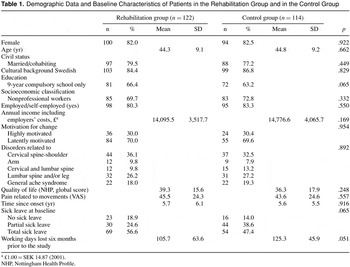
Demographic Data and Baseline Characteristics of Patients in the Rehabilitation Group and in the Control Group
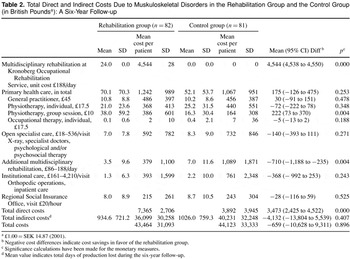
Total Direct and Indirect Costs Due to Muskuloskeletal Disorders in the Rehabilitation Group and the Control Group (in British Poundsa): A Six-Year Follow-up
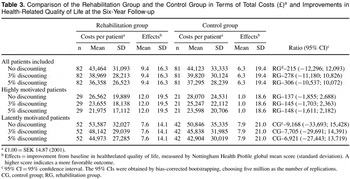
Comparison of the Rehabilitation Group and the Control Group in Terms of Total Costs (£)a and Improvements in Health-Related Quality of Life at the Six-Year Follow-up

Cost-effectiveness plane for the rehabilitation group compared with the control group for health-related quality of life, measured by the Nottingham Health Profile global score, with incremental three percent discounted costs/effect pairs distribution. The figures show 2,000 of the five million replications obtained in each model by bias-corrected bootstrapping. Asterisks indicate £1.00=SEK 14.87 (2001). The percentages show the distribution between the northeast quadrant (improvement and more expensive), the southeast quadrant (improvement and less expensive), the southwest quadrant (deterioration and less expensive), and the northwest quadrant (deterioration and more expensive).
 You have
Access
- 15
- Cited by