Introduction
Tension pneumothorax is a life-threatening condition that requires immediate intervention. It occurs in 0.2% to 1.7% of prehospital trauma cases and is a well-established cause of preventable mortality in chest injury patients.Reference Eckstein and Suyehara 1 , Reference Warner, Copass and Bulger 2 While the definitive treatment of this condition is via tube thoracostomy, temporizing treatment includes needle decompression of the pleural space.Reference Cullinane, Morris, Bass and Rutherford 3 This procedure is within the scope of practice for a paramedic. A retrospective comparison of needle versus tube thoracostomy in the prehospital setting found that overall mortality was similar.Reference Barton, Epperson, Hoyt, Fortlage and Rosen 4
Due to anatomic differences, the chest wall thickness that must be traversed by the catheter is variable. Insufficient catheter length is a potential cause of procedural failure.Reference Eckstein and Suyehara 1 , Reference Ball, Wyrzykowski and Kirkpatrick 5 , Reference Inaba, Branco and Eckstein 6 It can be difficult in the loud and chaotic out-of-hospital environment to hear the rush of air. If a paramedic inserts a catheter of insufficient length to the hub, he or she may assume mistakenly that the pneumothorax is not present or has been decompressed successfully. There is no consensus for optimum catheter length for needle decompression. Advanced Trauma Life Support (ATLS) guidelines recommend the use of a standard 5 cm catheter in the second intercostal space at the midclavicular line for needle decompression. However, they note that this will reach the pleural space only 50% of the time as opposed to 90% with an 8 cm catheter. 7 International Trauma Life Support guidelines recommend at least a 6 cm to 9 cm catheter for the anterior approach.Reference Alson and Braithwaite 8 Finally, in the latest edition of the Prehospital Trauma Life Support course, the text mentions using a longer 8 cm large bore (10 to 16 gauge) catheter for thoracostomy. 9
Equipment available for needle thoracostomy varies between systems. Standard 14 to 16 gauge catheters, intended for intravenous (IV) access, have lengths ranging from 3.2 cm to 4.4 cm. These IV catheters have been shown to have success rates that vary from 50% to 65%, with the higher failure rates being associated with shorter catheters.Reference Ball, Wyrzykowski and Kirkpatrick 5 , Reference Stevens, Rochester and Busko 10 These studies recommended using a catheter longer than the standard IV catheter carried on most ambulances. An analysis of cadaveric, radiographic, and clinical studies reported failure rates from 25% to 50% when 5 cm needles, such as those recommended by ATLS, are used.Reference Chang, Ross and Kiefer 11 Needle decompression kit catheters up to 8 cm to 10 cm in length are available.
Multiple studies have examined chest wall thickness in sample populations to determine appropriate catheter length for needle thoracostomy. Chest wall thickness is defined as the distance from the skin to the pleural space. To date, there has been no effort to pool data from these studies in order to make a more generalizable estimate of chest wall thickness at the most common site of needle decompression. This meta-analysis reviews the contemporary literature to determine the catheter length necessary for successful penetration of the pleural space at various percentiles of chest thickness.
Methods
A meta-analysis of published English language studies that measured the chest wall thickness at the second intercostal space at the midclavicular line in human subjects was conducted. Studies were included if they published a sample size, mean chest wall thickness, and a standard deviation or confidence interval, or sufficient information to determine these statistics. Studies with a sample size less than 20 were excluded. This study protocol was reviewed and exempted by the University at Buffalo’s Heath Science Institutional Review Board. This meta-analysis was not registered prospectively.
Search Strategy
A Medline (Medline Industries, Inc; Mundelein, Illinois USA) search was performed using the following search strategy: (“needle decompression” [keyword] OR “needle thoracentesis” [keyword] OR “chest decompression” [keyword] OR “pneumothorax decompression” [keyword] OR “needle thoracostomy” [keyword] OR “tension pneumothorax” [keyword]). Results were then limited to only those articles written in English. Using the same search strategy, a PubMed (National Center for Biotechnology Information; Bethesda, Maryland USA) search was performed for recently published articles that may not have been indexed by Medline at the time of the search.
Study Selection
Two researchers (BC and MR), independently and in duplicate, reviewed all abstracts from both searches for possible satisfaction of the inclusion and exclusion criteria. All studies identified by abstract review, by either reviewer, then had their full text evaluated by both reviewers to confirm that they met all criteria. Finally, the references cited by studies that met the meta-analysis inclusion criteria were reviewed using the same methods to identify any additional, relevant studies that may not have been found through the database searches. Any disagreement between reviewers was resolved by conference with a third reviewer.
Data Extraction
The same two researchers, independently and in duplicate, extracted data from the included studies into an Excel Spreadsheet (Microsoft Corp.; Redmond, Washington USA). The following data points from each of the included studies were extracted: sample size, mean chest wall thickness, and standard deviation at the midclavicular line. If right and left measurements were published separately, the number of unique subjects, not number of observations, was used to determine sample size. If the overall study mean was not published, it was calculated by combining mean right/left and/or male/female statistics in a weighted calculation. If the overall study standard deviation was not published, it was calculated from the sample size, mean, and confidence intervals.
Data Analysis
The sample sizes of the included studies were summed. The pooled mean was calculated in both a weighted (taking study sample size into account) and an unweighted (irrespective of individual sample size) fashion. Finally, the pooled standard deviation was calculated in a weighted and an unweighted fashion.
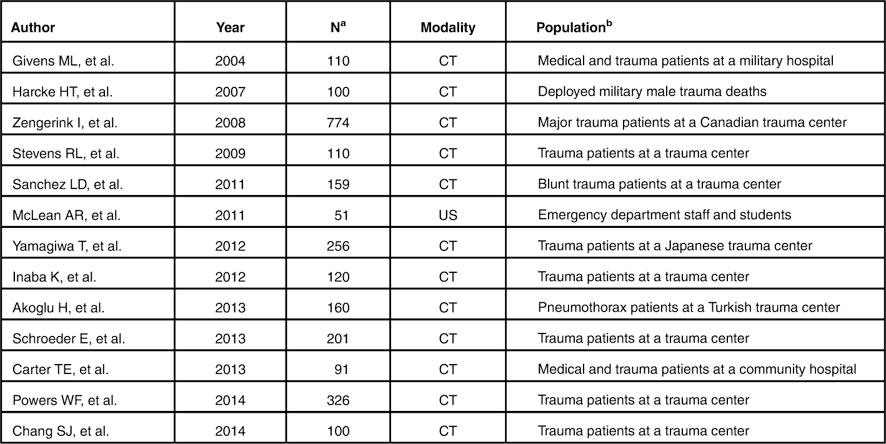
Normal distribution of data was assumed for both the individual studies and the pooled data. Procedural success was defined as catheter length equal to or greater than chest wall thickness. Population characteristics and method of measurement were reviewed and published in table form as they may have been a possible source of study bias (Table 1). Finally, a Cochran Q test was performed to evaluate for significant heterogeneity among the included studies.
Characteristics of Included Studies

Abbreviations: CT, computer tomography scan; US, ultrasound.
a N=sample size of patients with measurement at 2nd intercostal space, midclavicular line, which may be different than the study’s reported overall sample size.
b All populations from the United States, unless otherwise indicated.
Results
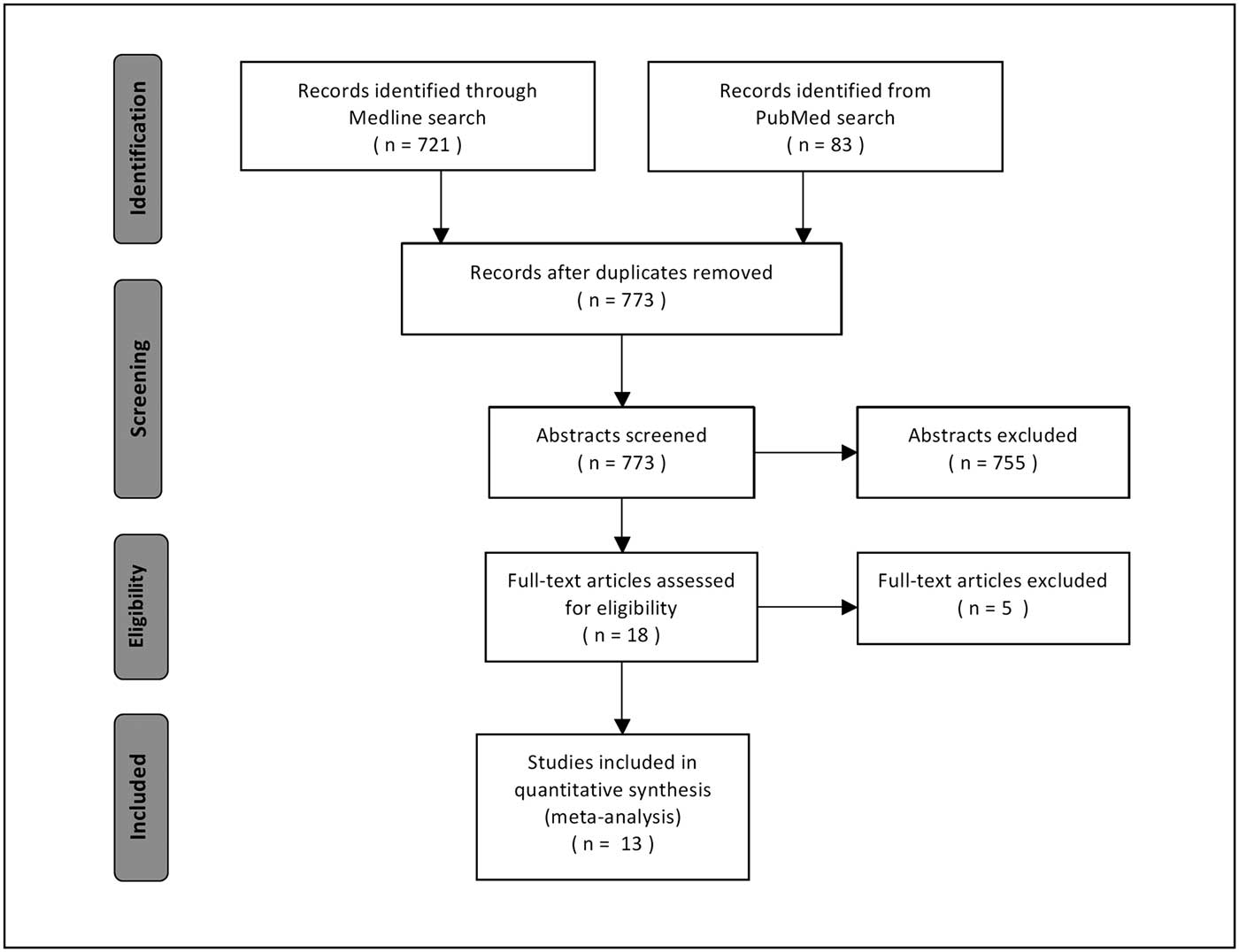
A Medline search using the planned search terms was performed on March 25, 2014. Studies were included from the inception of the database until the date of the search. This yielded 721 references. A PubMed search using the planned search terms was performed on April 25, 2014. Studies were included from January 1, 2013 until the date of the search. This yielded 83 references. The combined searches yielded 773 unique references.
Based on a review of all 773 abstracts, 18 studies were identified by at least one reviewer for full manuscript review. After full manuscript review by both reviewers, five studies were excluded for failure to meet the inclusion criteria. Thirteen studies were determined to meet the inclusion criteria and were included in the meta-analysis.Reference Stevens, Rochester and Busko 10 - Reference Zengerink, Brink, Laupland, Raber, Zygun and Kortbeek 22 The search strategy is presented as a PRISMA flow diagram in Figure 1.Reference Moher, Liberati, Tetzlaff, Altman and Group 23
PRISMA Flow Diagram.

The review of the works cited from the 13 included studies yielded 218 non-unique references. One of these references appeared to meet the inclusion criteria based on the review of the abstract. However, it was ultimately not included because it was found to be a conference abstract that was never published as a full-text manuscript. No new studies were found to meet the inclusion criteria in this final step.
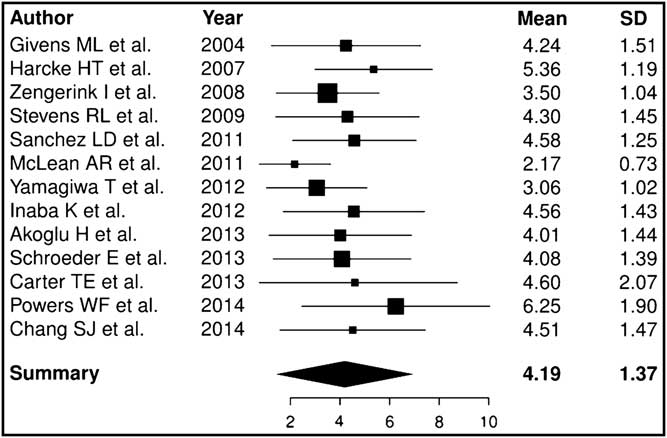
The pooled sample size was 2,558 patients. The weighted pooled mean and standard deviation of chest wall thickness were 4.19 cm and 1.37 cm, respectively (Figure 2). The unweighted calculations yielded similar results with a mean of 4.25 cm and SD of 1.38 cm. The 5 cm catheter recommended by ATLS, if placed optimally, would be of sufficient length in 72% of the sample. A 6.44 cm catheter would be the minimum length required to traverse the chest wall in 95% of patients in this pooled sample.
Forest Plot.

The Cochran Q test did not demonstrate significant heterogeneity among the included studies (P=.410).
Discussion
This meta-analysis follows PRISMA guidelines for clarity in reporting. These findings represent Level III evidence. An extensive literature search was undertaken, as described above, to identify the final 13 papers used for the analysis. The pooled sample size is more than three times larger than the largest individual study.Reference Zengerink, Brink, Laupland, Raber, Zygun and Kortbeek 22 The largest mean chest wall thickness was seen in a cross section of trauma patients from North Carolina (USA)Reference Powers, Clancy, Adams, West, Kotwall and Hope 18 grouped based on body mass index quartile, and the smallest mean chest wall thickness was seen in a convenience sample of medical staff and students in New Mexico (USA).Reference McLean, Richards, Crandall and Marinaro 17 Interestingly, the weighted and unweighted pooled datasets had similar means and standard deviations.
A 6.44 cm catheter is significantly longer than the catheters available for routine IV access. 24 It is also longer than the minimum length recommended in widely used trauma protocols and guidelines, such as ATLS. Based on these findings, a prudent recommendation would be use of catheter length of at least 6.5 cm. Given the increasing prevalence of obesity, 25 , 26 it is expected that the distance needed to traverse the chest wall will continue to increase.
As using a catheter of appropriate length is crucial to decompressing a tension pneumothorax, it would seem necessary that longer catheters be selected; this would ensure reaching or surpassing this 6.44 cm threshold. Care must be taken, however, to avoid iatrogenic injury to vital underlying structures that may result from using a longer needle, as it may increase the risk of adverse events such as hemothorax, cardiac tamponade, and pulmonary artery injury.Reference Butler, Best, Weaver and Bumpers 27 , Reference Rawlins, Brown, Carr and Cameron 28 The introduction of a longer catheter should be accompanied by education that not all patents require insertion to maximal depth. While there certainly is concern about vascular damage from a catheter that is too long, in the hands of properly trained providers, this outcome should be unlikely, whereas death from an untreated tension pneumothorax is much more likely.Reference Eckstein and Suyehara 1 , Reference Barton, Epperson, Hoyt, Fortlage and Rosen 4 , Reference Davis, Pettit and Rom 29 , Reference Heng, Bystrzycki and Fitzgerald 30
There was significant discrepancy between chest wall thickness measured by ultrasound versus computed tomography scan, even at the same institution.Reference McLean, Richards, Crandall and Marinaro 17 This may help explain, in part, why the smallest mean chest wall thickness that occurred in the analysis was seen in the lone ultrasound study. Compression of tissue by the ultrasound probe may have accounted for this discrepancy. Conversely, the presence of subcutaneous air in subjects with thoracic injuries may have increased the observed chest wall thickness in injured patients.
Limitations
This meta-analysis has several important limitations. The meta-analysis was limited to published data, and as such, is subject to publication bias. In pooling study means and standard deviations, normal distribution was assumed but cannot be assured. The larger pooled sample is more likely to be distributed normally than that of the smaller studies. The individual study sample sizes, means, and standard deviations were pooled to create the dataset. The pooled sample’s statistics may have differed if the individual data points from each of the studies were pooled. Finally, the evaluation of expected procedural success assumes that the catheter is placed perpendicularly through the chest wall, taking the most direct path into the pleural cavity. In reality, the success rate is likely to be even lower because ideal placement cannot be assured.
Conclusion
Based on this model, a catheter of at least 6.44 cm in length would be required to ensure that 95% of the patients in this pooled sample would have penetration of the pleural cavity at the second intercostal space mid clavicular line. Adequate catheter length is necessary but not sufficient for procedural success.
Author Contributions
BC conceived the study. BC, CT, HL, and JC designed the study. BC and MR performed the literature search. PM and JC performed the statistical analysis. BC, MR, and CT drafted the paper. All authors contributed to the revisions. BC takes responsibility for the paper as a whole.
Acknowledgements
The authors wish to acknowledge Nicholas Cherichio and Dr. Sarah Rich, whose work on this topic made the study possible.