INTRODUCTION
The canopy of a tropical forest supports a remarkably high diversity of arthropods (Basset et al. Reference BASSET, SAMUELSON, ALLISON and MILLER1996, Reference BASSET, NOVOTNY, MILLER, KITCHING, Basset, Novotny, Miller and Kitching2003; Erwin Reference ERWIN1982, Lucky et al. Reference LUCKY, ERWIN and WITMAN2002, Novotný & Basset Reference NOVOTNÝ and BASSET2000, Stork Reference STORK1987). This phenomenon has also been documented for agroforestry systems, such as coffee and cocoa (Bos et al. Reference BOS, STEFFAN-DEWENTER and TSCHARNTKE2007, Perfecto et al. Reference PERFECTO, VANDERMEER, HANSON and CARTÍN1997). So substantial is canopy arthropod species richness that Erwin's publications (Erwin Reference ERWIN1982, Reference ERWIN1983) on beetle diversity of the tree Luehua seemannii in Panama spawned new estimates on the number of total species thought to inhabit the earth's ecosystems. Although the debate on the overall estimates of species numbers still continues (Erwin Reference ERWIN1991, Gaston Reference GASTON1991), investigations of proximate and ultimate mechanisms responsible for the high diversity of tropical canopy fauna have only just begun (Basset et al. Reference BASSET, NOVOTNY, MILLER, KITCHING, Basset, Novotny, Miller and Kitching2003, Ellwood et al. Reference ELLWOOD, JONES and FOSTER2002, Stuntz et al. Reference STUNTZ, ZIEGLER, SIMON and STOTZ2002a). In general, complex vegetation structure and floristic diversity is thought to support high insect diversity. Epiphytes comprise a highly diverse group of plants that improve the structural complexity of the canopy and provide resources in addition to those provided by tree hosts (Benzing Reference BENZING1990, Gentry & Dodson Reference GENTRY and DODSON1987, Kress Reference KRESS1986, Nadkarni Reference NADKARNI1994, Nadkarni & Matelson Reference NADKARNI and MATELSON1989). It is therefore important to consider the role of epiphytes in supporting diversity in the forest canopy (Ellwood et al. Reference ELLWOOD, JONES and FOSTER2002, Kitching et al. Reference KITCHING, MITCHEL, MORSE, THEBAUD, Stork, Adis and Didham1997, Ødegaard Reference ØDEGAARD2000, Stork Reference STORK1987). It has already been established that epiphytes provide important resources for canopy vertebrates (Chan Reference CHAN2003, Cruz-Angón & Greenberg Reference CRUZ-ANGÓN and GREENBERG2005, Cruz-Angón et al. Reference CRUZ-ANGÓN, SILLETT and GREENBERG2008, Nadkarni & Matelson Reference NADKARNI and MATELSON1989, Raboy et al. Reference RABOY, CHRISTMAN and DIETZ2004, Sillett Reference SILLETT1996). Although several authors have specifically assessed arthropod diversity within the epiphyte microcosm (Armbruster et al. Reference ARMBRUSTER, HUTCHINSON and COTGREAVE2002, Cotgrave et al. Reference COTGRAVE, HILL and MIDDLETOWN1993, Paoletti et al. Reference PAOLETTI, TAYLOR, STINNER, STINNER and BENZING1991, Richardson Reference RICHARDSON1999, Richardson et al. Reference RICHARDSON, RICHARDSON, SCATENA and MCDOWELL2000, Stuntz Reference STUNTZ2001, Wittman Reference WITTMAN2000, Yanoviak et al. Reference YANOVIAK, NADKARNI and SOLANO2006), very few studies have established the overall contribution of epiphytes to an entire tree crown's arthropod diversity (Ellwood et al. Reference ELLWOOD, JONES and FOSTER2002, Stuntz et al. Reference STUNTZ, SIMON, ZOTZ, Basset, Novotny, Miller and Kitching2003).
Epiphytes may be important for canopy arthropods in several distinct ways. Epiphytes, particularly long-lived bromeliads (Benzing Reference BENZING1994), provide important microhabitats protected from the often harsh conditions of a tropical forest canopy (Ellwood et al. Reference ELLWOOD, JONES and FOSTER2002, Stuntz et al. Reference STUNTZ, ZIEGLER, SIMON and STOTZ2002a). Epiphytes may also enhance arthropod diversity through the production of soil and litter environment and the provision of foliage that is consumed by herbivorous insects (Schmidt & Zotz Reference SCHMIDT and ZOTZ2000). Epiphytes also attract predators and parasites of herbivorous insects as well as pollinators of epiphytic angiosperms (Wittman Reference WITTMAN2000). All these arthropods may only spend a portion of their life in the bromeliads and thus contribute to the overall abundance of arthropods throughout the canopy (Richardson et al. Reference RICHARDSON, RICHARDSON, SCATENA and MCDOWELL2000, Stork Reference STORK1987, Wittman Reference WITTMAN2000).
The development of techniques to access the canopy of tropical trees resulted in a great number of studies conducted within the last two decades (Floren & Linsenmair Reference FLOREN, LINSENMAIR, Stork, Adis and Didham1997). Among these techniques, knockdown insecticide fogging has been one of the most commonly used to collect from the ground big samples of canopy arthropods (Basset & Kitching Reference BASSET and KITCHING1991, Erwin Reference ERWIN1982, Reference ERWIN1983; Perfecto et al. Reference PERFECTO, VANDERMEER, HANSON and CARTÍN1997, Stork Reference STORK1987, Stork & Blackburn Reference STORK and BLACKBURN1993). In most studies of canopy arthropods, authors have failed to report the presence or absence of epiphytic components in the trees they have sampled. Only in very few studies the presence of epiphytes or their influence on canopy arthropods assessed was actually controlled or quantified (Ellwood et al. Reference ELLWOOD, JONES and FOSTER2002, Stork Reference STORK1987, Stuntz Reference STUNTZ2001). Thus, although epiphytes are an important resource for other canopy fauna, such as birds, in human-managed ecosystems such as agroforests (Cruz-Angón & Greenberg Reference CRUZ-ANGÓN and GREENBERG2005), no study has examined the contribution of epiphytic plants to insect diversity in these important tropical habitats. Working in a coffee plantation in Mexico, we determined the impact of the presence of epiphytes on canopy insects, where epiphytes were either experimentally removed from shade trees or left alone, by examining: (1) the richness and abundance of canopy insects; (2) the community similarity; (3) the patterns for large insects which are probably a more important resource for vertebrates. To our knowledge this is the first large-scale experiment where epiphytes have been removed to evaluate their influence on canopy insects in a coffee agro-ecosystem.
METHODS
Study site
Our study site was a 35-y-old, 200-ha shaded coffee plantation located in Coatepec, Veracruz, Mexico (19° 28′03″N, 96° 55′58″W; 1224 m asl). The coffee management system can be described as a commercial polyculture shade type (Moguel & Toledo Reference MOGUEL and TOLEDO1999). We recorded 35 species of tree in the canopy, but the tree assemblage was dominated by Inga jinicuil Schltdl. & Cham. ex G. Don, a nitrogen-fixing, fast-growing legume (Roskoski Reference ROSKOSKI1981, Reference ROSKOSKI1982). Epiphytes were abundant in the plantation where we have recorded up to 40 species of vascular epiphyte in the experimental plots out of 57 total canopy-dwelling species found on the plantation (Cruz-Angón unpubl. data). The most common species include bromeliads such as Tillandsia schiedeana Steud., T. heterophylla E. Morren and T. juncea (Ruiz & Pav.) Poir. The cactus Rhipsalis baccifera (Mill.) Stearn and the aroid Anthurium scandens (Aubl.) Engl. are also common.
Experimental design
We established two experimental sites located on opposite sides (hereafter site: N = North, S = South) of the coffee plantation, and separated by a distance of approximately 1 km. Each site was divided into two 3-ha plots surrounded by a matrix of shaded coffee with epiphytes. During the dry seasons of 1999 and 2000 plantation workers removed all the epiphytes from the shade trees of one of the two plots in both the north and south sites (hereafter plots: NE+ = North with epiphytes, NE− = North without epiphytes; SE+ = South with epiphytes, SE− = South without epiphytes). In each plot we established a grid of 625-m2 (25 × 25 m) quadrats identified by alphanumeric coordinates. We took several vegetation measurements to establish plot differences. An extended description of the study site and experimental plots can be seen in Cruz-Angón & Greenberg (Reference CRUZ-ANGÓN and GREENBERG2005). Mean epiphyte richness per tree among plots did not differ (F(2, 42) = 0.88, P = 0.42) (Cruz-Angón & Greenberg Reference CRUZ-ANGÓN and GREENBERG2005). As a result of the treatment applied, plots without epiphytes (NE− and SE−) had significantly more open canopy than their respective counterparts (NE+ and SE+). This was the only significantly different variable between control and treatment plots and is primarily the direct result of the loss of cover from the removal of epiphytes.
Tree selection
We restricted our samplings to I. jinicuil, the dominant shade-tree species which represented 48–77% of the total trees. In our study site these trees supported an abundant epiphytic flora, averaging (mean ± SE) 15.5 ± 0.4 epiphyte species per tree.
In each plot we randomly selected three grid points and located the nearest I. jinicuil tree. Trees were selected to be similar in crown diameter (≈ 8 m), height (8–11 m), dbh (30–60 cm), and epiphyte loads (50–60% branch covered with vascular epiphytes, primarily bromeliads). One advantage of working in a coffee plantation with commercial polyculture shade management is that most shade trees are planted at the same time, thus epiphyte colonization probably also started at the same time. Also, in commercial polycultures trees are usually pruned within the same year, and tree crowns do not overlap, thus facilitating fogging and collecting insects from a single tree crown.
Canopy fogging and insect collection
Insects were sampled by knock-down insecticide fogging, where a warm fog containing a pyrethrine-based non-persistent insecticide is generated by a thermal pulse-jet engine, which rises into a tree canopy (Stork Reference STORK1991). Insects coming into contact with the chemical are either killed or immobilized, and fall to the plastic sheets set up previously.
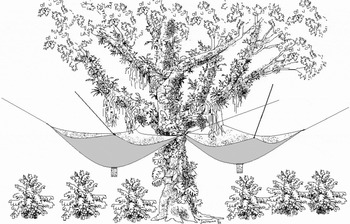
A day before we conducted the fogging, we set up two 4 × 4-m plastic sheets at each tree side, just above of the coffee shrubs (>2 m height), in order to cover most of the tree canopy (Figure 1) (Majer & Delabie Reference MAJER and DELABIE1993). Plastic sheets were kept folded until the fogging day when they were unfolded and extended. To collect insects dropping from the canopy, we placed a 1.89-litre plastic container with alcohol (70%) at the centre of each plastic sheet. A total surface area of 384 m2 was sampled overall.
Trap setting for a knockdown insecticide fogging of an Inga jinicuil tree with epiphytes in a coffee plantation, Coatepec, Veracruz, Mexico. Inga jinicuil trees experimentally depleted of epiphytes were also fogged and insects collected.

Fogging was conducted at 6h30–8h30 on 14–16 December 2000, when wind speeds were low, which allowed the fog to go up slowly, covering the entire tree before dispersing. The 15-min fogging process was followed by a 2-h drop-out period; plastic sheets were then screened very carefully and all insects in them were collected and placed in the containers. Insect containers were sealed and transported to the Entomology Laboratory of the Instituto de Ecología for further examination. Although we collected all invertebrates from fogged trees, we restricted our analysis to adult insect stages, because it was not possible with nymphs and larvae to accurately assign most to a given species. With the exception of Lepidoptera (which we were unable to sort), all adult individuals were counted, measured (length and width) and sorted to species based on external morphology. Immature stages were sorted only to family, measured and counted. All animals were cross-referenced with a voucher collection to ensure singularity of assigned species. The order Lepidoptera was excluded from all analyses regarding species richness and composition, but was included for the abundance analyses.
All of the specimens collected were checked and identified by one of the authors (M. L. Baena) to avoid taxonomic bias. Specimens were deposited at the Entomology Department of Instituto de Ecología, A.C. in Xalapa, Mexico.
Data analysis
Insect diversity and abundance. To assess the completeness of our sampling, we constructed smoothed species accumulation curves (Gotelli & Colwell Reference GOTELLI and COLWELL2001) by randomizing samples by plot 100 times. We then compared the observed values with the mean expected number of species using Chao1 estimator (Colwell & Coddington Reference COLWELL and CODDINGTON1994). We used EstimateS 7.5.0 (http://viceroy.eeb.uconn.edu/EstimateS7Pages/EstimateS7Support.htm) to randomize samples and to obtain the expected number of species. We conducted GLMs for a split-plot design where the whole plot was the sites (site: north and south) that contained the partial–experimental plots (treatment: E+ and E–). Trees were nested into the smaller plots. This allowed us to search for differences in abundance and species richness between treatments (E+ vs. E–) for all insects collected and for insects larger than 5 mm. This permitted us to maximize the power of tests for the factor (treatment) in which we were most interested (Sahai & Ageel Reference SAHAI and AGEEL2000). Following tests for normality and homoscedasticity we used a square-root transformation on the data (Zar Reference ZAR1999).
Composition and similarities of assemblages. To quantify the similarity in the composition of assemblages among trees in plots, we generated a similarity matrix that was used for all multivariate analysis described below. The similarity matrix consisted of pairwise comparisons between samples, based on the Bray–Curtis similarity index from observed species abundances transformed to the fourth root. This transformation reduces the influence of the most common taxa and focuses attention on patterns across the whole assemblage (Clarke Reference CLARKE1993). Subsequently, we performed a two-way crossed ANOSIM (analysis of similarity) using PRIMER 5 program (Clarke Reference CLARKE1993, Clarke & Gorley Reference CLARKE and GORLEY2001) to test for significant differences in community composition between site groups (North and South) and between treatment groups (E+ and E–). Finally, we conducted a Multidimensional scaling (MDS) using the MDS program in PRIMER, to graphically ordinate differences in species assemblages between treatment plots onto two dimensional charts.
RESULTS
Insect diversity and abundance
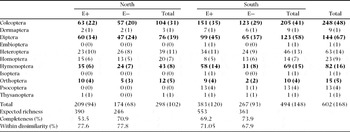
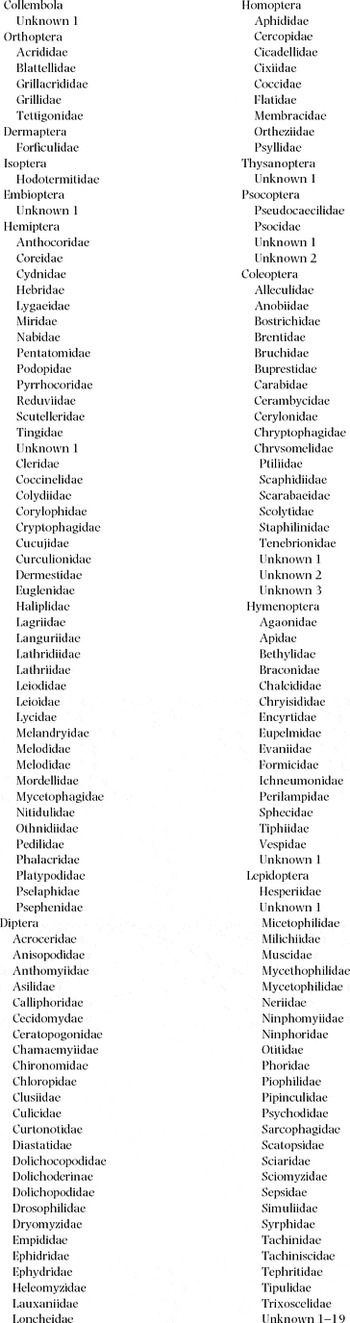
We collected 23 199 arthropods. Non-insect arthropods accounted for 30% of the collected items. Insect adults (61% of the collected individuals) comprised 12 orders, 168 families and 602 species (see Appendix 1 for list of orders and families collected). Of collected insect adults, 90% were < 5 mm long. Hymenoptera and Diptera were the most abundant insect orders, representing 39.8% and 31.2% of the adult individuals, respectively. The most species-rich orders were Coleoptera with 248 species in 48 families and Diptera with 144 species in 67 families (Table 1).
Number of insect morphospecies by order or suborder and number of families (in parentheses) captured during the canopy fogging of 12 Inga jinicuil trees in an experimental setting in a shade coffee plantation where six trees (three per plot) had epiphytes removed while the other six trees remain with epiphytes, in Coatepec, Veracruz, Mexico. Sites: North, South, Treatments: E+ = with epiphytes, E− = without epiphytes. Total columns show total number of families and species per site. Expected number of species was obtained using Chao 1 estimator. Completeness represents the percentage of observed versus estimated species richness. Within dissimilarity represents the mean percentage dissimilarity between samples within plots. In bold are the groups that showed a consistent pattern of higher diversity in E+ plots.

In general, 75.4% (454 species) of the species were represented by less than 10 individuals, contributing to less than 10% (1484 individuals) of the total catch. Indeed, 34% were represented by a single individual (singletons). Only 6% of the species (41) were represented by at least 50 individuals. These common species represented 72% of the collected individuals.
Response to epiphyte removal
The orders that showed a consistent pattern of higher diversity in E+ plots than in E– plots were Coleoptera, Diptera, Hymenoptera and Orthoptera (Table 1). In order Hymenoptera, ants (Formicidae) were three times more abundant in E+ than in E– plots (F(1,12) = 19.0, P > 0.001; Mean ± SE: E+ = 245 ± 76.8; E− = 69.6 ± 25.9).
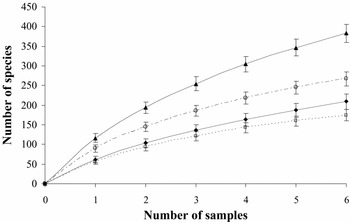
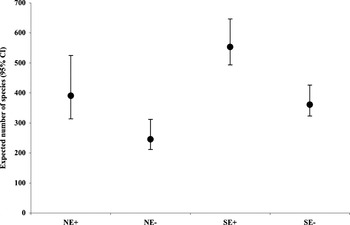
Randomized species accumulation curves show that plots in the South site had significantly more species than plots in the North site. None of the plots showed an asymptotic curve. Plots with epiphytes (NE+ and SE+) had significantly more species than their E– counterparts (Figure 2). Expected number of species showed a consistent pattern of species accumulation by treatment and sites (Figure 3). Richness estimates for E– plots indicate that inventory levels were above 70%, whereas for E+ plots inventory completeness were below 70% (Table 1). This indicates that in order to achieve more complete sampling, E+ plots would require a greater sampling effort than E– plots.
Mean species accumulation curves for insect species collected by knockdown fogging of three trees per plot (two samples per tree) in an experimental setting in a coffee plantation in Central Veracruz, Mexico. Experimental plots: North with epiphytes (♦), North without epiphytes (□), South with epiphytes (▲), and South without epiphytes (○). Error bars represent 95% Confidence Intervals.

Mean expected number of insect species by experimental plot in a coffee plantation in Central Veracruz, Mexico. Mean expected number of species were based on Chao 1 estimator form the 100 iterations. Experimental plots: NE+ = North with epiphytes, NE− = North without epiphytes, SE+ = South with epiphytes, SE− = South without epiphytes. Error bars represent 95% confidence intervals.

The ANOVA showed that sites differed significantly in both mean number of species and individuals (species: F (1,12) = 36.8, P < 0.001; individuals: F (1,12) = 79.7, P < 0.001). Mean (± SE) species richness and abundance by tree were significantly greater in South plots (species: 103 ± 10.9; individuals: 661 ± 126) than in the North plots (species: 58.6 ± 7.3; individuals: 338 ± 96.9). The treatment factor was significant for both mean number of species and individuals (species: F (1,12) = 8.9, P = 0.01; individuals: F (1,12) = 23.1, P < 0.001). The mean number of species and individuals was significantly greater in plots with epiphytes (species: 89.2 ± 13.4; individuals: 655 ± 143) than in plots without epiphytes (species: 72.7 ± 8.6; individuals: 344 ± 71.3). Site by treatment effects for either number of species or individuals were not significant (species: F (1,12) = 1.3, P < 0.27; individuals: F (1,1) = 0.02, P < 0.90). Treatment effects for abundance and richness of insects larger than 5 mm were also significant (species: F (1,12) = 9.6, P = 0.009; individuals: F (1,12) = 9.9, P = 0.008). Mean number of species and individuals for this group size was significantly greater in plots with epiphytes (species: 23.8 ± 6.09; individuals: 136 ± 56.1) than in plots without epiphytes (species: 11.2 ± 1.22; individuals: 47.7 ± 9.62).
Community structure and similarities
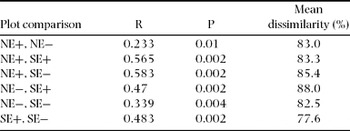
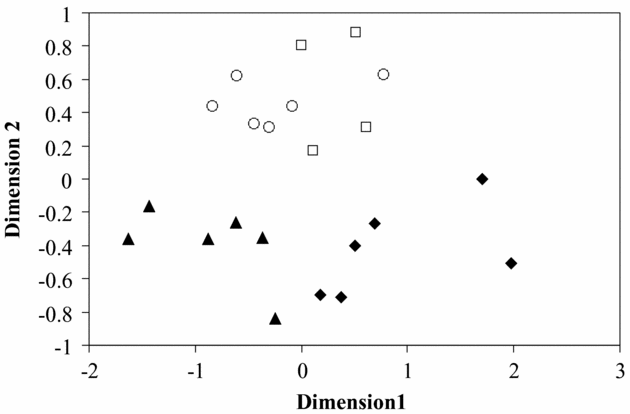
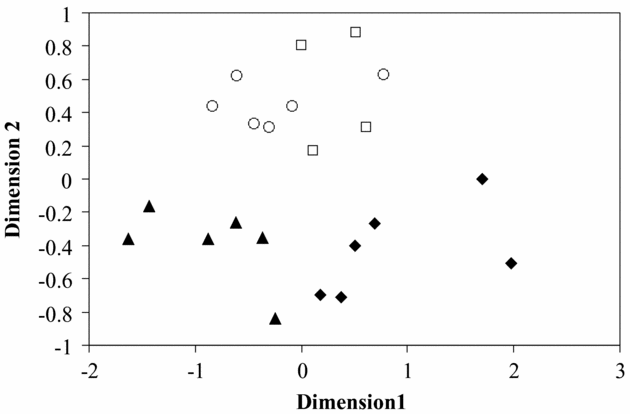
Community structure varied greatly among sites and treatments. Mean dissimilarity within plots was almost as great as dissimilarity among plots (Table 2). ANOSIM showed that all plots significantly differed in community composition. Averaged dissimilarity among plots was about 80%. Despite the high species turnover and community structure differences, the nMDS generated a well-defined ordination in which dimension 1 separated samples by site, whereas dimension 2 separated samples by treatment (Figure 4).
Results from two-way crossed ANOSIM test, based on Bray–Curtis dissimilarities in fourth-root-transformed insect abundances from four experimental plots in a coffee plantation, Central Veracruz, Mexico. Pairwise ANOSIM tests for differences between plots. Experimental plots: NE+ = North with epiphytes, NE− = North without epiphytes, SE+ = South with epiphytes, SE− = South without epiphytes.

Ordination of two matched pairs of experimental plots, based on a multidimensional scaling analysis used to compare the similarities of the studied plots (Stress = 0.17). Experiment consisted in removing epiphytes from all trees in one of two plots in two sites. Two samples per trees, three trees per site were fogged and insects were collected. Experimental Plots: North with epiphytes (♦), North without epiphytes (□), South with epiphytes (▲), and South without epiphytes (○). Stress = 0.16.
DISCUSSION
Insect richness, abundance and size distribution
Our results show that in the focal shade coffee plantation, epiphytes contributed to a high abundance and richness of insects. In our study the main difference between plots within a site (North and South) was the presence or absence of epiphytes. Trees with epiphytes had an average of 22% more species and 90% more individuals than trees without epiphytes. The percentage increase with epiphytes is even greater for insects > 5 mm in length (113% and 184%, respectively). Differences among sites may be explained by the difference in canopy cover which was greater in the South sites. Sites in the South had significantly more species and individuals than plots in the North. This indicates that the amount of tree foliage (canopy cover) may also be an important factor for canopy insect faunas (Wilkens et al. Reference WILKENS, VANDERKLEIN and LEMKE2005).
The relatively small number (10%) of insects larger than 5 mm was expected since, in general, average adult insect body length is in the order of 4–5 mm, and body size distributions more generally are skewed toward smaller sizes (Dudley Reference DUDLEY2000, May Reference MAY, Mound and Waloff1978). Moreover, it has been suggested that insecticide fogging may not be a good method to collect large canopy insects (Basset et al. Reference BASSET, SPRINGATE, ABERLENC, DELVARE, Stork, Adis and Didham1997, Ellwood et al. Reference ELLWOOD, JONES and FOSTER2002). This bias is mostly due to the fact that large insects get stuck in the canopy before dropping down. Nevertheless, a significantly greater number of large insects (> 5 mm), which are the most important food items for insectivorous vertebrates, were collected in trees with epiphytes than in trees without them. Experimental studies conducted in coffee plantations have shown that when birds are excluded from plants, insects within the exclosures tend to be larger and more abundant than insects outside the exclosure (Greenberg et al. Reference GREENBERG, BICHIER, CRUZ-ANGON, MACVEAN, PEREZ and CANO2000). Epiphytes may provide large insects with a hiding place from potential predators such as such as lizards or birds (Dial & Roughgarden Reference DIAL and ROUGHGARDEN1995, Greenberg et al. Reference GREENBERG, BICHIER, CRUZ-ANGON, MACVEAN, PEREZ and CANO2000). This may explain the significantly greater abundance of large insects in the E+ plots.
In terms of the effects of epiphytes on specific groups, only Hymenoptera (predominantly ants) showed significantly greater abundance in plots with epiphytes; ants have previously been reported to be the dominant insect species in epiphytes (Dejean et al. Reference DEJEAN, OLMSTED and SNELLING1995, Ellwood et al. Reference ELLWOOD, JONES and FOSTER2002, Longino & Nadkarni Reference LONGINO and NADKARNI1990, Stuntz et al. Reference STUNTZ, ZIEGLER, SIMON and STOTZ2002b, Wittman Reference WITTMAN2000). In addition to Hymenoptera three other orders (Coleoptera, Diptera and Orthoptera) showed a higher species richness in plots with epiphytes. Bromeliads can be used by different insect groups according to their own requirements. Some bromeliad species form cavities between their leaves and house insects like ants, which in turn can bring organic matter to the bromeliad cavities to fertilize their living domiciles. In such cases, the ants gain a place to live, but little or no food from their hosts (Janzen Reference JANZEN1974, Huxley Reference HUXLEY1980, Thompson Reference THOMPSON1981). Other insects can benefit from bromeliads, especially from trophic action, for example the particularly high relative abundance of Collembola (70%) probably reflects the high amount of decaying material retained within the epiphytes as this insect group is mainly comprised of detritivores (Rusek Reference RUSEK1998). Dermaptera species, some Coleoptera, especially from the Coccinellidae family and some ant species from the genera Pachicondyla, Odontomachus (Ponerinae) and Crematogaster (Myrmicinae) are predators and may help to protect epiphytes from herbivores.
In our study a large number of insect species (454) were represented by less than 10 individuals, a general pattern for tropical canopy (Basset & Kitching Reference BASSET and KITCHING1991, Floren & Linsenmair Reference FLOREN and LINSENMAIR1998, Lucky et al. Reference LUCKY, ERWIN and WITMAN2002, Morse et al. Reference MORSE, STORK and LAWTON1988, Novotný & Basset Reference NOVOTNÝ and BASSET2000). Given the large number of species found with fewer than 10 individuals it is possible that a portion of these species are tourist species that have no long-lasting relationship with the plant, but which may be attracted to trees for short-term use, such as for shelter and sustenance (honeydew and other substances), or as a site for sunbasking and sexual display (Gaston et al. Reference GASTON, BLACKBURN, HAMMOND and STORK1993). So our true canopy insect species richness may have been overestimated by the presence of tourist species, which we were not able to identify and exclude from the analysis. However, the presence of tourist species should not contribute to a systematic bias towards higher richness estimates for the epiphyte versus non-epiphyte plots. Furthermore, the influence of tourist species upon our estimate of faunal similarities should be low, since the index used is less sensitive to rare species.
Previous studies examining the role of epiphytes in arthropod communities are equivocal. Although very few studies have been based on an experimental removal of epiphytes (Ellwood et al. Reference ELLWOOD, JONES and FOSTER2002), the overall contribution of epiphytes to canopy insect abundance and composition at an ordinal level has been reported to be low (Stuntz et al. Reference STUNTZ, SIMON, ZOTZ, Basset, Novotny, Miller and Kitching2003). Stuntz et al. (Reference STUNTZ, SIMON, ZOTZ, Basset, Novotny, Miller and Kitching2003) studied the contribution of epiphytes to the overall arthropod richness of the small tropical tree Annona glabra (Annonaceae). In this study the authors collected the arthropods from A. glabra trees that had different species of epiphyte and no epiphytes at all. The authors found no significant differences in the abundance or community composition of arthropods between trees with and without epiphytes. However, their results may not be applicable to all tropical forest types, because they worked with a rather small tree (6 m) in an inundated area, and epiphytes were apparently not abundant in this tree. On the other hand, Ellwood et al. (Reference ELLWOOD, JONES and FOSTER2002) found that a single large bird's nest fern (Asplenium nidus) an epiphytic species that occurs throughout the forest of South-East Asia, may contain from 7–93% of the total number of invertebrates in the tree crown. These observations are more consistent with our results.
How appropriate is the canopy fogging technique for answering the questions posed in this study? Although insecticide knockdown fogging has proven not to be a good method for collecting the fauna of non-vascular epiphyte fauna (Yanoviak et al. Reference YANOVIAK, NADKARNI and GERING2003), the method has been reported to work well for vascular epiphytes (Stork & Hammond Reference STORK, HAMMOND, Stork, Adis and Didham1997). Furthermore, any underestimation of the abundance of arthropods in epiphytes due to the collection method would bias the results away from supporting the hypothesis of greater arthropod abundance on the epiphyte control plots. Therefore, we consider canopy fogging an appropriate approach to assessing the overall contribution of epiphytes to arthropod abundance and richness that should be followed up with more fine-tuned sampling and observational techniques to further assess guild composition, and proportion of rare species versus tourist.
Community structure and similarities
Our results showed great species dissimilarities between treatment and control plots, as well as trees within a plot. Such high spatial turnover between trees has been a consistent result of all tropical canopy arthropod studies (Davies et al. Reference DAVIES, STORK, BRENDELL, HINE, Stork, Adis and Didham1997, Erwin & Scott Reference ERWIN and SCOTT1980, Floren & Linsenmair Reference FLOREN and LINSENMAIR1998, Lucky et al. Reference LUCKY, ERWIN and WITMAN2002). Furthermore, high insect species turnover between epiphyte species has also been documented (Richardson et al. Reference RICHARDSON, BURGIN, AZARBAYJANI, LUTUBULA, Stork, Adis and Didham1997, Stuntz et al. Reference STUNTZ, ZIEGLER, SIMON and STOTZ2002b). For example, Stuntz et al. (Reference STUNTZ, ZIEGLER, SIMON and STOTZ2002b) found very little overlap in insect species composition for three species of epiphyte studied in an inundated forest in Panama. Despite the high levels of between-tree turnover in our study, we were able to document a pattern of faunal similarity within treatment groups based on multi-dimensional scaling, which indicates that regardless of the great species turnover, trees with epiphytes had a similar insect community structure when compared with trees without them. Our results are consistent with those of Stork (Reference STORK1987) who found that the amount of climbers and epiphytes was more important for faunal similarity in particular insect groups (i.e. Homoptera, Grulllidae, Anthicidae, Chrysomelidae and scavengers) than taxonomic relatedness of the trees, in a study conducted in Borneo.
Conservation implications of epiphyte removal
Over the last few decades several coffee-producing countries have simplified the shade of coffee plantations by reducing the richness and abundance of shade trees (Romero-Alvarado et al. Reference ROMERO-ALVARADO, SOTO-PINTO, GARCÍA-BARRIOS and BARRERA-GAYTAN2002). In Mexico, it has been estimated that over 49% of the producing area has been transformed from highly diverse shade systems to legume-dominated systems (Santoyo-Cortés et al. Reference SANTOYO-CORTÉS, DÍAZ-CÁRDENAS and RODRÍGUEZ-PADRÓN1994). In the latter systems, epiphyte removal from shade trees is a relatively common management practice (Cruz-Angón & Greenberg Reference CRUZ-ANGÓN and GREENBERG2005). The elimination of epiphytes and mistletoes from the canopy results in simplification of the vertical structure and richness of the coffee plantations that in fact are already simplified compared with pristine forests. Experimental evidence indicates that epiphyte removal may have negative effects in bird communities of coffee plantations (Cruz-Angón & Greenberg Reference CRUZ-ANGÓN and GREENBERG2005), even in species that do not have a direct relationship with epiphytes (do not use epiphytes as nesting sites or feeding substrate). In particular, insectivorous species that do not feed or nest in epiphytes were significantly less abundant in sites without epiphytes than in sites with epiphytes; the reduction of non-epiphyte-related bird species may be explained by the overall reduction in the number of insects observed in plots without epiphytes. Our results confirm that epiphytes might represent a keystone resource in coffee plantations, just as they do in other tropical forests because of their important role in controlling major functional characteristics of these ecosystems (Nadkarni Reference NADKARNI1994).
ACKNOWLEDGEMENTS
We thank A. Martínez-Fernández for assistance with fieldwork. The Martínez family and plantation manager R. Monge provided access to their coffee plantation and permission to tree fogging. F. Becerril drew the Inga jinicuil with epiphytes and trap setting for Figure 1. M. Ordano, R. Munguía and C. Tejeda, gave statistical advice; J.G. García-Franco, Federico Escobar, S. Philpott, V. Rico-Gray, and M. Coro-Arizmendi improved the manuscript with their comments and corrections. Funding to ACA was provided by CONACYT (scholarship 128767), Smithsonian Institution Fellowship 2002–2003, Departamento de Ecología Funcional and Laboratorio de Bioacústica of the Instituto de Ecología and grants from the National Geographic Society and Scholarly Studies Fund of the Smithsonian Institution to RSG.
List of families by order collected in shade trees of a coffee plantation in Central Veracruz, Mexico. Unidentified families are listed as unknown and numbered consecutively within the order they belong to.