In many developing countries, children with CHD are now receiving surgical repair or palliation for their complex medical condition. Consequently, parents require more in-depth discharge education programmes to enable them to recognise complications and manage their children’s care after hospital discharge. Upon discharge, parents are required to adhere to specific discharge instructions such as proper medication administration, provision of sufficient nutrition to augment wound healing, maintenance of appropriate activity limitations to promote sternal ossification, and application of infection-prevention practices at home to minimise the risk of surgical-site infections.Reference Lincoln, Cusick and Fantegrossi 1
Nurses are important agents in the transition from hospital to continued recovery at home through their discharge teaching; however, nurses often are not taught the fundamentals of patient/parent education or what discharge contents are important and to be shared with parents.Reference Clare 2 Therefore, nurse mastery of home care instructions and specific skills for discharge teaching are important precursors to effective parent discharge education. Nurses often rely only on the physician’s written discharge summary to guide their teaching on the day of discharge. Although the discharge summary contains facts of the child’s hospital stay, it is likely to be written in technical medical jargon, and often omits important home care instructions.Reference Cua and Kripalani 3 , Reference Katz, Jacobson and Veledar 4 Inadequate parent education results in a suboptimal transition from hospital to home, an increase in preventable postoperative complications, and ultimately hospital re-admission.Reference Lerret 5
We have previously reported preliminary findings suggesting that a structured nurse-led parent discharge education programme is feasible, acceptable, useful, effective, and sustainable for educating parents of children after cardiac surgery in Southern India.Reference Staveski, Zheleva and Paul 6 The specific aims of this investigation were threefold: to compare nurses’ home care knowledge and their medical record documentation before and after the discharge programme’s implementation, to compare the effect of the discharge programme on parental knowledge of home care requirements before and after the discharge programme’s implementation, and to compare child surgical outcomes – for example, surgical-site infections, length of stay from cardiac procedure to discharge, and primary hospitalisation and re-admission costs – before and after the structured discharge programme’s implementation.
Materials and methods
Parent education discharge instruction training materials
The parent education discharge instruction program teaches nurses how to effectively communicate post-discharge home care information to parents in order to improve post-cardiac surgery outcomes for children in resource-constrained environments. The programme is designed to enable nurses to effectively transfer knowledge and skills to parents, as well as other caregivers such as grandparents, and parents to care for their children after discharge. The parent education discharge instruction program is made up of a computer-based discharge education training programme for nurses, individualised bedside teaching and group teaching sessions for parents, and standardised parent educational resources designed for both literate and low-literacy parents. Nurses are taught the principles of parent education – that is, how to teach – and discharge education – that is, what to teach – via a computer-based training course. The nurses’ training course contains information on the following: when to seek medical care, signs of infection and infection-prevention strategies, oral care, fingernail care, medication administration, surgical wound care, behavioural changes after cardiac surgery, appropriate activity restrictions and school re-entry after cardiac surgery, nutritional requirements after cardiac surgery, and evidence-based discharge education strategies – for example, teach-back approach. Parent educational resources such as handouts and posters are accessible in English and six Indian dialects – Hindi, Bengali, Kannada, Malayalam, Tamil, and Telugu. A study on the description and evaluation of the nurse-led structured discharge programme in Southern India has been previously published.Reference Staveski, Zheleva and Paul 6
Research design
A quasi-experimental design was used to compare nurse and parent home care knowledge, nursing documentation, and child outcomes before and after introduction of the parent education discharge instruction program. Research approval was obtained from the Committee on Human Research at University of California, San Francisco, and from the Ethics Committee at the Amrita Institute of Medical Sciences. The principal investigator received an exemption for retrospective medical chart review.
Research team
The research team consisted of the principal investigator, hospital nurse educator, nursing director, and the cardiac surgery unit nurse manager and they coordinated the implementation and evaluation of the discharge programme. The nurse educator has a Master’s degree and is fluent in several languages including local Indian dialects and English. The nurse educator performed or supervised all parent interviews.
Setting
The investigation was carried out in a paediatric cardiac centre serving children from urban and rural regions in Southern India, the surrounding states, and from other countries. Approximately 700 cardiac surgeries are performed annually at the centre, including newborns and children up to 19 years of age. The cardiac surgery unit has ~45 inpatient cardiac surgery beds in multi-bed rooms serving low-income families.
Sample
The present study included non-random, convenience samples of parents of children who underwent cardiac surgery, nurses caring for children after cardiac surgery, and medical records of children who had cardiac surgery before and after implementation of the discharge programme. All nurse and parent patients either spoke in English or communicated through an interpreter. Exclusion criteria were as follows: parents of a child nearing end-of-life, and/or children and the families of children cared for in private rooms outside the cardiac surgery unit – that is, high-income families.
Measures
The Nursing Mastery test and the Parent Mastery test used in this investigation were developed for and used in the initial parent education discharge instruction program investigation.Reference Staveski, Zheleva and Paul 6 These tools have not yet received formal reliability and validity testing. The Nursing Mastery test is a 30-item questionnaire to assess nurses’ knowledge of discharge content essential for parents to know before caring for their child after discharge.Reference Staveski, Zheleva and Paul 6 The Nursing Mastery test’s questions were multiple-choice or true/false type questions. Total scores were calculated and based on a 0–30 point scale. Learning domains included the following: when to seek medical care, signs of infection and infection-prevention strategies, oral care, fingernail care, medication administration, surgical wound care, behavioural changes after cardiac surgery, appropriate activity restrictions and school re-entry after cardiac surgery, nutritional requirements after cardiac surgery, and evidence-based home care teaching methods.Reference Staveski, Zheleva and Paul 6
The Parent Mastery test is a four-item questionnaire developed by the research team to measure parents’ knowledge of important aspects of their child’s postoperative care at home after paediatric cardiac surgery in India.Reference Staveski, Zheleva and Paul 6 Learning domains included the following: when to seek medical care, signs of infection, oral care, and fingernail care. Total scores were calculated and based on a 0–4 point scale and the proportion of individual correctly answered questions reported.
Evidence of nurses’ documentation of parent discharge teaching completion was reviewed each week on nursing audit forms (Yes/No) for this investigation during the first 4 months after the discharge programme’s implementation. In addition, medical records were evaluated for the presence of parent discharge teaching in nursing notes (Yes/No) to corroborate the nursing discharge documentation on the study audit forms.
The medical records of children after cardiac surgery were examined for demographic and clinical characteristics; five dichotomous (Yes/No) items were evaluated and they included the following: developmental delay, presence of any genetic syndrome, other major medical illnesses, presence of pulmonary hypertension, and history of prematurity. In addition, two continuous variables were examined: baseline oxygen saturation and baseline haematocrit levels. Finally, calculation of surgical risk using the Risk Adjusted Classification for Congenital Heart Surgery was evaluated.Reference Jenkins, Gauvreau, Newburger, Spray, Moller and Iezzoni 7 All data were corroborated with the International Quality Improvement Collaborative database.
Children’s medical records were examined for the presence of surgical-site infections during hospitalisation and verified by the International Quality Improvement Collaborative database. The managers of the International Quality Improvement Collaborative database perform 30-day follow-up calls to assess for development of surgical-site infections after hospital discharge and these data were included in the analysis. Data collection occurred during summer and monsoon months, because those are historically the months with the highest rates of surgical-site infections.
In total, four variables were evaluated in child medical records and the financial database included the following: length of time from surgical procedure to discharge, primary hospitalisation costs, occurrence of re-hospitalisation after paediatric cardiac surgery, and re-admission costs for nursing care and bed utilisation.
Study procedures
The principal investigator and the supporting non-governmental organisation, Children’s HeartLink, provided hospital leadership support for adopting the parent education discharge instruction program as their standard of care based on a previous pilot study at another facility in Southern India, demonstrating its acceptability, feasibility, utility, and sustainability.Reference Staveski, Zheleva and Paul 6 Before the discharge programme’s implementation, parents in Cohort 1 (at T1) who consented to participate in the study were approached within 48 hours of their child’s anticipated discharge to complete the Parent Mastery test.Reference Staveski, Zheleva and Paul 6 Parents completed either a paper copy of the Parent Mastery test or were interviewed by the nurse educator, who transcribed their responses verbatim.
After 30 Cohort 1 Parent Mastery tests were completed, Cohort 1 nurse patients who consented to participate in the study completed the Nurse Mastery test at two time points before (T1) and immediately after training (T2).Reference Staveski, Zheleva and Paul 6 All the nurses in the cardiac surgery unit, except for two who were on leave, were educated using the discharge programme. After 90% of the nursing staff received training, members of the project team role-modelled 10 individualised and group teaching sessions of the parent education discharge instruction program’s teaching in the cardiac surgery unit. Nurses then assumed responsibility for providing discharge teaching to parents, with support and coaching from the study team.
Consecutive medical records of 90 children – unmatched with parent patients – were accrued. Demographic information and clinical characteristics, presence of surgical-site infections, and number of days from cardiac surgical procedure to discharge before implementation of the discharge programme were collected. Data were corroborated with the International Quality Improvement Collaborative database and no discrepancies were found. A convenience subset of child medical records were accrued from a separate database and data on length of stay from cardiac procedure to discharge, primary hospitalisation costs, and re-admission costs were collected.
The nurse manager examined nursing documentation for evidence of discharge teaching each week between T1 and T3. The nurse educator and nurse manager also incorporated the computer-based nurse parent education discharge instruction training into the orientation for new nurses hired for the cardiac surgery unit.
Parent patients in Cohort 2 and consecutive child medical records (unmatched) were accrued 4 months after the discharge programme’s implementation. Parents in Cohort 2 completed the Parent Mastery test.Reference Staveski, Zheleva and Paul 6 A subset of nurse patients in Cohort 1 completed the Nurse Mastery test at 4 months after the discharge programme’s implementation (T3). Newly hired nurses in Cohort 2 – consisting of cardiac surgery nurses hired after the initial study training – completed the Nursing Mastery test for the first time.
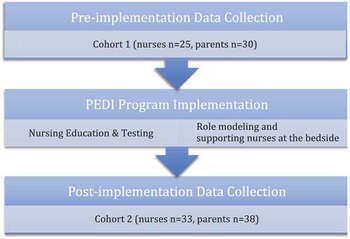
A second sample of 105 children’s medical records (Cohort 2) was accrued. Data were verified with the International Quality Improvement Collaborative database. A second convenience subset of child medical records was evaluated for length of stay from cardiac procedure to discharge, and the financial database was re-queried for primary hospitalisation costs and re-admission costs for these children (see Fig 1).
Study design.

The Amrita Institute of Medical Sciences’ infection control department was queried for monthly surgical-site infection rates in the hospital’s paediatric cardiac surgery population, and the proportion of surgical-site infection rates within a 6-month time period was calculated for Cohorts 1 and 2.
Analysis
Data were entered into SPSS (IBM SPSS Statistics Version 22.0; Armonk, New York, United States of America). All the data were expressed as means and standard deviation units for consistency; however, examination of statistical significance was based on meeting the assumptions for parametric or non-parametric statistics. A p-value <0.05 was considered to be significant.
Parent
Mann–Whitney U-tests were performed on Parent Mastery test scores, Cohorts 1 and 2. The Fischer exact test was used and the proportion of parents who correctly answered questions in the Parent Mastery test was determined.
Nurse
Nursing Mastery test scores at T3 and Risk Adjusted for Congenital Heart Surgery scores were determined. Wilcoxon’s Signed Rank test was used to examine Cohort 1 Nurse Mastery test scores at T1 and T2. A subset of Cohort 1 with Nurse Mastery test scores at T1, T2, and T3 was evaluated using the Friedman test.
Medical and financial records
Independent samples Student’s t-tests were performed on continuous variables such as days from cardiac procedure to discharge, oxygen saturation, haematocrit levels, and primary hospitalisation and re-admission costs. The Fisher exact test was used to examine the proportion of medical records with appropriate discharge documentation in nursing notes.
Surgical-site infections
The Fisher exact test was utilised to examine the proportion of children with surgical-site infections in Cohorts 1 and 2.
Results
There were 63 nurse patients in this study (Cohort 1=45, Cohort 2=18). Each cohort included 90% of nurses working in the cardiac surgery unit at that time point; the remaining 10% were on leave. None of the nurses declined participation; however, there was attrition, and this was reflected in the smaller Cohort 1 sample size at T3 (n=10).
Initial testing of mean nursing knowledge scores (0–30 scale) between T1 and T2 showed an improvement from 24.4 (SD=2.89) to 27.4 (SD=1.55) (Wilcoxon’s Signed Rank test, p<0.005); however, the scores essentially returned to baseline when evaluated 4 months after the programme’s implementation in the subset of nurses who were still actively employed at the hospital. This subset had mean knowledge score at T1 of 23.4 (SD=2.41), 28.1 (SD=1.37) at T2, and 23.8 (SD=3.4) at T3. In addition, there were 18 newly hired nurses, who received parent education discharge instruction training as part of their orientation in Cohort 2, and they had a mean score of 23.4 (SD=3.33). There was no significant difference between the Nursing Mastery test scores for nurses in Cohorts 1 and 2 at T3 (p=0.865) (see Table 1).
Comparison between pre- and post-parent education discharge instruction program implementation, nurse and parent total knowledge scores.

Reported values are in mean (SD) units.
Wilcoxon’s Cohort 1 time points 1 and 2.
Friedman’s Cohort 1 time points 1, 2, and 3.
Mann–Whitney U Cohort 2 nurses and parents.
p-value significant=0.05.
The proportion of documented discharge teaching in medical records for Cohort 1 before the discharge programme’s implementation was 53% (23/43). This increased to 95% in Cohort 2 (52/55, Fisher’s exact test, p<0.005). There were 46 discharge audits performed by the nurse manager on a weekly basis during the 4-month period after the discharge programme’s implementation that revealed 100% adherence with the discharge teaching documentation standards. These audit results were independently confirmed by the principal investigator during medical record examination and were found to have 100% adherence with documentation in nursing notes of patient medical records.
There were 68 parent patients (Cohort 1=30, Cohort 2=38); two parents declined to participate in the study, and two parents in Cohort 1 later declined to complete the Parent Mastery test. Baseline mean Parent Mastery test scores were 1.76 (SD=1.4; 0–4 scale) for Cohort 1 and 3.68 (SD=0.852) for Cohort 2 after the discharge programme’s implementation (p<0.005). The proportion of parents correctly answering individual questions improved after the discharge programme’s implementation – Q1: 50 versus 97%, Q2: 62 versus 97%, Q3: 24 versus 84%, Q4: 41 versus 89%; Fisher’s exact test, all p<0.005.
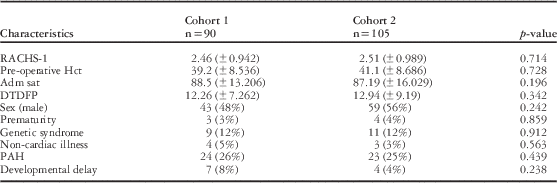
The medical records of 195 children in Cohorts 1 and 2 were examined for baseline characteristics and presence of surgical-site infections (Cohort 1=90; Cohort 2=105). There were no differences in baseline demographic and clinical characteristics between Cohorts 1 and 2 (see Table 2). A subset of Cohorts 1 and 2 was evaluated for length of stay from cardiac surgical procedure to discharge and cost of primary hospitalisation and re-admission (Cohort 1=61; Cohort 2=68).
Child characteristics (n=195)

RACHS-1 = Complexity Score (1-6, increasing complexity) Mann-Whitney U; Pre-operative Hct = pre-operative hematocrit, independent sample t-test; Adm Sat = admission oxygen saturation, independent sample t-test; DTDFP = days to discharge from procedure, independent sample t-test; PAH = pulmonary arterial hypertension (and other dichotomous variables) Mann-Whitney U
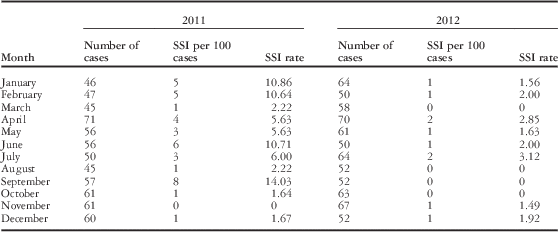
The overall percentage of children with surgical-site infections in Cohort 1 was 26.7%, and the percentage of children in the post-implementation cohort (Cohort 2) with surgical-site infections was 1.9% (p<0.005). Further analysis was performed comparing surgical-site infection rates for the same months – that is, June to December – in 2011 and 2012, and there was a significant reduction in surgical-site infections between the two matched periods – that is, 20 surgical-site infections out of 390 procedures from June to December in 2011 versus five surgical-site infections out of 400 procedures from June to December in 2012 (p=0.002) (see Table 3).
Surgical site infection rates 2011 and 2012

Pre-implementation data collection April 2012
Post-implementation data collection September 2012
There was no significant difference in the length of hospitalisation from cardiac procedure to discharge between cohorts (Cohort 1 M=12.3 days, SD=7.62; Cohort 2 M=12.9 days, SD=9.19; p=0.342) or in the cost of primary hospitalisation – pre-implementation M=$3252 United States dollars, SD=1726; post-implementation M=$3524 United States dollars, SD=1393, p=0.571). There were three re-admissions for children in Cohort 1 with a mean re-admission cost of $4420 United States dollars (SD=6752). There were five re-admissions for children in Cohort 2 with a mean re-admission cost of $600 United States dollars (SD=1140).
Discussion
This investigation evaluated relationships between nurse, parent, and child outcomes before and after implementation of the parent education discharge instruction program at a hospital in Southern India. We found that nurses had a high level of baseline discharge knowledge and that their knowledge scores increased immediately after participating in the discharge programme’s instruction, returning to baseline 4 months after programme implementation. There was a significant and sustained increase in nursing discharge documentation after implementation of the discharge programme with almost all parents receiving discharge teaching 4 months after the programme’s implementation. In addition, there was a significant increase in parent knowledge scores in Cohort 2. Finally, our findings indicate that children in Cohort 2 had fewer surgical-site infections compared with Cohort 1 and a trend in lower re-admission costs, but no difference in length of stay between cardiac procedure and discharge or primary hospitalisation costs.
The parent education discharge instruction program taught nurses discharge content and evidence-based methods of discharge teaching. Nursing mastery of important discharge content and teaching methods are central to parents’ ability to learn the discharge content;Reference Lerret 5 yet, little is known about what constitutes nursing mastery of discharge content or how to enhance the use of effective teaching methods by nurses in developed or developing countries. Our findings suggest that nurses in one hospital in a developing country have reasonable knowledge about home care for children with CHD after cardiac surgery, and that knowledge can be increased with instruction, but is not sustained without further intervention. Further research is needed to develop better strategies for sustaining the knowledge gained in educational sessions and to better understand the relationships between knowledge and skillfully communicating that knowledge in effective discharge teaching.
This investigation found a substantial and sustained increase in nursing documentation of discharge teaching to parents. Reviewing patient records for evidence of discharge teaching and for the robustness of the documentation provides insight into a nurse’s clinical practice. The use of documentation audits may have enhanced acceptance of this new care standard by nurses because the audits served as a reminder of the practice change and were closely monitored by their direct supervisor. This was one of the strategies described by Wang et alReference Wang, Hailey and Yu 8 in their systematic review of 77 papers on the quality of nursing documentation and interventions to enhance documentation. At present, regulatory compliance expectations are increasing in India, and as a consequence there is a growing effort to enhance the quality of nursing documentation, which may have contributed to the increase in nursing discharge documentation practices during the study period.Reference Tandulwadikar and Chigullaplli 9 Further research is warranted to better understand the relationship between the quality of discharge documentation and the quality of discharge teaching performed.
This investigation found a significant improvement in parent knowledge about home care after implementation of the discharge programme. In her systematic review, LerretReference Lerret 5 described parent education as essential for parents to comprehend their child’s home care needs, as well as to ensure their adherence to discharge recommendations. Our study findings suggest that the parent education discharge instruction program developed specifically for parents in resource-constrained environments may have provided parents with improved knowledge to care for their child at home. Further research is needed to determine whether greater parent knowledge is associated with fewer preventable complications in children such as surgical-site infections.
Surgical-site infection following surgical intervention for children with CHD has been cited as a major source of morbidity, mortality, and financial cost in a number of studies.Reference Tortoriello, Friedman and McKenzie 10 , Reference Woodward, Son, Taylor and Husain 11 Surgical-site infections represent a spectrum of disease ranging from superficial infections to deep sternal wound infections known as mediatinitis, and is a major cause of increased length of hospital stay.Reference Tortoriello, Friedman and McKenzie 10 There are no studies documenting increased length of stay or the costs of surgical-site infections in Indian hospitals; however, given that <5% of Indian children have medical insurance that covers CHD, such complications may have a significant impact on families’ financial status.Reference Rao 12 Reducing preventable complications is a valuable contribution to the lives of children with CHD. In addition, the negative impact of prolonged hospitalisation or re-admission on throughput within paediatric cardiac centers and the ability to provide surgical interventions for children with CHD are significant considerations.Reference Saxena 13 Our findings suggest that surgical-site infection prevention education provided to parents through the parent education discharge instruction program could be associated with a reduction in surgical-site infections and deserve further study in a multi-site trial.
Hurried teaching, ineffective learning, complicated home care needs, and caregiver stress can lead to hospital re-admissions.Reference Blagojevic and Stephens 14 Although there was a small number of re-admissions to the cardiac surgery unit, there was a trend towards lower re-admission costs after parent education discharge instruction program implementation. Further research is warranted to determine whether providing parents with surgical-site infection prevention education influences adherence with specific home care instruction and reduces re-admission costs.
The findings from this study should be considered in light of its limitations. Our study collected data from a non-random, convenience sample from a single site and was exploratory in nature, using a quasi-experimental design. Contextual factors may have influenced the results, such as a surgical-site infection quality improvement project that was completed 2 months before initiation of this study. Further limitations associated with the evaluation of re-admissions included incomplete data due to parents seeking care at a hospital closer home or financial considerations. In addition, nurses and parents were reluctant to provide their sociodemographic data. Finally, there was significant turnover in nursing staff in the cardiac surgery unit, which is not uncommon in resource-constrained environments. All these factors are sources of potential bias and limit the generalisability of the study. Nonetheless, given the paucity of literature on structured nurse-led parent discharge training programmes in resource-constrained environments, this exploratory study provides insight to inform future research.
Although nursing knowledge improved immediately after implementation of the parent education discharge instruction program, nurse mastery scores returned to their baseline high-level mastery scores 4 months after the education programme. After implementation of the parent education discharge instruction program, there was an increase in re-admissions; however, these re-admissions were less costly than re-admissions before the home care instruction programme’s implementation. A structured nurse-led parent discharge programme in a resource-constrained environment may have a positive influence on nurse, parent, and child outcomes. Further investigation is warranted for examining direct relationships and causality. A structured nurse-led parent discharge programme may be useful in preparing parents for home care. If shown to have proven positive effects, this programme could be more broadly applied to other children with complex illnesses in resource-constrained environments.
Acknowledgements
The authors acknowledge and thank the following individuals and organisations for their generous support in the development of the parent education discharge instruction materials, (in alphabetical order): Estelle Brouwer, MPA; Children’s HeartLink; Lizzy DeVita, illustrator and graphic designer; Justine Kidd, RN; Jeff Paurus, RN; Pam Sagan, RN; Shanthi Sivanandam, MD; WiRED International; Bistra Zheleva, MBA. This work was performed while Sandra Staveski was a doctoral candidate at the University of California, San Francisco.
Financial Support
This research received no specific grant from any funding agency, commercial, or not-for profit sectors.
Conflicts of Interest
None.
Ethical Standards
The authors assert that all procedures contributing to this work comply with the ethical standards of relevant international guidelines on human experimentation entitled international compilation of human research studies and with the Helsinki Declaration of 1975, as revised in 2008, and has been approved by the institutional committees of the University of California, San Francisco, and Amrita Institute of Medical Sciences.