Specific Event Identifiers
a. Event Type Hailstorm
b. Event Onset Date July 27, 2017
c. Location of Event İstanbul, Turkey
d. Geographic Coordinates in Latitude, Longitude, Elevation 41°01’59.9”N 29°06’05.0”E 120m
e. Date(s) of Observations Reported July 27-28, 2017
f. Response Type Emergency Management
Introduction
Hail is defined as precipitation in the form of ice with a diameter greater than five millimeters that occurs during hailstorms. Reference Raupach, Martius and Allen1,Reference Baltaci, Akkoyunlu and Tayanc2 Hailstorms (ie, convective storms that produce hail) are among the most damaging and destructive weather events. Reference Raupach, Martius and Allen1,Reference Battaglia, Mroz, Cecil and Michaelides3 Hailstorms result in billions of dollars’ worth of damage globally on an annual basis since they typically cause destruction to vehicles, buildings, crops, and agricultural areas. Reference Raupach, Martius and Allen1,Reference Púčik, Castellano and Groenemeijer4–Reference Lee and Collings6 Although hailstorms are primarily considered financial disasters, they can also cause serious injuries and even death. Reference Púčik, Castellano and Groenemeijer4,Reference Lee and Collings6
Although numerous reports of injuries caused by hailstorms have been published in the media, the current literature lacks a description of the characteristics of hail-related injuries. Reference Kaufman7–11 Hailstorms usually start abruptly, and weather forecast models often prove inadequate in anticipating these weather events. Reference Toker, Ezber and Sen12 In the afternoon of July 27, 2017, around 3:00pm, a severe hailstorm started in Istanbul, the largest metropolis in Turkey. The sudden hailstorm lasted approximately one hour and caused injuries to hundreds of individuals. Thousands of cars, buildings, and many airplanes at the airports were damaged by hail. Reference Baltaci, Akkoyunlu and Tayanc2,Reference Toker, Ezber and Sen12 Furthermore, both vegetation and agricultural regions suffered significant damage. The economic loss caused by this disaster in one hour was more than half-a-billion dollars. Reference Púčik, Castellano and Groenemeijer4 To date, many articles have been published on the economic losses inflicted by hailstorms. Reference Raupach, Martius and Allen1,Reference Púčik, Castellano and Groenemeijer4–Reference Lee and Collings6,Reference Botzen, Bouwer and van den Bergh13 However, the specific characteristics and epidemiology of hail-related injuries remain unknown. The hailstorm disaster that occurred in Istanbul also has important research value in this respect.
The aim of this study was to analyze the injury characteristics and outcomes of hailstorm victims.
Methods
Study Design
This retrospective descriptive study was conducted at Umraniye Training and Research Hospital, an 836-bed tertiary care hospital in Istanbul, Turkey. The hospital’s emergency department (ED) has a total area of 1,840 square meters, 560 square meters of which are corridors, waiting room, and triage area. The average annual number of admissions to the ED is over 100,000 and there are a total of 55 acute beds in the ED. Prior to the study, the Clinical Research Ethics Committee of the hospital approved the study protocol (approval number: B.10.1.TKH.4.34.H.GP.0.01/387).
Study Population and Data Collection
The study included patients who presented to the ED of this hospital due to hailstorm-related injuries on July 27 and July 28, 2017. Two researchers (SO and KK) reviewed the medical records of all patients who presented to the ED during the study period through the hospital data registration system, identified those with hailstorm-related injuries, and evaluated them for eligibility for inclusion in the study. The exclusion criteria were as follows: incurring injuries for other reasons (eg, traffic accidents, gunshot wounds), unknown mechanism of trauma, and incomplete data in file records.
The following information about the patients included in the study was collected by two researchers who examined the clinical records and patient files: demographic data (age and gender); injury characteristics (severity, mechanism, and type); physical examination findings, radiological images and reports, time from the beginning of the hailstorm to ED presentation, clinical outcomes, treatments applied, length of ED stay, and ED resource use. Two categories of injury severity were defined: minor and significant. Lacerations, swellings, bruises, superficial abrasions, sprains, contusions, and minor head injuries were considered minor injuries, while injuries treated in the operating room, those requiring hospitalization, those involving any bone fracture or joint dislocation, visceral injuries, and traumatic brain injuries (such as epidural hemorrhage) were classified as significant injuries. Injury mechanisms were categorized into four groups: direct impact of hailstones, broken glass fragments, slipping and falling, and other causes (such as tree branches breaking and falling on the patient due to hail and injuries caused by ceiling or roof collapses).
Statistical Analysis
In this descriptive study, statistical analyses were performed using SPSS for Windows, version 15.0 (IBM Corp.; Armonk, New York USA). The Kolmogorov-Smirnov test was used to evaluate whether continuous variables were normally distributed. While descriptive data were reported, continuous variables with a normal distribution were presented as mean (standard deviation [SD]), and continuous variables without a normal distribution were presented as median and interquartile range (25th–75th percentile) values. Frequency data were expressed as n (%) and compared using the chi-square test or Fisher’s exact test. The Student’s t-test was conducted to compare continuous variables with a normal distribution, and the Mann-Whitney U test was employed to compare non-parametric data.
Results
Following the hailstorm that occurred on July 27, 2017, a total of 76 patients with hailstorm-related injuries presented to the ED on the day of the hailstorm and the following day. There were 300 patient admissions to the ED on July 26, 343 on July 27, and 353 on July 28. The mean age of all patients was 37.4 (SD = 16.8; range: 5-79) years. Of the patients, 55.3% were male, with a mean age of 38.2 (SD = 17.9) years. The mean age of women was 36.5 (SD = 15.4) years (P = .66). While 86.8% (n = 66) of the patients were 18 years old or older, only three (3.9%) patients were over 65. More than one-half of the patients (n = 66; 86.8%) presented to the hospital within the first four hours after the disaster, and the vast majority of the patients (n = 74; 97.4%) presented within the first 24 hours. The most common cause of injury was the direct impact of hailstones (36.8%), followed by slipping or tripping and falling during escape (35.6%), and being hit by broken glass fragments (15.8%). Table 1 shows the baseline characteristics of the patients.
Baseline Characteristics of Patients Injured due to the Hailstorm - n (%)

Abbreviation: ED, emergency department.
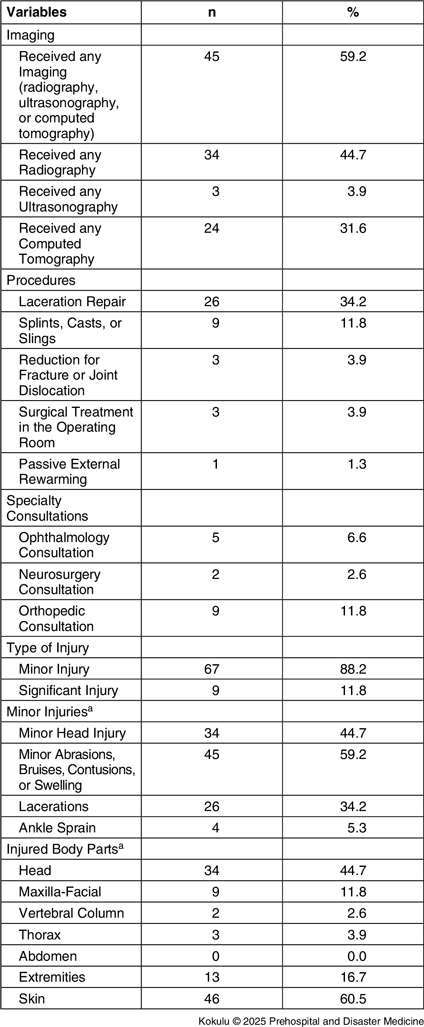
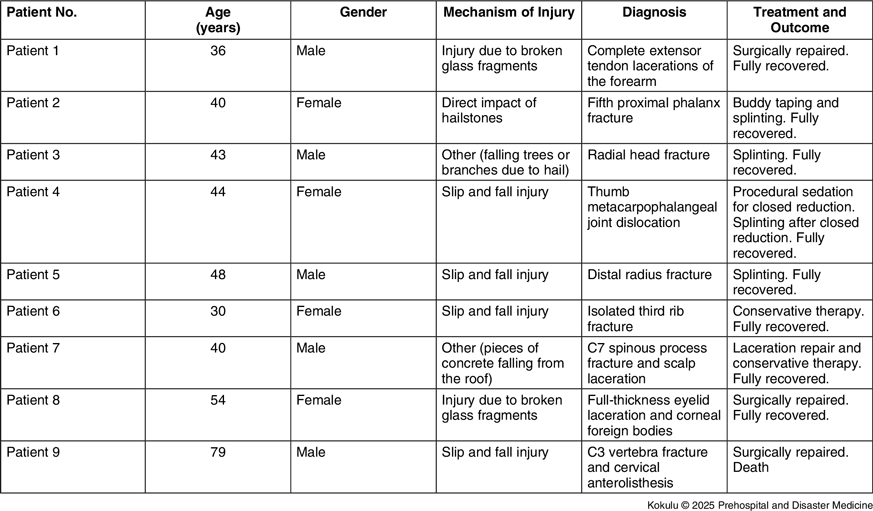
Table 2 summarizes the patients’ injury characteristics, treatments applied, and ED resource use. At least one imaging method was used for more than one-half of the patients (59.2%). The most frequently performed computed tomography was brain computed tomography at a rate of 23.7% (n = 18). The most frequently injured parts of the body were skin (60.5%), head (44.7%), and extremities (16.7%). Only 11.8% of all patients had significant injuries. One-third of the patients with significant injuries were treated surgically in the operating room. Of all patients, only one (1.3%) died on the post-operative seventh day due to a C3 vertebra fracture and cervical anterolisthesis, which occurred due to slipping and falling. The characteristics of the patients with significant injuries are shown in Table 3.
Emergency Department Resource Use, Interventions, and Injury Characteristics - n (%)

a Categories are not mutually exclusive.
Clinical Characteristics of Patients with Significant Injuries

The most common type of minor injury was soft tissue injuries, including abrasions, lacerations, and contusions (76.3%), while the second most common type was minor head injuries (44.7%). Among the interventions performed in the ED, laceration repair (34.2%) was the most common, whereas reduction for a fracture or joint dislocation was performed on 3.9% of the patients. In a patient with minor injuries, passive external rewarming was applied due to mild hypothermia.
There was no significant difference between the patients with significant injuries and those with minor injuries in terms of gender (P = .511). The mean age of the patients with significant injuries was 46.0 (SD = 14.1) years, and that of the patients with minor injuries was 36.3 (SD = 16.8) years (P = .103). Significant injuries developed in 13.6% (n = 9) of adults, and no significant injuries developed in any of the patients under 18 years of age. However, this difference was not statistically significant (P = .597).
Discussion
Both the annual average number of hailstorms and reported hail sizes are increasing world-wide, although their frequency varies depending on the geographical location of countries. Reference Púčik, Castellano and Groenemeijer4,Reference Allen, Tippett, Ashley, Kumjian and Cavanaugh14 In Europe, the average annual number of hailstorms producing large hail (minimum two centimeters in diameter) is 2,500. Reference Púčik, Castellano and Groenemeijer4 Climate change and global warming are projected to result in a rise in both the frequency and the intensity of hailstorms. Reference Raupach, Martius and Allen1,Reference Botzen, Bouwer and van den Bergh13 However, there is a lack of clear definition of the effects of hailstorms on human health, risk of injury, injury characteristics, risk of death, and pre-disaster preparedness recommendations. Therefore, it is very important to share experiences and acquired knowledge regarding injury characteristics, injury mechanisms, and ED management of hailstorm victims.
Upon the onset of the hailstorm in Istanbul on July 27, 2017, individuals in the hospital garden and on the street promptly sought refuge within the hospital since the hailstorm was very intense and the diameters of the hailstones varied between three and six centimeters. Reference Baltaci, Akkoyunlu and Tayanc2,Reference Toker, Ezber and Sen12 In a matter of minutes, the waiting area of the ED was completely filled with people. Of the hailstorm victims, 86.8% (n = 66) presented to the ED within the first four hours. During this rush phase, many injured individuals sought immediate medical attention in the ED of the hospital, and people in outdoor areas flocked to the ED to be protected from hailstones, even if they were not injured. This resulted in chaos within the ED, leading to disorganized medical care and inadequate triage. The reason for this chaos was not just injured patients presenting to the ED, but the real reason was that many more uninjured people than injured people sought refuge in the ED from the hailstones, crowding this limited-capacity space. In order to manage this situation, first, healthy individuals who were unharmed by the hailstorm and took shelter in the ED were directed to other areas of the hospital. Subsequently, the triage area and triage process were re-arranged. Finally, the chaos was resolved by starting multidisciplinary cooperation. In a study conducted by Lee, et al, similar to this study, EDs were reported to be over-crowded within the first 24 hours of a hailstorm that occurred in Sydney, Australia, and there was a 50% increase in the number of presentations. Reference Lee and Collings6 This shows the importance of planning triage and personnel strategies in EDs to prepare for possible disasters.
Perhaps the most important finding of this study is that the majority of hailstorm-related injuries (88.2%) were minor injuries. Nevertheless, one-third of the patients with significant injuries were treated surgically, and one patient died. Although previous studies have also documented hail-related injuries, these studies only provided information on the number of injured individuals without reporting on the severity and characteristics of the injuries. Reference Púčik, Castellano and Groenemeijer4,Reference Kunz, Blahak and Handwerker15,Reference Kim, Lee and Lee16 Only one study described hail-related soft tissue injuries, fractures, and lacerations among the individuals who presented to the ED without presenting any details. Reference Lee and Collings6 Unlike previous studies, the current study provided a detailed analysis of the anatomical localization, severity, and type of injuries of hailstorm victims.
In the current study, unlike the literature, the trauma mechanisms of hailstorm-induced injuries were also defined. It was determined that hailstorm-related injuries most frequently occurred as a result of hailstones hitting the human body directly. The second most common injury mechanism was slipping and falling during escape, followed by being hit by broken glass fragments. However, approximately one-half of the significant injuries (44.4%) occurred due to slipping and falling during escape.
Limitations
The most important limitation of the study was its single-center design. Therefore, it is acknowledged that this study under-estimates the total number of individuals injured in the hailstorm. Since the data on Emergency Medical Services were not collected in a digital database during the period when the hailstorm occurred, the study does not include data on hailstorm victims who were treated, discharged, or transferred by Emergency Medical Services. Hence, the generalizability of the results is limited. Another limitation is the retrospective nature of the study.
Conclusions
To the best of the authors’ knowledge, this study is the first to systematically evaluate and describe the characteristics and epidemiology of hailstorm-induced injuries. The results of the study showed that the most common causes of hailstorm-related injuries were the direct impact of hailstones and slipping and falling during escape. The majority of injured individuals were adults, and the most frequently anatomical area was the skin. Following a severe hailstorm, EDs may experience a significant influx of patients, resulting in inadequate medical care and triage. The results of this study can be used to predict the medical consequences of future hailstorms and prepare for similar disasters.
Author Contributions
All authors have made substantial contributions to the conception and design of the study, acquisition of data, or analysis and interpretation; drafting the article or revising it critically for important intellectual content; and final approval of the version to be submitted. All authors endorse the data and conclusions.
Conflicts of interest
The authors have no commercial associations or sources of support that might pose a conflict of interest.