1. Introduction
Verbs representing the concepts of GO and COMEFootnote 1 are fundamental to the languages of the world. Each language describes motion in a particular way that includes means of explicating the direction and goal of the movement. While analyses of GO and COME have been described extensively for English (Fillmore Reference Fillmore and Rauh1971, Reference Fillmore1997; Gathercole Reference Gathercole1977, Reference Gathercole1978; Lyons Reference Lyons1977; Oshima Reference Oshima2012) and other languages, a thorough description of verbs of motion in Pashto has not been done. Pashto has an unusual system of deictic motion verbs; while it has two main verbs for COME and GO (rā-tləl Footnote 2 and tləl, respectively),Footnote 3 there are greater complexities and intricacies with the Pashto COME verb than are found in COME in English and other languages. The Pashto COME verb rā-tləl demands an obligatory person marker in its use. That is, a first (rā), second (dər), or third person (wər) directional marker is intrinsic to the verb. Without the directional marker, the verb is another verb with its own meaning.
The function of the mandatory person markers used with COME in Pashto has been described as movement towards the locative goal of the action (Babrakzai Reference Babrakzai1999: 33; Tegey Reference Tegey1977: 34, 105). While in one respect this is correct, the situation can be quite complicated. It so happens that the goal marked by a dative adposition in the clause does not need to match the person of the verbal directional marker, as in (1). In this example, the goal marked by the postposition tə ‘to’ is tā ‘2SG’. The directional marker on COME is first person rā.
(1) zətātərā-ɣəl-eiy-əm
1sg.abs2sg.oblto1-come.ptcp-msgbe.prs-1sg
‘I have come to you [to the place where the speaker is now].’Footnote 4
Such person mismatches of the goal marked by the adposition tə ‘to’ and the directional markers on the verb raise questions. What defines the locative goal of the action? For if in (1) the goal is ‘2SG’ as marked by the adposition tə ‘to’, then why is the first person form of COME (i.e. rā-tləl) used? Since person markers are essential to COME, how is the use of such verbal directional markers determined?
This paper attempts to answer these questions and to describe the appropriate uses of COME and GO in Pashto. The choice of person marker is determined by the speaker's location in relation to the location of the addressee or a third party. COME and GO by nature take a semantic theme as an argument. A theme is “an entity which undergoes a change of location or possession, or whose location is being specified” (Kroeger Reference Kroeger2005: 54). So for COME and GO, the theme is the entity which is coming or going. For COME, then, the person marker describes the movement of the theme in relation to the speaker's point of view and environment. Further intricacies arise when COME is used in discourse, especially narrative discourse.
In §2, I draw from Oshima (Reference Oshima2012) to describe a general overview of COME and GO cross-linguistically. In §3, I distinguish oblique clitic pronouns from verbal directional clitics. In §4, I describe Pashto COME and GO and the person “mismatches” that can occur between the dative argument and the verbal directional marker. Furthermore, I describe instances of deictic projection in narrative. In §5, I show how the use of verbal directional markers is a wider phenomenon in Pashto. In particular, I outline how these markers are used with BRING.
In conclusion, I assert that deictic motion in Pashto presents a new system of how a language encodes motion. While COME and GO do align with some cross-linguistic tendencies, their unique properties present a system which offers new insights on motion in language.
2. Typological overview
The cross-linguistic comparisons of deictic motion verbs presented in this section lean heavily on Oshima's (Reference Oshima2012) reference point set analysis, in which he points out certain omissions in previous models and presents a new cross-linguistic approach to describing COME and GO.
Classical analyses of deictic motion say that GO describes motion away from the deictic centre, and COME motion towards the deictic centre. However, as Oshima (Reference Oshima2012) points out, in English these kinds of analyses are lacking because they cannot answer the asymmetries found between GO and COME, and they offer no explanation for situations with multiple reference points. In example (2a), the shifting of the deictic centre from the default speaker to the addressee is preferred. However, in (2b), shifting of the deictic centre from the speaker to the addressee is blocked.
(2)
a. Can I {a. ??go / b. come} visit you?
b. Will you {a. *go / b. come} visit me?
In (3), there is no one deictic centre, and the classical model cannot clearly explain the use of the deictic verbs here.
(3) At least two students {a. went / b. came} to talk to three professors.
Fillmore (Reference Fillmore1997) describes English go and come in the following manner:
(4)
a. Come indicates motion towards {the location at the utterance time, the location at the event time, or the “home base”} of {the speaker or the addressee}
b. Go indicates motion towards a location distinct from the speaker's at the utterance time.
Oshima states that while Fillmore's analysis explains many things, it predicts that come and go are equally acceptable in cases where the speaker is the theme and the addressee is at the goal location (either at utterance time or event time), as in (5). However, come is clearly the preferred, if not the only choice in these sentences.
- (5)
a. (on the phone) Is it hot there? I hope it will be cooler by the time I {come / *go}.
b. (on a street) Should I {come / *go} help you tomorrow?
(Nakazawa Reference Nakazawa and Hoji1990: 103)
Furthermore, Fillmore's analysis does not handle cases of deictic projection.Footnote 5 Thus, cases of deictic projection in 3rd person narrative must be dealt with as a special case.
Oshima (Reference Oshima2012) offers a new model which views deictic verbs as referring to discourse-salient reference points. (Such a set of reference points is abbreviated as RP throughout this article).
(6) Pragmatic meanings of go and come in English
a. Go requires that no member of the RP be at the goal at the utterance time.
b. Come requires that (i) there be some member of the RP at the goal at the utterance time or at the event time, or (ii) the goal be the home base of a member of the RP (at the event time).
(Oshima Reference Oshima2012: 4)
(7) Constraints on the RP in English:
a. The speaker is always a member of the RP.
b. It is preferred for the addressee to be a member of the RP as well. The degree of preference is affected by various factors…; under certain conditions, the inclusion of the addressee in the RP is almost obligatory.
c. A non-SAPFootnote 6 (third person) entity can be chosen as a member of the RP if it is discourse-salient. Inclusion of a non-SAP entity is marginal, however, when the speaker or the addressee is the theme … or a member thereof.
(Oshima Reference Oshima2012: 4–5)
This approach establishes a new group – the RP. As long as a member of the RP is at the goal at utterance time or event time, then COME can be used. And if no member is at the goal at utterance time, then GO is used. Under this analysis, all of the problematic examples (2), (3), and (5) are no longer problematic.
Oshima then makes predictions cross-linguistically concerning deictic verbs based on his reference point model.
(8)
(I) The person hierarchy for RP inclusion
Inclusion of X in the RP (i) implies inclusion of Y, and (ii) sometimes further requires that Y be not the theme (or a member thereof), where X outranks Y in the hierarchy of person: 1st < 2nd < 3rd.
(II) The relevance hierarchy for deictic predicates
A given deictic verb refers to some portion or the totality of the following hierarchy: an RP member's location at the utterance time < an RP member's location at the event time < an RP member's “home base” (at the event time).
(Oshima Reference Oshima2012: 6)
From (8I), it follows that the possible RPs for a given language are those in (9a). The sets in (9b) are impossible.
(9)
a. {speaker}, {speaker, addressee}, {speaker, addressee, non-SAP1, non-SAP2}
b. {addressee}, {speaker, non-SAP1}, { non-SAP1}
(Oshima Reference Oshima2012: 6)
From (8II), it follows that there are three possible kinds of GO and three possible kinds of COME in the world's languages.
(10)
a. GO1: No RP member is at the goal at the utterance time.
GO2: No RP member is at the goal at the utterance time or at the event time.
GO3: No RP member is at the goal at the utterance time or at the event time, and the goal is not an RP member's home base (at the event time)
b. COME1: Some RP member is at the goal at the utterance time.
COME2: Some RP member is at the goal at the utterance time or at the event time.
COME3: Some RP member is at the goal point at the utterance time or at the event time, or the goal point is an RP member's home base (at the event time).
(Oshima Reference Oshima2012: 6)
Let m be the index of GO and n be the index of COME, as in (10). This model predicts that when a language has GOm and COMEn, when m < n, then GO and COME can be used under the same RP. English would fall as a GO1-COME3 language. If m = n, then GO and COME would be in complementary distribution. And if m > n, then there would be situations that could be described neither by COME nor GO. Furthermore, it is predicted that no language exists in which m > n. In addition to English, Oshima presents evidence from Japanese (GO2-COME3), Mandarin (GO1-COME3), and Sive (GO1-COME1).
3. Function of pronouns rā, dər and wər
Essential to the examination of Pashto COME and GO are the three person markers rā ‘1’, dər ‘2’, and wər ‘3’. These markers are most often proclitics in Pashto and do not distinguish gender or number. They can cliticize to two different classes of words – postpositions and verbs.
3.1. Oblique clitic pronouns
When the clitics occur with postpositions, they function as the object of the postposition. Like Tegey (Reference Tegey1977: 34), I call these types of clitics “oblique clitic pronouns”. Oblique clitic pronouns are part of the system of weak pronouns in Pashto which are used for topic continuity in Pashto discourse (Tegey Reference Tegey1977: 12; Pate Reference Pate2012: 13–24). In (11) to (13), the (a) examples contain oblique clitic pronouns, while the (b) examples contain free pronouns.
(11)
a. Clitic as object of adpositional phrase
spoʐməirā=sarənāst-ədə
Spozhmeioc.1=withseated-fsgbe.3fsg
‘Spozhmei is seated with me/us.’
b. Free pronoun as object of adpositional phrase
spoʐməizmʊʐsarənāst-ədə
Spozhmeiwith +1pl.oblwithseated-fsgbe.3fsg
‘Spozhmei is seated with us.’
(12)
a. Clitic as object of adpositional phrase
zədər=tsəxəliriy-əm
1sg.nomoc.2=fromfar be-1sg
‘I am far from you (sg/pl).’
b. Free pronoun as object of adpositional phrase
zəstātsəxəliriy-əm
1sg.nomfrom +2sg.oblfromfarbe-1sg
‘I am far from you (sg).’
(13)
a. Clitic as object of adpositional phrase
husenwər=təwāy-i
Husseinoc.3=tosay.prs-3
‘Hussein is telling him/her/them.’
b. Free pronoun as object of adpositional phrase
husenhaɣatəwāy-i
Hussein3msgtosay.prs-3
‘Hussein is telling him.’
(taken from Pate Reference Pate2012: 17–8)
As shown in these examples, the oblique clitic pronoun has no real directional function. Instead, it simply replaces an oblique NP as the object of the adposition. The oblique clitic pronoun must match its referent in person only.
3.2. Verbal directional clitics
The second major use of person markers involves the verb. When these clitics attach to a motion predicate (i.e. a verb which takes a theme argument), they encode the direction of the action.Footnote 7 Tegey (Reference Tegey1977: 44) labels these clitics as “deictic preverbs”. While identical in form to the oblique clitic pronouns, they play quite a different role, as will be shown later in this section. As per Babrakzai (Reference Babrakzai1999) and Pate (Reference Pate2012), I call these clitics “verbal directive pronouns” or “verbal directive clitics”.Footnote 8 In (14), the verbal directive clitics appear on the verb leʐəl ‘send’, which takes a theme as its object, in this case yəw xat ‘one letter’.
(14)
a. habibmātəyəwxatrā=wəleʐ-əi
Habib1sg.obltoonelettervc.1=pfvsend.pst-3msg
‘Habib sent me a letter [to where I am].’
b. habibtātəyəwxatdər=wəleʐ-əi
Habib2sg.obltoonelettervc.2=pfvsend.pst-3msg
‘Habib sent you a letter [to where you are].’
c. habibtortəyəwxatwər=wəleʐ-əi
HabibTortoonelettervc.3=pfvsend.pst-3msg
‘Habib sent Tor a letter [to where a 3rd party is].’
(taken from Pate Reference Pate2012: 20)
For four verbs in Pashto, the verbal directive pronouns have become lexicalized into the verb so that they have lost their status as true clitics. These four verbs are rā-tləl ‘come’, rā-kəwəl ‘give’, rā-wɽəl ‘bring (things which cannot move on their own)’, and rā-wistəl ‘bring (things which can move on their own)’. For each of these verbs, the use of a verbal directive marker is mandatory, and without such a marker, each of these verbs' meanings would change.
4. COME and GO: rā-tləl and tləl
In this section, I outline how the verbs COME (rā-tləl) and GO (tləl) are used in Pashto.Footnote 9 These verbs are among the most common in Pashto. Both the speaker's location at utterance time and the goal at event time are important factors not only in determining which verb is used (i.e. COME versus GO), but also which directional marker for COME. Generally, when a discourse-salient entity is present (or intended to be present in the speaker's mind) at the goal, either at utterance time or event time, a form of COME is used in place of GO. Otherwise, GO is used. When COME is appropriate, a person directional marker – either rā ‘1’, dər ‘2’, or wər ‘3’ – must be chosen. A general principle that governs the choice of the person directional marker is to which person the theme is moving. That is, is the theme moving to the location of the speaker, the addressee, or a discourse-salient third party? While this seems simple enough, there are certain situations that add complexity to the issue.
The COME verb rā-tləl / dər-tləl / wər-tləl takes two semantic arguments. First, it takes a theme, i.e. an argument that is moving from one location to another. So for COME (as well as GO), the semantic theme is the grammatical subject of the sentence. The second argument is the goal. The goal is the location to which the theme is moving. This goal does not have to be expressed, but can be expressed by the object of an adpositional tə ‘to’ phrase. In (15a), the theme is the first person subject zə, and the goal is not expressed by a grammatical argument. The argument is overt in (15b). Furthermore, an entity which is at the locative goal of motion can also occur as the object of the adpositional tə ‘to’ phrase, as in (15c). Other adpositional phrases can also be used, such as the circumposition pə … pse in (15d).
(15)
a. zəbədar-s-əm
1sg.nomfut2-go.prs.pfv-1sg
‘I will come [to where you are].’
b. zəbəafɣānistāntədar-s-əm
1sg.nomfutAfghanistanto2-go.prs.pfv-1sg
‘I will come to Afghanistan [which is where you are].’
c. zəbətātədar-s-əm
1sg.nomfut2sg.oblto2-go.prs.pfv-1sg
‘I will come to you [which is where you are].’
d. zəpətāpsedər-dz-əm
1sg.nomafter2sg.oblafter2-go.prs.ipfv-1sg
‘I am coming after you [which is where you are].’
4.1. Important properties of the COME verb
Pashto COME and GO have some “peculiar” properties that do not correspond to the uses of COME and GO in other Indo-European languages. In this subsection I outline two main properties of the COME verb that differ from English usage. These properties are highly relevant to subsequent sections of this paper (cf., §4.2 and §4.3).
4.1.1. Properties of wər-tləl
Disregarding momentarily the three-way split of Pashto COME, the Pashto forms of COME and GO align with English usage of the verbs in most respects. That is, generally whenever the speaker or the hearer is present at the goal at either utterance time or event time, then COME is used. GO is used when neither the speaker nor the hearer is at the goal at utterance time (cf. (4) and (6)). However, in Pashto, the presence of a 3rd person discourse salient entity at the goal at event time also mandates the use of COME. The third person entity can be an actual person, a thing, or an event, but it must be salient in the discourse. In such cases, the third person marker wər is used. In (16) and (17), the theme moves to a third person discourse salient entity. In English, such uses of COME are not well-formed, and thus the verb go has been used in the sentence gloss.
(16) dāyəwgəɽei takiyak-ətʃi
thisonemomentleando.imp.pfv-sgcomp
zəwar-s-əm,daɣəʂədzidilāsāk-əm
1sg.nom3-go.sbjv-1sgthesewomencomforteddo.sbjv-1sg
‘Lean this back for a moment so that I can go [to where the women are] and comfort the women.’
(taken from the story of Musa Jan and Wali Jan from Mili Hindara)
(17) yā,zəwər-dz-əm
no1sg.nom3-go.prs.ipfv-1sg
‘No! I am going to go [to the place where the king is.]’
(taken from the story of Fateh Khan Bretsay from Mili Hindara)
The context of the utterance in (16) involves the warriors Musa Jan and Wali Jan leaving home. Their departure has left the women of their house worried and upset. The two men have ridden out to the street, and Wali Jan says the sentence in (16) to Musa Jan. So, the discourse-salient third person entity is the women who are back inside the house. Wali Jan is the theme and moves back towards the house where the women are. Thus wər-tləl ‘come’ is appropriate. The utterance in (17) is spoken by the warrior Fateh Khan. His enemy King Shamsuddin has summoned him to make peace, but Fateh Khan's trusted companion Karam Khan tells him not to go because he thinks it is a trap. Fateh Khan protests, and utters the sentence in (17). In this example, the discourse-salient third person entity is King Shamsuddin. The goal of location is the place King Shamsuddin is staying, and Fateh Khan, the theme, plans to move towards that place. So wər-tləl ‘come’ is appropriate.
Now the stipulation that the third party be discourse-salient is important. Suppose Ahmad and Hussein are talking, and Ahmad wants to tell Hussein he is going to the park. Then (18a) would be appropriate. However, if a third person entity is present in the conversation, and Ahmad wants to point out that his purpose in going to the park is to see that third person entity, then (18b) is appropriate, and (18a) would no longer be appropriate. This third person entity could be a person or persons, an event such as a concert, or a thing in the park such as a statue or tree. In short, any nominal that is activated in the discourse can serve as the third person entity.
(18)
a. zəpārktədz-əm
1sg.nomparktogo.prs.ipfv-1sg
‘I am going to the park.’
b. zəpārktəwər-dz-əm
1sg.nomparkto3-go.prs.ipfv-1sg
‘I am going to the park [where some third party will be].’
4.1.2. Movement towards the speaker at utterance time
For the Pashto COME verb, one of three verbal directional markers must be chosen – i.e. rā, dər, or wər. These markers generally denote motion towards the location of a first person, second person, or third person entity, respectively. That is, the goal of the movement is the location either of the speaker (rā), the addressee (dər), or a third person entity (wər) at event time.
(19) byertəbərā s-i
backfut1-go.prs.pfv-3
‘He will come back [to where I am]’
(taken from the story of Talib Jan from Mili Hindara)
(20) zənədər-dz-əm
1sg.nomneg2-go.prs.ipfv-1sg
‘I'm not going to come [to the place where you are.]'
(taken from the story of The Merchant's Three Sons from Mili Hindara)
(21) yā,zəwər-dz-əm
no1sg.nom3-go.prs.ipfv-1sg
‘No! I am going to go [to the place where the king is.]’
(taken from the story of Fateh Khan Bretsay from Mili Hindara)
However, this explanation is not complete. In addition to event time, the participant's location at utterance time also influences the choice of the verbal directional marker. For first person rā-tləl to be used, the theme does not necessarily have to move towards the speaker. If the theme moves towards the speaker's location at utterance time, rā-tləl is used. In example (22), the main character Shadi tells a girl with whom he is seated at the moment that he will go and pray, and then come straight back. He himself is the theme, and his goal is the same place at which he is present when he utters the sentence. Even though the theme is actually moving towards the addressee's (i.e. the girl's) location, because the speaker is present at the goal location at utterance time, rā-tləl must be used. If the speaker made his utterance from another place, for example by telephone, then example (23) would be appropriate. In this case, the speaker is no longer present at the goal at utterance time, and he is moving towards the addressee. Thus second person dər-tləl is used.
(22) lmundzbəwək-əm.byābəʒərrā-s-əm
prayerfutpfvdo.prs-1sgthenfutquick1-go.prs.pfv-1sg
‘I will do my prayers. Then I will quickly come back [to the place where I am now.]’
(taken from the story of Shadi and Bibo from Mili Hindara)
(23) byābəʒərdar-s-əm
thenfutquick2-go.prs.pfv-1sg
‘I'm coming back [to the place where you are now.]'
This use of rā-tləl is crucial to understanding many of the person “mismatches” between the verbal directional marker and the dative object outlined in §4.2.
4.2. Mismatches in dative goal and person marker on COME
As described above, COME has three different person markers – rā ‘1’, dər ‘2’, and wər ‘3’ – one of which must be chosen when using the verb. COME also takes a semantic goal as an argument. This goal can be unexpressed or overt. When overt, the goal appears as the dative object of the adposition tə ‘to’. This goal is often a place, as in (15b). However, the dative goal can also be a person, as in (15c).
Some descriptions of rā, dər and wər simply state that they represent movement towards a 1st, 2nd, or 3rd person, respectively. Babrakzai (Reference Babrakzai1999: 33) states: “The directive pronouns are used as prefixes with verbs, denoting the direction of the movement of the subject with intransitive verbs, and that of the direct object with transitive verbs”. He then gives examples of certain verbs, stating that rā is “toward speaker”, dər is “to 2nd person” and wər is “to 3rd person” (p. 34). He further labels these directive pronouns as “dative agreement” (p. 82) and states, “Since the agreement is between the indirect object phrase and the directional pronoun, any mismatch between them results in an ungrammatical sentence” (p. 83). He presents one ungrammatical example (here as (24)) in which the dative argument is 2nd person tā and the verbal directional pronoun is 3rd person wər.
(24) *zətātəyəwkitābwər=leʐ-əm
1sg.nom2sg.obltoonebookvc.3=send.prs.ipfv-1sg
‘I am sending a book to you.’
(transcription modified from Babrakzai Reference Babrakzai1999: 83)
Roberts (Reference Roberts2000: 105) also asserts that clitic doubling takes place in Pashto and that “verbal pronominal clitics correspond to NPs that would be marked dative, or as other sorts of indirect arguments”. This matching of dative argument with verbal directive pronoun is shown below in (25).
(25)
a. (1st person dative argument; 1st person verbal directional marker)
ahmadrā=tərā-dz-i
Ahmadoc.1=to1-go.prs.ipfv-3
‘Ahmad is coming [to where I am] to me.’
b. (2nd person dative argument; 2nd person verbal directional marker)
ahmaddər=tədər-dz-i
Ahmadoc.2=to2-go.prs.ipfv-3
‘Ahmad is coming [to where you are] to you.’
c. (3rd person dative argument; 3rd person verbal directional marker)
ahmadwər=təwər-dz-i
Ahmadoc.3=to3-go.prs.ipfv-3
‘Ahmad is coming [to where a 3rd party is] to a 3rd party.’
Babrakzai's (Reference Babrakzai1999) and Roberts' (Reference Roberts2000) analyses of these verbal markers is not quite accurate, however. Under these analyses, the verbal directional markers rā, dər and wər must always align with the dative argument in person, as shown in (25). However, this is not always the case. The verbal directional markers do not always align with the dative argument in person, as exemplified in (1). First of all, when the dative argument is a place, then clearly there is no dative 1st or 2nd person argument. First and second person directional markers rā and dər can still be used, however, as in (26).
(26)
a. zəbəwādətədər-dz-əm
1sg.nomfutweddingto2-go.prs.ipfv-1sg
‘I'll come [to where you are] to the wedding.’
(taken from the story of Adam Khan and Darkhanei from Mili Hindara)
b. nāwaxtəkortərā-s-ə
latehouseto1-go.imp.pfv-sg
‘Come [to the place where I am now] home late!’
(taken from the story of Hets)Footnote 10
Furthermore, what is missing in Babrakzai (Reference Babrakzai1999) and Roberts' (Reference Roberts2000) analyses is that the verbal directional markers do not mark the movement towards a 1st, 2nd, or 3rd person, but rather they point to the person's location. As shown in §4.1, the location of the discourse participant (whether 1st, 2nd, or 3rd person) is the focus of the movement as opposed to the discourse participant himself. When a discourse participant appears as the dative argument, then mismatches of dative argument and verbal directional pronoun can occur.
(27)
a. (2nd person dative argument; 1st person verbal directional marker)
byābəbəl-əwrədz dər=tərā-s-əm
againfutanother-fsgday oc.2=to1-go.prs.pfv-1sg
‘I'll come to you again [to where I am now speaking] another day.’
(taken from the story of The Weeping Pomegranate Tree and the Laughing Apple Tree from Mili Hindara)
b. (3rd person dative argument; 1st person verbal directional marker)
yəw-ə onəi wrustə bə byertə wər= tə rā-dz-əm
one-fsg week later fut back oc.3= to 1-go.prs.ipfv-1sg
‘I will come back [to the place where I am speaking now] to it in a week.’
(taken from De Kabul Tag, 2nd chapter)Footnote 11
c. (3rd person dative argument; 2nd person verbal directional marker)
(Hussein and Ahmad are together. I call Hussein and inform him)
zmāwrorbəahmadtədar-s-i
gen+1sg.oblbrotherfutAhmadto2-go.prs.pfv-3
‘My brother will come [to the place where you are] to Ahmad.’
In (27a), the context involves an old woman taking her leave of a young girl. The dative argument is the 2nd person oblique clitic dər=. However, the directional marker is 1st person rā because the old woman is present at the goal of motion at utterance time (cf. 4.1.2). In (27b), the speaker is talking to himself about his plans to leave his job in the city, and then possibly come back to the job a week later. The dative argument is the 3rd person oblique clitic wər= and it refers to his job. However, since his utterance is made at the destination location, first person rā-tləl is used instead of 3rd person wər-tləl. In (27c), the speaker is not at the goal location at utterance time. The theme is the speaker's brother and is intended to reach Ahmad, who is the overt dative argument. However, since the speaker thinks Ahmad and Hussein are together in one location, and since the addressee – Hussein – is present at the goal location, the 2nd person directional marker dər is used on the verb.
While the three “non-matching” combinations of dative marker and verbal directive pronoun in (27) are possible, other “non-matching” combinations are not possible. The examples in (28) show the three combinations which are never possible.
(28)
a. (1st person dative argument; 2nd person verbal directional marker)
*ahmadrā=tədər-dz-i
Ahmadoc.1=to2-go.prs.ipfv-3
‘Ahmad is coming [to where you are] to me.’
b. (1st person dative argument; 3rd person verbal directional marker)
*ahmadrā=təwər-dz-i
Ahmadoc.1=to3-go.prs.ipfv-3
‘Ahmad is coming [to where a 3rd party is] to me.’
c. (2nd person dative argument; 3rd person verbal directional marker)
*ahmaddər=təwər-dz-i
Ahmadoc.2=to3-go.prs.ipfv-3
‘Ahmad is coming [to where a third party is] to you.’
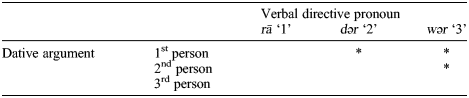
In short, there are nine possible combinations of dative argument and verbal directive pronoun (i.e. {3 choices for the dative pronoun} × {3 choices for the verbal directive pronoun} = {9 combinations}). The possible combinations are shown in Table 1. (An * marks an ungrammatical combination in Pashto). The examples in (25) correspond to the diagonal of the table, and the examples in (27) correspond to the three areas below the diagonal. The impossible combinations in (28) correspond to the three areas above the diagonal that are marked by an asterisk.
Possible combinations of dative argument and verbal directive pronouns

The combinations summarized in Table 1 can also be depicted in a spatial diagram (see Figure 1).
Spatial diagram of verbal directive pronouns

When Pashto speakers use the COME verb, they cognitively determine their location and those who are with them in that location. If speakers view their own location as the same as the goal location either at utterance time or event time, then rā ‘1’ is used. However, the motion could be designated for anyone in the left circle; i.e. the dative argument could be S, A, or 3 for rā ‘1’. If speakers do not view themselves at the goal location either at utterance time or event time, and if they do view the addressee at the goal location at event time, then dər ‘2’ is used. Then the only possible people in the addressee's location are the addressee himself and a 3rd person entity, as depicted in the middle circle. So the dative argument could be A or 3. If speakers do not view themselves or the addressee as present at the goal location, but if they view a 3rd person discourse-salient entity as present at the goal location, then wər ‘3’ is used, and the only possible participant in the goal location is a 3rd person entity. So the dative marker can only be 3.
The inclusion of entities in the circles in Figure 1 is tied to the fundamental concepts of 1st, 2nd, and 3rd person in Pashto. Pashto is similar to English in its categorization of person. In English, the first and second persons can refer to the following:
(29) English first person
(a) speaker(s) sg: I need a drink.
pl: We are the champions! (in unison)
(b) speaker(s) + other(s) We want you to come to dinner.
(c) speaker(s) + addressee(s) Shall we go?
(d) speaker(s) + addressee(s) + other(s) Can't we all get along?
(Wechsler Reference Wechsler2010: 333)
(30) English second person
(a) addressee(s) sg: You should behave yourself.
pl: You should behave yourselves.
(b) addressee(s) + other(s) How do you guys handle yourselves
over in Philosophy?
(Wechsler Reference Wechsler2010: 334)
The Pashto 1st and 2nd nominative pronouns are listed in Table 2.
Pashto 1st and 2nd nominative pronouns

The 1st and 2nd person categories in Pashto are in alignment with those in English. Any group which includes the speaker is still a 1st person plural mʊʐ idea. Any group without the speaker, but with the addressee, is a 2nd person plural tāsi idea.
(31) Pashto first person
(a) speaker(s)
sg: zə
pl: mʊʐ
(b) speaker(s) + other(s)
(zə əw ahmad), (mʊʐ əw dui)= mʊʐ
(I and Ahmad), (we and they)
(c) speaker(s) + addressee(s)
(zə əw tə),(zə əw tāsi),(mʊʐ əw tāsi) = mʊʐ
(I and you(sg))(I and you(pl))(We and you(pl))
(d) speaker(s)+addressee(s)+other(s)
(zə əw tə əw ahmad), (mʊʐ əw tāsi əw dui)= mʊʐ
(I and you(sg) and Ahmad)(We and you(pl) and they)
(32) Pashto second person
(a) addressee(s)
sg: tə
pl: tāsi
(b) addressee(s) + other(s)
(tə əw ahmad),(tāsi əw dui) = tāsi
(you(sg) and Ahmad),(you(pl) and they)
Any person or group of which the speaker(s) or addressee(s) are not a part is 3rd person.
What is relevant in this description of person in Pashto is that for a 1st person plural mʊʐ group, both 2nd person and 3rd person entities can be included. For a 2nd person plural tāsi group, a 3rd person entity can be included; however, a 1st person entity cannot. Finally, for a 3rd person group, neither a 1st nor a 2nd person entity can be included.
Because of the nature of persons in Pashto, the seeming “mismatches” between the dative argument and the verbal directive pronoun are possible. When the action is speaker-oriented (i.e. rā-tləl is used), the speaker can cognitively frame a 2nd or 3rd person entity as part of his surroundings. Thus, the verbal directive marker can encode the movement to the speaker's group, but the dative argument can mark some other 2nd or 3rd person entity inside that group. Hence, in these circumstances, the first column of Table 1 and the left circle of Figure 1 are possible. When the action is addressee-oriented (i.e. dər-tləl is used), the speaker can cognitively frame a 3rd person entity as part of the addressee's surrounding. But the speaker is no longer able to put himself together with the addressee. So in the middle column of Table 1, the combination of (1st person, dər ‘2’) is impossible. The verbal directive marker can encode the movement to the addressee's group, and the dative argument can point to 3rd person entity but not a 1st person entity. Finally, if the action is oriented to a 3rd person discourse-salient entity (i.e. wər-tləl is used), then the speaker can no longer cognitively put himself or the addressee into the third party's group. Thus, in column three of Table 1, only the bottom rectangle is possible. The two upper combinations – (1st person, wər ‘3’) and (2nd person, wər ‘3’) – are not possible.
Thus we find a rule involving the person hierarchy in (33).
(33) Person Hierarchy: 1 > 2 > 3
The verbal directional marker must outrank the dative argument on the person hierarchy. That is:
(34) Rule of verbal directional markers and dative arguments:
Let A = the person of the verbal directional marker, and let B = the person of the dative argument marked by tə ‘to’. Then A ≥ B on the Person Hierarchy.
So, as listed in Table 1, the following possibilities are possible for ordered pairs (A,B):
(35) Possible ordered pairs
A = B : (1st person, rā ‘1’), (2nd person, dər ‘2’), (3rd person, wər ‘3’)
A > B : (2nd person, rā ‘1’), (3rd person, rā ‘1’), (3rd person, dər ‘2’)
Impossible ordered pairs
A < B : (1st person, dər ‘2’), (1st person, wər ‘3’), (2nd person, wər ‘3’)
4.3. Deictic projection in narrative discourse
As detailed in §4.1.2, rā-tləl is used for motion towards the speaker's location either at utterance time or event time. In all the examples presented, the speaker was directly involved in the motion. In 3rd person narrative discourse, however, the speaker is the narrator. As the narrator, the speaker is not a part of the events taking place; i.e. is not a character in the story. Thus, the question arises as to what constitutes the deictic centre and where the narrator stands in direction to that centre.
In many languages, deictic projection occurs in narrative discourse. Deictic projection refers to the speaker projecting the deictic centre onto a participant other than him/herself (Lyons Reference Lyons1977: 579, Fillmore Reference Fillmore and Rauh1971). The narrator adopts a point of view inside the story setting.
Fillmore (Reference Fillmore and Rauh1971: 227) presents the following example in English narrative. In (36)a), the verb come is used deictically. The narrator is not a character in the story, and neither is the addressee. Thus, in normal English direct speech situations, come would not be appropriate. However, the narrator has projected the deictic centre to a new place – the mentioned bedroom. The use of come “indicates that the point-of-view is the location or the person inside the mentioned bedroom” (Fillmore Reference Fillmore and Rauh1971: 227). In (36b), the verb enter is not deictic; i.e. it is not interpreted by the immediate context. Thus, in contrast to (a), the (b) sentence does not mark anything about the narrator's perspective from within the bedroom.
(36)
a. The men came into her bedroom.
b. The men entered her bedroom.
(Fillmore Reference Fillmore and Rauh1971: 227)
Feiz Zarrin Ghalam (Reference Feiz Zarrin Ghalam2007: 149–50) also points out examples of deictic projection in Persian. In example (37), a man appears in the story with a goat and is moving towards a tree where another man is picking fruit. The narrator used the COME verb aamadan (here the past form oomad) to signal the man's arrival at the scene instead of the GO verb raftan. Thus the narrator has projected the deictic centre to the location under the tree, and thus the narrator uses COME.
(37) Persian
ye^ aa^ghaai oomad baa bo^zesh ra^d shodo:^,
‘A guy came passed by with a goat.’
(Feiz Zarrin Ghalam Reference Feiz Zarrin Ghalam2007: 150)
In Pashto, deictic projection also occurs in narrative discourse. In both English and Persian, only two verbs, COME and GO, are in contrast with each other. In a case of deictic projection, COME is used in place of GO. However, in Pashto, COME has three forms (rā-tləl, dər-tləl, and wər-tləl). Which form, then, is used in cases of deictic projection?
It turns out that first person rā-tləl is used when the semantic theme moves towards the projected deictic centre. That is, the action towards a projected deictic centre in a narrative is seen as action towards a first person participant's location. In this way, the narrator projects himself into a location, and movement that occurs towards his location is encoded with rā-tləl. As the narrator does not interact with the characters in the story however, there is never an addressee within the story. So there is never an addressee upon which the deictic centre can be projected, and thus dər-tləl is not used with deictic projection. Movement to a third person discourse-salient entity away from the narrator's point of view is encoded with wər-tləl.
In (38), word has just come to the king that the princess, who is in her chambers, has been healed of her madness, for which they had bound her in chains. The narrator's use of COME – rā-tləl in the second clause – is a use of deictic projection. The narrator is not a part of the story, yet he has projected himself into the princess's room. Thus the king comes to his daughter himself, and first person rā-tləl is appropriate.
(38) bātʃāɖerxwʊʃhālə s-u.
kingveryhappybecome.pst.pfv-3msg
pəxpələ Footnote 12lurtərā-ɣ-əi
himselfdaughterto1-go.pst.pfv-3msg
luryexlās-əkɽ-ə
daughtererg.3free-fsg do.pst.pfv-3fsg
‘The king became very happy. He himself came to his daughter. He freed his daughter.’
(taken from the story of Upright and Scoundrel from Mili Hindara)
Note that in the example above, if the narrator had not deictically projected himself into princess' room, then the third person wər-tləl would have been used in place of rā-tləl.
Some other examples of deictic projection in narrative are given in (39) to (41).
(39) sperkwənɖə rā-ɣl-əfiltə.
crested lark1-go.pst.pfv-3fsgelephantto
‘The crested lark came to the elephant.’
(taken from the story of The Crested Lark and the Elephant from Mili Hindara)
(40) dəxwāja-gān-otsəxə pəzorrā=ters-u.
fromeunuch-pl-oblfromwithforcevc.1=passbecome.pst.pfv-3msg
rā-ɣ-əibarābar dəʂədzo xemetə.
1-go.pst.pfv-3msgdirectly gen women.obl tent.obl to
‘He passed through the eunuchs by force. He came right up to the women's tent.’
(taken from the story of Musa Jan and Wali Jan from Mili Hindara)
(41) deitʃiwər=tərā-ɣ-əi,kəgor-i,
hecompoc.3to1-go.pst.pfv-3msgiflook.prs -3
yəwbātʃāməɽdəi
onekingdeadbe.prs.3msg
‘When he came to them, he saw that a king is dead.’
(taken from the story of Jalat Khan and Shamaila from Mili Hindara)
In (39), the crested lark arrives at a field where an elephant is. The narrator adopts the perspective of being in the field. Thus rā-tləl is used. In (40), the king's harem has set up camp for a picnic. Eunuchs are guarding the camp. Wali Jan passes through the eunuchs by force and arrives at the women's tent. The narrator takes the perspective as being inside the camp at the women's tent. Thus, rā-tləl is used.Footnote 13 In (41), a man named Muslim sees a commotion among some people in the town, so he goes to them to find out what is happening. (The oblique dative marker is the clitic wər= which refers to the townspeople.) The narrator thus takes the perspective of being among the townspeople. So in the first clause, rā-tləl is used.
Note that in examples (38), (39) and (41), the dative argument and the verbal directional marker do not agree in person.Footnote 14 For each of these examples, the dative argument is 3rd person while the verbal directional marker is 1st person. Thus, deictic projection introduces more examples of the seeming “mismatches” of dative marker and verbal directive marker outlined in §4.2. Namely they are (3rd person, rā ‘1’) combinations.
The use of deictic projection is not so much an issue of grammatical correctness as it is a pragmatic matter. For example, the sentence in (42) is taken from a story about an old woman in Afghanistan named Bibo. The entire story is set in Afghanistan. The immediate preceding text of (42) involves events pertaining to the old woman in Afghanistan. In the sentence in (42), one of Bibo's daughters, who lives in Germany, is introduced for the first time in the story as she has recently arrived in Afghanistan from Germany.
(42) pəde waxt ki də bibo yəw-ə lur də jarmanitsəxə
inthis.obl time in gen Bibo one-fsg daughterfromGermanyfrom
rā-ɣəl / #tləl/ #wər-aɣəl-e w-ə
1-go.ptcp go.ptcp 3-go.ptcp-fsg be.pst-fsg
‘At this time, one of Bibo's daughters had come / #left / #gone from Germany.’
(taken from the story Ghamjana Budei)
Since the entire story is set in Afghanistan, the narrator's projected centre is in Afghanistan, and thus, first person rā-tləl is appropriate. The use of a tləl or wər-tləl does not result in ungrammatical sentences. However, such sentences are not semantically well-formed. The use of tləl would mean Bibo's daughter had left Germany. However, since the author's projected deictic centre (Afghanistan) is the goal of the motion, and his intent is to show that Bibo's daughter had arrived in Afghanistan, tləl is not suitable here. Third person wər-tləl assumes that Bibo's daughter is moving towards a third person discourse-salient entity. However, the narrator would need to project himself deictically into Germany for this third person COME verb to be appropriate. Thus, since the movement of the theme (i.e. Bibo's daughter) is towards the projected deictic centre, only rā-tləl is appropriate.
5. The wider use of verbal directional markers
5.1. Other motion verbs
So far, the discussion in this paper has focused on the verbs COME and GO. However, as stated in the introduction, any motion verb which takes a theme argument can take the verbal directional markers. Some examples of such motion verbs are listed in (43).
(43) Verbs with thematic argumentsFootnote 15
tləl*Footnote 16‘go’
wɽəl*‘take (things that cannot move on their own)’
bewəl*‘take (things that can move on their own)’
axistəl‘take’Footnote 17
leʐəl‘send’
astawəl‘send’
rasawəl‘make arrive, deliver’
rasedəl‘arrive’
watəl‘go out, exit’
nanawatəl‘go in, enter’
istəl‘take out’
nanaistəl‘put in’
kʂəl‘take out, draw’
kəʃawəl‘drag’
xatəl‘go up’
xeʒawəl‘make go up’
portə kawəl‘raise’
portə kedəl‘be raised, go up’
kʂətə / kuz / tā kawəl‘lower’
kʂətə / kuz / tā kedəl‘be lowered, go down’
atʃawəl‘throw, toss’
lwedəl‘fall’
ɣwərdzawəl‘throw’
ɣwərdzedəl‘be thrown, fall’
teredəl‘pass’
tskawəl‘scoot (transitive)’
tskedəl‘scoot (intransitive)’
dzɣastəl‘run’
gərdzawəl‘move (transitive)’
gərdzedəl‘move (intransitive)’
lɣəɽawəl‘roll (transitive)’
lɣəɽedəl‘roll (intransitive)’
alwuzawəl‘fly (transitive)’
alwutəl‘fly (intransitive)’
aɽawəl‘turn (transitive), make cross’
awoʂtəl‘turn (intransitive), cross’
When verbal directional markers are used on motion verbs, they perform the same functions as they do on the COME verb. When no verbal directional marker is used on the verb, then the verb's usage parallels the usage of GO (tləl). As an example, I will show how the verb wɽəl ‘take (things that cannot move on their own)’ is affected by verbal directional markersFootnote 18 and how the use of such markers with wɽəl corresponds directly to their use with GO (tləl).
5.2. BRING/TAKE
5.2.1. Basic uses of verbal directional markers with wɽəl
As with GO (tləl), verbal directional markers can be used with TAKE (wɽəl). In (44), no verbal directional marker is used. The women have been moved from their source location. Thus wɽəl is appropriate. In (45), the theme (i.e. the food) is moving towards the location of the speaker, so rā-wɽəl is appropriate. The context for sentence (46) involves a servant washing a car near the gate of a compound. He looks to the porch of the house and sees another servant drinking a drink. He looks at the drink with thirst. The servant on the porch shouts the sentence in (46) to the man at the car. So the theme (the drink) is moving towards the location of the addressee. Thus second person dər-wɽəl is appropriate. In (47), a maid is telling her mistress what happens when she takes Talib Jan – her mistress's lover – food. Because Talib Jan is already salient in the discourse, the third person wər-wɽəl is used.
(44) wɽəl
zmāʂədzidʊʂmanyoɽ-e
gen+1sg.oblwomenenemytake.pst.pfv-3fpl
‘The enemy took my women away!’
(taken from the story of Musa Jan and Wali Jan from Mili Hindara)
(45) rā-wɽəl
ɖodəipəxək-əəw
breadcooked.fsgdo.imp.pfv-sgand
mātəyerā-wɽ-ə
1sg.obltoacc.31-take.imp.pfv-sg
‘Cook food and bring it to me [to the place where I am now.]’
(taken from Prangian Footnote 19)
(46) dər-wɽəl
dər-wɽ-əmye
2-take.prs.ipfv-1sgacc.3
‘I'm going to bring it [to the place where you are].’
(taken from the film Jabri Wada)
(47) wər-wɽəl
tʃizəɖoɖəiwar-wɽ-əm,
comp1sg.nombread3-take.prs.pfv-1sg
deietsʐəɣnəkəw-i
henonesoundnegdo.prs.ipfv-3
‘When I take him food, he doesn't make a sound.’
(taken from the story of Talib Jan and Gul Bashra from Mili Hindara)
Note that the English glosses of first person rā-wɽəl and second person dər-wɽəl are both ‘bring’. However, for third person wər-wɽəl, the English gloss is ‘take’. This use of the third person directional marker corresponds to its use with the COME verb (cf. §4.1.1).
As with COME and GO, the speaker's location at utterance time is also important (cf. §4.1.2). If the speaker is present at the goal location at utterance time, first person rā-wɽəl is used.
(48) səm-əd-ə.rābəyewɽ-əm
well-fsgbe-fsg1futacc.3take.prs.pfv-1sg
‘Very well. I will bring them [to the place where I am now.]’
(taken from the film Da Lastuni Mar)
In (48), a man is sitting at home with his wife, who has told him what she needs from the market. The husband responds with the sentence in (48). Thus, although he is bringing the things to the addressee (i.e. his wife), since the goal location of the groceries is his place of utterance, he uses the first person directional marker.
5.2.2. Mismatches in dative goal and person marker of BRING
The same issues of mismatches between the dative goal and the verbal directional marker for the COME verb also apply to the BRING verb. The person of the dative goal marked by the adposition tə ‘to’ and the verbal directional marker can be the same, as exemplified in (49).
(49)
a. (1st person dative argument; 1st person verbal directional marker)
ahmadyəwkitābrā=tərā-wɽ-i
Ahmadonebookoc.1=to1-take.prs.ipfv-3
‘Ahmad is bringing [to where I am] me a book.’
b. (2nd person dative argument; 2nd person verbal directional marker)
ahmadyəwkitābdər=tədər-wɽ-i
Ahmadonebookoc.2=to2-take.prs.ipfv-3
‘Ahmad is bringing [to where you are] you a book.’
c. (3rd person dative argument; 3rd person verbal directional marker)
ahmadyəwkitābwər=təwər-wɽ-i
Ahmadonebookoc.3=to3-take.prs.ipfv-3
‘Ahmad is taking [to where a 3rd party is] a 3rd party a book.’
However, the same person “mismatches” between the dative goal and the verbal directional marker that occurred for COME also occur with BRING (cf. (27)).
(50)
a. (2nd person dative argument; 1st person verbal directional marker)
obədər=tərā-wɽ-əm
wateroc.2=to1-take.sbjv-1sg
‘Should I bring [to where I am now speaking] you water?’
(taken from the film Da Lastuni Mar)
b. (3rd person dative argument; 1st person verbal directional marker)
wədeaʃnāitədiyəw tsəangurrā-wɽ-ə
tothis.oblfriendtogen.2somegrapes1-take.imp.pfv-2sg
‘Bring some grapes to this friend of yours [to the place where I am now.]’
(taken from the story of The Fairy Zabzabana from Mili Hindara)
c. (3rd person dative argument; 2nd person verbal directional marker)
(Hussein and Ahmad are together. The speaker phones Hussein and says:)
zmāwrorbəyəwkitābahmadtədar-wɽ-i
gen+1sg.oblbrotherfutonebookAhmadto2-take.prs.pfv-3
‘My brother will bring [to the place where you are] a book to Ahmad.’
In (50a), a girl is sitting together with her mother, and she asks whether she should bring her mother some water. So the dative goal is second person. The directional marker, however, is first person since the goal location of the water is the same as the place of utterance. In (50b), a princess commands her slave to bring his friend some grapes. At both utterance time and intended event time, the princess is present with the friend, so the verbal directional marker is first person. However, the dative goal (i.e. the friend) is third person. In (50c), Hussein is the addressee but is present with Ahmad at the goal location. So Ahmad is the dative goal, but a second person directional marker is used on the verb.
Furthermore, the impossible combinations of person of the dative goal and person of the verbal directional marker for COME are also impossible for BRING (cf. (28)).
(51)
a. (1st person dative argument; 2nd person verbal directional marker)
*ahmadyəwkitābrā=tədər-wɽ-i
Ahmadonebookoc.1=to2-take.prs.ipfv-3
‘Ahmad is bringing [to where you are] me a book.’
b. (1st person dative argument; 3rd person verbal directional marker)
*ahmadyəwkitābrā=təwər-wɽ-i
Ahmadonebookoc.1=to3-take.prs.ipfv-3
‘Ahmad is bringing [to where a 3rd party is] me a book.’
c. (2nd person dative argument; 3rd person verbal directional marker)
*ahmadyəwkitābdər=təwər-wɽ-i
Ahmadonebookoc.2=to3-take.prs.ipfv-3
‘Ahmad is bringing [to where a 3rd party is] you a book.’
Thus, Table 1 also applies to BRING. Furthermore, the rule of verbal directional clitics and dative arguments in (34) and the possible ordered pairs listed in (35) apply to BRING as well.
5.2.3. Deictic projection
Furthermore, the same issues of deictic projection for COME apply to BRING. As with COME, when the theme of BRING moves towards the projected deictic centre, first person rā-wɽəl is used.
(52) moryeɖoɖəiobəwər=tərā-wɽ-e
mothergen.3breadwateroc.3=to1-take.pst.pfv-3fpl
‘Her mother brought her food and water.’
(taken from the story of Talib Jan and Gul Bashra from Mili Hindara)
(53) bātʃātəyedāzmərei rā-wɽ-əi
kingtoerg.3thislion 1-take.pst.pfv-3msg
‘He brought the king this lion.’
(taken from the story of Jalat Khan and Shamaila from Mili Hindara)
In (52), the food and water are brought to Gul Bashra's room. The narrator has projected himself into her room, thus the theme moves towards the narrator and the first person rā-wɽəl is used. Similarly, in (53), the king's court is the goal location. The narrator projects himself into the king's court; thus first person rā-wɽəl is used.
In conclusion, the usage of the BRING/TAKE pairing parallels the usage of COME/GO described in §4. The uses of the verbal directional markers rā ‘1’, dər ‘2’, and wər ‘3’ are the same for both verbs. Furthermore, the same kinds of person “mismatches” between the dative argument and the verbal directional marker are present with BRING. For instances of deictic projection with BRING, the first person rā-wɽəl is used just as the first person rā-tləl is used in such instances with COME.
The verbal directional markers on motion verbs, as seen here with two examples (i.e. COME/GO and BRING/TAKE) is a widespread phenomenon in Pashto. Many more examples could be given. However, for brevity's sake, no more verbs are described in this paper. It is important to note, however, that in example (24) of §4.2, the verb is leʐəl ‘send’. The reason the sentence is ungrammatical is because the dative argument is second person, and the verbal directional marker is third person. As seen in (34) and (35), this combination is impermissible.
6. Conclusion
In conclusion, the Pashto deictic motion verbs have unique qualities not present in other languages. The COME verb has a threefold nature based on person. One of three verbal directive markers must be chosen when using Pashto COME. Previous analyses have not fully addressed the intricacies of the role of Pashto verbal directive markers. Through this analysis of COME, it is clear that the verbal directive markers rā ‘1’, dər ‘2’, and wər ‘3’ point to the location of the discourse participant (either 1st, 2nd, or 3rd person) instead of the participant itself. Because of this, the dative argument marked by the adposition tə ‘to’ can disagree with the verbal directive clitic in person. However, there are limits to this disagreement. The person of the verbal directive marker must outrank the person of the dative argument on the Person Hierarchy.
By and large, Oshima's reference point model corresponds well to Pashto COME and GO. The idea of reference points serves Pashto well in that the presence of the speaker, addressee or third person discourse-salient entity at the goal location is what allows COME rā-tləl / dər-tləl / wər-tləl to be used instead of GO tləl. So, in Pashto, when one of these discourse participants is at the goal location (either at utterance time or event time), then a form of COME can be used. If no discourse participant is at the goal at utterance time, then GO can be used.
In this way, Pashto, like English, largely patterns as a GO1-COME3 verb. However, Pashto has a further tier of disambiguation with the COME verb. The most striking difference between Pashto deictic verbs and other languages' deictic verbs is the fact that Pashto's COME has three forms. Many world languages that have been analysed, including English, Japanese, Turkish, German, Spanish, French, etc., have two deictic verbs COME and GO. Pashto COME, however, is threefold: rā-tləl, dər-tləl and wər-tləl. Oshima's reference point model does not directly address this trifold distinction.
Furthermore, one of Oshima's motivations for a reference point model was the fact that for English, Fillmore's analysis has to create a special case for deictic projection. Under Oshima's model, the projected deictic centre becomes a part of the RP, and thus come can be used in these situations. As shown in §4.3, deictic projection also occurs in Pashto, but the form of COME used in these situations is the first person rā-tləl, since the narrator is viewed as the speaker. In such cases of deictic projection, the reference point model does not sufficiently account for the choice of first person over third or even second person.
Oshima's model does well in predicting the general use of COME based on the reference point set. However, it stops there. Nothing further predicts which of the three forms of Pashto COME is harmonious. The explanations of the threefold Pashto COME in §4 show that the person of the reference point and its location in relation to the speaker and the theme is what determines the appropriate use of Pashto COME. Therefore, the establishment of an RP in Oshima's model is not always sufficient as a predictor of which verbal form is used; instead, the person of each RP member must be taken into consideration.
List of abbreviations and symbols
- *
ungrammatical
- (x)
x is optional
- (*x)
ungrammatical if x is present
- *(x)
ungrammatical if x is not present
- #
semantically ill-formed
- x
x is a 2nd position clitic
- x́
x is stressed
- 1
first person
- 2
second person
- 3
third person
- ABS
absolutive
- ACC
accusative
- COMP
complementizer
- ERG
ergative
- F
feminine
- FUT
future
- GEN
genitive
- IMP
imperative
- IPFV
imperfective aspect
- M
masculine
- NEG
negative
- NOM
nominative
- OBL
oblique
- OC
oblique clitic
- PFV
perfective aspect
- PL
plural
- PRS
present tense
- PST
past tense
- PTCP
participle
- RP
set of reference points, per Oshima (Reference Oshima2012)
- SAP
Speech-act participant
- SBJV
subjunctive
- SG
singular
- VC
verbal clitic