Implications
This review shows that a variety of technologies can be used to alleviate heat stress and improve production level under hot climate. The ability of the producers to access these technologies will depend on the availability and prices of water and energy and on the livestock production system (intensive v. extensive).
Introduction
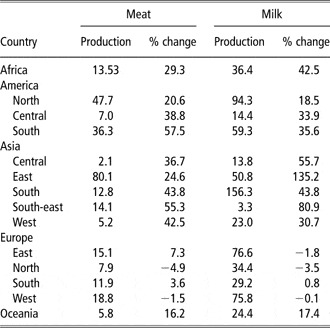
Over the past two decades, the global animal production has increased, especially in tropical and subtropical areas. This growth was driven by a strong increase in meat and milk production in developing countries, mainly in the tropical belt and semi-arid to arid areas (Table 1). The high production demand was related to demography, to an increase in animal protein consumption per capita and rising consumer income. In many cases (especially for monogastric species), the rise in animal production was achieved through an intensification based on animals and rations frequently imported from western countries. One can estimate that more than 50% of total world meat and 60% of milk originates from tropical and subtropical areas (FAO statistics, 2010). It is still predicted that livestock production in these areas will continue to sustain the world's future meat production.
Total animal production (million t/year) on meat and milk in 2008 and change in production (%) between 1988 and 2008

Source: FAOSTAT (http://faostat.fao.org/).
Many factors can affect livestock production in tropical and subtropical areas (availability and price of imported raw materials, quality of local feed resources, sanitary problems, etc.). Climatic environment is one of the main limiting factors of production efficiency in these regions. The increasing concerns on production losses because of high ambient temperature (T a) is justifiable not only for the tropical area but also for countries occupying the temperate zone in which heat stress is an occasional problem during the 2 to 3 summer months and/or during hot spells. In North America, Australia and Europe, these events caused morbidity, mortality, directly and indirectly reduced performance, resulting in dramatic economic losses and animal welfare concerns. In 2006 a major heat wave moving across the USA resulted in the death of 25 000 cattle and 700 000 poultry in California (Nienaber and Hahn, Reference Nienaber and Hahn2007). According to the modeling result of the Intergovernmental Panel on Climate Change (IPCC, 2007), the likelihood of these heat wave events is projected to increase both in number and in intensity. More generally, the increase in global average surface temperature by 2100 may be between 1.8°C and 4.0°C. These predictions suggest that negative effects of heat stress on livestock production will become more apparent in the future as the world population and food supply continue to increase rapidly especially in tropical and subtropical regions, while the free land gets limited (i.e. desertification, intensive agriculture, ethanol (biodiesel) production, etc.)
With the rapid development of landless industrial system of production, high-performance stocks were imported from North America and/or Western Europe to hot regions. Genetic selection program carried out in optimally controlled conditions clearly improved production traits (meat, milk or eggs); however, it may enhance the animal's susceptibility to high ambient temperature (T a) because of the strong relationship between production level and metabolic heat production.
Because of the recognition that high T a is a current and a future critical problem for livestock production, there has been a great deal of research and development of ways of reducing heat challenge of animals subjected to a short or an extended period of high T a. The objective of this paper was to review the main effective strategies to alleviate heat stress in the context of tropical and subtropical livestock production systems. This review is divided into two main parts. The first one is dedicated to the effect of hot climate on performance of the mains livestock species. The second part describes the coping strategies available for reducing the effect of thermal challenge in farm animals.
Effect of hot climate on livestock performance
Characterization of the climatic environment
The animal's climatic environment is complex, especially in outdoor conditions. Practically, in such conditions, air T a alone cannot be a representative measure of thermal environment and relative humidity (RH), solar radiation and wind speed must also be considered. However, scientists attempt to define it in an index value representing the influence of sensible and latent heat exchanges between the animal and its environment. Heat exchange could be accessed directly from physiological measurements (rectal, cloacal and skin temperatures, respiratory rate, panting and heat production) or indirectly from animal performance (growth rate, egg and milk production) that are related to the animal's ability or inability to efficiently cope with acute or chronic hot conditions. Various indexes derived from meteorological measurements have been developed and recently reviewed by Hahn et al. (Reference Hahn, Gaughan, Mader and Eigenberg2009). These indexes range from a simple measurement of T a to an index that takes into consideration the effects of air temperature, RH, solar radiation and wind speed. For example, the effective temperature for grazing animals was calculated from T a (dry bulb temperature) and direct and indirect radiations (black globe temperature; Yamamoto et al., Reference Yamamoto, Young, Purwanto, Nakamasu and Matsumoto1994), and a wet/dry bulb temperature or temperature humidity indexes (THIs) estimated for pigs, poultry and ruminants from T a (dry bulb temperature) and RH (wet bulb temperature; Hahn et al., Reference Hahn, Gaughan, Mader and Eigenberg2009). These climatic indexes have limitations because they reflect the average conditions in the facility and not the microenvironment around an animal.
In practice, animal responses vary according to the duration and the intensity of the thermal challenge. In temperate countries, short-term changes in physiological, behavioral and immunological functions are required to survive acute stressful events such as summer heat waves. The severity of these short thermal challenges depends on the magnitude (intensity × duration) of heat wave events and the possibility of recovering during the cool nighttime period. In contrast, under tropical and subtropical conditions, livestock animals are heat challenged most of the time. The long-term thermoregulatory responses underlying heat acclimation (or acclimatization) increase the physiological strains, which in most cases are accompanied by reduced performance. These responses occur within the lifetime of the animal and include a reduction of metabolic rate, changes in the cardiovascular system, efficient alteration in heat loss (vasomotor response: vasodilatation response), changes in behavior response and in the general morphology of the animal. In cattle, most acclimation occurs within the 3 to 4 days after the onset of a heat challenge (Nienaber and Hahn, Reference Nienaber and Hahn2007). Similar data were obtained in pigs (Renaudeau et al., Reference Renaudeau, Anais, Tel and Gourdine2010). However, in the latter study, we showed that the time course for the total acquisition of thermal acclimation takes several weeks and varies with the magnitude of the heat challenge. In poultry, a similar pattern of acclimation was demonstrated; that is, several days for vasomotor response, but several weeks for crucial changes in the cardiovascular system (plasma volume; Yahav et al., Reference Yahav, Straschnow, Plavnik and Hurwitz1997) or endocrine activity (thyroid gland activity; Yahav, Reference Yahav2009; Yahav et al., Reference Yahav, Shinder, Ruzal, Giloh and Piestun2009).
Thermoregulatory responses
Farm animals are homeotherms as they can keep relatively constant body core temperature within narrow limits despite wide variations in climatic environment. Thermoregulation is the balance between heat production and heat loss mechanisms that occur to maintain a relatively constant body temperature (T b). Under high thermal conditions, animals reduce heat storage by reducing metabolic heat production and improving heat losses by latent and sensible pathways.
Metabolic heat production (HP) is the sum of maintenance requirement and heat generated for production purposes. Maintenance requirement is traditionally considered to be proportional to the metabolic BW and body surface. However, it is also affected by others factors such as T a, physiological stage (e.g. growing v. lactating animals) and health status. Except for maintenance, energy is used for the production of meat, milk, eggs, wool and fat tissue. As the efficiency of metabolizable energy (ME) utilization for maintenance and production is not equal to 100%, the ME not retained in the body or in product is lost as heat. The utilization of ME above maintenance depends on the partition of energy into protein and lipid synthesis. Typically, the energetic efficiency for protein deposition is much lower than that for lipids (van Milgen and Noblet, Reference van Milgen and Noblet2003). Thus, total HP depends on the animal BW, and on the level and the kind of production.
An animal can lose heat by evaporation, conduction, convection and radiation. Although for evaporation the main driving force is the level of humidity in the surrounding air, for convection, radiation and conduction it mainly depends on the thermal gradient between the animal surface area and the surrounding air (radiation convection) and objects (conductance; Curtis, Reference Curtis1983). In both cases, the body surface area that is in contact with the surrounding environment also plays a crucial role in the efficacy of the heat loss process. When submitted to high temperatures, animals adjust their blood flow to favor heat loss, for instance by increasing blood flow toward skin (44% higher at 33°C than at 23°C in piglets; Collin et al., Reference Collin, Lebreton, Fillaut, Vincent, Thomas and Herpin2001a).
The increase in T a makes heat transfer by conductive, convective, and radiative exchanges less effective because the reduction of the required minimal thermal gradient between skin and air temperature for exchange (Hillman et al., Reference Hillman, Scott and Van Tienhoven1985). However, it has been recently shown that an optimal building air renewal and/or indoor ventilation while T a is above the animal thermoneutral zone (TNZ) during the growth period of broilers and turkeys (Yahav et al., Reference Yahav, Shinder, Tanny and Cohen2005 and Reference Yahav, Ruzal and Shinder2008) or during the period of egg production in laying hens can significantly increase heat loss by convection (up to 35% of heat loss in broilers as percentage of expenditure energy for maintenance). It declines heat loss by evaporation and contributes to a better production rate. In addition, it must be considered that in very humid tropical areas, any evaporation process will be less efficient and mainly sensible heat loss may reduce heat load. However, there is no doubt that heat loss by water evaporation is an efficient means of heat transfer to the hot environment. About 2.4 kJ heat is lost for every gram of water vaporized. Animals can evaporate water from the skin and through the respiratory tract. The early response of an animal is to increase its respiratory ventilation rate and thus the respiratory evaporative heat loss. First, a rapid shallow breathing called thermal polypnea leads to an increase in the amount of air passage through the upper region of the respiratory tract. When temperature continues to rise, this thermal polypnea shifts to a slower deeper panting phase (thermal hyperpnea) characterized by an increase of alveolar ventilation rate. This thermal hyperpnea improves the evaporative heat loss increasing the respiratory minute volume, but also results in respiratory alkalosis in the blood and may lead to a moderate-to-severe dehydration. Pigs can only dissipate less than 50% of their heat production by respiratory evaporation (at 32°C, from Renaudeau et al., unpublished results). In contrast, poultry species rely much on respiratory hyperventilation to dissipate heat (Tesseraud and Temim, Reference Tesseraud and Temim1999), breathing frequency being increased threefold between 22°C and 32°C (Leterrier et al., Reference Leterrier, Colina, Collin, Bastianelli, Constantin and De Basilio2009). Skin evaporation can occur by both passive and active processes. In passive conditions, water diffuses through the skin with a direction that depends on the vapor pressure gradient and the rate of ventilation. In some cases where the rate of ventilation is very high, it may induce a passive water loss from the skin (Yahav et al., Reference Yahav, Shinder, Tanny and Cohen2005). The active water loss is realized by sweating. Birds do not have sweat glands. Pigs’ sweat glands (30/cm2; Renaudeau et al., Reference Renaudeau, Leclercq-Smekens and Herin2006) are not stimulated by heat stress (Ingram, Reference Ingram1967), and thus pigs cannot lose heat by sweating. Cattle and sheep have a greater density of sweat glands than pigs (800 to 2000/cm2 and 250/cm2, respectively; Amakiri and Mordi, Reference Amakiri and Mordi1975) and respond to heat stress by secreting sweat on the skin surface.
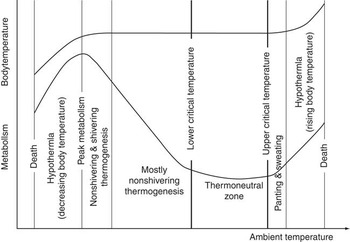
The relationship between T a and the balance between heat production and heat loss is schematically illustrated in Figure 1. The thermoneutral zone (TNZ) is the interval of thermal environment, usually characterized by T a over which heat production is relatively constant for a given energy intake. The lower and upper limits of the thermoneutral zone are called the lower (LCT) and the upper critical temperature (UCT), respectively. When ambient temperature increases above the UCT, the animal can no longer control its T b and this severe hyperthermia can be lethal. However, it must be taken into consideration that in domestic animals it is almost impossible to determine the TNZ as a result of their outstanding production, which obviously leads to difficulties to maintain dynamic steady state. The effects of high T a on T b depends on the type of exposure: in case of acute heat exposure, T b will rapidly increase up to critical values. In chicken, death occurs approximately when T b reaches 4°C above the ‘regular’ physiological temperature (Amand et al., Reference Amand, Aubert, Bourdette, Bouvarel, Chevalier, Dusantier, Franck, Guillou, Hassouna, Le Biavan, Mahé, Prigent and Robin2004). However, when pigs, chickens or calves are exposed for a long period to a moderately high temperature, they will first present a phase of increasing T b that will then decline to a dynamic steady state corresponding to an ‘acclimated’ state (Bianca, Reference Bianca1959; Cooper and Washburn, Reference Cooper and Washburn1998; Collin et al., Reference Collin, Vaz and Le Dividich2002; Renaudeau et al., Reference Renaudeau, Anais, Tel and Gourdine2010).
Effect of ambient temperature on animal metabolism and body temperature (A. Collin, personal communication).

Consequences of the thermoregulatory responses on animal performance
General considerations
Physiological and metabolic adjustments resulting from the thermoregulatory responses to a thermal stress have negative consequences on animal productivity and health. Under warm conditions, the reduced animal performance is largely because of both direct and indirect effects of heat stress on reducing feed intake. In ad libitum-fed animals, the reduction in heat production related to consumption and metabolic utilization of feed is an essential mechanism to maintain T b within a physiological safe range. The related low energy and nutrient intakes mainly explain the reduction in meat, milk and egg production under heat stress. However, a portion of the reduced performance is because of a direct effect of high temperature (independent of feed intake) on reproductive physiology, health, energy metabolism and on protein and fat deposition. In the sections below, we will address the effects of thermal stress on animal health and performance in monogastric and ruminants species.
Consequence of the thermoregulatory responses on swine performance
Swine performance under hot climate varies depending on the age of the animals. For instance, in growing finishing pigs, the threshold temperature at which feed consumption and growth rate start to decrease is mainly affected by the BW (Collin et al., Reference Collin, Van Milgen and Le Dividich2001c; Renaudeau et al., Reference Renaudeau, Gourdine and St-Pierre2011). Heavier pigs are more susceptible to heat stress than young pigs in connection with their higher energy intake relative to maintenance requirement and with a lower ability to dissipate heat (i.e. a lower surface area-to-mass ratio (volume) and higher subcutaneous fat tissues).
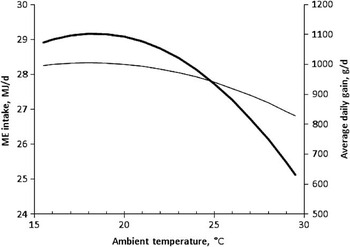
Some other factors related to animal characteristics (genotype, sex) or breeding conditions (feeding, housing conditions, management, climatic parameters other than temperature and sanitary status) can also influence the effect of thermal environment on animal performance. The decrease in growth rate associated with thermal stress is primarily a result of a decline in feed intake, although a slight increase in feed conversion ratio at very high-temperature level has been reported by several authors (Figure 2; Collin et al., Reference Collin, van Milgen, Dubois and Noblet2001b; Renaudeau et al., Reference Renaudeau, Gourdine and St-Pierre2011). Lower carcass fatness at slaughter connected to the feed restriction is generally reported in heat-stressed pigs (Le Dividich et al., Reference Le Dividich, Noblet, Herpin, van Milgen, Quiniou, Wiseman, Varley and Chadwick1998). In addition, there appears to be little effect of rearing pigs under hot temperature on fresh meat quality parameters (Lefaucheur et al., Reference Lefaucheur, Le Dividich, Mourot, Monin, Ecolan and Krauss1991). According to Le Bellego et al. (Reference Le Bellego, van Milgen and Noblet2002), the partitioning of energy between protein and fat deposition is dependent on both the feeding level and T a. These authors showed that there was lower protein retention at 30°C than at 23°C when pigs were fed the same amount of energy. The direct effect of high temperature on protein deposition is explained by the high energetic cost of protein deposition relative to lipid deposition. These latter results are not confirmed in piglets (Collin et al., Reference Collin, van Milgen, Dubois and Noblet2001b), which have lower sensibility to heat stress compared with growing finishing pigs.
Effect of ambient temperature on growing pigs performance ( , ME intake (MJ/day); —, average daily gain (g/d)). Adapted from Renaudeau et al. (Reference Renaudeau, Gourdine and St-Pierre2011) for a 50 kg BW pig.

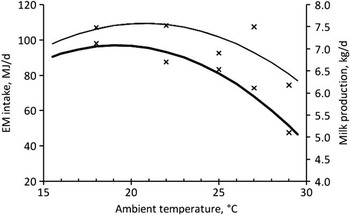
In pigs, a certain degree of seasonality of reproduction has been reported in many countries. Major manifestations of season on reproduction in sows includes delayed onset of puberty, a prolonged weaning to estrus interval and a reduced proportion of mated sows that farrow. This reduction in farrowing rate is of the greatest economic importance because producers are unable to predict it, and therefore to maintain production output. Numerous studies have highlighted the multi-factorial nature of the seasonal infertility problem. Sows reproductive problems are partly explained by a reduced semen quality of the boar (Wettmann et al., Reference Wettmann, Wells, Omtvedt, Pope and Turman1976; Suriyasomboon et al., Reference Suriyasomboon, Lundeheim, Kunavongkrit and Einarsson2004). However, changes in the photoperiod and/or a thermal challenge occurring during the mating period, in early or in late gestation period or the extent to which maternal body reserves are mobilized during the preceding lactation period also affect the reproductive performance of the sow (Prunier et al., Reference Prunier, Soede, Quesnel, Kemp, Pluske, Le Dividich and Verstegen2003). Lactating sows that have higher metabolic rates related to milk production demonstrate a greater sensibility to high temperatures in comparison with growing pigs (Renaudeau et al., Reference Renaudeau, Gourdine and St-Pierre2011). Yet, the effects of high temperature on the performance of lactating sows are quite variable among studies. The average reduction in ME intake was calculated to be about 2.6 MJ/day per °C (Renaudeau, Reference Renaudeau2008a). However, as shown for growing pigs, the effect of heat stress on feed consumption becomes more pronounced as the T a increases (Figure 3). Concomitantly, the amount of nutrients and energy available for milk synthesis is reduced with a negative consequence on the litter growth rate (−50 g/day per °C; from a review of the literature – Renaudeau, Reference Renaudeau2008a). In thermoneutral conditions, the energy requirement for milk production generally exceeds the feed intake capacity especially in modern hyper-prolific sows. Consequently, the mobilization of body reserves is necessary to compensate for the energetic deficit. Sows losing excessive amounts of BW have a prolonged weaning-to-estrus intervals. Under thermal stress, the energy deficit and occurrence of reproductive failure are accentuated (Prunier et al., Reference Prunier, Quesnel, Messias de Bragança and Kermabon1996). Variation of milk production in hot conditions is mainly explained by the reduced feed consumption. However, direct effects of heat stress on milk production and body reserves mobilization have also been reported in primiparous (Messias de Bragança et al., Reference Messias de Bragança, Mounier and Prunier1998) and multiparous sows (Renaudeau et al., Reference Renaudeau, Noblet and Dourmad2003). For milk production, a deficiency in nutrient supply to the mammary gland may be related to a redistribution of blood flow to the skin in order to increase heat losses (Renaudeau et al., Reference Renaudeau, Noblet and Dourmad2003).
Effect of ambient temperature on sow performance during lactation ( , ME intake (MJ/day); —, milk production (kg/day)). Adapted from Quiniou and Noblet (Reference Quiniou and Noblet1999) for LW mulitparous sows during a 21-day lactation period.

To our knowledge, data on the effects of hot climate on pig health are scarce. According to Morrow-Tesch et al. (Reference Morrow-Tesch, McGlone and Salak-Johnson1994), chronic heat stress results in an increase of neutrophil numbers and a decrease in antibody production in growing pigs. Using a dirty pen model to stimulate the immune system in pigs, it has been reported that a deterioration of the sanitary status in tropical climate emphasized the negative effect of hot season on feed consumption and growth performance (Renaudeau, Reference Renaudeau2008b). From data collected in 130 swine-breeding farms in Canada, D'Allaire et al. (Reference D'Allaire, Drolet and Brodeur1996) showed a fourfold increase in sows’ death rate when the maximal ambient temperature rises above 30°C. According to these authors, a large proportion of death is explained by heat stress-related cardiovascular failures.
Consequence of the thermoregulatory responses on poultry performance
As for poultry species, the effect of heat exposure depends on several factors. For instance, broiler chickens, for which selection has favored growth rate and muscle mass at the detriment of thermoregulatory organs (Havenstein et al., Reference Havenstein, Ferket and Qureshi2003), are much less thermo-tolerant than layers (Yahav et al., Reference Yahav, Shinder, Ruzal, Giloh and Piestun2009). Male broiler chickens are less tolerant to heat than females (Cahaner and Leenstra, Reference Cahaner and Leenstra1992). However, turkeys that were selected for growth rate, similar to broilers, can sustain much better heat-stress exposure. This may partially be related to the larger unfeathered surface, which enables better heat loss by radiation and convection.
In broilers, feed intake is depressed when T a rises (Figure 4). In broiler chickens aged 4 to 6 weeks, feed consumption is 24% lower at 32°C than at 22°C (Géraert et al., Reference Géraert, Padilha and Guillaumin1996), in an attempt to reduce their metabolic heat production. This effect is mediated by a decrease in the main metabolic hormone – plasma triiodothyroxine (T3) concentration, which was found to be linearly related to T a in broilers (Yahav, Reference Yahav2009). The fasting heat production is the main component being affected by high temperature in chickens (Géraert et al., Reference Géraert, Padilha and Guillaumin1996). Surprisingly, these latter authors showed that heat-exposed chickens have higher thermic effect of feed when expressed as g of feed ingested than those at thermal neutrality. However, the reduction of growth in broilers is often greater than the reduction in feed intake, resulting in a lower feed efficiency (Géraert et al., Reference Géraert, Guillaumin and Leclercq1993; Al-Fataftah and Abu-Dieyeh, Reference Al-Fataftah and Abu-Dieyeh2007; Figure 4). In fact, using pair-feeding techniques, it has been demonstrated that about half of the reduction of growth due to heat stress was not related to feed intake, and thus have other origins (Géraert, Reference Géraert1998). As previously shown for pigs (Le Bellego et al., Reference Le Bellego, van Milgen and Noblet2002), for a similar feed intake (pair-feeding), heat-exposed broilers gain less protein (Temim et al., Reference Temim, Chagneau, Guillaumin, Michel, Peresson, Géraert and Tesseraud1999) but retain more fat, especially in subcutaneous fat tissues (Ain Baziz et al., Reference Ain Baziz, Géraert, Padilha and Guillaumin1996). The decrease in protein deposition is explained by a decrease in the capacities of protein synthesis (Temim et al., Reference Temim, Chagneau, Peresson and Tesseraud2000), but also by an altered insulin signaling in muscles (Boussaid-Om Ezzine et al., Reference Boussaid-Om Ezzine, Everaert, Métayer-Coustard, Rideau, Berri, Joubert, Temim, Collin and Tesseraud2010). Muscle proteolysis rate may also be affected, depending on T a and on the age of animals (Yunianto et al., Reference Yunianto, Hayashi, Kaneda, Ohtsuka and Tomita1997; Temim et al., Reference Temim, Chagneau, Peresson and Tesseraud2000). The increase in peripheral fat is mainly explained by a decrease in peripheral lipolysis. However, in these tissues, unchanged to lower de novo lipogenesis capacities could also be observed (Ain Baziz et al., Reference Ain Baziz, Géraert, Padilha and Guillaumin1996; Géraert et al., Reference Géraert, Padilha and Guillaumin1996). The higher peripheral fat accretion will affect cutaneous heat loss capacity by altering thermal conductivity, which might be involved in the chicken's poor heat loss capacity. Chicken meat quality is influenced by thermal stress via an effect of the glucose metabolism. Ain Baziz et al. (Reference Ain Baziz, Géraert, Padilha and Guillaumin1996) showed a lower muscle glycogen content in chronically heat-exposed chickens, whereas acute heat stress increases glycaemia, affects glycolytic potential and 24-h post-mortem ultimate pH in the chicken leg muscle (Debut et al., Reference Debut, Berri, Baeza, Sellier, Arnould, Guemene, Jehl, Boutten, Jego, Beaumont and Bihan-Duval2003). Lower drip loss was measured for the breast muscle of heat-stressed chickens compared with control chickens (Collin et al., Reference Collin, Berri, Tesseraud, Rodón, Skiba-Cassy, Crochet, Duclos, Rideau, Tona, Buyse, Bruggeman, Decuypere, Picard and Yahav2007).
Effect of constant (▪) and diurnally cycling temperature ( ) on weight gain, food intake and food efficiency in 5–8-week-old male broiler chickens. Value of cyclic temperature are shown against their average temperature (from Yahav et al., Reference Yahav, Straschnow, Plavnik and Hurwitz1996).

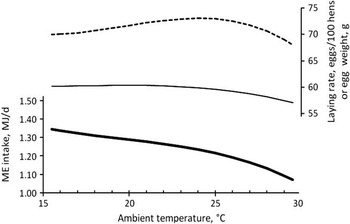
In laying hens, thermal stress resulted in a reduction in feed consumption, egg production, egg weight and eggshell quality (Figure 5). In heat-exposed laying hens feed consumption decreases following a curvilinear function of T a (Mardsen and Morris, Reference Mardsen and Morris1987). According to these authors, feed intake decreases by 1% to 1.5% per degree between 20°C and 30°C, and by 5% per degree between 32 and 38°C (Travel et al., Reference Travel, Nys and Lopes2010). The decline in egg productivity by laying hens at high T a depends on the level and the duration of exposure to heat stress (Smith, Reference Smith1973). The laying peak is lowered and further egg production declines faster at 30°C than under thermoneutral conditions (Balnave and Brake, Reference Balnave and Brake2005). In hot conditions, total nutrient intake is generally insufficient to support normal rate of lay. Changes in egg weight and quality in warm conditions result from a combination of heat stress per se and from the reduced nutrient intake. As observed for feed intake, the average egg weight shows a curvilinear decrease as the T a is increased above 25°C (Smith and Oliver, Reference Smith and Oliver1972). This decrease in egg weight is associated with an immediate decline in egg albumin weight and a delayed decrease in egg yolk weight (Sauveur and Picard, Reference Sauveur and Picard1987). This lower average egg weight is partly explained by the shortage of protein and energy intake during thermal stress. However, the reduction in blood flow to the uterus because of greater flow to the peripheral tissues may also reduce the amount of nutrient available for egg development (Smith, Reference Smith1974). The alteration of eggshell quality is frequently reported under heat stress (Travel et al., Reference Travel, Nys and Lopes2010). This problem could be partly related to an inadequate calcium intake. However, most commercial layer feeds provide enough calcium to support shell formation even at low feeding level. In fact, most of the effects of heat stress on the eggshell is because of a rise in blood pH (alkalosis) caused by loss of excessive amounts of carbon dioxide by panting. As a result, blood bicarbonate availability for eggshell mineralization is reduced with negative consequence on eggshell thickness. Furthermore, alkalosis induces an increase in organic acid production, which reduces the free calcium ions in the blood, thereby affecting eggshell quality. However, heat seems to act as a filter, meaning that performance of laying hens can be recovered soon after the T a returns back to thermal neutrality (Picard et al., Reference Picard, Sauveur, Fernadji, Angulo and Mongin1993).
Effects of temperature on laying hens performance ( , ME intake (MJ/d); —, laying rate (eggs/100 hens per day) and – –, egg weight (g/egg)). Adapted from Mardsen and Morris (Reference Mardsen and Morris1987).

There is some evidence that health and immune system of the poultry are adversely affected by heat stress. The humoral immunity of broilers or laying hens is generally depressed in hot conditions, including decreases in total white blood cell count and antibody production (Mashaly et al., Reference Mashaly, Hendricks, Kalama, Gehad, Abbas and Patterson2004). However, these effects depend on animal-related factors such as breed, type and age of bird and environmental factors such as length and intensity of heat exposure (Picard et al., Reference Picard, Sauveur, Fernadji, Angulo and Mongin1993). The immune-depressive effect of heat stress may increase the sensibility of poultry flocks to virus challenge, bacterial infections and parasitic diseases, emphasize the effect of high T a on performance and increase death rate (Quinteiro-Filho et al., Reference Quinteiro-Filho, Ribeiro, Ferraz-de-Paula, Pinheiro, Sakai, Sa, Ferreira and Palermo-Neto2010). Acute severe heat stresses that occur during heat wave events are known to cause a large death rate, especially in heavy broilers and laying hens. In 2006, the major heat waves moving across the United States of America and Canada resulted in a death of over 700 000 poultry in California alone (Gaughan et al., Reference Gaughan, Lacetera, Valtora, Khalifah, Hahn and Mader2009).
Consequence of the thermoregulatory responses on ruminant performance
Both grazing and feedlot cattle suffer from heat stress during periods of high T a and humidity, which affects rate and efficiency of beef production (Birkelo et al., Reference Birkelo, Johnson and Phetteplace1991). Worldwide, ruminant animals are often partially or completely reared outdoors with a constant exposure to natural climatic conditions. In such conditions, heat stress is caused by a combination of environmental factors (temperature, RH, solar radiation, air movement and precipitation). In consequence, for ruminant species, a THI or black globe heat index is often used to assess the degree of thermal stress for a given environment (Collier and Beede, Reference Collier and Beede1985; Wiersma and Armstrong, Reference Wiersma and Armstrong1989).
Beef cattle are particularly vulnerable not only to extreme thermal environmental conditions but also to a rapid change in climate. Typically pastured cattle are not as susceptible to heat stress as feedlot cattle. Pastured cattle have the ability to seek shade, water and air movement to cool themselves, whereas radiant heat from dirt or concrete surface is increased for feedlot cattle. The susceptibility to heat stress of feedlot cattle mainly depends on the intensity and duration of the thermal challenge and on animal-related factors (breed, BW, growing phase, sanitary and nutritional status). In a review by Bernabucci et al. (Reference Bernabucci, Lacetera, Baumgard, Rhoads, Ronchi and Nardone2010), it was reported that the threshold T a at which DM intake of beef cattle starts to decrease is about 30°C for a RH below 80%. Above 80%, the corresponding value for the threshold T a is 27°C. For growing steers fed ad libitum with concentrate (corn + silage) and housed in a climatic chamber, feed consumption was reduced by 20% from 18°C and 30°C, and by 25% from 30°C and 34°C (Brown-Brandl et al., Reference Brown-Brandl, Nienaber, Eigenberg, Hahn and Freetly2003). Such deleterious effects of high T a may be aggravated when the feeds include high percentage of roughages. High T a affects the activity and function of the digestive system in ruminant species. Generally, the digestibility of feed is improved under hot conditions because of the reduced feed intake (Morand-Fehr and Doreau, Reference Morand-Fehr and Doreau2001). This higher digestibility coefficient seems to be related to a slower rate of digesta passage in the total gastrointestinal tract (Christopherson and Kennedy, Reference Christopherson and Kennedy1983). For beef and dairy cattle, feed conversion ratio is increased under heat stress mainly as a consequence of increased maintenance requirements. The lower feed intake has a direct impact on growth performance. High T a can also have a strong negative effect on beef meat quality. Heat stress can favor greater muscle marbling and fat deposition in the internal depot in place of the subcutaneous depot (Gregory, Reference Gregory2010). In addition, hot climate can lead to more dark-cutting beef. The frequency of dark cutters is reduced when shade is provided to feedlot heifers (Mitlohner et al., Reference Mitlohner, Morrow, Dailey, Wilson, Galyean, Miller and McGlone2001). In addition, heat stress can favor greater muscle marbling and fat deposition in the internal depot in place of the subcutaneous depot (Gregory, Reference Gregory2010).
Seasonal high T a are associated with low reproductive performance in dairy and beef cows (Wolfenson, Reference Wolfenson2009). According to Amundson et al. (Reference Amundson, Mader, Rasby and Hu2006), a reduction in pregnancy rate is noticed when THI is equal or exceeds 72.9 for beef cows in pasture. On average, conception rate drops by 24% during summertime (Bernabucci et al., Reference Bernabucci, Lacetera, Baumgard, Rhoads, Ronchi and Nardone2010). This decrease in fertility is caused by an impaired ovarian function, lower expression of estrus, oocytes health problems and lower embryonic development (Wolfenson, Reference Wolfenson2009). Finally, Meyerhoeffer et al. (Reference Meyerhoeffer, Wettemann, Coleman and Wells1985) reported that the deterioration of bull fertility related to heat stress could also partly explain the summer infertility of the cow.
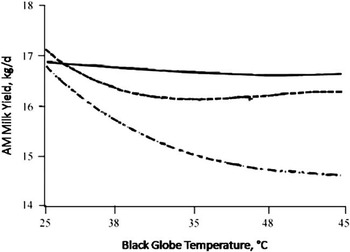
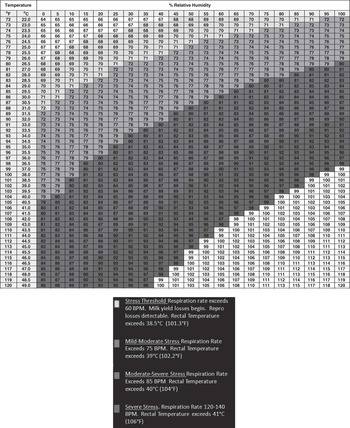
Because of their very high metabolic rate associated with milk production, modern high-producing dairy cows are more vulnerable to heat stress. According to Kadzere et al. (Reference Kadzere, Murphy, Silznikove and Maltz2002), feed intake in lactating cows begins to decline at a threshold T a of 25°C to 26°C. As previously reported for the beef cattle and monogastric species, the extent to which temperature affects feed intake in dairy cows depends on the T a level. Milk production is negatively affected by high T a. The point on the lactation curve at which the cow experiences heat stress is also important for milk production. Collier et al. (Reference Collier, Eley, Sharma, Pereira and Buffington1981) demonstrated that milk yield decline was detectable at Black Globe Temperatures above 25°C (Figure 6). Research has also indicated that the effects of a given temperature on milk production are maximal between 24 and 48 h following heat stress (Collier et al., Reference Collier, Eley, Sharma, Pereira and Buffington1981; Figure 6). It has also been reported that ambient weather conditions two days before milk yield measurement had the greatest correlation to decreases in milk production and dry matter intake (West, Reference West2003). Recently, the THI for lactating dairy cows was recalculated by Zimbleman et al. (Reference Zimbleman, Rhoads, Rhoads, Duff, Baumgard and Collier2009). The revised THI takes into account new information from controlled and large herd studies under a variety of climatic conditions using data from high-producing dairy cows. The new THI stress threshold for high-producing cows (>35 kg milk/day) is 68 (Figure 7). In a comprehensive review (Bernabucci et al., Reference Bernabucci, Lacetera, Baumgard, Rhoads, Ronchi and Nardone2010), heat-induced reduction of milk production is 14% in early lactation and 35% in mid-lactation in dairy cows. The negative effect of heat stress on milk production is primarily explained by a reduced nutrient intake and a decrease of nutrient uptake by the portal-drained vein (McGuire et al., Reference McGuire, Beede, DeLorenzo, Wilcox, Huntington, Reynolds and Collier1989). Using pair-feeding techniques (Rhoads et al., Reference Rhoads, Rhoads, VanBaale, Collier, Sanders, Weber, Crooker and Baumgard2009) showed that the reduced feed intake accounts for only 35% of the milk production decrease under heat stress. As previously suggested for milk production in lactating sows or egg production in laying hens, blood flow shift to peripheral tissues for cooling purposes may alter nutrient metabolism and contribute to lower cattle milk production during hot weather. The reduced milk production in hot season is accompanied by a decrease in milk protein contents related to a decrease in casein fraction (Bernabucci et al., Reference Bernabucci, Lacetera, Ronchi and Nardone2002).
Least squares regressions of average afternoon Black Globe temperature 2 days prior to (—**—), 1 day prior to (— —), or day of (—) a.m. milking on milk yield (Collier et al., Reference Collier, Eley, Sharma, Pereira and Buffington1981).

Revised temperature humidity index chart for dairy cows (Zimbleman et al., Reference Zimbleman, Rhoads, Rhoads, Duff, Baumgard and Collier2009).

In contrast to dairy and beef cows, less information about the effects of heat stress on sheep and goats is available in the literature, mainly because of their minor importance with regard to world milk production. Approximately 67% of all dairy sheep are located in the Mediterranean region, where heat stress is common during warm summer months (Finocchiaro et al., Reference Finocchiaro, van Kaam, Portolano and Misztal2005). Sheep and goats appear to be less susceptible to heat stress than other domesticated ruminant species in relation with unique characteristics such as water conservation capability, potential water loss up to 35% of total body water content (in the Bedouin goat Shkolnik and Choshniak, Reference Shkolnik and Choshniak2006), higher sweating and respiratory rate and lower basal heat production (Kadzere et al., Reference Kadzere, Murphy, Silznikove and Maltz2002). Whereas cattle are considered stressed above a THI of 72, the threshold for heat stress in sheep is 82 (Marai et al., Reference Marai, El-Darawany, Fadiel and Abdel-Hafez2007). Sheep evolving in a semi-arid environment can easily handle high T a, but have great difficulty with the combination of high T a and humidity (Marai et al., Reference Marai, El-Darawany, Fadiel and Abdel-Hafez2007). Sheep are also panting animals and develop respiratory alkalosis under conditions of high T a and concomitant high respiration rates (Marai et al., Reference Marai, El-Darawany, Fadiel and Abdel-Hafez2007).
Literature on the effects of heat stress on the health of ruminants is scarce. As previously described for poultry, heat-stressed cows generally exhibit altered blood acid–base chemistry as a result of the shift in cooling from sensible heat losses to evaporative cooling. Panting results in a respiratory alkalosis, which is compensated by an increase in urinary bicarbonate excretion leading to decline in blood bicarbonate concentration. This reduced concentration of bicarbonate compromises the buffer capability associated with the bicarbonate system that may cause metabolic acidosis problems, especially during summer when cows are fed diets rich in concentrate in order to compensate the low feed ingestion (West, Reference West2003). In addition, heat-stressed dairy cattle can lose a large amount of K via sweat, whereas feed consumption is reduced and K requirement for milk synthesis is high. This could result in K deficiency with detrimental consequences on health and performance (Beede and Collier, Reference Beede and Collier1986). In a comprehensive review, Gaughan et al. (Reference Gaughan, Lacetera, Valtora, Khalifah, Hahn and Mader2009) reported a higher occurrence of mastitis in dairy cows during periods of heat stress and they hypothesized that hot conditions could favor the development of pathogens responsible for mastitis and/or have negative effects on the animals’ immune response. Another direct effect of heat stress includes thermal-related death mainly during heat wave events. In 1995, the summer heat wave in the mid–central United States caused a loss in cattle industry of $28 million by animal losses and reduced performance (Hahn, Reference Hahn1999).
Strategies to alleviate heat stress in farm animals
Environmental modifications
A broad spectrum of environmental and technical solutions can be used to temper the effects of hot climates. However, environmental applications to alleviate heat stress in farm animals are not appropriate if nutrition, disease control or breeding factors limiting animal performance are not optimal. For example, in laying hens, stocking density should be reduced under warm T a to avoid the accumulation of radiant heat between the animals and excessive heat stress (Burmeister et al., Reference Burmeister, Jurkschat and Nichelmann1986). In addition, during the hottest periods of the day, additional stress on animals must be avoided. Consequently, animals should not be manipulated during hot spells to avoid stress-related mortality (Amand et al., Reference Amand, Aubert, Bourdette, Bouvarel, Chevalier, Dusantier, Franck, Guillou, Hassouna, Le Biavan, Mahé, Prigent and Robin2004). Finally, heat can be minimized by adopting simple and basic rules for designing animal facilities (shape, orientation, thermo-physical properties of construction materials, ventilation, opening facilities, etc.). In cattle, Collier and Beede (Reference Collier and Beede1985) suggested that physical modification of the environment or genetic selection for more heat-tolerant cattle would be the primary means of reducing adverse effects of the environment on animal production and dairy profitability. This assumption is also valuable for pigs and poultry. Classically, these methods can be divided into two groups, those modifying the environment to prevent or limit the degree of heat stress to which the animals are exposed or those enhancing heat exchange between the animal and the environment.
Methods for reducing heat stress
These environmental modifications attempt to reduce the potential for heat stress by lowering the solar radiation or T a around the animal. For outdoors animals, the provision of shade (natural or artificial) is one of the simplest and cost-effective methods to minimize heat from solar radiations. Trees are very effective and natural shading materials providing shade to the animals combined with beneficial cooling as moisture evaporates from the leaves. Artificial shades have been used with success for heat-stressed animals in confinement or in intensive situations. Shade is effective in protecting cows from solar radiation, but does not alter the air temperature or RH around the cows to maximize sensible routes of heat loss (Armstrong, Reference Armstrong1994; West, Reference West2003). Studies comparing shade v. no shade have demonstrated improved milk yield and reproduction, as well as reduced respiration rate and rectal temperature in shaded dairy cows (Bond and Kelly, Reference Bond and Kelly1955; Roman-Ponce et al., Reference Roman-Ponce, Thatcher, Buffington, Wilcox and Horn1977; Collier et al., Reference Collier, Eley, Sharma, Pereira and Buffington1981 and Reference Collier, Dahl and VanBaale2006). The beneficial effect of shade on dairy cow performance depends on the breed (Collier et al., Reference Collier, Eley, Sharma, Pereira and Buffington1981) and coat color (Blackshaw and Blackshaw, Reference Blackshaw and Blackshaw1994). Providing shade is also an effective method of reducing heat stress for feedlot or beef cattle. Shade ameliorates heat load of cattle (Valtorta et al., Reference Valtorta, Leva and Gallardo1997; Gaughan et al., Reference Gaughan, Bonner, Loxton, Mader, Lisle and Lawrence2010) and reduces mortality in extreme weather conditions (Bubsy and Loy, Reference Bubsy and Loy1996). However, shade does not remove all the effects of thermal stress (Gaughan et al., Reference Gaughan, Bonner, Loxton, Mader, Lisle and Lawrence2010). In West Texas, feed intake and growth performance were significantly increased when shade was provided to feedlot cattle (Blackshaw and Blackshaw, Reference Blackshaw and Blackshaw1994; Mitlohner et al., Reference Mitlohner, Morrow, Dailey, Wilson, Galyean, Miller and McGlone2001). Generally, more consistent advantages of shade were found in hot-arid climates than in humid regions (Ames and Ray, Reference Ames and Ray1983). Major design considerations must be taken into account for shade structures (orientation, space, height and roof construction). In the southwestern United States, a mature dairy cow requires 3.5 to 4.5 m2 of space beneath the shade and a north–south orientation (Armstrong, Reference Armstrong1994). A smaller space increases the risk of occurrence of udder problems, whereas an excessive shade pen has no additional benefits. Various types of roofing materials can be used for shade structures. The most effective in terms of reducing heat load is a reflective roof such as a white galvanized or aluminum roof (Blackshaw and Blackshaw, Reference Blackshaw and Blackshaw1994). Slats or other shade materials with less than total shading capabilities are considerably less effective (Armstrong, Reference Armstrong1994). Whether the benefits of shade justify the cost depends on year, breed (Collier et al., Reference Collier, Eley, Sharma, Pereira and Buffington1981) and possibly hair color of the cow (Armstrong, Reference Armstrong1994).
Various cooling systems have also been evaluated. Air temperature can be lowered by air conditioning, but the expense of such types of mechanical air cooling make it impractical for cooling livestock animals (West, Reference West2003). Evaporative cooling systems use the energy from the air to evaporate water and evaporation of water into warm air reduces the air temperature while increasing RH. Water can be evaporated from atomizing nozzles or from cooling pads. Fogging systems use very fine droplets of water in order to increase the water surface in contact with the air. The water is evaporated into the air causing a reduction in T a. These systems are most effective in dry areas but can also be used in high humid regions during daytime hours when RH is low. As the water is completely evaporated, fogging systems do not waste water. Misting systems generate larger droplets than fogging systems, but cool the air by the same principle. In humid climate, mist droplets are too large to fully evaporate before setting the ground and can wet the bedding and feed. With pad cooling system, the ambient air within the building is cooled down forcing air into the building through a wet pad. However, this wet pad can be replaced by a fine mist injection apparatus that injects water under high pressure into a stream of air. This system was found to be very effective to reduce the T a during the hottest periods of the day, especially when RH was low. In swine production, fogging systems allow the improvement of growth performance by 5% to 10%, especially in finishing pigs (Nichols et al., Reference Nichols, Ames and Hines1979; Dutertre et al., Reference Dutertre, Massabie, Ginestet and Granier1998; Haeussermann et al., Reference Haeussermann, Hartung, Jungbluth, Vranken, Aerts and Berckmans2007). However, the gain of evaporative cooling pads for improving pig performance under heat stress is relatively low perhaps because it results in an increase of air moisture (Dutertre et al., Reference Dutertre, Massabie, Ginestet and Granier1998; Sartor et al., Reference Sartor, Baêta, Tinôco and Luz2003; Kunavongkrit et al., Reference Kunavongkrit, Suriyasomboon, Lundeheim, Heard and Einarsson2005). Finally, pad cooling is effective to lower T a in closed poultry or pig houses (Europe, United States, etc.), but it is still an expensive means to alleviate heat stress. In ruminant species, evaporative cooling options have been used mainly in dairy cattle in relationship with their high susceptibility to heat stress. In Saudi Arabia, milk production and reproductive performance of dairy cattle were improved using an evaporative cooling system (Ryan et al., Reference Ryan, Boland, Kopel, Armstrong, Munyakazi, Godke and Ingraham1992). Despite the high initial investment and the operating expense, these authors concluded that there was a long-term economic benefit from the use of pad cooling systems. However, the effectiveness of these systems is questionable in humid climates. In Florida, where cooling pads were used, milk production was not improved, although rectal temperature and respiratory rate were reduced (Taylor et al., Reference Taylor, Buffington, Collier and Delorenzo1986).
Methods for enhancing animal heat losses
Increased heat exchange generally involves increasing heat loss from the body surface by enhancing heat loss mechanisms.
Air movement is an important factor in the relief of heat stress, as it affects both convective and evaporative heat losses. Natural ventilation rate can be maximized using a well-oriented semi-opened building with high and well-isolated roof (Holik, Reference Holik2009). Additional fans can be installed if natural airflow is not sufficient. Sensible heat loss in chickens can be improved by increasing ventilation in the poultry house; optimum ventilation is described as a bell shaped curve with maximum value that shifted with T a being, for example, 2 m/s at 35°C and 60% RH (Yahav et al., Reference Yahav, Straschnow, Luger, Shinder, Tanny and Cohen2004b). Using optimal ventilation significantly improves performance rate of broilers (Yahav et al., Reference Yahav, Shinder, Tanny and Cohen2005), turkeys (Yahav et al., Reference Yahav, Shinder, Ruzal, Giloh and Piestun2009) and laying hens. The increase of airflow in swine facilities lowered the effects of thermal stress on growing pigs and lactating sow performances. A provision of supplemental fresh air directly over the animal can be a very efficient way to improve performance of the heat-stressed animal. Snout cooler designed to direct air on the sow's head and neck permitted a 25% to 35% improvement in the feed consumption at 30°C (Stansbury et al., Reference Stansbury, McGlone and Tribble1987; McGlone et al., Reference McGlone, Stansbury and Tribble1988).
One of the most common and effective methods to promote heat losses involves the addition of water to the skin with or without supplemental airflow to increase the rate of evaporation of additional water. Heating 1 g of water by 1°C only requires 1 calorie of energy, whereas evaporating 1 g of water requires 580 calories. Water evaporation occurs by absorbing heat directly from the body of the animal and also by absorbing heat from the surrounding air. The water can be provided to the air coat with drippers or sprinkler equipments. However, such equipment is known to generate a large volume of water to be processed. These systems are widely used in pig production for alleviating heat stress and have generally the highest performance when compared with the other cooling methods (Nichols et al., Reference Nichols, Ames and Hines1979). However, the efficiency of this system depends on pig BW (weaning < growing < finishing pigs < lactating sows) and the conditions of the water application. The interval between wettings, the duration of water application and the amount of supplied water per wetting need to be considered in order to maximize evaporative heat loss. Practically, the droplet size must be large enough to wet the skin of the animal and must be applied intermittently to permit time for evaporation of the moisture from the skin. In lactating sows kept at 30°C during the lactation period, voluntary feed intake and milk production were increased by 24% and 19% using drip cooling method (McGlone et al., Reference McGlone, Stansbury and Tribble1988). With sprinklers operating intermittently (1 min on and 14 min off) below 29.5°C and continuously above 29.5°C, feed intake and average daily gain were improved by 13% in heat-stressed finishing pigs (Nichols et al., Reference Nichols, Thaler, Murphy, Hines and Nelssen1987). In that study, the reduction of water flow rate from 1.6 to 0.8 l/pig per h did not change the performance of the spray cooling system. In addition, air movement over the pig must be significant to improve the skin evaporation. As a result, a provision of supplemental airflow can critically improve the benefit of the spray cooling systems (Turner et al., Reference Turner, Monegue, Gates and Lindemann1997). The effects of sprinkling on dairy cow and beef performance have been extensively studied. Dairy cattle allowed access to sprinklers (with and without forced ventilation) have increased milk production (Igono et al., Reference Igono, Steevens, Shanklin and Johnson1985; Turner et al., Reference Turner, Chastain, Hemken, Gates and Crist1992), improved reproduction and improved conversion of feed to milk (Wolfenson, Reference Wolfenson2009). Comparable economic benefits of cooling feedlot cattle are less evident, likely because of the ability of heat-stressed cattle to exhibit rapid compensatory growth following heat stress (Davis et al., Reference Davis, Mader, Holt and Parkhurst2003). In poultry, intermittent partial surface sprinkling is useful as a support eliminating heat stress, especially when RH is low. However, this method can also be used for hot and humid climates, where other types of evaporative cooling methods based on the use of high-pressure fogging would increase RH in the building and be less able to reduce the effective temperature for birds (Mutaf et al., Reference Mutaf, Seber Kahraman and Firat2008). Chepete and Xin (Reference Chepete and Xin1999) showed that intermittent partial sprinkling of 8 ml of water (every 15 min) to the head and appendages of heat-stressed laying hens allows them to reduce T b increases and overall mortality. A 3% increase of overall egg production during summertime was found with sprinklers operating 10 s (2.1 ml/s) every 10 min when the internal T a exceeded 32°C (Ikeguchi and Xin, Reference Ikeguchi and Xin2001). In broilers, surface wetting coupled with good air movement is also reported to be effective in relieving heat stress of the birds even under relatively humid conditions (Tao and Xin, Reference Tao and Xin2003).
Because of the high susceptibility of lactating sows to heat stress, reducing thermal stress to increase milk production and decrease body reserve mobilization is a key issue in pig production. However, thermal requirement of the sows and suckling piglets widely differ, and thus local devices have to be used to cool the sows without negative effect on the piglets’ well-being. Lactating sows spend about 85% to 90% of the day resting. This means that most of the time, a large part of their body is in contact with the floor. Thus, the thermal comfort provided by the floor is very important. The reduction in floor temperature improves sensible heat flux between the animal and the floor. According to Silva et al. (Reference Silva, Oliveira, Donzele, Fernandes, Lima, Renaudeau and Noblet2009), milk production increased from 7.2 to 9.5 kg/day in primiparous lactating sows during summertime in an experimental trial performed in Brazil. In this experiment, the temperature of the water circulating in the cooled floor was maintained at about 17°C
Feeding modifications
Several extensive reviews of nutritional strategies for managing heat-stress dairy cows (West, Reference West2003), poultry (Lin et al., Reference Lin, Jiao, Buyse and Decuypere2006; Daghir, Reference Daghir2009) and pigs (Renaudeau et al., Reference Renaudeau, Gourdine, Silva and Noblet2008) have been published. Various dietary approaches or feeding strategies have been used to alleviate the adverse effect of heat stress with varying degrees of success. They aim to maintain water balance, nutrients and electrolytes intake and/or to satisfy the special needs during heat stress such as vitamins and minerals.
Changes in macronutrients composition
The depressed feed intake in hot weather is commonly considered as an adaptation to reduce metabolic heat production. Heat increment because of the metabolic utilization of crude proteins (CPs) or fiber is higher than for starch or fat. The higher heat increment of CP is partly related to the desamination of excess of amino acids (AAs) for urea synthesis and a higher protein turnover. The energy losses associated with the metabolic utilization of digestible fiber are mainly related to the losses of combustible gases and heat arising from fermentation and during the production of ATP from the oxidation of short-chain fatty acids, which is less efficient compared with ATP gains from the oxidation of glucose. From that, it has been suggested that low-CP or fiber diets should attenuate the depressed intake associated with heat stress. Moreover, the reduction in dietary fiber reduces the bulk density of the diet and then would encourage intake. Practically, two main nutritional strategies are available to minimize the reduction of energy and nutrient intake under heat stress by (1) using energy or protein concentrate diets to overcome the low DM intake and (2) using low increment diets to improve DM intake.
Whatever the species, several authors have shown that increasing the energy content of the diet via lipid addition can partially overcome the effect of heat stress. In fact, this practice not only increases the energy intake but also reduces the diet heat increment.
Multiple trials were carried out for evaluating the performance of growing pigs reared under high T a conditions and fed high-energy diets. First, studies on this topic were published by researchers from the universities of Georgia and Kentucky. Schenck et al. (Reference Schenck, Stahly and Cromwell1992a and Reference Schenck, Stahly and Cromwell1992b) increased by 5% the dietary fat content and did not report any improvement on growth performance in weaning and growing pigs housed at T a higher than 29°C. In contrast, growth performance was improved in heat-stressed finishing pigs fed high-fat diets (Stahly et al., Reference Stahly, Cromwell and Overfield1981; Katsumata et al., Reference Katsumata, Kaji and Saitoh1996; Spencer et al., Reference Spencer, Gaines, Rentfrow, Cast, Usry and Allee2001). The discrepancy between growing and finishing phases could be explained by the higher susceptibility of older pigs to heat stress. In most of the studies, the addition of fat resulted in an increase of carcass fatness. In fact, results on the effect of a combined diet with high energy correctly balanced for the protein-to-energy ratio in hot conditions are scarce. Using a high-fat diet supplemented with synthetic l-lysine in growing finishing pigs Myer et al. (Reference Myer, Brendemuhl and Bucklin2008) showed an improvement of growth rate without any negative effects on carcass adiposity. The response to high dietary fat addition-energy diets has also been studied in heat-stressed lactating sows, but under variable conditions. When high-fat diets were used without an increase of CP or essential AA to maintain a constant CP/ME ratio, the BW loss during lactation and the milk yield were not affected by the dietary treatment (McGlone et al., Reference McGlone, Stansbury and Tribble1988). In contrast, when the diet was correctly balanced for CP or Lys-to-ME ratio, the increase of nutrient density in heat-stressed sows improved litter BW gain via an increase of milk fat content, but did not limit sows’ body reserves mobilization (Schoenherr et al., Reference Schoenherr, Stahly and Cromwell1989a and Reference Schoenherr, Stahly and Cromwell1989b; Dove and Haydon, Reference Dove and Haydon1994; Quiniou et al., Reference Quiniou, Gaudré, Rapp and Guillou2000). However, the magnitude of these effects seems to be dependent on the rate of dietary fat incorporation and origin. In pigs, a decrease of dietary CP content without a synthetic AA supplementation results in a strong reduction in growth performance due to AA imbalance (Renaudeau, Reference Renaudeau2008a). Considering only the experiments available in the literature in which essential AA supplies were kept constant, adequately balanced and above the requirement for growth performance, most of them concluded to the lack of beneficial effect of low-CP diets on pig performance under hot conditions. Spencer et al. (Reference Spencer, Gaines, Rentfrow, Cast, Usry and Allee2001) showed that the negative effect of high T a on growth performance was significantly attenuated in group-housed late-finishing pigs fed a low-CP diet (i.e. 11.3%). According to the high susceptibility of the lactating sows to heat stress, the potential gain in using low-increment diets under hot conditions should be increased. In comparison with growing pigs, few studies are available on the effect of low-CP diets on performance of lactating sows exposed to heat stress. Renaudeau et al. (Reference Renaudeau, Quiniou and Noblet2001) showed a numerical increase of approximately 8 MJ in daily net energy intake and a decrease of 30% BW loss in multiparous sows kept at 29°C using a diet with a combined reduced CP level (17.6% to 14.2%) and increased fat content (+4%). From the results available in the literature, the utilization of low-CP diets at high T a can alleviate the effects of heat stress only in highly heat-susceptible animals (finishing pigs and lactating sows). Some results indicate that the optimal AA balance for the lactating sow would change during thermal stress. Traditionally, the AA requirement of the lactating sow is calculated using the ideal protein concept based on the AA profile in milk. However, AA composition of maternal tissues mobilized during the lactation period for milk synthesis differs widely from that of the milk (Kim et al., Reference Kim, Hurley, Wu and Ji2009). As a consequence, the expected levels of AA mobilization are important factors that must be considered in designing diets for lactating sows. Using this concept, the improvement of protein quality might then be an attractive solution to alleviate the effect of heat stress on maternal body reserve mobilization and post weaning reproductive performance, especially in primiparous sows.
As reviewed for swine, several authors have shown that fat supplementation can partly overcome the negative effect of heat exposure on poultry performance (Dale and Fuller, Reference Dale and Fuller1980; Tanor et al., Reference Tanor, Leeson and Summers1984). Under heat-stress conditions (35°C to 36°C), broilers that received high-fat diet (5% to 10%) gained more BW than those fed low-fat diets (Dale and Fuller, Reference Dale and Fuller1980; Ghazalah et al., Reference Ghazalah, Abd-Elsamee and Ali2008). This increase in growth performance with high-fat diet is related to a stimulation of energy consumption. However, increasing the energy content of the diet by lipid supplementation enhanced lipid retention in broilers and in growing turkeys (Dale and Fuller, Reference Dale and Fuller1980; Hurwitz et al., Reference Hurwitz, Plavnik, Rosenberg, BenGal, Talpaz and Bartov1987). An increased mortality rate can be observed in heavy broilers fed high-fat diet during heat stress but this effect depends of the nature of fat (Zulkifli et al., Reference Zulkifli, Htin, Alimon, Loh and Hair-Bejo2007). In laying hens, providing a more concentrate feed increases the range of 22°C to 24°C to a range of 25°C to 29°C, the threshold T a from which performances begin to decrease. Similar to broilers, dietary energy concentration limits the degradation of performance of heat-stressed laying hens, especially when associated with calcium supplementation (Hurwitz et al., Reference Hurwitz, Plavnik, Rosenberg, BenGal, Talpaz and Bartov1987). Providing less protein with increasing AA supply was suggested to give better results than providing high-protein diets. Cheng et al. (Reference Cheng, Hamre and Coon1997) reported that feeding low-CP diets to broilers can partially ameliorate weigh gain and limit the negative effect of high T a (from 26.7°C to 32.2°C). In contrast, providing a low-protein diet (16% CP) supplemented with lysine, methionine, threonine, arginine and valine (v. 20% CP) did not prevent the negative effect of high T a on the growth performance in broilers (Alleman and Leclercq, Reference Alleman and Leclercq1997). Several factors may be involved in differing responses to reduced CP content and AAs supplementation at high T a. As reviewed by Daghir (Reference Daghir2009), the ideal AAs balance could change at high T a. In other words, the AA supplementation in low-CP diet, based on the ideal AA balance for animal in thermoneutral conditions, would not be sufficient to meet the protein requirement of a heat-stressed animal. For example, performance of broilers raised under hot conditions was improved by increasing the Arg : Lys ratio (Daghir, Reference Daghir2009). In addition, detrimental effects of hot T a can also be reduced by providing additional AA or proteins to a conventional CP diet. According to Géraert (Reference Géraert1998), increasing dietary CP content from 15% to 25% in finisher broilers resulted in an increased weight gain at 32°C, and it may also increase protein retention to a small extent (Tesseraud and Temim, Reference Tesseraud and Temim1999), whereas the maximal weight gain in thermoneutral conditions was obtained with a 20% CP diet. Similarly, in layers, a positive effect of high-CP diets has also been reported (Géraert, Reference Géraert1998). However, under extremely high T a, this method is not effective, and an excess in protein can even decrease performances when one AA is limiting (Picard et al., Reference Picard, Sauveur, Fernadji, Angulo and Mongin1993).
In ruminants, formulating diets with low heat increments can also help improve feed intake and performance under heat stress. In hot environments, nutrient requirements are altered during heat stress, which results in a need for reformulation of rations (Collier et al., Reference Collier, Dahl and VanBaale2006). In dairy cattle, a portion of the milk production lost (∼35% to 50%) as a consequence of heat stress may be potentially recuperated through nutritional management (Rhoads et al., Reference Rhoads, Kim, Collier, Crooker, Boisclair, Baumgard and Rhoads2010). Past implementations of nutrition in order to alleviate heat stress have been minor compared with environmental modifications. However, some approaches have been somewhat successful, such as decreasing fiber intake in order to allow the rumen to function properly, adding fat supplementation mostly because of its high-energy content and low heat increment and implementing increased concentrate diets with caution to avoid metabolic disorders (Morrison, Reference Morrison1983; Beede and Collier, Reference Beede and Collier1986; Knapp and Grummer, Reference Knapp and Grummer1991). The most limiting nutrient for cattle during heat stress is usually energy intake, and a common approach to increase energy density is to reduce forage and to increase concentrate content in the ration. Some of the depression of DMI reported during heat stress could be prevented when diets contain 14% to 17% ADF compared with 20% (Cummins, Reference Cummins1992). This effect is explained by a reduction of the bulkiness of the diet, which favors intake by an increase in energy density. Low fiber, high fermentable carbohydrate diets can be used under hot conditions to stimulate energy intake but the effect must be balanced with the potential for rumen acidosis associated with high-grain diets (West, Reference West2003). To avoid metabolic disorders and maintain proper rumen function, ADF and NDF should not be decreased below 18% and 28% of the ration dry matter, respectively (West, Reference West1994). According to its higher energy density and its lower metabolic heat when compared with fiber or starch, fat supplementation can be used to reduce heat load and to increase net energy intake in heat-stressed dairy cows (Morrison, Reference Morrison1983; Beede and Collier, Reference Beede and Collier1986; Knapp and Grummer, Reference Knapp and Grummer1991). Several studies investigated the effect of fat supplementation during hot season on milk production and results have varied. Increasing dietary fat content (+5%) enhanced milk production efficiency and yield in the warm season (Skaar et al., Reference Skaar, Grummer, Dentine and Stauffacher1989). In contrast, another study did not find change in milk production in hot condition when 5% of fat was supplemented in the diet (Knapp and Grummer, Reference Knapp and Grummer1991). The inconsistency in results could be attributed to variations in heat-stress intensity or to other factors such as milk production potential and the nature of fat supplementation.
Reports of feeding excess rumen degradable protein during heat stress have been shown to decrease DMI and milk production (Huber et al., Reference Huber, Higginbotham, Gomez-Alarcon, Taylor, Chen KH Chan and Wu1994). This reduction is because of the increase in maintenance requirements and decrease in energy being consumed. To metabolize the excess protein, extra energy is required to convert protein into urea for excretion (Huber et al., Reference Huber, Higginbotham, Gomez-Alarcon, Taylor, Chen KH Chan and Wu1994). An option to prevent this is to improve the quality of the protein being fed so that it may support increased milk levels in cows during heat stress (Huber et al., Reference Huber, Higginbotham, Gomez-Alarcon, Taylor, Chen KH Chan and Wu1994). Researchers have found that supplementing with lysine led to increase in milk yields by 11% when fed to animals undergoing heat stress (Chen et al., Reference Chen, Huber, Theurer, Armstrong, Wanderley, Simas, Chan and Sullivan1993). During periods of heat stress, the effects of decreased DMI and increased maintenance requirements resulted in the animal metabolizing more protein in order to meet energy requirements compared with cows under moderate temperature environments (Beede and Collier, Reference Beede and Collier1986).
Changes in micronutrient composition
The development of nutritional strategies to cope with heat stress must also address metabolic, physiological and immunological disturbances induced by heat strain. As a result of sweating and/or panting, the blood acid–base balance is disturbed in heat-stressed animals (Collier et al., Reference Collier, Dahl and VanBaale2006). The alteration in electrolyte status must be corrected by mineral supplementation. In addition, according to the fact that heat stress could induce oxidative injuries, a supplementation of vitamins could have beneficial effects on performance of heat-stressed animals. More generally, the ability of micronutrients addition to enhance performance under hot conditions depends on species and on the physiological stage within each species (growing v. reproductive animals).
Under hot environment, animals reduce their feed intake, and therefore the mineral intake. In addition, thermoregulatory responses during heat stress may also affect the mineral requirements. The primary avenue for heat loss under heat stress are sweating and panting. Cattle lose a large amount of minerals via sweat (especially potassium and sodium). As reviewed by Beede and Collier (Reference Beede and Collier1986) in heat-stressed lactating cows, potassium and sodium supplementation above NRC recommendations resulted in 3% to 11% increase in milk yield. Blood acid–base balance is disturbed by hyperventilation and results in respiratory alkalosis, which can suppress the growth of broiler chickens, impair eggshell quality of laying hens and reduce growth rate and milk production in beef and dairy cattle. Mineral therapy and manipulation appear to be effective means of limiting the detrimental effect of respiratory alkalosis on performance. The supplementation of electrolytes (ammonium chloride, potassium chloride and/or sodium bicarbonate) in drinking water or in diet reduces the detrimental effect of heat stress in broilers (Ahmad et al., Reference Ahmad, Khalid, Mushtaq, Mirza, Nadeem, Babar and Ahmad2008). However, the magnitude of the effects of electrolytes depends on the dietary electrolyte balance (Lin et al., Reference Lin, Jiao, Buyse and Decuypere2006). In laying hens, dietary supplementation of sodium bicarbonate can improve shell quality as long as hens have free access to feed during the period of eggshell formation by using continuous light (Balnave and Muheereza, Reference Balnave and Muheereza1997). In heat-stressed cows, reduced concentration of blood bicarbonate as a result of respiratory alkalosis compromises the rumen buffering capacity. The loss of saliva from increased respiratory rate and drooling in severely heat-stressed cows can also accentuate this problem decreasing the salivary  pool for rumen buffering. Reduced feed intake, a preference for concentrates rather than forage and loss of buffering capacities contribute to a greater potential for rumen acidosis during heat stress. The needs and the use of dietary buffers in heat-stressed cows have been extensively discussed in a review of Sanchez et al. (Reference Sanchez, McGuire and Beede1994). Enhanced milk production in heat-stressed lactating cows fed high concentrate diets were generally reported by providing 1.0% dietary sodium bicarbonate (Schneider et al., Reference Schneider, Beede and Wilcox1986).
The decreased feed consumption at high T a also has repercussions on the intake of vitamins, which play an important role on performance and immune function. In terms of reducing the negative effects of environmental stress, vitamins C, E and A are generally used in poultry diet because of the reported benefits of these vitamins including their anti-stress effects, and also because of the fact that their utilization and thus their concentrations are reduced during heat stress (Sahin and Kucuk, Reference Sahin and Kucuk2001; Kucuk et al., Reference Kucuk, Sahin and Sahin2003). Under hot conditions, feed consumption was improved with dietary supplementation of vitamin C with subsequent positive effects on growth and carcass performance (Kutlu, Reference Kutlu2001). In heat-stressed laying hens, beneficial effects of vitamins A and C in the water are not clearly demonstrated, whereas vitamin E supplementation may have a positive effect on egg production (Lin et al., Reference Lin, Jiao, Buyse and Decuypere2006). In contrast to poultry, the effect of high T a on the vitamin requirements of pigs and cattle has received little attention. Zhao and Guo (Reference Zhao and Guo2005) showed that selenium and vitamin E complementation improved the resistance of pigs against heat stress. In dairy cattle, injection of vitamin E had no effect on pregnancy rate during heat stress (Alan et al., Reference Alan, Carlos, David, Carlos and Peter1994).
Other feed additives such as niacin, fungal culture, conjugated linoleic acid can attenuate the effect of high elevated T a on performance in ruminant and poultry.
Feeding strategies
Some logical and relatively simple alterations in feeding programs can help the animal to cope with heat stress. In poultry, temporary feed restriction before or during heat exposure is found to be an effective way to improve heat resistance by lowering metabolic heat production (Amand et al., Reference Amand, Aubert, Bourdette, Bouvarel, Chevalier, Dusantier, Franck, Guillou, Hassouna, Le Biavan, Mahé, Prigent and Robin2004). In Turkey, Ozkan et al. (Reference Ozkan, Akbas, Altan, Altan, Ayhan and Ozkan2003) showed that feed withdrawal during the hottest period of the day reduced mortality without any negative effect on growth performance. Similar results were recently reported by De Basilio et al. (Reference De Basilio, Lovera, Tepper, Becerra, Bastianelli and Rojas2010). A feed withdrawal between 1400 and 1800 h improves the feed consumption and the egg production of laying hens exposed to 35°C (Sahin and Kucuk, Reference Sahin and Kucuk2001). Feedlot cattle given access to feed only during the fresher periods of the day enhanced the animal's ability to cope with heat stress during summertime episodes without adversely affecting growth performance (Holt et al., Reference Holt, Gaughan and Mader2004; Mader and Davis, Reference Mader and Davis2004). In fact, these feeding strategies (limiting feed intake and/or feeding duration) prevent the metabolic peak and environmental heat loads from occurring simultaneously. In addition, a feed restriction at early age in broilers has been demonstrated to have a beneficial effect in alleviating subsequent response to heat stress (Lin et al., Reference Lin, Jiao, Buyse and Decuypere2006). In cattle, provision of fresh feeds through multiple feedings (especially during the nocturnal period) can also encourage the frequent feeding bouts and increase daily feed consumption under heat stress (West, Reference West1999). In outdoor rearing systems, feeders and drinkers must be in a shade (Beede and Collier, Reference Beede and Collier1986). In poultry, self-selection feeding techniques of separate energy-rich and protein-rich diets would also improve performance in laying hens (Balnave, Reference Balnave1998). Recently, Umar Faruk et al. (Reference Umar Faruk, Lescoat, Bouvarel, Nys and Tukur2010) have tested sequential feeding with local feed in Nigeria. They showed that millet can be substituted to maize under the hot semi-arid conditions, and used as whole grain in loose-mix or sequentially with a protein–mineral concentrate without detrimental effect to hen performance. In growing pigs and lactating sows, the occurrence and the size of these feeding peaks are driven by light and T a changes (Renaudeau et al., Reference Renaudeau, Gourdine, Quiniou and Noblet2005). Studies on the diurnal pattern of the feeding behavior of pigs or lactating sows raised under hot conditions suggest that their performance under heat stress can be improved by changing the feeding time and/or frequency. However, in contrast to the other livestock species, these feeding techniques have not yet been investigated and deserve future research.
Water management
Water is an essential nutrient for livestock animals, especially during a thermal stress. Water intake during heat stress is a limiting factor for survival and performance, as water has a fundamental role in the heat exchange system for temperature regulation and maintenance of hydration balance. Whatever the species, water restriction enhances the negative effect of thermal stress on animal performance. In hot conditions, water losses increase (evaporation by panting and sweating) and water ingested in feed and generated by metabolism is reduced. Consequently, drinking water consumption has to increase to cover the requirements of a heat-stressed animal. In warm climate, a key husbandry practice is to provide an abundant and clean source of drinking water close to the feeding area. Moreover, in many high-temperature regions, drinking water provided to livestock animals is often warm. Whatever the species, some studies demonstrated that a provision of chilled water would improve animal performance reducing T b through absorbed heat energy (West, Reference West2003; Jeon et al., Reference Jeon, Yeon, Choi, Min, Kim, Kim and Chang2006). However, it must be considered that most animals are limited in chilled water consumption. According to Jeon et al. (Reference Jeon, Yeon, Choi, Min, Kim, Kim and Chang2006), chilled water can provide sufficient cooling to allow the lactating sows to increase their feed intake and milk production during heat stress. In addition, improved feed intake in lactating sows during summer has been reported using a system combining self-feeding and an option for the sow to wet her feed, which is comparable with a dry feed hand-fed system (Pettigrew et al., Reference Pettigrew, Moser, Cornelius and Miller1985).
Early heat conditioning in poultry
Apart from management considerations to limit heat-stress, strategies for early acclimation to high T a are currently under study in chickens. The physiological basis of these techniques is the fact that the neuroendocrine response to heat can be modified during the period when the thyroid and adrenal axes are set up (Piestun et al., Reference Piestun, Shinder, Ruzal, Halevy, Brake and Yahav2009a) with long-term consequences on T b and tolerance to heat (Tzschentke and Nichelmann, Reference Tzschentke and Nichelmann1997; Piestun et al., Reference Piestun, Halevy and Yahav2009b). It is well recognized that the chick exposure to heat during 24 h (38°C v. 30°C) at 3 or 5 days of age provides the capacity to better sustain high T a during the finishing period (De Basilio et al., Reference De Basilio, Vilarino, Yahav and Picard2001; Yahav and McMurtry, Reference Yahav and McMurtry2001). However, such a strategy would be more efficient and easier to use in practice if animal thermotolerance was improved during embryogenesis. Several attempts have been made to determine the optimal time period, duration and level of embryo heat acclimation in chickens (Moraes et al., Reference Moraes, Malheiros, Bruggeman, Collin, Tona, Van As, Onagbesan, Buyse, Decuypere and Macari2003 and Reference Moraes, Malheiros, Bruggeman, Collin, Tona, Van As, Onagbesan, Buyse, Decuypere and Macari2004; Yahav et al., Reference Yahav, Collin, Shinder and Picard2004a and Reference Yahav, Straschnow, Luger, Shinder, Tanny and Cohen2004b; Collin et al., Reference Collin, Picard and Yahav2005 and Reference Collin, Berri, Tesseraud, Rodón, Skiba-Cassy, Crochet, Duclos, Rideau, Tona, Buyse, Bruggeman, Decuypere, Picard and Yahav2007; Tona et al., Reference Tona, Onagbesan, Bruggeman, Collin, Berri, Duclos, Tesseraud, Buyse, Decuypere and Yahav2008), inducing short-term modifications of body temperature. Recently, Piestun et al. (Reference Piestun, Shinder, Ruzal, Halevy, Brake and Yahav2009a and Reference Piestun, Halevy and Yahav2009b) have provided the fine tuning conditions that induce a long-lasting thermotolerance improvement accompanied with improvement of the broiler performance by using an increase of incubation temperature (39.5°C instead of 37.8°C) and RH (65% instead of 56%) for 12 h a day from 7 to 16 days of incubation. The period of 7 to 16 days of incubation paralleled the development and maturation of the hypothalamus–hypophysis–thyroid and adrenal axes. The thermal manipulation used during embryogenesis evoked a significant reduction in the broilers’ heat production, a significant vasomotor alteration that significantly improved sensible heat loss under hot conditions, a significant decline in stress response (Piestun et al., Reference Piestun, Shinder, Ruzal, Halevy, Brake and Yahav2009a and Reference Piestun, Halevy and Yahav2009b), followed by numerically decreased mortality during a heat challenge (Bedrani et al., Reference Bedrani, Berri, Grasteau, Jégo, Yahav, Everaert, Jlali, Joubert, Métayer Coustard, Praud, Temim, Tesseraud and Collin2009) and better performance at marketing age (Piestun et al., Reference Piestun, Shinder, Ruzal, Halevy, Brake and Yahav2009a). The large-scale application of this technique and its consequences on other parameters of chick and chicken quality remain to be determined.
The physiological and biochemical determinants of early heat acclimation are currently studied. This acclimation seems to affect T b through changes in thyroid hormones and corticosterone responses, heat production and probably heat loss (Yahav et al., Reference Yahav, Shinder, Tanny and Cohen2005). Epigenetic mechanisms modulating promoter methylations (Yossifoff et al., Reference Yossifoff, Kisliouk and Meiri2008), histone modifications and miRNA expression (Kisliouk and Meiri, Reference Kisliouk and Meiri2009) are proposed to participate in this thermotolerance acquisition by affecting the transcription of key thermoregulatory genes.
Genetic selection
Whatever the species, selection for improved performance has led to increased metabolic heat production, which increases their susceptibility to heat stress. The rapid development of livestock production throughout the world has resulted in high-performance stocks, coming from international breeding companies located in North American and Western Europe, and being imported into developing countries with hot climate conditions. Because of the sporadic and short-term nature of acute heat stress in selection conditions, animal survival should rely on managements practices such as cooling methods, feeding strategies and animal management in the case of a heat wave (Cahaner, Reference Cahaner1996). However, during a chronic stress, the depressed effect of thermal stress cannot be totally eliminated by management practices aimed at alleviating heat stress. In addition, these practices are for most part quite expensive and not economically or technically feasible in all the developing tropical countries. In consequence, breeding for heat tolerance, if successful, could be the most cost-effective approach for mitigating climatic heat stress.
Considerable variation exists for heat tolerance between individual species/breeds and even between individuals within a species/breed. In tropical areas, the process of natural selection has favored the emergence of breeds with a high ability to cope with thermal stress. However, their adaptation include not only heat tolerance but also their ability to survive, to grow and to reproduce in the presence of poor seasonal nutrition, high parasite and disease pressure. The high heat tolerance of tropical local breeds is generally correlated with their small size, their low-production level and some special morphological traits (properties of the skin or hair, sweating capacity, tissue insulation, special appendages) compared with mainstream breeds and commercial lines (Hansen, Reference Hansen2004). When compared in similar experimental conditions, the productivity of indigenous tropical breeds is generally lower than that of exotic livestock breeds (Renaudeau et al., Reference Renaudeau, Huc and Noblet2007). However, in very harsh conditions (hot climate and/or poor nutritional resources or livestock management), the use of indigenous breeds would likely be most successful in improving production levels. The thermal tolerance of local breeds can be utilized by crossbreeding commercial breeds with an exotic breed in order to improve performance level by taking advantage of specific abilities (Falconer and Mackay, Reference Falconer and Mackay1996). This technique is being successfully used in beef cattle and meat chicken to improve heat tolerance, but such heterosis gain is not permanent. To our knowledge, little has been published on this topic in pigs, despite the wide use of crossbreeding schemes in temperate production. The identification of well-adapted individuals within existing breeds may be an alternative solution. In this case, two main strategies can be used (1) identify phenotypes that will meet current and future market specifications within a heat-tolerant breed or (2) select heat-tolerant animals within breeds that currently meet the market specifications (Gaughan et al., Reference Gaughan, Lacetera, Valtora, Khalifah, Hahn and Mader2009). Simulation studies in dairy cattle (Nardone and Valentini, Reference Nardone and Valentini2000) suggest that it would be faster to select commercial breeds for improved adaptation than to select locally adapted breeds for higher production levels. However, conclusions for similar simulation studies would differ according to the species and/or physiological stages (e.g. growing animals v. reproductive animals).
Improving animal adaptation to climatic stress can be achieved either by selection in stressed conditions or by introgressing ‘heat adaptation’ genes from a local breed into a commercial breed. In contrast to production traits, the inheritance of traits related to heat tolerance is poorly described. Among them, the rectal temperature reflects the animals’ ability to maintain thermal equilibrium. It is the only parameter for which heritability has been ascertained with a rather good accuracy. In a review, heritability estimates for rectal temperature have been found to be moderate, between 0.11 and 0.37, within similar ranges of values according to the species (Renaudeau et al., Reference Renaudeau, Mandonnet, Tixier-Boichard, Noblet and Bidanel2004). The genetic correlations between performance traits and rectal temperature are generally unfavorable and moderate to high. In most cases, these genetic correlations are estimated with large standard errors. To our knowledge, no practical commercial genetic program including rectal temperature in the selection index is being conducted, mainly because of the difficulties with measuring this trait in practical conditions. In contrast, some easily measurable morphological/anatomical traits could be used to select heat-tolerant animals. These traits are generally related to change in the animal's ability for heat dissipation. In cattle, slick hair coat plays an important role in heat tolerance (Olson et al., Reference Olson, Hammond and Chase2003). In poultry, several breeds exhibit traits favoring heat tolerance, such as those involved in sensible heat loss. For instance, feather characteristics that can be modulated by selection and mutations in major genes have been described, such as the naked-neck (NA; Bordas and Mérat, Reference Bordas and Mérat1984) or the frizzle (Zerjal et al., Reference Zerjal, Gourichon, Rivet and Bordas2010) genes. The scaleless mutation (Cahaner et al., Reference Cahaner, Ajuh, Siegmund-Schultze, Azoulay, Druyan and Zárate2008) results in featherless chickens and it is currently introgressed in a fast-growing line for improving thermotolerance. When driven by one or few major variations of the genome, such morphological traits are relatively easy to import into commercial lines. However, it has to be applied at the expense of a particular effort for maintaining polygenic diversity in the receiving breed, that is, potentially lowering the genetic gain on the production traits during few generations. Selection for quantitative traits related to thermal adaptation, such as lower metabolic heat production, could also increase animal heat tolerance. However, this selection must be done without major negative impact on production potential. The selection for low residual feed consumption (RFC), that is, defined as the difference between the actual feed intake of an animal and that theoretically required for maintenance and growth, reduces metabolic heat production in poultry (Gabarrou et al., Reference Gabarrou, Gearert, François, Guillaumin, Picard and Bordas1998), in pigs (Barea et al., Reference Barea, Dubois, Gilbert, Sellier, van Milgen and Noblet2010) and in beef cattle (Richardson et al., Reference Richardson, Herd, Archer and Arthur2004) without major negative consequences on performance. Theoretically, animals with low RFC (RFC−) should be more heat tolerant than their RFC+ counterparts. This assumption is verified in broilers (Luiting et al., Reference Luiting, Vangen, Rauw, Knap and Beilharz1997) and in pigs (Renaudeau et al., unpublished results). In contrast, in lying hens, a RFC+ line selected at INRA was less sensitive to heat stress compared with low RFC line, in connection with the development of longer comb and tarsus that might enable better sensible heat loss (Bordas et Minvielle, Reference Bordas and Minvielle1997). The existence of genetic variation for RFC, with heritability estimates ranging from 0.15 to 0.34 in the growing pig, offers the potential to select for low RFC to increase heat tolerance. More generally, the inclusion of heat-tolerance traits in conventional breeding schemes is not easy because of the difficulties to choose biologically relevant traits technically easy to record routinely and negative genetic correlations with production traits, and the weight of the trait in the breeding goal. An alternative would be to directly measure the ability of an animal to produce under heat stress, that is, average daily gain under a thermal challenge, rather than traits related to thermoregulatory responses measured under temperate conditions. For this purpose, reaction norm model implemented by random regression models have been shown to be effective for genetic evaluation of heat tolerance. This approach was first developed in dairy cattle by Ravagnolo et al. (Reference Ravagnolo, Misztal and Hoogenboom2000), who estimated genetic parameters for resistance to heat stress indirectly by regressing phenotypic performance on a THI value calculated from data coming from public weather stations. A similar work was performed in finishing pigs using a heat load index calculated for the 10 weeks before slaughter (Zumbach et al., Reference Zumbach, Misztal, Tsuruta, Sanchez, Azain, Herring, Holl, Long and Culbertson2008). In both studies, heritabilities for performance traits (milk production or carcass weight at slaughter) were found to increase as a function of THI. In another approach, a hierarchical Bayes model has been proposed, where both threshold of heat stress at which performance start to decrease and rate of decline from heat stress could be estimated (Sánchez et al., Reference Sánchez, Misztal, Aguilar, Zumbach and Rekaya2009). On the basis on Holstein milk production data, they found that both parameters are heritable traits (0.32 to 0.56, respectively), suggesting that selective improvement of such characters is possible. In terms of breeding objectives, different choices can be envisaged: either the breeders will be able to select animals adapted to each environment of production, or the breeders will choose to breed for robust animals, that is, animals able to maintain a high level of production in most conditions of production. Independently from that choice, this means being able to estimate breeding values for several environments of production.
With the availability of animal genome sequences, a new area of genome-enabled technologies is foretelling the feasibility of rapidly identifying genetic markers associated with production traits using emerging high-throughput novel technologies. Good examples are high-density single-nucleotide polymorphism (SNP) panels. These genetic markers are now a tool of choice to further dissect complex traits like heat tolerance. These markers are essential for two main purposes: the first is localizing QTL/genes related to heat tolerance and the second is selecting chromosomal regions involved in heat tolerance. Protocols to map QTL for heat tolerance traits in livestock species are often complex and costly to implement. Among the large panel of results published in this area, only few recorded traits are related to heat tolerance. However, recent successful examples include the identification of QTL for body temperature in the Japanese quail (Minvielle et al., Reference Minvielle, Kayang, Inoue-Murayama, Miwa, Vignal, Gourichon, Neau, Monvoisin and Ito2005) and in chicken (Nadaf et al., Reference Nadaf, Pitel, Gilbert, Duclos, Vignoles, Beaumont, Vignal, Porter, Cogburn, Aggrey, Simon and Le Bihan-Duval2009) and molecular markers linked to the slick gene that codes for short, sleek hair that helps cattle to cope with heat stress (Olson et al., Reference Olson, Hammond and Chase2003). However, QTL regions previously identified in research programs have generally too large confidence intervals to define markers to be used in marker-assisted selection strategies. In consequence, new fine mapping strategies have to be used to identify markers showing complete association with QTL of interest. Alternatively, defining genomic breeding values dedicated to production in hot environment would overcome the necessity to identify specific genes involved in heat tolerance. With that strategy, a reference population of several thousand individuals has to be tested first in order to estimate for each trait of interest the variance components related to each SNP allele of a set of thousand of markers, classically with 50 to 60 K chips. Again, one can imagine producing such estimates for thermal tolerance traits, like rectal temperature, or for production traits under stressing conditions, like carcass composition in tropical climate. Such genomic breeding values can be estimated for any animal if DNA is available. Two major limits are identified for such selection: the reference population and the candidates have to be close enough for the genomic breeding values to be accurately estimated, and the cost of SNP genotypes have to be low compared with phenotyping costs.
Currently, functional genomics research via the identification of genes that are upregulated or downregulated during thermal stress can provide new knowledge about how stress impacts productive functions. This kind of works has only recently begun. In rodents, a wide variety of changes takes place at the cellular level as the animal acclimate to thermal stress (Horowitz, Reference Horowitz2002; Moran et al., Reference Moran, Eli-Berchoer, Heled, Mendel, Schocina and Horowitz2006). All of these involve alteration in expression of many thousands of genes that are coordinated among cell types and tissues (Collier et al., Reference Collier, Collier, Rhoads and Baumgard2008). Using microarray technology, it is now possible (for a reduced cost) to assess the abundance of many transcripts and of the entire known transcriptome simultaneously. The nature and the level of transcription of heat-resistance/tolerance genes can be used as a phenotypic trait and subjected to statistical analyses in an effort to localize and identify the causal underlying genetic factors. In these approaches called expression QTL (eQTL), functional genomics (transcriptome) data are integrated to molecular genetics (markers) to produce reliable genetic tools to be used in selection (identification of candidate gene and mutation) and help elucidating the pathways responsible for heat tolerance mechanisms. Finally, these new genetic tools will facilitate the selection of livestock animals with high production level under warm environment. Meanwhile, efforts are developed to successfully select animals with high-production efficiency and optimal heat tolerance, many additional researches are still required to better understand the genetic basis of variation for heat tolerance, and both approaches are likely to feed each other in close future.
Conclusions
Heat stress negatively impacts the animal performance in tropical countries and in temperate countries during summer, which results in very important economic losses in livestock industries. The severity of heat-stress issue will become an increasing problem in the future as global warming progresses especially if genetic selection for growth rate and milk production continues. Major advances in environmental management including improved housing and cooling systems and changes in feeding strategy can attenuate the effect of thermal stress on performances. The efficiency of these solutions depends on many factors related to the animal (species, physiological stage and breed) and the livestock production system (confined systems v. Extensive systems). Practically, the decision on the degree to modify animal environment depends on the cost of providing improved environment with the value of improved performance. Maximizing the production level and the efficiency of livestock enterprises is important; however economic considerations largely determine the level of environmental manipulation selected for livestock systems (Ames and Ray, Reference Ames and Ray1983). According to the high genetic variability between and within breeds, there is no doubt that it is feasible to select for tolerance to heat stress, although all the practical problems have not yet been solved.
In terms of research needs, additional works are required to better predict adequately the effect of heat stress on animal productivity in practical conditions. In fact, the suitability of equations derived from laboratory and field experiments for predicting the effects of T a on animal performance is highly questionable. The understanding of the animal responses to thermal challenge is paramount to successful implementation of strategies to ameliorate production level under warm climate. In addition, substantial efforts are underway to identify specific genes associated with tolerance and sensitivity to heat stress.
Acknowledgments
The authors thank Hélène Gilbert for reviewing the section ‘Genetic selection’.