Cardiopulmonary bypass-induced systemic inflammation can contribute to morbidity following neonatal cardiac surgery, including capillary leak syndrome, acute lung injury, systemic inflammatory response syndrome, coagulopathy, and multi-organ failure.Reference Levy and Tanaka 1 , Reference Hauser, Ben-Ari and Colvin 2 The effects of cardiopulmonary bypass-induced systemic inflammatory response syndrome can be particularly pronounced at the extremes of age, and therefore pose an important challenge for improving outcomes after neonatal heart surgery.
Neonates seem to be particularly susceptible to systemic inflammation following cardiopulmonary bypass, and one factor that has been linked to this risk is the necessity to prime the cardiopulmonary bypass circuit with blood.Reference Scott, Seifert, Glass and Grimson 3 Previous research has documented that adding blood to the cardiopulmonary bypass prime is associated with a greater degree of systemic inflammatory response.Reference Levy and Tanaka 1 , Reference Aĝirbaşli, Nguyen and Win 4 Although use of an asanguinous prime is attractive, and has been demonstrated to significantly reduce morbidity from inflammation following exposure to cardiopulmonary bypass in both animal and human models, an asanguinous prime loses practicality for small babies, particularly neonates. In neonates, use of an asanguinous prime would result in substantial haemodilutionReference Jonas, Wypij and Roth 5 even with today’s smallest circuits,Reference Hickey, Karamlou, You and Ungerleider 6 which could impact the outcome when the patient is ultimately weaned from cardiopulmonary bypass. There is evidence in the literature to suggest that haemodilution in infants undergoing cardiopulmonary bypass has a substantial negative impact on both the short- and long-term postoperative periods in terms of surrogate inflammatory markers and psychomotor developmental outcome, prompting the need to preserve intraoperative haematocrit as best as possible.Reference Jonas, Wypij and Roth 5 , Reference Newburger, Jonas and Soul 7 , Reference Wypij, Jonas and Bellinger 8
The questions addressed by this study are as follows: if a neonatal patient exposed to cardiopulmonary bypass is going to require a blood transfusion in order to produce an adequate haematocrit following surgery, does the timing of the blood transfusion alter the inflammatory response? Can the systemic inflammation seen when using a blood prime be ameliorated by using an asanguinous prime and then transfusing after the patient has been exposed to the asanguinous circuit?
Materials and methods
Experimental design
The cardiopulmonary bypass circuit consisted of a minimal length of 3/16-inch uncoated polyvinyl chloride tubing running through a roller head pump and the Affinity Pixie combined oxygenator and cardiotomy/venous reservoir (Medtronic Inc., Minneapolis, Minnesota, United States of America). No suction circuit was used, and any mediastinal blood was removed from the chest and discarded. The basic priming strategy consisted of a “base prime” solution of mannitol (35 ml), plasmalyte (100 ml), bicarbonate (20 ml), and heparin (1000 U). The circuit was wetted with ~400 ml of base prime and then all but 150 ml was removed. Next, depending on the group being tested, 100 ml of either blood or additional base prime was added for a final circuit volume of 250 ml.
In total, four groups were tested – the control group was exposed to blood in the prime (Blood Prime), whereas the experimental groups had an asanguinous prime and were later exposed to transfused blood at selected time points. For groups exposed to asanguinous prime, 100 ml of haemoconcentrated blood – identical to that used in the blood prime – was administered after 3 minutes of cardiopulmonary bypass but before cooling (Before Cool), at the end of cooling (End Cool), or at the end of re-warming (End Re-warm). Additional 50-ml aliquots of base prime were added to the pump circuit during bypass as needed to maintain adequate volume in the reservoir.
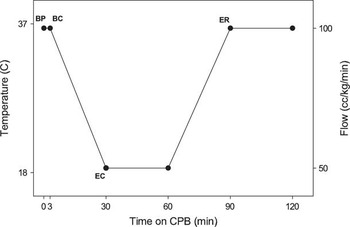
During the experiment, at time points outlined in Figure 1, arterial blood samples were obtained for point-of-care arterial blood gas measurement, haematocrit, glucose, and activated clotting time measurements, whereas the remainder of the sample was preserved on ice for later centrifugation and recovery of plasma for cytokine analysis.
Experimental model of neonatal cardiopulmonary bypass (CPB). Time points of blood administration corresponding to group names are blood prime (BP), before cooling (BC), end of cooling (EC), and end of re-warming (ER).

Heterologous blood
Blood to be transfused was obtained from non-terminal adult pig donors (Lampire Biological Laboratories Inc., Pipersville, Pennsylvania, United States of America), and was stored in a refrigerator for no more than 5 days. The blood to be transfused was haemoconcentrated to a target haematocrit of 55–65%, using a Hemocor ultrafiltration column (Terumo Cardiovascular Group, Ann Arbor, Michigan, United States of America). Aliquots (100 ml) of this blood were used either as a component of the initial prime or administered at target times during the experimental course. Each animal received only one aliquot of heterologous blood.
Surgical preparation
All animal studies were performed in accordance to the Guide for the Care and Use of Animals and under a protocol approved by the Wake Forest University Animal Care and Use Committee. Piglets were obtained at ~1 week of age (between 7 and 15 days), having received appropriate vaccinations and iron supplementation. Animals weighed between 1.96 and 5.50 kg at the time of surgery, with a mean weight of 3.96±0.25 kg. On the day of operation, piglets were sedated with ketamine (22 mg/kg), acepromazine (1.1 mg/kg), xylazine (2 mg/kg), and atropine (0.05 mg/kg) via intramuscular injection and anaesthetised with inhaled isoflurane before endotracheal intubation and mechanical ventilation. Anaesthesia was then maintained with a combination of isoflurane titrated for a minimum alveolar concentration of 1.5% and intravenous fentanyl at 10–50 mcg/kg/minute. Temperature was monitored rectally, and normothermia was maintained through instrumentation using heating pads and warmed saline bags. Intravenous access and central venous pressure monitoring were obtained through a right internal jugular vein cut-down. Arterial access was established through a left femoral artery cut-down for pressure monitoring and blood sampling. Haemodynamic parameters were monitored and stored using the iox software suite (emka Technologies, Paris, France).
The chest was opened via midline sternotomy, and the heart and aorta were exposed and supported by pericardial cradling sutures. The ascending aorta was cannulated with an 8-Fr straight-tip, wire-reinforced arterial cannula (Medtronic Inc.), and the right atrial appendage was cannulated with a 16-French, straight-tip, single-stage venous cannula (Edwards Lifesciences Corp., Irvine, California, United States of America); two Millar micro-tip catheter pressure transducers (Millar Instruments Inc., Houston, Texas, United States of America) were inserted – one transapically into the right ventricle and a second advanced through the pulmonary valve into the main pulmonary artery via the superior right ventricle.
Cardiopulmonary bypass
Cardiopulmonary bypass was initiated after systemic heparinisation with 600 U/kg of heparin given intravenously and a confirmed activated clotting time of >400 seconds (see Fig 1 for the experimental timeline). Following 3 minutes of bypass at normothermia, cooling was initiated with a target of 18°C; 30 minutes after cooling was initiated, a low-flow, hypothermic bypass was instituted for an additional 30 minutes, after which a 30-minute re-warming phase was started. At the end of the re-warming phase, a final 30-minute normothermic, normal flow period preceded euthanasia and tissue collection.
Tissue analysis
Animals were weighed following induction to obtain initial body weight. Animals were weighed again immediately after euthanasia. To facilitate comparison, all instruments and cannulas were removed, and vessel and cardiac entry sites were ligated to prevent excess blood loss. In addition, tissue samples of the lung and kidney were recovered after euthanasia and processed. The right lower lobe of the lung was exposed and sharply excised; 1-g segments were divided and saved for the following: wet-to-dry desiccation, preservation in formalin, and two separate flash-frozen samples at −90°C. The wet-to-dry samples were placed into open-top specimen containers and dried in a 40°C desiccation oven for 24 hours, at which time a post-drying weight was obtained. The resulting difference was recorded as organ water content.
Lactate analysis
Eton Bioscience l-Lactate Assay Kit II (Eton Bioscience, San Diego, California, United States of America) was used to quantify serum lactate concentrations at baseline and at the end of bypass in all piglets. A standard concentration curve was generated at 570-nm absorbance according to kit instructions for the colorimetric assay. Piglet serum samples were diluted 20–100-fold with 10-mM phosphate buffer in order to obtain a lactate concentration within the range of the standard curve. Serum samples were then prepared and assessed according to kit instructions, and lactate values were calculated using the standard curve and the final dilution of the sample.
Cytokine analysis
Arterial blood samples from each time point were immediately stored on ice after being obtained from the animal, and at the end of the experiment were centrifuged at 5000 rpm at 5°C for 5 minutes. They were then removed from the centrifuge, and the plasma was carefully decanted into smaller sample containers and frozen at −80°C. Batches of the plasma samples were taken to a core laboratory for enzyme-linked immunosorbent assay microarray and run in triplicate for concentrations of interleukin 8, interleukin 10, and tumour necrosis factor α.
Data analysis
Data points including cytokine concentrations, preoperative and postoperative animal weights, organ oedema, lactate concentrations, haematocrit values, arterial blood gas measurements, and volumes of fluid added during bypass were entered into a spreadsheet within SigmaPlot statistical analysis software. All data are presented as mean±standard error of the mean. Statistical analyses of the haematocrit and cytokine data between groups over each time point were performed by two-way, repeated-measures analysis of variance, using the Holm–Sidak post hoc test where appropriate. Lactates, weight gain, organ oedema, and haematocrit values were analysed using one-way analysis of variance. Where appropriate, statistical analysis also included Student’s paired t-test with significance defined as p<0.05.
Results
Baseline characteristics
In total, 19 neonatal swine with body weights ranging between 1.96 and 5.56 kg with a mean of 3.96±0.25 kg were included in the final analysis. Their approximate ages were between 3 and 15 days. Preoperative haematocrit was similar among all groups, with a mean of 34.00±0.95%. Baseline lactate was 2.02±0.22 mM and did not differ between groups (p=0.714).
Exclusions
A small number of animals that were included under the study protocol was excluded due to health problems and/or experimental difficulties. Examples of this were animals noted to develop severe haemodynamic instability on induction, methaemoglobinaemia secondary to benzocaine spray, or excessive bleeding from pressure transducer catheters and cannula sites. This left us with the following number of animals in each group: Blood Prime=5; Before Cool=3; End Cool=5; and End Re-warm=6.
Haemodynamics
Baseline mean heart rate, peripheral arterial pressure, pulmonary artery pressure, and right ventricular pressure varied slightly among animals, but were not found to be significantly different between groups (155±5 beats/minute, p=0.121; 51.3±4.2 mmHg, 51.3±4.2 mmHg, p=0.279; 13.8±1.9 mmHg, p=0.570; 24.5±3.5 mmHg, p=0.886, respectively). At the end of bypass, the animals were slightly more tachycardic (161±22 beats/minute) and had lower mean peripheral arterial pressure (37.5±3.1 mmHg), but this was not found to be significantly different between groups (p=0.542 and 0.338, respectively). The mean pressure during bypass was 31.0±2.6 mmHg at 30 minutes on pump, and there was no statistically significant variance between treatment groups (p=0.341).
Volume requirements
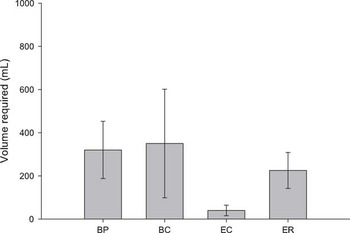
Perfusion throughout the bypass run was maintained with goal mean arterial pressure of 30–40 mmHg and temperature gradients as noted previously in Figure 1. With the exception of blood and base prime aliquots given at the pre-determined time points, attempts were made to avoid adding volume to the circuit; however, during some bypass runs, the cardiotomy reservoir was noted to run low and required additional volume in order to continue perfusion without the risk of introducing air into the circuit (Fig 2). Among all groups, the mean volume added was 221.05±59.64 ml. The before cool group required an average of 350±252 ml of additional prime, followed closely by the blood prime group at 320±133 ml and the end re-warm group with 225±83 ml. The least additional volume needed was observed in the end cool group, with 40±24 ml (Fig 2). None of these data reached statistical significance (p=0.118).
Additional volume required during cardiopulmonary bypass. BC=Before Cool; BP=Blood Prime; EC=End Cool; ER=End Re-warm.

Haematocrit
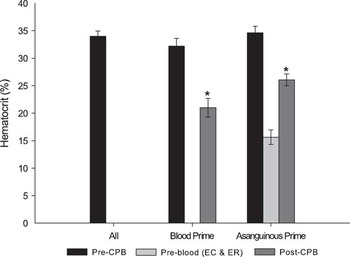
All groups had similar baseline haematocrits averaging 34.00±0.95%, without significant inter-group comparison differences (Fig 3). Animals with a blood prime dropped from an average haematocrit of 32.20±1.39 to 21.0±1.68% after bypass (p=0.001). The blood prime group maintained a haematocrit of 18% or greater throughout the cardiopulmonary bypass protocol. As expected, there was a significant initial drop in haematocrit in groups having an asanguinous prime, to a mean of 15.6±1.34% (p<0.001), but by the end of the experiment they recovered to 26.1±1.06%, which was significantly higher than the blood primed animals (p=0.034).
Haematocrit values among groups throughout cardiopulmonary bypass (CPB). *p=0.034 for comparison between post-cardiopulmonary bypass blood prime versus asanguinous prime groups. EC=End Cool; ER=End Re-warm.

Lactate
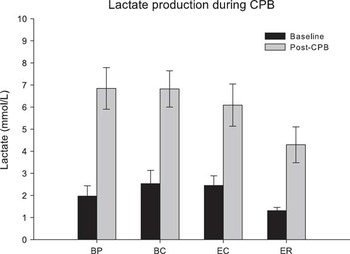
Lactate release was measured as a marker of effective perfusion and tissue health. Serum lactate (Fig 4) at the end of cardiopulmonary bypass as compared with baseline was increased in all groups. Although there was no statistical difference between animals receiving a blood prime versus the asanguinous primes (p=0.235), the change in lactic acid production trended to being better in groups that received blood much later after the initiation of bypass. Warming without blood only produced a mild increase in lactate (2.98±0.67 mmol/L), which was not significantly different from a blood prime (p=0.363).
Lactate production over the course of cardiopulmonary bypass (CPB). BC=Before Cool; BP=Blood Prime; EC=End Cool; ER=End Re-warm.

Cytokines
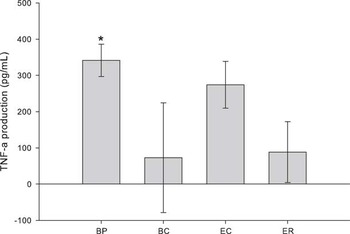
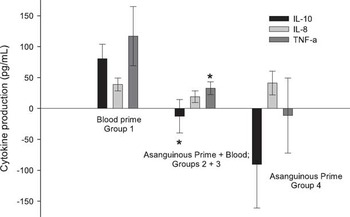
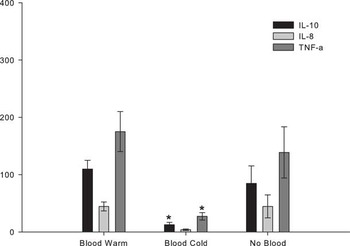
Previous research has demonstrated a significant reduction in tumour necrosis factor α production in animals exposed to an asanguinous prime for the entire duration of bypass.Reference Karamlou, Schultz and Silliman 9 Tumour necrosis factor α is of particular interest because of its implicated role in progressive neuronal damage,Reference Feuerstein, Wang and Barone 10 especially during the perinatal period.Reference Silverstein, Barks, Hagan, Liu, Ivacko and Szaflarski 11 Our data show that animals exposed to a blood prime had significantly higher tumour necrosis factor α at 120 minutes compared with all asanguinous groups combined (Fig 5) (p=0.023). When combining animals into three groups – blood prime (Blood Prime), asanguinous prime with blood added after exposure to cardiopulmonary bypass (Before Cool, End Cool), and asanguinous prime only (End Re-warm, which was an asanguinous “control” up to the 90-minute time point) – there was significantly less production of interleukin 10 (p=0.006) and tumour necrosis factor α (0.019) in the asanguinous prime+blood group compared with the blood prime group (Fig 6). The asanguinous group did not demonstrate a statistically significant difference from blood prime, although the data points are striking. When these data were analysed up to the 90-minute mark of cardiopulmonary bypass (when re-warming was complete), a significantly reduced production of interleukin 10 (p=0.026) and tumour necrosis factor α (p=0.033) was found in the group where blood was added to a cold circuit (End Cool) compared with groups where blood was added to a warm circuit (Blood Prime, Before Cool) or not at all (End Re-warm) (Fig 7).
Tumour necrosis factor α (TNF-α) production throughout cardiopulmonary bypass. *p=0.023 as compared with all asanguinous prime groups combined. BC=Before Cool; BP=Blood Prime; EC=End Cool; ER=End Re-warm.

Cytokine production over 90 minutes of cardiopulmonary bypass, grouped as blood prime, asanguinous prime with blood added, versus asanguinous “control”. *p=0.006 for interleukin 10 (IL-10) when comparing Blood Prime versus asanguinous prime+blood; *p=0.019 for and tumour necrosis factor α (TNF-α) when comparing Blood Prime versus asanguinous prime+blood.

Cytokine production as grouped by animals receiving blood while warm, cold, and not at all. *p=0.029 for interleukin 10 (IL-10) and p=0.033 for tumour necrosis factor α (TNF-α) when compared with the warm blood group.

Oedema
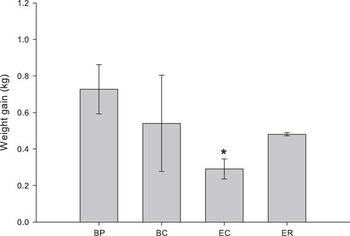
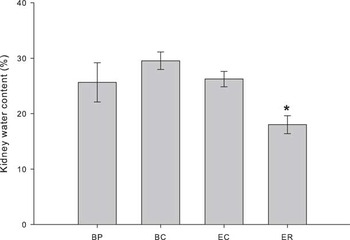
Whole-body oedema as quantified by water weight gain (Fig 8) and was significantly less in the End Cool group with a mean of 0.29±0.05 kg, p=0.011. Furthermore, organ oedema was quantified to evaluate the inflammatory-mediated capillary leakage in the lungs and kidneys – two systems that are frequently impaired after cardiopulmonary bypass. Lung water content did not differ significantly between groups. Kidney water content was significantly lower (p<0.009) in the group that received blood after 90 minutes of asanguinous cardiopulmonary bypass (End Re-warm) (Fig 9).
Total water weight gain over the course of cardiopulmonary bypass. *p=0.018 as compared with Blood Prime. BC=Before Cool; BP=Blood Prime; EC=End Cool; ER=End Re-warm.

Kidney water content. *p<0.009 when comparing End Re-warm (ER) to either Before Cool (BC) or End Cool (EC). BP=Blood Prime.

Discussion
In this neonatal swine model, the addition of blood to the circuit following exposure of the animal to cardiopulmonary bypass produced a strikingly different pattern of inflammation, demonstrated by cytokines and end-organ response, compared with animals exposed to a more conventional blood prime. Our model used a period of cooling to 18°C, and our observations may have relied on a period of cooling on cardiopulmonary bypass in order to produce these benefits. Regardless, addition of blood to the pump after exposure to cardiopulmonary bypass resulted in an acceptable haematocrit at the end of the study, in fact the end haematocrit was significantly higher in the asanguinous groups that received blood late compared with animals whose blood was transfused as blood prime, no demonstrable increase in lactic acid production from the period of “anaemia”, and a more favourable pattern of cytokine expression compared with animals receiving a blood prime. Although numerous previous studies, from our group and others,Reference Karamlou, Schultz and Silliman 9 , Reference Golab, Takkenberg and Bogers 12 , Reference Golab and Bogers 13 have reproducibly demonstrated the benefit of an asanguinous prime for neonates, this is the first study to ask the question and to demonstrate that blood added after exposure to cardiopulmonary bypass is less inflammatory than blood added before exposure to cardiopulmonary bypass.
Our data showed a significantly higher mean haematocrit of 26.1% at the end of cardiopulmonary bypass in the groups initiated with an asanguinous prime compared with a mean haematocrit of 21.0% in the blood prime group. Randomised clinical trials have demonstrated significantly lower serum lactate in the immediate postoperative period and better psychomotor development 1 year later in infants under 9 months of age undergoing cardiopulmonary bypass with a haematocrit >24% before the onset of low-flow cardiopulmonary bypass.Reference Jonas, Wypij and Roth 5 , Reference Newburger, Jonas and Soul 7 , Reference Wypij, Jonas and Bellinger 8 It has been suggested that the ability to maintain haematocrit >25% throughout infant cardiopulmonary bypass including during re-warming may allow for the best long-term prognosis.Reference Wypij, Jonas and Bellinger 8 Therefore, our data suggest that not only is it possible to achieve an acceptable haematocrit by the end of cardiopulmonary bypass using an asanguinous prime followed by intraoperative blood transfusion but also that it may be easier using our novel method as opposed to a conventional blood prime to achieve a haematocrit that has been associated in the literature with a better prognosis.
The change in lactic acid production over the course of the experiment, although not statistically different between groups, actually trended to being better in the groups that received blood after exposure to cardiopulmonary bypass, even if the blood was added at the conclusion of the re-warming period, indicating that delaying exposure to blood until after commencement of cardiopulmonary bypass does not result in inadequate tissue oxygen delivery, at least as reflected by lactic acid production. This may be due to the salutary effects of cooling or to the anti-inflammatory effects of cardiopulmonary bypass with an asanguinous prime. Decreased lactate release at the end of bypass suggests that using an asanguinous prime to initiate cardiopulmonary bypass, even if it results in a haematocrit <20, may not be deleterious.
The blood prime group had a much greater index of fluid retention, expressed as weight gain at the end of the experiment, than did the asanguinous groups. This result is consistent with the reduced fluid requirement on bypass for the asanguinous groups. Among all, two organ systems were explored for their contributions to the water gain, and although the groups had insignificant differences between them in terms of lung water, there was significantly less kidney water at the end of the study for the group with the longest period of asanguinous bypass – the End Re-warm group – although this was not reflected by overall less water weight gain by this group. In fact, the only group that showed overall less weight gain was the group that received blood at the end of cooling. These two measurements would suggest that using an asanguinous prime and then providing blood at the end of cooling or during the period of re-warming might be the most optimal timing for blood transfusion. Other areas of fluid sequestration include the peritoneum, pleural spaces, and subcutaneous soft tissues, which are difficult to individually quantify.
Interleukin 8 was chosen as an end point in our study in light of previous studies demonstrating an association between interleukin 8 levels in neonates undergoing cardiopulmonary bypass and pulmonary dysfunction, days of inotropic support, and length of paediatric ICU stay.Reference Alcaraz, Manzano and Sancho 14 We found pro-inflammatory cytokine production (interleukin 8) to be lowest in the group receiving blood at the end of cooling. Asanguinous groups produced less interleukin 10 and tumour necrosis factor α. Although higher levels of interleukin 10 produced on cardiopulmonary bypass have been associated with reduced postoperative organ damage,Reference Qing, Vazquez-Jimenez and Klosterhalfen 15 other studies have suggested that the ratio of pro-inflammatory to anti-inflammatory cytokines may be more important when it comes to predicting duration and extent of postoperative morbidity in patients experiencing systemic inflammatory response syndrome following cardiopulmonary bypass.Reference Hövels-Gürich, Schumacher and Vazquez-Jimenez 16 , Reference Taniguchi, Koido, Aiboshi, Yamashita, Suzaki and Kurokawa 17 When we looked at the timing of blood transfusion by whether the blood was given to a warm versus cold animal, the data suggested a benefit for blood provided at the end of cooling. It appears that the optimal timing of blood transfusion was after initiating bypass with an asanguinous prime and then transfusing at the end of cooling and before initiation of an altered flow strategy. Haemodynamics were preserved at acceptable parameters among all groups throughout bypass.
The period between 90 and 120 minutes was notable. Up until the 90-minute time point, the End Re-warm group was an asanguinous control; however, at 90 minutes, blood was added to the circuit for this group and the animals were maintained, warm, on cardiopulmonary bypass for an additional 30 minutes. Animals in other groups, which had received blood in the prime, at the beginning of cooling, or at the end of cooling, were also maintained warm on cardiopulmonary bypass for this additional 30 minutes. All groups demonstrated a rise in inflammatory mediators during this time period, with the most marked rise being of tumour necrosis factor α in the blood prime group (Fig 5); however, the results suggest that once warm on cardiopulmonary bypass, prolonged exposure to cardiopulmonary bypass may be deleterious with respect to inflammation. Regardless, the end water weight gain – an end-organ response to inflammation – and cytokine production during cardiopulmonary bypass seemed to favour an asanguinous prime with blood given at the end of cooling, or after re-warming. We did not study the effects of blood given just before re-warming with termination of cardiopulmonary bypass in all groups as soon as adequate warming was achieved.
Our study is limited by a somewhat small sample size, a non-human model, and variability in animal size and age. Furthermore, the preparation was technically challenging and contributed to some animals not successfully completing the various phases of the study. Regardless, it was clear to us that the animals exposed to an asanguinous prime with blood added during the cardiopulmonary bypass period simply “pumped better” and had fewer complications related to cardiopulmonary bypass.
This study asks a novel question: Does blood added to the circuit after exposure to cardiopulmonary bypass produce a pattern of inflammation similar to what is seen with a blood prime, or is the inflammatory response more like that seen with an asanguinous prime? Our results suggest that delayed transfusion of blood during cardiopulmonary bypass in neonates may be safe and can potentially combine the proven anti-inflammatory effects of an asanguinous prime with a safer timing – after exposure to the cardiopulmonary bypass circuit and possibly to some degree of hypothermia – of providing the blood transfusion required to maintain haematocrit and tissue oxygen delivery. The implications of this strategy are intriguing, and along with modifications in circuit design help make asanguinous prime in neonatal cardiopulmonary bypass a feasible reality.
Acknowledgements
None.
Financial Support
This work was supported by Grant # 36861 from the Children’s Heart Foundation. This work was also supported by a donation of oxygenators from Medtronic Inc.
Conflicts of Interest
None.
Ethical Standards
The authors assert that all procedures contributing to this work comply with the ethical standards of the Guide for the Care and Use of Animals and under a protocol that has been approved by the Wake Forest University Animal Care and Use Committee.