In the light of the current economic environment, rising globalization and head to head competition have forced Indian organizations to deal with a number of challenges such as rapid enhancement in productivity levels, reduction in various costs, and management of de-skilling and multi-skilling issues (Budhwar & Varma, Reference Budhwar and Varma2011). Managers in Indian firms are now compelled to think of the ‘human factor’ in organizations as a basis on which they can survive and compete (Kundu & Gahlawat, Reference Kundu and Gahlawat2016). Several scholars have found that the organizations in emerging economies have started relying on human resource (HR) systems that facilitate organizational learning, promote empowerment, and enhance the employee adaptability at workplaces, commonly known as high-performance work systems (HPWS) (Macky & Boxall, Reference Macky and Boxall2007). However, there is a doubt whether these Western human resource management (HRM) systems like HPWS really effective in India, a country who is known for its complex cultural characteristics such as high power distance, moderate to high masculinity, high collectivism, more importance to caste, networks, and political connections than performance (Kundu, Reference Kundu and Gahlawat2008; Som, Reference Som2008). Over the past few years, the Indian economy is witnessing an annual growth rate of 7–10% (International Monetary Fund, 2015) and its industrial sectors are expanding at a very fast pace in response to the increased liberalization and privatization. It is quite natural that the interests of both academicians and HR practitioners around the globe lie in examining the kind of contemporary HRM systems that are effective in Indian organizations. An attempt has been made in our study to settle this doubt by investigating the efficacy of HPWS in Indian context.
Indeed, a growing body of literature has revealed the statistically significant relationship between HPWS and firm performance (Gong, Chang, & Cheung, Reference Gong, Chang and Cheung2010; Bello-Pintado, Reference Bello-Pintado2015). There is still an ambiguity over the intermediary mechanisms that act as a link between the HPWS and performance of the organizations (Boselie, Dietz, & Boon, Reference Boselie, Dietz and Boon2005). Shih, Chiang, and Hsu (Reference Shih, Chiang and Hsu2006) have opined that despite the availability of the extant literature on HPWS, no satisfactory evidences are found that indicate the exact constituents of HPWS and subsequently reveal the causality between HPWS components and firm performance. To unlock this so-called ‘black box,’ the current study has introduced affective commitment as a mediating variable in the research framework so as to bridge the causal gap between HPWS and firm performance. This study is distinct from most of the previous studies as it is particularly aimed to examine the performance effects of HPWS in relation to the abilities, motivation, and opportunities (AMO) theory given by Appelbaum, Bailey, Berg, and Kalleberg (Reference Appelbaum, Bailey, Berg and Kalleberg2000). It has been observed that a large number of previous studies has adopted the HPWS as a single system and ignored the diverse performance outcomes related to the three bundles/components of the AMO model. Being first in a developing country context like India, this study definitely contributes to the current HRM literature by offering a clearer theoretical understanding and empirical evidences of how the HPWS components result in enhanced firm performance through their effects on the affective commitment of the employees.
Theoretical Framework And Hypotheses Development
AMO model
Unlike the traditional ‘isolated’ point of view regarding HRM, studies in recent years have shifted their focus to the ‘systems’ view where HR practices are seen as interrelated components of a system (MacDuffie, Reference MacDuffie1995; Gong, Chang, & Cheung, Reference Gong, Chang and Cheung2010; Kundu & Gahlawat, Reference Kundu2015). Among the various kinds of HRM systems, HPWS are found to be highly examined and mostly preferred over the traditional production systems which were set in accordance with the scientific management principles (Wu, Wei, Zhang, & Han, Reference Wu, Wei, Zhang and Han2011). It has also been observed that there is a general tendency among researchers to use a ‘unidimensional index’ of HR practices under the umbrella term ‘HPWS’ where each constituent practice of the system is supposed to behave in an identical manner relative to the outcomes (Arthur, Reference Arthur1994; Huselid, Reference Huselid1995; Boselie, Dietz, & Boon, Reference Boselie, Dietz and Boon2005). Contrary to this postulation, a rising stream of research has suggested that the HR practices effect organizational performance in different ways (Subramony, Reference Subramony2009; Gardner, Wright, & Moynihan, Reference Gardner, Wright and Moynihan2011) and therefore, must be conceptualized along the lines of the three domains based on AMO model.
The AMO model represents the strategic relevance of HPWS in an explicit manner by concentrating specifically on those HR practices that effectively enhance the discretionary behavior among employees (Appelbaum et al., Reference Appelbaum, Bailey, Berg and Kalleberg2000). Its first component ‘ability’ focuses on developing the capabilities of the employees for performance and includes practices like rigorous staffing, extensive training, job enrichment, and coaching (Boselie, Reference Boselie2010; Jiang, Lepak, Hu, & Baer, Reference Jiang, Lepak, Hu and Baer2012). The second component ‘motivation’ is assumed to increase the employees’ motivation for discretionary efforts and is comprised of the practices like pay for performance, developmental performance management, rewards and incentives, and job security (Appelbaum et al., Reference Appelbaum, Bailey, Berg and Kalleberg2000; Jiang et al., Reference Jiang, Lepak, Hu and Baer2012). The third component ‘opportunity’ represents the open prospects for employees to contribute toward the organizations’ success and includes practices like information sharing, flexible work assignments, work teams, and participation in decision making (Gardner, Wright, & Moynihan, Reference Gardner, Wright and Moynihan2011; Jiang et al., Reference Jiang, Lepak, Hu and Baer2012). The rationale behind this segregation is hidden in the configurational perspective. It pinpoints that the firm performance is more influenced by the holistic patterns of synergistic HR practices than the mere combination of HR practices in an additive manner (Gooderham, Parry, & Ringdal, Reference Gooderham, Parry and Ringdal2008). Moreover, recent studies have suggested that the different subsets of HPWS may vary in their effects on performance; even they may influence the performance through distinct routes (Subramony, Reference Subramony2009; Park, Reference Park2015). Considering these viewpoints, we have opted for the ‘three component AMO framework’ to describe the set of HR practices instead of a ‘single’ HPWS index while investigating the effects on the performance outcomes.
AMO model, affective commitment, and firm performance
Affective commitment basically represents the emotional attachment of employees toward the organizations. In opinion of Allen and Meyer (Reference Allen and Meyer1990), affective commitment in employees is mainly recognized by the combination of three elements i.e., a strong desire to remain within the organization, an eagerness to put extra efforts in work, and a strong conviction in the organizations’ goals. Prior scholars have found a positive relationship between the employees’ perceptions regarding HPWS and organizational commitment (Whitener, Reference Whitener2001; Mao, Song, & Han, Reference Mao, Song and Han2013). They believe that the relationship between HPWS and organizational commitment can be understood well with the help of social exchange theory. The theory establishes that when an organization invests in HR practices with a special focus on employees, the employees feel obliged to reciprocate the same through more positive work-related attitudes and behaviors (Blau, Reference Blau1964). Similar can be assumed for the AMO model, i.e. when employees perceive that the organizations have invested in HR practices with an aim to enhance their AMO to participate for better performance, they may respond back with the heightened emotional attachment and a stronger desire to remain with their organizations.
In past few years, numerous scholars have tried to establish a relationship between the subsets of high-performance HR practices and affective commitment. Appelbaum et al. (Reference Appelbaum, Bailey, Berg and Kalleberg2000) have indicated a positive relationship of motivation-enhancing and empowerment-enhancing HR practices with individual commitment. Boselie (Reference Boselie2010) has also revealed that the high-performance work practices aiming toward the enrichment in abilities of employees display positive effects on affective commitment. Similarly, Meyer and Smith (Reference Meyer and Allen2000) believe that when an organization adopts practices like empowerment, provision of adequate incentives and rewards, and profit sharing, the employees feel valued in their organization and consequently, get emotionally attached to their workplace. Recently, through a study in South Korea, Park (Reference Park2015) has also revealed that the employee participation practices like self-managing teams, individual and group-level incentives enhance the affective commitment among employees. Thus, drawing upon the above discussion, we propose the following set of hypotheses to be tested in Indian context:
Hypothesis 1a: Ability-enhancing HR practices are positively related to affective commitment.
Hypothesis 1b: Motivation-enhancing HR practices are positively related to affective commitment.
Hypothesis 1c: Opportunity-enhancing HR practices are positively related to affective commitment.
Indeed, numerous researchers have attempted to elucidate the so-called relationship between HR practices and firm performance (Arthur, Reference Arthur1994; Huselid, Reference Huselid1995; Bae & Lawler, Reference Bae and Lawler2000; Jiang et al., Reference Jiang, Lepak, Hu and Baer2012). Still there is lack of consensus regarding which aspects of firm performance need to be pin down in order to measure the effects of HR practices. Firm performance is a multifaceted concept, very similar to the organizational effectiveness (Paauwe, Reference Paauwe2004). It has been realized that the studies adopt a variety of performance outcomes for assessing the firm performance such as productivity (Datta, Guthrie, & Wright, Reference Datta, Guthrie and Wright2005), return on investment (Reed, Lubatkin, & Srinivasan, Reference Reed, Lubatkin and Srinivasan2006), employee commitment (Whitener, Reference Whitener2001), accident rate (Preuss, Reference Preuss2003), quality of products and services (MacDuffie, Reference MacDuffie1995), etc. Becker and Gerhart (Reference Becker and Gerhart1996) have suggested that the appropriateness of such performance measures (in terms of number and nature) very much depends upon the level of investigation required in the study. Some researchers have found that in context of emerging economies, the perceptive measures are more easily accessible for HRM-performance studies in comparison with the objective indicators (Bae & Lawler, Reference Bae and Lawler2000; Fey & Bjorkman, Reference Fey and Bjorkman2001). Further, Hoskisson, Eden, Lau, and Wright (Reference Hoskisson, Eden, Lau and Wright2000) have argued that the presence of issues like less transparency in financial reporting, poor regulatory mechanisms, and provision of fictitious financial information play a major hindrance in exact measurement of financial indicators in emerging economies. Following these various perspectives, we have found that perceptual measures are appropriate to be used in our study context.
An examination of the extant literature indicates that the evidences for statistically significant relationship between a firm’s HPWS and its performance are not unobtrusive. Among various theoretical elucidations related to the HPWS-firm performance linkage, the resource-based view of the firm is undoubtedly the most discussed one. The resource-based view perspective is built upon the argument that an organization’s competitive advantage lies mainly in those internal resources that can be identified as valuable, rare, inimitable, and nonsubstitutable (Barney, Reference Barney1991). The key essence is that ‘human resources,’ being an internal asset, have potential to be emerged as a barrier to imitation and as a unique source of competitive advantage if being developed and managed correctly (Wright & McMahan, 1992). Based on this notion, it is assumed that the organizations’ use of high-performance HR practices to enhance the AMO to perform in employees help them in creating ‘employees’ as a source of competitive advantage which in long-term result in positive organizational outcomes.
Till now, several studies have tried to reveal a positive relationship between these specific sets of AMO-enhancing HR practices and firm performance. According to Birdi, Clegg, Patterson, Robinson, Stride, Wall, and Wood et al. (Reference Birdi, Clegg, Patterson, Robinson, Stride, Wall and Wood2008), ability-enhancing HR practices primarily related to staffing and training upgrade the employees’ knowledge, skills, and abilities which in turn, assist the employees in producing high-quality products and services and adapting to change in a better manner. Further, it has been found that motivation-enhancing HR practices such as result-oriented performance appraisal and performance-contingent compensation help in directing the employee efforts toward the accomplishment of the organizational goals by providing the necessary inducements that elicit higher levels of work motivation (Huselid, Reference Huselid1995; Kinnie, Hutchinson, Purcell, & Swart, Reference Kinnie, Hutchinson, Purcell and Swart2006). In the same way, some researchers suggest that opportunity-enhancing HR practices enhance the firm performance by providing autonomy to employees in developing and using the new skills and abilities, reducing the cost of supervision, and encouraging them to work more flexibly and enthusiastically (Parker, Williams, & Turner, Reference Parker, Williams and Turner2006). Basing on the above discussion, the following is proposed to be tested in Indian context:
Hypothesis 2a: Ability-enhancing HR practices are positively related to firm performance.
Hypothesis 2b: Motivation-enhancing HR practices are positively related to firm performance.
Hypothesis 2c: Opportunity-enhancing HR practices are positively related to firm performance.
Affective commitment has been considered as a very important predictor for performance by researchers, mainly because of its inheritance of ‘affective’ element and its direct relationship with employee motivation (Gong, Law, Chang, & Xin, Reference Gong, Law, Chang and Xin2009). Evidences suggest that the committed employees use their discretionary behavior to perform the job-related tasks in ways that are consistent with the organizational goals and values (Arthur, Reference Arthur1994). According to Jose and Mampilly (Reference Jose and Mampilly2012), wide array of positive organizational outcomes are related to employee commitment. They are of the opinion that the employee commitment toward organization results in better interactions with customers, generation of crucial thinking capabilities, improved innovation and service quality, and increased levels of productivity. Meyer, Paunonen, Gellately, Goffin, and Jackson (Reference Meyer, Paunonen, Gellately, Goffin and Jackson1989) have also suggested that the affectively committed employees are largely recognized by their high levels of involvement and dedication to their organization, such kind of employee attitude often results in superior firm performance. Hence, the following hypothesis is proposed to be tested in Indian context:
Hypothesis 3: Affective commitment is positively related to firm performance.
Previous studies have undeniably demonstrated a positive relationship between HPWS and firm performance, but only a few have got successful in explaining the how and why of this association (Purcell, Kinnie, Hutchinson, Rayton, & Swart, Reference Purcell, Kinnie, Hutchinson, Rayton and Swart2003). Boselie, Dietz, and Boon (Reference Boselie, Dietz and Boon2005) have labeled this unexplained connection as ‘black box.’ Recently, Mansour, Gara, and Gaha (Reference Mansour, Gara and Gaha2014) have recommended some variables that can be documented as ‘black box’ components such as employee commitment, organizational climate, creative environment, human capital, and work design. Further, in an effort to explain the distant relationship of HR practices and firm performance, Wright and Nishii (Reference Wright and McMahan2013) have proposed a theoretical model that demonstrates how the employees’ perceptions of organizations’ HR practices first affect their work attitudes and behaviors and then influence the organizational outcomes. Similar to this, Zhang and Morris (Reference Zhang and Morris2014) have also confirmed that the more proximal intervening variables such as employee outcomes held potential to mediate the influence of HPWS on a subsequent distal variable, i.e. organizational performance.
Highlighting the importance of employee attitudes in the HPWS-performance equation, Gong et al. (Reference Gong, Law, Chang and Xin2009) further reveal that the employees’ perceptions of the organizations’ development and implementation of a system of interconnected HR practices for improving their performance enhance the affective commitment among employees which subsequently promote the firm performance. Therefore, at this point, while analyzing the pattern of relationships discussed in the above sections, it is worth examining whether affective commitment mediates the relationship between ability-enhancing, motivation-enhancing, and opportunity-enhancing HR practices and firm performance. Based on the above discussion, it will be apt to assume that the employees’ positive perceptions regarding the use of AMO-enhancing HR practices enhance the emotional attachment of employees toward their organizations which further result in increased in-role and extra-role behaviors that play a lead role in improving the firm performance. Hence, the following hypotheses can be generated:
Hypothesis 4a: The positive relationship between ability-enhancing HR practices and firm performance is mediated by affective commitment.
Hypothesis 4b: The positive relationship between motivation-enhancing HR practices and firm performance is mediated by affective commitment.
Hypothesis 4c: The positive relationship between opportunity-enhancing HR practices and firm performance is mediated by affective commitment.
Research Methodology
Sample and data collection
For testing the proposed hypotheses, self-administered questionnaires were used to gather the primary data. At the beginning, an extensive list of around 500 organizations (belonging to various industries, ownership, and size) was randomly drawn from the database of the organizations registered in Federation of Indian Chambers of Commerce and Industry. And then, the senior HR managers of these selected organizations were contacted and asked if their organizations were having HPWS in practice. After getting the favorable responses from HR managers of 204 organizations in terms of the HPWS existence, a set of four questionnaires were then sent to each of these organizations with a request that these questionnaires be filled out by the cross section of employees. In total, 563 usable questionnaires were received with a response rate of 68.9%. This whole process of data collection was done during the time period between March, 2012 and January, 2013. The respondents were mainly executives and belonged to the various functions across the organizations including HRM, finance, marketing, and production. Out of these 563 respondents, 48% belonged to the Indian domestic firms and 52% were working in the foreign MNCs operating in India. Considering the nature of the firms, 48% of the employees belonged to the manufacturing firms and 52% were from service firms. Both male (73.4%) and female (26.6%) managers/employees were part of the sample and average age of the respondent employees/executives was 31.04 years.
Since the data were collected through self-reporting questionnaires, possibility of common method variance could not be ignored. Though, proper precautions were taken while designing and distributing the questionnaires, it seemed wise to apply the Harman’s (Reference Harman1976) single-factor test on all the variables of the study model prior to the main analyses. According to Podsakoff, MacKenzie, and Podsakoff (Reference Podsakoff, MacKenzie and Podsakoff2012), significant common method variance emerges if a single factor describes the majority of covariance in the variables. On applying factor analysis to all the 51 measurement items, we found that there were in total 10 factors explaining 65.4% of the total variance and the first factor accounted for only 11.3% of the variance in the data. Based on this test, the common method variance could not be taken as an alarming issue in this study (Podsakoff, MacKenzie, & Podsakoff, Reference Podsakoff, MacKenzie and Podsakoff2012).
Measures
HPWS (independent variable)
We measured the HPWS through creation of three components in terms of AMO-enhancing HR practices. However, instead of adopting the theoretically driven formative constructs as conceptualized in previous studies (e.g., Appelbaum et al., Reference Appelbaum, Bailey, Berg and Kalleberg2000; Gardner, Wright, & Moynihan, Reference Gardner, Wright and Moynihan2011), we employed the reflective constructs based on factor analyses results and then, operationalized them into additive indexes for further use. The chosen approach is based on two decisive points. One is related to the classic test theory which is based on the assumption that intercorrelations among items of a scale reflect the underlying latent constructs and thus can be considered as the basis for reflective measures (Bollen, Reference Bollen1989). And second is related to the suggestion given by MacKenzie, Podsakoff, and Jarvis (Reference MacKenzie, Podsakoff and Jarvis2005) that adopting the reflective construct is appropriate if measures are expressions of the construct in a way that they are each determined by it.
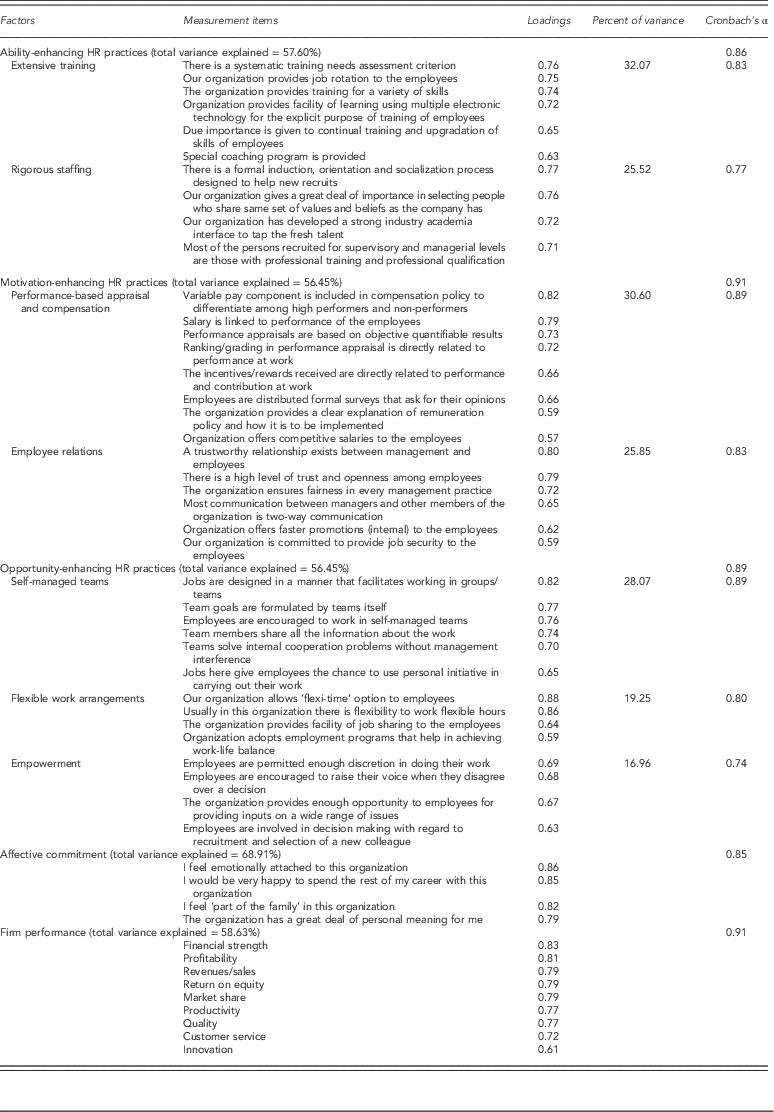
To address ability-enhancing HR practices, the study adapted the six items related to extensive training (Agarwala, Reference Agarwala2003; Ahmad & Schroeder, Reference Ahmad and Schroeder2003; Edralin, Reference Edralin2008; Boselie, Reference Boselie2011) and four items related to rigorous staffing (Agarwala, Reference Agarwala2003; Edralin, Reference Edralin2008; Som, Reference Som2008). Motivation-enhancing HR practices included eight items related to performance-based appraisal and compensation (Snell & Dean, Reference Snell and Dean1992; Agarwala, Reference Agarwala2003; Rao, Reference Rao2007; Som, Reference Som2008) and six items related to employee relations (Agarwala, Reference Agarwala2003; García-Morales, Matías-Reche, & Verdú-Jover, Reference García-Morales, Matías-Reche and Verdú-Jover2011). Opportunity-enhancing HR practices included six items related to self-managed teams (Bae & Lawler, Reference Bae and Lawler2000; Kuipers & Stoker, Reference Kuipers and Stoker2009), four items related to flexible work arrangements (Bardoel, De Cieri, & Mayson, Reference Bardoel, De Cieri and Mayson2008; Som, Reference Som2008), and four items associated with empowerment (Bae & Lawler, Reference Bae and Lawler2000; Boselie, Reference Boselie2011). The respondents were asked to evaluate their opinions on a 5-point Likert scale ranging from 1=‘strongly disagree,’ to 5=‘strongly agree’ regarding the extent to which they perceived that their firms were practising these high-performance HR practices. In all, the 38 perceptual items representing the seven aforementioned high-performance HR practices (see Table 1) were put into three different domains related to HPWS (i.e., a separate factor analysis was performed on the abovementioned three components to get the reflective constructs).
Factor analytic and reliability results

Firm performance (dependent variable)
Wall, Michie, Patterson, Wood, Sheehan, Clegg, and West et al. (Reference Wall, Michie, Patterson, Wood, Sheehan, Clegg and West2004) have stated that the subjective measures of firm performance when put in comparison with competitors are equivalent to the objective measures. Following this, we adopted a perceptual measure of nine items (Khandwalla, Reference Khandwalla1977; Som, Reference Som2008) to assess the firm performance. The items were measured on a 5-point Likert scale ranging from 1=‘much lower,’ to =‘much higher.’ The respondents were asked to consider how their firms were performing in comparison to competing firms over the past 3 years in the same industry. Cronbach’s α for this scale was 0.91.
Affective commitment (mediating variable)
Four items (rated from 1=‘strongly disagree,’ to 5=‘strongly agree’) were used to measure affective commitment among employees. The items were adapted from Ellemers, De Gilder, and Van Den Heuvel (Reference Ellemers, De Gilder and Van Den Heuvel1998) study (see Table 1). Cronbach’s α for this scale was 0.85.
Control variables
Variables like gender, age of employees, and ownership were chosen as control variables. Prior empirical studies have reported these characteristics to be linked with some of the variables used in our study (Meyer & Allen, Reference Meyer and Smith1997; Mansour, Gara, & Gaha, Reference Mansour, Gara and Gaha2014). Age of employees was broadly classified into six categories: <25 years, 26–30 years, 31–40 years, 41–50 years, 51–60 years, and >60 years. Other control variables were characterized as: gender (male and female) and ownership (Indian and MNCs). The considering point is that these variables were employed only to exert control on the proposed relationships, not to examine their moderating effects on the hypothesized relationships.
Results
Factor analyses
A total of 10 variables regarding ability-enhancing HR practices were subjected to principal component factor analysis with varimax rotation while following the criterion that factors with eigen value >1.00 are fit to be retained. The two factors were extracted with eigen values 4.51 and 1.25, respectively, explaining 57.60% of the variance (see Table 1). The first factor named as ‘extensive training’ loaded significantly with six variables and second factor ‘rigorous staffing’ loaded significantly with four variables. Both the factors represented the application of those HR practices that help in developing the employees’ skills and abilities for superior performance. Cronbach’s α values for the subscales were 0.83 and 0.77 and for full scale, it was 0.86, higher than the suggested value of 0.70 (Hair, Anderson, Tatham, & Black, Reference Hair, Anderson, Tatham and Black1998).
Table 1 further shows that two factors were extracted in case of motivation-enhancing HR practices with eigen values 6.48 and 1.43, respectively, explaining 56.45% of the variance. The first factor recognized as ‘performance-based appraisal and compensation’ loaded significantly with eight variables and second factor ‘employee relations’ loaded significantly with six variables. Collectively, both the factors stressed on the presence of those HR practices that help in increasing the employees’ motivation for discretionary efforts. Cronbach’s α values for the subscales were 0.89 and 0.83 and for composite scale, it was 0.91.
The three extracted factors related to opportunity-enhancing practices had eigen values 6.06, 1.88, and 1.06, respectively, explaining 64.28% of the variance. The first factor acknowledged as ‘self-managed teams’ loaded significantly with six variables, the second factor ‘flexible work arrangements’ loaded significantly with four variables, and the last, third factor named as ‘empowerment’ loaded with four variables. All the three factors collectively concerned with the initiation of those HR practices that provide employees the opportunities to make full utilization of their skills and abilities in their jobs. Cronbach’s α values for the three subscales were 0.89, 0.80, and 0.74, respectively, and for full scale, it was 0.89.
Descriptive statistics
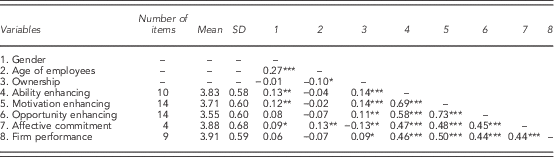
Means, standard deviations, and correlation values related to the study variables are reported in Table 2. Mean values highlighted the considerable presence of ability-enhancing
 ${\rm (}\bar{x}{\rm {\,\equals\,}3}{\rm .83)}$
, motivation-enhancing
 ${\rm (}\bar{x}{\rm {\,\equals\,}3}{\rm .71)}$
, and opportunity-enhancing
 ${\rm (}\bar{x}{\rm {\,\equals\,}3}{\rm .55)}$
HR practices in organizations operating in India. And the correlation values supported the hypothesized linkages between the study variables (see the hypotheses development section). Since significant correlations established among the study variables, it was necessary to examine the possibility of multicollinearity among predictor variables prior to the regression analyses. The variance inflation factor (VIF) statistics associated with the predictors fallen within the range of 1.38–2.75, clearly within acceptable limits (Hair et al., Reference Hair, Anderson, Tatham and Black1998). The lowest tolerance value was 0.36, higher than the ‘cause of concern value’ of 0.20 (Menard, Reference Menard1995). Overall, these statistics indicated the absence of multicollinearity in the specified regression equations.
Means, standard deviations, and correlations

Note. ***p≤.001; **p≤.01; *p≤.05.
Regression analyses
To test the proposed hypotheses, we adopted mediated regression analysis recommended by Baron and Kenny (Reference Baron and Kenny1986). According to these authors, three conditions in prior need to be fulfilled for the successful mediation. First, the predictor variable (ability-enhancing, motivation-enhancing, and opportunity-enhancing HR practices) must exercise a direct effect on the proposed mediating variable (affective commitment). Second, the proposed mediating variable must have a direct influence on the dependent variable (firm performance). And third, the predictor variable must have a direct effect on the dependent variable when there is no mediating variable in the regression equation. After that, the β values are compared when both the predictor variables and the mediating variable are added simultaneously in the regression equation. For partial mediation, the effect size of the predictor variable must reduce but remain different from zero. For full mediation, the effect size of the predictor variable must reduce to nonsignificant.
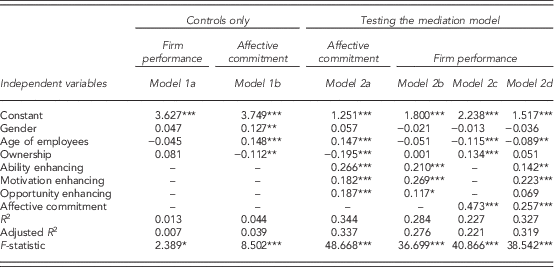
Table 3 highlights that every condition necessary for mediation was satisfied. Models 1a and 1b were taken as the base models that included the control variables only. Model 2a captured the direct effects of all the three components related to HPWS on affective commitment. The coefficients of ability-enhancing, motivation-enhancing, and opportunity-enhancing HR practices were found positive and significant for affective commitment (β=0.266, p≤.001; β=0.182, p≤.001; and β=0.187, p≤.001, respectively), and 34.4% of the variances in affective commitment were explained by the independent variables. Accordingly, the results supported the Hypotheses 1a, 1b, and 1c. Model 2b captured the direct effects of the three components on firm performance. The coefficients of ability-enhancing, motivation-enhancing, and opportunity-enhancing HR practices were found positive and significant for firm performance (β=0.210, p≤.001; β=0.269, p≤.001; and β=0.117, p≤.05, respectively) and 28.4% of the variances in firm performance were explained by the independent variables. Hence, the results supported the Hypotheses 2a, 2b, and 2c. Model 2c demonstrated a significant and positive influence of affective commitment on firm performance (β=0.473, p≤.001) and 22.7% of the variances in firm performance were explained by the independent variables. Thus, the Hypothesis 3 was also supported.
Results of multiple regression analysis testing the mediating effects of affective commitment

Note. N=563.
***p≤.001; **p≤.01; *p≤.05.
Further, when all the three components of HPWS and affective commitment were entered simultaneously into the regression equation as independent variables (see Model 2d), β coefficient related to the opportunity-enhancing HR practices was no longer remained significant, whereas β coefficients related to the ability-enhancing HR practices (β=0.142, p≤.01) and the motivation-enhancing HR practices (β=0.223, p≤.001) were significant but reduced in size (see Table 3). It depicted that affective commitment fully mediated the relationship between opportunity-enhancing HR practices and firm performance and partially mediated the relationships of ability-enhancing and motivation-enhancing HR practices with firm performance. In this model, 32.7% of the variances in firm performance were explained by the independent variables. Further, to check the significance of this mediation effect, the Sobel (Reference Sobel1982) test suggested by Baron and Kenny (Reference Baron and Kenny1986) was performed. The Sobel (Reference Sobel1982) test confirmed the mediating role of affective commitment by revealing the significant indirect paths linking ability-enhancing (z=4.26, p≤.01), motivation-enhancing (z=2.59, p≤.01), and opportunity-enhancing HR practices (z=3.40, p≤.01) to firm performance through affective commitment. Therefore, Hypotheses 4a and 4b were partially supported and Hypothesis 4c was fully supported.
Discussion
Using multiple regression analyses on a sample of 563 respondents from 204 organizations operating in India, the study has reinforced the significant role of HPWS in Indian organizations. The results have demonstrated that the adoption of three AMO components, i.e. ability-enhancing, motivation-enhancing, and opportunity-enhancing HR practices results in enhanced affective commitment and improved firm performance. Considering from a broader perspective, the study provides evidences in favor of the resource-based view perspective by representing that employees are valuable assets of organizations and investing in them help organizations in achieving the competitive advantage regardless of the differences in cultural and managerial values. Overall, the study outcomes provide a significant contribution toward the understanding of whether contemporary HRM systems can work within the context of emerging economies in general; and for organizations in India in particular.
The significant positive relationships emerged between the AMO components and firm performance in this study are consistent with the evidences from previous empirical studies which were carried out in a single national context and focused mainly on the manufacturing firms (Subramony, Reference Subramony2009; Bello-Pintado, Reference Bello-Pintado2015). However, the extent of relationship varies for the three AMO components and performance indicators in our study. Our findings have indicated that motivation-enhancing and ability-enhancing HR practices are more effective in improving the firm performance than opportunity-enhancing HR practices. In contrast, through a meta-analysis of US studies, Subramony (Reference Subramony2009) has emphasized upon more effective role of empowerment practices in firm performance than the combination of other HR practices. The possible justification for this finding can be attributed to high power distance and hierarchical nature of the Indian society which make operationalization and effectiveness of opportunity-enhancing practices like self-managed teams, flexible work arrangements, and empowerment more intricate than the practices included in the other two components.
Again, for commitment, the findings reveal that all the three subsets of high-performance HR practices are positively associated with affective commitment in Indian employees. Though, the magnitude of relationship also varies here. It has been found that ability-enhancing HR practices are far more effective in enhancing the affective commitment among employees than motivation and opportunity-enhancing HR practices. However, prior studies have found positive effects of only two components of HPWS, i.e. motivation-enhancing and opportunity-enhancing HR practices on employee commitment (Appelbaum et al., Reference Appelbaum, Bailey, Berg and Kalleberg2000; Gardner, Wright, & Moynihan, Reference Gardner, Wright and Moynihan2011). The probable reason is that employees may make different attributions about the organizations’ investment in aforementioned three subsets of HR practices and it may further lead them to react toward these investments in different ways. Indian employees are conditioned to value status and hierarchical relationships and live in a centralized workplace. Subsequently, they show more optimism toward ability-enhancing HR practices than opportunity and motivation-enhancing HR practices which further results in greater increase in affective commitment for ability-enhancing practices. Furthermore, the results have explored that affective commitment is positively related to firm performance. The reason behind this finding is that committed employees not only feel stronger attachment and greater dedication toward their organization, they also likely to engage in in-role and extra-role behaviors which in consequence result in improved firm performance. In support of our finding, Boxall and Macky (Reference Boxall and Macky2009) have explained that firm performance is an outcome of employee performance which is the product of positive employee attitudes and behaviors.
At the outset of this study, we have highlighted that the mechanisms through which ability-enhancing, motivation-enhancing, and opportunity-enhancing HR practices are linked to firm performance have received a very little attention from the researchers (Boxall & Macky, Reference Boxall and Macky2009). The present study has tried to fill this gap by investigating the mediating effect of one such mechanism, i.e. affective commitment. The results have revealed that affective commitment fully mediates the relationship between opportunity-enhancing HR practices and firm performance and partially mediates the relationships of ability-enhancing and motivation-enhancing HR practices with firm performance. It means that opportunity-enhancing HR practices only have indirect effects on firm performance through increase in affective commitment of employees. Whereas ability-enhancing and motivation-enhancing HR practices have both direct as well as indirect effects on firm performance. The probable reason behind this finding is that the effect size of the direct impact on firm performance has been found to be greater in case of ability and motivation-enhancing practices than opportunity-enhancing practices and that has further resulted in the diverse mediating effects of affective commitment.
Similar to our study, through a sample of 351 Tunisian employees, Mansour, Gara, & Gaha (Reference Mansour, Gara and Gaha2014) have confirmed that HPWS has both direct and indirect effects on perceived firm performance through positive increase in organizational commitment. It can be inferred from the results that not only the three components vary in their effects on firm performance, how they affect the firm performance also differs. Since the nature of mediation differs in case of the stated three HPWS components, the study supports the prevailing notion that some subcomponents of HPWS may have diverse impacts on the mediators and dependent variables (Park, Reference Park2015) and therefore need to be tested separately. Overall, the current study has provided empirical support for the efficacy of examining the different components or bundles of HPWS in contrast to the overall index, as suggested by Boxall and Macky (Reference Boxall and Macky2009).
Practical implications
The study has offered some remarkable implications for HR practitioners and organizations in Indian as well as in global context. From a practical standpoint, the study implies that to achieve a greater level of firm performance, it is important to design and implement high-performance HR practices that are aimed to enhance the AMO to perform among employees specifically including rigorous staffing, extensive training, performance-based appraisal and compensation, employee relations, self-managed teams, flexible work arrangements, and empowerment. Further, it is recommended that in order to incur more benefits from HR policies and programs, the organizations have to strategically invest in these bundles of high-performance HR practices specifically complementing ability and motivation-enhancing HR practices. An understanding of how HPWS components play a role in improving firm performance will definitely help in improving the accuracy and generalizability of the AMO model in Indian context while providing insight to the HR practitioners regarding how employees can be managed more effectively for enhancing the firm performance. Managers must know that the three HPWS components may not directly affect the firm performance; it is with the increased affective commitment that these three subsets of high-performing HR practices improve the firm performance.
Another point of implication is that instead of monitoring the employees’ productivity only, the organizations should focus on meeting the physical and emotional needs of the employees. It will encourage the employees to engage in more productive behavior and hence, will contribute to superior firm performance. The study further imply that since these are the positive employees’ perceptions regarding the components of the AMO model that are found to have impact on employee commitment and firm performance, the organizations need to put equal emphasis on consistent communication about these subsystems in order to ensure that employees develop a more positive view about the organizations’ actions. In all, the study has offered a broader view about the type of contemporary HR practices that are successful in Indian industrial sector. The positive relationship between the contemporary HRM systems like HPWS and firm performance reflects the readiness of the organizations in India to adopt any advanced HRM system for enhancing their firm performance regardless of their diverse cultural characteristics. It is definitely in favor of the foreign firms who are planning to enter India in near future as fewer resources and efforts will be required to attune the organization’s culture and values with the outside environment.
Conclusions
The regression model presented in this study has advanced our understanding of how the employees’ perceptions regarding organizations’ use of high-performance HR practices affect the firm performance. The empirical evidences have provided a platform to the researchers to openly debate on universalistic versus configurational application of HPWS in the organizations. However, like every other empirical research, the present study also possesses some limitations and is in a position to offer some directions for further studies. The first limitation is that we used only subjective performance measures. Though, the researchers have claimed that the subjective performance measures have been used successfully in previous studies and the results are consistent with the studies that have incorporated the objective measures of performance (Delery & Doty, Reference Delery and Doty1996; Wall et al., Reference Wall, Michie, Patterson, Wood, Sheehan, Clegg and West2004). Future researchers should also include objective performance measures for caution. One more point of concern is that the study was cross-sectional in nature. A replica in the form of longitudinal design must be taken into consideration so as to collect the data over repeated observations. It will definitely bring more robust evidences of the mechanisms involved in our study.
The other limitation is that we investigated for the mediating effects of one underlying mechanism only, i.e. affective commitment. Future researches should incorporate the other variables as mediators such as trust, motivation, and employee engagement when investigating the links between various HPWS components and firm performance. Furthermore, the study has ignored the role of moderators in explaining the relationship between HPWS components, affective commitment, and firm performance. Considering the significant positive relationship between job satisfaction and affective commitment (Johnston, Pasuraman, Futrell, & Black, Reference Johnston, Pasuraman, Futrell and Black1990), future researchers should explore the moderating role of job satisfaction and other alike variables while testing such relationships. The effects of interaction between the three components of HPWS were also not studied in this research. Upcoming studies need to focus on this aspect too. Finally, to obtain more validated and generalized results, it is suggested that the similar studies must be carried out in countries with different cultural backgrounds.
Acknowledgements
None. This manuscript is an original work that has not been submitted to nor published anywhere else. All authors have read and approved the paper and have met the criteria for authorship listed above. By investigating the effects of ability-motivation-opportunity enhancing HR practices on firm performance, an attempt has been made in this paper to assess the effectiveness of contemporary HRM systems in organizations operating in the Indian context.
Financial Support
This research has received no specific grant from any funding agency, commercial, or not-for-profit sectors.
Conflicts of Interest
None.