Introduction
It is well established that cognitive dysfunction is present in a significant proportion of individuals who are diagnosed with amyotrophic lateral sclerosis (ALS). One recent investigation reported that as many as 51% of patients with ALS have cognitive impairments (Ringholz et al., Reference Rascovsky, Hodges, Knowpman, Mendez, Kramer, Neuhaus and Miller2005). In patients with ALS, executive function deficits (e.g., defects in verbal fluency, problem solving, and working memory) are frequently reported (Phukan, Pender, Hardiman, Reference Neary, Snowden and Mann2007). Additionally, behavioral dysfunction in patients with ALS has been reported (e.g., Grossman, Woolley-Levine, Bradley, & Miller, Reference Grace and Malloy2007). Together, these executive deficits and behavioral changes are suggestive of alterations in the functioning of prefrontal circuitry in patients with ALS. Indeed, the diagnosis of frontotemporal dementia (FTD) is sometimes made in patients with ALS, and pathological studies have demonstrated overlap between these conditions (Lomen-Hoerth, Anderson, & Miller, Reference Lillo, Mioshi, Burrell, Kiernan, Hodges and Hornberger2002; Ludolph, Brettschneider, & Weishaupt, Reference Lomen-Hoerth, Murphy, Langmore, Kramer, Olney and Miller2012; Mackenzie, Reference Ludolph, Brettschneider and Weishaupt2007; Talbot & Ansorge, Reference Schreiber, Gaigalat, Wiedemuth-Catrinescu, Graf, Uttner, Muche and Ludolph2006). However, changes in personality are one metric of prefrontal systems functioning that have not been well investigated in individuals with ALS.
Multiple methods have been used to demonstrate changes in prefrontal systems in patients with ALS. Various brain imaging methods have been used, and a thorough review of this topic was presented by Tsermentseli, Leigh, and Goldstein (Reference Tsermentseli, Leigh and Goldstein2012). In summary, these authors described functional and structural imaging changes in patients with ALS in frontal, temporal and somatosensory regions, and hypothesized that subcortical white matter changes may underlie the cognitive changes seen in this population. Specific changes have also been reported in the frontal lobes of patients with ALS. For example, Abrahams and colleagues (2005) reported reduced frontal white matter volume in a group of ALS patients who were impaired on verbal fluency, relative to a group of ALS patients who did not demonstrate such a deficit. Structural imaging work has also shown overlaps (in anterior cingulate and motor cortex) among patients with ALS, FTD, and patients who carry both diagnoses (Lillo et al., Reference Lillo, Mioshi, Zoing, Kiernan and Hodges2012). In this study, patients with ALS-FTD showed widespread grey and white matter changes involving frontal and temporal lobes, and similar findings were also noted in a follow-up investigation (Mioshi et al., Reference Meier, Charleston and Tippett2013). Taken together, both structural and functional imaging studies have demonstrated that, in addition to changes in motor cortex, frontal and temporal abnormalities (of both gray and white matter) are also frequently observed.
Although ALS is often viewed as primarily a motor disorder, cognitive changes have long been noted in the disease. Indeed, sporadic reports of cognitive changes go back many years (see Achi & Rudnicki, 2012), and more recent standardized neuropsychological investigations of cognitive decline have suggested that frontally-mediated executive abilities are often most impacted (Gibbons et al., 2007; Gibbons et al., 2008; Neary, Snowden, & Mann, Reference Mioshi, Lillo, Yew, Hsieh, Savage, Hodges and Hornberger2000). Some investigations have demonstrated that abilities mediated by lateral frontal lobe structures such as fluency tasks were impacted (Irwin, Lippa, & Swearer, Reference Grossman, Woolley-Levine, Bradley and Miller2007; Lomen-Hoerth et al., Reference Lomen-Hoerth, Anderson and Miller2003; Schreiber et al., Reference Ringholz, Appel, Bradshaw, Cooke, Mosnik and Schulz2005). Other studies have also demonstrated deficits on orbital-frontal mediated tasks in patients with ALS (Meier, Charleston, & Tippett, Reference Mackenzie2010). Some investigations have reported differences in cognition between bulbar and spinal onset ALS (Schreiber et al., Reference Ringholz, Appel, Bradshaw, Cooke, Mosnik and Schulz2005), although this has not been highly consistent (Zalonis et al., Reference Wechsler2012).
Social and emotional processing are associated with the medial and orbital frontal lobes (Tranel, Reference Terada, Obi, Yoshizumi, Murai, Miyajima and Mizoguchi2013). In this vein, it is notable that Girardi, MacPherson, and Abrahams (Reference Gibbons, Richardson, Neary and Snowden2011) described deficits in theory of mind in a group of ALS patients. Other studies of patients with ALS have reported social and emotional processing deficits (Zimmerman, Eslinger, Simmons, & Barrett, Reference Witgert, Salamone, Strutt, Jawaid, Massman, Bradshaw and Schulz2007).
Behavioral changes have also been reported in patients with ALS. One measure that has commonly been used to assess ALS patients for behavior change is the Frontal Systems Behavior Scale (FrSBe; Grace & Malloy, Reference Gläscher, Adolphs, Damasio, Bechara, Rudrauf, Calamia and Tranel2001), a rating scale of three aspects of frontal systems behavior: apathy, disinhibition, and executive dysfunction. In such studies, increased apathy has been frequently reported (Girardi et al., 2010; Grossman et al., Reference Grace and Malloy2007), seen on both self- and family-reports. This apathy has been shown to be independent of functional abilities and respiratory factors that can also be influenced by ALS (Terada et al., Reference Talbot and Ansorge2011). Through the use of voxel-based morphometry techniques, increased apathy has been associated with atrophy in prefrontal cortices, particularly in the orbitofrontal and dorsolateral prefrontal regions (Tsujimoto et al., Reference Tranel2011). In each of these previously described studies, the behavioral changes on the FrSBe were seen concurrent with or subsequent to cognitive changes. Witgert and colleagues (Reference Wechsler2010) evaluated several ALS patients using the FrSBe and other neuropsychological measures. Increased apathy was the most commonly reported change, and increased behavioral dysfunction was associated with more severe cognitive deficits (Witgert et al., Reference Wechsler2010); however, a small proportion (16%) of their patients had behavioral dysfunction with no cognitive dysfunction. Similar findings of reduced motivation and increased apathy have also been found in ALS patients in investigations using other personality assessment instruments (Lillo, Mioshi, Zoing, Kiernan, & Hodges, Reference Irwin, Lippa and Swearer2011).
While behavioral changes, primarily apathy, have been reported in patients with ALS, the literature to date leaves open the important question whether personality changes are secondary to acquired cognitive deficits or may occur in their own right, independent of deficits in cognitive functioning. Another question is whether other aspects of personality, going beyond behavioral changes such as increased apathy, are impacted in patients with ALS. In the case report presented here, we describe a 59-year-old woman with bulbar onset ALS who has relatively intact cognitive functioning (including executive abilities) and who does not meet criteria for dementia, but in whom there has been marked change in personality.
Methods
Patient
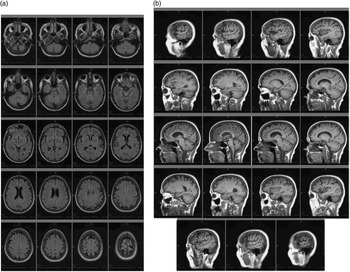
At the time of neuropsychological assessment, the patient was a 59-year-old, right-handed, woman with 12 years of education. She reported earning As and Bs in her high school classes. She completed extra coursework related to her occupation, but did not complete a post-high school degree. She had known her husband for 48 years, and they had been married since young adulthood. They had three adult children (two daughters, who were in their 30s, and a son). She had worked as a secretary, and was on social security disability insurance secondary to ALS. Her medical history included hyperlipidemia, uterine fibromas, and a basal cell carcinoma that was removed from her left arm. She did not have a prior neurologic or psychiatric history. She did not use tobacco, alcohol, or illicit drugs. At the time of the exam, she was prescribed glycopyrrolate, loratadine, riluzole, and scopolamine patch. She had begun experiencing symptoms in August of 2010 such as slurring of speech, and difficulty with swallowing and other tongue movements, and was diagnosed with clinically possible ALS (bulbar onset) based on the revised El Escorial criteria (Brooks, Miller, Swash, Munsat, World Federation of Neurology Research Group on Motor Neuron Diseases, Reference Bechara, Tranel and Damasio2000) in June of 2011. She was also involved in a double-blind investigation of a medication for ALS. MRI of her brain (Figures 1a & 1b) in January of 2011 was read as normal.
Examination
The patient was referred for neuropsychological assessment in the Benton Neuropsychology Laboratory at the University of Iowa Hospitals and Clinics by her neurologist, a neuromuscular specialist (coauthor A.S.). The consult referenced changes in her cognition and activity level, and asked us to “please evaluate for FTD, if activity needs to be limited, and if she needs supervision.” The patient was evaluated over the course of two sessions in April and May, 2012. On both exam dates, she was accompanied by her husband and her daughters.
a: Axial MRI montage (FLAIR images) of the patient’s brain from 01/2011. b: Sagittal MRI montage (T1 images) of the patient’s brain from 01/2011.

The patient was anarthric secondary to motor impairment. She communicated through writing, gestures, and use of an application on her iPad. On interview, she indicated that she has experienced some increased difficulty with her spelling abilities, but denied other cognitive changes since being diagnosed with ALS. She denied problems with or changes in her mood or personality. Her husband and daughters, however, described several changes in her personality, and they also reported some problems with “executive” processes. Specifically, they stated that she had become lost in familiar places, has had greater difficulties with keeping information straight, planning and memory. They reported that she became angry more easily, that her hygiene had declined, and that she lied and did not accept responsibility for her actions. They also noted that she had become increasingly disorganized, and had begun hoarding food and other items. Her daughters said that she had been spending money on items that she did not need. Her family members reported that these changes were progressing rapidly.
Personality Assessment
Personality was assessed with the Iowa Scales of Personality Change (ISPC; Barrash et al., Reference Achi and Rudnicki1997). The ISPC assesses 30 personality characteristics by way of behaviorally anchored ratings completed by an informant, typically a family member or close friend. The behavioral rating guidelines for each of the personality characteristics explicitly focus the rater’s attention on enduring behavioral tendencies or characteristics that have been in evidence across a variety of situations, rather than specific instances of behavior at a specific point in time (as would be seen in a test performance). Two ratings are made for each assessed aspect of personality: “Before” (characteristic functioning over the adult years before the onset of a neuropathological condition), and “Now” (characteristic functioning over the past several months, after the onset of the neuropathological condition). Ratings are made on an asymmetrical 7-point scale (1–7), with 3 reflecting the usual amount of the characteristic for a typical adult of the same sex and age, as judged by the informant, and ratings above 3 reflecting increasing disturbance in that characteristic. Ratings of 5 are considered to reflect “mild disturbance,” 6 “moderate disturbance,” and 7 “severe disturbance.” Change in a characteristic is quantified by subtracting its current level (“now” rating) from the premorbid level of that characteristic (“before” rating). Principal components analysis of the ISPC has revealed five dimensions of personality disturbance in a neurological population, including executive/decision-making deficits, disturbed social behavior, irascibility, diminished motivation/hypo-emotionality, and distress (Barrash et al., Reference Barrash, Anderson, Hathaway-Nepple, Jones and Tranel2011).
The patient’s husband (individually) and her daughters (together, but independent of husband) provided personality ratings with the ISPC.
This research was completed in compliance with research standards of the University of Iowa and in accordance with the Helsinki Declaration.
Neuropsychological test performances

Results
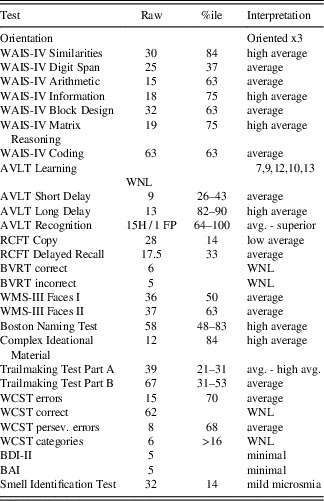
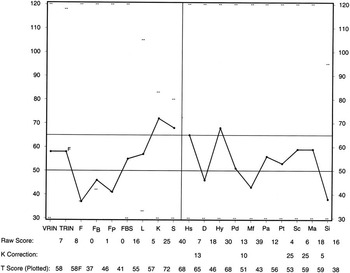
The results of cognitive testing are presented in Table 1. Consistent with premorbid expectations, the patient performed in the average to high average range across all measured aspects of cognitive functioning, including measures of executive abilities. One exception to this was a low average performance on the copy trial of the Complex Figure Test (Rey Osterrieth form). Her drawing of this figure was well-organized, but notable for a somewhat hurried approach with suboptimal reproduction of the figure’s details. She demonstrated mild microsmia on a measure of olfaction. She endorsed items consistent with minimal symptoms of depression and anxiety on the Beck Depression Inventory-II and the Beck Anxiety Inventory. With her responses to the Minnesota Multiphasic Personality Inventory-2 (Figure 2) the patient portrayed herself as an extraverted, socially comfortable individual with somatic concerns, but otherwise without any discernible psychological or social difficulties. However, validity scales and the clinical profile indicate tendencies toward defensiveness and minimization of negative emotions and concern regarding possible psychosocial problems, tendencies that would be expected to contribute to poor insight. Based on interview information and ISPC ratings, it is inferred that that her poor insight reflects a longstanding tendency to a minor degree, but with a more recent decline in this ability. In support of this notion, both the patient’s husband and her daughters provided the most severe possible rating on the ISPC item addressing insight, suggesting “She has extremely poor awareness of changes in her thinking and behavior which have occurred since the onset of her neurological condition, and problems these changes may have caused.”
The patient’s MMPI-2 profile.

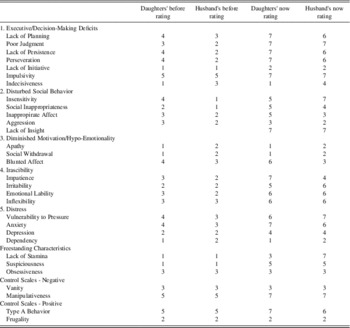
Personality ratings on the ISPC by the husband and by the two daughters, presented in Table 2, show very strong inter-rater reliability for “Before” ratings (reflecting longstanding, premorbid personality). It is important to note that the ratings indicate generally unremarkable premorbid personality, with only mild elevations in a few traits (“type A” behavior, impulsivity and manipulativeness), good executive functioning, and emotional even-temperedness.
The “Now” ratings provided by her husband and daughters also show very good consistency. These ratings reflected widespread personality changes relative to “before” ratings. In particular, dramatic changes—development of moderately severe or severe disturbances—were evident for numerous characteristics. Disturbance was especially pervasive and severe in the domains of Executive/Decision-Making Deficits and Irascibility, as well as anxiety and vulnerability to pressure and, to a lesser extent, Disturbed Social Behavior. Her family all agreed that the patient had an acquired, profound, lack of insight into the acquired personality disturbances, in keeping with her failure to report any such changes to her care providers.
ISPC ratings (broken down into the domains described by Barrash et al., Reference Barrash, Anderson, Hathaway-Nepple, Jones and Tranel2011)

DISCUSSION
The current results suggest that personality changes may manifest in the absence of significant cognitive changes in individuals with ALS. Although a direct neural correlate was not established, these findings, in conjunction with her impaired olfaction, raise the question of vmPFC dysfunction. While previous investigations have documented cognitive deficits and apathy in patients with ALS (suggestive of prefrontal cortex dysfunction), to the best of our knowledge this is the first report systematically documenting widespread personality changes in a patient with ALS. There is a brief clinical case report in the Japanese literature of middle-aged woman with prominent personality changes, not simply characterized as apathy (Fukae et al., Reference Eslinger and Damasio2005). In this investigation, the patient’s husband reportedly indicated that personality change (most notably, increased irritability) had begun when the patient was 53 years old. By age 56, personality changes reflected apathy resulting in frequently not going in to work and ignoring housework. She also reportedly began to go to the grocery store one kilometer away several times a day, purchasing only one item at each visit, she began wandering around the house without purpose, and she easily became angry with her husband and was violent toward him. Cognitive function at that point was not commented on, but neuromuscular symptoms included upper extremity motor weakness, dysphagia, and dysarthria. The patient was first brought to medical attention (and first seen by the authors) at age 57, with complaints of muscle weakness and atrophy. By this time, she was found to be very demented (e.g., unable to accurately report her age, name more than three vegetables, or perform simple arithmetic). Symptoms continued to progress and she died the following year. The findings in our patient are all the more striking in that her cognition was intact on a clinically focused neuropsychological evaluation, and she does not meet criteria for behavioral variant FTD (bvFTD) based on the Rascovsky criteria (Rascovsky et al., Reference Phukan, Pender and Hardiman2011), although she may meet criteria for “possible bvFTD” given the reports of behavioral disinhibition, loss of empathy, and possible ritualistic behaviors.
Of interest, previous investigations of behavioral disturbance in ALS patients have primarily reported increased apathy. However, ratings provided by her family members on the ISPC did not indicate any change in apathy, as she remained at low levels on this trait. It is possible that apathy is a disturbance that tends to develop after further progression of the disease and increased dysfunction of prefrontal cortices.
The current results indicate that other personality characteristics, aside from apathy, may be altered by the ALS disease process, and that assessment of personality changes may be a useful tool for characterizing the early stages of cerebral dysfunction in individuals with ALS. Indeed, it is now becoming evident that some percentage of individuals with ALS develop concomitant frontotemporal dementia (estimated to be 5% by Phukan et al., Reference Neary, Snowden and Mann2007, although others have reported a slightly higher percentage; Barson, Kinsella, Ong, & Mathers, Reference Barrash, Tranel and Anderson2000), and the present findings suggest that ALS can impact the function of prefrontal cortices. The pattern of acquired personality disturbances in our patient is highly consistent with findings of investigations of the nature of acquired personality disturbances specific to groups of patients with well-characterized, focal ventromedial prefrontal lesions compared to patients with damage elsewhere in the brain. That is, marked disturbances of executive characteristics/decision-making, and disturbed social behavior were characteristic of vmPFC patients but not patients with brain-damage outside of the vmPFC (Barrash et al., Reference Barrash, Anderson, Hathaway-Nepple, Jones and Tranel2011; Barrash, Tranel, & Anderson, Reference Barrash, Asp, Markon, Manzel, Anderson and Tranel2000; Eslinger & Damasio, 1985). In the case of our patient, findings support the idea that personality disturbances and behavioral changes may be the first manifestations of prefrontal degradation, in the absence of demonstrable changes in cognitive capacities. Additionally, as suggested by the rating provided by her family members, she showed a lack of insight into the changes in her personality and behaviors. Thus, this report helps to illustrate the importance of acquiring information from collateral sources close to the patient.
We have focused this case report on the patient’s personality changes. In addition to personality changes, though, her family members also reported changes in some aspects of her cognitive functioning. As indicated, cognitive deficits were not evident on the standardized neuropsychological measures that we administered. It may be the case that changes in her personality (e.g., executive changes such as high levels of impulsivity, poor planning, poor insight, and poor judgment, as were noted on the ISPC) are responsible for the “cognitive” changes described by her family members during the interview—it is not uncommon for such changes, which are more properly termed “personality,” to be reported by caregivers as “cognitive.” Alternatively, more comprehensive evaluation of executive functioning could have revealed subtle weaknesses in this domain. Specifically, our clinical examination used typical, “high yield,” measures of executive functioning that tax mainly dorsal and lateral regions of the prefrontal cortex. Had we expanded this investigation to include more measures of executive functioning, such as written verbal fluency (to compare to the observed verbal fluency deficits that have been seen in other patients with ALS), deficits may have been identified. Additionally, measures of value-based decision-making would more fully assess functioning of the ventromedial sector of the prefrontal cortex—for example, the Iowa Gambling Task has been shown to be sensitive to vmPFC dysfunction (Bechara, Tranel, & Damasio, Reference Barson, Kinsella, Ong and Mathers2000; Gläscher et al., Reference Girardi, MacPherson and Abrahams2012), and some of the newer social cognition measures in the Advanced Clinical Solutions portion of the Wechsler scales (Wechsler, Reference Tsermentseli, Leigh and Goldstein2008, Reference Tsujimoto, Senda, Ishihara, Niimi, Kawai, Atsuta and Sobue2009) might have been informative as well.
In conjunction with the case described by Fukae et al. (Reference Eslinger and Damasio2005), this case provides evidence that personality changes in patients with ALS are not limited to apathy, and that it is important to carefully evaluate a broader range of possible personality changes and behavioral disturbances in patients with ALS. Additionally, this case demonstrates that personality changes can occur in the apparent absence of cognitive changes in patients with ALS, and they raise the question of whether personality disturbance can be the first sign of prefrontal systems dysfunction or possible FTD. These findings have important implications for real-life functioning and management issues for patients with ALS.
ACKNOWLEDGMENTS
This work was supported by NINDS PO1 NS19632. Thank you also to our colleague, Satoshi Kitazaki, Ph.D., for his help in translating one of the references. The authors report no conflicts of interest.