Introduction
Research has repeatedly found child physical, sexual and emotional maltreatment to be associated with a wide array of adverse consequences, including somatic morbidity and pain (Paras et al. Reference Paras, Murad, Chen, Goranson, Sattler, Colbenson, Elamin, Seime, Prokop and Zirakzadeh2009; Wegman & Stetler, Reference Wegman and Stetler2009), psychopathology, substance misuse and self-harming behavior (Nelson et al. Reference Nelson, Heath, Madden, Cooper, Dinwiddie, Bucholz, Glowinski, McLaughlin, Dunne, Statham and Martin2002, Reference Nelson, Heath, Lynskey, Bucholz, Madden, Statham and Martin2006; Widom et al. Reference Widom, DuMont and Czaja2007; Cutajar et al. Reference Cutajar, Mullen, Ogloff, Thomas, Wells and Spataro2010; Kessler et al. Reference Kessler, McLaughlin, Green, Gruber, Sampson, Zaslavsky, Aguilar-Gaxiola, Alhamzawi, Alonso, Angermeyer, Benjet, Bromet, Chatterji, de Girolamo, Demyttenaere, Fayyad, Florescu, Gal, Gureje, Haro, Hu, Karam, Kawakami, Lee, Lépine, Ormel, Posada-Villa, Sagar, Tsang, Ustün, Vassilev, Viana and Williams2010; McLaughlin et al. Reference McLaughlin, Greif Green, Gruber, Sampson, Zaslavsky and Kessler2010; Teicher et al. Reference Teicher, Samson, Sheu, Polcari and McGreenery2010; Afifi et al. Reference Afifi, Mather, Boman, Fleisher, Enns, Macmillan and Sareen2011; Jonas et al. Reference Jonas, Bebbington, McManus, Meltzer, Jenkins, Kuipers, Cooper, King and Brugha2011; for reviews see Klonsky & Moyer, Reference Klonsky and Moyer2008; Gilbert et al. Reference Gilbert, Widom, Browne, Fergusson, Webb and Janson2009; Maniglio, Reference Maniglio2009, Reference Maniglio2010;Chen et al. Reference Chen, Murad, Paras, Colbenson, Sattler, Goranson, Elamin, Seime, Shinozaki, Prokop and Zirakzadeh2010; Hillberg et al. Reference Hillberg, Hamilton-Giachritsis and Dixon2011). In parallel, the ‘cycle of violence’ hypothesis, whereby victimized children are presumed to be at increased risk of violent behavior later in life (Widom, Reference Widom1989), is widely embraced by professionals working with assessment and treatment of victims and perpetrators of interpersonal violence. There is indeed empirical evidence for such a link (e.g. Maxfield & Widom, Reference Maxfield and Widom1996; Stouthamer-Loeber et al. Reference Stouthamer-Loeber, Loeber, Homish and Wei2001; Loeber et al. Reference Loeber, Pardini, Homish, Wei, Crawford, Farrington, Stouthamer-Loeber, Creemers, Koehler and Rosenfeld2005; Seto et al. Reference Seto, Kjellgren, Priebe, Mossige, Svedin and Långström2010; Nikulina et al. Reference Nikulina, Widom and Czaja2011; for a review see Wilson et al. Reference Wilson, Stover and Berkowitz2009). However, no matter how unacceptable, inhumane or illegal such maltreatment is, it is important to find out by which mechanisms that child maltreatment may lead to later violent behavior. If child maltreatment has causal effects on violent behavior, preventing it should decrease the likelihood that abused or neglected children grow up to become violent. By contrast, if child maltreatment and adult violent offending are associated through familial factors (genetic and/or environmental), maltreatment-focused prevention programs may not suffice to hinder the development of violent behavior.
Unfortunately, the majority of the extensive literature in this area is methodologically weak. In particular, causal conclusions beyond the finding of associations (i.e. risks or correlations) have been difficult to draw because few studies have used adequate controls to handle genetic and environmental confounding of any association between child victimization and later violent behaviour (see Freyd et al. Reference Freyd, Putnam, Lyon, Becker-Blease, Cheit, Siegel and Pezdek2005; McMillan et al. Reference McMillan, Hastings, Salter and Skuse2008; Kendler & Gardner, Reference Kendler and Gardner2010 for discussions). An exception to this is a previous twin study (Jaffee et al. Reference Jaffee, Caspi, Moffitt and Taylor2004) suggesting a large effect (Cohen's d=0.80) of physical maltreatment at age 5 years on antisocial behavior at age 7 years. Twin analyses showed that genetic factors accounted for approximately half of this association, indicating that the association was partly due to overlapping genetic factors, and also that physical maltreatment played a causal role in the development of child antisocial behavior. Data presented by Nelson et al. (Reference Nelson, Heath, Madden, Cooper, Dinwiddie, Bucholz, Glowinski, McLaughlin, Dunne, Statham and Martin2002), using self-reported child sexual abuse and lifetime DSM-IV conduct disorder among young adult twins, also suggested causal influences of child sexual abuse on conduct disorder. A more recent report, combining twin- and family-based designs, also found that officially reported child maltreatment causally influenced parent-reported antisocial behavior when controlling for inherited liability of the latter (Jonson-Reid et al. Reference Jonson-Reid, Presnall, Drake, Fox, Bierut, Reich, Kane, Todd and Constantino2010). By contrast, a recent study by Schulz-Heik et al. (Reference Schulz-Heik, Rhee, Silvern, Haberstick, Hopfer, Lessem and Hewitt2010) found no support for a causal effect of self-reported child maltreatment on self-reported conduct problems in 16- to 17-year olds.
However, none of these four studies examined the ‘cycle of violence’ concept (Widom, Reference Widom1989) by connecting maltreatment in childhood with interpersonal violence in adulthood. Moreover, the relationship between child maltreatment and adult antisocial behavior has never been examined previously in a large-scale population study addressing officially validated crime (criminal convictions rather than parent or self-report), and controlling for familial factors (genetics and family environment).
We aimed to examine, in a very large, contemporary population-based twin cohort, the association between self-reported child maltreatment (between ages 0 and 18 years) and registered violent offending in adulthood (from age 18 years), and to determine whether the association is causal rather than resulting from shared familial risk (genetic and/or family environmental factors). In a sensitivity analysis, we also examined the association between child maltreatment and any criminal offending (including interpersonal violence) in adulthood.
Method
Participants
We used data from the web-based Swedish Study of Twin Adults: Genes and Environment (STAGE; Lichtenstein et al. Reference Lichtenstein, Sullivan, Cnattingius, Gatz, Johansson, Carlström, Björk, Svartengren, Wolk, Klareskog, de Faire, Schalling, Palmgren and Pedersen2006). All twins in the total population-based Swedish Twin Registry born 1959–1985 (n=42 224), if both siblings were alive and living in the country, were invited to participate in a 2005 data collection. Participants could also choose a telephone interview supplemented with a self-administered paper questionnaire for sensitive topics. STAGE contains some 1300 items addressing sociodemographic factors, abuse and maltreatment, physical and mental health, substance misuse, and sexual behavior. Because all of the twins were born in Sweden, none of them were first-generation immigrants. Non-responders were reminded up to three times and the overall response rate for the survey was 60.1% (n=25 381), although certain questions had somewhat lower internal response rates. Altogether, we had access to data on maltreatment experiences and violent offending from 18 083 participants. A previous study (Furberg et al. Reference Furberg, Lichtenstein, Pedersen, Thornton, Bulik, Lerman and Sullivan2008) suggested that STAGE responders and non-responders did not differ by age, birthweight or in-patient treatment for neurological disorder. Compared with STAGE non-responders, however, responders were more often female, better educated, and of majority ethnicity. Conversely, they had less often been treated as in-patients for a psychiatric disorder or convicted of a crime and had higher intellectual performance scores (at mandatory conscription, data available for men only).
Twin zygosity was established using standard physical similarity questions previously validated through genotyping (99% correct classification; Lichtenstein et al. Reference Lichtenstein, Sullivan, Cnattingius, Gatz, Johansson, Carlström, Björk, Svartengren, Wolk, Klareskog, de Faire, Schalling, Palmgren and Pedersen2006). The sample consisted of monozygotic (MZ) men (n=2669), same-sex dizygotic (DZ) men (n=2193), MZ women (n=4230), same-sex DZ women (n=3152), opposite-sex DZ men (n=2192) and opposite-sex DZ women (n=3240). The Regional Ethics Committee in Stockholm, Sweden approved the study.
Measures
Child maltreatment
To measure child maltreatment, we used items from the Life Stressor Checklist – Revised (LSC-R; Wolfe & Kimerling, Reference Wolfe, Kimerling, Wilson and Keane1997). The LSC-R provides self-report data on (1) emotional neglect assessed by the question: ‘Have you ever been emotionally abused or neglected? For example, being frequently shamed, embarrassed, ignored, or repeatedly told that you were “no good” ’; (2) physical neglect: ‘Have you ever been physically neglected? For example, not fed, not properly clothed, or left to take care of yourself when you felt you were too young or ill’; (3) exposure to physical abuse between family members: ‘When you were young, before age 18, did you ever observe physical violence between family members? For example, hitting, kicking or punching’; (4) physical abuse: ‘Have you ever been physically abused – for example, hit, choked, burned, or beaten – or severely punished – for example, locked up in a closet, tied up, or chained – by someone you knew well such as a parent, sibling, boyfriend or girlfriend?’; and (5) sexual abuse assessed by the two questions: ‘Were you ever touched or made to touch someone else in a sexual way, because you felt forced in some way or threatened by harm to yourself or someone else?’ and ‘Did you ever have sex because you felt forced in some way or threatened by harm to yourself or someone else? With sex, we mean orally, anally, and/or genitally’. Follow-up questions addressed the age at which the specific maltreatment first occurred: by intervals 0–6 years, 7–12, 13–15, 16–18 or >18 years, the latter not applicable for observing physical violence between family members. In this study, we used age 18 years as the cut-off for child maltreatment. Participants were defined as maltreated if they endorsed any of the six maltreatment questions.
Violent offending
We obtained data on all convictions for offences in Sweden 1973–2009 from the Swedish Crime Register (held by the National Council of Crime Prevention). Conviction data included all individuals who received custodial or non-custodial sentences and cases where the prosecutor decided to caution or fine. Rates of violent crime and their clearance in Sweden do not differ considerably from other members of the European Union (Westfelt, Reference Westfelt and Ekström2008). Although comparisons between Sweden and the USA are more complicated because of judicial differences, police-recorded assault rates during 1981–1999 were essentially similar (Farrington et al. Reference Farrington, Langan and Tonry2004). The age of criminal responsibility in Sweden is 15 years, but we only included violent offences committed from age 18 years to avoid temporal overlap with child maltreatment (0–18 years). In accordance with previous work (Fazel et al. Reference Fazel, Långström, Hjern, Grann and Lichtenstein2009; Frisell et al. Reference Frisell, Lichtenstein and Långström2011), we defined violent crime as murder, manslaughter, filicide, assault, unlawful threat, robbery, arson, illegal coercion, intimidation, and gross violation of a person's or a woman's integrity. Convictions for attempted or aggravated versions of included offences were included wherever applicable. Furthermore, any offending was defined as any criminal conviction, including violent crime, from age 18 years.
Statistical analyses
We used generalized estimating equation (GEE) analysis (PROC GENMOD in SAS version 9; SAS Institute Inc., USA) to examine the association between child maltreatment and adult offending by comparing maltreated individuals (cases) and controls. By using GEEs, we controlled for the clustering of (lack of independence between) twins within a pair. Odds ratios (ORs) and 95% confidence intervals (CIs) were calculated with adjustment for age, sex and highest level of completed education: 1=9-year compulsory school (reference), 2=upper secondary school or high school, 3=university.
For the co-twin control analyses, we selected MZ and DZ twin pairs discordant for child maltreatment. If maltreatment truly caused adult violent offending, we would expect this exposure to be associated with the outcome in comparisons of both cases and unrelated controls and within twin pairs discordant for child maltreatment. By contrast, if the association between exposure and outcome decreased from comparisons with unrelated controls to co-twin controls, this would suggest confounding by genetic and/or family environmental factors (see McGue et al. Reference McGue, Osler and Christensen2010 for a review). Furthermore, if an association between maltreatment and adult violent offending were partly causal and partly confounded by genetic or family environmental factors, the risk would be greater than 1 among maltreatment-discordant twins but still lower than that observed for comparisons with unrelated non-maltreated controls.
Results
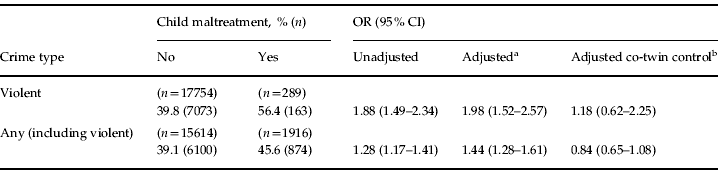
Table 1 shows ORs for the association between child maltreatment and criminal offending analyzed with GEEs and ORs from logistic regression within discordant twin pairs. Our data suggested a moderate association between child maltreatment and violent offending (OR 1.88). Adjusting for age, sex and education affected this link only marginally. However, the risk decreased to a weak and non-significant OR of 1.18 in the co-twin control analysis.
Self-reported child maltreatment (up to age 18 years) and risk of conviction for adult crime among 18083 20- to 47-year-old individuals in a 2005 population-based twin study in Sweden

OR, Odds ratio; CI, confidence interval.
ORs express the strength of the relationship between child maltreatment and adult convictions (from age 18 years) for violent and any criminal offending respectively. CIs that do not include 1.00 indicate a statistically significant OR at p<0.05.
a OR for the relationship between child maltreatment and adult criminal offending, adjusted for age, sex and education level.
b OR for the relationship between child maltreatment and adult criminal offending within discordant monozygotic (MZ) and dizygotic (DZ) twin pairs.
In a sensitivity analysis, we explored the association between child maltreatment and any criminal offending (i.e. violent and non-violent offending). As Table 1 suggests, the association of child maltreatment with any criminal offending was weaker than for violent offending and there was no evidence of a causal influence on any offending as the OR decreased to 0.84 in the co-twin control analysis.
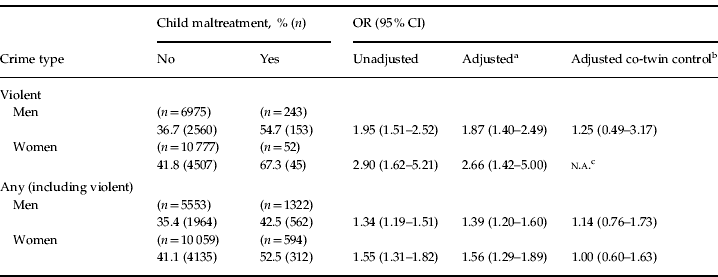
The association pattern for child maltreatment and any adult crime was similar across men and women (Appendix Table A1). Whereas the link between child maltreatment and violent offending was somewhat stronger in women than in men (albeit not significantly stronger), the absence of informative female twin pairs precluded a conclusion on the level of familial confounding among the former (Appendix Table A1). Together, this suggested that the association between child maltreatment and adult crime was substantially confounded by genetic or family environmental factors but that a small causal effect could not be excluded for violent offending.
Discussion
We used a nationwide, genetically informative general population sample of more than 18000 twins to examine the strength and nature of the association between child maltreatment and adult violent offending. Retrospective self-reports of child maltreatment (age 0–18 years) were obtained in 2005 when participants were 20–47 years old and participating men and women were followed longitudinally (from age 18 years) regarding officially registered convictions for criminal offences. In line with previous research (e.g. Widom, Reference Widom1989; Maxfield & Widom, Reference Maxfield and Widom1996; Stouthamer-Loeber et al. Reference Stouthamer-Loeber, Loeber, Homish and Wei2001; Loeber et al. Reference Loeber, Pardini, Homish, Wei, Crawford, Farrington, Stouthamer-Loeber, Creemers, Koehler and Rosenfeld2005; Nikulina et al. Reference Nikulina, Widom and Czaja2011), we found that neglected, physically abused and sexually abused children had a moderately increased risk of being convicted of a violent offence in adulthood. Importantly, however, within-family analyses of co-twins discordant for maltreatment suggested that this association was explained primarily by shared genetic factors or early family environment (e.g. poor nutrition, communication, or problem solving) that increased the risk of being maltreated and of adult violent offending. Sensitivity analyses found these association patterns to hold also for any (including violent) offending. Hence, child maltreatment seems to be a weak causal risk factor for adult violent offending. Whereas social learning theory supports the idea that child maltreatment per se might perpetuate the cycle of violence, few prior studies have tested whether this association might be confounded by familial factors. Although improved prevention of child maltreatment is extremely important from a human rights perspective, our results indicate that previous research might have overestimated its potential to reduce intergenerational transmission of interpersonal violence.
In agreement with two previous twin studies with children (Jaffee et al. Reference Jaffee, Caspi, Moffitt and Taylor2004; Jonson-Reid et al. Reference Jonson-Reid, Presnall, Drake, Fox, Bierut, Reich, Kane, Todd and Constantino2010), we found possible evidence for a weak, albeit non-significant, causal effect of child maltreatment on adult violent (but not general) offending. This study extends previous research by suggesting a causal link between child maltreatment and adult violent offending in adulthood as defined by officially registered convictions. Hence, the present findings do not exclude the possibility that preventing child maltreatment might decrease the risk of later violence also in adulthood. Further study of genetic and environmental factors that mediate this association is crucial. For example, it may be that maltreated individuals with specific gene variants, for instance the short allele of the monoamine oxidase A (MAOA) gene, are at higher risk for expressing violent behavior than others (Kim-Cohen et al. Reference Kim-Cohen, Caspi, Taylor, Williams, Newcombe, Craig and Moffitt2006; Derringer et al. Reference Derringer, Krueger, Irons and Iacono2010; Fergusson et al. Reference Fergusson, Boden, Horwood, Miller and Kennedy2011).
There are certain limitations with the current study. First, although this is, to date, the largest twin study of associations between child maltreatment and registered adult offending, we failed to secure statistical significance for effects obtained for violent crime in co-twin control analyses. Ideally, to increase statistical power, the present study should be replicated with an even larger number of twins or with self-reports of violent offending (the latter not included in the STAGE database). Second, the co-twin control design cannot guarantee definite causal inferences, despite being substantially more informative than analyses without controls for unmeasured familial confounding. Hence, although the lack of a within-twin pair association between exposure and outcome within discordant twin pairs would disconfirm the existence of a causal effect, the presence of an association cannot firmly establish causality (McGue et al. Reference McGue, Osler and Christensen2010). The latter situation might also be caused by factors such as temperamental characteristics or deviant peer relationships that led to twin discordance regarding child maltreatment and differences in violent offending. Third, the validity of adult retrospective reports of adverse childhood experiences has been questioned. Nevertheless, a variety of studies suggest that such reports involve a substantial rate of false negatives, but that false positive reports are probably rare (see Hardt & Rutter, Reference Hardt and Rutter2004 for a review). Thus, possible associations between child maltreatment and violent behavior may be biased if violent individuals retrospectively under- or over-reported childhood maltreatment compared to non-violent individuals. However, previous studies suggest that this does not seem to be the case because relative risk increases for later violence are mostly similar for prospective and retrospective (i.e. self-reported) reporting of childhood maltreatment (Tajima et al. Reference Tajima, Herrenkohl, Huang and Whitney2004; Smith et al. Reference Smith, Ireland, Thornberry and Elwyn2008). On a related note, criminal convictions only represent a small proportion of all violent crime and previous authors have suggested comparisons with self-reported violence as the outcome. However, Arseneault et al. (Reference Arseneault, Moffitt, Caspi, Taylor and Silva2000) found that the underestimation of absolute rates of violence based on comparisons of conviction data with self-reports of violence were similar in general population individuals diagnosed with various psychiatric disorders and non-diagnosed controls. Hence, risk estimates were only marginally affected (Arseneault et al. Reference Arseneault, Moffitt, Caspi, Taylor and Silva2000). We have no reason to believe that this would be substantially different for individuals with and without exposure to child maltreatment (instead of psychiatric disorder). Furthermore, generally similar effect sizes for associations between prospectively or retrospectively reported childhood maltreatment and later violent behavior (Tajima et al. Reference Tajima, Herrenkohl, Huang and Whitney2004; Smith et al. Reference Smith, Ireland, Thornberry and Elwyn2008) suggest that violent and non-violent individuals do not report childhood maltreatment with different sensitivity and specificity.
In summary, preventing child maltreatment and hereby protecting children's integrity and human rights is a most important issue. In fact, our finding of a small, possible, but formally non-significant causal effect of child maltreatment on adult violent offending also supports the view that prevention of child maltreatment should remain a priority. However, the results also indicate that focusing solely on child maltreatment in itself may not be enough to prevent maltreated children from developing criminal behavior, including violent offending. Better delineation of genetic and family environmental risk factors for both child maltreatment and violent crime could inform the development of more effective interventions aimed at breaking the ‘cycle of violence’, the mythic link between these two major public health problems.
Acknowledgements
The Swedish Prison and Probation Service R&D funded this research.
Declaration of Interest
None.
Appendix
Self-reported child maltreatment (up to age 18 years) and risk of conviction for adult crime among 18 083 20- to 47-year-old individuals in a 2005 population-based twin study in Sweden. Data presented separately for men and women

OR, Odds ratio; CI, confidence interval; n.a., not available.
ORs express the strength of the relationship between child maltreatment and adult convictions (from age 18 years) for violent and any criminal offending respectively. CIs that do not include 1.00 indicate a statistically significant OR at p<0.05.
a OR for the relationship between child maltreatment and adult criminal offending, adjusted for age, sex and education level.
b OR for the relationship between child maltreatment and adult criminal offending within discordant monozygotic (MZ) and dizygotic (DZ) twin pairs.
c ORs could not be calculated (division by zero): four female twin pairs were discordant for child maltreatment and violent crime. However, the four twins who self-reported child maltreatment were also convicted for adult violent offending whereas their co-twins negated child maltreatment and had no adult violent crime.