




No CrossRef data available.
Article contents
Spatial memory deficits in patients after unilateral selective amygdalohippocampectomy
Published online by Cambridge University Press: 01 October 2004
Abstract
The present study investigated the differential involvement of the right and left hippocampus in various forms of spatial memory: spatial search, positional memory versus object–location binding, and coordinate versus categorical processing. Twenty-five epilepsy patients with selective amygdalohippocampectomy were examined using a sensitive computer paradigm to measure these spatial memory aspects. The patients' performance was compared to a group of thirty healthy controls. The results show that the left amygdalohippocampectomy group performed poorly on the ability to bind together object information to coordinate spatial locations. In turn, the right amygdalohippocampectomy group was impaired in coordinate positional memory. Both patient groups were unimpaired on the spatial search task. These findings are discussed focusing on the “binding device” hypothesis in combination with the cognitive map theory. (JINS, 2004, 10, 907–912.)
Information
- Type
- BRIEF COMMUNICATION
- Information
- Journal of the International Neuropsychological Society , Volume 10 , Issue 6 , October 2004 , pp. 907 - 912
- Copyright
- © 2004 The International Neuropsychological Society
INTRODUCTION
It is well established that the medial temporal lobe (MTL) including the hippocampal formation are important in human memory, and are involved in the encoding and storage of information for longer time periods (Squire, 1982). Furthermore, there is ample evidence that the MTL plays a crucial role in the encoding of contextual information in specific. For instance, patients with hippocampal lesions perform poorly on memory task relying on context, such as paired-associate learning and spatial learning (Mayes & Roberts, 2001). The inability to encode and recall contextual information related to the target information is often referred to as source amnesia, and might reflect a problem in binding together multiple aspects of information in memory (Chalfonte et al., 1996). One of the most important contextual features in everyday life is related to spatial characteristics. It is, for example, important to remember where you have left your glasses or your keys, or to search your room effectively in case you have forgotten where they are. Problems in spatial memory can thus result in profound behavioral impairments in everyday life functioning, and are frequently reported in patients suffering from amnesia (Kessels et al., 2000).
Importantly, spatial memory is not a unitary construct, but can be divided into multiple subprocesses, each of which might be selectively impaired in neuropsychological patients. A recent meta-analysis focusing on studies in patients with hippocampal lesions (Kessels et al., 2001) made a distinction between route learning (e.g., remembering a path in a maze), positional encoding (storing coordinates in the form of a cognitive map), object-location memory (recalling the locations of objects in the environments) and spatial working memory (online maintenance of spatial information for a short time period). Furthermore, memory for positional information and memory for bound identity–location information has been found to dissociate in patients with cortical lesions following stroke (Kessels et al., 2002a). The results of these previous studies can also be explained by differences in the nature of the spatial relations to be processed (Postma et al., 2004). Specifically, the distinction between categorical and coordinate processing, as proposed by Kosslyn (1994), is relevant here. This theory suggests that the left hemisphere is specialized in the processing of categorical spatial relations (such as above/below or left/right). In turn, the right hemisphere is specialized in coordinate (or “metric”) spatial processing (e.g., remembering that the chair is located 2 m from the window).
To further examine the contribution of the human hippocampus to various forms of spatial memory, a group of medically refractory epilepsy patients was tested who underwent a selective unilateral amygdalohippocampectomy as treatment for the relief of epileptic seizures. Spatial working memory was examined using a computerized spatial search task in which the participant had to search through a number of boxes on the screen in order to find a hidden object. Memory for the locations of objects was studied using a computer task in which positional processing can be separated from object–location binding. Also, the task conditions assess either coordinate processing by means of relocation in free space or categorical processing using pre-marked locations or a grid during relocation (cf. Findlay et al., 1994). The performance of the patients with either left- or right-sided hippocampal lesions was compared to a healthy control group. It could be expected that both amgygdalohippocampectomy groups performs relatively normally on the spatial search task, since spatial working memory function is predominantly subserved by the prefrontal cortex (Fletcher & Henson, 2001), although some studies have found hippocampal involvement in spatial search tasks (Feigenbaum et al., 1996). In contrast, both hippocampal groups were hypothesized to display impairments on the object–location memory task. In line with previous findings in nonhippocampal patients (Kessels et al., 2002a), it might be expected that hemispheric specialization between object–location binding and memory for positional information exists for the hippocampus as well.
METHODS
Research Participants
Twenty-five patients receiving periodical outpatient therapy at the Hans Berger Clinic were asked to participate in this study. All patients had suffered from medically refractory temporal-lobe epilepsy caused by mesiotemporal sclerosis (MTS) that was diagnosed with structural magnetic resonance imaging (MRI), and had undergone a unilateral selective amgygdalohippocampectomy for treatment of their seizures. Of these patients, 16 had a left and 9 a right amgygdalohippocampectomy. Presurgically, all patients were investigated according to a phased protocol, which included a thorough medical history, a full neurological examination with a routine EEG and a long-term interictal and ictal EEG with video monitoring. Furthermore, the patients underwent an intracarotid sodium amytal test (Wada procedure) that revealed left-hemisphere language function in all patients. The Dutch version of the Wechsler Memory Scale–Revised (WMS–R; Wechsler, 1987) was performed by all patients as a measure of overall memory performance. The control group consisted of 30 healthy volunteers. Table 1 shows the characteristics of the patient and control group. There were no significant differences between the groups on age [F(2,52) = 1.4, p = .26] or sex distribution [χ2(2) = 5.0, p = .08]. The control group had a slightly higher education level compared to the patients [F(2,52) = 4.9, p < .05]. The left and right surgery groups did not significantly differ with respect to time after operation, age of seizure onset, seizure duration, seizure frequency or performance on the WMS–R index scores (all ts < 1.99). The study was approved by the medical ethics committee of Utrecht University (University Medical Center) and informed consents were obtained.
Characteristics for the left- and right-amgygdalohippocampectomy patients and the healthy controls (age, sex, education level, seizure characteristics, WMS–R performance and time after operation)

Materials and Procedures
Box task
The Box Task is a newly developed spatial search task based on the principle of spatial search tasks such as the Executive Golf Task (Feigenbaum et al., 1996). Pictures of closed boxes (size approximately 1 × 1 cm) were displayed at different locations within a 19 × 19 frame on a 15″ touch-sensitive LCD computer monitor. A target object (e.g., shoe, umbrella) was visible at the bottom of the screen. The participant was instructed to search through the boxes until the target object (which was also hidden inside one of the boxes) was found. Clicking a box (using the touch-sensitive screen) resulted in the opening of that box, displaying either an empty box or the object that had to be found. An empty box closed again in 2 s. If the target object was found, a new target object was displayed on the bottom of the screen and the box containing the previous target was closed again. All previously found target objects within a trial remained hidden inside their box; the participant had to remember which boxes had already been searched, as well as which boxes already contained target objects. Thus, all the boxes on the screen were subsequently filled with target objects. Hereafter, the next trial started using a new spatial layout (one trial consisted of multiple searches in the same spatial layout). The number of boxes increased after two different trials with the same number of boxes (resulting in set sizes of 4, 6, or 8 boxes). The task begun with two practice trials containing only three boxes. Two types of errors were possible (see also Feigenbaum et al., 1996). First, a within-search error occurred if the subject returned within one search to a previously opened box which did not contain the target object. This measure reflects the ability to actively keep spatial information on-line during a search. Second, a between-search error occurred if the subject returned to a box which contains a target item from a previous search. This measure assesses the ability to maintain spatial information over longer time periods within working memory (possibly linked to storage into long-term memory).
Object relocation
To assess memory for the locations of objects, the Object Relocation program was used (Kessels et al., 1999) to present stimulus displays containing ten everyday objects (size approximately 1 × 1 cm) at different spatial locations within a 19 × 19 cm frame (also on the 15″ touch-sensitive LCD computer screen). Each stimulus display was presented for 30 s, after which the frame was emptied and the objects were made visible on top of the frame. The participant was instructed to relocate the objects to their previously occupied locations within the frame, with no time restrictions, using the touch-sensitive screen. Four spatial memory conditions were included, measuring either object–location binding or positional memory, and categorical or coordinate processing. In the categorical object–location binding (categorical–OLB) condition, 10 different objects were shown at different locations. Subsequently, the locations of the objects were marked with black dots, and the subject had to assign the objects to their previously occupied locations. Here, the percentage incorrectly relocated objects in a stimulus display was used as error score. In the categorical positional (categorical–POS) condition, 10 identical objects were presented at different locations. In the subsequent relocation phase, a 7 × 7 grid was present, and the objects had to be relocated to their previously occupied locations (note that the grid was visible in the relocation phase only). The percentage incorrectly placed objects was calculated (i.e., within the correct cell or not). In the coordinate object–location-binding (coordinate–OLB) condition, again 10 different objects were presented at different locations, which had to be relocated subsequently in an empty frame (with no grid or pre-marked dots present). Here, the absolute deviation in millimeters was computed for a stimulus display as a whole (the total differences between the objects' original and relocated positions). Finally, the presentation phase of the coordinate positional (coordinate–POS) condition was the same as the categorical–POS condition, but no grid was present in the relocation phase. Thus, the exact locations had to be relocated as accurately as possible in an empty frame. Since only positions were presented without object information, it is difficult to determine which relocated position belongs to which original position in order to calculate the absolute deviation in mm. Theoretically, it would be possible to assign each relocated object to the original position that is nearest, but the results of this calculation cannot be easily interpreted. Therefore, the best fit score was computed: all possible configurations between original and relocated positions are computed, and the fit that has the smallest error rate is considered to be the best fit configuration (Kessels et al., 1999). This best-fit score reflects positional reconstruction, taking into account possible rotations and shifts. Each task condition consisted of two trials using different spatial layouts and different objects, and was preceded by a practice trial using only four objects and locations. The order of the task was fixed to minimize possible order effects (Kessels et al., 2002b).
RESULTS
Figure 1 shows the results for the Box Task. Within-search errors were analyzed using a repeated-measures General Linear Model (GLM) with set size (4, 6, or 8 boxes) as within-subjects factor and group (left-sided surgery, right-sided surgery and control) as between-subject factor. Overall, a main effect of set size was present [F(2,47) = 9.0, p < .0005], indicating a significant (but small) increase in within-search errors if more boxes had to be searched. No group effect or Group × Set Size interactions were present (Fs < 1.23). For the between-search errors, a GLM was performed using the same factors. Again, a set size effect was found [F(2,47) = 22.9, p < .0005] showing an increase in errors if more boxes had to be searched. No overall group effect or Group × Set Size interaction was found (Fs < 1.5).

Mean (+ SEM) number of within-search and between-search errors for the amgygdalohippocampectomy and the control group on the Box Task for the three set sizes (4, 6, and 8 boxes).
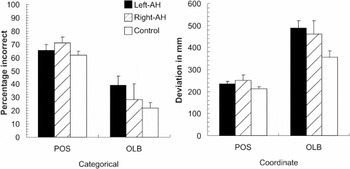
Figure 2 shows the results for the object relocation conditions. A GLM revealed group effects on the coordinate–POS condition [F(2,49) = 3.5, p < .04] and the coordinate–OLB condition [F(2,49) = 4.3, p < .02], but not on the categorical–POS [F(2,49) = 1.0] and categorical–OLB [F(2,49) = 2.1, p = .13] conditions. Post-hoc Dunnett t tests with the control group as reference showed that the left-sided amgygdalohippocampectomy group performed worse than the control group on the coordinate–OLB condition (p < .008), whereas the right-sided amgygdalohippocampectomy group performed worse than the controls on the coordinate–POS condition (p < .031) selectively.

Mean (+ SEM) percentage incorrectly placed objects for the categorical positional (POS) and the categorical object–location binding (OLB) condition, and mean (+ SEM) deviation in millimeters for the coordinate POS and the coordinate OLB conditions for the left and right amgygdalohippocampectomy (AH) patients and the control group.
DISCUSSION
The purpose of the present study was to investigate the contribution of the right and left hippocampus to various forms of memory for the location of objects. Clearly, the findings demonstrate selective and lateralized impairments in various spatial memory components. First, no impairments were found on the spatial search task; neither in the ability to actively manipulate information online (as measured by the within-search score) nor in the ability to maintain information over longer time periods (the between-search performance). Although some studies have identified hippocampal involvement in spatial search tasks (e.g., Feigenbaum et al., 1996), the current finding is in agreement with the notion that other cortical areas than the hippocampal formation are specialized in spatial search processes, for example the prefrontal cortex (Fletcher & Henson, 2001).
Second, the left amgygdalohippocampectomy group showed an impaired performance on the condition that assesses the ability to bind together coordinate location information and object–identity information within memory. This supports the hypothesis of the left hippocampus being a “binding device,” which has been proposed by several authors, based on either animal experiments (Eichenbaum & Bunsey, 1995) or on studies in amnesic patients (Chalfonte et al., 1996). With respect to possible lateralization effects of hippocampal involvement in binding, a recent fMRI study demonstrated that specifically the left anterior hippocampal area was activated during a task condition requiring the binding of objects to locations, but not during trials in which only object information or only spatial information had to be remembered (Mitchell et al., 2000). This is in line with the current finding that left amgygdalohippocampectomy patients show a selective problem in binding objects to coordinate locations.
Third, the right amgygdalohippocampectomy group performed worse than the controls on the condition which involves coordinate positional processing. This is in agreement with O'Keefe and Nadel's (1978) influential theory originating from studies in rats, suggesting that the right hippocampus stores this type of spatial information in the form of an allocentric cognitive map. This hypothesis was recently studied in patients with hippocampal lesions (Holdstock et al., 1999), providing further evidence for a hippocampal contribution to allocentric spatial memory. The present results do not show hippocampal involvement in the processing of categorical spatial relations. It might be argued that tasks assessing categorical processing (i.e., a mental representation that consists of categories rather than a continuous positional map) are merely less sensitive than coordinate tasks. However, selective effects on categorical spatial memory conditions have been found in previous studies (Alexander et al., 2002; Kessels et al., 2002b). Thus, the current findings suggest that categorical spatial-memory processing is primarily subserved by nonhippocampal brain areas (cf. Kosslyn, 1994).
Only a few studies have used spatial memory tasks that rely only on metric processing, that is, without any semantic content. More studies have examined spatial memory for a combination of positional information and object identities. For example, various authors have investigated the relocation of toy objects on a table top in patients with hippocampal lesions, commonly demonstrating a right-hippocampal involvement (Nunn et al., 1999; Smith & Milner, 1989). In general, the current findings corroborate and extend previous results with similar paradigms. For example, a study in patients with unilateral cortical stroke demonstrated left-hemisphere involvement in object–location binding and right-hemisphere involvement in coordinate spatial processing (Kessels et al., 2002b). Moreover, preliminary results in amgygdalohippocampectomy patients (Köylü et al., 2003) indicate that left-sided surgery patients were impaired on both object–location binding and positional memory, whereas right-sided surgery patients were impaired on positional memory only. Although the latter results also show a differential hemisphere-dependent involvement in various aspects of spatial memory, our present findings do not show entirely the same pattern as in the study of Köylü et al. (2003). This discrepancy might be due to the fact that the Köylü study probably focused on more subacute postoperative effects. It is possible that a relatively short period after the operation results in more severe memory problems caused by more diffuse effects of the surgical treatment itself, and that selective effects are more likely to be found in the chronic postoperative state.
Also, the present results support the notion that remembering the locations of objects can be both functionally and neuroanatomically dissociated from merely remembering positions. Originally, it was hypothesized that remembering the locations of objects requires an integration process of both positional memory and the binding of object information to given locations. Hence, an impaired performance on positional memory would automatically result in impaired coordinate object–location binding. However, no empirical evidence for such an integration process has been found either in group studies (Kessels et al., 2002b) or in individual cases (Kessels et al., 2002a). Finally, it should be noted that the lesions in the current patient group were not limited to the hippocampus, but also included the amygdala. However, as a result of the proximity of the hippocampus and the amygdala in the brain, it is difficult to separately examine possible differential effects of lesions in these specific areas using neurosurgical patients or neuroimaging techniques.
In sum, the present results show that, in line with the cognitive map theory, the right hippocampus is involved in coordinate spatial memory processing, and that the left hippocampus acts as a binding device. No evidence was found of hippocampal involvement in categorical spatial memory processes. The current findings also emphasizes the importance of detailed clinical assessment of spatial memory function in MTL epilepsy patients as part of a pre- and postoperative neuropsychological assessment, which is currently rarely performed. Moreover, the application of these experimental tasks in combination with other ecologically valid spatial memory tests may lead to a better understanding of the subjective memory problems many of these patients experience in daily life.
ACKNOWLEDGMENTS
This study was supported by a VENI research grant to R.K. (#451-02-037) and a PIONIER research grant to A.P. and M.v.A. (#440-20-000) from the Netherlands Organization for Scientific Research (NWO). The data of this article have been presented at the First Congress of the European Neuropsychological Societies, Modena, Italy, April 2004.
References
REFERENCES
Alexander, G.M.,
Packard, M.G., &
Peterson, B.S.
(2002).
Sex and spatial position effects on object location memory
following intentional learning of object identities.
Neuropsychologia,
40,
1516–1522.Google Scholar
Chalfonte, B.L.,
Verfaellie, M.,
Johnson, M.K., &
Reiss, L.
(1996).
Spatial location memory in amnesia: Binding item and location
information under incidental and intentional encoding conditions.
Memory,
4,
591–614.Google Scholar
Eichenbaum, H. &
Bunsey, M.
(1995).
On the binding of associations in memory: Clues from studies on the
role of the hippocampal region in paired-associate learning.
Current Directions in Psychological Science,
4,
19–23.Google Scholar
Feigenbaum, J.D.,
Polkey, C.E., &
Morris, R.G.
(1996).
Deficits in spatial working memory after unilateral temporal
lobectomy in man.
Neuropsychologia,
34,
163–176.Google Scholar
Findlay, R.,
Ashton, R., &
McFarland, K.
(1994).
Hemispheric differences in image generation and use in the haptic
modality.
Brain and Cognition,
25,
67–78.Google Scholar
Fletcher, P.C. &
Henson, R.N.
(2001).
Frontal lobes and human memory: Insights from functional
neuroimaging.
Brain,
124,
849–881.Google Scholar
Holdstock, J.S.,
Mayes, A.R.,
Cezayirli, E.,
Aggleton, J.P., &
Roberts, N.
(1999).
A comparison of egocentric and allocentric spatial memory in medial
temporal lobe and Korsakoff amnesics.
Cortex,
35,
479–501.Google Scholar
Kessels, R.P.C.,
De Haan, E.H.F.,
Kappelle, L.J., &
Postma, A.
(2001).
Varieties of human spatial memory: A meta-analysis on the effects
of hippocampal lesions.
Brain Research Reviews,
35,
295–303.Google Scholar
Kessels, R.P.C.,
De Haan, E.H.F.,
Kappelle, L.J., &
Postma, A.
(2002a).
Selective impairments in spatial memory after ischemic stroke.
Journal of Clinical and Experimental Neuropsychology,
24,
115–129.Google Scholar
Kessels, R.P.C.,
Kappelle, L.J.,
De Haan, E.H.F., &
Postma, A.
(2002b).
Lateralization of spatial-memory processes in humans: Evidence on
spatial span, maze learning and memory for object locations.
Neuropsychologia,
40,
1465–1473.Google Scholar
Kessels, R.P.C.,
Postma, A., &
De Haan, E.H.F.
(1999).
Object Relocation: A program for setting up, running, and analyzing
experiments on memory for object locations.
Behavior Research Methods, Instruments, and Computers,
31,
423–428.Google Scholar
Kessels, R.P.C.,
Postma, A.,
Wester, A.J., &
De Haan, E.H.F.
(2000).
Memory for object locations in Korsakoff's amnesia.
Cortex,
36,
47–57.Google Scholar
Kosslyn, S.M.
(1994).
Image and brain: The resolution of the imagery debate.
Cambridge, MA:
MIT Press.
Köylü, B.,
Bartha, L.,
Eberhart, T.,
Trinka, E.,
Bauer, G., &
Benke, T.
(2003).
Selective spatial memory deficits after right selective
amygdalohippocampectomy.
Journal of the International Neurological Society,
9,
578.Google Scholar
Mayes, A.R. &
Roberts, N.
(2001).
Theories of episodic memory.
Philosophical Transactions of the Royal Society of London,
356B,
1395–1408.Google Scholar
Mitchell, K.J.,
Johnson, M.K.,
Raye, C.L., &
D'Esposito, M.
(2000).
fMRI evidence of age-related hippocampal dysfunction in feature
binding in working memory.
Cognitive Brain Research,
10,
197–206.Google Scholar
Nunn, J.A.,
Graydon, F.J.,
Polkey, C.E., &
Morris, R.G.
(1999).
Differential spatial memory impairment after right temporal
lobectomy demonstrated using temporal titration.
Brain,
122,
47–59.Google Scholar
O'Keefe, J. &
Nadel, L.
(1978).
The hippocampus as a cognitive map.
Oxford, UK:
Clarendon Press.
Postma, A.,
Kessels, R.P.C., &
Van Asselen, M.
(2004).
The neuropsychology of object-location memory. In
G.L. Allen (Ed.),
Human spatial memory: Remembering where (pp.
143–160).
Mahwah, NJ:
Lawrence Erlbaum Associates.
Smith, M.L. &
Milner, B.
(1989).
Right hippocampal impairment in the recall of spatial location:
Encoding deficit or rapid forgetting?
Neuropsychologia,
27,
71–81.Google Scholar
Squire, L.R.
(1982).
The neuropsychology of human memory.
Annual Review of Neuroscience,
5,
241–273.Google Scholar
Wechsler, D.
(1987).
Wechsler Memory Scale–Revised manual.
San Antonio, TX:
Psychological Corporation.

Characteristics for the left- and right-amgygdalohippocampectomy patients and the healthy controls (age, sex, education level, seizure characteristics, WMS–R performance and time after operation)

Mean (+ SEM) number of within-search and between-search errors for the amgygdalohippocampectomy and the control group on the Box Task for the three set sizes (4, 6, and 8 boxes).
Mean (+ SEM) percentage incorrectly placed objects for the categorical positional (POS) and the categorical object–location binding (OLB) condition, and mean (+ SEM) deviation in millimeters for the coordinate POS and the coordinate OLB conditions for the left and right amgygdalohippocampectomy (AH) patients and the control group.
 You have
Access
- 44
- Cited by