Among the factors regulating nest density and distribution of Neotropical leaf-cutting ants (genera Atta and Acromyrmex), the availability of pioneer plants appears to be one of the most important (palatable forage hypothesis; Farji-Brener Reference FARJI-BRENER2001). In fact, the elevated nest density of LCAs at secondary forests has been particularly associated to proliferation of pioneer plants (Silva et al. Reference SILVA, BIEBER, LEAL, WIRTH and TABARELLI2009). However, demographic patterns of LCAs may be complementarily attributed to soil physicochemical variables (suitable-soil hypothesis; van Gils et al. Reference VAN GILS, GAIGL and GÓMEZ2010). Van Gils et al. (Reference VAN GILS, GAIGL and GÓMEZ2010) found negative correlations between soil properties (e.g. per cent silt, soil resistance and pH) and Atta sexdens nest distribution.
Near rivers, flood certainly is another strong factor influencing nest density and distribution of LCAs. Floods may (1) inhibit the colony foundation, when the queen excavates a nest chamber in the soil or, in already-established colonies (2) affect negatively the colony survival and performance, consequently (3) promoting their death or migration to higher sites safer against inundation (Adis Reference ADIS1982). Moreover, LCA colonies may tolerate flooding, constructing huge mounds and turrets (Cosarinsky & Roces Reference COSARINSKY and ROCES2007) or closing nest entrances, but this increases the carbon dioxide concentration inside nests, thus compromising colony performance (Kleineidam & Roces Reference KLEINEIDAM and ROCES2000). La Selva Biological Station, in north-eastern Costa Rica, is crossed by several small valleys, streams and rivers (McDade et al. Reference MCDADE, BAWA, HESPENHEIDE and HARTSHORN1994). Flood events are especially unpredictable and may reach up to 12 m above normal levels (Sollins et al. Reference SOLLINS, SANCHO, MATA, SANFORD, McDade, Bawa, Hespenheide and Hartshorn1994). Since flood can compromise the colony performance and survival, they may also affect demographical aspects of Atta cephalotes near rivers. We expected that flood risk (estimated by the distance to streambeds and topography) should reduce nest number and size. Considering that nest size correlates with colony age (Bitancourt Reference BITANCOURT1941), nest size was taken as a surrogate of nest age. To test this hypothesis (hereafter: flood effect hypothesis), we evaluated the distribution and nest size of Atta cephalotes (L.) across stream valleys (i.e. starting in valley bottoms toward plateaux) at La Selva Biological Station (10°26′N, 83°59′W). We expected that both nest density and size would increase towards the plateaux (non-flooded environments). Furthermore, considering the palatable forage hypothesis, we also compared the effects of flooded and non-flooded locations between a secondary and an old-growth forest expecting that nest distribution varied with the forest successional state. Finally, we considered the soil type as a factor potentially affecting nest distribution and size.
The average annual precipitation at La Selva Biological Station is 4400 mm y−1, March is the driest month and July and December are the wettest months (McDade et al. Reference MCDADE, BAWA, HESPENHEIDE and HARTSHORN1994). The station is mainly composed of tropical wet forest with 23 soil consociations and one complex (Sollins et al. Reference SOLLINS, SANCHO, MATA, SANFORD, McDade, Bawa, Hespenheide and Hartshorn1994). Nest density and nest size of Atta cephalotes were evaluated in different patches of forests located on the banks of El Salto and El Surá streams, which are tributaries to the Río Puerto Viejo and among the three primary streams of La Selva, in February and March 2004. The last flood event before our study occurred in June 2001, reaching hill slopes in several points. We established 12 sampling sites around El Salto and El Surá streams (old-growth forest) and 12 in secondary forests (18–24 y old; i.e. abandoned plantations around El Salto stream), maintaining 50–150 m between sites. The successional and land-use history of the areas are well known (Corella Reference CORELLA2001, McDade et al. Reference MCDADE, BAWA, HESPENHEIDE and HARTSHORN1994). In each site, we established five transects (10 × 100 m each), one per topographical category: (1) valley bottom and (2) slope base (both habitats closer to streambed, thus with a higher flooding risk), (3) mid-slopes, (4) slope top and (5) plateaux (habitat 6–18 m higher than streambed and with the lower flooding risk), totalling 60 transect and 12 ha per forest type. Each transect was established following the topography of each site (parallel to valley slopes) and was visually inspected for mounds of active A. cephalotes nests (i.e. nest with workers’ presence, fresh leaf pieces). The nest size was estimated by multiplying mound diameter measured in two perpendicular directions. The geographical position of each nest was established by using the grid system of La Selva (mesh size of the grid is 50 m; McDade et al. Reference MCDADE, BAWA, HESPENHEIDE and HARTSHORN1994). We also compared the position of each nest with the maximum flood levels of both streams in June 2001, available data of the Geographic Information Systems (GIS) of La Selva Biological Station (http://www.ots.ac.cr/). We also used the information on the GIS database to determine the soil consociation present in each transect. Our study sites included 11 of those consociations.
Differences in nest density (i.e. number of nests per transect) and size between forest types, topographic environment, flooded or non-flooded areas and soil consociation were evaluated using a factorial ANOVA including only second-grade interactions. Differences in nest densities between topographic categories inside forest types were addressed by Fisher HSD post hoc tests (Sokal & Rohlf Reference SOKAL and ROHLF1995). Reported values represent mean ± SD. To confirm topographical differences among transect categories the ground slope was estimated for each observed colony according to information available on the GIS database. Slope was steeper for nests in the (3) mid-slopes (7.1% ± 3.2%) than in the (4) slope tops (4.9% ± 2.7%) and the (5) plateaux (2.7% ± 1.1%; F2,38 = 5.5, P < 0.007).
A total of 41 A. cephalotes nests were found (i.e. 12 ha; 20 nests in secondary forest and 21 in old-growth forest). This corresponds to a total density of 3.4 colonies ha−1 (i.e. 3.3 colonies ha−1 in patches of secondary forest and 3.5 colonies ha−1 in old-growth forest). Most nests were situated in areas outside the 2001 flood (only six were inside flood limits) and nest density was higher in non-flooded areas (0.12 ± 0.38 nests per transect in flooded areas and 0.53 ± 0.62 in non-flooded areas; F = 22.7, P < 0.001).
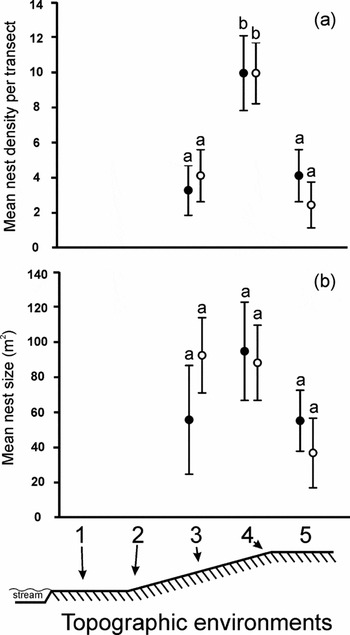
We did not observe nests either in valley bottoms or in slope bases, both regions closer to the river and with higher inundation risk. The colonies were located about 10.6 ± 6.61 m above river level. However, mean nest density varied between topographic environments (Figure 1a; F = 12.9, P < 0.001). Mean nest density was higher in slope tops (1 ± 0.65 nests per transect) than mid-slopes (0.37 ± 0.10 nests per transect) and plateaux (0.33 ± 0.48 nests per transect) for both forest types (Fisher post hoc, P < 0.01; Figure 1a), but no difference was observed comparing mid-slopes with plateaux (Fisher post hoc, P > 0.05; Figure 1a). We did not find differences in nest density between old-growth and secondary forests (F = 0.04, P = 0.84) and among the 11 soil consociations (F = 0.68, P = 0.74). Moreover, all second level interactions between pairs of explanatory variables were considered non-significant (P > 0.05). Most of our transects (65%) were located on alluvial soils, however, nest densities were not different between alluvial (0.35 ± 0.58 colonies per transect) and volcanic (0.33 ± 0.53 nests per transect).
Atta cephalotes mean nest density (nests per transect) (a) and nest size (b) in three topographical environments in both old-growth forest (black circles) and secondary forests (white circles) in La Selva Biological Station, Costa Rica: mid-slopes (3), slope top (4) and plateaux (5) (mean ± SE). Different letters above bars indicate significant differences among sample groups (P > 0.05, Tukey HSD post-hoc test). No nest was found either in valley bottoms or in slope bases.

Mean nest size was higher in non-flooded areas (90.6 ± 65.2 m2) than sites affected by the 2001 flood (17.2 ± 5.45 m2; F = 5.03, P = 0.04). No difference in terms of mean nest size was observed between topographic environments, forest types, soil consociation or regarding the interaction between them (Figure 1b, P > 0.05 in all cases). The five biggest nests (> 200 m2), however, were found on the slope tops.
Here, some evidence suggests that flood drastically affects the nest distribution and size of A. cephalotes (flood effect hypothesis) in La Selva Biological Station. We did not observe nests in either valley bottoms or slope bases (flooded areas). In contrast, a high nest density was found in non-flooded areas (i.e. slope tops). Nests with high mounds (up to 40–50 cm) were also observed only in big mound nests (more than ~100 m2) on slope tops and plateaux.
Flood events, like the 2001 flood, certainly limit nest establishment and/or survival in valley bottoms and slope bases. Thus, as expected, colonies in flooded areas were also much younger than those located in non-flooded areas. Although van Gils et al. (Reference VAN GILS, GAIGL and GÓMEZ2010) have proposed a suitable-soil hypothesis acting complementary with the palatable forage hypothesis, no relation between nest density and size with soil consociations was observed. Besides, nest density did not vary between alluvial and volcanic soils, even though there is a notable and known difference among them (IUSS Working Group WRB 2006).
However, the flood effect hypothesis alone did not explain the higher nest density in slope tops (compared with mid-slope and plateaux) and why the five biggest nests were found there. Slope tops may provide benefits for colonies of LCAs, functioning as locations to forage and establish new nests within a food-rich habitat composed of shade-tolerant species and pioneer species (consistent with palatable forage hypothesis). This occurs because some factors promoting treefall such as wind and soil instability may become more important on slope areas (Denslow Reference DENSLOW1987), retaining a high occurrence of gaps and an increased incidence of pioneer trees (Laurance et al. Reference LAURANCE, FERREIRA, RANKIN-DE MERONA and LAURANCE1998). Treefall gaps provide the essential physical condition to the pioneer establishment (Schnitzer & Carson Reference SCHNITZER and CARSON2001) and are highly relevant to LCAs foraging (Peñaloza & Farji-Brener Reference PEÑALOZA and FARJI-BRENER2003). As a result, nests on the slope tops are located not only in non-flooded areas but also within a food-rich habitat (independently of the forest successional status) with access to foraging areas with few or no other potentially competitor LCA nests (i.e. valley bottoms and slope bases).
In summary, our study showed that the flood effect hypothesis was more important than the palatable-forage hypothesis to explain nest distribution, but on a more local scale, at slope tops, both forces may be synergistically affecting LCAs nest distribution in La Selva Biological Station. Survival and/or establishment of colonies may be reduced in valley bottoms producing a pattern of nest accumulation towards more elevated environments (slope tops and plateaux), where nests are also allowed to grow bigger and possibly for a longer time. Further studies should focus on testing the real advantages of establishing nests in these environments, seeking to confirm three emergent hypotheses: (1) whether colonies of LCAs migrate towards plateaux as a result of flooding events; (2) whether the slope tops in riparian zone function as an edge habitat with higher abundance of pioneer trees and/or occurrence of treefall gaps and supporting larger leaf-cutting ant populations; and (3) whether during non-flood periods, workers of nests located in slope tops would also collect plant materials at valley bottom and slope base. Finally, we suggested that abiotic factors, such as flooding, should be considered in combination with biotic variables to better explain the population dynamics of these keystone species.
ACKNOWLEDGEMENTS
We thank the Organization for Tropical Studies (OTS) for providing funds to develop fieldwork and providing logistic support to SFS in La Selva Biological Station. We thank the Geographic Information Systems team in La Selva Biological Station for providing assistance and geographical data. Also, to the professors and participants of the OTS 2004 ‘Ecología Tropical y Conservacion’ course. A. G. Bieber, L. Kaminski, E. M. Vieira-Neto and P. S. Oliveira are acknowledged for their comments on the manuscript. SFS was sponsored by ‘Fundação de Amparo à Pesquisa do Estado de São Paulo’ (FAPESP, 07/59881-5) and PSDS by ‘Fundação de Amparo à Pesquisa do Estado da Bahia’(FAPESB, 3178/2010).