Introduction
That living humans have late Pleistocene ancestors is beyond dispute. All humans alive today descend from people who lived in Africa between 100000 and 200000 years ago (Stringer Reference Stringer2012). None of us is morphologically identical to those ancestral Africans; rather, we share with them an evolved capacity for wide behavioural variability (Shea Reference Shea2011). These facts stand in contrast to ‘primordialist’ claims that particular ethnic groups have survived largely unchanged since Pleistocene times (e.g. Sollas Reference Sollas1911). Here, we review recent arguments linking the San populations of southern Africa with the late Pleistocene Later Stone Age (LSA) (c. 44 kya) at Border Cave, South Africa (d'Errico et al. Reference d'Errico, Backwell, Villa, Degano, Lucejko, Bamford, Higham, Colombini and Beaumont2012). These and other claims for the Pleistocene antiquity of modern-day cultures arise from a fundamental misunderstanding of the nature of cultural and archaeological taxonomies, and are a misuse of analogical reasoning. Our discussion is relevant not only in southern Africa, but to archaeologists everywhere.
Background
Analogies are a critical component of archaeological thinking (Wylie Reference Wylie1989). They come in two primary forms: direct historical, and relational. Direct historical analogies require that a demonstrated cultural continuity exists between source and subject. They are equivalent to proposing homologous relationships in genetic and cultural evolutionary studies (Shennan Reference Shennan2009). Due to the difficulties with using archaeology to trace living communities directly back into the past, analogies that assume heritable continuity are rarely unproblematic (Lane Reference Lane1994–Reference Lane1995).
Relational analogies require that a relational link (functional, raw material or ecological resemblances, for example) exists between source and subject. By this logic, relational analogies explore the causes for apparent similarities and differences. This form of analogy requires that the quality of an analogical argument be assessed by examining whether the relevance and relational structure of the analogy are valid in the first place.
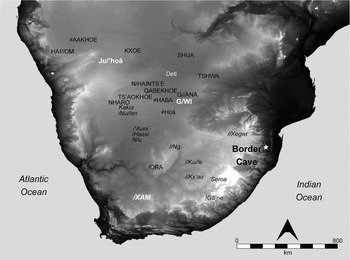
The San populations of southern Africa are among the best known and best documented ethnographic hunter-gatherers; they have been studied extensively over the past 150 years (Biesele et al. Reference Biesele, Gordon, Lee and Marshall1986). These studies have generated models of foraging, mobility, site formation, kinship and exchange (among other cultural facets), each taken to have broad analogical relevance to our understanding of hunter-gatherer behaviour (e.g. Lee & DeVore Reference Lee and DeVore1976). This relevance extends up to and includes employing the Kalahari San as archetypal, mobile hunter-gatherers in many introductory anthropology texts. The data underlying these models, however, derive predominantly from just three groups: the now extinct /Xam of South Africa's Northern Cape Province, the Ju/’hoãnsi of the north-western Kalahari and the G/wi of central Botswana (Mitchell Reference Mitchell2010). All three groups come from what are now relatively resource-marginal, arid and semi-arid areas (Figure 1). Measured on a range of variables—meat consumption, mobility, plant food consumption, use of aquatic resources and so on—they are far from archetypal hunter-gatherers (Kelly Reference Kelly2013). More fundamentally, their location, behaviours and identities are the product of centuries of interaction and integration in complex, shifting socio-political landscapes, the influences of which were active in the relatively recent past and remain so today (Solway & Lee Reference Solway and Lee1990).
The location of Border Cave in relation to the main geographic sources of ‘San’ ethnography.

Notions of a mutable and evolving San identity propelled the so-called ‘Kalahari debates’, which questioned the ‘pristineness’ of populations depicted in the classic Kalahari ethnographies of the mid twentieth century, and their usefulness as analogues for prehistoric populations (see Denbow Reference Denbow and Schrire1984; Schrire Reference Schrire and Schrire1984; Solway & Lee Reference Solway and Lee1990; Wilmsen & Denbow Reference Wilmsen and Denbow1990; Gordon Reference Gordon1992). Yet conceptualisations of ethnographically documented San groups as, in some sense, holotypes of a deeper, southern African hunter-gatherer identity continue to affect how archaeological, genetic and linguistic research is carried out (e.g. Kim et al. Reference Kim, Ratan, Perry, Montenegro, Miller and Schuster2014: 6).
That multiple analysts put ‘San’ and ‘Khoisan’ peoples close to the genetic root of the Homo sapiens family tree may itself encourage a view of them as ‘primordial’. Proponents of primordialism see ethnic identity as fixed and persistent over long stretches of time (see Geertz Reference Geertz and Geertz1963; Isaacs Reference Isaacs1974). In archaeology, primordialism is conceptually aligned with culture-history, which assumes that “bounded, homogeneous cultural entities correlate with particular peoples, ethnic groups, tribes, and/or races” (Jones Reference Jones1997: 24). Beginning in the 1960s, primordialism and traditional cultural-historical archaeology suffered a series of devastating critiques centred on their inability to explain the permeability of ethnic boundaries, the historical and situational variability of individual and group identity, and processes of cultural change. In this vein, claims that a cultural pattern called ‘San’ can be traced back into the Pleistocene ignore the effects of servitude, assimilation, political landscape change, genocide and interbreeding on the demography and political economy of click-speaking groups, as well as the fact that the ‘San’ fall into three distinct language families (Güldemann Reference Güldemann2008). Add in the impacts of successive shifts in climate and ecology on human demography, and tracing cultural identities back into the Pleistocene becomes a theoretically flawed exercise.
Border Cave and the origin of ‘San’ material culture
Unit 1WA (>40 kya) at Border Cave has been claimed to show the origin of San material culture and the LSA in southern Africa (d'Errico et al. Reference d'Errico, Backwell, Villa, Degano, Lucejko, Bamford, Higham, Colombini and Beaumont2012). Recent analyses demonstrate the presence, by c. 44 kya, of poisons, bone and tusk implements, shell beads, wooden digging sticks and ground stone artefacts said to be similar in form to those used by Kalahari San groups. These finds have revived notions of a late Pleistocene ancestry for the ‘San’. Here we employ a formal approach (see Van Reybrouck Reference Van Reybrouck2012) to examine the direct historical analogy between the evidence from Border Cave and the ‘San’.
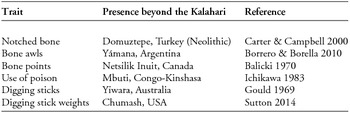
In discussing the relevance of the Border Cave materials, d'Errico et al. (Reference d'Errico, Backwell, Villa, Degano, Lucejko, Bamford, Higham, Colombini and Beaumont2012) chose only a single ethnographic example for comparison: the ‘San’. When this comparative net is cast wider, as shown in Table 1, it is clear that the San are not the only groups to employ such items. Bone awls, bone points, digging sticks and digging stick weights are all found in ethnographic contexts wholly unrelated to the San. Flueggea virosa, the wood species probably used to make the Border Cave digging stick, is widely employed across southern, western and eastern Africa (d'Errico et al. Reference d'Errico, Backwell, Villa, Degano, Lucejko, Bamford, Higham, Colombini and Beaumont2012), implying a general, rather than culturally specific, application for this material. Digging stick weights are far from universal among ethnographically attested San and go unmentioned in Kalahari ethnography, although they were used by nineteenth-century /Xam (Ouzman Reference Ouzman and Wadley1997). If indeed these objects are so inseparable from San identity and social organisation as to signal their presence at Border Cave, then their absence from certain San groups, and presence in non-San groups, needs to be explained.
Select examples of Border Cave ‘San’ material culture found beyond the Kalahari.

The choice of source material in the Border Cave analogy is also questionable. Which San groups are being referenced: the desert-dwelling Ju/’hoãnsi, riverine fisher-herders such as the Deti, or the now goat-keeping G/wi? Each of these groups is the product of different historical contingencies far removed from the mountainous contexts of south-east southern Africa where Border Cave is located (Figure 1). These contingencies are manifest in variable worldviews and economies (Barnard Reference Barnard1992) that represent anything but an “unambiguous parallel” (d'Errico et al. Reference d'Errico, Backwell, Villa, Degano, Lucejko, Bamford, Higham, Colombini and Beaumont2012: 13218) with the artefacts at Border Cave.
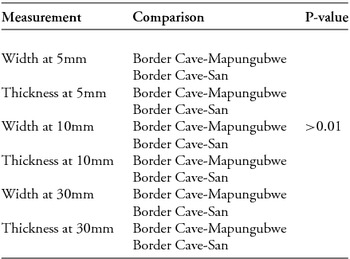
D'Errico et al. (Reference d'Errico, Backwell, Villa, Degano, Lucejko, Bamford, Higham, Colombini and Beaumont2012) claim that the bone points and other items of material culture found at Border Cave are similar enough to those found amongst San communities to suggest a direct cultural link. To explore the issue of similarity between the Border Cave materials and various source data more systematically, we conducted statistical tests on the Border Cave bone point morphological data presented in SI Table 2 of d'Errico et al. (Reference d'Errico, Backwell, Villa, Degano, Lucejko, Bamford, Higham, Colombini and Beaumont2012) (Table 2). We used their comparative data on width and thickness for San bone points in the Fourie ethnographic collection from Namibia (n = 50), and bone points found at the South African Iron Age complex of Mapungubwe (n = 25). For our comparisons, we employed Kruskal-Wallis tests, a form of non-parametric ANOVA. Our results (Table 2) demonstrate that the Border Cave bone points are statistically indistinguishable from those in the Fourie collection, but that they are also indistinguishable from those made at Mapungubwe (non-San). D'Errico et al. (Reference d'Errico, Backwell, Villa, Degano, Lucejko, Bamford, Higham, Colombini and Beaumont2012) left this similarity between the Border Cave and non-‘San’ bone points undiscussed.
Statistical comparisons of the d'Errico et al. (Reference d'Errico, Backwell, Villa, Degano, Lucejko, Bamford, Higham, Colombini and Beaumont2012) bone point morphological data.

D'Errico et al. (Reference d'Errico, Backwell, Villa, Degano, Lucejko, Bamford, Higham, Colombini and Beaumont2012) focus only on how the poisons, bone implements, ostrich eggshell beads and ground stone artefacts are similar to those found at Border Cave, not on the ways in which these items might differ or be discontinuous over time. For example, the Nassarius kraussianus beads found there have no referent in Ju/’hoãn ethnography (Lee & DeVore Reference Lee and DeVore1976). Bone implements are also exceedingly rare for the 30000 years following Unit 1WA at Border Cave, as are bored stones (Mitchell Reference Mitchell2002).
Table 3 shows the occurrence of the Border Cave material claimed to be ‘San’ compared to the major late Pleistocene Stone Age techno-complexes of southern Africa. These data show that six of the seven techno-complexes exhibit very little by way of material culture patterning that can be referred to as ‘San’-like by Border Cave standards. The only period containing these items consistently is the Wilton (c. 8–2 kya). Thus, in the case of the Border Cave finds, there is currently very little evidence of continuity in this package of material culture across the approximately 40000 years plus implied by d'Errico et al. (Reference d'Errico, Backwell, Villa, Degano, Lucejko, Bamford, Higham, Colombini and Beaumont2012). Moreover, as most of these organic items have preservation biases, they should not be taken to indicate the presence/absence of the ‘San’ in the Pleistocene archaeological record (cf. Henshilwood & Marean Reference Henshilwood, Marean and Soodyall2006).
Putative ‘San’ traits and their presence in southern Africa's major late Pleistocene technocomplexes. 0: absent, 0.5: rare; 1: common. Data from Mitchell (Reference Mitchell2002) and Lombard et al. (Reference Lombard, Wadley, Deacon, Wurz, Parsons, Mohapi, Swart and Mitchell2012).

Editor's note: please see comments on this table in d'Errico et al., and in the present authors' final reply, both of which are in this issue.
But even if we are to assume that a level of uniformitarianism existed in the Border Cave material, it need imply nothing more than strong, sustained and stabilising selective pressure on those artefact designs, not on ‘San culture’ as a whole. All late Pleistocene southern Africans were Homo sapiens with human cognitive abilities (Lombard & Parsons Reference Lombard and Parsons2011). Facing a need for bone tools, glues and projectile weapons of one kind or another, they surveyed their environment, devised a range of effective solutions and stuck with them until those needs changed.
Conclusion
The fundamental problem with trying to identify a ‘San culture’ in the Pleistocene is that this taxonomic unit holds little internal or external validity. Scientists generate taxonomic units to explore patterns in data. Named ethnographic cultures are abstract taxonomic concepts created by anthropologists and historians in reference to fluid human identities (Bayart et al. Reference Bayart, Rendall, Roitman and Derrick2005). There is a difference between cultures as anthropological taxa and the cultural traits that they comprise. Taxa are stable and finite (albeit variably well defined). Cultural traits, such as ideas, languages and ways of doing things, are fluid, being transmitted with varying degrees of fidelity, altered, combined and recombined in multiple different configurations over long time-spans. Genes behave in a similar way. At any given time slice in this fluid continuum—including the ‘ethnographic present’—it is possible to identify a given cultural group in terms of its particular combination of traits, and to assign it a name. Yet if we trace a descendant population through multiple time slices, its cultural traits will be variously inherited, blended, lost or reinvented depending on selective pressures mediated by historical contingency (McGranaghan Reference McGranaghan2014). The characteristics of these cultures are not immutable. These factors make the use of direct historical analogy (or homology) in the search for specific named ethnographic cultures in the deep recesses of the archaeological record a fundamentally flawed endeavour.
Finally, why should anthropologists working outside southern Africa care about this issue? They should care because knowledge claims based on science have power that those derived from other sources do not. The concept that particular human cultures can be traced into deep time, and have thereby remained essentially unchanged over vast periods and across evolutionary timescales, is one such idea. Unchallenged, politicians and other demagogues have used, and will use, pseudo-scientific claims—about one culture's purity and lost glories, and another's inability to change with the times—to justify war, economic injustice, development agendas and even genocide (Kuper Reference Kuper1988). Just as a former generation of anthropologists spoke out forthrightly against fixed and invariable ‘racial’ taxonomies as an organising principle for society (Montagu Reference Montagu1945), anthropologists today also need to speak out when we see claims about fixed and invariable human ‘cultures’ used for similar purposes. We must not forget that it is not that long since links between some San groups and their ‘Stone Age culture’ were invoked as a pretext for resettling them away from those fragments of land that they still retained (Survival 2010).