Introduction
Cardiovascular disease is one of the leading causes of death in the United States and incidence rates have been increasing throughout the past decade.Reference Mozaffarian, Benjamin and Go 1 The literature has routinely shown that cardiovascular disease is a result of genetic predisposition, lack of physical activity engagement and a diet high in saturated fats.Reference Barker 2 – Reference Thornburg 5 However, an emerging risk factor for cardiovascular impairment is growth restriction caused by early life nutrition. Professor David Barker championed the Developmental Origins of Health and Disease (DOHaD) hypothesis which states that a brief period of malnutrition or growth restriction in early life will increase the likelihood of cardiovascular disease in adulthood.Reference Barker 2 – Reference Barker, Winter, Osmond, Margetts and Simmonds 7 Yearly, 15 million babies worldwide will be born prematurely and/or experience growth delays due to poor postnatal nutrition. In fact, over 7,000,000 deaths per year is attributed to cardiovascular disease as a result of a suboptimal nutritional environment in early life. Yet, this topic is surprisingly under-researched in terms of mechanisms associated with cardiovascular disease development as a result of early life undernutrition.Reference Ritchey, Loustalot, Bowman and Hong 8
Evidence has shown that those who suffered from undernutrition in the early formative years have modified cardiovascular development. This phenotype is represented in humans, mice, rats, sheep, pigs and cows.Reference Barker 2 – Reference Thornburg 5 , Reference Fall, Barker and Osmond 9 , Reference Wells 10 Mice that are undernourished early (EUN) in development [postnatal day (PN) 1 to PN11] exhibit less cardiomyocyte number and with the majority being mononucleated cardiomyocytes. While those undernourished later (LUN, PN11 to PN21) in life show the effects of impaired cardiomyocyte hypertrophy.Reference Thornburg 5 , Reference Louey, Jonker, Giraud and Thornburg 11 – Reference Bubb, Cock and Black 14 Thus, suboptimal nutrition during these different time points could have differential effects on the function of the heart. Specifically, any adverse conditions experienced in the postnatal environment that lead to cardiac reprogramming on heart size, heart structure, or Ca2+ managementReference Bubb, Cock and Black 14 – Reference Taffet, Pham and Bick 17 may be associated with increased likelihood of cardiac arrhythmias.Reference Louey, Jonker, Giraud and Thornburg 11 , Reference Baum, Ortiz and Quan 18 – Reference Hannan, Jenkins, Jenkins and Brandenburger 20
The use of an electrocardiogram (ECG) as an imaging tool for cardiac impairment has been widely used in the clinical and research setting, with recent advancements leading to the development of ECGs designed to be used in a murine model.Reference Fenske, Probstle and Auer 21 – Reference Mongue-Din, Salmon, Fiszman and Fromes 23 Recent evidence from our lab and othersReference Drenckhahn, Schwarz and Gray 24 , Reference Drenckhahn, Strasen and Heinecke 25 has suggested that cardiac impairment as a result of early life undernutrition is quiescent during rest and pathological during times of stress. Thus, in order to evaluate cardiac health as a result of early life nutrition the heart must be evaluated during rest and when stressed. Dobutamine is a common adrenergic agent used to increase cardiac output.Reference Boiten, van Domburg and Geleijnse 26 – Reference Kim, Kim and Kim 29 Dobutamine acts on the β1 receptors of the sympathetic nervous system to stimulate an increase in stroke volume by causing an inotropic effect on the heart, with a secondary response to increase heart rate (HR) and blood pressure.Reference Boiten, van Domburg and Geleijnse 26 , Reference Henri, Piérard and Lancellotti 28 , Reference Kim, Kim and Kim 29 A growing use for dobutamine administration has been in the use of Pharmacological Stress Echocardiography to observe cardiac function and diagnose cardiovascular disease.Reference Boiten, van Domburg and Geleijnse 26 , Reference Henri, Piérard and Lancellotti 28 Pharmacological stress testing is an alternative method to dynamic exercise testing that when combined with noninvasive imaging allows for the detection of myocardial impairment.Reference Standbridge and Reyes 30 Thus, we used pharmacological stress testing coupled with ECG analysis in mice that were undernourished during the early, late and whole period of postnatal development as a means to determine whether early life nutrition predisposes mice for cardiac arrhythmogenesis.
Methods
All experiments were conducted according to the recommendations of the Guide for Care and Use of Laboratory Animals and were approved by the Institutional Animal Care and Use Committee at Michigan State University. All animals were housed in the vivarium on wood-chip bedding in a single room maintained at 21°C with a 12 h light/dark cycle.
Nutritive model
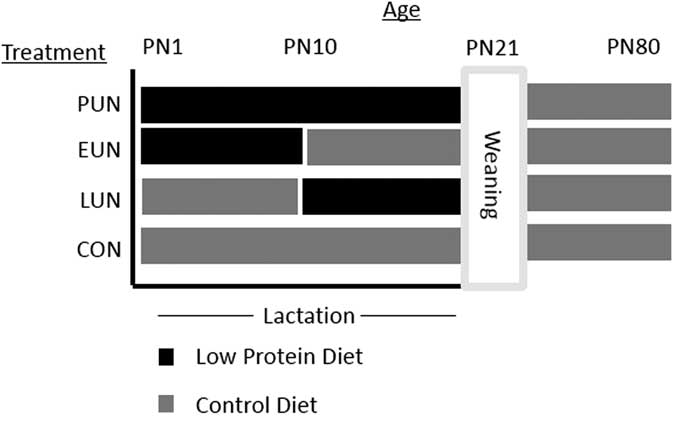
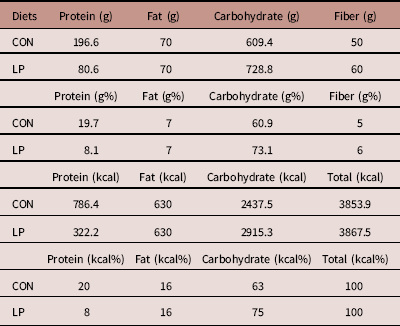
To induce postnatal undernutrition we used methods previously described.Reference Fiorotto, Davis and Sosa 31 In brief, second and third parity FVB (FVB/N; Charles River Laboratories, Wilmington, MA, USA) mouse dams were fed either a semi-purified control diet (20% protein; Research Diets, New Brunswick, NJ, USA) based on AIN93G, or a low-protein (LP) isocaloric diet (8% protein) beginning 1 week before mating. Table 1 displays the composition of the diets. These diets are casein, cornstarch and soybean oil and have been validated for rodent use during gestation, lactation and early postnatal life. For a detailed review on the theoretical framework for diet composition readers are directed to the work by Reeves et al.Reference Reeves, Nielsen and Fahey 32 Mating was timed by introducing males for a 24-h period; only pups born within the same 24-h period (PN0) were studied. On PN1 all pups born to dams on the control diet were pooled, and redistributed to one of two experimental groups: (1) Control (CON): pups born to and suckled by well-nourished control dams and weaned to a control diet at weaning (PN21); n=16; (2) postnatal undernutrition (PUN): pups born to well-nourished dams and suckled by dams fed the LP diet, then fed the control diet at weaning (PN21). Mouse dams that are fed a LP diet produce 15–20% less milk – thus pups nursed by LP dams will experience a global nutrient deficit and possibly a slightly greater deficit in protein intake.Reference Sampson, Hunsaker and Jansen 33 – Reference Mueller and Cox 38 This methodology closely mimics the nutrient intake of many infants who are born small for gestational age.Reference Lim, Zimanyi and Black 39 In order to distinguish cardiac differences at different stages of postnatal life we used a cross-fostering model at PN10 to segregated postnatal undernutrition to the early phase of undernutrition (EUN; PN1–10; n=14 liters) and late phase of undernutrition (LUN; PN11–21; n=15 liters). As displayed in Figure 1, at PN10 a subcohort pups suckled to control dams were cross-fostered to dams fed the LP diet (LUN). Additionally at PN10 a subcohort of pups suckled to dams fed the LP diet were cross-fostered to dams fed the control diet (EUN). At PN21 all pups (CON, PUN, EUN and LUN) were weaned and fed the control diet until ECG measurement at PN80. Thus, at the time of measurement all mice were consuming a nonrestrictive diet.
Cross-foster model for early life nutrition. Control diet=20% protein, low-protein (LP) diet=8% protein. Both diets are isocaloric. Postnatal undernutrition (PUN) refers to mice suckled to dams fed the LP diet from ostnatal day (PN) 1 to PN21. Early phase of undernutrition (EUN) refers to mice suckled to dams fed the LP diet from PN1–PN10, and then pups were cross-fostered to dams fed the control diet from PN11 to PN21. Late phase of undernutrition (LUN) refers to mice suckled to dams fed the CON diet from PN1–PN10; then cross-fostered to dams fed the LP from PN11 to PN21. Control group (CON) refers to mice suckled to dams fed the CON diet PN1–PN21. At PN21 all pups were weaned from dams and fed the control diet.

Composition of control (CON) and low-protein (LP) diets

Diets were casein and cornstarch based with soybean oil as the only source of fat. LP diet was achieved by replacing casein with additional cornstarch. The two diets contained the same amount of oil (70 g), and the fatty acid profile (weight percentage of total fat) consists of palmitic (10.3), oleic (22.8), linoleic (51) and linolenic (6.8) acids.
Each dam received seven pups (2–3 males and 4–5 females) and individual pups within a litter were identified with a unique tattoo. Females were only evaluated in this study, as work from our lab has shown that males did not display cardiac impairment as measured by treadmill testing, echocardiography and calcium flux of isolated cardiomyocytes and therefore it was hypothesized that they would not display cardiac arrhythmias.Reference Ferguson, Dangott, Vellers, Schmitt and Lightfoot 40 Pups were allocated so that on PN1, average pup weight for all groups was the same. Litter size was maintained constant throughout lactation by introducing ‘donor’ pups of similar body weight and age to replace any deaths; donor pups were not studied.
Body composition
At PN80 mice were weighed then fat mass and lean mass were measured by Quantitative Magnetic Resonance (EchoMRI, Houston, TX, USA).Reference Fiorotto, Davis and Sosa 31 Body composition was determined using the supplied software. Mice were then evaluated for cardiac function via ECG.
ECG
All tests were done with mice placed under 1% isoflurane anesthesia, with the mice on an ECG/heated board (EMKA, Paris, France) and the limbs taped to the four electrodes. Leads I, II and III recordings were obtained for 5 min. The mouse was then administered an intraperitoneal injection of dobutamine (1.5 µg/g body weight; Hospira, Lake Forest, IL, USA) and the measurements were repeated.
ECG parameters that were obtained were HR (beats/min), R-R interval (ms), QRS duration (ms), ST deflection (V) and QT duration (ms). Only parameters found to be within established ranges were anlayzed.Reference Berul, Aronovitz, Wang and Mendelsohn 41 Shape-based software (EMKA, Paris, France) was used to detect any change in morphology and presence of an arrhythmia. These parameters have been indicated and validated in studies previously analyzing various heart diseases.Reference Zwanenburg, Jellema and Jennekens 42 – Reference Han, Jing and Tian 44
After completion of the studies, the mice were allowed to recover for 24 h after which they were euthanized and the hearts were dissected quantitatively and weighed. Heart weights are reported as absolute weight and as normalized for body surface area as calculated using Meeh’s formula.Reference Gouma, Simos and Verginadis 45
 $${\rm Body}\,{\rm surface}\,{\rm area}\,{\equals}\,{\rm 9}.{\rm 662}{\times}\left( {{\rm body}\,{\rm weight},\,{\rm g}} \right)^{{0.{\rm 667}}} .$$
Evaluation of estrous cycle
A validated visual method to evaluate the stage of the estrous cycle was implemented as previously described.Reference Byers, Wiles, Dunn and Taft 46 In brief, each mouse was held by the tail with the forepaws resting on a cage lid. Vaginal openings were then visually inspected and classified based on previous literature for the stage of estrous cycle. Mice used in the study were within the follicular phase with low circulating estrogen levels.
Statistics
All data were analyzed in JMP v7.0 (SAS, Cary, NC, USA). Body composition and heart weight were analyzed by an one-way analysis of variance (ANOVA) with the main effects being diet (CON, EUN, LUN and PUN).
ECG parameters were analyzed with a two-way ANOVA with the main effects being diet (CON, EUN, LUN and PUN) and treatment (baseline or dobutamine) and a Tukey’s honest significant difference post-hoc test. An α level of 0.05 was set a priori.
Results
Body composition and heart weight
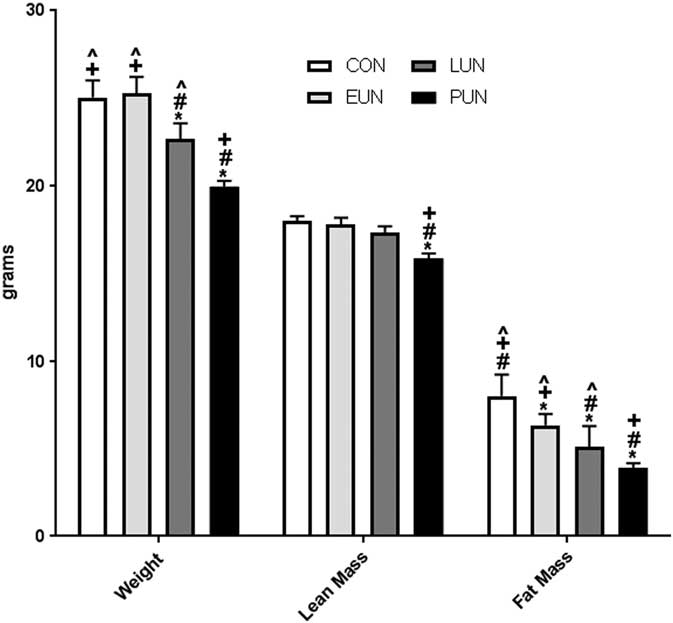
Our nutritive model successfully induced growth restriction (Fig. 2), as evident by a reduction (P<0.05) in body weight, in the PUN (19.96±0.32 g) and LUN (22.68±0.88 g) groups as compared with controls (25.05±0.96 g) and EUN (25.28±0.92 g). In addition to having the lowest absolute weight the PUN mice had a significant (P<0.05) reduction in lean mass (15.85±0.28 g) as compared with CON, EUN and LUN. There was no difference in lean mass between CON (17.99±0.26 g), EUN (17.78±0.39 g) and LUN (17.34±0.33 g). Fat mass was greatest in the CON (8.00±1.2 g) group followed by EUN (6.32±0.65 g), LUN (5.11±1.1 g) and PUN (3.90±0.25 g), each group was significantly different (P<0.05) from the other.
Body weight and composition at postnatal day (PN) 80. Mice were undernourished during early (EUN), late (LUN) and throughout (PUN) lactation phase alongside the control (CON) group. Weight was significantly decreased in the LUN and PUN groups compared with CON and EUN. Lean mass was significantly decreased in the PUN group only. Fat mass was significantly different between all groups. *Significantly different from control; #significantly different from EUN; +significantly different from LUN; ^significantly different from PUN. P<0.05 values are mean±SE.

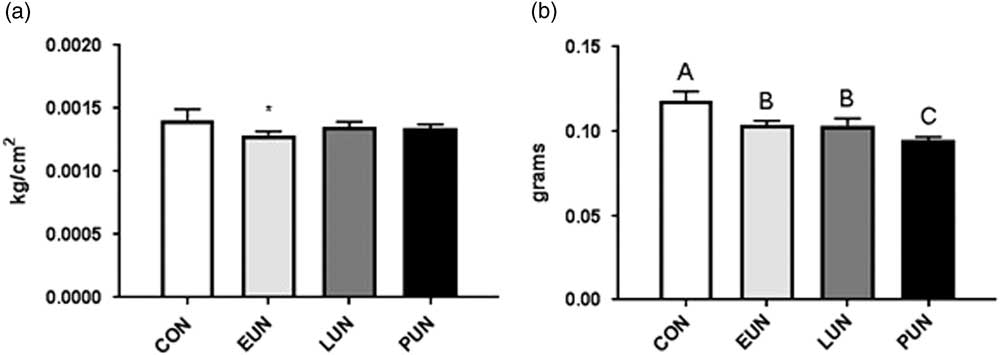
The absolute heart weight of the CON group (0.118±0.005 g) was significantly (P<0.001) higher than the EUN (0.103±0.002 g), LUN (0.103±0.004 g) and the PUN group (0.094±0.001 g); with the PUN group being significantly less than the three other groups. There was no difference between the EUN and LUN absolute heart weights (Fig. 3b).
(a) Heart weight (standardized to body surface area): mice were undernourished during early (EUN), late (LUN) and throughout (PUN) lactation alongside the control (CON) group. *The EUN group had a significantly decreased heart weight as compared with the CON group (P<0.05, values are mean±SE). (b) Absolute heart weight: the control group had a higher heart weight than the other treatment groups with the PUN group being significantly less than the CON, EUN and LUN group (P<0.001). The EUN and LUN groups were not significantly different from each other (values are mean±SE; A,B,Cdifferent letters indicate significant difference).

When comparing heart weight (standardized to body surface area), amongst the four nutritive groups the only significant decrease in heart weight was the EUN group (1.288±0.031 kg/cm2) as compared with CON (1.405±0.089 kg/cm2), LUN (1.350±0.040 kg/cm2) and PUN (1.342±0.031 kg/cm2) (P<0.05, Fig. 3a).
ECG
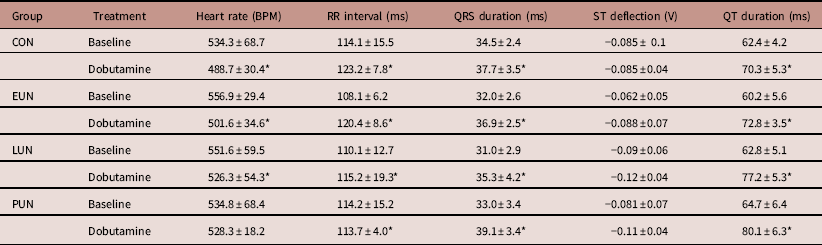
Table 2 displays the results obtained from the ECG analysis for mice that were undernourished during critical periods of development along with the response to dobutamine treatment.
Electrocardiogram (ECG) parameters for mice that were undernourished during the early, late and whole phase of lactation along with a control group with and without stimulation of dobutamine

BPM, beats per minute.
ECG parameters obtained from lead II on control (CON), postnatal undernutrition (PUN), early phase of undernutrition (EUN) and late phase of undernutrition (LUN) groups at baseline and following dobutamine treatment.
*Significant (P<0.05) change from baseline measurement to dobutamine treatment.
Baseline measurements
The HR of the CON group was 534.3±68.7 beats/min. The EUN group displayed HR values of 556.9±29.4 beats/min, whereas the PUN and LUN baseline groups HR was 534.8±68.4 beats/min and 551.6±59.5 beats/min, respectively. There was no difference (P>0.05) in baseline HR values between the groups. As RR interval is closely associated with HR there was also no difference in RR intervals (P>0.05) between the groups (CON RR interval 114.1±15.5 ms; EUN 108.1±6.2 ms; LUN 125.0±15.2 ms; PUN 114.2±15.2 ms). Electrical function of the ventricles at baseline showed that there was no difference (P>0.05) in QRS duration between the four groups (CON 34.5±2.4 ms; EUN 32.0±2.6 ms, LUN 31.0±2.9 ms; PUN 33.0±3.4 ms). There was no significant (P>0.05) difference in QT duration between any of the groups at baseline (CON QT duration 62.4±4.2 ms; EUN 60.2±5.6; ms; LUN 62.8±5.1 ms; PUN 64.7±6.4 ms). Additionally ST deflection at baseline was not significantly different (P>0.05) between the diet groups (CON −0.085±0.1 V; EUN −0.062±0.05 V; LUN −0.090±0.06; PUN −0.081±0.07).
Dobutamine treatment
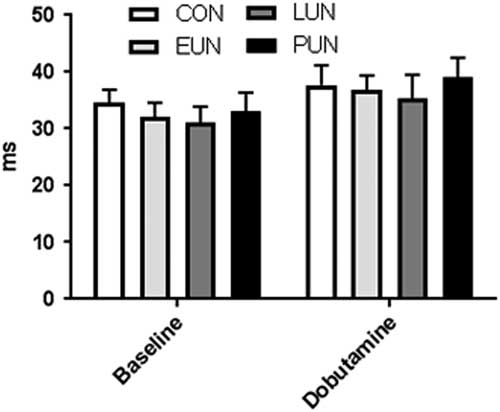
HR had a blunted decrease (P=0.0132) in the PUN group with dobutamine treatment as compared with the other groups with a −1.2% change from baseline as compared with an −8.5% change in the CON mice, −9.9% change in the EUN and −4.6% change in the LUN. Corresponding to the HR the RR interval response with dobutamine treatment significantly increased (P<0.001) in all groups. The PUN group had a 38% change in RR interval from baseline (120.9±25.9 ms) to dobutamine stimulation (166.9±22.6 ms). In comparison, the CON group had 11% change from baseline (123.9±6.1 ms) to dobutamine stimulation (137.6±5.4 ms). Treatment with dobutamine also significantly increased the QRS duration (P<0.001) for all groups. The PUN group had an 18.48% change from baseline (33.0±3.4 ms) to dobutamine stimulation (39.1±3.4 ms). In opposition, the CON group had 9.2% change from baseline (34.5±2.4 ms) to dobutamine stimulation (37.7±3.5 ms). The EUN and LUN groups recorded 15.3% (32.0±2.6 ms at baseline to 36.9±2.5 ms with dobutamine) and 13.8% change (31.0±2.9 ms at baseline to 35.3±4.2 ms with dobutamine) in QRS duration, respectively. As shown in Figure 4a trending interaction effect (P=0.09) showed the PUN group had the longest QRS duration (39.1±3.4 ms), as compared with the other groups (CON 37.7±3.5 ms; EUN 36.9±2.5 ms; LUN 35.3±4.2).
QRS duration from the electrocardiogram at baseline and with administration of dobutamine. A trend (P=0.09) for increased QRS duration was observed in the postnatal undernutrition (PUN) group following dobutamine stimulation.

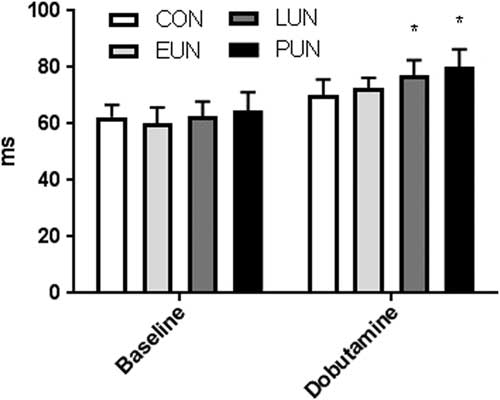
Dobutamine treatment had a significant (P=0.01) effect on QT duration (Fig. 5) with the PUN (80.1±6.3 ms) and LUN (77.2±5.3 ms) groups having a longer QT duration as compared with CON (70.3±5.3 ms) and EUN (72.8±3.5 ms) groups with dobutamine treatment. There was no difference in ST deflection following dobutamine treatment (P>0.05).
QT duration from the electrocardiogram at baseline and following administration of dobutamine. *Significant (P=0.01) difference in QT duration in postnatal undernutrition (PUN) and late phase of undernutrition (LUN) groups following dobutamine stimulation as compared with the control (CON) and early phase of undernutrition (EUN) group.

Shape-based arrhythmia detection
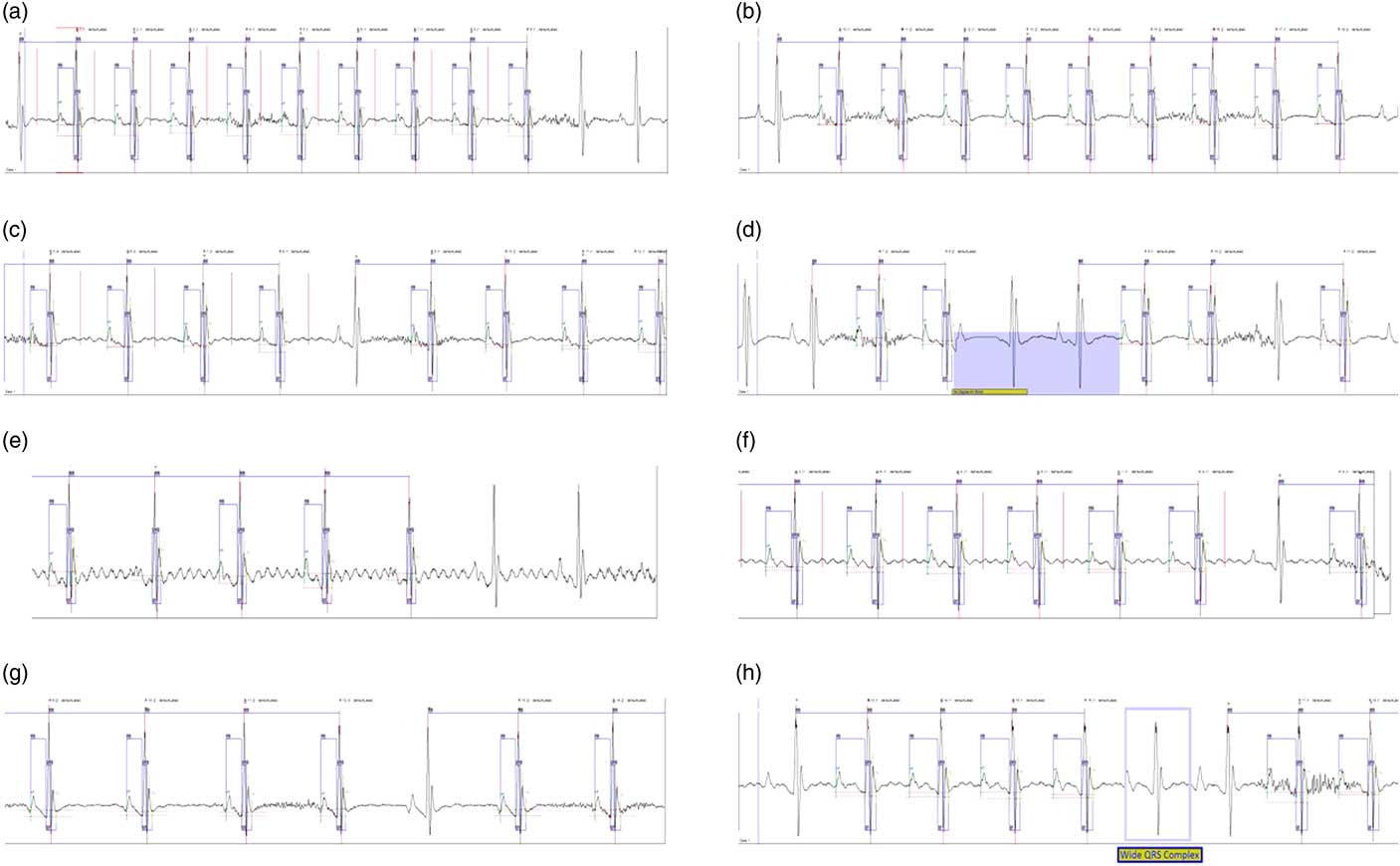
There were three types of arrhythmias detected [wide QRS complex (25.0% of PUN baseline and 87.5% of PUN+dobutamine), 1st degree atrioventricular (AV) block (12.5% of EUN baseline and 12.5% of EUN+dobutamine) and atrial flutter (EUN baseline=62.5%, EUN+dobutamine=25.0%, LUN baseline=62.5%, LUN+dobutamine=62.5%, PUN baseline=50.0% and PUN+dobutamine=25.0%)]. The control group did not present any arrhythmias at baseline or with dobutamine stimulation (Fig. 6).
Electrocardiogram rhythm strips collect from EMKA Technologies Software. (a) Control (CON) group baseline measurement, with normal sinus rhythm. (b) CON group+dobutamine treatment, no arrhythmias detected. (c) Early phase of undernutrition (EUN) group baseline measurement, normal sinus rhythm with minimal artifact. (d) EUN group+dobutamine treatment, software detection of 1st degree atrioventricular Block. (e) late phase of undernutrition (LUN) group baseline measurement reveals atrial flutter. (f) LUN group+dobutamine treatment reveals atrial flutter. (g) postnatal undernutrition (PUN) group baseline measurement, no arrhythmias detected. (h) PUN group+dobutamine treatment, wide QRS complex detection.

Discussion
The DOHaD hypothesis states that growth restriction in neonatal life permanently effects the body’s structure and function, in ways that may lead to chronic disease in adult life.Reference Barker 2 – Reference Barker 4 , Reference Barker, Winter, Osmond, Margetts and Simmonds 7 Professor David Barker first championed this hypothesis and the resulting influence on cardiovascular disease over 30 years ago. Since then the literature has documented the effect of neonatal nutrition on growth rate, organ size, body composition, along with clinical relevance on insulin sensitivity and hypertension.Reference Fall, Barker and Osmond 9 , Reference Wells 10 , Reference Matthews, Sameulsson and Seed 47 However, there is limited information on how undernutrition during various windows of postnatal life influences cardiac function. Thus, the purpose of this study was to determine whether early life undernutrition during key windows of development produced alterations in the depolarization and repolarization phases of the heart as measured by an ECG. Furthermore, we assessed the electrical activity of the heart at rest and when pharmacologically stressed with dobutamine, to determine if cardiac functional impairment was quiescent when the mouse was not in a stressed state.
We evaluated three-time points of postnatal undernutrition along with a control group. The EUN group experienced an initial deficit in nutrition from PN1 to PN11, the LUN group undergoing undernutrition from PN11 to PN21, and lastly, the PUN group enduring the lengthiest undernourishment period from PN1 to PN21, while the CON group did not experience undernutrition. Following the period of undernutrition the mice were nutritionally rehabilitated.
PN1–PN11 (EUN) is the cardiomyocyte proliferative phase of development in mice where mononucleated cells divide in order to increase cardiomyocyte number.Reference Louey, Jonker, Giraud and Thornburg 11 , Reference Botting, Wang and Padhee 48 During this period the electrical conductance system is continuing to mature as well.Reference Louey, Jonker, Giraud and Thornburg 11 , Reference Botting, Wang and Padhee 48 At the end of this period (PN7–10) cardiomyocytes undergo nuclear but not cellular division resulting in binucleated cardiomyocytes.Reference Louey, Jonker, Giraud and Thornburg 11 , Reference Botting, Wang and Padhee 48 The period of PN11–PN21 (LUN) is considered to be the hypertrophy phase of the cardiomyocytes, where the cells increase cross-sectional area in order to produce contractile force to overcome after load experienced by extra uterine life.Reference Botting, Wang and Padhee 48 Thus, any nutritional insult, during these periods of development will have a lifelong effect, on the structure and function of the heart.
Postnatal growth failure occurs in a considerable majority of extremely low birth weight infants.Reference Sampson, Hunsaker and Jansen 33 , Reference Grimble and Mansaray 34 , Reference Dusick, Poindexter, Ehrenkranz and Lemons 49 Suboptimal nutrition during early life development has been shown to alter body composition including lean mass and increased adiposity.Reference Woo, Isganaitis and Fitzpatrick 50 Our nutritive model (Fig. 1) produced changes in fat and lean mass dependent on the window of development. LUN and PUN mice weighed less than CON and EUN, indicating that EUN mice experienced catch up growth, however the increase in body mass at PN80 was primarily due to an increase in fat mass (Fig. 2). The LUN group did not have increased fat deposition but displayed similar lean mass to the CON and EUN groups. The PUN group displayed a reduction in lean mass and fat mass as compared with the other groups. The PUN’s inability to experience lean mass catch up growth could be due to a reduction in myogenic stem cell frequencyReference Woo, Isganaitis and Fitzpatrick 50 and a reduction in ribosomal abundance.Reference Fiorotto, Davis and Sosa 31 The combination of these impairments would reduce muscle protein synthesis and reduce lean mass over the lifespan.
One aspect to the clinical significance of developmental programming is that in addition to a reduction in body mass there can be organ specific growth restriction,Reference Wang, Li, Dangott and Wu 51 as evident by the fact that the longer the nutrient restriction the smaller the absolute heart weight at PN80 (Fig. 3b), however, when standardizing heart weight to body size the EUN group only displayed a significant impairment in heart weight (Fig. 3a). During PN1–10, when EUN was restricted, cardiomyocytes are proliferating thus undernutrition during that time period will reduce cell number and impair growth which cannot be recovered in the later phases of development with cardiomyocyte hypertrophy.Reference Drenckhahn, Schwarz and Gray 24 , Reference Drenckhahn, Strasen and Heinecke 25
As the reduction in heart mass was a result of cardiomyocyte impairment it was hypothesized that there would be an associated functional impairment, which could manifest in the atria and the ventricles.
Atrial impairment
Under adrenergic stimulation the EUN group developed 1st degree AV block representing a slow conduction velocity in the electrical impulse being sent from the sinoatrial node to the atrioventricular node. Previous studies using a murine model have shown that 1st degree AV block will progress into 2nd degree AV block and left ventricular hypertrophy if hypertension is present.Reference Wei, Taffet and Khoury 52 The DOHaD literature has consistently shown that early life undernutrition leads to an increased incidence of hypertension.Reference Barker 2 – Reference Thornburg 5 , Reference Barker, Winter, Osmond, Margetts and Simmonds 7
When undernutrition was isolated to the hypertrophy phase of postnatal development (LUN) the ECG analysis revealed atrial flutter at rest and under beta-adrenergic stimulation. Atrial flutter is a condition in which the electrical and contractile properties of the atria are impaired and disorganized.Reference Yagi, Akaike and Aihara 53 Previous literature has hypothesized that atrial flutter and fibrillation are caused by remodeling of the cardiac tissue, causing the cells to become frail and fibrotic,Reference Jansen, Moghtadaei and Mackasey 54 with histological analysis of hearts from mice subjected to early life growth restriction having an increase in fibrotic tissue,Reference Drenckhahn, Schwarz and Gray 24 , Reference Drenckhahn, Strasen and Heinecke 25 while we did not perform histological analysis on these hearts the manifestation of atrial flutter could be a result of fibrotic tissue present. The development of atrial flutter if gone untreated can potentially lead to an increased risk of atrial fibrillation and stroke due to the increased risk of blood clot formation in the atria.Reference Allessie, Konings, Kirchhof and Wijffels 55 – Reference Zhang, Timofeyev and Lu 59 It has been well documented in the literature that early life growth restriction increases the risk for stroke.Reference Morton, Tsang and Hohimer 12 While the etiology of stroke risk from fetal origins may be independent of atrial fibrillation the fact that early life undernutrition also increases the risk of atrial flutter and fibrillation there is a further increase in the risk of stroke for individuals exposed to early life growth restriction.
It was observed in a small proportion of the EUN (three mice) and PUN (two mice) that with an injection of dobutamine there was atrial flutter withdrawal. A possible explanation for this is the dobutamine stimulation prolonged the refractory period and slowed the conduction velocity thus preventing re-entry back into atrial flutter, acting as an anti-arrhythmic drug.Reference van der Hooft, Heeringa and van Herpen 60
Ventricular impairment
Ventricular arrhythmias are generally accepted to have more clinical significance than atrial, due to the increased mortality risk.Reference Velasco, Stirrup and Hage 61 The PUN group presented with a healthy ECG tracing at baseline, however when stressed with dobutamine the PUN group displayed a widened QRS complex which represents a prolonged ventricular depolarization. We hypothesize that undernutrition in the late phase (PN11–21) of cardiomyocyte development impaired ventricular conduction as both the PUN and LUN groups had significantly longer QT durations when stimulated with dobutamine indicating a lengthened ventricular repolarization.
We did potentially observe a clinical condition in our PUN and LUN mice, termed long QT syndrome (Fig. 5). The pathology of long QT syndrome is characterized by impairment in ventricular repolarization leading to sudden cardiac death. The long QT syndrome is a family of arrhythmic disorders caused by dysfunction in one of 13 different ion channel complex proteins, including calcium, sodium and potassium channels.Reference Iyer, Roman-Campos and Sampson 62 During the hypertrophy phase of cardiomyocyte development the sarcoplasmic reticulum matures in order to optimize calcium flux during depolarization,Reference Hamaguchi, Kawakami and Honda 63 thus early life nutrition during this phase could increase the risk of sudden cardiac death syndrome.
In conclusion, these findings suggest that undernourishment during the various phases (EUN, LUN and PUN) of cardiomyocyte development causes functional and structural impairment. Most notably functional impairment only arose when the heart was stressed. Furthermore, our data indicate that undernutrition during these distinct windows of development results in specific arrhythmias present in adulthood. It was hypothesized that any arrhythmias present in the PUN group would be a combination of arrhythmias present in the EUN and LUN group. As this was not observed in our data, perhaps there is a mechanistic cascade associated with the timing of re-feed that result in the PUN group being different from EUN and LUN and not simply a combination of the two.
Acknowledgments
The authors thank Dr. Daniel Columbus from the Prairie Swine Research Center.
Author contributions
D.P.F. collected the data and co-wrote the manuscript. J.R.V. analyzed the data and co-wrote the manuscript.
Financial Support
This research received no specific grant from any funding agency, commercial or not-for-profit sectors.
Conflicts of Interest
None.
Ethical Standards
The authors assert that all procedures contributing to this work comply with the ethical standards of the relevant national guidelines on the care and use of laboratory animals (Institutional Animal Care and Use Committee) and has been approved by Michigan State University.