INTRODUCTION
Moreover the legion has engineers, carpenters, masons, wagon-makers, blacksmiths, painters and other artificers … to fabricate new arms, wagons and the other kinds of torsion-engines, or repair them when damaged, They used to have workshops, too, for shields, cuirasses and bows, in which arrows, missiles, helmets and arms of every type were made. For the main aim was to ensure that nothing which the army thought to require should be lacking in camp.Footnote 1
As the passage from Vegetius quoted above makes clear, the Roman army was not merely a fighting force but an organisation whose members spent a great deal of their time in engineering and manufacturing activities. The evidence for the latter can often be seen in the legionary pottery industries. The start of these is frequently contemporary with the foundation of new legionary fortresses in areas where the local potters were not making appropriate types of vessels.Footnote 2 There can be debate over whether the workers producing and firing the pots were military personnel or slaves, but there can be no doubt that that the products were for a military market and produced under military control. Glass vessels have not normally been considered as products that might have been made within a similar organisational model. This article describes the evidence that they were. It deals with fragments of bottles that can be shown to have been made within a legionary fortress. The material also provides intriguing insights into military provisioning and how long bottles may have remained in use.
The article arises from a project I have been conducting to rationalise records of the glass I have worked on for a period now approaching 40 years. As any specialist will know, though a considerable number of reports are eventually published, many are not, and the ultimate aim of the project is to transfer the latter to the public domain. Both of the bottle base fragments to be considered here fall into the category of the unpublished. As both of the units which conducted the excavations went out of business prior to completing the reports, it seems unlikely at present that full details will become available. For this reason it has been felt it will be useful to publish them here, given the information they provide. Catalogue entries for the glass fragments will be found in Appendix 1.
BOTTLES AND MOULDS
One of the commonest Roman glass vessel forms in use across the empire was the blue/green prismatic bottle. These had a variety of body cross sections including square, hexagonal and rectangular, but it is the square form that dominates.Footnote 3 They were made by blowing a paraison of hot glass into a multi-part mould to shape the body and the base, and then the rim, neck, shoulder and handle were formed by manipulation.Footnote 4 Although there are occasional finds in Claudian contexts, they started to be made in very large quantities towards the end of the Neronian period. This can be seen by the virtual absence of the form in assemblages belonging to the earlier years of the a.d. 60s such as in the Boudican destruction deposits of Colchester and the earthquake levels at Pompeii, and the large quantities of fragments from those of the a.d. 70s such as in the forts associated with the Flavian advance in to the north of Britain and the eruption deposits at Pompeii.Footnote 5 The bottles continued in use into the third century. They were a utilitarian container form, generally for liquids judged by the size of the rim apertures, but the larger ones would have been appropriate for solid contents. In some cases the larger ones ended their lives as urns for cremated bones in graves. This was clearly a form that people across the whole spectrum of society found very useful, given the quantities of fragments found in assemblages from a wide range of site types. Most were thick-walled and robust and could have been re-used many times after their initial contents were finished.
The base moulds have channels cut into them that result in raised ridges on the finished bottles. The commonest pattern was of one or more concentric circles. More complex geometric patterns were less common but are frequently found. Figurative patterns were rare. In the early part of this century, the Association Française pour l'Archéologie du Verre co-ordinated scholars from across the empire to produce the Corpus des signatures et marques sur verres antiques (henceforth CSMVA) in three volumes.Footnote 6 This project attempted to catalogue and illustrate the basal marking on all types of Roman glass vessels, including those on prismatic bottles. The entry for Roman Britain published in the third volume only included the bottle bases with figurative and lettered designs, but those for other provinces normally included the geometric markings as well. There is, therefore, a robust corpus of data with which to compare base markings.
As with any mould-blown glass, vessels blown into the same mould should produce identical mouldings, though there is always the possibility that the pattern will not be reproduced fully if there are errors in preparing the mould.Footnote 7 In theory, therefore, it should be possible to identify the products of a particular mould by closely comparing the basal mouldings on different fragments. This is best done by taking a graphite rubbing of the base in a similar way to how the decoration on samian pottery is now normally recorded and published. Modern digital technology such as Photoshop makes it easy to scan and compare rubbings by overlaying them to see if any parts are identical. If they are, there are very good grounds for thinking the fragments came from bottles made in the same mould. This was the process by which it was possible to link base fragments found in Exeter and Castleford to show they were made in the same mould, as recently published in this journal.Footnote 8
While the theory of identifying the products of the same mould is straightforward, in practice it is more difficult. These bottles must have been made in the hundreds of thousands. When broken, their thick walls made them ideal candidates for recycling either as cullet for new vessels or as fragments to be made into counters or tools. While bottle fragments are found in very large numbers, they must represent only a relatively small proportion of the bottles made and used in the first to third centuries. To look for mould parallels is the equivalent of looking for the proverbial needle in a haystack. As an illustration, it can be noted that in my records I have 450 rubbings from fragments that retain more than part of a single circular moulding. Amongst these I have only, so far, been able identify 20 matches indicative of nine different moulds and this comes from accumulating the records over several decades.
The moulds themselves were made in stone and ceramic and discoveries of them are extremely rare. Excluding the group of mould fragments to be discussed in the next section, Amrein and Nenna were only able to identify a dozen basal moulds from across the empire.Footnote 9 To discover that two bottle fragments in my records must have come from the same mould and, moreover, that the mould itself had been found is remarkable. The odds against it must be somewhat akin to being the sole winner of a national lottery on a rollover week with a single ticket. It is to this mould and its products we now turn.
MILITARY BOTTLES
The limestone mould fragments were found within the legionary fortress at Bonn in 1960. The excavations have never been published in full, but some details are available in a variety of publications. The glass-working debris was found in an area of taburnae fronting, and on the right-hand side of, the via praetoria directly in front of the baths (praetentura dextra).Footnote 10 Non-ferrous metal-working debris was found in the same area. Follmann-Schulz provides a little more information about the location and the finds, noting the excavations were to the south of the modern Badener Strasse.Footnote 11 She goes on to describe the presence of three tank furnaces associated with glass working which appear to have had a single use. The date of the activity is assigned to the final quarter of the first century on the basis of the pottery.
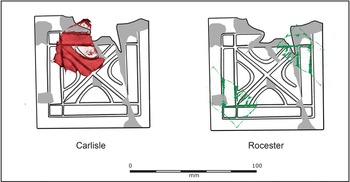
Full details of the moulds are published in the third volume of CSMVA.Footnote 12 Numerous fragments of moulds in limestone together with two marble fragments were found close to the tank furnaces. They had been deliberately smashed and this, together with the demolition of the furnaces, is given as happening towards the end of the first century (‘vers la fin du 1er siècle ap. J-C’). The mould fragments consisted of both side and base plates. These indicated that tall narrow square bottles were being produced. Three different base patterns were present, consisting of one of two concentric circles and two with geometric patterns. It is the one of the latter which combines complex mouldings of a double square frame and a diagonal cross with semi-circles in each compartment that is of interest here.Footnote 13 This and the two glass fragments are illustrated in figure 1.
The limestone base mould DM-4 from Bonn (after Follman-Schulz 2011) and the glass base fragments from Carlisle and Rocester (scale 1:2).

A date for the Bonn activity of within the final quarter of the first century, with the cessation of glass-blowing activity by the late first century, means that there are two legions that could have been involved with the production. Following the destruction of the timber legionary fortress in a.d. 69, it was rebuilt in stone during the period c. a.d. 70–79 by the legio XXI rapax with the help of their auxiliaries the ala sulpicia and the cohors I civium Romanorum. The XXI rapax was replaced in a.d. 83 by the legio I Minerva.Footnote 14 None of these units are recorded as having connections with Roman Britain.
The first bottle base fragment encountered was found in Carlisle during excavations in 1989 at Annetwell Street by the Carlisle Archaeology Unit. Annetwell Street has been the focus of much excavation and this intervention was in advance of the Tullie House Museum Extension (NY 3978 5605). A brief note about the excavations was published in Britannia.Footnote 15 I wrote the glass report in 1992 and retained a rubbing of the base from which the illustration in figure 1 has been prepared. The site information available when the report was written indicated that the fragment came from a Period 8b soil layer in Trench D Cutting IIIA. This related to buildings immediately outside of the rampart of the fort with a suggested date within the period a.d. 170–183.Footnote 16
At the time of the excavation, it was thought that this context would have been associated with a stone fort built shortly after the abandonment of the second timber fort in the middle of the century. Since then, excavations close by have suggested that the first stone fort was of Severan date and that what was happening in the second half of the second century is obscure.Footnote 17 What can be noted is that, broadly contemporary with the deposition date of the glass fragment, the prefect of the ala Augusta ob virtutem appellata was making an elaborate stone dedication to Hercules celebrating a victory by his men over a band of barbarians.Footnote 18 The dedication can be dated within the period a.d. 180–192 and was found to the south of the fort in English Street. Jarrett notes that by a.d. 188 the unit was stationed at Old Carlisle some 17 km away, and suggests the English Street dedication was erected while the unit was based there.Footnote 19 Whether that is correct or not, the inscription certainly indicates a continuing military interest in this area of Carlisle at the time the bottle fragment was deposited.
The fragment from Rocester, Staffordshire, was found during excavations off Northfield Avenue (SK 1115 3970) by the Birmingham University Field Archaeology Unit between October 2001 and February 2002. The area lay to the north of the Roman fort complex within the village. A brief report of the evaluation which preceded it in October 2001 is available,Footnote 20 but the full excavation report was only in draft form when the unit was disbanded. I wrote a report on the glass in 2007 and by that time was regularly illustrating my glass reports. The drawing in figure 1 was thus made from the piece in 2007. The site information at that point indicated that the fragment came from the fill of a large rubbish pit within Enclosure 1.
Information about military occupation at Rocester is available from the publication of earlier excavations at the New Cemetery within the fort complex and at Orton's Pasture to the south of it.Footnote 21 This work has established a military presence consisting of three separate phases. The first, starting about a.d. 100, was short-lived. The second fort was occupied within the first third of the second century. The third fort was constructed in the a.d. 140–160 period. This Antonine fort was abandoned about a.d. 200. The garrisons of these forts are unknown.
Dr Roger White has very kindly made the draft excavation report for Northfield Avenue as it existed in 2011 available to me. From this it can be established that all the fills of the pit in which the glass fragment was found had pottery belonging to the Hadrianic/Antonine period. The enclosures were aligned with the layout of the third fort and were thought to be for stock management. The pit thus appears to be contemporary with the third fort and to be of Antonine date. Earlier occupation on the site had consisted of droveways possibly associated with the earlier forts.
Figure 2 shows coloured rubbings of the glass fragments superimposed on the drawing of the mould. As can be seen, the large fragment from Carlisle corresponds in all elements. The fragment from Rocester has mouldings in slightly lower relief, resulting in a paler rubbing. It has been positioned in two places. Judging by the small elements of the arcs and diagonal extant, it may well have come from the part of the mould in the top right corner which is not so well preserved. The positioning of the rubbing in the bottom left part of the mould shows how closely it corresponds to the square frame and central diagonal. There can be little doubt that the bottles from which these fragments came were made in the praetentura of the fortress at Bonn.
The glass fragments superimposed on the stone mould (scale 1:2).

Follmann-Schultz, when publishing these mould fragments, said the patterns were common. While this is the case for the mould producing bases with concentric circles, it cannot be said to be correct for the geometric patterns. The CSMAV volumes produce no comparanda for the pattern under consideration and I have no record of any other examples from Roman Britain. This raises an interesting question about the possible presence in Britain of a vessel made in the other geometric mould from Bonn.Footnote 22
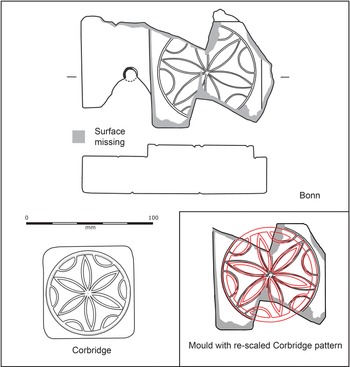
Figure 3 shows a drawing of this mould together with the basal pattern of a bottle from Corbridge illustrated by Charlesworth in her survey of the glass used in northern Britain.Footnote 23 This base would have come from early excavations at the site, when glass vessels were rarely reported on in excavation reports, and does not seem to have been published elsewhere. To my knowledge this is the only base which exactly matches the pattern on the Bonn mould. While the pattern of petals bounded by a circular moulding is encountered not infrequently, the addition of arcs appended to the inner side of the frame between the petal points is extremely rare. The CSMAV volumes have two instances, one probably from Tripoli and the other from the region of Gaziantep in Turkey.Footnote 24 Both of these, however, are on much larger bottles and have elaborate corner mouldings in addition to the petal design. They have no connection with the Bonn mould.
The limestone base mould DM-5 from Bonn (after Follman-Schulz Reference Follmann-Schulz2011), the Corbridge base as published by Charlesworth (Reference Charlesworth1959) and the latter re-scaled and superimposed on the mould (see text). (Scale 1:2.)

Deciding whether the Corbridge bottle came from the Bonn mould would depend on comparing a rubbing of the glass fragment with the mould as has been done with the Carlisle and Rocester fragments. At present this is not possible. As can be seen in figure 3, the illustration would suggest a bottle slightly smaller than the ones produced in the mould. The Corbridge bottle measured from the illustration, which is stated to be at a scale of 1:2, would be c. 73 mm wide. The mould would provide a bottle with a base width of 84 mm. There are grounds for wondering, however, whether the illustrations in the 1959 paper are entirely accurate. The figure illustrates two lettered bases from Corbridge and Coventina's Well at the top and then nine base designs in three columns from Corbridge. The illustration on figure 3 here is taken from the bottom right of the figure. The Coventina's Well base on the figure can be compared to the illustration given in the publication of the material from the wellFootnote 25 and would appear to be c. 6 mm too small (at full size). It can also be observed that the base drawings in each column of the 1959 figure are suspiciously similar in size and that all are drawn as complete, which would be unusual. In discussing the bottles, the paper says ‘Most of the bottles have some sort of moulded base markings, generally of a geometric pattern (a selection of those from Corbridge is reproduced in fig. 9).’
It seems likely that the 1959 figure was prepared to show the range of patterns present in a format that fitted the small page size of the journal in which it was published and may not be entirely accurately scaled. It is also possible that the complete base patterns presented were extrapolated from the part of the pattern extant on a fragment. This would not be difficult, as the geometric patterns were generally compass drawn and full patterns can easily be reconstructed from fragments. If the Corbridge base pattern is rescaled to increase it by 6 mm, i.e. by the amount that would correspond to the difference seen with the 1985 drawing of the Coventina's Well bottle, the correspondence between the Bonn mould and the Corbidge base becomes very close. Figure 3 shows this with the re-scaled Corbridge basal pattern in red superimposed on the Bonn mould.
There is the distinct possibility, therefore, that another product of the Bonn bottle manufacturers may have reached Britain, again within a military context.
THE QUESTIONS RAISED BY THESE BOTTLES
The first question to ask is: what purpose did glass bottles serve if they fell into the category of items which, to follow Vegetius, the army thought were necessary to have to hand? It is certainly true that the Roman army was a heavy consumer of such bottles at the time of the manufacturing activity at Bonn. Military vessel glass assemblages in the Flavian period, and later, are characterised by high levels of bottle use.Footnote 26 Were they useful as containers in themselves, or were they useful for a specific commodity they contained? It is likely, given the different shapes and sizes, that square bottles in general could have contained a variety of things, but the tall, narrow ones produced at Bonn would have had a liquid content.
Given we have both the base dimensions and the height of the body it is possible to calculate an approximate capacity. It has to be approximate, as the wall and base thickness on such bottles are never uniform. The centres of the sides and bases are always thicker than the areas near the corners. Each bottle was blown individually and they were not like modern glass bottles manufactured reliably to deliver a set capacity. Even if bottles were blown into the same mould, the capacity might not be the same. Charlesworth, in her seminal article which first considered these vessels in detail, pointed this out using the example of four bottles found at Mainz, all from the same mould.Footnote 27 They were short bottles with identical base measurements of 72 mm by 72 mm and uniform heights of 160 mm. She was able to measure the capacity to the base of the neck and they varied from 440 to 510 cc.
Taking the widest thickness on the Rocester bottle as a guide, the internal capacity of bottle blown into the Bonn mould using the height of the extant side panels can be calculated as c. 82 × 82 × 240 mm which is the equivalent of 1,613 ml. The precise quantity will obviously vary, but as a rough guide we can assume they would have held 1.5 litres, the equivalent of two modern bottles of wine. Translated into Roman liquid measures they would have held c. 3 sextarii.
The implication of the manufacture of the bottles within the fortress is that they were also going to be filled there. One advantage of glass bottles is that they do not absorb residues from their contents. When empty they can be washed and re-used without any fear that the previous content will contaminate the new one. Within the context of a fortress, probably their most likely function would have been as the final containers for products that arrived in large transport amphora. These contained large quantities of liquids that would have had to be decanted.Footnote 28 As is well known, the soldiers in contubernia lived together and cooked together. Their quarters were not large, and certainly not large enough to keep amphoras on hand within them.
The accounts and lists present within the Vindolanda writing tablets show a constant stream of transactions between the personnel of the fort as they acquired items of food, drink and other essentials. Some retain indications of the quantities of liquid goods that were being used. The account relating consumption within the commandant's house over a few days one June is especially useful.Footnote 29 There 2 sextarii of sour wine and 1.5 sextarii of fish sauce are noted. Both would happily fit into one of the Bonn bottles. Wine comes in larger quantities, between 1 modius 14 sextarii (i.e. 30 sextarii) and 12 sextarii. The larger quantity would be in the vicinity of half an amphora, the latter less than a fifth of one, or the equivalent of four Bonn bottles. A commandant's household would have been larger than a contubernium and would have had more storage space, but even there the quantities cited suggest it was making use of other containers to hold decanted goods. Tantalisingly, a second Vindolanda list makes reference to glass vessels four times in a context that indicates they were needed for or from a cook.Footnote 30 The type of glass vessel is not stated, but the other two utensils listed (cooking pot and dish) would both fall within utensils used in cooking and it is tempting to see the glass vessels as containers for ingredients as well.
The need for containers into which to decant supplies within a legion of 5,000 men might well explain why the authorities at Bonn decided it was useful to start glass bottle production. There would be breakages of course, but the bottles could have had long lives, being emptied and re-filled many times. Cylindrical bottles, which were in use contemporaneously with the earlier part of the square bottle date range, clearly had long lives. Fragments frequently show vertical scratch marks caused by repeated removal from their basketry holders.Footnote 31 Square bottles were not stored in the same way and so their sides do not show this scratching, but the bases often show signs of wear.
The second question arising from these finds is how the bottles made in Bonn ended up breaking and being deposited almost a century after they were made and in another province. Both Rocester and Carlisle are military sites, but of auxiliary units with no known connection with the legions stationed in Bonn in the late first century. There is the possibility that the Antonine contexts of both are the result of re-deposition and the fragments are residual. This cannot be ruled out in the case of the Carlisle fragment, as the lack of a final publication means that insufficient is known about the context and the other items found with it. In the case of the Rocester fragment, residuality seems unlikely, both because of the nature and position of the deposit and the consistent dating of the pottery within the pit fill. It is salutary to think that, without the evidence of the Bonn moulds, bottles with this base pattern would undoubtedly have been assigned an Antonine date of manufacture. Now they can take their place as an example of how long items could remain in use.
Given the bottles were made in a legionary setting and effectively died much later in an auxiliary one, it seems reasonable to conclude that they spent their lives within the military community. How they moved around within it is a fascinating, but currently unanswerable, question. Did quartermasters keep supplies which could be sent to other units when need arose? Did bottles become the property of individual soldiers or conturbernia and so travel with them if they were transferred elsewhere? Or were bottles something that had to be returned to central stores with only the contents having to be paid for? The finds from Bonn, Carlisle and Rocester raise many questions that have yet to be resolved, and show that there are many aspects of Roman military life we have yet to explore. They do, however, start to explain why military glass assemblages are always dominated by bottle fragments.
ACKNOWLEDGEMENT
I am most grateful to Roger White for allowing me to see the draft excavation report for the Rocester excavations which he had access to when BUFAU was disbanded.
APPENDIX 1: CATALOGUE ENTRIES TAKEN FROM THE ORIGINAL UNPUBLISHED REPORTS
Carlisle ANN D(177) Period 8b Cutting IIIA.
Base fragment of probably square bottle. Blue/green. Suggested reconstruction of base design – two square mouldings with side mouldings of inner square continuing to outer square and forming crosses; two diagonal mouldings internally crossing at centre; one curved moulding in each of four compartments formed by diagonal mouldings. Fragment from one corner of design retaining part of outer square and crossed ends of inner square, parts of both diagonal mouldings; parts of two curved mouldings. Dim. 49 × 44 mm, suggested width of bottle c. 90 mm.
Rocester, Northfield Avenue [8019], [8354].
Square bottle; lower body and corner of base, two joining fragments. Blue/green. Base design – two square mouldings forming a frame, diagonal moulding projecting into centre, stubs of two other mouldings projecting in, possibly semi-circles. Dimensions 47 × 25 mm, present height 14 mm.