Introduction
The potential for recovering communicative abilities for people who have lost them, but who remain cognitively active, is highly desirable. In order to understand some of the potential ethical considerations associated with this desirable technology, this article explores how a speech neuroprosthesis works, the nature of language use it permits, and how we ought to understand the complete system.
Neural speech prostheses promise to record the neural signals associated with covert speech from which can be decoded overt speech features.Footnote 1 This can be done via processes involving noninvasive EEG, or by intracerebral probes. Software processing of the signals, using neural net computing for example, allows reconstruction of acoustic features to represent the covert speech.Footnote 2 Together, this recording, processing, and reconstruction enables a system to externalize covert speech.Footnote 3,Footnote 4 The technology has applications in various medical contexts, such as in cases of aphasia, locked-in syndrome, and speech pathologies where motor function is compromised but cognitive ability is not.
Scalp electroencephalography (EEG) has been used to explore the temporal sequence of processing in speech production,Footnote 5 but its low spatial resolution restricts its usefulness for decoding (despite a handful of studies suggesting that differentiating pairs of vowels or syllables using EEG is feasible).Footnote 6,Footnote 7 More promising is intracranial EEG (iEEG), which is mostly performed as part of the evaluation for epilepsy surgery in patients with drug-resistant epilepsyFootnote 8 and combines millisecond temporal resolution with subcentimetric spatial resolution. The first iEEG studies of covert word production confirmed that iEEG signals showed consistent results with fMRI, with a similar anatomical pattern of activation, and provided additional information on the time course of brain activation during the task.Footnote 9
Also relevant to the purpose of decoding speech from brain signals are iEEG data on the production and perception of actual speech using high-density iEEG grids that improve further on the spatial resolution of conventional iEEG. These studies revealed that the superior temporal gyrus is sensitive to the phonetic features of heard speech,Footnote 10 while the sensorimotor cortex on the ventral portions of the pre- and postcentral gyri contains the representations of specific articulators during speech production.Footnote 11 Given the anatomical specificity of these representations of heard and produced speech, attempts were made to reconstruct actually-heard speech from iEEG recordings of activity in the auditory cortex. Performance was good: although the reconstructed sounds were not intelligible to human ears, the words they corresponded to could be classified accurately by a speech recognition algorithm.Footnote 12
The brain areas that are most consistently activated during word selection tasks are the middle frontal gyrus and the posterior portions of the middle and inferior temporal gyri of the dominant hemisphere, while those associated with articulatory planning include the pars opercularis of the dominant inferior frontal gyrus (part of Broca’s area) and the ventral premotor cortex.Footnote 13 While the high spatial resolution of fMRI, together with careful experimental design, has provided significant refinement into the anatomical correlates of covert speech production, the slow temporal resolution of this technique prevents it from accessing the precise neuronal operations that underlie this process in real time. For such a purpose, electrophysiological methods that record the electromagnetic fields emitted by the brain with millisecond temporal resolution are required.
Because covert speech engages a neuroanatomical framework that is similar to overt speech, and neural recording technologies give access to a cerebral representation of overt speech that is fine-grained enough to attempt its reconstruction from the neuronal signals, the idea of decoding covert speech from neural signals emerged.Footnote 14 The first studies were able to decode single vowels,Footnote 15 or vowels and consonants within isolated one-syllable words.Footnote 16 Further work showed that it was possible to decode which one of a pair of more complex words was imagined.Footnote 17
These encouraging early results must not obscure the fact that we are at present quite far away from being able to decode covert speech. They do suggest, however, that given sufficiently dense recordings of cerebral activity and sufficiently powerful reconstruction algorithms, speech prostheses might become a viable alternative to the currently available interfaces that restore communication in patients with severe neurological disability.Footnote 18,Footnote 19
In the ideal, probes scan, record, and decode neural information, before mapping it onto relevant linguistic structures (words, sentences, likely phrases) and externalizing intelligible analogues of covert speech.Footnote 20 These will typically be a printoutFootnote 21 or synthesized speech.Footnote 22,Footnote 23 Given significant quality of life implications associated with addressing profound communication problems in patients,Footnote 24 the continuing development of this technology is morally desirable.Footnote 25 There are potential areas of concern, however, in terms of accuracy and user control over the device.
We first examine what it means for the output of the device to be accurate, drawing a distinction between technical accuracy on the one hand, and semantic accuracy on the other.
Both technical and semantic accuracy of the device will be necessary (but not yet sufficient) for the user to have sufficient control over the device. Sufficient control is an ethical consideration: we place high value on being able to express ourselves when we want and how we want. Sufficient control of a neural speech prosthesis requires that a speaker can reliably use their speech apparatus as they want to—to communicate when and only when they intend to—and can expect their speech to authentically represent them, i.e., that when they speak, they identify with the words and phrases produced.
In relation to control, we draw a distinction between two relevant features which bear on the question of whether the user has sufficient control: voluntariness of speech and the authenticity of the speech. These can come apart: the user might involuntarily produce an authentic output (perhaps revealing private thoughts) or might voluntarily produce an inauthentic output (e.g., when the output is not semantically accurate). Both features will be important to the user’s control of the device and her consequent satisfaction with the output.
Finally, we consider the role of the interlocutor in interpreting the content and purpose of the communication.
Accuracy and Control
The development of neural interfacing technologies and brain-computer interfaces raise numerous ethical questions.Footnote 26 Specific to speech neuroprostheses, there are potential technological challenges and associated ethical implications in terms of covert speech. How ought we to think of speech that is intended to be verbalized, and that which the user wishes to remain ‘in their head,’ for instance? One difference here is between someone who wants to say, “The ball is round” and someone else who wishes merely to think it, or more generally problems with the apt reproduction of what a neuroprosthesis user wants to say, and how they want to say it.
Whereas means of dealing with ambiguity, error, and so on, have developed for communication in general, these structures cannot be presumed to be simply reproduced in practices of neuroprosthetically-mediated communication. Scrutiny is required on the otherwise ‘taken-for-granteds’ of familiar communication. Moreover, that the problems we note are not unique to neuroprostheses does not mean that they are not significant for the device, its development, or its end users. The generic problems need to be framed in terms of this technology,Footnote 27,Footnote 28 just as they can be so framed for others like text messaging.
Imagine a device user who is unable to control her device sufficiently well so as to externalize her covert speech as she intends it. The device could nonetheless produce coherent speech that might (erroneously) be taken by an audience as a genuine representation of the user’s perspective. Similarly, a user could be skilled with their device, but intentionally use it to produce outputs that are not faithful to any planned content, for example by allowing it to make predictions based on incomplete or unclear covert speech. In these scenarios, we must ask how close is close enough when it comes to externalizing covert speech.
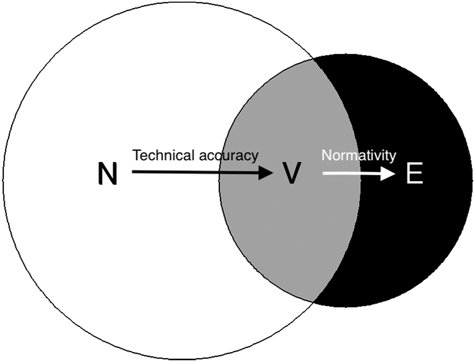
Achieving accuracy in the correct mapping of neural signals to acoustic outputs is not sufficient to guarantee adequate control nor, as we will argue, is it the most important sense of accuracy. To demonstrate the insufficiency of technical accuracy to guarantee sufficient control, consider the following. A total set of linguistically relevant neural states, N, that may be accurately recorded, but with only a subset, V, intended to be vocalized. That subset has a normative accuracy relation on a set of externalized utterances, E. This is depicted below, in Figure 1. The remainder set of N–V ought to be proscribed from externalization. V and E are normatively related in terms of faithful reproduction of phonemes as well as communicative intention. The descriptive accuracy of N as reproduced in the device recording relates to the normativity at play between V and E, but is not the whole story. The communicative intentions of the device user make up the remainder. As we will argue below, these communicative intentions straddle issues of semantic (as opposed to merely technical) accuracy, as well as issues of user control.
Relations of accuracy and normative adequacy.

It seems plausible, and problematic, that dissociations between communicative intentions and device output could appear. In determining the ideal state of device functioning, we need to ask whether we should conceive of technologically-mediated speech as representing the ‘true’ state of the speaker’s state of mind, or not. We must also consider what is sufficient for voluntary user control of the speech prosthesis, in order to safeguard communication. We can discern, at least, the following three normative areas in this context —accuracy, sufficient control, and pragmatic considerations.
Accuracy
It may be considered that sufficient accuracy is achieved when covert speech is predictably detected, recorded, and used as a trigger for the device. This sense of accuracy might best be thought of in terms of the technical functioning of the device. We call this technical accuracy. In another sense, we can think of covert speech in terms of propositional content. In this sense, the accuracy of operation of a neuroprosthesis depends on how well it discloses the content or meaning the user intends to communicate. We call this semantic accuracy.
Accuracy in the technical sense indicates the good functioning of the neuroprosthetic system, from the recording of neural activity through processing, to the production of an acoustic output. In this narrow sense, ‘accuracy’ means that there is a close correspondence between neural activity, the recording made by the neuroprosthetic device, and the acoustic output. This can be summarized as follows:
The neuroprosthesis can be called ‘accurate’ if it:
1) detects and records neural activity associated with an instance of covert speech,
2) maps this to articulatory-motor properties,
3) derives acoustic properties from the articulatory-motor properties, and
4) produces a synthetic verbal output matching those acoustic properties
Even if 1–4 are met, the accurate neural recording, decoding, and synthesized verbal output may yet not appropriately correspond to what a speaker wishes to say. This might be because the act of covert speech triggers the device properly, but in the process of being externalized, some fidelity is lost—perhaps the algorithmic processing of the neural activity produces something not quite intended, or perhaps the user has not generated the neural activity that would produce the desired output. The system here is still ‘accurate’ in terms of the covert speech acting as a trigger for the device, and the reconstruction algorithm working properly, but it externalizes something unintended by the user. Whether or not the device is technically accurate is not affected by the user’s intended meaning—it is a question of mechanism.
The different parts of the system seem able to detach from one another in ways not familiar in everyday communication. The technical accuracy of the prosthetic in representing neural activity is one thing, but the assessment of how this ought to relate to the ultimate synthesized speech involves thinking about the propositional content of the user’s covert speech activity.
In this context it ought to be asked: in relation to what, exactly, is synthesized speech being deemed accurate? Speech perception activates phoneme-specific (or phonetic feature-specific) responses in the superior temporal cortex, similar to the articulator motor-specific activation patterns in the inferior frontal cortex during speech production.Footnote 29,Footnote 30 Accuracy of neural recording in motor areas may reflect not just what is intended by the speaker, but also what they hear—something not in their control. There is the suggestion at least of overlapping or coextensive properties between perceiving and producing speech that could well ground analyses of speech processing.Footnote 31 These could feasibly bear upon how to understand the speech produced or intended to be produced—the pertinent question might concern how we know what exactly we are decoding. Once we have a clear picture of this, we can still ask to what standards ought we to assess the speech the neuroprosthesis produces.
‘Accuracy’ in a broader sense is not just a question of correctly mapping electrical field activity in articulatory-motor areas of the brain, via algorithmic reconstruction, to acoustic output. That is, we ought not to think of a neuroprosthetic device as ‘accurate’ in its output simply if it registers perfectly the electrical field activity of specified neural areas.
We ought to distinguish technical accuracy, the accurate functioning of the device, from semantic accuracy, the accurate representation of what the user wanted to say. As argued, the former is a technical question. Even if difficult to know for sure, there will be an objective fact of the matter about the degree of match-up between neural activity and machine representation. The latter is more difficult to operationalize, yet clearly ethically significant. Some argue there may be no equivalent ‘fact of the matter.’Footnote 32 Natural speech often does not quite match what a speaker attempts to say, and speakers sometimes seem to find out what they ‘think’ through speaking.Footnote 33
In the next section, we demonstrate how semantic accuracy in particular relates to the user’s control of the device. In order for the user to be satisfied with the output of the device, she not only needs to be able to exert voluntary causal control, triggering the device when and only when she intends, but she also must be satisfied with the semantic accuracy of the output such that she identifies with the words and phrases produced. We will argue below that descriptive semantic accuracy is important given the value we place on our utterances authentically representing us. In combination, these bear on the right sorts of relations between sets V and E from Figure 1. Further pragmatic dimensions will affect E, but will be discussed later.
Reflection on both senses of accuracy and how we set the bar for adequacy in these domains prompts broader discussion about the nature of synthetic speech and whether we should hold it to the same standards as natural speech. Is it that neuroprosthesis-aided speech is to restore a speech capacity that has been lost, or is this case more like the instigation of a new communicative practice that will replace that which has been lost? If the former, the way we assess the adequacy of synthesized speech will be in terms of everyday speech, which will constitute a high bar for synthetic speech. If the latter, we must consider whether a replacement for standard speech can be considered adequate if it is not as linguistically rich and fluent as a hypothetical ‘restored’ speech. This has some bearing on the pragmatic dimensions of speech explored below.
As argued, semantic accuracy requires us to assess factors beyond the technical function of the device, and to examine the wider interaction between the device and the user. Conceptual questions of accuracy shade into ethical issues when we examine their relevance for the user’s control of her speech neuroprosthesis.
Control
Control of the device in terms of merely triggering it via covert speech is parallel to the technical functioning sense of accuracy just mentioned. But user control ought to also be thought of in terms of the user’s ability to moderate the activity of the prosthesis, to ‘steer’ it, and curate its speech outcomes. This is most pertinent because control concerns freedom of action which, Nita Farahany writes, “…means the freedom of intending an action, being able to bring it about without obstacles or impediments, and identifying with the action that results.”Footnote 34
Both the voluntariness of the production of an output and the authenticity of that output will be important to assessing whether the user has sufficient control over their device and can be satisfied with the output. We therefore draw a distinction between the voluntariness of the speech and the authenticity of the speech, both of which are of ethical significance. Together, these dimensions of control affect how we assess instances of synthesized speech as intended, both in the sense of volition (whether the user intended to produce speech), and of meaning (whether the output is an authentic representation of what the user intended). We first examine features of the device that will influence the voluntariness of the speech.
Given the general nature of the recording and decoding approach so far described, it is conceivable that a neuroprosthesis could be too sensitive, or too coarse, in decoding neural activity. This effect could result in the involuntary externalization of much more covert speech than a user might desire. Any activity sufficiently covert language-like (in neuroanatomical terms) to be decoded as such by the neuroprosthetic speech system could be externalized. This presents at least four areas for consideration. An instance of covert speech may not be:
1) intended to be externalized at all (e.g., private thought),
2) ready to be externalized (e.g., reflection, ‘practice’ or ‘preparatory’ speech),
3) externalized as was intended (e.g., malapropism), or
4) intended at all (e.g., mind-wandering)
The externalization of these kinds of covert speech might amount to a failure of control of the neuroprosthetic device. As such, they might be mitigated via training and practice. This ought not to be surprising—the systems envisioned here permit the externalization of covert speech via mechanisms controlled through brain activity. This requires discipline, and some practice.Footnote 35,Footnote 36 Nonetheless, a private thought, or mind-wandering moment, may plausibly be manifested as an instance of covert speech. The neuroprosthetic device could record, decode, and ultimately make overt this instance. However, it might go against the speaker’s volition.
Further, as a ‘mere’ thought, it may not reflect the user’s desires, values, or intentions. Depending on one’s account of authentic speech and thoughts, the content of fleeting thoughts may not be judged to be ‘authentic’ unless reflectively endorsed.Footnote 37 ‘Reflective endorsement’ would mean that the content of a thought would be validated by the agent, given further opportunities to evaluate it. The user would identify with it. This is a complex area drawing in discussions of autonomy among others, which requires more analysis than the present context can provide, but which can be seen in the discussions of De David Grazia,Footnote 38 Alexandre Erler and Tony Hope,Footnote 39 and Johnny Pugh, Hannah Maslen and Julian Savulescu.Footnote 40
For the purposes of this paper, the idea of reflective endorsement demonstrates that involuntariness may sometimes produce inauthentic outputs. Crucially, this would be a case where there may be semantic accuracy but inauthentic speech. We might not want to preclude the possibility of voluntary inauthentic speech (part of natural speech), but would want to avoid all instances of involuntary speech (even where semantically accurate), and cases where semantically inaccurate yet authentic speech is externalized, i.e., the speech externalized is not ‘as intended’ yet the prosthesis user identifies with it and reflectively endorses it.
Semantic accuracy alone is not sufficient for authentic speech. Involuntarily externalized ‘random’ thoughts might exemplify this. Nor is it necessary for authentic speech: a prosthesis user might not plan in detail what she’s going to say, or there is significant shaping by processing of the device, yet she identifies with and endorses the output. The question of whether the speech is authentic requires us to assess the broader relationship between the utterance and the agent.
In short, the speech produced by the prosthesis could be involuntary but authentic (as in the case of reflectively endorsed private thought externalized by mistake). Further, voluntary speech could also be ultimately inauthentic if, for example, too much prediction or ‘smoothing out’ by processing were to occur.
We remain neutral on what precisely counts as authentic speech. However, we now argue that, regardless of one’s account, the way the device functions may generate new challenges for assessing authenticity, since the device itself will contribute to and shape the output. In cases where the covert speech instigation of the neuroprosthetic system and final synthesized speech output diverge—i.e., where there is semantic inaccuracy—or where covert speech is externalized involuntarily, the recording, processing, word prediction, and decoding functions of the prosthesis could be playing a significant role. This is ethically significant, as individuals often learn about or refine what they value and believe through engaging in communication with others—i.e., they take their own utterances to represent something about their beliefs, desires and values. Whilst potentially improving efficiency, the more the output is shaped by the processing, the greater the potential for some degree of disconnect between the user and the output.
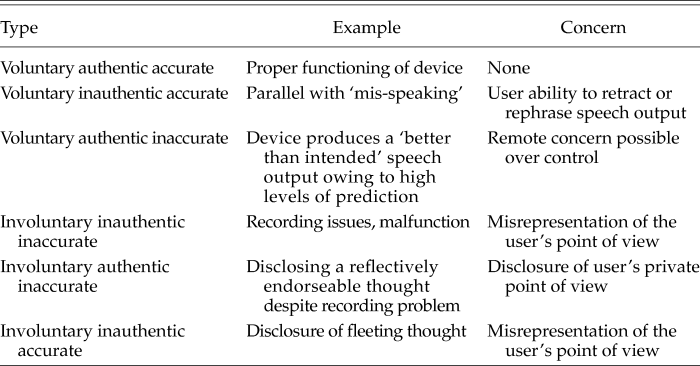
In worst-case scenarios, the user could be like a ship’s captain without a working tiller, knowing where to go, but without means to steer.Footnote 41 Or, where there is a significant contribution to the output made during processing, the user could be like a ship’s captain who has the impression he is steering and picking his course, when in fact his hands are nudged more or less often by autopilot. More coarse-grained control could (at least) allow the user to omit to say anything at all, to halt a course begun in error, or taken up unexpectedly by the system, or any other such sequence of events that diverges from that intended by the user. Some examples are summarized in Table 1.
Summary of possible types of speech and concerns.

For example, a feedback loop, ‘first listen’ approach would enable a user to evaluate and to release only those externalizations fitting their evaluative standards. The idea of a feedback loop is a promising candidate to buttress control. However, where the ambition is to create a device that can ultimately provide a communicative ability akin to unimpaired natural speech, this would represent an obstacle—introducing a delay by design would inhibit the free-flowing nature of speech expected in everyday communication. Given its value in providing assurances over the proper functioning of the device, however, this might still have value as a part of the research and training process.
In terms of technology readiness levels (TRLs)Footnote 42 we can think of the role for feedback as an early stage heuristic in the development of the technology. Its usefulness is particular to the development of the early stages of the prosthetic technology, as it is at this stage that researchers and early users must come to an understanding of the nature and scope of applications of the devices under development. This is specifically for TRLs of 1 and 2 (basic research, proof of concept), where development is underway. By TRLs 5–9 (validation in context, to final product), the device would be expected to operate more comparably with natural speech and so the feedback mechanism would represent an obstacle.
The focus upon control is not a straightforward solution in itself. For instance, a feedback mechanism between prosthetic and user might yet be considered in terms of ‘verbal overshadowing,’ wherein sincere reports made by a user are subsumed by ‘objective’ descriptions given to them by the device.Footnote 43 Ben Alderson-Day et al. note that this phenomenon came to the fore “…following evidence that verbal description of the perpetrator of a crime was associated with a 25% reduction in recognition of the perpetrator’s face.”Footnote 44 Specifically in terms of auditory perception, Timothy J. Perfect et. al write that,
Providing a verbal description [of a voice in a voice line-up] impaired subsequent identification accuracy (a verbal overshadowing effect), without reducing confidence. Thus, these data demonstrate that verbal overshadowing can occur in voice recognition, and also provide another dissociation between confidence and performance.Footnote 45
Might the speech produced by a prosthesis, once played through a speaker and heard by the prosthesis-user, risk producing a verbal overshadowing effect in that user? The superior temporal gyrus is sensitive to the phonetic features of heard speech, which could be problematic were the effects of the prosthetic’s playback to interfere with its recording activity through stimulating the neuronal activity it is supposed to be monitoring.Footnote 46 The speech system, or the users themselves, could become confused over what is being intended as speech, and heard as playback, especially in cases where medication or cognitive issues may play a role. Not least, this would seem highly salient where complicated issues about informed consent are at stake.
It is extremely difficult to say for any speaker if or how their eventual utterance relates to their initial intention and actual verbalization.Footnote 47 It might be part of everyday discourse that one is more pleased with an utterance than expected. Situating speech within its context, with careful critical attention, can be central to discerning the meaning of that speech as it relates to a speaker and a particular conversation. These are potential constraints upon the set ‘E’ from Figure 1.
Pragmatic considerations
There is a pragmatic dimension to this that requires attention: What role does an interlocutor have in assessing accuracy and inferring degree of control, and what are her interpretive duties? Departing from the first-person perspective, ’accuracy’ may in part be dependent on the listener performing her role as participant in a communicative exchange. What an audience knows of a speaker’s character, who they are, and of the context’s influence on speech activity will be seen to be important in ascribing meaning to communicatively employed language. In the novel case of neuroprosthetically mediated communication, norms of communicative action require scrutiny.
Pragmatic dimensions of speech require some focus given potential failures in control that may be relevant to judgements of accuracy, especially in terms of authenticity. How an interlocutor notices a mistake, or something amiss, in a discussion can relate to how well a speaker appears to reflect their own perspective in their verbal behaviour. The remarks made here require further elaboration, likely in another paper focussing upon informed consent. Nevertheless, this dimension deserves some exploration in the context of the discussion so far.
Pragmatics draws upon interaction with other people, which in the case of neuroprosthetic devices presupposes user control of their device. Thus, where pragmatic considerations arise in technologically-mediated speech, volition and control are central issues. Apparent divergence between what a speaker likely means and what they actually say can result from involuntariness or failure of control. In either case, this can be addressed in pragmatic terms.
Paul Grice’s pragmatic analyses are particularly relevant here, as they centre upon the relations among speakers and their utterances, and among speakers and their audiences, in order to account fully for linguistic meaning. This draws attention to the pragmatic dimension of meaning, highlighting the responsibilities upon audiences in understanding utterances.
Grice characterizes his ‘cooperative principle’ as follows:
Our talk exchanges do not normally consist of a succession of disconnected remarks, and would not be rational if they did. They are characteristically, to some degree at least, cooperative efforts… We might then formulate a rough general principle which participants will be expected (ceteris paribus) to observe, namely: Make your conversational contribution such as is required, at the stage at which it occurs, by the accepted purpose or direction of the talk exchange in which you are engaged.Footnote 48
User control can play a role in terms of ensuring speech externalized by the prosthesis is a voluntary, authentic reflection of the user’s covert speech. Grice’s principle serves to highlight the remaining interpretive task of the listener. Where clarity of meaning is at stake, there is an onus upon the listener to actively seek to recognize that meaning. Therefore, in addition to technical solutions, ‘social’ measures ought also to be developed in order to prepare the context for speech realized via neuroprosthetic devices.
Careful phrasing of questions put to the users of prosthetics; the construction of multiple phrasings in order to verify the apparent contents of speech produced; a suitable degree of interpretive charity with which to contextualize potential misunderstandings;Footnote 49 as well as other such measures on behalf of the audience can serve well to mitigate issues here. Primarily, the recognition of this kind of communication as potentially different from that routinely encountered, and so deserving of care in reception, is what counts.
Discussion
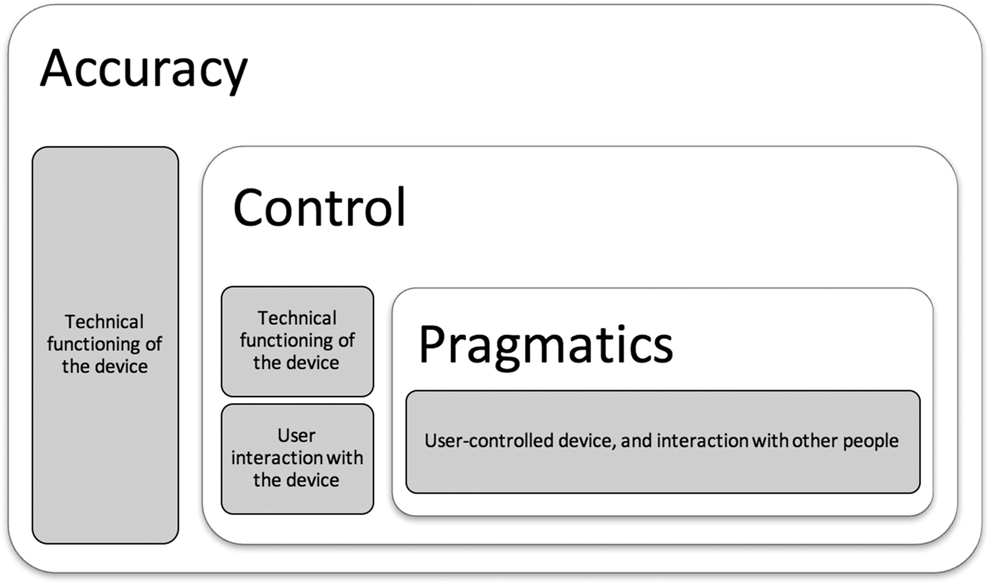
The dimensions of accuracy, control, and pragmatics are clearly related, but distinguishable. The connections among different dimensions of ‘accuracy’, the multifaceted nature of ‘control’, and general pragmatic conditions of communicative action are each of importance in trying to understand ascription of responsibility in uses of neuroprostheses. We can sketch these interrelations in the following diagram:
Here we see that generally technical matters are associated with accuracy, but that these are implicated in the area of user control where the user’s communicative intentions are at stake—semantic accuracy. Control is implicated in the wider issues surrounding pragmatics as a user’s practice meets interlocutors. Pragmatic concerns presuppose control as interlocutors must assume a degree of intentional (voluntary and authentic) expression if they are to be able to interpret one another. Control is required in terms of ‘steering’ the device, in order to ensure adequate operation beyond its mere triggering. This operation would include dealing with errors such as mismatches between the content of covert speech and the externalized synthesized outcome of the device’s operation. This all relies on a fundamental level of control in which covert speech per se acts as a trigger to ‘turn on’ the device.
Whilst the accuracy and pragmatic dimensions of prosthetic-aided speech are of importance, and we raised themes pertinent to their analysis, we focussed on how these arise specifically in relation to control of the device. This prompted exploration of the voluntariness and authenticity of the speech that a neuroprosthetic speech device might afford the user. These relations are illustrated in Figure 2
Depiction of how accuracy, control, and pragmatics relate in the case of a speech neuroprosthesis.

Conclusions
How a neuroprosthetic speech device processes covert speech signals intended to be externalized, as opposed to those that are not, may well be a question for neuroscientists and engineers; what degree of control is sufficient, and who is responsible for unintended speech, are principally ethical questions. We have framed this latter discussion in terms of accuracy and control.
User control is of central importance in the development of neuroprosthetic devices for facilitating communication. Such control will help to address possible issues surrounding the accuracy and voluntariness of speech mediated via the technology. This is essential where users of speech neuroprostheses are to be thought of as responsible for their utterances. This is also essential for those utterances to be considered as authentically the prosthesis-user’s own, as could be indicated by reflective endorsement.
At early stages of technology development (TRLS 1 and 2 especially) feedback, by way of previews of the speech to be externalized, ought to be exposed to the user before more general externalization. This is to establish the device as something responsive to user input, to their communicative intent, and responsive to their values and desires. Activation, steering, and deactivation of the device ought to be considered in order to acknowledge differences among types of covert speech in order to ensure that what is not meant to be externalized remains unverbalized. Pragmatic dimensions of linguistic meaning ought to be uppermost in the minds of audiences in communication with those using technologically-mediated speech. Pragmatic considerations ought to also be borne in mind when acquiring informed consent, discussing end-of-life decision making, and so on.
Neuroprosthetic devices for language production ought to be considered in terms of tools whose careful use can enable communicative practices. In positioning such devices in this way, the necessity of user-control is emphasized. This will help to keep expectations about the device realistic. This permits the conception of degrees of control, hence degrees of responsibility for communicative offerings.Footnote 50 These are keyed to control of the device by the user, and to dimensions of responsiveness to users’ communicative intent.