Introduction
The past few decades have seen an increasing amount of research investigating effects of bilingualism on cognitive functioning, particularly the efficiency of executive control. First, Bialystok and her research group reported evidence of positive effects on executive control functions for bilingual children (c.f. Bialystok, Reference Bialystok1999); in later studies, they found similar advantages for bilingual adults (Bialystok, Craik & Ryan, Reference Bialystok, Craik and Ryan2006). Moreover, it has been found that bilingualism modulates the age-related decline of executive control in older adults (Bialystok, Craik, Klein & Viswanathan, Reference Bialystok, Craik, Klein and Viswanathan2004), and has been claimed to delay the onset of symptoms of Alzheimer's Disease in bilingual elderly (Bialystok, Craik & Freedman, Reference Bialystok, Craik and Freedman2007). Bialystok's studies were followed by a growing body of research into effects of bilingualism, which either expanded the evidence for a bilingual advantage (c.f. Costa, Hernández & Sebastián-Gallés, Reference Costa, Hernández and Sebastián-Gallés2008; Colzato, Bajo, van den Wildenberg, Paolieri, Nieuwenhuis, La Heij & Hommel, Reference Colzato, Bajo, van den Wildenberg, Paolieri, Nieuwenhuis, La Heij and Hommel2008), or showed no differences between monolinguals and bilinguals (e.g., Morton & Harper, Reference Morton and Harper2007; Paap & Greenberg, Reference Paap and Greenberg2013). The question whether a bilingual advantage in general cognitive functioning genuinely exists has not been conclusively answered yet. The main issues concern the types of bilingualism a potential bilingual advantage would apply to, and the mechanism(s) behind it. Because of the lack of conclusive evidence so far, we conducted an experiment into the impact of bilingualism on executive control by comparing performance of monolinguals and bilinguals on a task-switching test. With a view to potential interactions between bilingualism and aging, our focus is on middle-aged and elderly participants. First, we briefly discuss evidence and counter-evidence for bilingual effects on the efficiency of executive control, particularly in elderly speakers. The aim of this section is twofold: it shows how previous studies led to the choice of our task, and it summarizes the main factors that may affect the impact of bilingualism on executive control, so that we can control for these factors in our study.
Bilingualism and general cognitive performance
The first publications reporting a bilingual advantage in executive control mostly used tasks tapping into inhibition (see Miyake, Friedman, Emerson, Witzki, Howerter & Wager Reference Miyake, Friedman, Emerson, Witzki, Howerter and Wager2000, for their definition of three executive functions: set shifting, inhibition and updating of working memory). However, as shown in overviews by Costa, Hernández, Costa-Faidella and Sebastián-Gallés (Reference Costa, Hernández, Costa-Faidella and Sebastián-Gallés2009) and Hilchey and Klein (Reference Hilchey and Klein2011), a bilingual advantage in inhibition (alternatively referred to as attentional control or conflict resolution) was rare; bilinguals more often outperformed monolinguals on both incongruent and congruent trials. This effect on overall reaction times was attributed to the monitoring processes involved in the implementation of conflict resolution. Consequently, a bilingual advantage would be most likely to be found in an interaction of different aspects of executive control (c.f. Bialystok, Craik & Luk, Reference Bialystok, Craik and Luk2012), especially in tasks resembling bilingual language use. Good examples of such tasks would be task-switching tests (but for a different view, see e.g., Paap & Greenberg, Reference Paap and Greenberg2013).
Prior and MacWhinney (Reference Prior and MacWhinney2010) conducted an experiment involving bilingual and monolingual college students, based on a cued task-switching paradigm. In the mixed blocks of this experiment a cue indicates which criterion (color or shape) participants have to decide on. Switching costs are defined as the difference in response times (RTs) between switch and non-switch trials, and mixing costs as the difference in RTs between single blocks, and repeat trials in mixed blocks. The bilinguals showed reduced switching costs, which the authors attributed to the improvement of two control processes: the (re)activation of the rule applying to that particular trial and the reconfiguration of the stimulus-response mappings belonging to that rule. The authors concluded that bilingualism leads to increased flexibility in shifting between mental sets and to increased resistance to proactive interference, a subtype of inhibitory control, because this effect has been claimed to be one of the mechanisms underlying switch costs (c.f. Philipp, Kalinich, Koch & Schubotz, Reference Philipp, Kalinich, Koch and Schubotz2008). Thus, bilingualism would affect at least two of the (interacting) executive control components defined by Miyake et al. (Reference Miyake, Friedman, Emerson, Witzki, Howerter and Wager2000).
However, some studies based on task-switching paradigms contradict a bilingual advantage. Hernández, Martin, Barceló & Costa (Reference Hernández, Martin, Barceló and Costa2013) do not find group differences in switching costs, but the bilinguals were faster in overall reaction times. Moradzadeh, Blumenthal & Wiseheart (Reference Moradzadeh, Blumenthal and Wiseheart2014), Mor, Yitzhaki-Amsalem and Prior (Reference Mor, Yitzhaki-Amsalem and Prior2014), Paap and Sawi (Reference Paap and Sawi2014), Paap, Johnson and Sawi (Reference Paap, Johnson and Sawi2014), and Paap, Johnson, Wagner and Eusebio (under review) all report null-results. Paap and Greenberg (Reference Paap and Greenberg2013) compared bilinguals and monolinguals on a cued task-switching test and 14 other indicators of executive control and only found a monolingual advantage in one measure. In view of the lack of cross-task correlations, the authors proposed that effects in executive control tasks are not proper indicators of domain-general abilities, and that studies should be based on at least two experiments tapping into the same components of executive functioning. Notably, all these studies involved young adults.
Because of the contradictory results in task-switching experiments, some studies investigated effects of linguistic and extra-linguistic factors. Prior and Gollan (Reference Prior and Gollan2011) showed a relation between a bilingual benefit in task switching and the amount of language switching, but found no effect in a second experiment. This finding was confirmed by Verreyt, Woumans.,Vandelanotte, Szmalec & Duyck (in press), but their assessment of the amount of language switching, by means of self-report, is questionable. Paap et al.(under review) also analyzed switching and mixing-costs by frequency of switching but found no effect. The amount of language switching can also be related to the amount of balance in the frequency of use of languages. Houtzager, Lowie and de Bot (Reference Houtzager, Lowie, De Bot, Filipović and Pütz2014) used a questionnaire to determine their bilingual participants’ degree of language balance across the lifespan. This measure correlated negatively with the size of the switch effect, suggesting that the more balanced the bilingual is, the lower are the costs incurred by switching between tasks. The participants in this study (the same as in the current paper) were bilingual in Dutch and Frisian, which are typologically closely related languages. The degree of similarity between languages might also affect task results: keeping closely-related languages apart might be more difficult than keeping languages apart that are more different (see also Abutalebi, Canini, Della Rosa, Green & Weekes.in press, but see Barac and Bialystok, Reference Barac and Bialystok2012, who found no effect for the degree of language similarity). A few studies (e.g., Costa et al., Reference Colzato, Bajo, van den Wildenberg, Paolieri, Nieuwenhuis, La Heij and Hommel2008 and Reference Costa, Hernández, Costa-Faidella and Sebastián-Gallés2009; Hernández, Costa, Fuentes, Vivas & Sebastián-Gallés, Reference Hernández, Costa, Fuentes, Vivas and Sebastián-Gallés2010 and Reference Hernández, Martin, Barceló and Costa2013) control for the degree of cognateness of languages, but most studies do not (e.g., Bialystok et al., Reference Bialystok, Craik, Klein and Viswanathan2004; Prior & MacWhinney, Reference Prior and MacWhinney2010). Paap, Darrow, Dalibar and Johnson (Reference Paap, Darrow, Dalibar and Johnson2014) looked at effects of ‘script’ similarity on executive functioning but found null-results on all tasks, including a color/shape task-switching test. Lastly, Valian (Reference Valian2015) proposed that bilingualism is one of many challenging factors that may affect executive control. Consequently, a failure to find bilingual effects could be due to an abundance of other beneficial experiences, which make the benefits of bilingualism invisible. In order to rule out that group differences in executive control are wrongly attributed to bilingualism, Hilchey and Klein (Reference Hilchey and Klein2011), amongst others, emphasize the importance of matching language groups on demographic factors.
Bilingualism and aging
We could assume that a potential bilingual advantage would be most easily detectable in older adults, since they usually show a decline in executive control (see e.g., Craik & Salthouse, Reference Craik and Salthouse2008), or alternatively, because less exposure to stimulating cognitive activities would make effects of bilingualism better visible (Valian, Reference Valian2015). Still, for adults above age 65, evidence for bilingual advantages in executive control is scarce, possibly because experimental research involving this age-group is complex. Bialystok et al. (Reference Bialystok, Craik, Klein and Viswanathan2004) found that bilingualism significantly attenuated the age-related increase in the size of the Simon effect. However, the effects that they reported were unusually large and have not been replicated. Bialystok, Craik and Luk (Reference Bialystok, Craik and Luk2008) report a reduction for bilinguals of the age-related increase of the Simon-effect in a Simon arrows-task and a bilingual advantage in the Stroop task, but found no effects in a go/no-go and in another version of the Simon task. Bialystok, Craik and Ryan (Reference Bialystok, Craik and Ryan2006) report a bilingual advantage, increasing with age, in all conditions of the anti-saccade task except the control condition. Finally, in two alternating-runs task-switching experiments Gold, Kim, Johnson, Kryscio & Smith (Reference Gold, Kim, Johnson, Kryscio and Smith2013) found that older, but not younger, bilinguals incurred lower switch-costs than their monolinguals counterparts, suggesting an association between bilingualism and an age-related decline in executive control. However, neither Gathercole, Thomas, Kennedy, Prys, Young, Viñas Guasch & Jones (Reference Gathercole, Thomas, Kennedy, Prys, Young, Viñas Guasch and Jones2014), using a Simon-task and a card-sorting test, nor Kousaie and Philips (Reference Kousaie and Phillips2012), using a Stroop interference test, found differences between elderly monolinguals and bilinguals, which makes evidence for a bilingual cognitive advantage in older adults and for interactions between aging and bilingualism inconclusive as well.
Aim and design of this study
In this study we opted for a cued task-switching paradigm because of its possible resemblance to bilingual language use. We recruited bilingual participants who report frequent use and switching between their languages. Since the cognateness of the languages may affect results, our study focuses on bilinguals who are fluent in the same, closely-related language-pairs. Because bilingual effects seem more likely to occur in older adults, our study focuses on elderly speakers. With these considerations in mind, we compare performance of middle-aged and elderly early bilinguals and functional monolinguals on a cued task-switching test. In the same study, a verbal fluency test was administered, which is fully reported on in a separate paper (Timmermeister, Houtzager & Lowie, submitted).
Our research questions are, first, whether there are age-related differences, or differences between monolinguals and bilinguals, in the efficiency of executive control, reflected in switching and mixing costs (c.f. Prior & MacWhinney, Reference Prior and MacWhinney2010). Second, we investigate whether there are age-related differences, or differences between monolinguals and bilinguals, in overall response times. Lastly, we investigate whether there are interactions between bilingualism and aging, either in switching and mixing costs or in overall response times. Because we expect an age-related decline in Working Memory span (Chen & Naveh-Benjamin, Reference Chen and Naveh-Benjamin2012; Hoyer & Verhaeghen, Reference Hoyer, Verhaeghen, Birren and Schaie2006), which could interact with the switch and mix-effect, we also conduct a Working Memory Test.
Methodology
Participants
Our experiment involved a group of 50 early bilinguals and a control group of 50 functional monolinguals. The participants of each language group were equally divided over two age groups, i.e., a middle-aged group (35–56 years old) and an elderly group (65–85). Bilinguals were fluent in Dutch and Frisian, had acquired these languages before age six and used them on a daily basis ever since. Frisian is a minority language spoken in Friesland, a northern province of the Netherlands, and is highly related to Dutch. Proficiency in additional languages was logged, but not taken into account as an additional variable.
The functionally monolingual group consisted of 48 speakers of German, living in the northwestern part of Germany, and 2 speakers of English, living in the UK. Participants of this group filled out a self-assessment report with yes/no questions on their knowledge of languages they were familiar with. We chose native speakers of German instead of Dutch as a control group because in Germany exposure to foreign languages is much less common than in the Netherlands, which makes it possible to find participants with no proficiency in foreign languages, regardless of their level of education. Because finding middle-aged participants fitting this criterion proved difficult, we included two monolingual speakers of English. As German, Dutch and Frisian are closely-related languages, German monolinguals seemed an appropriate control group for this study. Besides, because all participants were from roughly the same geographic area (the North-Eastern part of the Netherlands and the North-Western part of Germany), culturally the groups were also highly similar.
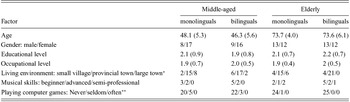
In accordance with recommendations in earlier studies (cf. Hilchey & Klein, Reference Hilchey and Klein2011), the language groups were closely matched on demographic factors. Our bilinguals were neither bicultural nor immigrants. To match the groups on socioeconomic status, we defined the factors occupational level and education. We operationalized occupational level on a three-point scale, to give an indication of participants’ occupational prestige and concomitant income. Manual or unqualified jobs were rated as 1, jobs requiring advanced vocational training as 2, and academic professions, e.g., doctor, lawyer, or teacher in higher education as 3. Since education in the Netherlands and Germany is offered at different levels, we defined educational level as a factor with a three-point scale. The divisions for educational levels in Germany and the Netherlands were matched by German educational professionals, living and working in the Netherlands. All elderly participants lived independently, prepared their own meals and led active social lives. Regarding living environment, most participants lived in the more rural parts of the north of the Netherlands or Germany, but we also controlled for this factor by means of a distinction between living in a small village, a large village, a provincial town or a large town. All details on demographic factors are presented in Table 1.
Demographic details for the middle-aged and elderly participants, monolinguals and bilinguals. Decimals indicate averages, integers represent counts. For more detailed information on the scales, please refer to the main text.

*Small village < 5000 inhabitants; large village/provincial town > 5000 inhabitants; large town > 180.00 inhabitants
**seldom: no more than 1 hour per day
Procedure, general
All participants were tested in their own homes, during a single experimental session lasting ca. 120 minutes. The early bilinguals were tested by the first author of this paper, and the monolinguals by this same experimenter or by a German research assistant. To ensure that the testing conditions were similar, the procedure was consistently carried out according to a written-out script. First, in a test-demo, participants were given instructions for the computerized version of the task-switching test. Next, they performed the first part of this task-switching test, to be followed by a verbal fluency test, and then the second part of the task-switching test. The verbal fluency test comprised 3 conditions: phonological fluency, requiring participants to name words starting with the same letter; semantic fluency, where words had to be named from one specific semantic category; and its subcomponent category fluency, where participants had to switch between two semantic categories. Then, participants carried out the forward and backward versions of the Corsi Blocks test (a spatial working-memory test developed by Corsi (Reference Corsi1972), in which participants repeat a sequence of blocks, tapped by the examiner, in the correct sequential order). Finally, the Frisians filled out a contextualized version of the language background questionnaire by Gullberg and Indefrey (Reference Gullberg and Indefrey2003), which assesses their daily language use pattern, their self-rated proficiency and the age at which they acquired their L2 and other languages they were familiar with. The monolinguals filled out a questionnaire containing a yes-no self-assessment report about their knowledge of languages they were familiar with. Both questionnaires also contained questions on personal and educational background and on factors that might affect cognitive functioning.
Task-switching test
The task-switching test was based on the experiment reported by Prior and MacWhinney (Reference Prior and MacWhinney2010). Participants were instructed to react to the appearance of a colored target in response to a cue on the computer screen, by pressing one of four buttons on a Serial Response Box. Targets were red or green squares or triangles, and cues either a color wheel or a black undefinable shape. The test consisted of three blocks: a color block, a shape block (the single blocks), and a mixed block. During the color task, participants responded to the appearance of a red target with the right index finger, and to that of a green target with the right middle finger. During the shape task, they responded to the appearance of a triangle with the left index finger, and to that of a square with the left middle finger. During mixed-task blocks, the conditions from the single-task blocks were combined and the assignment of task to hand and finger was preserved. The buttons of the response box were labeled with stickers, with similar stickers attached below the screen, so that participants would not have to move their gaze from the screen to the response box to remember the instructions.
All trials started with the presentation of a fixation cross for 350 ms, followed by a 150 ms blank screen. Then one of the two task cues appeared, followed after 650 ms by the target. Cue and target remained on the screen until the participant's response. During practice trials, participants received written feedback; during experimental trials no feedback was given. After the participant's response a blank screen was presented during 850 ms, followed by the start of the next trial.
The first part of the task-switching experiment comprised two single-task blocks (first color, then shape), each including 8 practice trials and 24 experimental trials, and one mixed-task block including 8 mixed-task practice trials, followed by 48 experimental trials. Participants could only start with experimental trials when at least 80% of their responses on the practice trials were correct. Furthermore, 2 dummy trials were added before each group of experimental trials, which were not included in the analysis. In the mixed block, half of the experimental trials were switch trials (i.e., participants had to switch from indicating the color, to indicating the shape of the target, or vice versa) and half of them non-switch or repetition trials, ordered in a semi-random design with a maximum of 3 consecutive trials of the same type. The second part of the test comprised the same number of trials as the first part, but started with a mixed-task block, to be followed by the single-task blocks, presented in the opposite order from the first part. Altogether, the experimental blocks in this sandwich design contained 48 switch trials, 48 repetition trials, and 96 single-task trials.
Results
Working memory performance
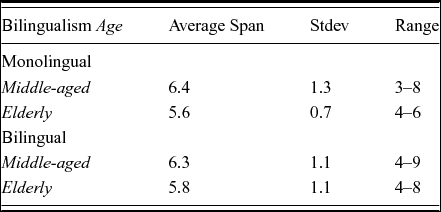
In Table 2 we report the tapping scores for the forward condition of the Corsi Blocks working-memory test. This task condition was least prone to strategies invented by the participants and thus provided the most reliable indication of their working-memory span.
Summary of the working-memory scores (Corsi block forward span) for the four groups of speakers.

The results show that, descriptively, the middle-aged groups show higher working-memory scores than the elderly, but that this effect is not modulated by bilingualism. While the bilinguals show slightly higher scores than the monolinguals, the difference is small. These results were tested in an ANOVA, with Bilingualism (Monolingual vs. Bilingual) and Age Group (Middle-aged vs. Elderly) as between-subject factors: Forward Span - Bilingualism: F(1,96) < 1, η2 p = 0.0; Age Group: F(1,96) = 9.143, p = .003, η2 p = .09; Bilingualism * Age Group: F(1,96) < 1, η2 p = 0.0. Total forward span - all Fs < 1.
The results confirm our observations, showing a reliable effect of age on working memory, but none of Bilingualism.
Reaction time analyses
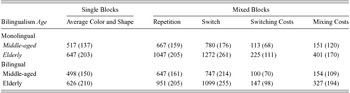
After visual inspection of the response time distributions, response times below 300 and above 3000 ms were removed from the dataset (0.4% of observations in the switching costs analysis and 1.2% in the mixing costs analysis). Table 3 provides a summary of the response time per condition and age group.
Average response times and standard deviations (in parentheses), and switching and mixing costs, in the task-switching test for the four groups of speakers.

Switching costs
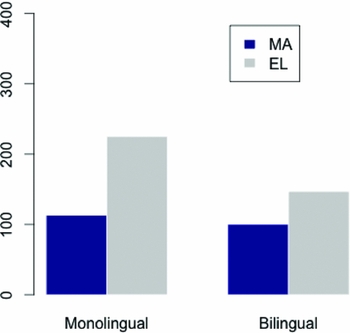
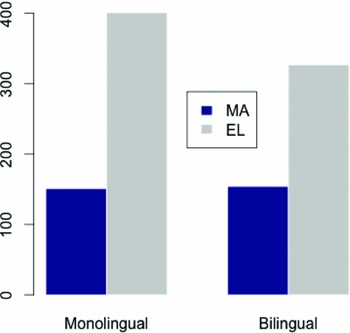
Figure 1 shows the average switching costs per speaker group (monolingual or bilingual) and age group (middle-aged or elderly). The graph shows that – on average – only the elderly speakers profit from being bilingual: their switching costs are considerably smaller than those of the monolingual controls. In contrast, the middle-aged groups show only a small difference in switching costs. The averages thus suggest an interaction of the factors Bilingualism and Age group. We performed a between-subjects ANOVA on the switching costs, with Subject as random factor, to confirm this observation. The results show a significant effect of Bilingualism (F(1,96) = 6.56, p = .012, η2 p = .06), a significant effect of age group (F(1,96) = 20.13, p < .001, η2 p = .17), but only a marginally significant interaction (F(1,96) = 3.36, p = .07, η2 p = .03). Taken together, these results are clearly at odds with the pattern that we see in the averages, which clearly suggest that the main effect of bilingualism that we find in the ANOVA is in fact driven by the group of elderly subjects. What are possible reasons for this discrepancy? We considered two factors that might affect the actual data pattern, but that are not mirrored appropriately in our 2x2 ANOVA. The first and most important factor is the arbitrary nature of the age groups. While a division in middle-aged and elderly groups, and the group boundaries that we chose, make intuitive sense, it is in fact unclear whether these groups reflect the effect of age best. In fact, there is no independent theoretical reason for the artificial dichotomy. In contrast, avoiding such a dichotomy follows current recommendations for the analysis of psycholinguistic data (Baayen, Reference Baayen2004). Second, the ANOVA does not take into account possible confounding effects of individual differences in working memory capacity. Based on these considerations, we decided to re-analyze the data with a more fine-grained method that allows us to explain both the variance that is due to age and the variance due to working memory in much more detail. Additionally, to counteract possible effects of a positive skew of the data, we performed all these analyses on the log-transformed response times.
Switching costs in milliseconds, by age group and language group.

We fitted a Linear Mixed Effect Model to the data. The fixed effects that were included in the model were Bilingualism (two levels, monolingual vs. bilingual), Age (continuous, centered, with an average of sixty years), Trial Type (within-subject, two levels, repetition trials vs. switch trials), Memory Span (Corsi Forward Span, continuous, centered) as well as the full set of interactions. By including age as a continuous rather than a categorical factor, we could include the full range of age-related variance in our model. As random effects, by-subject random intercepts were included, with by-subject random slopes for the factor Trial Type. For reporting purposes, we here convert the estimates back to the RT scale (for exact, log-scale estimates, standard errors and t-values, please refer to the Appendix 1, Table A.1). Here, we present a summary of the results, both in terms of the original parameters and in terms of the derived non-log response time effects, as those are easier to interpret. Following Baayen, Davidson and Bates (Reference Baayen, Davidson and Bates2008, p. 398), estimates are considered significant if the absolute t-value exceeds two. The predicted response times for a specific condition can be calculated as the sum of the unconditional expected mean and all relevant (combinations of) factor levels. Here, the unconditional expected mean 742 ms represents the condition in which a monolingual sixty-year old participant with an average Corsi Forward span responds to a repetition trial.
According to the fitted model, the response times in the switch trials are significantly longer than in the repetition trials (switching costs, 167 ms, β = 0.2, SE = 0.01, t = 15.6) and further increase with Age (9 ms, β =0.01, SE = 0.002, t = 5.16). While there is no reliable overall speed-up related to the factors Bilingualism or Memory Span, we find that the response times in the switch trials are further modulated by both Bilingualism and Age: bilinguals are slowed down by the switching condition significantly less so than their monolingual counterparts (2 ms per year of age, β = -0.003, SE = 0.001, t = -2.16). The effects of Memory Span are largely non-significant, with one exception: in the bilingual speakers, the effect of age is further modulated by Memory Span (6 ms, β = 0.01, SE = 0.003, t = 2.24). A formal model comparison of the present model with a model that does not include an effect of Memory span shows that the present model is superior (χ² = 15.975, p = .0427).
Taken together, we replicate Prior and MacWhinney's (Reference Prior and MacWhinney2010) finding of smaller switching costs in bilinguals (167 - 35= 132 ms). However, this effect is modulated by age: while the effect size for subjects at the younger end of our spectrum is relatively small, we find that the benefits of bilingualism mostly concern a reduction of the slow-down related to age (9 + 3 = 12 ms per year for the monolinguals vs. 9 + 3 - 2 = 10 ms per year for the bilinguals).
Mixing costs
Figure 2 shows the average mixing costs per speaker group (monolingual or bilingual) and age group (middle-aged or elderly). The graph shows that – on average – only the elderly speakers seem to profit from being bilingual: their mixing costs are somewhat smaller than those of the monolingual controls. In contrast, the middle-aged groups show no difference in mixing costs. In addition, the averages suggest a strong effect of age group, as the average mixing costs for the elderly groups of speakers are more than twice as high as those for the middle-aged speakers. The averages thus suggest a main effect of age group and possible an interaction of the factors Bilingualism and Age group. In contrast to the averages of the switching costs, there is no reason to assume a main effect of Bilingualism, as any effects of Bilingualism should be driven by the group of elderly speakers only. We performed a between-subjects ANOVA on the mixing costs, with Subject as random factor, to confirm our observations. The results confirm the lack of a significant effect of Bilingualism (F(1,96) = 1.40, p = .24, η2 p = .01), a significant effect of age group (F(1,96) = 48.28, p < .001, η2 p = .33), and the lack of a significant interaction (F(1,96) = 1.60, p = .21, η2 p = .02). Taken together, these results match the pattern that we see in the averages, with the only reliable effect being the one of age group.
Mixing costs in milliseconds, by age group and language group.

For the sake of completeness, we decided to fit a Linear Mixed Effect Model to these data as well. The analyses confirm the results of the ANOVA. While the factor Working Memory makes a significant contribution to the model, it does not surface as a significant effect by itself. For a detailed description of the results of the LME, please refer to Appendix 2.
General discussion
The main objective of this study was to answer the question whether lifelong bilingualism can be associated with enhanced executive control, particularly mental flexibility. We therefore compared performance of bilinguals and monolinguals in a cued task-switching test and a spatial working-memory test. In contrast to previous studies, our bilinguals were fluent in the same, closely-related language pairs. We also investigated whether bilingualism can be associated with a modulation of an age-related decline in executive control, by focusing on middle-aged and elderly participants. Following a study by Prior and MacWhinney (Reference Prior and MacWhinney2010), we focused on the switch effect (the difference between repetition and switch trials) and the mix effect (the difference between single block trials and repetition trials in mixed blocks). Additionally, we looked at differences between language-groups in overall response times. Finally, our study tested age-related effects. As expected (c.f. Chen & Naveh-Benjamin, Reference Chen and Naveh-Benjamin2012; Hoyer & Verhaeghen, Reference Hoyer, Verhaeghen, Birren and Schaie2006), we found an age-related decline in Working Memory span. To make sure that any age-related effects were not in fact driven by this factor, we included Working Memory span as a separate factor in the analyses of our results.
Our results show a small, but significant positive age-related effect on switching costs, which is in line with the results of previous studies (Kray, Li and Lindenberger, Reference Kray, Li and Lindenberger2002). The bilinguals also incurred significantly lower switching costs than the monolinguals, which confirms the results reported by Prior and MacWhinney. However, the effect we found is most pronounced in elderly speakers and hardly visible for middle-aged participants. This contradicts the findings by Prior and MacWhinney, but is in line with the study by Gold et al. (Reference Gold, Kim, Johnson, Kryscio and Smith2013). Thus, the most important effect we found is that the bilinguals were less affected by an age-related increase in switching costs than the monolinguals. This finding is in line with Bialystok et al. (Reference Bialystok, Craik and Ryan2006), Bialystok et al. (Reference Bialystok, Craik and Luk2008) and Gold et al. (Reference Gold, Kim, Johnson, Kryscio and Smith2013), who report a modulation in bilinguals of the age-related decline of executive control.
For both language-groups, the mixing costs significantly increased with age, too. This finding is consistent with some earlier findings (Kray & Lindenberger, Reference Kray and Lindenberger2000; Reimers & Maylor, Reference Reimers and Maylor2005), but contradicts the study by Kray, Li and Lindenberger (Reference Kray, Li and Lindenberger2002); however, this study involved different age-groups. We found no differences between the language-groups in the size of the mix effect, which confirms the results reported by Prior and MacWhinney (Reference Prior and MacWhinney2010). There was no significant interaction between the factors aging and bilingualism either. Probably, the high variability within the elderly groups prevented this interaction from becoming significant.
Finally, we found an age-related increase in overall response times, indicating slower processing speed in the elderly. Again, this finding confirms earlier findings (c.f. Cerella & Hale, Reference Cerella and Hale1994; Salthouse, Reference Salthouse2000; Eckert, Reference Eckert2011). However, we did not find an association between overall response times and bilingualism, nor did bilingualism modulate the age-related increase in response times.
Since our results show an advantage for the bilingual group, it seems logical to propose that lifelong bilingualism has resulted in an enhancement of a number of interacting executive control processes. More specifically, the lower switching costs for the bilinguals suggest that bilingualism has boosted their ability to switch between mental sets (c.f. Miyake et al., Reference Miyake, Friedman, Emerson, Witzki, Howerter and Wager2000). Additionally, bilingualism may have resulted in increased resistance to proactive interference, a mechanism underlying switching costs (c.f. Philipp, et al., Reference Philipp, Kalinich, Koch and Schubotz2008). On this view, the advantage for the bilinguals suggests that they partly depend on domain-general executive control mechanisms to achieve language control (c.f. Gollan, Sandoval & Salmon, Reference Gollan, Sandoval and Salmon2011; Costa, Miozzo & Caramazza, Reference Costa, Miozzo and Caramazza1999). The fact that the language groups did not differ in the size of the mixing costs suggests that there is no specific bilingual advantage in the resistance to distractor interference (Friedman & Miyake, Reference Friedman and Miyake2004). Finally, the bilingual advantage that we found in switching costs may be related to the fact that our bilinguals were fluent in highly cognate languages. Just like the results of other studies on the bilingual advantage, it is therefore not a priori generalizable to other types of bilingualism, but its contribution to the research field is that it can be added to similar evidence in studies involving other language pairs.
However, as we observed above, the small difference in switching costs between middle-aged monolinguals and bilinguals contradicts the study by Prior and MacWhinney (Reference Prior and MacWhinney2010), who found an advantage for young bilingual adults. One possible explanation for this inconsistency relates to the configuration of our task. Several studies (c.f. Meiran, Reference Meiran2000; Rogers & Monsell, Reference Rogers and Monsell1995) show a strong negative correlation between switching costs and the time interval between the presentation of the cue and the target, and also that between the response on a trial and the start of the subsequent trial (Kiesel & Hoffmann, Reference Kiesel and Hoffmann2004). Because our study also looked at age-related effects, the time intervals were kept constant, making them relatively long for middle-aged participants.
Consequently, for this group the test may not have been optimally fine-tuned to register potential differences between language-groups. Still, the middle-aged participants also incurred significant switching costs, which makes this explanation less likely. We therefore acknowledge the possibility that the advantage for the bilinguals may not have been caused by their language experience (c.f. Hilchey & Klein, Reference Hilchey and Klein2011; Paap, Reference Paap2014; Valian, Reference Valian2015). The bilinguals in our study were not immigrants, and our participants were matched on demographic variables (see Table 1). Still, it cannot be ruled out that our results are confounded by factors that we have not taken into account, related for instance to events or behaviors that occurred earlier in the lifespan.
As we argued in the background section, studies on the bilingual advantage should ideally comprise two tasks reflecting the same components of executive functioning (c.f. Paap & Greenberg, Reference Paap and Greenberg2013). Our experiment did not entail two such tests, but an analysis within the bilingual group (see Houtzager et al., Reference Houtzager, Lowie, De Bot, Filipović and Pütz2014) reported significant correlations between language balance, the switch effect and the category switching condition of the verbal fluency testFootnote 1 . We propose that these correlations demonstrate cross-task validity, and that the effect of the factor language balance in both tasks confirms evidence for a bilingual effect. As this effect was found within one population, demographic factors cannot have confounded the results.
Finally, as stated in the method section, we limited the working-memory load imposed by the test by using additional stickers slightly below the screen. The finding that effects and interactions of age, trial type and bilingualism are still found, even with the factor working memory included in the model, shows that the process of switching between tasks is not merely a function of working memory, but also taps into the separate function of set-shifting. Moreover, the fact that inclusion of the factor working memory improves the model and explains extra variance suggests that it does not simply reflect an age-related effect, but taps into the separate executive function of “updating information”, separable from but correlated with the construct of “switching between mental sets” (c.f. Miyake et al., Reference Miyake, Friedman, Emerson, Witzki, Howerter and Wager2000).
Conclusion
In a cued task-switching test, older bilinguals incurred lower switching costs than monolinguals. Although this bilingual advantage may be attributable to confounding factors, this effect may also be due to an enhancement by bilingualism of the efficiency of executive control, since the language-groups were matched carefully on demographic variables. Moreover, significant correlations between the factor language balance, the switch effect and the category switching condition of the verbal fluency test within the same bilingual group (reported in Houtzager et al., Reference Houtzager, Lowie, De Bot, Filipović and Pütz2014), support evidence for a bilingual effect. The fact that this study found an advantage for bilinguals may be attributable to the specific task, and to the fact that the bilinguals were fluent in closely-related languages. We also found an age-related increase in the switch and the mix effect, and a modulation of the age-related increase of the switch effect for the bilinguals. The latter finding suggests an association between bilingualism and a modulation of the age-related decrease in the efficiency of executive control, particularly switching between mental sets, and improved resistance to proactive interference.
Our study raises a number of questions for further research. First, our task-switching implementation does not allow us to disentangle the effects of two cognitive processes embedded in the switch costs, namely reactivation vs. reconfiguration of stimulus-response mappings. Barceló (Reference Barceló2003) and Hernández et al. (Reference Hernández, Martin, Barceló and Costa2013) employed a different task-switching test that distinguishes between these effects. This particular task implementation might reveal whether a bilingual advantage in switching costs reflects not only more efficient S-R reconfiguration processes, but also better S-R reactivation, which is more clearly linked to inhibitory processes, particularly proactive interference.
Secondly, in some previous studies, bilinguals outperformed the monolingual peers only initially, with the monolinguals ‘catching up’ after a number of trials (e.g., Bialystok et al., Reference Bialystok, Craik, Klein and Viswanathan2004). This phenomenon did not occur in our experiment. A study focusing on time-course analyses of task-switching data could throw light on the development of monolingual and bilingual performance over time. Lastly, all bilinguals in this study acquired proficiency in their languages before age six. We are currently conducting a study involving bilinguals who acquired their second language after puberty, as this might provide insight into the mechanisms behind potential bilingual effects. Yet, while it is true that many issues in the debate about a bilingual cognitive advantage still have to be solved, we propose that this paper provides compelling evidence for an advantage in task-switching for elderly bilinguals over their monolingual counterparts, which could well be attributable to the lifelong experience of speaking more than one language.
Supplementary Material
For supplementary material accompanying this paper, visit http://dx.doi.org/10.1017/S1366728915000498