




No CrossRef data available.
Economic Insecurity and Social Policy Expansion: Evidence from Interwar Europe
Published online by Cambridge University Press: 01 October 2004
Abstract
What is the impact of economic insecurity on the development of institutions of social insurance? Existing studies have examined this question by exploring the impact of various measures of economic volatility on aggregate government expenditures or revenues. These aggregate data are, however, an imperfect proxy of the character of institutions of social protection. To overcome the limitations of earlier studies, this article explores the conditions under which economic insecurity leads to the extension of the level of social insurance coverage. I argue that economic insecurity sharpens a sectoral cleavage between coalitions in “high-risk” and “low-risk” sectors. Workers (and some employers) in high-risk sectors will favor the introduction of social insurance institutions characterized by broad levels of coverage and a high redistribution of costs across occupations. In contrast, a cross-class alliance in low-risk sectors will oppose proposals aiming at the introduction of redistributive social policies, fearing that these policies will turn them into subsidizers of high-risk industries. A redistributive social insurance policy will be introduced only if the “high-risk” coalition is larger. The article tests both the micro- and macro-level implications of this theory, by examining the development of unemployment insurance policies in interwar Europe.I gratefully acknowledge comments from Carles Boix, Peter Gourevitch, and two anonymous referees. Many thanks to Stefano Bartolini, John Fitzgerald, and Michael Tomz for sharing data with me.
Information
- Type
- Research Article
- Information
- Copyright
- © 2004 The IO Foundation and Cambridge University Press
The study of the relationship between economic insecurity and the size of the public economy is a dynamic, rapidly growing area of current research. A large number of studies have explored this relationship from both micro- and macro-level angles. Public opinion scholars have examined the impact of economic insecurity on individual demands for various forms of policy protection.1
Macro-level studies have examined the role of economic insecurity in explaining cross-national differences in the size of the public sector. An important subset of this literature has used either economic openness or the volatility in the terms of trade as a proxy for the level of economic insecurity and has identified a positive relationship between these variables and the size of the welfare state.2See Cameron 1978; Garrett 1998; Burgoon 2001; and Adserà and Boix 2002.
Critics have identified two limitations of existing research linking economic insecurity and larger welfare states. One important shortcoming of these studies is that the political mechanism linking economic insecurity and larger public economies is still insufficiently developed.4
For a formulation of this criticism, see Huber and Stephens 2001, 48; and Adserà and Boix 2002.
For a formulation of this argument, see Mares 2002.
In this article, I address the shortcomings of existing studies linking economic insecurity and larger welfare states. First, I develop a political analysis that specifies the impact of economic insecurity on the social policy demands of different sectors and on the political coalitions formed in support of or opposition to redistributive social policies. The analysis highlights the importance of a distributive conflict between political coalitions in high-risk and low-risk sectors. Secondly, I develop a number of propositions about the conditions under which changes in the level of economic insecurity lead to the introduction of policies characterized by different levels of coverage, hence to different types of welfare states. In the empirical analysis, I move beyond an emphasis on social policy expenditures and examine the impact of economic insecurity on institutional differences among welfare states. Thus, the article provides an explanation of the conditions under which economic insecurity leads to the introduction of more redistributive social policies and not only to larger public sectors.
The central proposition of the article is that economic insecurity deepens a sectoral cleavage over the scope and design of institutions of social insurance. Workers in sectors experiencing a high volatility in income will demand the introduction of social insurance institutions that provide income support during moments of employment loss. In contrast to these “high-risk” sectors of the economy, workers in “low-risk sectors” will oppose social policy proposals aiming at the broadening of social insurance coverage, fearing that these policies will turn them into subsidizers of high-risk industries. Thus, workers in low-risk sectors of the economy will favor social policies characterized by occupational fragmentation and a low level of redistribution of costs across industries.
As recent “revisionist” accounts of the development of modern institutions of social protection have pointed out, some employers in “high-risk” sectors can also support redistributive social insurance policies.6
Some firms facing high levels of volatility in the demand for their products may support the introduction of these social policies for two reasons. First, these firms might have an interest in providing some guarantees to their high-skilled workers that their investment in skills will not be undermined during moments of employment loss, and thus these firms support policies of social protection that raise the reservation wage of high-skilled workers relative to low-skilled workers. Second, socialized insurance can be more “cost-effective” than private-type social policies for these employers. These cross-class alliances in “high-risk sectors” of the economy will support the introduction of social policies characterized by a wide level of coverage, which redistribute the costs of insurance across wide segments of the population. In contrast, some employers in low-risk sectors will join workers in these sectors, in supporting private-type social policies or social insurance policies characterized by high occupational fragmentation. A new social policy will be introduced only if the cross-class alliance comprising workers and firms in high-risk sectors is larger. Under these conditions, one should see the policy change in the direction of social policies characterized by broad levels of coverage. By contrast, if the cross-class alliance comprising low-risk sectors is larger, it will be able to block policy proposals calling for the broadening of social insurance coverage. In this case, the resulting policy outcome will be a social policy characterized by limited coverage, institutional fragmentation, and a low redistribution of costs across occupations.Economic insecurity can affect this political dynamic via two related mechanisms. On the one hand, exogenous shocks (such as fluctuations in the demand for the products of an industry or changes in the volatility in the terms of trade) increase the demand for social insurance coverage of workers in the high-risk sector. On the other hand, an increase in the volatility of the level of employment can bring about a reordering of the social policy preferences of workers and employers in these sectors. Thus, as a result of an increase in the volatility of employment, some groups might abandon earlier demands for occupational-based social policy and demand the introduction of policies characterized by a broad level of coverage and a high reallocation of costs across occupations. This suggests that an increase in the level of economic insecurity can increase the size of the political coalition favoring redistributive social policies.
I test the theoretical model by examining policy developments in interwar Europe. This is an important test case for the theories positing a causal link between economic insecurity and larger welfare states. The interwar period was a period of significant welfare state expansion. Policy change occurred in every single European state—either as a result of the expansion of the generosity of existing programs or as a result of the introduction of new social policies.7
Flora and Heidenheimer 1982, 59.
The formulation belongs to Jeffrey Williamson. See Aghion and Williamson 1998, 106.
To develop these arguments, the article will proceed as follows. The following section lays out the basic theoretical framework that explores the impact of economic insecurity on the social policy preferences of workers and producers in different sectors. I test the empirical implications of the theory in two stages. I begin by testing the micro-level predictions of the theory and by examining the social policy demands of workers and firms in sectors facing different levels of economic insecurity. I focus on policy developments in France and Germany, two countries that have responded in divergent ways to the growing economic insecurity and the rise of unemployment of the period. While German policymakers expanded the level of social protection, by introducing a contributory unemployment insurance in 1927, the efforts of French policymakers to introduce similar policies were defeated politically by the strong opposition of the sectors facing lower levels of unemployment. Next, I test the macro-level implications of the model in a statistical analysis of the impact of various measures of external insecurity on the level of unemployment insurance coverage in thirteen European economies. The concluding section of the article analyzes the implications of these findings for the literature linking economic insecurity and social protection.
Economic Insecurity and Social Insurance
Among macro-level studies examining the impact of economic insecurity on social protection, the largest number of studies has proxied economic insecurity by using various measures of openness, such as the total trade flows of an economy or the volatility in the terms of trade. Critics of this literature assert that these studies fail to specify a political logic by which higher levels of economic insecurity lead to larger welfare states. As Huber and Stephens express this objection, “we are skeptical about the openness argument, both with regard to its presumed direct effect on welfare state expansion and its indirect effect via corporatism, because decisions about welfare state expansion are politically mediated rather than automatic reactions to needs for social protection.”9
Huber and Stephens 2001, 48; see also Adserà and Boix 2002.
Cameron 1978.
Ibid., 1256. See also Ingham 1974, 40–41.
Cameron 1978, 1257.
Ibid.
Rodrik has advanced a second competing logic14
Rodrik 1997, 1998. Rodrik's argument builds on a pioneering paper by Bates, Brock, and Tiefenthaler 1991.
Rodrik 1998, 1014.
What is common to both logics is that they focus exclusively on the policy preferences of groups that have an interest in some kind of public spending: trade union associations, in Cameron's case, and a hypothetical household with a very volatile income stream, in Rodrik's case. None of the studies examines the policy preferences of groups that oppose the expansion of the public economy. Neither Rodrik nor Cameron attempt to specify the conditions under which proposals to expand social provision actually fail. Hence, both accounts underestimate the intense political conflict that is usually associated with the introduction of a new social policy. The analyses are thus at odds with most qualitative studies of welfare state development that emphasize intense distributional conflicts over a new social policy. Thus, existing models fail to provide a theoretical link between external insecurity and domestic political conflicts over the institutional design of a new social policy.
A second important limitation of these political analyses is the poorly specified notion of welfare state. Cameron focuses on the “extractive” capacity of governments, Rodrik on the aggregate levels of government consumption. These are not simply decisions about operationalization but conceptual decisions being closely tied to the theoretical approach advanced by these authors. In defense of his measure that focuses on government consumption, Rodrik admits that these expenditures are “obviously not targeted on dislocations arising specifically from trade,”16
Rodrik 1997, 58.
Ibid.
Esping-Andersen 1990, 19–21.
This article seeks to overcome these limitations of existing studies linking economic insecurity and the demands for social spending. It extends existing studies in three ways. First, I bring distributional conflict over the design of a new social policy to the center of the analysis. The analysis stands in contrast to the existing work of Cameron and Rodrik. Their studies focus only on the preferences of political actors that favor the introduction of a new social policy and that omit sectors that oppose the introduction of a new social policy. Secondly, I develop propositions specifying the impact of economic insecurity on the types of institutions of social protection favored by different actors. Finally, in contrast to existing studies, I link economic insecurity to actual policy decisions, such as the level of social insurance coverage. Thus, this study overcomes the exclusive reliance on social policy expenditures of earlier studies.
To examine these questions, I begin by considering the questions of policy design that are distributionally most divisive during the introduction of a new social policy. These questions concern the scope of social insurance coverage and the reallocation of costs among different sectors. What groups and occupations should participate in the financing of existing social policies? What should be their insurance contributions and benefits? Existing systems of social protection vary widely in the political resolution of these questions. At one extreme, one finds social policies characterized by narrow levels of coverage and no reallocation of costs across occupations. In these cases, the social insurance contributions of various occupations are tied to the incidence of a risk of a group. At the other extreme, one finds social policies characterized by broad and extensive coverage. In this case, all occupations pay the same level of insurance contributions.
As a vast literature on the development of systems of social protection has demonstrated, the level of economic insecurity (or risk) facing a group is a key variable predicting the political cleavage over the introduction of a new social policy. Consider first the social policy demands of workers in sectors facing a high volatility in the demands for their products and thus a high volatility of employment. These workers will have a higher demand for social insurance than workers in “low-risk” occupations. Workers in high-risk sectors are likely to support social policies with two policy characteristics. First, they will favor the broadening of social insurance coverage and the inclusion of a large number of occupations within social insurance. Second, they will favor social policies in which the level of insurance contributions is separated from the incidence of a risk. Both choices of policy design advantage workers in high-risk sectors, by lowering their social insurance contributions. But these choices of policy design are not distributionally neutral: they favor high-risk workers and disadvantage workers in low-risk sectors.
Workers facing a lower volatility in their employment level are expected to have different social policy preferences. On the one hand, their overall demand for social insurance is lower, given the lower levels of risk. But one expects these workers to favor social policies with different characteristics. First, workers in low-risk sectors are expected to oppose the proposals aiming at broadening the scope of social insurance advocated by high-risk sectors. Second, these sectors are expected to demand the decoupling of the level of insurance contributions from the incidence of a risk. In contrast to high-risk sectors, low-risk sectors are net contributors to social policies characterized by a high redistribution of risks across occupations, and, thus, become “subsidizers” of high-risk industries. Hence, one expects workers in low-risk sectors either to oppose the introduction of a new social policy or to favor occupational-based social policies that involve no redistribution of costs across occupations.
Recent accounts of the role played by employers in the development of modern institutions of social insurance have pointed out that employers have not regarded the introduction of a new social policy with undifferentiated hostility and opposition.19
These studies have demonstrated that, under some conditions, employers have supported social policies out of self-interest, not altruism. As several scholars have argued, the main reason accounting for business support for the development of institutions of social insurance is the desire of firms to mitigate the reluctance of workers to invest in skills. Because high-skilled workers face higher income losses than low-skilled workers during periods of employment loss, high-skilled workers will demand some income protection during periods of employment loss to mitigate their initial reluctance to invest in skills. Hence, it is rational for employers who rely on high-skilled workers to support social policies that protect a significant part of the income loss by high-skilled workers during periods of loss of work. Clearly, as these studies have shown, additional factors such as the skill composition of the workforce or firm size affect the social policy preferences of firms. The level in the volatility of demand is an important factor affecting the social policy preference of employers. One can find a political cleavage among high-risk and low-risk producers that parallels the cleavage among workers. If firms have an interest in the provision of some social policy benefits for their workers, firms in sectors facing a high volatility in the demand for their products will favor social policies characterized by broad levels of insurance coverage and a high level of redistribution of costs across occupations. In contrast, firms in low-risk sectors that have an interest in the provision of social insurance for their workers will favor occupational-based or private type-social policies. Thus, external factors—such as the volatility in the terms of employment—are likely to accentuate a political cleavage among employers. As recent studies have pointed out, risk interacts with other variables, such as skill level and firm size, in predicting the social policy preferences of employers.20How does external risk affect these political cleavages between high-risk and low-risk sectors? An increase in the volatility in the terms of trade increases the economic insecurity of export sectors. This heightened economic insecurity can have two political consequences. First, it will increase demand for social insurance of workers and employers in the high-risk sectors. Workers in these sectors will demand more redistributive social policies. Second, heightened economic insecurity might bring about a change of workers' and employers' preference orderings of some sectors. Consider, for example, a case in which some sectors that favor, say, occupational-based social policies over social policies that mandate uniform levels of insurance contributions from all sectors. An increase in the level of external insecurity can bring about a reversal in the preference orderings of these sectors. A redistributive social policy will now be much more attractive than an occupational-based social policy to these sectors. This suggests that an increase in the volatility in the terms of trade will increase the size of the coalition that favors the introduction of a redistributive social policy. If the high-risk coalition is larger, higher volatility in the terms of trade will lead to the introduction of more redistributive social policy.
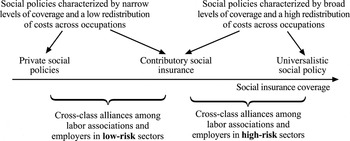
Figure 1 summarizes the above discussion about the predicted effect of economic insecurity. The implication of the above analysis is that an increase in the level of economic insecurity will sharpen a sectoral cleavage over the design of institutions of social insurance. Workers in high-risk sectors will push for social policies characterized by a broad level of reallocation of costs across occupations. Some firms in high-risk sectors that have an interest in the provision of social policy benefits to their workers will also support proposals for the introduction of a new social policy. In contrast, workers in sectors characterized by a low volatility in the level of employment will oppose social policies characterized by a high level of redistribution of costs across occupations. Firms in low-risk sectors who are interested in providing social protection to their workers will also favor social policies characterized by narrower coverage. The resolution of this conflict between high-risk and low-risk sectors depends on the relative size and political influence of the cross-class alliance comprising high-risk or low-risk sectors. If the cross-class alliance comprising high-risk sectors is larger or benefits from a closer access to the decision-making process, the state will introduce a new social policy characterized by broad levels of coverage. If the low-risk alliance is politically more influential, one should see social policies characterized by high levels of occupational fragmentation or no policy change.

Hypothesized preferences toward the design of social insurance policies and potential cross-class alliances.
The above analysis has both micro-level and macro-level implications. At the micro-level, the analysis allows one to derive predictions linking various levels of economic insecurity to demands for different institutions of social insurance. The macro-level predictions of the theory allow one to examine the impact of economic insecurity on the level of social insurance coverage. The remaining part of the article tests both sets of predictions, by focusing on social policy developments in interwar Europe. I begin by examining the impact of two measures of economic insecurity—the volatility in the level of unemployment and the volatility in the terms of trade—on the social policy demand of different sectors. Next, I test the macro-level implications of the model in a statistical analysis of the development of unemployment insurance in interwar Europe.
Policy Developments in Germany
Germany's economic development during the interwar years was characterized by a steady rise in the level of unemployment. This heightened economic insecurity was an important factor contributing to the political instability of the Weimar period. Unemployment figures rose steadily during the period, from 1.7 percent of the total labor force in 1920 to 13.9 percent in 1931 and 17.2 percent in 1932.21
The level of economic insecurity varied dramatically across sectors. Consider two indicators for this economic insecurity. The first are sectoral unemployment rates. According to data collected by the German Labor Ministry in 1926, one year prior to the introduction of the compulsory unemployment insurance legislation, unemployment rates reached 10.7 percent in metalworking, 9.08 percent in the wood-processing industry, and 8.17 percent in mining. In contrast, sectors experiencing low levels of unemployment were agriculture (0.3 percent), the paper industry (1.75 percent), and the food-processing industry (1.42 percent).22
Deutscher Reichstag 1927.
Hoffmann 1965.
This article has hypothesized that a new social policy is the result of a negotiation between a coalition comprising workers and some employers in the high-risk sector and a coalition comprising workers and employers in the low-risk sectors. The relative size of these sectors serves as a proxy for the relative influence of these two coalitions. By the end of World War I, Germany had achieved a high level of industrialization. According to data reported in Mitchell, in 1925, 42.15 percent of the German labor force was employed in manufacturing.24
Mitchell 1998, 150.
Mitchell 1998, 18.
The question about the development of a policy of unemployment insurance was on the agenda of reform of German policymakers beginning with the first years of the Weimar period. During fall 1918, amidst efforts of demobilization, a coalition government that included representatives of the Social Democratic Party and of the Catholic Zentrum Party introduced a policy of unemployment assistance (Erwerbslosenfürsorge).27
This policy provided means-tested unemployment benefits, which were financed by the central government (Reich), states (Länder), and communes and which were distributed by local authorities.28Wermel and Urban 1949, 29.
Erdmann and Vogt 1978, 274.
Reichsarbeitsblatt 1920.
An analysis of the policy preferences of various associations representing both employers and trade unions supports the crucial hypotheses formulated in the previous section. Both employers and employees in Germany's “high-risk sectors”—such as metalworking, machine-tools, or textiles—supported the introduction of a compulsory unemployment insurance. In a number of policy documents submitted to the Ministry of Labor and Social Affairs, the two important peak associations representing large manufacturing producers, the Association of German Industry (Reichsverband der Deutschen Industrie) and the Association of German Employers' Federation (Centralverband der Deutschen Arbeitgebervebände) supported the introduction of a policy of unemployment insurance. In 1920, the Association of German Industry recommended to the Imperial Employment Office: “The means-tested unemployment assistance has to be replaced immediately by an unemployment insurance.”31
Reichsverband der Deutschen Industrie 1920.
Vereinigung der Deutschen Arbeitgeberverbände 1920b.
An important policy demand formulated by German manufacturing employers was the demand to extend unemployment insurance to a large number of sectors. This policy measure had the obvious advantage of lowering the social insurance charges of high-risk occupations. In 1922, the Association of German Employers' Federations demanded the “expansion of the scope of the unemployment insurance legislation” and the “inclusion of good risks (günstige Risiken) within unemployment insurance, in other words, of occupations in which the danger of future unemployment is lower.”33
Ibid.
Vereinigung der Deutschen Arbeitgeberverbände 1923, 35.
Vereinigung der Deutschen Arbeitgeberverbände 1920a, 475.
Vereinigung der Deutschen Arbeitgeberverbände 1921, 27.
The Federation of German Trade Unions (Allgemeiner Deutscher Gewerkschaftsbund, ADGB), an association dominated by unions of the metal-working sectors, supported a redistributive policy of unemployment insurance. In 1918, the ADGB issued a ten-point program that formulated the economic and social policy demands of the labor movement.37
Allgemeiner Deutscher Gewerkschaftsbund 1918, 6.
On this change in demands of the German labor movement, see Bieber 1981, 360–415; and Pothoff 1979, 194.
Allgemeiner Deutscher Gewerkschaftsbund 1920.
Spliedt 1924, 257.
Allgemeiner Deutscher Gewerkschaftsbund 1922, 521.
In contrast to employers and unions in occupations facing a high volatility in the demands for their products and a high incidence of the risk of unemployment, low-risk sectors opposed a highly redistributive policy of unemployment insurance. The two most important associations representing agricultural producers, the Association of Employers' Organizations in Agriculture and Forestry (Reichsverband der land- und forstwirtschaflichen Arbeitgeberbewegungen) together with an association of agricultural employers (Reichslandbund) opposed the proposals of lawmakers to extend unemployment insurance coverage to agriculture. Invoking the relatively low levels of unemployment in agriculture, these employers argued that “the labor market contract of agricultural employers is the best insurance against the risk of unemployment.”42
Führer 1990, 323. Führer refers to a statement of the president of the peak association of agricultural employers (Reichsverband der landwitschaftlichen Arbeigebervereinigungen).
Führer 1990, 326.
Deutscher Reichslandbund 1923.
Führer 1990, 327.
Associations representing agricultural employees also worried that the introduction of compulsory unemployment insurance redistributed costs in favor of manufacturing employees and disadvantaged agriculture. The Central Association of Agricultural Employees (Zentralverband der Landarbeiter) demanded the differentiation of social insurance contributions and benefits among agriculture and industry. As this association argued, “one cannot ask agricultural workers to raise important means to support idleness in the cities.”46
Ibid., 324. Führer refers to a policy document of Franz Behrens, the president of the Central Association of agricultural employees (Zentralverband der Landarbeiter).
Ibid., 325.
The analysis suggests that the main axis of political contestation surrounding the design of the policy of unemployment compensation was the cleavage among high- and low-risk sectors. The policy demands defended by these actors during the political bargaining had important consequences and influenced the shape and policy design of the final unemployment insurance bill. In line with a more general pattern of policymaking characteristic of the Weimar period, the decisions about the design of unemployment insurance law were taken during deliberations between the representatives of the Imperial Employment Office and the relevant interest groups.48
Witt 1983, 139. As Witt argues, if we exclude the emergency legislation, “the overwhelming number of all successive legislative initiatives originated in the bureaucracy.”
Deutscher Reichstag 1927.
Führer 1990, 338.
Political Developments in France
Similarly to German policymakers, French reformers began to pursue policy proposals aimed at the introduction of compulsory social insurance in the aftermath of World War I. A number of political factors accounted for the impetus with which policymakers of the Third Republic approached the question of social policy reform. The first cause was the political failure of previous social insurance legislation, such as the 1905 reform that had established a Ghent policy of unemployment assistance and the 1910 law that had introduced old-age insurance (for a limited segment of the French workforce).53
On the failure of these laws, see Hatzfeld 1971.
See Hatzfeld 1971, 143–44.
Immergut 1992, 90.
Journal Officiel 1921.
Immergut 1992, 91.
Journal Officiel 1926.
One finds a strong variation in the level of economic insecurity experienced by various sectors during this period. Woodworking and the metal industry were among the “high-risk” sectors of the French economy. The unemployment rates experienced by these sectors (8.2 percent in woodworking and 7.2 percent in metalworking) were twice as high as the average unemployment rate for the French economy.59
Salais 1988, 254.
The standard deviation of the percentage change in the terms of trade during 1920–28 was 52.57 for metalworking, 31.45 for silk, 26.59 for wine, and 17.22 for wheat. Statistique Générale de la France 1920–1928.
The economic structure of the French economy differed fundamentally from the structure of Germany. The percentage of the population employed in agriculture was significantly higher than the share of the population employed in manufacturing. In 1921, 41.5 percent of the workforce were employed in agriculture, with 26.45 percent in manufacturing, and the remaining 32.05 percent employed in services.62
Mitchell 1998, 149.
The two main associations representing agricultural producers, the Society of French Farmers (Société des Agriculteurs de France) and the National Confederation of Agricultural Associations (Confédération Nationale des Associations Agricoles) strongly opposed the plans of French lawmakers to extend social insurance to agricultural producers.63
Augé-Laribé 1950, 109–17.
In addition to lobbying against the extension of policies of social insurance to agriculture, agricultural employers made use of another important veto threat: they refused to enroll in the institutions of social insurance and refused to pay mandatory insurance contributions. The likelihood of tax evasion of agricultural employers was high, because of the weak administrative capabilities of the French social insurance administration. One of the primary causes accounting for the failure of previous social policies (such as the 1910 pension law) had been the refusal of agricultural employers to pay insurance contributions. On repeated occasions during policy deliberations, French policymakers worried “that we would encounter the most severe difficulties in the application of compulsory insurance in the rural world, where the spirit of individualism is so developed and modes in which labor is remunerated are so diverse. As has been already the case with the application of certain fiscal laws and the application of the pension law of 1910, the resistance in certain regions or in certain environments will be very strong. The consequence will be that the law will not be applied everywhere to all those that should be subjected to the law, leading to a great material and moral disorder.”64
Ministère du Travail 1922, 4.
The Confédération Générale du Travail (CGT) was one of the most active groups militating in favor of the introduction of compulsory social insurance.65
Hatzfeld 1971, 251.
Confédération Générale du Travail 1921, 19.
Confédération Générale du Travail 1923, 134.
The main association representing manufacturing employers—the Union of Metallurgical and Mining Industries (Union des Industries Métallurgiques et Minières)—recommended important modifications to the social insurance bill that was on the agenda of French policymakers. These employers expressed a moderate degree of support toward the creation of social insurance policies, provided that the administration of these institutions remained in the hands of employers and not in the hands of state bureaucrats. According to these employers, “the fundamental error of the project consists in neglecting existing institutions of social insurance.” As these employers argued, “the firm shapes the existence of the worker in crucial ways, by determining the level of wages, the kinds of risks to which the worker is exposed, by establishing the strongest bonds of solidarity among workers. Enterprises also facilitate the creation of large autonomous and homogenous insurance funds for the provision of old-age benefits.”68
Union des Industries Métallurgiques et Minières 1922, 13.
As in the German case, sectors facing a different incidence of risks favored institutions of social insurance characterized by different levels of coverage. Both unions and employers in low-risk sectors—such as agriculture—opposed the introduction of new social policies. Unions in high-risk manufacturing supported some proposals for the introduction of social insurance. Manufacturing employers in high-risk sectors supported the introduction of some social insurance but disagreed with French policymakers about the policy design of these institutions. In the French case, the political coalition opposing the social insurance project was much stronger than the coalition supporting it. Faced with the vocal opposition of agriculture toward the extension of social insurance, French policymakers retreated from their initial policy proposals. The second draft bill of the social insurance legislation that came out of the deliberations of the Chamber of Deputies in 1924 continued to recommend the introduction of compulsory social insurance for all employees whose income was lower than 10,000 F. However, this draft bill proposed the financial and administrative separation of social insurance for agricultural employees.69
Journal Officiel 1923, 53–54.
Ibid., 53.
Ibid., 54.
The comparative analysis of these two cases has allowed me to trace the impact of external insecurity on the social policy preferences of different sectors. Economic insecurity was an important variable accounting for the policy disagreement among high-risk and low-risk sectors over the design of institutions of social insurance. In both countries, workers in high-risk sectors supported the introduction of a policy of unemployment compensation characterized by broad levels of insurance coverage. German employers in high-risk sectors also favored the introduction of a policy of unemployment compensation characterized by a high redistribution of costs across occupations. In contrast, French employers favored a more gradual extension of insurance coverage. In both countries, workers and employers in low-risk industries opposed the introduction of redistributive social policies. The divergence in the relative size of the high-risk versus low-risk coalition explains the divergence in the policy outcomes among France and Germany. Germany, which had an economy in which the high-risk coalition was politically more influential, introduced a policy of unemployment insurance. In contrast, the low-risk coalition in France was politically more influential and defeated the policy proposal aiming at the introduction of compulsory unemployment insurance.
A Quantitative Analysis of the Relationship Between Economic Insecurity and the Development of Unemployment Insurance
I now test the macro-level implications of this theory. What is the impact of economic insecurity on the provision of unemployment insurance? I have argued that an increase in the level of economic insecurity will lead to the introduction of a social policy characterized by broader levels of coverage only if the coalition comprising unions and employers in the “high-risk” sectors is larger. By contrast, if the “low-risk” political coalition is more influential, it will be able to block proposals aiming at the introduction of a redistributive social policy. Secondly, I have advanced the proposition that higher levels of external insecurity will deepen the preexisting cleavage between “high-risk” and “low-risk” coalitions. Higher levels of external risk can increase the intensity in the demands for social insurance of the high-risk sector and can also increase the size of the “high-risk” coalition. This section tests these propositions, by examining the policy experience of thirteen European economies during the period between 1920 and 1938.72
The countries included in the analysis are Austria, Belgium, Denmark, Finland, France, Germany, Ireland, Italy, Netherlands, Norway, Sweden, Switzerland, and the United Kingdom.
Most econometric studies of the relationship between economic openness and the development of institutions of social protection rely on highly aggregated measures of government expenditures or government receipts. These broad measures are, however, problematic because they discard important information about the distributional aspects of many welfare states. What matters for workers who have lost their jobs as a result of economic downturns is not the statistical artifact known as “per capita social policy expenditures,” but the actual conditions of their social policy coverage, the level and duration of social insurance benefits, the level of insurance contributions, and so on. To overcome problems associated with the use of highly aggregated measures of social policy expenditures, this article uses measures of the level of unemployment insurance coverage. As qualitative studies of the development of many social policies have pointed out, the level of social insurance coverage is the question of policy design that is distributionally most divisive during the formulation of a new social policy. I restrict the analysis to the unemployment subsystem of the welfare state, because this policy mediates most directly the economic consequences of external insecurity.
The dependent variable—the level of unemployment insurance coverage—is computed as share of the population (above age fifteen) that has access to unemployment insurance benefits.73
See Flora et al. 1983.
These countries had a Ghent policy of unemployment insurance. Finland introduced this policy in 1917, France in 1905, and Sweden in 1934.
What is the role of economic insecurity in explaining these differences in the level of social protection? To examine these questions, I use two different measures of economic insecurity. The first of these measures—unemployment volatility—is computed as the standard deviation in the level of unemployment. The second measure—external risk—provides a baseline measure of external insecurity that is comparable across countries. Following Rodrik, the level of external risk is computed as the standard deviation in first logarithmic differences in the terms of trade.75
Rodrik 1998, 56. To compute the terms of trade data for European economies during the interwar period, I have relied on Kindleberger 1956. I am grateful to Mike Tomz and John Fitzgerald for providing additional data.
In addition to these variables that test for the impact of economic insecurity, I have included additional political and economic variables to various specifications of the model. To test for the hypothesis put forward by modernization scholars that wealthier countries have more redistributive welfare states, I have included the standard measure of economic development, real GDP per capita (economic development).76
See Maddison 1991.
Mackie and Rose 1974.
Ibid.
Visser 1989.
Bain and Price 1980.
An additional political control variable is a measure of the degree of concentration of the political system. The variable political concentration is computed as [sum ]si2, where si is the share of parliamentary seats held by party i.82
The measure can be regarded as the political equivalent of a Herfindahl-Hirschman Index. See Carlton and Perloff 1994, 344.
Following the standard approach to the analysis of panel data advocated by Beck and Katz, I estimate the model using ordinary least squares with a lagged dependent variable and panel-corrected standard errors to correct for autocorrelation and heteroskedastic disturbances between panels.83
Beck and Katz 1995.

where i's and t's represent observations on countries and time points respectively, α represents the equation intercepts, β represents the slope of the independent variable, γK represents a vector of coefficients for the matrix of exogenous variables XK, and εi,t is the error term. I used various empirical specifications of the model and thus checked for the robustness of the relationship between economic insecurity and social protection, by successively adding political control variables to the analysis.
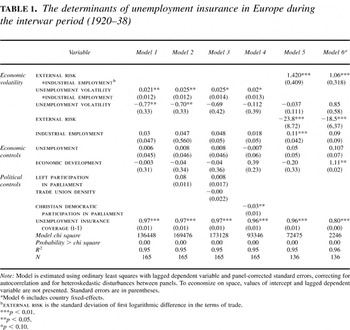
I begin by analyzing the relationship between economic insecurity—measured as the standard deviation in the level of unemployment—and unemployment compensation. Table 1 presents the results. Model 1 presents a baseline model that includes an interaction term between unemployment volatility and industrial employment, the constituent terms, and two economic controls, the level of economic development and the level of unemployment. The interaction term between unemployment volatility and industrial employment has the predicted sign and is significant at the 95 percent level. Model 2 adds a variable controlling for the impact of left-wing participation in government to the baseline economic model. The variable has the predicted positive sign but remains statistically insignificant. Model 3 adds an additional control variable for the level of trade union density to Model 2. The variable is not statistically significant and its sign is opposite to the predicted sign of the coefficient. Model 4 adds a variable measuring Christian Democratic political strength to the model. The variable is statistically significant but also has a negative sign, suggesting that parliamentary strength of Christian Democratic Parties was not associated with the introduction of encompassing policies of unemployment compensation during this period. Models 5 and 6 examine whether external insecurity has an additional independent effect on the development of policies of unemployment compensation, after controlling for the impact of employment volatility, by introducing an interactive term between external insecurity and industrial employment to the model. (The main difference in these models is that Model 6 includes country-fixed effects.) The interactive term external risk*industrial employment has a positive sign and is statistically significant, suggesting that external volatility played some role in the development of a policy of unemployment compensation.
The determinants of unemployment insurance in Europe during the interwar period (1920–38)

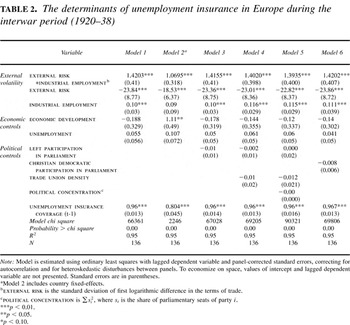
The results presented in Table 2 examine additional aspects of the relationship between external insecurity and unemployment compensation. Models 1 and 2 estimate a simple model that includes the interaction term between external risk and the percentage of workforce employed in industry along with the two constituent variables and two economic controls (the level of unemployment and economic development). (Model 2 reestimates Model 1 and introduces country fixed-effects). The interaction term between external risk and industrial employment has the predicted sign and is significant at the 99 percent level. Models 3 to 6 examine the impact of additional political variables. Models 3, 4, and 5 test the hypothesis that stronger parliamentary participation of left-wing parties leads to the introduction of unemployment insurance policies characterized by broader levels of coverage. The coefficient of the left partisanship variable is not statistically significant, and its sign varies across these different specifications of the model. The variable measuring trade union strength (introduced in Model 4) has a negative sign and its effect is not statistically significant. Model 5 adds the variable measuring the number of parliamentary veto players. While the variable has the predicted sign (countries with fewer parliamentary veto players have social policies characterized by broader levels of coverage), the effect of the variable is not statistically distinguishable from 0. Model 6 tests for the impact of Christian Democratic Parties. The sign of the variable is negative and not statistically significant. A stronger presence of Christian Democratic Parties in parliament is not associated with an increase in the level of unemployment insurance coverage. Two conclusions follow from this analysis. First, both measures of economic insecurity (volatility in the terms of trade or the volatility in unemployment) in interaction with the size of the industrial sector have a significant effect that is robust across various specifications. Secondly, none of the political variables has a strong effect that is robust across different specifications.
The determinants of unemployment insurance in Europe during the interwar period (1920–38)

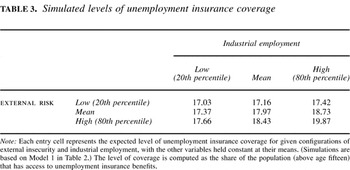
The results reported in Table 3 examine the substantive impact of the explanatory variables on the level of unemployment insurance coverage. The entries in the cells provide “counterfactual” estimates of the level of unemployment insurance coverage, given different levels of external insecurity and different levels of industrial employment. I present simulated values for low and high values of these variables, corresponding to the 20th and 80th percentiles in the data set respectively with all other variables set at their means. Simulations are based on Model 1 in Table 2 and are computed using the Clarify program.84
King, Tomz, and Wittenberg 2000.
Simulated levels of unemployment insurance coverage

This statistical analysis provides additional support for the argument developed in this article linking economic insecurity to the development of policies of unemployment compensation. As hypothesized in the article, the impact of economic insecurity on the development of policies of unemployment compensation is conditional on the sectoral composition of the economy. Economies characterized by high levels of volatility and in which the manufacturing sector is larger have expanded the level of unemployment insurance coverage. Economic insecurity has an impact on the development of policies of unemployment compensation, even after controlling for political variables such as the strength of left-wing or Christian Democratic Parties, the trade union density, the number of parliamentary veto players, or the level of economic development.
Conclusions
This article contributes to the rapidly growing literature that examines the relationship between economic insecurity and the size of the public sector. I develop and test a political explanation of the relationship between economic insecurity and social protection that explores the implications of a sectoral conflict over the design of institutions of social protection. In this account, economic insecurity—measured as an increase in the volatility in the terms of trade or as an increase in the volatility of unemployment—amplifies a sectoral conflict between coalitions of high-risk and low-risk sectors over the design of institutions of social protection. Workers in sectors experiencing a high volatility in the demand for their product will favor the introduction of institutions of social insurance characterized by high levels of insurance coverage and a high reallocation of costs across occupations. Some employers in high-risk sectors will also favor these redistributive social policies over possible alternatives (such as private-type institutions of social protection or no social policies), in an effort to lower the costs of social insurance. In contrast, workers in sectors characterized by a low volatility in demand will favor social polices characterized by narrower coverage and lower redistribution of costs across occupations. A social policy characterized by broad levels of insurance coverage will be introduced only if the coalition comprising workers and some employers of the high-risk sectors is larger.
The explanation developed in this article accounts for the divergent policies of unemployment compensation introduced by European economies during the interwar period. The historical analysis supports the micro-level predictions of the theory for the social policy preferences of different sectors facing different levels of economic risk. The study of the social policy preferences expressed by various sectors in France and Germany demonstrates the existence of a sectoral cleavage among “high-risk” and “low-risk” sectors. The quantitative analysis provides additional support for the hypothesis that higher levels of economic insecurity lead to an increase in the level of social protection, if the high-risk sector is politically more influential. Thus, the findings have broader theoretical and empirical implications for the study of comparative study of systems of social protection. The findings suggest that existing studies of the relationship between external risk and social insurance have paid insufficient attention to the domestic political conflict surrounding the introduction of a new social policy. Focusing on the demands of groups that have an interest in the provision of social insurance—trade unions or workers in the risky sectors—is insufficient. The introduction of a new social policy generates winners and losers. Groups that are potential “losers” from the introduction of a new social policy can often block policy proposals with broad redistributive goals. These findings open up new avenues for future research linking economic insecurity to cross-national differences in the character of institutions of social protection. Future research could examine whether the findings of this article are robust across space and time.
Appendix
Descriptive statistics

References
REFERENCES
Adserà, Alícia, and
Carles Boix.
2002.
Trade, Democracy, and the Size of the Public Sector: The Political
Underpinnings of Openness.
International Organization
56 (2):229–62.Google Scholar
Aghion, Philippe, and
Jeffrey Williamson.
1998.
Growth, Inequality, and Globalization: Theory, History, and Policy.
New York:
Cambridge University Press.
Allgemeiner Deutscher Gewerkschaftsbund.
1918.
Leitsätze für eine Arbeitslosenversicherung.
Correspondenzblatt der Generalkomission der Gewerkschaften
Deutschlands
28 (1):6.Google Scholar
Allgemeiner Deutscher Gewerkschaftsbund.
1920.
Ein Gesetzentwurf über Arbeitslosenversicherung.
Correspondenzblatt des Allgemeinen Deutschen Gewerkschaftsbundes
30 (20):249–51.Google Scholar
Allgemeiner Deutscher Gewerkschaftsbund.
1922.
Zum Entwurf einer Arbeitslosenversicherung.
Correspondenzblatt der Generalkomission der Gewerkschaften
Deutschlands
32 (35):502–6.Google Scholar
Augé-Laribé, Michel.
1950.
La Politique Agricole de la France de 1880 à 1940.
Paris:
Presses Universitaires de France.
Bain, George, and
Robert Price.
1980.
Profiles of Union Growth: A Comparative Statistical Portrait of
Eight Countries.
Oxford:
Basil Blackwell.
Baker, Andy.
2003.
Why Is Trade Reform So Popular in Latin America?
World Politics
55 (3):423–55.Google Scholar
Bartolini, Stefano.
n.d.
A Data-Set of Trade Union Density.
Unpublished data set (personal communication).
Bates, Robert,
Philip Brock, and
Jill Tiefenthaler.
1991.
Risk and Trade Regimes: Another Exploration.
International Organization
45 (1):1–18.Google Scholar
Beck, Nathaniel, and
Jonathan Katz.
1995.
What to Do (and Not to Do) with Time-Series Cross-Section Data.
American Political Science Review
89 (3):634–47.Google Scholar
Bieber, Hans-Joachim.
1981.
Gewerkschaften in Krieg und Revolution: Arbeiterbewegung,
Industrie, Staat und Militär in Deutschland 1914–1920.
Hamburg, Germany:
Christians.
Burgoon, Brian.
2001.
Globalization and Welfare Compensation: Disentangling the Ties that
Bind.
International Organization
55 (3):509–51.Google Scholar
Cameron, David.
1978.
The Expansion of the Public Economy: A Comparative Analysis.
American Political Science Review
72 (4):1243–61.Google Scholar
Carlton, Dennis, and
Jeffrey Perloff.
1994.
Modern Industrial Organization.
2d ed. New York:
Harper Collins.
Confédération Générale du
Travail.
1921.
Compte-rendu officiel des travaux du Congrès, Lille, 25–30
July 1921.
Confédération Générale du
Travail.
1923.
Rapport de la Commission Administrative de la Confédération
Générale du Travail sur les Assurances Sociales, in Compte-rendu
officiel des travaux du Congrès, edited by
Confédération Générale du
Travail,
134–36.
Paris:
Confédération Générale du Travail.
Deutscher Reichslandbund.
1923.
Denkschrift an das Reichsarbeitsministerium vom 3 November 1923,
Zentrales Staatsarchiv Potsdam, Reichsarbeitsministerium 1018.
Deutscher Reichstag.
1927.
Entwurf eines Gesetzes über die Arbeitslosenversicherung.
Drucksachen des Reichstages Nr. 2885, III. Wahlperiode, 6 January
1927.
Erdmann, Karl-Dietrich, and
Martin Vogt, eds.
1978.
Die Kabinette Stresemann I und II.
Boppard am Rhein, Germany:
Boldt.
Esping-Andersen, Gøsta.
1990.
Three Worlds of Welfare Capitalism.
Princeton, N.J.:
Princeton University Press.
Flora, Peter,
et al.
1983.
State, Economy, and Society in Western Europe 1815–1875: A
Handbook in Two Volumes.
Chicago:
St. James Press.
Flora, Peter, and
Arnold Heidenheimer.
1982.
Modernization, Democratization, and the Development of Welfare
States in Europe. In
The Development of Welfare States in Europe and America, edited by
Peter Flora and
Arnold Heidenheimer,
37–80.
New Brunswick, N.J.:
Transaction Books.
Führer, Karl Christian.
1990.
Arbeitslosigkeit und die Entstehung der Arbeitslosenversicherung in
Deutschland 1902–1927.
Berlin:
Colloqium Verlag.
Garrett, Geoffrey.
1998.
Partisan Politics in the Global Economy.
New York:
Cambridge University Press.
Giersch, Herbert, ed.
1996.
Fighting Europe's Unemployment in the 1990s.
Berlin:
Springer.
Gujarati, Damodar.
2003.
Basic Econometrics.
4th ed.
Boston:
McGraw Hill.
Hatzfeld, Henri.
1971.
Du Paupérisme à la sécurité sociale:
Essai sur les Origines de la Sécurité Sociale en France,
1850–1940.
Paris:
Armand Colin.
Hoffmann, Walther.
1965.
Das Wachstum der Deutschen Wirtschaft seit der Mitte des 19.
Jahrhunderts.
Berlin:
Springer-Verlag.
Huber, Evelyne, and
John Stephens.
2001.
Development and Crisis of the Welfare State: Parties and Policies
in Global Markets.
Chicago:
University of Chicago Press.
Immergut, Ellen.
1992.
Health Politics: Interests and Institutions in Western Europe.
Cambridge:
Cambridge University Press.
Ingham, Geoffrey.
1974.
Strikes and Industrial Conflict: Britain and Scandinavia.
London:
Macmillan.
Journal Officiel.
1921.
Dépot d'un projet de loi sur les assurances sociales.
Nr. 2369 (Chambre des Députés)
1297–322.
Journal Officiel.
1923.
Rapport fait au nom de la commission d'assurance et de
prévoyance sociale chargée d'éxaminer le
projet de loi sur les assurances sociales par M. Edouard Grinda,
Nr. 5505 (Chambre des Députés)
33–129.
Journal Officiel.
1926.
Rapport supplémentaire fait au nom de la Commission de
l'hygiène, de l'assistance, de l'assurance sociale
et de prévoyance sociale chargée d'examiner le projet
de loi sur les assurances sociales adopté par la Chambre des
Députés par M. Chaveau,
Nr. 628 (Sénat),
33–64.
Katzenstein, Peter.
1985.
Small States in World Markets: Industrial Policy in Europe.
Ithaca, N.Y.:
Cornell University Press.
Kindleberger, Charles.
1956.
The Terms of Trade: A European Case Study.
New York:
John Wiley.
King, Gary,
Michael Tomz, and
Jason Wittenberg.
2000.
Making the Most of Statistical Analyses: Improving Interpretation
and Presentation.
American Journal of Political Science
44 (2):347–61.Google Scholar
Lewek, Peter.
1992.
Arbeitslosigkeit und Arbeitslosenversicherung in der Weimarer
Republik, 1918–1927.
Stuttgart, Germany:
Franz Steiner.
Mackie, Thomas, and
Richard Rose.
1974.
The International Almanac of Electoral History.
London:
Macmillan.
Maddison, Angus.
1991.
Dynamic Forces in Capitalist Development: A Long-Run Comparative
View.
Oxford:
Oxford University Press.
Mares, Isabela.
2001.
Firms and the Welfare State: When, Why, and How Does Social Policy
Matter to Employers? In
Varieties of Capitalism: The Institutional Foundations of
Comparative Advantage, edited by
Peter Hall and
David Soskice,
184–212.
Oxford:
Oxford University Press.
Mares, Isabela.
2002.
Social Protection Around the World: External Insecurity, State Capacity,
and Domestic Political Cleavages.
Paper presented at the 98th Annual Meeting of the American Political
Science Association, August, Boston.
Mares, Isabela.
2003a.
The Politics of Social Risk: Business and Welfare State Development.
Cambridge:
Cambridge University Press.
Mares, Isabela.
2003b.
The Sources of Business Interest in Social Insurance: Sectoral
Versus National Differences.
World Politics
55 (2):229–58.Google Scholar
Mayda, Anna Maria, and
Dani Rodrik.
2001.
Why Are Some People (and Countries) More Protectionist than Others?
Working Paper 8461.
Cambridge, Mass.:
National Bureau of Economic Research.
Ministère du Travail.
1922.
Rapport présenté au nom de la minorité de la
commission permanente par M. Pralon, 15 Novembre 1922,
Archive of the Chamber of Commerce of Paris, III.
5.50 (9).
Mitchell, B. R.
1980.
European Historical Statistics 1750–1975.
New York:
Facts on File.
Mitchell, B. R.
1998.
International Historical Statistics: Europe 1750–1993.
New York:
Stockton Press.
Pothoff, Heinrich.
1979.
Gewerkschaften und Politik zwischen Revolution und Inflation.
Düsseldorf, Germany:
Droste.
Reichsarbeitsblatt.
1920.
Entwurf zum Gesetz der Arbeitslosenversicherung.
Reichsarbeitsblatt
18:391–410.Google Scholar
Reichsverband der Deutschen Industrie.
1920.
Zur Frage der Arbeitslosenversicherung, Berlin, 18 December 1920,
Zentrales Staatsarchiv Potsdam, Reichsarbeitsministerium 4311.
Rodrik, Dani.
1997.
Has Globalization Gone Too Far?
Washington, D.C.:
Institute for International Economics.
Rodrik, Dani.
1998.
Why Do More Open Economies Have Bigger Governments?
Journal of Political Economy
106 (5):997–1032.Google Scholar
Salais, Robert.
1988.
Why Was Unemployment So Low in France During the 1930s? In
Interwar Unemployment in International Perspective, edited by
Barry Eichengreen and
T. J. Hatton,
247–88.
Dordrecht, Netherlands:
Kluwer.
Scheve, Kenneth, and
Matthew Slaughter.
2003.
Public Opinion, International Economic Integration, and the Welfare
State.
Working Paper CAR37.
New Haven, Conn.:
Yale Center for International and Area Studies.
Spliedt, Franz.
1924.
Einheitliche Gefahrengemeinschaft in der Arbeitslosenversicherung.
Die Arbeit
5 (1):257–66.Google Scholar
Statistique Générale de la France.
1920–1928.
Annuaire Statistique.
Paris:
Imprimerie Nationale.
Swenson, Peter.
1997.
Arranged Alliance: Business Interests in the New Deal.
Politics and Society
25 (1):66–116.Google Scholar
Swenson, Peter.
2002.
Capitalists Against Markets: The Making of Labor Markets and
Welfare States in the United States and Sweden.
Oxford:
Oxford University Press.
Union des Industries Métallurgiques et
Minières.
1922.
Déposition devant la Commission des Assurances et de
Prévoyance Sociale de la Chambre de Députées et
le Conseil Supérieur du Travail sur le Projet de loi relatif aux
assurances Sociales,
Archive of the Paris Chamber of Commerce, III.
5.56 (9).
Vereinigung der Deutschen Arbeitgeberverbände.
1920a.
Denkschrift der Vereinigung der Deutschen Arbeitgeberverbände an
das Reichsarbeitsministerium, 20 April 1920,
Zentrales Staatsarchiv Potsdam:
Reichsarbeitsamt 4310.
Vereinigung der Deutschen Arbeitgeberverbände.
1920b.
Zur Frage der Erwerbslosenfürsorge, Deutsche Arbeitgeberzeitung,
11.01.1920.
Vereinigung der Deutschen Arbeitgeberverbände.
1921.
Geschäftsbericht der Vereinigung der Deutschen
Arbeitgeberverbände 1920.
Berlin:
VDA.
Vereinigung der Deutschen Arbeitgeberverbände.
1923.
Geschäftsbericht über das Jahr 1922.
Berlin:
VDA.
Visser, Jelle.
1989.
European Trade Unions in Figures.
Boston:
Kluwer Law and Taxation.
Wermel, Michael, and
Roswitha Urban.
1949.
Arbeitslosenfürsorge und Arbeitslosenversicherung in
Deutschland.
Munich, Germany:
Richard Pflaum.
Witt, Peter Christian.
1983.
Das Verhältnis von Regierung, Bürokratie und Parlament
in Deutschland. In
Bürokratie und Parliament in Deutschland, edited by
Gerhard Ritter,
117–49.
Düsseldorf, Germany:
Droste.
Hypothesized preferences toward the design of social insurance policies and potential cross-class alliances.
The determinants of unemployment insurance in Europe during the interwar period (1920–38)
The determinants of unemployment insurance in Europe during the interwar period (1920–38)
Simulated levels of unemployment insurance coverage
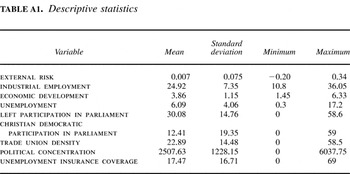
Descriptive statistics
 You have
Access
- 22
- Cited by