Introduction
Population ageing is a foremost challenge for European societies today. Societal age structures will change ever more rapidly, with different consequences for various age groups and societies. Given increasing average life expectancy, pension and health systems face many pressures. People of working age will have to fund the pensions for the growing number of pensioners, while expecting lower pensions themselves. Furthermore, these cohorts provide most of the necessary practical support for their older parents in terms of the instrumental activities of daily living (IADLs) (see e.g. Brandt, Haberkern and Szydlik Reference Brandt, Haberkern and Szydlik2009). Even if people today are experiencing a rising number of healthy life years, which they can spend actively without need of support, the burden for offspring are likely to grow as ever fewer younger people will have to care for their older parents and relatives (e.g. Höpflinger and Hugentobler Reference Höpflinger and Hugentobler2003).
How different welfare systems will cope with these demographic changes is still an open question. Intergenerational assistance and the interplay between family and state as possible sources of support in old age have attracted great attention in social and policy research (see e.g. Saraceno Reference Saraceno2008). Most particularly, intensive, intimate body-related care of parents has been examined frequently (e.g. Haberkern and Szydlik Reference Haberkern and Szydlik2010) since it is seen as one or the most important aspects of intergenerational solidarity especially at a time of population ageing. From a societal perspective, this form of support is needed only if parents are ill and require regular support; it occurs much less often than other forms of intergenerational support. Everyday help with IADLs such as household chores is exchanged in and between all cohorts and over the whole life cycle and thus encompasses a much greater proportion of the population (see alsoBrandt Reference Brandt2009; Brandt and Szydlik Reference Brandt and Szydlik2008; Walker, Pratt and Eddy Reference Walker, Pratt and Eddy1995). Financial support between generations is another indicator of solidarity that has been studied frequently (e.g. Arrondel and Masson Reference Arrondel and Masson2001; Björnberg and Latta Reference Björnberg and Latta2007; Cox and Jakubson Reference Cox and Jakubson1995; Finch Reference Finch and Walker1996; Fritzell and Lennartsson Reference Fritzell and Lennartsson2005; Kohli Reference Kohli1999). In particular, transfer flows from parents to their children have been analysed intensively (e.g. Attias-Donfut Reference Attias-Donfut1995), but transfers from children to their older parents have had less attention in empirical research (for exceptions seeReil-Held Reference Reil-Held2006; Sloan, Zang and Wang Reference Sloan, Zhang and Wang2002).
This paper takes a close look at financial and practical support with IADLs between middle-aged children and their older parents. It takes a comparative perspective and asks the following questions: Do family members react to different welfare state arrangements? If so, how can the interrelationship between social policies and intergenerational transfers be described and explained? These topics will be addressed drawing on data from the second wave of the Survey of Health, Ageing and Retirement in Europe (SHARE), which collected information on transfers of help and money between middle-aged children (aged 50+ years) and their older parents (aged 64+ years) in 14 European countries, namely Austria, Belgium, the Czech Republic, Denmark, France, Germany, Greece, Italy, Ireland, The Netherlands, Poland, Sweden, Switzerland and Spain.
Intergenerational solidarity and transfers
Intergenerational solidarity is a broad concept and its definition is keenly debated and elusive, but it can be regarded as a multi-dimensional latent construct (van Gaalen and Dykstra Reference van Gaalen and Dykstra2006). Bengtson and colleagues (Bengtson and Roberts Reference Bengtson and Roberts1991; Bengtson et al. Reference Bengtson, Giarrusso, Mabry and Silverstein2002) identified six dimensions, namely associational, affectual, consensual, functional, normative and structural solidarity, all of which indicate different aspects of intergenerational relations and exchange. Here we examine only functional solidarity in the form of giving and receiving time (practical help) and money; normative, affective and associative connotations of solidarity will not be taken into account. Structural aspects, such as residential distance, will be used to explain the transfer outcome.
Transfers are influenced by various additional factors on the micro (characteristics of the relation and the individuals), the meso (family characteristics) and the macro levels (characteristics of groups and societies) (Szydlik Reference Szydlik2004, Reference Szydlik2008). In order to be able to provide support, a potential giver needs sufficient resources, in terms of either the time to help or discretionary income (opportunities). On the other side, the needs of a potential receiver, like frailty or a poor financial situation, stimulate different forms of intergenerational support. Additionally, the family composition as a whole is important for transfer decisions: individual support might be reduced if the responsibility can be shared with siblings or if other family members also need support. These influencing factors on the individual and family level have been examined extensively and confirmed concerning different transfer types and intergenerational directions (e.g. Attias-Donfut, Ogg and Wolff Reference Attias-Donfut, Ogg and Wolff2005; Bonsang Reference Bonsang2007; Hank Reference Hank2007; Hank and Buber Reference Hank and Buber2009; Igel et al. Reference Igel, Brandt, Haberkern and Szydlik2009; Kalmijn and Saraceno Reference Kalmijn and Saraceno2008; Ogg and Renaut Reference Ogg and Renaut2006).
Societal features also exert important influences on the likelihood of intergenerational transfers. Family norms as well as social and family policies are known to be inter-related with family members' behaviour and with intergenerational support patterns (e.g. Hashimoto, Kendig and Coppard Reference Hashimoto, Kendig, Coppard, Kendig, Hashimoto and Coppard1992). Concerning the impact of contextual factors on financial transfers, the ‘crowding out’ thesis has been supported empirically (e.g. Reil-Held Reference Reil-Held2006). According to this concept, a generous welfare state (and a generous pension system) crowds out private financial support to older people who have withdrawn from the labour force. On the other hand, retirees have the financial means to support their offspring if they receive generous pensions, which points to the contrary ‘crowding in’ thesis (Deindl Reference Deindl2011). The consolidation of intergenerational support by state interventions has been documented in a number of studies. Attias-Donfut and Wolf (Reference Attias-Donfut, Wolff, Arber and Attias-Donfut2000) found that people who receive public care services also receive more private care, and Lingsom (Reference Lingsom1997) documented the same for household services in Norway. All in all, private support levels are higher in countries with higher service levels (Daatland and Herlofson Reference Daatland, Herlofson, Lowenstein and Ogg2003). According to these findings, the state backs up private resources and thereby enhances intergenerational transfers. The more social services and public transfers that a state offers, the more support is exchanged between generations.
These competing findings may be reconciled on the basis of the ‘specialisation’ hypothesis, which states that particular tasks are shared between the family and the state or formal organisations (Motel-Klingebiel and Tesch-Römer Reference Motel-Klingebiel and Tesch-Römer2006; Motel-Klingebiel, Tesch-Römer and von Kondratowitz Reference Motel-Klingebiel, Tesch-Römer and von Kondratowitz2005; Litwak et al. Reference Litwak, Silverstein, Bengtson, Wilson Hirst, Bengtson and Lowenstein2003). Analysing different solidarity indicators, such as upward and downward financial and practical support, simultaneously and in combination with specific welfare indicators, may reveal such specialisation patterns (cf. Brandt Reference Brandt2009; Brandt, Haberkern and Szydlik Reference Brandt, Haberkern and Szydlik2009): The development of the welfare state and the introduction of pensions has not only progressively replaced the need for financial support by offspring, but also enabled elders to support their children financially. Over time, the growth of public services has given offspring more (voluntary) possibilities to provide everyday practical help to their elders, because burdensome support tasks like intensive care have been taken over at least partly by public services, or, alternatively, generous public transfers have enabled more and more people to purchase them privately. During the development of Norwegian care services, for example, the number of family care-givers increased, while the intensity of the care they provided declined (Lingsom Reference Lingsom1997). All in all, family members seem to provide more low-intensity support when burdensome support tasks are taken over by professional providers (Daatland and Herlofson Reference Daatland, Herlofson, Lowenstein and Ogg2003). When service providers take over medical and legally- or technically-demanding tasks, and family members provide complementary personal care and support using their intimate knowledge of the relative, the task sharing may have not only quantitative but also qualitative advantages for both giver and receiver.
For these reasons, ‘crowding in’ and ‘crowding out’ are not mutually exclusive processes. Following our thoughts on specialisation and on the basis of the findings of recent research, we expect less upward financial support and more downward transfers of money in generous welfare states. Furthermore, sporadic intergenerational help is expected to be more likely in developed social service regimes.
Data and method
The empirical analyses draw on data from the second wave of SHARE of 2006–07 which provides information about the living conditions and support relations of around 33,300 respondents aged 50 or more years in 14 European countries. The data include information about parents and adult children. For the analysis, practical intergenerational help was measured as support with household chores such as gardening, repairs and transport, and with paperwork and administrative issues to and from parents in another household. Monetary support was denoted as transfers of at least €250 in the last 12 months/since the last interview.
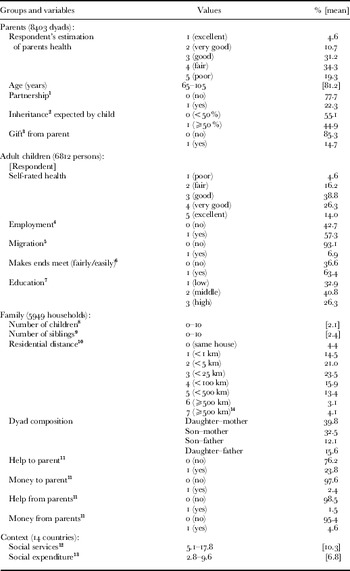
Our sample includes all children aged 50 or more years with at least one natural parent aged 64 or more years alive. All information about support given and received as well as individual and parental characteristics was reported by the respondents (detailed in Table 1). We distinguished specific respondent–parent dyads to analyse exchanges of help and money transfers to and from older mothers and fathers. As these relationships are nested in individuals (respondent-father, respondent-mother), we applied multilevel models (cf. Hox Reference Hox2002; Snijders and Bosker Reference Snijders and Bosker2004). Additionally, people living in the same household share similar characteristics, so the household was included as the third level. These families are nested in countries that form the fourth level. As we were interested in the effects of contextual structures on the likelihood of transfers, controlling for the composition of a country in terms of opportunities, needs and family structures, we estimated multivariate logistic random intercept models using the Stata module GLLAMM (Rabe-Hesketh and Skrondal Reference Rabe-Hesketh and Skrondal2008).
Profile of the sample of older parents and adult children, 14 European countries, 2006–07

Notes: 1. Implies both parents living at same distance from child. 2. Respondent's estimation of the probability of receiving an inheritance within the next ten years. 3. Gift worth €5,000 or more received from parents. 4. Full or part-time employed. 5. Foreign citizenship and/or country of birth. 6. Financial respondent's estimation for household. 7. Categories based on International Standard Classification of Education (ISCED 0 1 2 / 3 4 / 5 6), excluding ‘still in school’ and ‘other’. 8. Own and partner's children, maximum 10+. 9. Living siblings, maximum 10+. 10. Residential distance (km) of the dyad. 11. Transfer in the last 12 months/since the last interview. 12. Percentage of employees in health and social services using International Standard Industrial Classification sector N (OECD 2007b). 13. Expenditure for monetary transfers, goods and services for deprived citizens, US $1,000 per capita in 2004, purchasing power adjusted (OECD 2007a). 14. And abroad.
Source: SHARE wave 2, release 2.3.0; for details, see text. Own calculations according to measurement level, unweighted.
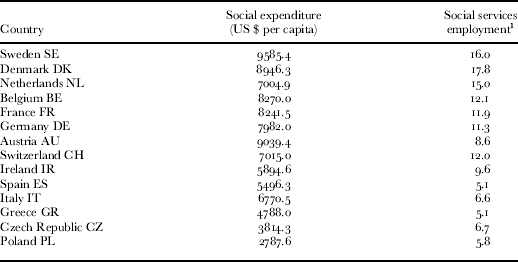
To estimate the connections between specific public and private transfers, the indicators must be congruent to avoid spurious effects. Financial transfers between the two generations can be traced back to social expenditure which is mostly directed towards older people (Therborn Reference Therborn2000) and a measure of the generosity of social welfare. The provision of social services is the best measure of the availability of public or state practical support that substitutes for family support. Social policy is measured here as social expenditure (US $) per capita in 2004, and as the percentage of all employees in the health and social services in 2004, both retrieved from Organisation for Economic Cooperation and Development (OECD 2007a, 2007b) databases.
Transfers of help and money between older generations
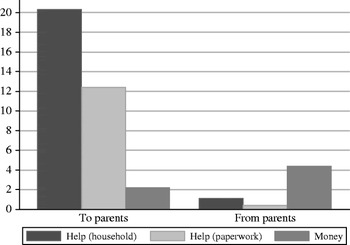
In what ways and how often do older parents and children support each other in the 14 European countries? Figure 1 shows the flows of money and practical support between middle-aged children and their parents at the dyadic level. Help to older parents occurs more frequently than the converse. In 20 per cent of the child–parent dyads, the children helped their parent with household chores and 12 per cent assisted with paperwork. Financial transfers to parents were very rare: in only 2 per cent of the dyads was money transferred upwards. Transfers from parents to children were quite different. Financial transfers were the most frequent, occurring in around 4 per cent of the dyads, followed by help with household chores (1%) and paperwork (0.4%). Help and financial transfers thus exhibit reverse directional patterns. For obvious reasons (such as frailty or illness), many older parents lack the capability to provide practical support to their offspring, and are more likely to need instrumental help. The opposite is true for financial transfers: parents are more likely to give money than to receive financial support. This may indicate that they have sufficient financial resources and are thus also able to stimulate or reward help by children (see e.g. Brandt et al. Reference Brandt, Deindl, Haberkern and Szydlik2008).
Help and monetary transfers to and from parents.

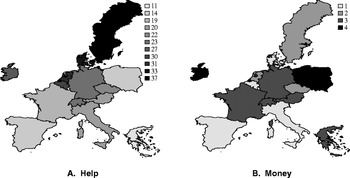
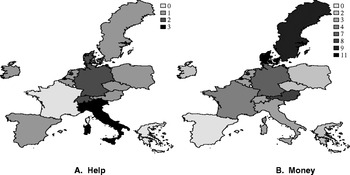
Across the 14 countries, among those who provided any help, practical help from children to parents on average involved 3.6 hours per week, and that from parents to children was for 3.7 hours. As to monetary transfers, on average €2,306 was transferred to parents, and €2,030 by parents to children.Footnote 1 As shown in Figure 2, huge differences between the numbers of support dyads can be found among the 14 countries. In the case of practical help to parents, an obvious North–South/West–East gradient appears, with more than one-third of all dyads providing help in Denmark, Sweden, Belgium, The Netherlands and Ireland, and around 10 per cent in Spain, Greece and Poland. There was less variation in the financial support of older parents, with the range from 1 to 4 per cent of all dyads – the highest transfer rates being in Poland, Greece and Ireland. The regional patterns differ for transfers in the opposite direction: the number of dyads where support with IADL was given downwards ranged from nearly zero in France to about 3 per cent in Italy, without any distinct regional distribution (Figure 3). The pattern of downward financial transfers showed similar North–South/West–East distributions as practical help to parents, but these transfers generally occurred less often. Following the specialisation hypothesis, our assumption is that these country differences may be ascribed to different social policies: the more public support the state offers, the more children help their parents sporadically, the less private financial support the elders need, and the more money they give to their offspring.
Transfers of help and money to parents (percentage of dyads).

Transfers of help and money from parents (percentage of dyads).

Social policy and intergenerational support
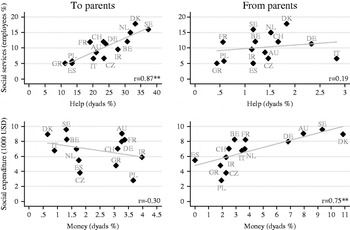
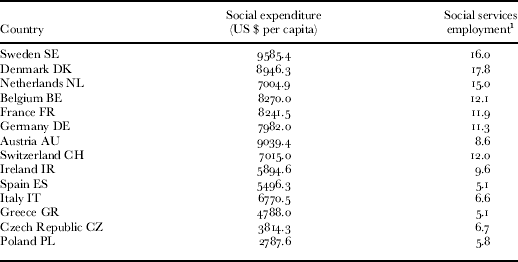
Table 2 shows the distribution of social expenditure and services in the 14 studied countries. These again indicate a North West–South East gradient, with more public transfers and services in Northern and Western Europe than in the Eastern and Southern countries. Figure 4 (left) shows the correlations between the two social policy indicators and transfers of money and time from children to parents. We find a positive relation between practical support and social services. The more employees employed in social services, the higher the percentage of parents who are supported by their offspring with everyday household tasks. The correlation between social expenditure and financial transfers is negative, pointing to a crowding out of private upward transfers with regard to monetary support, even if the correlation on the basis of 14 observations is not statistically significant. The correlations between social policy and the support that middle-aged children receive from their older parents are very different (Figure 4, right). First, the correlation between practical help and social services is less pronounced than in the opposite intergenerational direction. Second, financial transfers from parents display a highly significant positive correlation with social expenditure. To summarise, the statistically significant findings show that the greater the publicly-provided support, the more parents aged 64 or more years support their children financially, and the more children aged 50 or more years help their parents (‘crowding in’).
Transfers of help and money to and from parents (percentage of dyads).

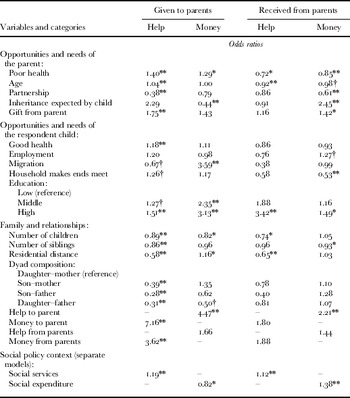
Apart from these findings, there may be other differences among the countries that have an impact on intergenerational transfers. One has to take into account that a country's composition of needs, opportunities and family structures may strongly influence transfers between parents and children. To examine such effects, we carried out multilevel analyses to specify the net associations between intergenerational support and contextual features (Table 3). Taking first parents' opportunities and needs, it was found that elders in poor health were more likely to be given help than their healthy counterparts, and that they provided less support to their offspring. There was also a relationship with increased age: it increased the likelihood of receiving help and decreased the likelihood of giving. Parents who still lived with their partner received less practical support and also gave less money to their children. Monetary resources, measured by children's anticipated inheritances and gifts, had a positive effect on practical help, but a negative effect on monetary transfers to parents: elders with sufficient financial resources stimulated or rewarded help from children, but naturally needed no financial support from their offspring. In a similar vein, parents were more likely to give money to their offspring when they had more financial means.

The needs and opportunities of the adult children also had a strong influence on support between generations. The better their health, the more likely they provided practical help to their parents. In the case of monetary transfers, migration is a very important factor: children with an immigrant background were much more likely to transfer money to their older parents. This is not surprising since the importance of remittances is well known (e.g. Poirine Reference Poirine2006): migrant children tend to help their parents and maintain the long-distance relationship by sending money back home. Higher education is associated with a greater likelihood of giving and receiving support: the better educated build and rely on the safety-net of the family more than people with lower education. On the contrary, children in a better financial situation received less help and money from their parents – presumably because they did not need it.Footnote 2
All these factors are embedded in relational and family structures that influence transfers of time and money between the family generations, especially it appears for practical help. Having (grand) children implies ‘competing obligations’ in terms of help and money, so the greater the number, the less that the adult children provided and received help to and from their parents – presumably both groups directed their support more to (grand) children in these cases (seeIgel et al. Reference Igel, Brandt, Haberkern and Szydlik2009). If there are siblings, support to parents can be split, thus every single sibling has a lower chance of helping (but not of transferring money). The residential distance between a parent and child is important for both transfers and their directions, by decreasing the likelihood of practical help but increasing the likelihood of monetary support, maybe partly as compensation for the lacking practical help. Practical assistance was most likely between daughters and mothers, and then in descending order from sons to mothers, from sons to fathers, and from daughters to fathers. The gender differences were less pronounced for financial transfers to elders and for receiving help and money from them. Nonetheless mothers received money more often than fathers, whereas fathers tended to give money to sons more than to daughters.
Concerning the combinations of different kinds of transfers, we found that money is often given in combination with practical help. If family members need support, they receive it in several ways without (directly) having to give something back. This indication of altruistic transfer motives is consistent with the mostly non-significant effects for mutual transfers: the only indication of reciprocity was that parents who received help from their children also had a higher likelihood of transferring money to their children (see alsoBrandt et al. Reference Brandt, Deindl, Haberkern and Szydlik2008).
As discussed, recently there has been increasing interest in the influences of social policies on intergenerational transfers. Examined separately, the findings support both the ‘crowding in’ and the ‘crowding out’ hypotheses. On the one hand, more public services seem to increase the likelihood of help between parents and children, and in addition downward monetary transfers are more likely in generous welfare states (‘crowding in’). On the other hand, upward financial support is less likely when the state provides adequate public support, thus indicating a ‘crowding out’ of private transfers by state transfers. Integrating these findings, we suspect that ‘specialisation’ occurs, whereby state and family take on different supportive tasks and work together complimentarily. The more transfers a welfare state provides, the less children have to support their parents financially. Still, the offspring do not withdraw from family obligations but appear to concentrate on practical help; rather spontaneous forms of support that are not (and probably cannot be) provided as well by public services. In generous welfare states, older people do not have to rely on their offspring financially, and are even able to redistribute the state's old-age and disability-related payments they receive among their offspring and other family members. The state thus seems to promote (specific) private transfers within the family and also encourages elders to play an active support role in later family life.
Conclusions
Practical help and money exchanges between older people and their adult children are two important forms of everyday intergenerational support (see alsoAlbertini and Kohli Reference Albertini and Kohli2009; Albertini, Kohli and Vogel Reference Albertini, Kohli and Vogel2007; Wolff and Dimova Reference Wolff and Dimova2006), but until now their interplay in different transfer directions and their association with the social policy contexts have not been extensively studied. Practical help mostly flows from the offspring to the older parents, while money goes in the opposite direction more often (seeAttias-Donfut, Ogg and Wolff Reference Attias-Donfut, Ogg and Wolff2005), but with distinct variations among individuals, families and countries. The SHARE data confirm that needs and opportunities as well as family structures are important influences on intergenerational transfers all over Europe – as many other studies have found before. The higher the needs and the more opportunities, the more likely that help and/or money are transferred. Additionally, transfers are modified by family structures such as the number of siblings and the residential distance. As it is ever more important to understand whether the level and forms of private or family support can at least partly be governed by public policies and provision, we examined the associations between social policy indicators and intergenerational transfers. It was found that patterns of intergenerational support differ considerably between countries and strongly relate to social policy. In states with generous social services and transfers, children and parents seem to help each other more, and children (have to) provide less financial support to their elders.
Our findings are based on a sample constituted from countries with very different political, religious and family cultures (Reher Reference Reher1998) encompassing the variation in the European ‘natural laboratory’, which includes Northern socio-democratic regimes, familistic Mediterranean regimes, central European transition countries and states with Roman Catholic, Protestant and Orthodox Christian and other backgrounds. In this ‘SHARE-Europe’, neither ‘crowding in’ nor ‘crowding out’ was found, but rather the modification of private transfers dependent on public transfers (and vice versa), which suggests the specialisation of private and public support in specific instances.
Even if the comparative cross-sectional analysis can only hint at the causal mechanisms – longitudinal data would be needed to disentangle the causality attributable to culture, politics and family composition – both theoretical reasoning and the empirical evidence indicate that not only does private support follow obligations and necessities, but also, especially within families, emotional bonds lead to voluntary support exchanges when and if the required resources exist (Künemund and Rein Reference Künemund and Rein1999). Additionally, human needs are not restricted (Lingsom Reference Lingsom1997) and may therefore never be fully met by state providers. If regular or technically, legally and medically demanding tasks are substituted by public providers (e.g. personal care and pension payments), voluntary, spontaneous and/or emotionally-demanding support might be encouraged because the potential private givers have more resources. When different support types are analysed simultaneously, as we have done, substitution and encouragement of private intergenerational transfers are found because family and state work together complementarily.
This division of the labour of support should not only relieve family members from burdensome and vital obligations, but also improve the situation of people in need both quantitatively and qualitatively. Especially in times of progressive population ageing, the comprehensive provision of public support may help to sustain essential assistance for a growing number of older people without over-burdening the family. When older people are able to stay in their own homes with sufficient public and private help, this will create jobs in social services and reduce costs for long-term institutional care. Additionally, with comprehensive public support, parents have more resources by which to support and reward their offspring financially. In this way, generous public transfers enable people in advanced age to continue to play an active support role in family life.
Acknowledgements
This paper uses data from SHARE release 2.3.0 as of 13 November 2009. SHARE data collection in 2004–2007 was primarily funded by the European Commission through its 5th and 6th Framework Programmes (project numbers QLK6-CT-2001-00360; RII-CT-2006-062193; CIT5-CT-2005-028857). Additional funding by the US National Institute on Aging (grant numbers U01 AG09740-13S2; P01 AG005842; P01 AG08291; P30 AG12815; Y1-AG-4553-01; OGHA 04-064; R21 AG025169) as well as by various national sources is gratefully acknowledged (see http://www.share-project.org for a full list of funding institutions).