Introduction
Predation is one of the main selective pressures that shape communities (Glasser Reference Glasser1979). Consequently, anti-predator behaviours significantly shape species interactions (Glasser Reference Glasser1979) and hold a central position in evolutionary ecology by directly influencing survival and fitness (Lind & Cresswell Reference Lind and Cresswell2005). These anti-predatory mechanisms are diverse, encompassing chemical defenses (e.g., venom, poison, pheromones), coloration (e.g., Batesian mimicry, Serrano et al. Reference Serrano, Farhat, Díaz-Ricaurte and Martins2024a), morphological defenses such as spines and stinging hairs, and a wide repertoire of anti-predatory behaviours ranging from fleeing to thanatosis (Cloudsley-Thompson Reference Cloudsley-Thompson and Cloudsley-Thompson1996; Durso & Mullin Reference Durso and Mullin2014). These anti-predatory behaviours depend on diverse morphological and behavioural components (Blomberg et al. Reference Blomberg, Garland and Ives2003) and are under strong selection (Alcock Reference Alcock2009), thus representing a fundamental component of fitness (Réale et al. Reference Réale, Reader, Sol, McDougall and Dingemanse2007). Nevertheless, the contextual components of animal behavioural traits – and how these are spatially structured – are poorly understood and remain a relevant subject of debate among scientists (Koski Reference Koski2014; Wilson et al. Reference Wilson, Guenther, Øverli, Seltmann and Altschul2019).
While most defensive mechanisms that depend on morphological structures (e.g., rattles in rattlesnakes, venom glands) are phylogenetically conserved, behaviour often varies amongst species of the same clade (Blomberg et al. Reference Blomberg, Garland and Ives2003). Furthermore, defensive behaviours may have a higher fitness in a specific context but lower fitness in others (Hoverman & Relyea Reference Hoverman and Relyea2009), such as rattlesnakes being less likely to engage in rattling behaviour in areas of high human activity (Atkins et al. Reference Atkins, Howarth, Russello, Tomal and Larsen2022). The ability to display different anti-predator behaviours may be important for an effective defense (Heynen et al. Reference Heynen, Bunnefeld and Borcherding2017) and defensive behaviour varies across species of the same genus and often even within species due to factors such as phenotypic plasticity and environmental cues (Aubret et al. Reference Aubret, Michniewicz and Shine2011). This is especially important because there may be different scenarios of selective pressure in different populations, which results in a correlation of local predator-prey behaviours (Toju & Sota, Reference Toju and Sota2006; Meo et al. Reference Meo, Østbye, Kahilainen, Hayden, Fagertun and Poléo2021) and in prey under a higher predation risk developing more complex defenses (Steinberg et al. Reference Steinberg, Estes and Winter1995; Trussell & Smith Reference Trussell and Smith2000). Thus, one of the most important aspects shaping behavioural strategies is the selective pressure by local predators, which also varies at different spatial scales (habitat and region) (Placyk Reference Placyk2012).
Geographical differences of prey response to potential predators are poorly studied, with most studies mostly focused on intraspecific differences (at the population level) but not on interspecific differences (Herzog & Schwartz Reference Herzog and Schwartz1990; Placyk Reference Placyk2012). These interspecific differences are worth analysing, especially in taxa with broader geographical ranges, since different environmental conditions may have different predatory pressures (Placyk Reference Placyk2012; Moura et al. Reference Moura2023). This variation of predation pressure should therefore be a driver of defensive behaviour across space. For example, biotic interactions are thought to be stronger at lower latitudes, where temperatures are higher and climate is less (Romero et al. Reference Romero, Gonçalves-Souza, Kratina, Marino, Petry, Sobral-Souza and Roslin2018), and thus metabolic rates might impose different cost-efficiency of defensive behaviours (Delaney Reference Delaney2019). This is supported by deliberate tail loss of limbless reptiles being reported more for warmer regions (Moura et al. Reference Moura2023) or snails having thicker shells in populations with shell-piercing predators in austral populations (Trussell & Smith Reference Trussell and Smith2000). At the same time, activity patterns and habitat use – strongly linked to abiotic factors – are important as they modulate the chance of encounter between prey and predator (Moura et al. Reference Moura2023). On the contrary, the expression of defensive strategies in prey is often correlated with predator abundance or diversity over a range of spatial scales (Trussell & Smith Reference Trussell and Smith2000; Santos et al. Reference Santos, Feriche, Leon, Filippakopoulou, Vidal-Garcia, Llorente and Pleguezuelos2011). Since predators differ in their foraging strategies and predation efficiency, they can drive the evolution of distinct traits in prey populations (Placyk Reference Placyk2012). Furthermore, predatory pressure is also linked to large-greescale characteristics such as climate and vegetation structure in limbless reptiles (Moura et al. Reference Moura2023), favouring similar defensive behaviours for species that occur in sympatry. Thus, sympatric species exposed to similar conditions, such as the type and number of potential predators, could have similar anti-predator behaviours, which has been shown for marine gastropods (Aguilera et al., Reference Aguilera, Weiß and Thiel2019). However, even though geographical overlap has been suggested as a good predictor of similarity in defensive behaviours (Greene Reference Greene1979), this hypothesis has never been tested.
Among vertebrates, snakes exhibit a highly varied repertoires of defensive behaviours to avoid predation, likely due to the diverse array of both vertebrate and invertebrate predators as well as a lack of social structures (e.g., herding in ungulates or mobbing in birds), which have likely shaped the evolution of these defenses (Greene Reference Greene1979, Greene Reference Greene, Gans and Huey1988). Documenting and reporting anti-predator behaviours of snakes in diverse regions is essential to better understand their behavioural ecology, especially in the Neotropical region in which these are still under-reported but also where “paradoxically, the most spectacular and complex defensive repertoires are often found […]” Greene (Reference Greene, Gans and Huey1988). Among Neotropical snakes, Pseudoboini Wagler, 1830 is one of the most ecologically diverse tribes, especially regarding defensive behaviours (Gaiarsa et al. Reference Gaiarsa, Alencar and Martins2013). This tribe belongs to the Dipsadidae family and comprises 49 species from 11 genera (Uetz et al. Reference Uetz, Freed, Aguilar and Hošek2024) distributed in the Neotropical region (Nogueira et al. Reference Nogueira2019; Uetz et al. Reference Uetz, Freed, Aguilar and Hošek2024). Species of the Pseudoboini tribe are predominantly nocturnal and terrestrial (e.g., Díaz-Ricaurte et al. Reference Díaz-Ricaurte, Serrano and Fiorillo2018; Díaz-Ricaurte & Arteaga Reference Díaz-Ricaurte, Arteaga, A, Bustamante, Vieira and Guayasamin2021) but some species can be considered as semi-arboreal (e.g., Siphlophis genus) or fossorial (Phimophis genus). These habits also reflect their greatly diverse range of traits such as morphology, diet, natural history and even coloration (Gaiarsa et al. Reference Gaiarsa, Alencar and Martins2013; Serrano et al. in prep). For instance, species of the genus Oxyrhopus have aposematic coloration similar to venomous coral snakes of the genus Micrurus, such that there is a geographical association between these two genera of snakes, which likely decreases the chance of predation by visual animals such as birds and mammals (Bosque et al. Reference Bosque, Noonan and Colli2016). Due to the comprehensive studies on the natural history of Pseudoboini (Gaiarsa et al. Reference Gaiarsa, Alencar and Martins2013), this tribe is an excellent model to understand how defensive behaviour might be spatially structured.
Herein, we assess if defensive behaviour is spatially structured, potentially due to similar selective pressures from predation. We test the hypothesis that co-occurring species have similar defensive behaviours, accounting for phylogenetic relatedness and ecological similarity. To do so, we review all reported defensive behaviours for the snake tribe Pseudoboini and add descriptions of unreported behaviours for three species of Oxyrhopus.
Materials and methods
Literature review and new defensive behaviours
To compile all the defensive behaviours present in species of the tribe Pseudoboini and to update the existing information on Gaiarsa et al. (Reference Gaiarsa, Alencar and Martins2013), we conducted searches for articles published between 1980 and 2023 in the databases of Scopus, Web of Science, Scielo and Google Scholar. Also, we reviewed the entire archive of natural history notes published in Herpetological Review, Herpetology Notes and Herpetological Bulletin. We searched the literature for articles mentioning defensive behaviour for species using a combination of the terms ‘defensive display’, ‘natural history’, ‘neotropical snake’, ‘false coral snake’, ‘Pseudoboini, ‘behaviours’ and ‘defensive behaviour’, in English, Portuguese and Spanish regardless of year. Behaviours were included as reported, grouping them whenever redundant (e.g., ‘body depression’ and ‘body flattening’). We furthermore describe new unreported defensive behaviours for three species from personal field observations and personal communications.
Statistical analysis
Using compiled defensive behaviour for each species, we performed a comparison among species with a cluster analysis, using a ‘binary’ UPGMA (unweighted pair-group average; Saraçli et al. Reference Saraçli, Doğan and Doğan2013; Supp. Mat. S1) to generate a matrix of cophenetic distance between species, as dissimilarity in defensive behaviour. This method uses proportional averaging weighted by the number of taxa in each cluster, with resulting clustering species indicating a higher similarity in defensive behaviours than with species in other clusters. Locomotor escape was considered as present for all species since it is the first line of defense in snakes, although often not reported in literature, while mimicry was not included in the cluster analysis because it is a passive display (Bosque et al. Reference Bosque, Noonan and Colli2016). Nevertheless, we still report species considered as aposematic mimics to account for the complete defensive aspects of Pseudoboini species.
To assess whether geographical overlap predicts congruence in defensive behaviour, we estimate this parameter between each pair of species with at least one reported defensive behaviour. We first obtained the distribution ranges of species using the Global Assessment of Reptile Distributions (GARD version 1.7, Roll et al. Reference Roll2017). We calculated pairwise geographical overlap by dividing the area of the geographical intersection of each pair of species by the total area of the geographical union of both species, with values ranging from 1 (fully sympatric) to 0 (fully allopatric) (McKee et al. Reference McKee, Hayman, Kosoy and Webb2016). Furthermore, we calculated macrohabitat similarity by intersecting each species’ distribution range with global ecoregions (Dinerstein et al. Reference Dinerstein2017). We then obtained the proportion of species occurrence in each ecoregion to then generate a macrohabitat dissimilarity matrix, using a Euclidean UPGMA (Saraçli et al. Reference Saraçli, Doğan and Doğan2013; Supp. Mat. S1).
We included relevant ecological traits potentially linked to defensive behaviour: arboreality and body size. Arboreality modulates both the encounter rate and type of predators, leading to a greater diversity of defensive behaviours in snakes (Martins et al. Reference Martins, Marques and Sazima2008). Herein, we define arboreality as the relative number of records in trees as made available by Gaiarsa et al. (Reference Gaiarsa, Alencar and Martins2013) and use pairwise differences in arboreality as the absolute difference of arboreality between each two species. Body size is also correlated with defensive behaviour, with larger individuals exhibiting higher levels of aggression and number of anti-predatory behaviours (Delaney Reference Delaney2019). We obtained maximum length for each species from ReptTraits (Oskyrko et al. Reference Oskyrko, Mi, Meiri and Du2024) and calculated pairwise differences in body size as the absolute difference between each two species.
Lastly, since behaviour can be phylogenetically conserved in clades (Thierry et al. Reference Thierry, Iwaniuk and Pellis2000; Miranda et al. Reference Miranda, Klaczko, Tonini and Brandão2022; Zocca et al. Reference Zocca, Lourenço-de-Moraes, Campos and Ferreira2022), we used a dated phylogeny of Dipsadidae (Serrano et al. Reference Serrano, Pontes-Nogueira, Sawaya, Alencar, Nogueira and Grazziotin2024b) to generate pairwise phylogenetic distances for each species present in the phylogeny. We used a generalised linear mixed model (GLMM) approach to test if dissimilarity in defensive behaviour is predicted by the interaction of geographical overlap, ecoregion similarity, phylogenetic distance and differences in microhabitat (absolute difference in arboreality) and body size (absolute difference of maximum length), using the package ‘glmmTMB’ (Brooks et al. Reference Brooks, Bolker, Kristensen, Maechler, Magnusson and McGillycuddy2023). We used a beta distribution since dissimilarity in defensive behaviour ranges from 0 to 1 and used nested species pairs as a random effect since each species is compared with every other species. We only included species that simultaneously had data on defensive behaviour and were present in the phylogeny. Before inclusion in the GLMM, we tested collinearity between variables with Pearson’s Correlation and excluded ecoregion similarity due to collinearity with geographical overlap (r > 0.6). We then performed full-model averaging using the package ‘MuMIn’ (Barton Reference Barton2020) since it can provide more reliable confidence intervals compared to model selection and it lessens issues with over-complex models, especially in behavioural ecology (Symonds & Moussalli Reference Symonds and Moussalli2011). Additionally, in order to assess whether the number of reported behaviours could be biased towards widespread species, we performed a phylogenetic generalised linear mixed model (PGLMM) to test the relationship between the number of reported behaviours for each species and the log of its area of distribution, with a Poisson distribution and correcting for phylogenetic relatedness. All analyses were performed in R version 4.0.2 (R Core Team 2020).
Results
New unreported behaviours
Oxyrhopus petolarius (Linnaeus 1758)
On September 22, 2020, at 21:45h and February 22, 2022, at 22:30 h, we observed a male and a female (total length = 251 mm; snout–to-vent length [SVL] = 219 mm; weight = 4 g and total length = 1020 mm; SVL = 740 mm; weight = 63 g, respectively) in the foothills of the Amazon rainforest (Municipality of San José del Fragua, Caquetá, Colombia. (1.336826, -75.966334; 349 m asl, WGS84). The first individual exhibited balling behaviour towards the observers followed by thanatosis (Figure 1A–B). After a few minutes, it raised its head and again tried to flee. When approached, the second individual expanded its body and, with its neck in a coil (Figure 1C), made several false strikes towards the observer. Balling involves tight coils in a spherical shape (Fig. 1A), and differs from head-hiding where the snake (here an O. rhombifer hides its head under loose coils and has an overall flatter body position (Fig. 1D).
New defensive behaviours for Oxyrhopus petolarius and O. rhombifer. For O. petolarius, the newly reported behaviours are A) balling, B) thanatosis, and C) neck S-coil behaviour. For O. rhombifer, the newly reported behaviour is D) head-hiding behaviour, with much looser coils and a flatter body compared to the typical spherical shape of balling snakes.

Oxyrhopus fitzingeri (Tschudi 1845)
According to César Luque-Fernandéz and Luis Villegas Paredes (pers. comm.), an individual of O. fitzingeri caught in Atiquipa, Arequipa (Peru) coiled its neck in an S-shape, raised its head and made lateral movements, shortly after which it tried to escape. This is the first detailed description of this behaviour for this species but more details about the individual and the locality can be found in Luque-Fernandez & Villegas Paredes (Reference Luque-Fernández and Villegas Paredes2017).
Oxyrhopus doliatus Duméril, Bibron & Duméril 1854
According to Luís Esqueda (pers. comm.), individuals of O. doliatus in Venezuela attempt to flee when first detected and often make lateral movements and flatten the body (mainly the juveniles), using cloacal discharges when captured. More details on the locality of record can be found in Esqueda et al. (Reference Esqueda, Natera-Muma, Bazo and La Marca2008).
Literature review
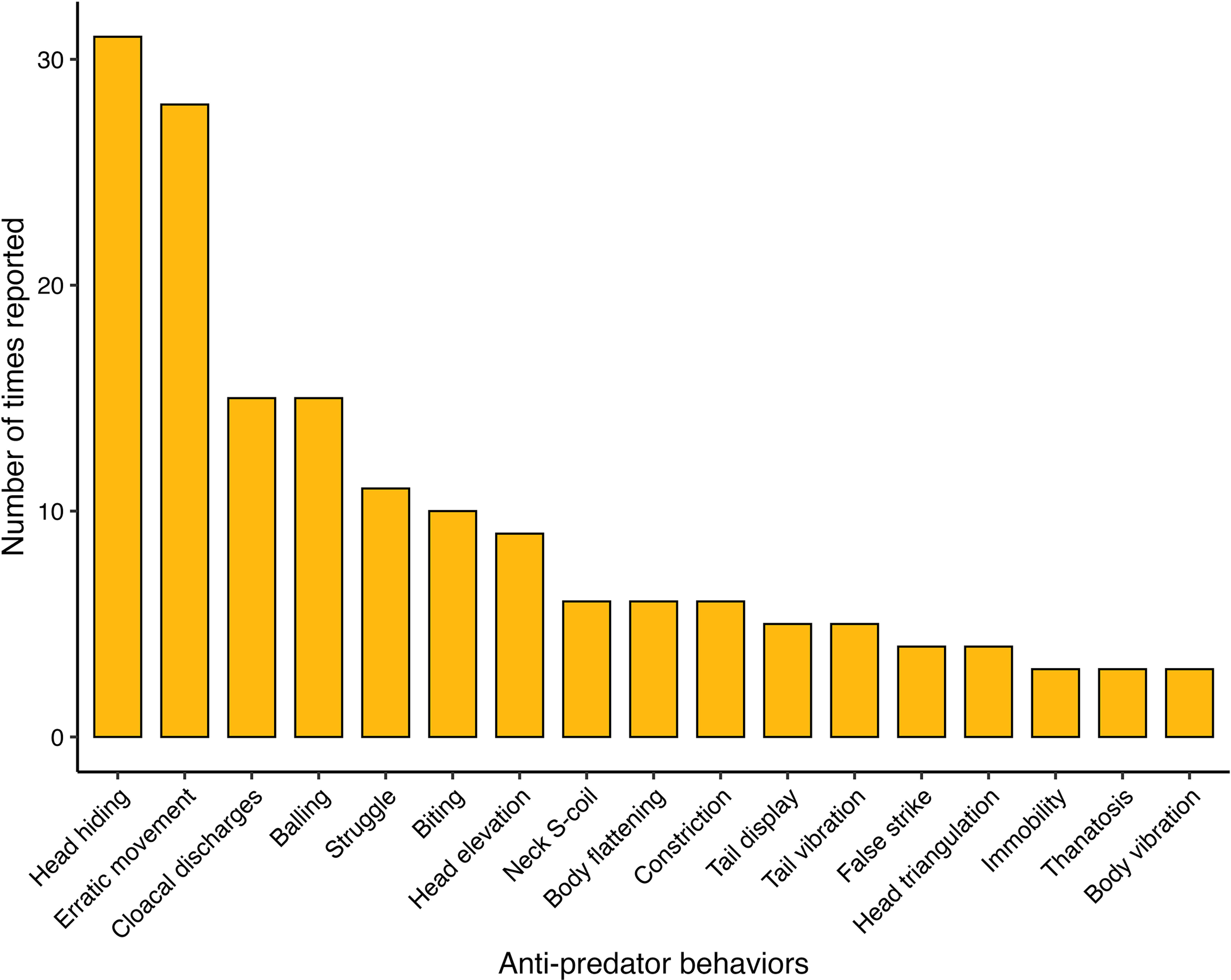
Our literature review of anti-predatory behaviours in the study species, belonging to the snake tribe Pseudoboini, revealed the presence of 19 distinct defensive anti-predatory behaviours. These observed behaviours correspond to the known repertoire for this tribe and encompass: balling (BA); body flattening (BD); biting (BT); body vibration (BV); cloacal discharges (CD); constriction (CO); erratic movements (EM); false strike (FS); head elevation (HE); hiding the head (HH); head triangulation (HT); immobility (IM); locomotor escape (LE); mimicry (MI); neck S-coil (NC); struggle (ST); tail display (TD); thanatosis (death feigning) (TH); and tail vibration (TV). We found data on defensive behaviour for 41 species of 11 genera (83.7% and 100%, respectively) of Pseudoboini snakes (Table 1). Only 22 species had simultaneously reported defensive behaviour and were present in the phylogeny. The species for which a higher number of behaviours has been reported was Oxyrhopus rhombifer, with 14, followed by Siphlophis compressus and O. petolarius, both with 12. Among the reported defensive behaviours for Pseudoboini species, the most commonly reported were head-hiding, erratic movements, cloacal discharges, and balling (Figure 2).
Defensive behaviours reported for the snake tribe Pseudoboini. BA = balling; BD = body flattening; BT = biting; BV = body vibration; CD = Cloacal discharges; CO =. Constriction; EM = Erratic movements; FS = False strike; HE = Head elevation; HH = Hiding the head; HT = Head triangulation; IM = Immobility; LE = Locomotor escape; MI = Mimicry; NC = neck S-coil; ST = Struggle; TD = tail display; TH = thanatosis (death feigning); TV = tail vibration. Abbreviations in bold with * correspond to new behaviours for the species described in this work. List of references can be found in Supplementary Material S2

Number of species of Pseudoboini reported to show each defensive behaviour. For more details, see Table 1. Locomotor escape was excluded since it is often not reported, and mimicry was excluded due to being a passive defensive mechanism, but not a behaviour per se.
The UPGMA dendrogram of behavioural dissimilarity of this subset yielded two major clusters (Figure 3A), with one comprising only Paraphimophis rusticus + Oxyrhopus fitzingeri + Siphlophis pulcher). The other cluster was composed of all the other 19 species, divided into two sub-clades: one comprising seven species, featuring all three species from the Siphlophis genus; and the other one comprising 12 species, mainly from the Boiruna, Clelia, Pseudoboa and Mussurana genera (Figure 3A). Species from the Oxyrhopus genus were equally present in both subclades.
A) Correspondence of phylogeny (left; scale in million years, Serrano et al. Reference Serrano, Pontes-Nogueira, Sawaya, Alencar, Nogueira and Grazziotin2024b) and behavioural dissimilarity (right; scale in which the higher the value, the more dissimilar the species are) for species of the Pseudoboini tribe. Lines connect the same species in both clusters (phylogeny and behavioural dissimilarity). Different colours represent different genera. Notice the two major clusters of dissimilarity of behaviour, with one comprising only three species from different genera and the other with the other 19 species divided into different sub-clades. B) Behavioural dissimilarity between snakes from the Pseudoboini tribe decreases with geographical overlap and size difference (darker colours indicate larger size differences). Even highly sympatric species (those with >75% of geographical overlap) show marked behavioural dissimilarity.
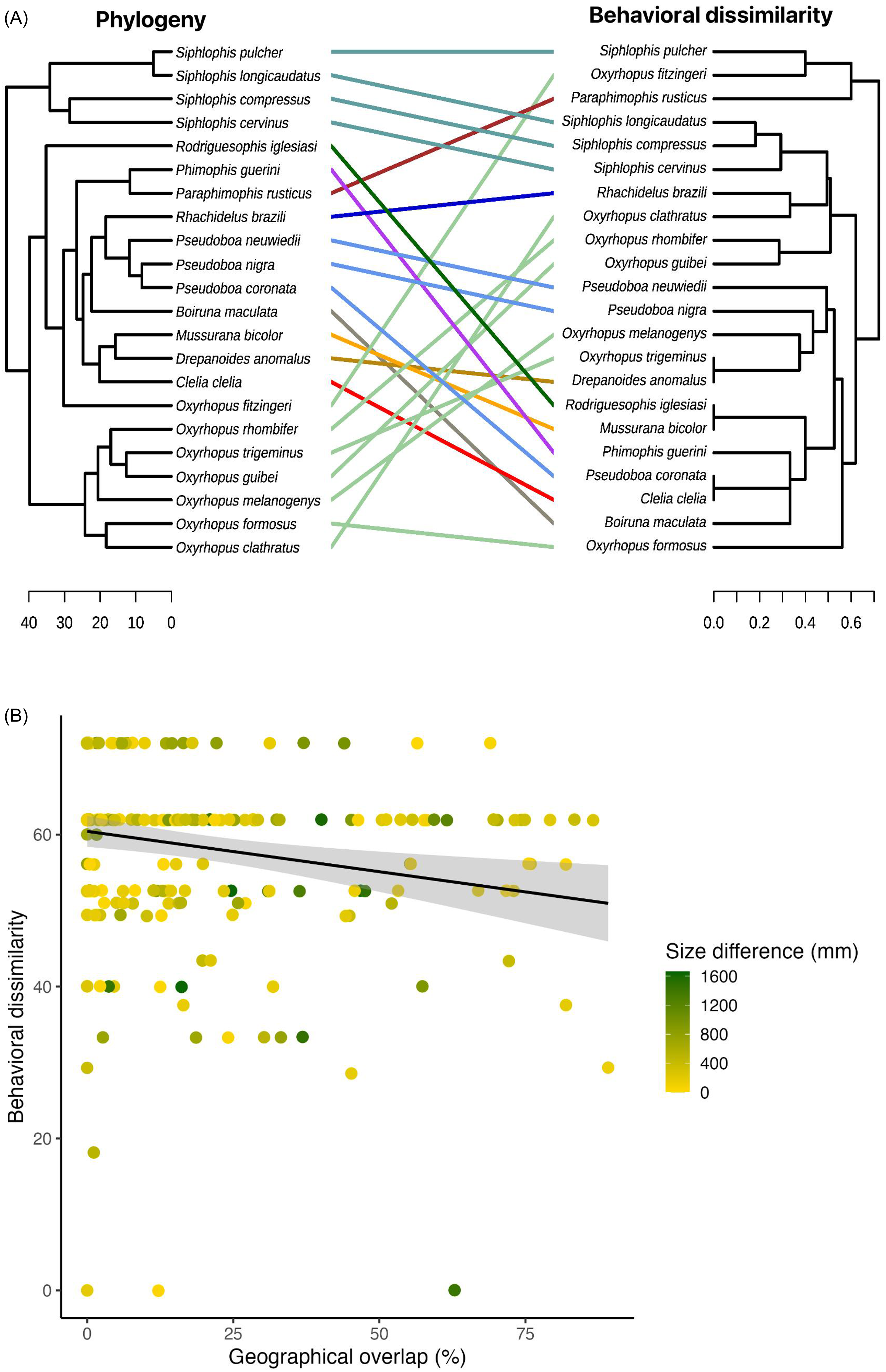
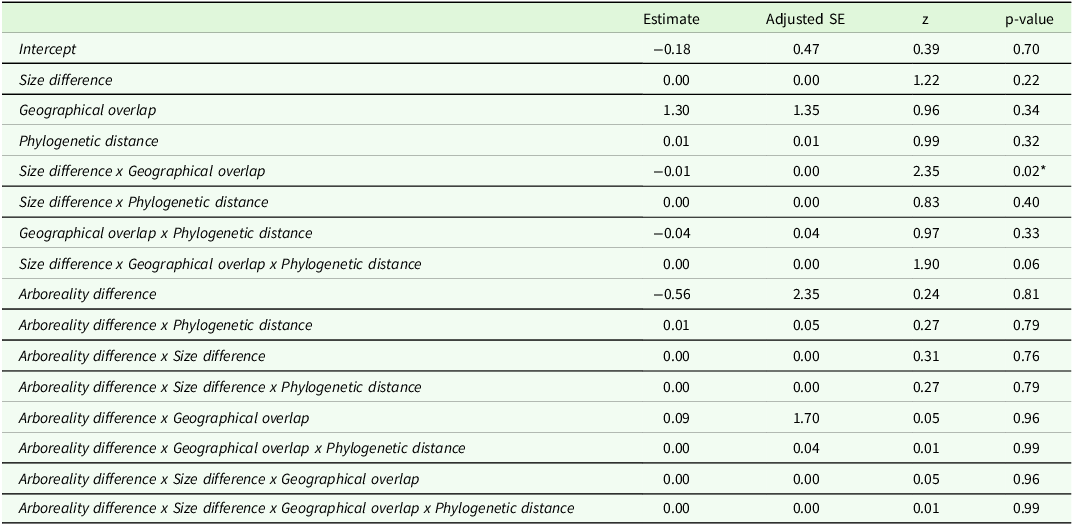
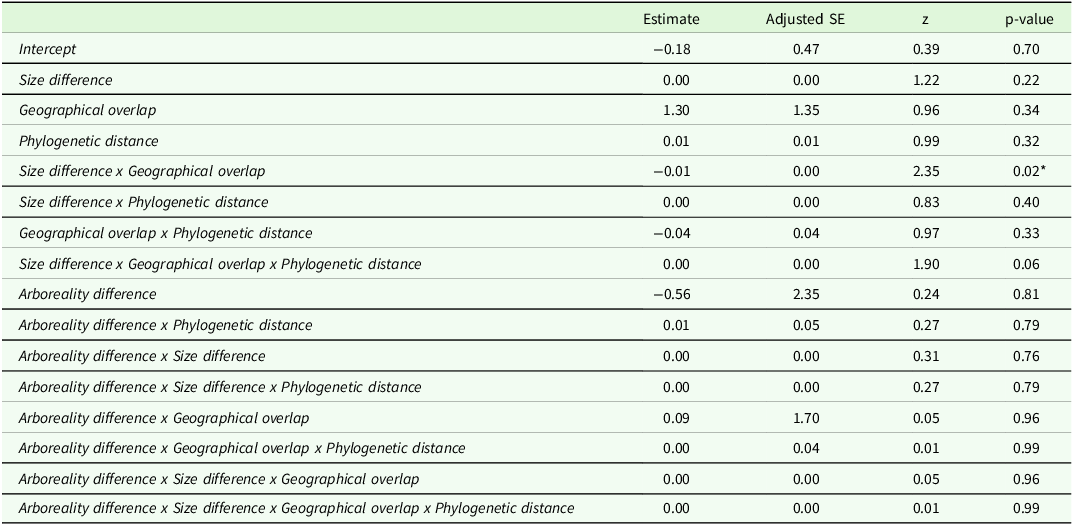
The average geographical overlap between species was 18.8% (± 23.7%) and varied from 0 (e.g., between Oxyrhopus clathratus and O. melanogenys) and 89.2% (between Siphlophis compressus and S. cervinus) (Supp. Mat. S3). Overall, average geographical overlap between species of the same genus (19.5% ± 25.3%, n = 30 pairs) was similar to species belonging to different genus (18.7% ± 23.6%, n = 201 pairs) Our analysis showed that geographical overlap by itself did not significantly predict dissimilarity in defensive behaviour (Table 2). However, the interaction of geographical overlap and difference in body size (estimate = -0.01, p = 0.02) had a significant negative effect, albeit weak, on the dissimilarity in defensive behaviour (Table 2, Figure 3B). The interaction of these factors with phylogenetic distance was weak and marginally non-significant (p = 0.054), but phylogenetic distance by itself was poorly correlated with dissimilarity in defensive behaviour (Table 2, Figure 3A). For instance, even though most species of the Oxyrhopus genus comprise a monophyletic group (excluding O. fitzingeri, see Serrano et al. Reference Serrano, Pontes-Nogueira, Sawaya, Alencar, Nogueira and Grazziotin2024b), they do not cluster together regarding behavioural dissimilarity. On the contary, species from the Siphlophis genus (excluding S. pulcher) are clustered both phylogenetically and in behavioural dissimilarity, albeit with different relationships among them. Our PGLMM also showed that species with a higher number of reported behaviours did not have wider distributions (p = 0.17).
Model output of the PGLMM, testing for the effects of geographical overlap, difference in body size, difference in arboreality difference and phylogenetic distance on behavioural dissimilarity. * indicates a significant effect
Discussion
Herein, we showed that the Neotropical snake tribe Pseudoboini has a diverse repertoire of defensive behaviours. We confirmed our hypothesis that species that co-occur tend to be more similar in defensive behaviour, but only if they have similar body sizes. Furthermore, similarity in defensive behaviour is not phylogenetically structured. Our work explicitly tests ecogeographical differences of defensive behaviour between species, which might be an important component of species ecology and their interactions.
Behaviours such as locomotor escape, cloacal discharge and head-hiding were more than three times as frequent than thanatosis, body vibration, body flattening or tail display. Although all these aforementioned behaviours are considered non-intimidating defensive behaviours (Gray Reference Gray2015), they may have different trade-offs in cost and success that reflect their reported frequency and the moment they are employed. While behaviours such as locomotor escape and struggle might have a high energetic cost (e.g., continuous movement to escape from the potential predator), they increase the distance between the snake and the predator upon detection and are usually among the initial anti-predatory behaviours shown before contact with a predator (Gray Reference Gray2015). In contrast, behaviours such as balling, head-hiding and thanatosis likely have a low energetic cost as they are meant to deter or minimize predatory attacks, but these behaviours have the cost of leaving the snake more vulnerable to predation. These are often employed after physical contact, when escape is no longer feasible (Greene Reference Greene, Gans and Huey1988). To corroborate if the frequency of these behaviours reflects different perceptions of threat, further studies should experimentally test the progression of these behaviours (see Davis Rabosky et al. Reference Davis Rabosky, Moore, Sánchez-Paredes, Westeen, Larson, Sealey and Balinski2021).
We corroborated our hypothesis that there is a relationship between defensive behaviour with co-occurrence at a larger scale (sympatry), which had been previously suggested (Greene Reference Greene1979) but never tested. However, this similarity in defensive behaviour for sympatric species is only strongly supported for species of similar size. Anti-predator behaviour of snakes had already been shown to be linked to body size (Delaney Reference Delaney2019), but our work is the first to assess how it plays a role in the similarity in defensive behaviour across sympatric species. While being large-bodied increases the chances of being detected by predators, it also decreases the probability of capture by predators as well as posing a higher risk (Urban Reference Urban2007). Body size strongly impacts ecophysiological parameters such as behavioural thermal tolerances (Klockmann et al. Reference Klockmann, Günter and Fischer2017) thus activity time and period and consequently exposure to predators (Grigaltchik et al. Reference Grigaltchik, Ward and Seebacher2012).
Even though body size is often phylogenetically conserved (Martins et al., Reference Martins, Araujo, Sawaya and Nunes2001), we found that phylogenetic relatedness, by itself, was not a strong predictor of similarity in anti-predator behaviour. This absence of relationship between phylogeny and defensive behaviour may also be influenced by geographical overlap being similar between congeneric and non-congeneric species, which suggests that phylogenetic relatedness does not determine geographical overlap of Pseudoboini snakes, at least at broad scales. Other studies have shown that defensive behaviour can vary depending on the perceived threat and that it is one of the most labile traits (Brodie & Russell Reference Brodie III and Russell1999; Blomberg et al. Reference Blomberg, Garland and Ives2003; Martins et al. Reference Martins, Marques and Sazima2008), even though for some groups there is a phylogenetic component in anti-predator behaviour (Davis Rabosky et al. Reference Davis Rabosky, Moore, Sánchez-Paredes, Westeen, Larson, Sealey and Balinski2021; but see Araújo & Martins Reference Araújo and Martins2006). Furthermore, arboreality was not present in the best models that explain dissimilarity in defensive behaviour. Even though arboreal snakes typically have a greater diversity of defensive behaviours, which has been linked to higher predation pressures (Moura et al. Reference Moura2023), this is not true for snakes of the Xenodontinae subfamily, such as those in the tribe Pseudoboini (Martins et al. Reference Martins, Marques and Sazima2008). Since all Pseudoboine snakes are strongly nocturnal, this may reflect how both arboreal and non-arboreal species use the same anti-predator behaviours, in contrast with diurnal species, which often use significantly more diverse behaviours (Martins et al. Reference Martins, Marques and Sazima2008).
We found that the number of reported anti-predator behaviours is not correlated with range size. This suggests that the potential for reporting biases—whereby more widespread species might be studied more extensively and have more behaviours documented—is not significantly influencing our findings. Therefore, our conclusions are likely robust across species with different range sizes, as even well-studied, widespread species do not consistently show a higher number of reported behaviours. However, even though the scarcity of data for Pseudoboini is not as pronounced as for other less widespread but diverse snake clades, further information could help elucidate the role of geography on defensive behaviours, especially for species with restricted ranges such as O. erdisii, O. leucomelas and O. marcapatae (see distribution in Uetz et al. Reference Uetz, Freed, Aguilar and Hošek2024). More in-depth investigation of the fitness costs and benefits of each anti-predator behaviour is also required to fully evaluate the geographical patterns of predator–prey interactions (Arnold Reference Arnold1992; Roth & Johnson Reference Roth and Johnson2004). Even though previous studies have studied the geographical variation of anti-predator behaviour, most have focused only on different populations of the same species (Herzog & Schwartz Reference Herzog and Schwartz1990; Placyk Reference Placyk2012), with our study being among the first to test inter-species differences. Herein, we show that space, especially at a large scale, is an important component of anti-predator behaviour. We hope that our work stimulates future research on defensive strategies, as our findings can be broadly applied to and tested in other taxa.
Supplementary material
The supplementary material for this article can be found at https://doi.org/10.1017/S026646742510014X
Data availability statement
The data that supports the findings of this study are available in the Supporting Information of this paper.
Acknowledgements
We thank César Luque-Fernández, Luis Villegas Paredes and Luis Esqueda for providing us with their valuable behavioural observations of Oxyrhopus species.
Author contributions
FCS and JCDR planned the study; YGD, ALG, RDDM and SRTC recorded the new defensive behaviours; FCS, JCDR, CAAF, YGD and RDDM reviewed and collected the data in literature; FCS led the writing of the manuscript; FCS analysed the data; FCS, JCDRs and CAAF wrote the original draft; FCS and JCDR contributed critically to the manuscript; FCS supervised the manuscript. All authors approved the final version of this manuscript.
Funding statement
This study was partly financed by the Coordenação de Aperfeiçoamento de Pessoal de Nível Superior—Brazil (CAPES)—Finance Code 001″, by the Secretaría de Desarrollo Social (SEDESOL), Becas Solidarias – Honduras, and by Fundação de Amparo à Pesquisa do Estado de São Paulo (FAPESP; #2023/06999-1, #2024/10038-0, and #2023/14087-2).
Competing interests
The authors declare no conflict of interest.