Introduction
Ageing populations are a worldwide phenomenon that has turned the attention of researchers and politicians towards strategies tackling not only financial but also societal issues relevant to healthy ageing. The World Health Organisation, as an example, has implemented various initiatives that seek to tackle the effects of ageing on both society as well as individuals' health. In addition, in November 2010 the European Commission launched a pilot partnership on active and healthy ageing, in order to increase the average healthy lifespan of Europeans by two years, by 2020. This partnership aims to improve populations' health by encouraging independent living and active ageing, efficient and sustainable health and social care systems, and increased competition of European industries (European Commission 2011). Regarding social issues relevant to ageing, social capital resources (reciprocity, civic trust, group participation) have been found to be important for the understanding of health and wellbeing among older adults (Berry Reference Berry2008; Nummela et al. Reference Nummela, Sulander, Karisto and Uutela2009; Nyqvist and Nygård Reference Nyqvist and Nygård2013; Nyqvist et al. Reference Nyqvist, Forsman, Giuntoli and Cattan2013; Pollack and Knesebeck Reference Pollack and Knesebeck2004).
Among the different theories of social capital, Putnam's has received most attention within health research. According to Putnam, social capital is a public good which consists of trust, norms and ties, and is a shared property based on community activities and not the property of individuals alone (Putnam Reference Putnam1993). He suggested that networks of civic engagement foster norms of generalised reciprocity and promote the emergence of social trust (Putnam Reference Putnam1995), and proposed that structural aspects of social participation are closely related with cognitive aspects, such as trust, an approach that has been applied in the current study. Participation and trust are thus central features of the concept and the stronger these characteristics, the more co-operation for mutual benefits will be facilitated. In recent years, studies have proposed investigations mainly of the role of trust with regard to the social capital's association with health inequalities (Chappell and Funk Reference Chappell and Funk2010), and self-rated health, in particular (Beaudoin Reference Beaudoin2009; Dahl and Malmberg-Heimonen Reference Dahl and Malmberg-Heimonen2010; Giordano and Lindström Reference Giordano and Lindström2010; Veenstra Reference Veenstra2000). High levels of generalised trust have been associated with higher levels of self-rated health (Moore et al. Reference Moore, Bockenholt, Daniel, Frohlich, Kestens and Richard2011; Nieminen et al. Reference Nieminen, Martelin, Koskinen, Aro, Alanen and Hyyppa2010; Yiengprugsawan et al. Reference Yiengprugsawan, Khamman, Seubsman, Lim and Sleigh2011), and studies have shown that social participation, in terms of social contacts and networks, are also associated with self-rated health (Berkman and Glass Reference Berkman, Glass, Berkman and Kawachi2000; Gele and Harsløf Reference Gele and Harsløf2010).
Importantly, the definition by Putnam suggests that social capital may benefit an individual because of his or her membership in a certain community, implying that that the experience of social capital is highly context dependent (Putnam Reference Putnam2000). Indeed, previously it has been shown that social capital varies across European countries (Carlson Reference Carlson2004; Kumlin and Rothstein Reference Kumlin and Rothstein2005; Pichler and Wallace Reference Pichler and Wallace2007; Van Oorschot, Arts and Gelissen Reference Van Oorschot, Arts and Gelissen2006) and it is also known that health is distributed differently across the countries (Knesebeck and Geyer Reference Knesebeck and Geyer2007; Poortinga Reference Poortinga2006). In particular, the population in Central and Eastern Europe experience poor health compared to Western Europe (Poortinga Reference Poortinga2006). In addition, it has been argued that social capital varies between welfare regimes so that the Northern European countries, especially the universal welfare-state regimes in Scandinavia, experience higher levels of social capital whereas, for example, the East European and South European welfare regimes exhibit lower levels (Kumlin and Rothstein Reference Kumlin and Rothstein2005; Rostila Reference Rostila2007, Reference Rostila2013). These findings suggest that different welfare regimes (Esping-Andersen Reference Esping-Andersen1990) may produce not only different outcomes for social capital and health regarded as separate phenomena, but that the institutional characteristics inherent in these regimes may also have a bearing on the association between social capital and health (cf. Rostila Reference Rostila2007, Reference Rostila2013). Therefore, it is important to bring the role of the welfare-institutional context into analyses of the health outcomes of social capital. Social capital seems to be able to explain part of the observed differences in health in Europe (Carlson Reference Carlson2004; Mansyur et al. Reference Mansyur, Amick, Harrist and Franzini2008; Poortinga Reference Poortinga2006; Van Oorshot, Arts and Gelissen Reference Van Oorschot, Arts and Gelissen2006). The European Social Survey (ESS) data provide a good opportunity to study aspects of social capital and health within Europe.
Methods
Data and study population
In this study we compare the association between structural and cognitive aspects of social capital and self-rated health in three European countries – Finland, Poland and Spain – that can be said to represent different welfare regimes (e.g. Esping-Andersen Reference Esping-Andersen1990). Finland has often been categorised as a member of the ‘universal’ Nordic or ‘Social Democratic’ welfare state, whereas Poland and Spain can be said to represent a continental and South European welfare system, respectively. The study is a part of the EU research project Collaborative Research on Ageing in Europe (COURAGE in Europe), which focuses on the development of measures of health and health-related outcomes for an ageing population (for more details, see http://www.courageproject.eu/). Although the analysis uses data from the ESS Round 4 (2008/09) which is gathered from a total of 30 European countries, the actual country sample in this paper is restricted to the three above-mentioned countries that were part of the research project. Notwithstanding the small country sample, the study permits us to explore the ways in which structural and cognitive aspects of social capital may function as resources for health and wellbeing in older people within different welfare-state contexts. Consequently, the aim of this study was to investigate the potential association between aspects of social capital measured by informal networks and trust and self-rated health in Finland, Poland and Spain, among adults aged 50 or more, and also to show the potential association of social capital indicators – of informal networks of socialising and general trust – with good self-rated health through cross-country analyses.
As the authors of the ESS study describe, in each of these three countries, effective samples of at least 1,500 respondents were drawn by using strict random probability methods at every stage. In order to achieve an effective sample size of 1,500 face-to-face interviews per country and to meet the expected minimum response rate of 70 per cent, an appropriate initial or gross achieved sample size was determined for each country by taking into account the impact of clustering, eligibility rates, over-sampling and non-response. The sample available in the ESS with complete cases of participants in the above-mentioned three countries aged 50 or older was 2,758. The country sample was motivated by the fact that these countries reflect different welfare models in Europe and that this is likely to have an impact on not only levels of social capital, but also levels of self-rated health (e.g. Kumlin and Rothstein Reference Kumlin and Rothstein2005; Van Oorschot and Finsveen Reference Van Oorschot and Finsveen2009). Whereas Finland can be seen as a member of the Nordic – or Scandinavian – model, Poland and Spain can be seen as members of a continental and southern welfare model, respectively (Cousins Reference Cousins2005).
Variables and measurement
From the ESS study we selected self-rated health as an outcome variable, which was assessed with the question ‘How is your (physical and mental) health in general’ on a five-point scale (‘very good’, ‘good’, ‘fair’, ‘bad’ and ‘very bad’). This five-grade scale was then dichotomised, which produced two categories: ‘good health’ (very good, good) and ‘poor health’ (fair, bad and very bad). Defining ‘fair’ as ‘poor’ health seems to be a general procedure within social epidemiology (Manderbacka, Lahelma and Martikainen Reference Manderbacka, Lahelma and Martikainen1998). We analysed the likelihood of reporting good health rather than poor.
Two variables were used for measuring structural and cognitive aspects of social capital. Similar measures from the ESS have been used elsewhere in order to explore the association between social capital and health (Huijts and Kraaykamp Reference Huijts and Kraaykamp2012; Knesebeck, Dragano and Siegrist Reference Knesebeck, Dragano and Siegrist2005; Olsen and Dahl Reference Olsen and Dahl2007). Structural social capital was measured as informal networks by asking the respondents: ‘How often do you meet socially with friends, relatives or work colleagues?’ The response alternatives ranged from ‘never’ to ‘every day’. The original response alternatives were dichotomised by grouping the categories ‘every day’, ‘several times a week’ and ‘once a week’ into a new category: ‘high level of networks’ (at least once a week). Correspondingly, the original values ‘several times a month’, ‘less than once a month’ and ‘never’ were grouped into the new category ‘low level of networks’ (less often than once a week). Cognitive social capital was assessed as general trust by asking: ‘Generally speaking, would you say that most people can be trusted, or that you can't be too careful in dealing with people?’ The original response categories, which ranged from 1 (‘you can't be too careful’) to 10 (‘most people can be trusted’) were grouped into two new categories: ‘low trust’ (0–5) and ‘high trust’ (6–10).
In order to control the robustness of the association between social capital variables and self-rated health, a range of relevant socio-demographic control variables were used, namely gender, age, marital status, education and residence. The original continuous age variable was recoded into a dichotomous variable with the categories 50–64 years and 65 years and over. Similarly, marital status was recoded as ‘single’ or ‘in a relationship’. Education was used as a measure of socio-economic status. In the ESS, participants were asked to state their highest achieved level of education ranging from the category ‘not completed primary education’ to ‘second stage of tertiary education’. The original categories were recoded into a new variable with three categories of education levels: ‘primary’, ‘secondary’ and ‘tertiary’. In our analysis we also controlled for rural or urban residence. The original response alternatives ‘metropolis’, ‘suburbs’, ‘town’, ‘small city’ were grouped as ‘urban’ and village and countryside as ‘rural’.
Data analyses
The association between structural and cognitive aspects of social capital and self-rated health was analysed by using multivariate logistic regression models treating the country variable as a ‘fixed’ effect (Möhring Reference Möhring2012). Due to the small sample of countries and to the characteristics of the ESS data, we could not use multi-level logistic regression models. In our study, initially weighted country-stratified descriptive statistics were calculated for the outcome variable as well as the independent variables. Secondly, country-stratified cross-tabulations were calculated for self-rated health and the two indicators of social capital, plus Pearson's chi-squared tests were performed. Then logistic regressions were used to analyse the factors associated with self-rated health and the results were presented as odds ratios (OR) and their 95 per cent confidence intervals (CI). We began the analyses by including country (reference (ref.)=Poland) as a fixed effect (Model 0). Thereafter, in Model 1 we included socio-demographic background variables such as male gender (ref.=female), age group (ref.=65 or older), marital status (ref.=single), education (ref.=primary) and residence (ref.=urban). In Model 2 we added the social capital indicators of networks (ref.=low) and trust (ref.=low). Nagelkerke R 2 was reported for the models to show change in the overall goodness of model fit. Finally, the joint effects of country and social capital were examined by estimating multivariate models to assess whether the association between social capital and self-rated health differs according to country. These joint effects were calculated as interaction terms between each country and the two social capital variables, respectively, while simultaneously adjusting for male gender, age, marital status, education and residence.
Results
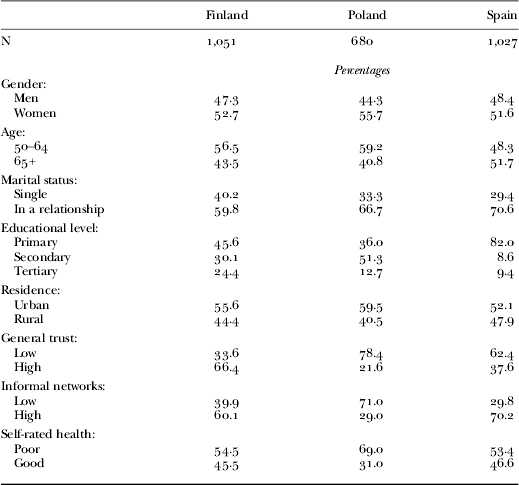
Table 1 presents descriptive statistics for the socio-demographic characteristics, self-rated health, social network and trust by country. Substantial variation for several of the independent variables was found. Polish and Spanish respondents were more frequently married or co-habiting than Finnish; the Finnish respondents more frequently reported higher education levels (24% compared to 13% of Polish and 9% of Spanish). In addition, between-country differences for social capital indicators were found: in particular, Finland appeared to be a high social capital country with regard to social networks and general trust. Spain had a fairly low level of general trust as measured in this study, whereas Poland had more people reporting a low level of informal networks compared to Finland and Spain. Table 1 suggests health inequalities between the countries. The proportion of older people with good health was clearly lower in Poland than in Finland and Spain.
Distribution of socio-demographic indicators, social capital indicators and self-rated health by country

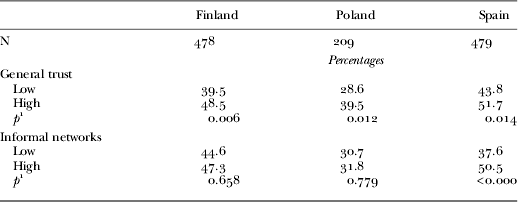
Table 2 shows the country-stratified associations between the two indicators of social capital and good self-rated health. Significant health differences between respondents reporting low and high interpersonal trust were found in Finland, Poland and Spain. Reported good health was more commonly reported among high-trusting respondents. For example, in Finland 48.5 per cent of the respondents with high trust reported good health compared to only 39.5 per cent of the respondents with low general trust. Furthermore, the differences between categories of social network, in respect to reported good health, were not significant in Finland or Poland; while in Spain they were found to be significant. Table 2 indicates that the prevalence of good self-rated health among respondents with frequent social contacts with friends, relatives and work colleagues was more common in Spain than in Finland and in Poland.
The prevalence of good self-rated health by country and by social capital indicators
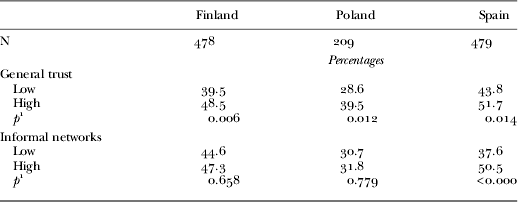
Note: 1. Pearson's chi-squared test.
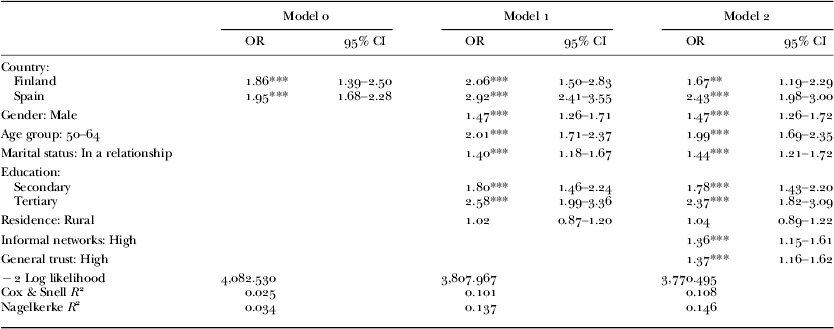
Table 3 shows the results from multivariate logistic regression models of good self-rated health among citizens aged 50 or more in Finland, Poland and Spain (N=2,758). As shown in Model 0, the three countries differ with regard to self-rated health. The odds for rating their health status as good were significantly higher among respondents in Finland and Spain compared to those in Poland. These associations were further strengthened when controlling for individual-level characteristics (Model 1). As can be seen in Model 1 that presents the OR for the socio-demographic variables, good self-rated health was positively associated with being male, 50–64 years, in a relationship and more educated. In Model 2, the social capital indicators were included and the results show that informal networks and trust were positively associated with good health. The influence of country remained stable across the models, even though the OR values were somewhat weakened by the inclusion of social capital variables in Model 2. A comparison of the models showed that Model 2 produced a better fit that Models 0 and 1.
Odds ratios (OR) and 95 per cent confidence intervals (95% CI) for good self-rated health in Poland, Finland and Spain
Notes: N=2,758. Country and gender are dummy variables.
Significance levels: * p<0.05, ** p<0.01, *** p<0.001.
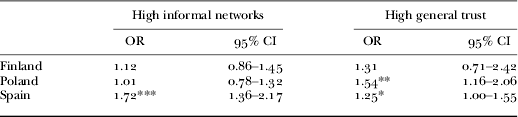
Table 4 shows the joint effect of country and social capital on self-rated health. It was found that trust was significantly and positively associated with good self-rated health in Poland and Spain, whereas the association between high informal networks and good health was significant in Poland only.
The association between social capital variables and self-rated health stratified by country
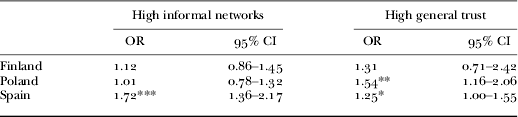
Notes: OR: odds ratio. 95% CI: 95 per cent confidence intervals. The results are based on one specification for the joint effect of country and informal networks and trust, respectively. Each estimate is based on five degrees of freedom. The reference group used was older people with low social capital in Finland, Poland and Spain, respectively. The analyses are adjusted for male gender, age, marital status, education and residence.
Significance levels: * p<0.05, ** p<0.01, *** p<0.001.
Discussion
This study explored the potential difference between three European countries based on reported evidence of the ESS on social capital and self-rated health of older persons. Health differences, though based on self-reports, were found: Polish respondents reported being in good health less frequently compared to Finnish and Spanish respondents. Results also suggest that the association between social capital and self-rated health differs in the three countries. Specifically, Finland was found to be a country of high social capital, in terms of social networks and general trust, with Poland reporting low levels of informal social networks and Spain showing low levels of general trust. Further, our analyses found support for different associations between social capital and health according to country. The association between social capital and health was not significant in Finland as compared to Spain (trust, informal networks) and Poland (trust). Health differences appeared between countries, with Poland reporting the smallest percentage of good health among older adults, compared to Finland and Spain.
As to the relevance of social capital for self-rated health, the results showed that high levels of general trust were associated with good health, while cross-country differences on social networks and subjective health were not found to be significant. Spain is an exception in this regard, however, since good self-rated health was more common among respondents with frequent informal social contacts. A possible explanation to the country differences in terms of associations between social capital and self-reported health could be the unique welfare-institutional configurations of the three countries in question. It is arguable that the relevance of social capital for health is weaker in comprehensive welfare states with a large provision of public social welfare, whereas social capital plays a more important role for self-reported health in countries with less comprehensive welfare states. The possibility to acquire different resources through one's informal networks might be relatively more important for people's health in less-developed welfare states (cf. Rostila Reference Rostila2007). Another explanation could be the fact that there are cross-country differences in the contributions that family or social contacts make as informal care-givers, providing health care to their family members, not only due to weaknesses in a country's health system, but also due to social norms/attitudes according to the duty to provide care to close informal social contacts.
Previous research (Lindström Reference Lindström2009) has shown that older adults that have never been married or are divorced, that possess medium or low levels of education, and that display low levels of trust, tend to report significantly higher levels of poor self-rated health. In our study, the place of residence of the respondents – whether rural or urban – was not significantly related to self-rated health, a finding which is in contrast with work showing that persons living in neighbourhoods with lower levels of social capital have a higher risk of poor self-rated health (Mohnen et al. Reference Mohnen, Groenewegen, Völker and Flap2011; Sundquist and Yang Reference Sundquist and Yang2007).
Social capital, informal networks and general trust were significantly and positively associated with good self-reported health, which is consistent with previous studies (Beaudoin Reference Beaudoin2009; Berkman and Glass Reference Berkman, Glass, Berkman and Kawachi2000; Dahl and Malmberg-Heimonen Reference Dahl and Malmberg-Heimonen2010; Gele and Harsløf Reference Gele and Harsløf2010; Giordano and Lindström Reference Giordano and Lindström2010; Veenstra Reference Veenstra2000). The meaning of social capital and health differed between the countries, suggesting that the features of welfare states may have an impact on the association between social capital and health. This is an interesting finding that not only supports but also contributes to earlier research in this field (cf. Rostila Reference Rostila2007, Reference Rostila2013) by emphasising the contextual sensitivity of the relation between social capital and health. Given that we only included three countries in analyses, further studies with more countries included are needed in order to assess the role of European welfare regimes on the association between social capital and health. Further and more in-depth analysis – possibly with the use of a qualitative-based approach – could contribute to identify the exact factors explaining specific health differences, since considerable difference in self-rated health between the countries remains unexplained in our study.
We also have to acknowledge some other limitations of the current study. First, the ESS cross-sectional design does not allow us to provide evidence about causality. Second, health outcome variables were dichotomised, which made us lose part of the information; we were, however, interested in bivariate relationships for self-reports of poor and good health. In addition, previous research suggests that self-rated health measured on an ordinal scale could be viewed as a continuum that goes from poor to good health (Mackenbach et al. Reference Mackenbach, van den Bos, Joung, van de Mheen and Stronks1994; Manderbacka, Lahelma and Martikainen Reference Manderbacka, Lahelma and Martikainen1998). Therefore, our choice of cut-off point should not seriously influence the estimated effects. Furthermore, the used social capital indicators are not fully validated; however, similar indicators have been used in previous research (Knesebeck, Dragano and Siegrist Reference Knesebeck, Dragano and Siegrist2005; Olsen and Dahl Reference Olsen and Dahl2007; Van Deth Reference Van Deth, Castiglione and Wolleb2008; Huijts and Kraaykamp Reference Huijts and Kraaykamp2012). Finally, attention should be paid when addressing the issue of health inequalities across countries, since a ‘good-health’ state was defined through a self-reported measure only.
Additionally, the relationship between residential neighbourhood environment (i.e. urban or rural) and population health was not examined here, but it may contribute to the better understanding of the role of the social environment for older adults' health (Mohnen et al. Reference Mohnen, Groenewegen, Völker and Flap2011; Sundquist and Yang Reference Sundquist and Yang2007). It has been suggested that the process and consequences of the relationship between social capital and health are different according to the level analysed (Engström et al. Reference Engström, Mattsson, Jarleborg and Hallqvist2008). Whereas a country level reflects social, health and economic policies, a neighbourhood level reflects a day-to-day interaction in the immediate environment.
Our study focused on three countries and shows that there is considerable variation in social capital between them. The small number of countries may, however, prove problematic when it comes to testing the relevance of contextual-level social capital. Healthy ageing has been associated with higher social capital, thus, higher levels of trust and social cohesion can foster the advancement of health for older populations (Walsh et al. Reference Walsh, Heller, Schupf and Van Schrojenstein Lantman-de Valk2001), a fact which is complemented by the findings of the current study. As shown also in a previous study on social capital (Islam et al. Reference Islam, Merlo, Kawachi, Lingstrom and Gerthan2006), our findings confirm that various structural and cognitive social capital resources such as social contacts and general trust are important in explaining health inequalities.
Conclusion
This research has shown that cross-country differences emerged between Finland, Poland and Spain, with Finland showing overall the highest level of social capital, while Spain and Poland reported low levels of general trust and low levels of informal social networks, respectively. However, the association of social capital and health in Finland was not as significant as it was in Poland and Spain. It was also shown that high levels of general trust were associated with good health, while cross-country differences on social networks and subjective health were not found to be significant, with the exception of Spain where good health was reported more from participants with frequent informal social contacts. Overall, the findings showed that the associations of the levels of social capital and health varied across countries, thus further research could shed light upon the impact that aspects of the welfare states may have on the association between social capital and health, at neighbourhood level as well.
Acknowledgements
The authors wish to thank Professor Jan Saarela for his comments on the statistical analyses performed. The study was supported by the COURAGE in Europe (Collaborative Research on Ageing in Europe) Project, funded by the European Commission, Seventh Framework Programme (contract number HEALTH-F2-2009-223071). The work by FN was financially supported by Academy of Finland (project no. 250054) as part of the FLARE-2 programme.