In 2020 the revolution in Libya is nearly a decade old and is now becoming a historic event rather than a current affair. How can historians begin to write about it and what sort of archival sources could they use? This is a problem that has come up many times over the past quarter-century as various totalitarian regimes have similarly passed into history. Although the archival material that has become available varies in origin and shape, it has sometimes resembled what happened with Libya in the ephemeral forms that it took, and in the circumstances in which it appeared. As a source for writing the most recent history of the country, the confused and disordered records are only partial, fillers-in of the gaps in the record, but no archival record ever can be complete. The disorder and confusion or the records are part of the history itself, but they are also a a source for the history of the Libyan revolution. That is how they are understood in this article rather than as part of a theoretical discussion about social media, and this article shows how they can be used to examine and explain aspects of the Libyan revolution that have not been included in historical analysis of those events.
This article examines archival records that emerged at a time of state collapse. This has occurred many times throughout the last generation or so. In January 1990 the German Democratic Republic ceased to exist and by 1991 former citizens were allowed to examine some of the archives of the Ministry of State Security, the Stasi. In November 2019, the British National Archives released material on the internal conditions of Russia in 1994, four years after the collapse of the Soviet Union. Those were orderly approaches to archival access. Over the same thirty-year period archives of several dictatorial states in the Middle East and North Africa became partially available, but the process was not regulated by a similarly bureaucratic control. The Iraqi experience was famously chaotic. In 1991, the Kurdish rising against Saddam Hussein revealed many internal records of the state, to lay bare the mechanisms of tyranny. Uncoordinated militias collected a mass of documents that were eventually brought together and transported to the United States. After the invasion of 2003, the American military seized another huge collection of Baʿath Party archives. The Iraq Memory Foundation digitised very many documents and made them available, under a regulated system, to scholars, but other material was digitised and released onto the web more haphazardly by the United States military. Some were quickly taken down again when American intelligence authorities realised that the contents threatened national security (Pennell Reference Pennell2019). Finally, in late 2018, The New York Times announced a joint project with the Program on Extremism at the George Washington University to digitise around 15,000 pages of internal Islamic State group documents that Rukmini Callimachi and her helpers had extracted from Mosul. The intention was to create a ‘virtual public archive’ of Islamic State rule in northern Syria and Iraq.Footnote 1
These were archival collections in a commonly understood sense. The Oxford English Dictionary, pushing its ultimate derivation back to Greek concepts of ‘magisterial residence, public office’, defines an archive as a ‘historical record or document so preserved’ and a ‘place in which public records or other important historic documents are kept’. The archival record of some of these collapsed states may have emerged in chaotic times, but they were records of government and ordered by subsequent archivists. This is not what happened in Libya. After Tripoli fell to Gaddafi's opponents at the end of August 2011, militia forces took control of the city. Documentation of the fallen regime emerged from the confusion in a serendipitous fashion: international reporters found some intriguing and newsworthy files and reproduced copies of individual documents to underpin a series of scoops. Some correspondents even suspected that this was the last bow of departing regime officials, who had left files to be easily found, to embarrass western interests (Pennell Reference Pennell2019).
Yet although the archives of Gaddafi's state did not emerge in an ordered fashion, and perhaps never will, other sources do exist to document the revolution and its tumultuous aftermath. One set of records did not originate from the offices of the deposed Gaddafi state, but from those who were outside it, its declared enemies or, at least, among those the state did not control. The revolutionaries communicated through social media, and journalists and propagandists who supported the rising collected some of this material together and made it available shortly after the regime fell. A second source of information came from the legal records of foreign countries that needed to document the accounts of people fleeing Libya to find safety in asylum.
Neither of these sources is comprehensive, but they provide an alternative structure of documentation even though they are very different in form and had their roots in quite different intentions. This article has a restricted objective. It aims to describe these sources and explain their uses and limitations, because they have hardly been used before. It does not seek to rewrite the history of Libya on the basis of what they describe – they are part of a pattern of sources, not a replacement. Nor is there an intention to analyse the events that the two examples examine. It is quite simply an examination of fragile sources and their value.
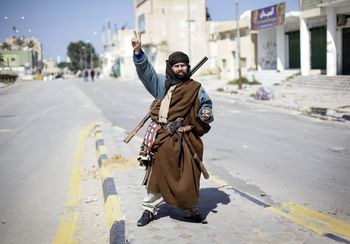
Certainly, there has been extensive analysis of social media as a phenomenon of the Arab Spring. A central theme of this literature has been the idea of a ‘counter-public’, drawn from politically marginalised groups who succeeded in reshaping public opinion with political activism and opposing a hegemonic power structure that controlled the ‘mainstream public’. Social media, relying on an inexpensive technology, provided the opponents of the state with the means to do that (Faris Reference Faris2010; Al-Jenaibi Reference Al-Jenaibi2014). Wael Ghonim, whose Facebook page, ‘We are all Khaled Saeed’, is widely credited with sparking the revolution against Hosni Mubarak,Footnote 2 was quoted as saying that ‘If you want to free a society, just give them Internet access.’ (Khamis and Vaughn Reference Khamis and Vaughn2011.) Yet it is possible to exaggerate the subversive potential of social media and underestimate the resilience of a government's power structures (Lindgren Reference Lindgren2013, 208). In Libya, not every revolutionary was a technocrat, something the Spanish newspaper El Pais captured in two photographs on 24 March. One showed a young, clean-shaven militiaman in battle-jacket, beret and smart sunglasses; the other was an older man in a brown jellaba and a black turban, with an ordinary hand-axe threaded through his waistband.Footnote 3 Both fought against Gaddafi, but it is hard to visualise the second man using social media (see Figure 1).
An armed resident makes the victory sign in the main square in Zawiya 50 kilometres west of Tripoli on Sunday 27 February 2011 (Photo Ben Curtis, AP).

Simon Lindgren's analysis of Twitter usage on the first day of the Libyan uprising (17 February 2011) divided tweeters into three groups: activist organisations (e.g. ShababLibya), individual activists, and news channels (e.g. AlArabiya). He identified three themes in their tweets: the need for objective reporting of the events; a running commentary of reports of protests, arrests and events; and the encouragement of social media activity (Lindgren Reference Lindgren2013, 215–216). There are two ways to interpret his material. One approach emphasizes the involvement of people outside Libya like media companies and their employees and prominent political activists; the other makes activists inside Libya the prime movers in the tweeting (Lindgren Reference Lindgren2013, 214). But it is hard to use Lindgren's material because he does not explain clearly where it comes from. He cites the websites of two organisations that no longer exist - Shabab Libya and Enough Qaddafi (respectively www.shabablibya.com and www.enoughgaddafi.com).Footnote 4 An alternative site, which he does not cite, is the still-live Libya Uprising Archive, which is the subject of the analysis that follows.
As outlined in the introduction, this article is not intended in any way to add to the analysis of the phenomenon of social media but to examine something quite different: the unfolding of events and the structures that contained them and how we can use them to understand the history of the Libyan revolution. An instructive comparison is with the local radio-messaging that took place in Beirut during the opening stages of the Lebanese civil war in 1975, which Lina Tabbara wrote about in her memoir:
We are not the only ones getting the most out of life in spite of the situation. The short-wave radio is most revealing in this respect. The family of Camille Chamoun, the old Lebanese National Party leader is using it with particular flair. When Patty, Dany Chamoun's wife, isn't making a date with friends to do some shopping in Hamra, then daughter Tracy is looking for her fiancé by calling all the barricades. Only Dany, Chamoun's son, uses the radio-telephone seriously. He leads the NLP troops from a base in the mountains . . . All you have to do is to turn the knob to hear the police, or what's left of it, or the army, which is making vague efforts to organise the protection of civilians, or the Phalangists, or the Mourabitouns, or any of the many groups in the Palestinian resistance movement. The choice is wide open. Nobody thinks of using a code, not even the American embassy, whose messages are perfectly clear (Tabbara 1979, 42).
What Tabbara described was a surging back and forth of communications about all sorts of subjects between a multitude of actors. She gives the shape of the exchanges, not their content: that is lost forever because there was no way to record them. In Libya, the social media messages have not all disappeared forever.
The legal material comes from a quite different source: the official decision-making processes of liberal democratic states. These were the enforced depositions of people who were necessarily unsympathetic to the power elites they were fleeing. The recipients were legal bodies that, at the very least, held no brief for those elites, although their purpose was to limit refuge to only those in the most extreme danger. There has been a limited analysis of these depositions and how they can be generally understood and some use of these archives as sources for the recent history of Morocco, Libya and Algeria (Belkziz and Pennell 2017; Pennell Reference Pennell2019; Pennell Reference Pennell2017).
The two sets of sources share two important characteristics. One is that they were born digital. This means that they have always taken a digital form, as electronic communications or as digital records, and did not become digital by reformatting physical records through scanning. The other is that they are to differing degrees ephemeral. The Libya Uprising Archive's presence on the web is not guaranteed to be permanent, and the tribunal records, which are designed for the practical purposes of lawyers and administrators, are not reliably present either (Pennell Reference Pennell2017).
This article does not suggest that such records provide the sole basis for writing the history of the revolution in Libya in 2011 and its aftermath, although the same could be said for any source, of course (paper archives, memoirs, press sources, or photographs). Its purpose is, firstly, to explain that they provide a source, another contribution to writing that history, one that can fill in some of the gaps, and secondly, to examine how historians can use and understand them. To do that, this article deals with each set of material in turn and illustrates each with a limited case study based upon them.
The Libya Uprising Archive
The Libya Uprising Archive has hardly been used. A doctoral thesis in politics at the University of Warwick (Alfasi Reference Alfasi2017) lists it in the bibliography but does not cite it in the text, and two articles about humanitarian law in legal journals give it a single citation each (Breen Reference Breen2013, 165, n. 37; Ruys Reference Ruys2014, 265, n. 135). But it is still availableFootnote 5 and is preserved, apparently at the request of its webmasters, in Archive-It, part of the Wayback facility on The Internet Archive.Footnote 6
The archive dates from the beginning of the revolution, when Mohammed Nabbous, a journalist, set up Libya al-Hurra (Free Libya), a live stream television service in Benghazi. Broadcasts began on 19 February, two days after Benghazi fell into rebel hands.Footnote 7 Within four weeks over 150,000 worldwide viewers had visited the news channel, which also reproduced social media such as Facebook and Twitter (Morris Reference Morris2014). In week five, an unidentified sniper shot Nabbous dead, while he was reporting from the thick of the fighting.
To commemorate their dead colleague, Nabbous's co-workers set up the Libya Uprising Archive and dedicated it ‘to help show the world the spirit, wit, bravery, tenacity, and beauty of Free Libya.’Footnote 8 In late 2019, the site was still open although the last articles on the home page dated from September/October 2012. Although the home page said ‘all main sections of the site are active except some of the Daily Archives’, some hyperlinks had fallen out. There are some other essential limitations: its frank expression of partisanship, its patchy coverage because it relied on volunteers; and its working language, English, a characteristic of Twitter exchanges (Lindgren Reference Lindgren2013, 212), with only a few translated Arabic and Tamazight communications. Yet for all that, the archive is a very large source for the recent history of Libya that derives not from the activities of the state, but from the communications of its opponents.
Case study 1: the events of 20 October: what sort of information does the Libya Revolution Archive provide?
The Libya Revolution Archive has many separate sections: eyewitness accounts, pages about former militants, translated transcripts of hacked phone calls of Gaddafi-era officials and more. One section aggregates social media exchanges; within it ‘Daily Archives’ documents the rising from February to May 2011 and then links to ‘From a Good Source’ covering May to 20 November, when the Zintan militia captured Saif al-Islam Qaddafi.Footnote 9 This last group has a whole page devoted to 20 October 2011, the day when men from a Misrata militia captured Gaddafi and killed him in a very sordid fashion. Because it is a particularly extensive page, there is enough content for it to be examined here as a coherent unit. All the tweets quoted below come from that page where the organisers of the site aggregated them.Footnote 10
There were three groups of tweeters: foreigners, Libyans, some of them based inside and others outside the country, and local Libyan revolutionary news organisations. Not all foreign tweeters were reporters – David Bachmann was the commercial counsellor at the Austrian embassy in TripoliFootnote 11 – but many well-known international journalists supplemented the material they did not include in their regular news reports with tweets. Among them were Gabriel Gatehouse and Wyre Davies (BBC), Jonny Hallam (CNN), Barry Malone and Evan Hill (al Jazeera) and Abdul Hamid Ahmad (Gulf News); Andy Carvin, (National Public Radio) was very prolific. Among the Libyans based outside the country were Matog Saleh, who worked for Sky News Arabia and Guma El-Gamaty, a very regular poster who had lived in London for over a quarter of a century. El-Gamaty was present in 1984 at a protest outside the Libyan diplomatic mission in London when a gunman inside the building shot and killed a woman police constable. After the rising began, he represented the Libyan Interim National Council in Britain and later led a small, non-Islamist, political party (Taghyeer).Footnote 12
Among the locally-based tweeters were political activists who carried on agitating in the post-Gaddafi period. They included Bilal Bettamer (who tweeted as @Bilalhb), a law student and human rights activist from Benghazi, who organised protests against the Islamist militias there in 2012 and eventually lined up, very cautiously, with General Khalifa Hafter.Footnote 13 Some Libyan tweeters kept a lower profile. ‘Tweeting Tripoli’, was a very prolific participant who used the tag @2011feb17, but about all that is known of him is that he belonged to a Tripoli-based rebel group. Ali Tweel, another prolific tweeter, was careful not to blow his cover at the time, because he shared a house with his brother Abdulhakeem Amer, close to the Bab Al Aziziyah barracks. Together they used a secret satellite dish to pass on stories. Ali later became a minor celebrity in blogs and Abdulhakeem was a local historian of Tripoli who, during the late Gaddafi period, had written a book on the ‘lost’ Protestant cemetery (Ṭawīl Reference Ṭawīl2008; Wright Reference Wright2007; Thorn Reference Thorn2006; Ward Reference Ward2012). His tweets were very focussed on the irresponsible use of guns, fired into the air in celebration of Gaddafi's death.
The final group of tweeters were those, like Libya al-Hurra itself, that ran online news services. The Freedom Group TV was a video service set up by rebels in Misrata. It provided rebel fighters with sat-phones to film the battles for the city and transmitted the recordings live streaming. The Arabic Service of the BBC and Al-Jazeera made extensive use of them (Viguier Reference Viguier2011).
The events of 20 October were confused, but a sense of immediacy runs through the archive of tweets. Some were human interest stories: ‘twins born in the middle of the revolution #Libya So beautiful :)’; ‘This man Abdulkareem AlKameety found 1million Dollars in #Sirt and handed it over to the #NTC.Proud to be Libyan #Libya’. Otherwise, there were three strong themes on this day – dark tales about the supernatural powers Gaddafi was supposed to rely on, his death, and the reactions to it, including the celebrations, which were marred by the irresponsible use of guns, fired into the air, that caused terrible injuries when the bullets fell to earth.
The day began with reports that revolutionaries had captured two of Gaddafi's sons, Saif al-Islam and Muʿtassim. ‘I know this might be a rumour but there is news coming in saying that #Saif #Gadaffu [sic] has been caught;’ ‘Confirmed: the capture of Saif Alislam is not confirmed.’ There was some dark humour about the two men's fates: ‘So..ongoing saga of Libyan rumours, Seif loses his arm, Moatassim lost his [censored]……I'm hoping Big G himself loses his head next;’
Bilal Bettamer tweeted the same jocular remark about which piece of his body Saif al-Islam lost ‘What's up with Saif? I hope the arm he lost is the one with the finger lol #TooLate’. Matog Saleh did the same ‘They said Saif lost his arm #Libya I hope the arm that #Saif lost (If true) is the one that contains that freaky finger he pointed at us #Libya.’
It was unrealistic to suppose that a Libyan journalist should maintain formal neutrality at these moments: he and other journalists were too deeply engaged with the war. But Saleh is a professional journalist and his current twitter profile firmly states that ‘Tweets only represent my personal views.’Footnote 14
Early on 20 October a tweeter reported ‘Relatively quiet day after intense fighting on Tuesday. One doctor said he saw 28 #NTC fighters killed, 100+ injured.’ But as the day wore on, both fighting and tweeting became more intense. The revolutionaries held the capital but had not captured the Colonel. Tweeters were sceptical about reports he had been taken: ‘Too bad that the noise level in Tripoli isn't a reliable truth detector [Andy Carvin tweeted]; if it were, it'd now be reporting that Gaddafi is very, very dead.’ ‘Please treat the following with lots of caution, but the Misratah Military Council is reporting that Gaddafi himself has been arrested.’ ‘Some now saying that #Gaddafi either seriously injured or maybe killed? Libya #feb17.’
News came that rebels had taken Sirte, Gaddafi's last stronghold, and it seemed the regime might actually be finished: ‘Libya breaking a very high profile person has been captured by FF [Freedom Fighters] in Sirte as the city is being finally liberated! More details shortly!’ ‘Crazy scenes of jubilation on every road in #Tripoli right now – unbelievable! Libya #feb17’; ‘Everyone shooting wildly in the air in Tripoli – don't want to get my hopes up! #Libya #feb17 #Gaddafi;’ ‘Amazing scenes of #FF celebration in #Sirte. BUT no such partying in #Tripoli yet #Libya.’ Confusion still reigned, with Libya al-Hurra repeatedly reporting that Gaddafi had been caught in Sirte and was being taken to Misratah. The Misratah-based Freedom Group TV was more cautious: ‘As God is my witness, I just spoke2 fighter who said he just slapped Gaddafi. But let's wait for confirmation.’
Qaddafi had escaped from Sirte and made a last break for freedom. When a tweet reported that ‘a convoy of 100 cars left #Sirte driving Westwards. #Libya’ it quickly became the focus of attention. When, at last, news correctly came that Qaddafi was dead, it was first reported by an American free-lance journalist, Holly Pickett, who was covering the fighting around Sirte, embedded in an ambulance crew. Through a stroke of luck, she came across another ambulance carrying Qaddafi's body back to Misratah and tweeted the news:
So weird. #Sirte #Libya. I have been going to #Sirte every couple of days and was with an ambulance. They turned back toward Misratah from the field hosp.
We were in a residential area behind the field hospital. Suddenly an ambulance races by with the body of #Gaddafi. We chased. #Libya
The ambulance with #Gaddafi's body stopped very briefly at the field hospital, then hit the highway for Misrata. #sirte #Libya
10 Revolutionaries were packed inside. The doors were open, but it was difficult to see #Gaddafi. We drove close to the open door.
From the side door, I could see a bare chest with bullet wound and a bloody hand. He was wearing gold-colored pants. #Gaddafi #Libya
We fell back behind the ambulance and they opened rear the door to reveal a partly bald, bloody head with frizzy black hair. #Gaddafi
There is no question it was #Gaddafi. Every time the ambulance stopped, it was mobbed by rebels. Everyone was going nuts. #Libya
When they opened the back of the ambulance, a rebel truck went crazy and ran us off the highway at high speed. We crashed in a ditch. #Libya
One of the medics in our ambulance re-injured a wound from a mortar attack a couple weeks ago. He required immediate assistance. #Libya
We decided to make straight for Misratah and overtook the ambulance with #Gaddafi's body in it. #Sirte #Libya
At every checkpoint between #Sirte and #Misrata, crowds had gathered and wanted to know if we were the ambulance with #Gaddafi's body in it.
Upon hearing the truth, that #Gaddafi was truly dead, revolutionaries at the checkpoints were beside themselves, shouting with joy.
We didn't know they had #Gaddafi when we went behind the field hospital. We heard something about his son Muatassim. #Libya
Crowds lined the streets in #Misrata. A boy shouted in my window with a huge smile, “Where is Shafshufa (Frizzy Hair)?” #Libya
It looks like #Gaddafi was taken alive. Bloody, but alive, according to a video that three people have now shown me. #Libya
All I could think when I found out they had #Gaddafi was, “I am the only journalist who knows what happened. I have to get a photo.” #Libya
I was a little afraid that this would turn into another undocumented rumor. That's why I chased the ambulance with #Gaddafi's body. #Libya
There are several YouTube videos of Gaddafi's death, but Holly Pickett's dramatic account hardly appeared in any published media. The Montana Standard, from her home state in America, quoted bits,Footnote 15 and the Australian ABC's website reproduced it in full, but without the twitter hashtags that gave it a sense of immediacy.Footnote 16 Very short extracts appeared in some published news reporting, on the website report of CBS, which preserved those hashtags, and in the New York Times which did not.Footnote 17
After Gaddafi's death, two more themes emerged, many of them centred around a 21-year old student named ‘Omran Shaaban’ who claimed he had killed Gaddafi in a culvert. The New York Times interviewed him and reported that ‘Colonel Qaddafi was carrying what Mr. Shaaban described as a sack of magic charms.’Footnote 18 That was the only time a story about the Gaddafi regime's satanic reputation reached the mainstream international media. Perhaps it seemed trivial or merely weird. Wyre Davies of the BBC heard similar stories: ‘Black magic at work in #Sirte? Pro #Gaddafi fighters accused of using gazelle heads with human eye’ but he treated them with skepticism: ‘Understandable speculation re “gazelle heads” story in #Sirte #Libya. Not convinced of it myself just reporting allegations on the ground;’ and it did not get into print. Yet the story was widespread. Bilal Bettamer tweeted ‘Have i mentioned the “black magic” Gaddafi forces had? One of them had Quran in his pocket but full with words written by a “magician”.’ On 21 October Andy Carvin, of NPR, tweeted ‘Colonel Qaddafi was carrying what Mr. Shaaban described as a sack of magic charms.’ ‘MwattinLeebi’ (clearly a pseudonym), reported #Gaddafi clung on to kufr and black magic to the last moment of his when he was found clutching a ‘hjaab’ (pouch containing black magic).Footnote 19 Those who spread the story were deeply unsympathetic to Gaddafi. Was it true or was this black propaganda, to make Gaddafi even more outlandish and savage? Did the winners disdain such nonsense, or did it reflect a sneaking worry that Gaddafi might once again slip free?
After reports confirmed the probable death of Gaddafi, tweets from both journalistic and local sources described the celebrations in the streets of Tripoli.
‘Crazy scenes of jubilation on every road in #Tripoli right now - unbelieveable!’
‘Everyone shooting wildly in the air in #tripoli - don't want to get my hopes up! #Libya #feb17 #Gaddafi,’ a Libyan tweeter reported.
‘#TRIPOLI has now started CELEBRATION as people get the news Beeping cars Cheering People #Libya.’
‘#TRIPOLI Ships in Harbour are sounding their HORNS I am in tears I cant believe this day has come on Thursday October20 2011 Free #Libya.’
‘#LIBYA is going BALLISTIC now People are crazy with Happiness Cars Ships People anybody who can make a Noise is doing so #GaddafiCaptured.’
A Libyan tweeter said that ‘Iman [sic] from out [sic] local mosque in #Tripoli is exclaiming ‘praise and thanks to god’ on a very loud speaker. #Feb17.’ Another Libyan tweeted, cynically, ‘Libyan State TV now showing footage of NTC fighters posing with Gaddafi's body… Might leave this sandwich #Libya.’ And David Bachman, the Austrian diplomat, described ‘Groups of women chanting in the street, a lot of military – luckily not so much shooting in the air #tripoli.’ This last hope was much too optimistic, and both local and foreign tweeters told a quite different story.
The dangers from joyful gunfire were very great. ‘#TRIPOLI is AWASH with guys shooting celebratory Bullets in the Air defying #NTC warning of facing arrest #Libya’, Jonny Hallam complained. Another tweet reported ‘#Tripoli going mental! . . .really not fun being on a rooftop with people firing machine guns nearby #Tripoli #Libya;’ and an anonymous Libyan declared ‘Gunfire should stop!! Already heard of a victim in Tajoora!! Car horns and Wheelies are ok !! :D #Libya. Ali Tweel reported ‘Check points are stopping idiots from doing celebratory firing.’ One cynic suggested that ‘Gaddafi might have been hit on the head by falling #celebullets from FF [Freedom Fighters] celebrating his rumored capture… Yes he could be actually dead :).’
Things were different in Sirte, Gaddafi's hometown where it was conquerors, rather than the local population, who celebrated. NTC troops, who had besieged Sirte for nearly two months, hoisted the new national flag above the city centre, amidst the usual celebratory gunfire. A local observer commented ‘The entire world is watching the celebrations in Sirte now. I wish they'd stop shooting in the air and take out the cigarettes in their mouth’. Gaddafi loyalists fled.
The thoughtful Bilal Bettamer was happy that Sirte had fallen but worried about the future: ‘In #Sirte we didn't fight people who loved Gaddafi we fought people who were fighting for there own lives, they think we will insult them.’ That was what happened. Gabriel Gatehouse tweeted ‘#Sirte mostly empty of civilians, though not entirely: some staying behind because they fear looting/arson by #NTC fighters.’ Another tweet described NTC fighters chasing ‘#Gaddafi goons escaping the city trying to capture or kill them’ and pointed to a video that ‘shows difference between battle for #BaniWalid and the battle for other towns across [Libya]’. A Libyan tweeter reported that:
I've just been told that 7 fighters from Suok Al Juma are martyred in #Sirte and #Bani Walid, today is a big funeral there. The brother of my brother's best friend was martyred ystrdy in #Sirte and his funeral is today in Shat Al Hanshir, Souk Aljuma, #Tripoli. The fall of #Sirte has been a tough one.
Although the observers did not always agree with each other, they conveyed a sense of turbulent, restless energy. Besides the cathartic celebration of Qaddafi's demise, they described an atmosphere of chaos that would play out in violence in later years. Interestingly, religion hardly appears in the tweets, but ethnicity and tribal origin stood out.
Early on 20 October tweets reported an interview by Mahmoud Jibril, the NTC's interim Prime Minister, with al-Sharq al-Awsat, the Saudi-backed newspaper based in London. Jibril referred to a large convoy of African migrants who had fled to Chad from southern Libya. Another convoy of 68 vehicles had crossed into Mali. Jibril said Gaddafi had courted support in the Sahara, in southern Libya, Niger, and southern Algeria to help him return to power. He had recruited fighters among the Tebu and the Tuareg, another 5–10,000 mercenaries from the Sudanese Darfur and from the Rashayda tribal group who were famous for how well they knew the desert and their long history of smuggling and banditry. Jibril talked of a deal with the Hamada tribe, who roamed the borders between Chad, Sudan and Libya, to provide another 12,000 fighters ‘to enter Libya and start the fight.’
Not everyone in the Libyan twittersphere had actually heard of the Hamada – one tweet asked ‘Who are the Hamada tribe?’ and a reply came back ‘Descendants from nomadic Bedouins from Arabia’ (very similar, in short, to the origins of the Rashdaya), and throughout the day dark rumours circulated about these mercenaries. One story, which came after Gaddafi's death, concerned a Chadian Tebu mercenary who was unable to speak Arabic and yet pretended to be ‘pro-Feb17’.
The alienation of people from Qaddafi's homeland around Sirte and Beni Walid and the mistrust of people from the Sahara and further south are themes that run through the evidence given to the asylum tribunals adjudicating the appeals of refugees.
Official born-digital archives: the asylum tribunals
After the Gaddafi regime fell, a new order reversed the old. The Colonel's supporters were now vulnerable themselves, and many fled or decided not to return. Their stories were recorded in the born-digital records of the various asylum tribunals in the liberal democracies of Europe, North America and the Pacific. But the circumstances of their production present a challenge to academic analysis because they were never intended as part of a historical record despite their very great volume.
In 2012, 21,785 refugees from across the world applied for asylum in the United Kingdom, and of those 16,918 cases were finally decided, with 36% granted asylum. In 2011–12 the Australian Refugee Review Tribunal dealt with 206 appeals, and allowed 2,804. In 2011, 1,290 people applied in Ireland and 2011–2012 the New Zealand Refugee Status Branch dealt with 303 claims and approved just under a third of them (32.8%) (Pennell Reference Pennell2017).
It is hard to use asylum records for historical research. In Britain, government web-archiving only includes snapshots of the sites so that much daily information is excluded. The database of the ‘Courts and Tribunals Judiciary’ website of the Ministry of Justice only includes ‘reported’ cases.Footnote 20 The legal database BAILII contains many more ‘unreported’ cases, but its purpose is to guide lawyers and judges on points of law, so as historical evidence many of the documents are foreshortened. The British National Archives’ efforts to record official websites, which began in 2003, only has snapshots of individual days so that much daily information is excluded.Footnote 21 In Australia, cases after 1993 are available on the public legal database AUSLII,Footnote 22 although it is not comprehensive because the Migration and the Refugee Review Tribunals must only publish ‘a broad cross section of decisions’ (about 40% of them, in practice).Footnote 23 The New Zealand Ministry of Justice has a single database of ‘Refugee/Protection Decisions’ which is easy to use but the volume is smaller.Footnote 24 The Irish database (Tribunal Decisions Archive) is smaller still and even more user friendly, but access is only provided from behind a password provided by the Department of Justice.
These determinations are virtual documents. Although they resemble printed texts – the British reports have the royal coat of arms on the first page – they are born digital. The intended audience is not historians but lawyers and public officials. They are not interested in the personal details of claimants but in priciples, and questions of law. The details vary in how fiercely the databases anonymise appellants’ names, places of residence, vital personal dates and employment details but the process of rewriting makes each document an original one in its own right. Claimants tell their stories to conform to the demands of bureaucrats and lawyers and they are generally reproduced in reported speech rather than verbatim, and the standardised written language that is not their own. Even so, appellants’ voices do break through, at moments that are emotionally charged. And the sheer amount of material in a huge collection of records is a credible basis for future historians to reconstruct history (Pennell Reference Pennell2017).
Case study 2: tribalism and danger in Libya after the revolution – what sort of information do asylum determinations provide?
What use are asylum determinations to historians? Do the constrained stories of individuals, however many of them there may be, throw light on broader social and political contexts? Do they explain wider historical issues? The following case study focusses on how some individual Libyans experienced the post-revolutionary period and the widely-canvassed question of the role of tribes. Analysts tend to agree that tribalism was important although they do not agree whether this was in terms of a broad tribal affiliation to the Gaddafi regime, or whether tribal links mattered for local leaders, but were less relevant for most other Libyans.
Many analysts thought tribal loyalty was a prime mover in the civil war. In an article published in late 2011, describing the final stages of the conflict, Wolfram Lacher described Gaddafi's army as ‘recruited primarily from Qaddafi's tribe (the Qadhadfa) as well as two allied tribes, the Warfalla and Magarha’ (Lacher Reference Lacher2011, 142). Lacher depicted the prominent personalities of the National Transition Council as coming from families prominent under the former royal regime (Lacher Reference Lacher2011, 142–143). He wrote that the NTC's coalition relied on tribal leaders who opposed other tribal leaders who supported the doomed regime. Even in Tripoli, urban resistance came from districts dominated by particular tribes: the Warfalla in Abu Salim, for example (Lacher Reference Lacher2011, 146).
In 2016, a report published by the United States Institute for Peace stressed the importance of tribes:
Governance in Libya has long been influenced by tribal leaders alongside central authority. Tribalism and its meaning for Libyans, though, has evolved over the centuries, initially in response to outside powers and more recently to internal circumstances. The first efforts to extend central government authority, introduced during the Ottoman era, were continued through the Gadhafi era and fueled significant conflict between tribes. In the wake of the 2011 revolution that destroyed what little remained of state institutions, tribes and armed groups stepped in to fill the vacuum. This trend increased after the collapse of central state security in 2014 (Cole and Mangan Reference Cole and Mangan2016, 3).
A year later, as the Libyan civil war ground on, another report for the Fondation pour la Récherche Stratégique in Paris began: ‘Libya was built, for better or for worst [sic], around a tribal and regional system. The tribe thus plays a key role in the formation of loyalty and affiliations’, (Ben Lamma Reference Ben Lamma2017, 3). It categorised the Warfalla and the Qadhadfa as part of the base of the Gaddafi regime's ‘hegemonic force’ and the Zintan as the centre of opposition. Even so, the report recognised that constituent groups might act independently: thus the Banu Walid section of the Warfalla supported the regime, while members of the tribe from further east rallied to the NTC (Ben Lamma Reference Ben Lamma2017, 11–12). M Cherif Bassiouni began a careful account of human rights abuses during both the Gaddafi period and afterwards by saying:
In western Libya, the regime marginalized the Zintan tribe, while favoring the Mashashiyya . . . The Warfalla tribe, located mostly in Bani Walid in the Tripolitania region, was considered one of the most loyal to the Qadhafi regime. Members of the Warfalla, Qadhadhfa and Magarha, conventionally loyal to the regime, held high-level positions within the security forces and Revolutionary Committees. . . Leading figures from these tribes were often put in charge of politically unstable areas . . . The deliberate policy of favoritism drew resentment from groups who felt mistreated and underrepresented by the regime, and divisions along tribal and ethnic lines were exacerbated (Bassiouni 2013, 71).
During the Libyan revolution, he said, ‘Thuwar (insurgent) forces from Zintan entered Zawiyyat al-Bajul in May and Awaniyya in July, targeting members of the Mashashiyya for their suspected support of the Qadhafi forces’ (Bassiouni Reference Bassiouni2013, 179).
It is a commonplace in the historical anthropology of North Africa that ‘tribes’ did not necessarily function as coherent units. Scholars have disagreed over whether the subdivisions of tribes (qabīla in Arabic) were genealogically or territorially based; but there is general consensus that they were subdivided and factionalised. Henry Munson, who rejected segmentary theory as an analytical tool in North Africa, asserted that tribes lacked both economic and political corporateness (Munson Reference Munson1989, 391), while David Hart, a most articulate exponent of the value of segmentary theory, described how tribal structure was based on opposition between alliance groups within a tribe (Hart Reference Hart1976, Ch 12). There is an inherent flaw in this reification of tribes. Writing in the late 1980s about the Zuwaya of eastern Libya, John Davis pointed out that ‘In Ajdabiya revolutionary friend and revolutionary foe were embedded in the same structures of descent and marriage and neighbourliness’ (Davis Reference Davis1987, 93). More recently, Thomas Hussken, who researched on the Libyan-Egyptian border during the ‘Arab Spring’ period, concluded that:
[P]olitical Islam and Jihadism . . . have very little to do with their particular form of social organisation as a tribal confederation. It is true that there are jihadist networks within tribes in a number of societies in the Middle East, and it is also apparent that some factions of certain tribes have forged political and military alliances with jihadist movements, but the same could be said about any other social group class or milieu in the Arab Middle East (Hüsken Reference Hüsken2019, 2015–206).
Even the USIP report referred to above incorporated social survey data showing that Libyans, especially younger Libyans, ‘feel little association with tribe in their daily lives’ and that tribes had marginal political influence. It concluded that tribal links mattered more for the local leaders than for the Libyan population as a whole (Cole and Mangan Reference Cole and Mangan2016, 10).
The determinations of refugee tribunals provide material to understand the role of tribes in the post-Gaddafi period. There is no space to analyse events in detail, and this article can only illustrate and demonstrate their possibilities as evidence. Still, there are many references to the Mashashiya, for example.
In 2013 a man in his early twenties sought asylum in Britain. He had arrived in April 2011, before Gaddafi was killed. His father, who worked for an oil company, owned five houses in Janzur, an up-market part of Tripoli's urban sprawl with a tourist village, a good beach, a small museum, and a University of Tripoli campus (Kh Ali et al. Reference Kh Ali, Noorazuan, Rostam and Jusoh2008; Preece Reference Preece2011). But the family home was in Yefran in the mountains southwest of Tripoli. His brother and a cousin worked for internal security; the brother headed a department that collected information about opponents of the government. His sister, a school teacher, worked for the Revolutionary Committees. In early 2011, his brother recruited him to photograph protests and demonstrations in Zintan, Yefran and elsewhere. He also collected names and addresses for his brother and as a result, he told the tribunal, he believed some people were detained and killed. In response, the rebels abducted his cousin and killed him and burned down the family's house in Yefran. He believed his brother later fled to Tunisia, and his sister claimed asylum in Britain (United Kingdom. Immigration Appeal Tribunal 2013).
Although his account stressed his danger through his family's close involvement with the former regime, the tribunal was more exercised by his ethnic and tribal origin. Refugee determinations rarely quote a refugee's own words as direct speech (Pennell Reference Pennell2017, 50) but this one did so when relating how the tribunal questioned him about a confusion in his earlier statements. In one he had said he belonged to the Mashashiya tribe. In another, he said he came from Yefren in the Jbal Nafusa region, one of the Amazigh centres of Libya and that his tribe was ‘Yefren’. He explained:
In Libya, when we were asked about our tribe we can say Yefran or Mashashiya. Everyone from my family originate from Yefran. There are other tribes that originate from Yefran, but one thing that we all have in common is that we are all Berber. When I stated that my tribe is Yefran, I did not think it was important to make a distinction between Yefran and the precise name of my tribe. I thought that by informing my adviser that my tribe is Yefran, it would be easier for her to research my case because this place is easily identified on the map of Libya. The Mashashiya tribe is the biggest tribe in Yefran.
For him, his tribal origins were not the issue: ‘I believe that I will be immediately killed if I am returned to Libya, not directly because of my tribal affiliation, but because of association with my brother and my cousin’.
Another case involving a family from the Mashashiyya occurred in Australia, where the regime had given the husband a study scholarship to reward his support. He described himself as a ‘moderate Muslim opposed to the extremist views of the radical Islamists’. The Australian board turned down the application saying he was not important enough to be at risk. Then his wife took up the leading role. Having grasped the importance of explaining that her husband had also been a member of the Revolutionary Committee structure, she then ‘provided the bulk of the evidence at hearing, supported by her husband’.
She agreed that the Mashasha tribe had been pro-Gaddafi and that other tribes ‘have taken violent action against various members’. But the real problem came from her own, her husband's and her family's involvement in pro-Gaddafi politics. At primary school, she had won a trophy for a test on the Green Book. As a student at Tripoli University, she had been an activist defending Gaddafi's ideas and had attended women's conferences. After finishing her degree, she became a teaching assistant at a Libyan university, earned a local master's degree and was then promoted to a full lectureship. She then joined the Revolutionary Committee, attended women's conferences and had lectured new students about the leader and his Green Book. She also married a more senior member of the Revolutionary Committee, who was a sort of secret policeman:
He would collect information on fundamentalist Islamic groups and anti-Gadhafi people, prepare reports and send them off to others in the hierarchy. If Gadhafi wished to visit, he would check out the areas and travel as well as follow other important people himself. Everyone knew he was involved with the Revolutionary Committee.
The couple, she explained to the tribunal, had joined the Revolutionary Committee partly because they believed in Gadhafi's ideas and ‘thought it was their [duty]to protect their country’ and partly for personal advancement. Her brothers were not involved in political activities, and although her sister was a member of the Revolutionary Committee and lectured at university, she and her husband's voluntary work brought privileges and rewards – such as cars. While it might be possible to get a scholarship from the Gadhafi Foundation to study in Australia without being a member of a Revolutionary Committee, it would be very difficult (Australia. Refugee Review Tribunal 2013). Tribal links provided the initial framework and contacts, but the couple's own actions had taken them forward and had now put them at risk.
Conclusion
How are we to understand these sources? They are so much more ephemeral and fragile than the contents of a regulated archive, either paper or digitised, but they have a character of immediacy and instrumentality. They are records of events, and in that, they resemble the contents of the regular written archive of a government or organisation: they represent a record of activities, and a means of bringing about change. But they are more, because they originate outside the structures of the state and are directly instrumental in the events themselves and the collapse of that structure. The tweets of 20 October were intended to inform and encourage the rebels and they were as close to the raw material of the revolution as it is possible to be. The reported rumours that helped to encourage the rebels also recorded unsubstantiated and unsubstantiable events, material that journalists excluded even from their most vivid front-line reports because they could not be sure it was correct.
That is one reason why Holly Pickett's tweet about the death of Gaddafi has been scarcely reproduced – at the time she sent it, it was unconfirmed news. Afterwards, as she put it in a personal email, ‘the hours before Gaddafi's death was widely confirmed were but a blip on the 24-7 news coverage of the time’.Footnote 25 Afterwards, CNN interviewed her, and her verbal description of the arrival of Gaddafi's apparent corpse in Misurata was vivid and detailed, but as she said in the interview, she was only journalist present so she had to try to confirm that he was in fact dead.Footnote 26 Pickett also omitted the tweet from her personal record – she is primarily a photo journalist and her own confirmation of Gaddafi's death was her picture of his corpse on a bloody mattress that she has put on her personal website.Footnote 27
What is true for the dynamics of news reporting does not always hold for a historical account ten years later. Historians may want to capture the rough-and-tumble of events that have faded in current memories. Their confusion and excitement have historical significance, and not only to demonstrate the ‘fog of war’ but as a corrective to the official version of events put forward by the Transitional National Council that Gaddafi was killed in cross-fire. Muhammad Jibril, its Prime Minister, declared Gaddafi's death a few hours later asserting that it was a moment of joy, but also saying that ‘We were serious about giving him a fair trial’.Footnote 28 That quote catches the conflicting assumptions of the insurgents very well, as do the less newsworthy tweets of Bilal Bettamer, who may have been on the same side as the militiamen firing celebratory rounds into the air, though he thoroughly disliked their dangerous conduct.
The digital records of the asylum tribunals were intended for an immediate purpose: recording active case law, so that they served as the building blocks of subsequent cases and there was no reason to preserve cases that had been superseded. But more survives in the online databases than in the formal collections of case-law on government web archives, and examined carefully, they provide a much more nuanced account than more generalised published sources. The examples cited in this article swing the attention away from tribal orientation towards ideological and opportunistic motivations in determining loyalty or opposition.
The fragility can be mitigated by web-archiving technology such as the Internet Archives Wayback Machine and its other facilities, or by officially mandated web-archiving of government digital documents, but it is still inherent in the collections themselves. What is born digital may die digital as well, and the circumstances of both birth and death are themselves part of the historical momentum.
Acknowledgements
I would like to thank Dan Curtis of Associated Press and Holly Pickett for their help and comments.