Developmental Trauma is a term that describes the impact of adverse childhood experiences including, but not limited to, insecure attachment, neglect, emotional, physical and sexual abuse. These adverse experiences result in the loss of capacity to integrate sensory, emotional, cognitive and relational information into cohesive, trusting and safe life experiences (Elbrecht, Reference Elbrecht2012; Heller & LaPierre, Reference Heller and LaPierre2012). From a neurodevelopmental perspective, the infant's and young child's brain is vulnerable to relational and environmental experiences. The developing brain forms from these experiences the underpinning blueprint for the infant and young child to build the capacity to respond with healthy and life giving responses or unhealthy and developmentally arrested responses to their lived experiences (Perry, Reference Perry2009).
The brain of a child from infancy to adolescence develops hierarchically from the regulatory survival functions of the brainstem to the more complex executive functions of the cerebral cortex. There are complex neural networks that relay sensory, relational, affective and cognitive/symbolic information based on the lived experience of the child. Further, “these crucial networks play a role in integrating, processing and acting on incoming patterns of information from the primary sensory network such as touch, vision and sound” (Gaskill & Perry, Reference Gaskill, Perry, Malchiodi and Crenshaw2014, p. 182). When the development of these neural networks is compromised due to trauma and ongoing adverse experiences, the result will be dysregulation. Landreth (as cited in Gaskill & Perry, Reference Gaskill, Perry, Malchiodi and Crenshaw2014) suggests that cognitive based therapies alone are developmentally inappropriate and insufficient for young children, while for many children initial therapeutic intervention should be based on sensory and regulatory integration (Malchiodi, Reference Malchiodi, Malchiodi and Crenshaw2014, Reference Malchiodi2015; Perry, Reference Perry2009; Schore, Reference Schore2012; Seymour, Reference Seymour, Malchiodi and Crenshaw2014; Van der Kolk, Reference Van der Kolk2014).
It is now well accepted that best practice in trauma therapy includes a bottom-up approach where kinesthetic and motor impulses can give rise to sensory and cognitive awareness (Adult Survivors of Child Abuse [ASCA], Reference Kezelman and Stavropoulous2012). Play therapy incorporates techniques of arts therapy, music therapy, dance/movement therapy and sand tray to engage a child in imaginative play where the child's traumas and lived experiences are symbolised through play. The focus of play therapy is to allow the child to express their story in the presence of a therapist and to restore the trauma, gaining mastery over these adverse experiences and therefore build the capacity to continue on their developmental path (Crenshaw & Lee, Reference Crenshaw, Lee, Malchiodi and Crenshaw2014). Work at the Clay Field® is a sensorimotor art therapy and differs significantly from play therapy as it focuses on haptic perception. The hands and the sense of touch are a tool of perception. The hands speak to the brain and the brain speaks to the hands (Wilson, Reference Wilson1998). They not only indicate the developmental arrest and needs of the children within the setting of the Clay Field, the hands also unerringly speak the wisdom of the body towards healing developmental trauma (Elbrecht, Reference Elbrecht2012).
The Clay Field and a bowl of water.

Touch is at the core of human experiences. Infants are held to be soothed and to feel safe and loved. Touch calms them and regulates their nervous system. We hug friends to be in touch (Orbach Reference Orbach2009). Interpersonal relationships, in particular love and sexuality, but also violence are primarily communicated through touch. Inappropriate touching, accidents and medical procedures can invade our skin boundary as well as a vast majority of traumatic memories involve touch.
There is little awareness of the sense of touch in our visually dominated modern world. Art therapy literature is meagre on the potential of touch to heal. In addition, many therapists may be cautious of clay's regressive qualities (Henley, Reference Henley2002; Hinz, Reference Hinz2009; Sholt & Gavron, Reference Sholt and Gavron2006). However, it is exactly these qualities, given structure and insight through haptic perception, that allow therapists to turn back the clock and address trauma through the bottom-up approach. Neuro-affective touch enables children to “form meaning from bodily experience” (Heller & LaPierre, Reference Heller and LaPierre2012, p. 269). Touching smooth non-gritty clay is pliable, yet has weight, offers resistance and is a mass much larger than the hands. The Clay Field is a rectangular, flat wooden box that can hold up to 15 kgs of clay. A bowl of water is supplied. The box offers a safe container, which is crucial in this setting, providing boundaries and unchanging reliability, whereas the clay is limited in its amount, but unlimited in its possibilities.
Expression of trauma through the hands. This is the initial session of a 10-year-old girl who had been removed from home due to sexual abuse. Her right hand clings to the edge of the Clay Field for safety, while her left oscillates between aggressive attacks into the clay and retreat. Her fingers are rigid with fear. Her hands shy away from contact with the material. Her inability to relate causes an inability to create, to handle and transform the world at hand. It took a number of sessions until she gained enough trust and confidence to find an active response to her trauma in the clay that settled her hyper-vigilant nervous system.
The Clay Field and Haptic Perception
Work at the Clay Field® as a form of therapy has been developed by Professor Heinz Deuser over the past 40 years in Germany for children from 2 years of age to adulthood (Deuser, Reference Deuser2004, Reference Deuser, Tschachler-Nagy and Fleck2006, Reference Deuser and Tschachler-Nagy2007, Reference Deuser2009). Deuser's core discovery over decades of research is the potential and value of haptic perception. The perception through touch, where the active hands are neurophysiological sensory organs (Deuser, Reference Deuser2009: Elbrecht, Reference Elbrecht2012; Grunwald, Reference Grunwald2008; Mountcastle, Reference Mountcastle2005; Paterson, Reference Paterson2007). Wilson (Reference Wilson1998) researched the correlation between the evolution of the human brain and hand movements. Specifically, how the human hand was instrumental in the development of skills, tool use and communication through gestures; and which was also found to be related to the development of the prefrontal cortex. Further, the proximal sense of touch is instrumental in cortical development in children.
Deuser structured haptic perception into three core senses as the underpinning components of haptic object relations. Haptic object relations here refers to when the hands relate to an object through touch. The core senses that underpin this concept of haptic object relations are as follows. Skin sense, which develops in infancy; the vestibular sense of balance, which is acquired in the second year of life and depth sensibility, which healthy children discover between the age of three and four. Understanding haptic object relations allows therapists to diagnose developmental needs and assist children in a unique sensorimotor healing process.
The topography of the hand.
Developmental Trauma
To put haptic perception into the context of developmental trauma, we need to first outline a few basic constructs regarding neurological and child development. The human cortex is largely experience-dependent, whereas the brainstem is predominantly organised through genetics. Babies are born with an orbitofrontal cortex that develops almost entirely after birth. Moment by moment, mother and infant co-regulate their emotional arousal. It is only through attuned mirroring that the social brain comes online. Children up to 36 months of age need a consistently attuned care giver to help them to regulate their nervous systems (Gerhardt, Reference Gerhardt2004; Orbach, Reference Orbach2009).
Relational attunement or misattunement between care giver and infant writes implicit body-memories. Neural pathways patterned through misattunement are the cause for emotional dysregulation. This can lead to disorders like attention deficit hyperactivity disorder (ADHD), anxiety and panic attacks in childhood and substance and alcohol abuse, eating disorders, bipolar mood swings and depression in adulthood. In addition, developmental trauma is linked to scores of psychosomatic symptoms (Van der Kolk, Reference Van der Kolk2005, Reference Van der Kolk2014), all of which share nervous system dysregulation. In many cases, self-regulation has never been reliably learnt in the first place. (Gerhardt, Reference Gerhardt2004; Heller & LaPierre, Reference Heller and LaPierre2012; Levine & Kline, Reference Levine and Kline2007; Schore, Reference Schore2001).
Infants and young children cannot fight or flee. Perinatal trauma, neglect, separation, loud noises and quarrelling represent an inescapable and overwhelming threat for their still fragile nervous systems. Often, it is the primary care giver who can also be the abuser, and therefore the one most feared, who is also the one in charge to care for and keep a child safe (Heller & LaPierre, Reference Heller and LaPierre2012; Levine & Kline, Reference Levine and Kline2007; Van der Kolk, Reference Van der Kolk2014). These experiences can leave children in states of high stress which have otherwise only been witnessed in soldiers after years in combat. Their nervous systems are either hyper-aroused or shut down with minimal capacity to regulate (Van der Kolk, Reference Van der Kolk2013). “Sensory-motor functions develop simultaneously with emotional, relational and social capacities, and all build on each other. When children miss their developmental markers at the sensory-motor level, the physiological foundation is not in place to support the emergence of their emotional and relational capacities, and they have no alternative but to compensate and work around the compromised capacities”. (Heller & La Pierre, Reference Heller and LaPierre2012, p. 242). Heller and LaPierre (Reference Heller and LaPierre2012) also suggest that while research about neuro-affective touch is still in its infancy, it does suggest that it can repair synapses in the brain that either could never develop in the first place or suffered setbacks due to developmental trauma.
Skin sense. This 3-year-old girl creamed her hands, and arms up to her elbows with soft watery clay relishing the nurturing experience.
Thousands of Clay Field sessions with children and adults have demonstrated successfully that when individuals are supported to allow the emergence of their own body's impulses and movements, dyadic attunement is projected into the Clay Field and relational trauma can be repaired through touch. “Touch can strengthen the feedback loops between the nervous system, viscera and cortical functions” (Heller & LaPierre, Reference Heller and LaPierre2012, p. 250). “The hands talk to the brain and the brain talks to the hands” (Wilson, Reference Wilson1998, p. 60). As such, the hands are capable of creating implicit memory, and sensorimotor achievements at the Clay Field can have lasting effects. They are remembered in ways similar to having learnt to swim or ride a bike.
The smooth surface of the Clay Field becomes available for creation only through an act of destruction, as we must have the courage to take an existing order apart. Infants acquire trust by building blocks up and then tearing them down over and over again; and this is how they learn to survive change and acquire object constancy (Winnicott, Reference Winnicott1971). Children who have been overwhelmed by destruction, however, lose their ability to create and they no longer believe in the possibility of repair. They do not dare to grasp the clay as symbolic of not being able to handle life. Their hands instead retreat and freeze in terror or blindly act out, and their ability to relate is dimmed down. Work at the Clay Field can build sensorimotor resources that will eventually allow an active response in the clay to physical and emotional injuries. Such an active response is capable of undoing the patterns of developmental arrest in the nervous system without the need to concentrate on what happened (Heller & LaPierre, Reference Heller and LaPierre2012; Levine, Reference Levine2010; Levine & Kline, Reference Levine and Kline2007). Children's traumatic memories are often impossible to retrace, and children either cannot or do not want to remember. Their body, however, keeps score. Children “do not necessarily remember their traumas (one of the criteria for post-traumatic stress disorder [PTSD] diagnosis) or at least they are not preoccupied with specific memories of their abuse, but they continue to behave as if they are still in danger. They go from one extreme to the other; they have trouble staying on task and they continually lash out against themselves and others. To some degree their problems do overlap with those of combat soldiers, but they are also very different in that their childhood trauma has prevented them from developing some of the mental capacities that adult soldiers possessed before their traumas occurred” (Van der Kolk, Reference Van der Kolk2014, p. 142).
Skin sense. This 9-year-old boy was diagnosed with ADHD. His mother was life-threateningly ill and dying, his parents were divorced. Initially, he had no strength and the Clay Field in front of him appeared hard and unmanageable. Within two sessions, he learnt through self-directed play in the Clay Field to fulfil earlier developmental needs. At one stage, he encased his arms in a holding place, taking turns to rest his hands and arms inside it. Such restoration of trust and safety enabled him to stand up and master the clay in the following session. His learning and behavioural difficulties at school were noticeably reduced after only two sessions.
Body-Awareness and the Hands
Body-awareness is determined by exteroceptors: touch, taste, smell, sound, sight; and interoceptors: connective tissue, muscles and viscera. (Rothschild, Reference Rothschild2000). Body memories are stored in the interoceptors. Exteroceptors focus on the environment outside of the body. The proximal senses of touch and taste are designed to assess events close by, while smell, sound and sight deal with events further away. Interoceptors perceive stimuli emanating from inside the body. They include our vestibular sense of balance, proprioception as our ability to locate ourselves in space, the kinaesthetic sense of movement and the internal sense which gives feedback on body states such as heart rate, respiration, internal temperature, muscular tension and visceral discomfort (Rothschild, Reference Rothschild2000).
Skin sense. This 3-year-old girl is simply happy to HAVE the material. Her grabbing of the clay is not about creating with it, but has the purpose of fulfilling a powerful sensory desire that can awaken tonus and self-perception in the body.
It is the internal sense that often becomes overactive for traumatised children. It communicates anxiety through increased heart rate, cold sweat or hot flushes, as well as muscular and visceral tension. Intense anxiety can diminish the exteroceptors to the extent that the here-and-now reality of the outside world becomes seriously distorted and the inner sensations begin to define reality. Both exteroceptors and interoceptors find their particular expression in the hands and significantly contribute to what is called haptic perception.
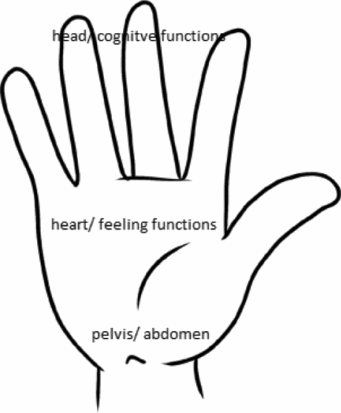
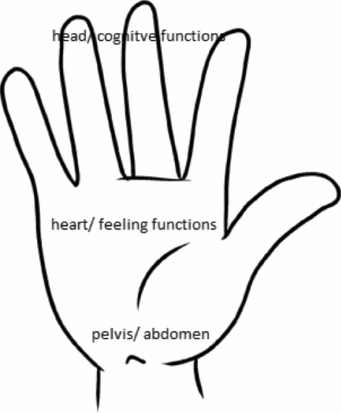
Unlike any other body part, our hands are extraordinary complex sense organs. On our fingertips, every square inch of skin has about 16,000 touch sensors that communicate with our brain (Murphy, Reference Murphy2010). Traditional Eastern and Western medicine teaches that the hands mirror the entire human organism. We can find references to this in acupuncture, acupressure, reflexology and palmistry. The base of the hand relates to the pelvis and abdomen and is used to execute motor impulses such as pressure and pushing. The centre of the hand has the feeling function; it is in touch with the heart and lungs. In order to really connect with an object, the hand needs to be flat. The fingers reflect the head, its cognitive and subtle perceptual functions. The fine motor skills of the fingers can “see”. In this context, the thumb is not a finger, but executes impulses arising from the instinctual base of the hand.
Sense of balance. The landscaping of the Clay Field by this 11-year-old boy is imbalanced. In the left half, he built a fort, while the right half was initially deserted. His parents had recently separated. He continued to create a battle scene with figurines he had brought to the session in his school bag. The chasm has now widened. It is filled with water, which connects, and the action figures, even though at war, have contact with each other.
Haptic Perception and Haptic Object Relations in Work at the Clay Field
Let us now examine haptic perception, and more specifically the core components of Work at the Clay Field®, as haptic object relations. These include haptic object relations through skin sense; haptic object relations through the vestibular sense of balance and haptic object relations through depth sense. The primary motivation for human development is based on our relationship with others, our self and the environment. These factors shape the human psyche and our sense of identity. However, while human relationships are constantly shifting and changing, the clay offers neutral feedback. It only mirrors what children project into it with their hands.
Observing hands in the Clay Field allows diagnostic conclusions about clients’ embodiment and patterns of dissociation. Haptic object relations refer to the way humans learn to handle the world and how infants and children discover the environment they live in. At every developmental stage are core needs that demand satiation. They are relational building blocks that can be clearly observed at the Clay Field. Their sensorimotor fulfillment through touch has neurophysiological repercussions, such as the embodied knowledge of a vital sense of self, a feeling of aliveness and inner stability. If the sensorimotor basis remains fragmented due to biography and life events, hand actions remain instable and fragile. Such instability in the embodiment of the self, manifests as lack of confidence and vitality and is at best compensated through fantasies. Many however, will be constantly triggered by their fears and act out or disappear behind a veil of numbing shut down.
At the Clay Field, children's hands will unerringly find exactly that developmental stage that requires attention and, if supported in their efforts, they will aim to explore and retrieve the lost and necessary aspects of their developmental building blocks.
Haptic Object Relations through the Skin Sense
Developmentally, this building block is learnt between the ages of 0 to 12 months. Skin contact here is the primary mode of communication. Touch communicates safety, love and emotional regulation. Skin contains and surrounds the entire human body. It divides our inside from the outside. There is only a rudimentary sense of self, which can be stimulated when something comes to the skin from the outside. Only then can the perception of a felt boundary emerge as a layer of contact between the self and the other.
At the Clay Field, the clay is perceived as there somehow, it has a being-quality as the hands search for contact, for a tangible supportive base on which they can rest. Hands here are dreamy, they are not doing anything. Individuals who need to regress to this stage due to insecure attachment for example, or due to the need to reconnect with a comforting maternal presence experience the clay purely as contact as something that is available, smooth, supportive and soft. The hands and also arms, elbows and even the head may want to rest on the clay or cuddle into it.
Depth Sensibility. A 2.5-year-old boy discovers his strength. Pressure is applied, predominantly with the base of the left hand, while the right hand pushes. Such actions require organisation in the body, an upright spine and his feet planted firmly on the ground and the joints aligned in order to have an effect on the material.
It is clearly visible when the clay is not available for a child's hands, when they cannot connect with the field. The hands seem to ask: Is it safe to touch this? To support contact with the clay, a sponge can be used to add water and often the clay is turned into a soft smooth bog into which the hands can sink. Liquid clay can be creamed onto the hands, arms and face. The clay then embeds and surrounds the skin, warms and caresses it like a mother's touch. Such active self-fulfillment can be deeply reassuring. If the clay begins to dry then this dry clay on skin will enhance the awareness of the skin boundary.
Children who lack experiences of being held and being safe will greatly benefit from having their hands packed into clay. Packing the hands in the clay is a kin to and often experienced as being held in a warm safe embrace, a hug. In this case, the therapist will gently pile clay around the child's hands; warm water can be poured into the cavity to create a “womb”, a prenatal environment. It can be quite surprising to find otherwise restless, unfocussed children settle in this holding space, to witness how they calm down and surrender to the fulfillment of nurturing needs.
Developmentally, older infants who have gained a sense of trust will now play with the clay similar to a toddler left alone with a bowl of mashed potatoes. They will pat and smear, squish and squirt, relishing how the clay can ooze through the fingers. All is sensual delight. The hands want to grab the clay full of vital desire. They do not want an object. They just want to have it. Explore how much they can have of it. Conflict arises out of past experiences such as: “The others always get more. I never get enough!”
Depth Sensibility. All the material was piled into the water container by this 4-year old. Standing up he used every bit of his strength to press it down. Every joint and muscle in his body is aligned. He is immensely proud of his achievement to be able to have it all and move it all, to be “sooooo strong!”.
The fulfillment of these vital actions resonates in the entire body and awakens tonus and awareness. If a piece of clay is lifted out and shown to the therapist: “Look! I have got something”, it is in the context of the skin sense, purely about desire, not about creating an object. All these actions have no permanence. Furrows and indentations may be filled in the next moment and piles patted down. The hunger to have is vitally necessary for inner stability. Object constancy here is acquired through building up and tearing down, digging out and filling in as a lustful acquisition.
Rhythmic repetition, through tapping with fingertips, banging with the fists, caressing with the open hand or poking with the index finger helps the interoceptors to remember achievements. It may take a number of sessions to complete developmental cycles that were not fulfilled as infants. Here, children seek oneness, contact and attunement where otherwise erratic children can experience contentment. Surprising amounts of time can be spent here caressing smooth mounds of clay while humming happily. It is important not to push for meaning, rather to allow children to satiate their need for safe attachment.
For older children and adults with developmental maturity, the skin sense becomes linked to our sensory awareness. Through mostly sensing with the flat hand, we can distinguish physical qualities in the clay such as soft or hard, dry or soggy as well as also projecting emotions into the material such as loving or disgusting; broken or fertile; reliable and safe. The clay at this stage frequently evokes memories of a sensual and sexual nature. Since trauma almost always affects an individual's skin boundary, traumatic body-memories are easily provoked through the skin sense. “Resolved” hands that have discharged the tension from previously held anxiety appear relaxed in their contact with the flat hand on or in the clay. They are visibly comfortable in their skin.
Depth Sensibility. This 9-year-old girl took great delight in retrieving these balls from the watery bog of her skin sense soup. She then piled them up in the centre of the field, asserting her identity and sense of self.
Haptic Object Relations through the Vestibular Sense of Balance
The most significant developmental achievement between the age of one and two is the discovery of a physical identity, of being a separate individual. This physical sense of self is primarily perceived as a growing awareness of the spine. Toddlers can now walk. Moving upright separates them from the ground and from there they begin to explore away from the safety of their care givers. The discovery of duality, however, is charged with emotional ambivalence. On one side is the powerful urge to be curious, while on the other is the terrifying expanse of an unknown world. One hand dips into the Clay Field, the other holds onto the side of the box for security. The discovery of an other-than-me provokes differentiation between self-perception and object-perception. This is not yet object creation, but object perception.
Initially, this encounter between the self and “world” in the Clay Field is acted out as touching and letting go, as connecting and disconnecting of the hands. A game toddler's love worldwide is Gone-There or Peek-a-Boo. Something disappears and returns, mother leaves and comes back. Trust is gained through distancing and connecting.
Alternating, synchronised, rhythmic dance movements that stimulate a rotation around the spinal axis provoke physical self-awareness. Drumming a beat into the clay resonates in the entire body and stimulates the awareness that the body has two sides and a centre, the left and the right and the central axis of the spine. Identity here is physical. See-sawing movements, weighing bits of clay in each hand, or “walking” across the field holding balls of clay or square-shaped stamps to claim the space are all part of this body-based discovery of the self. The Clay Field in this context takes on the role of the stabilising third that gives the moving hands and the moving body a reliable hold.
This 12-year-old girl has suffered sexual abuse. The right hand is not engaged at all, the left is frozen in fear. Her inner tension is visible in every finger. Curiosity to touch and withdrawal are fighting inside her.
At this developmental stage, children will also experiment with age-specific separation anxiety. This is acted out by picking bits out of the clay. A handful of clay becomes separated from the whole and put back into it, reunited with it. The hands can cause imbalance and repair it. Separation and contact has now been transferred onto a thing, an object (Elbrecht, Reference Elbrecht2012).
Balance as a spatial order manifests in the Clay Field as small and big, high and low, empty and full. These are not yet meaningful landscapes even though they may evoke associations of mouse and elephant, mountain and valley, swimming pool and tower. The lack of such opposite pairs is usually an indicator for traumatic overwhelm, as it points towards a loss of perspective and orientation. The accompanier may facilitate by asking for the matching opposite and thus assist to rebalance a child's nervous system.
In older children, the loss of a parent through death, divorce or absence will inevitably manifest as imbalance, whereas parental unison can be observed as coordination of the hands, alignment of the body, with the field and landscaping both sides and the centre of the Clay Field. In the context of the Clay Field setting, the left and right side of the body, as with the clay field represent the parents. The centre represents the self as the sense of the spine is an embodied experience of self. All children need to find a way to exist alongside their parents, whether they are together or apart. Schore (Reference Schore, Solomon and Siegel2003) reports that by 18 months of age there is both a mother attachment system and a separate father attachment system. At the Clay Field, imbalance in children is when only one hand is being used, while the other remains inactive. They will only fill or imbue life in sections of the field while other sections are ignored. This is similar to aspects of their psyche also being ignored. The body twists sideways when part of the child's psyche twists away from something unmanageable and has learned not to be involved. When children have to come to terms with their parents’ divorce they often build divisions in the field such as trenches, ditches, rivers, walls and fences. Children who can restore balance within themselves at the Clay Field have far more resilience and cope better with adverse circumstances at home than those who are left powerless. In this case, their hands will build bridges or tunnels that connect the two hemispheres of the field. Water is often used with abundance to enhance the connection.
The formation of attachment relationships has life-long implications for individuals. Insecure attachments and accumulative stress from early childhood abuse and neglect causes structural impairments to the developing brain such as the neural networks that establish the capacity for social and emotional functioning (Schore, Reference Schore, Solomon and Siegel2003). Psycho-neurologically abuse and trauma creates a hyper-alert status of flight or fight in children and “their rational brains lack proper control over their emotional brains” (Van der Kolk, Reference Van der Kolk2014, p. 310). At the Clay Field, any encouragement to use both hands in the creative process will be of benefit; the cooperation between both hands and eventually a balanced use of the entire field will assist a child to reset the equilibrium.
Haptic Object Relations through Depth Sensibility
Healthy children complete their sensorimotor foundations between 2 and 4 years of age with the acquisition of depth sense. “Depth sensibility describes the awareness of deep-reaching bodily firmness and weight, the perception of interconnected joints and structural build of the hands” (Elbrecht, Reference Elbrecht2012, p. 69). Children have satiated their need for secure attachment through the experience of oneness and support through skin sense. They have discovered their physical sense of identity through balance, in particular in the spine and their ability to be upright. With depth sensibility, they learn to do things, to handle an other-than-me. Depth sensibility is characterised by the urge to move, have and mark the clay. Such actions give children a sense of power and competence. They confirm the previously acquired physical sense of identity (balance) and expand it into the psychological emergence of I-ness, of Ego. The clay now takes on an able-quality; it becomes graspable, pliable and moveable. Children's hands dig, grab, push, pull, squeeze, excavate, lift, pound, strangle, hit, rip, turn and move the clay in many different ways experimenting with pressure. The core achievements of depth sensibility are: pressure, impressions and imprints, pushing, pulling, drilling and differentiating.
This 12-year-old boy has constructed a meaningful world, a water tower. With a sponge, he squirts water onto the top and follows its flow through tunnels and floodgates, a scenario, which helps him to deal with the flow of his emotions.
These are intentional gestures that are directed towards an object and the effect the hands have, becomes instantly visible in the clay. The experience for the child is simultaneous: the hands demonstrate visible capability through their experiments with pressure, while their body gives them a powerful felt sense (Gendlin, Reference Gendlin1981) of coordinated joints, muscles, ligaments and an aligned skeletal system. Children who have not been able to develop a reliable skin sense and balance are the ones who at this stage begin to act out in frustration or respond through withdrawal. Their bodies are not coordinated, their hands have no effect, and their identity is too feeble to have the courage to acquire skills. During this time too, a diagnosis of ADHD and other behavioural and learning disorders are prevalent for many of the children whose history holds abuse and trauma (Van der Kolk, Reference Van der Kolk2014). Further, it can be astounding to witness such children, when they are supported to develop these sensorimotor building blocks at the Clay Field.
Initially, children will experiment with simple pressure as a directed impulse. Sometimes they simply need to be shown in a playful demonstration how they can plant their feet firmly on the ground, erect their spine, align arms, shoulders, elbows, wrists and hands and apply maximum pressure onto the clay and be strong! The clay can be pushed away or pulled towards the body, but all movements require tonus and the concentration of physical strength.
The clay in this context still has no particular symbolic meaning. It is simply a mass that is there and it provokes handling. Children learn to deal with tension and charge directed towards an opposite. Their hands are now firm and filled with tonus; they radiate enthusiasm, anticipation and tension. They discover flexibility and rhythm and learn to maintain distance in the contact with an opposite. They neither need to cling to the other for support as in skin sense, nor balance it. They can face the Clay Field, deal with it and confront it with intention.
Such sensorimotor achievements allow children to write implicit memories that are similar to riding a bike or learning to swim; they will not be forgotten. The hands and all the large joints: shoulders, pelvis and hips, the knees and ankles awaken to their muscular and skeletal substance and become one integrated organism. This includes embodied knowledge of the skin being firm and containing the individual within, with a clear boundary. Such expanded embodiment through tonus and bodily organisation communicates solid positioning within the physical self.
The Clay Field is wonderfully suited for such experiments. Children will test their endurance at times — “Look how long I can push down!”, and thus experience their impressive power and simultaneous grounding in their body. They will squash down piles and vehemently flatten mountains. As they take possession of the field, they explore their relentless potency. Pushing is far more dynamic than simple downward pressure. Now, children are dealing with mass and resistance in a linear, intentional movement away from the body. The hands cause distance; they cause the creation of new space; they cause separation. Or, if they want to have a close encounter with an opposite; then they bring in the material, retrieve it and pull it close to the body in a big hug. Once push and pull have become integrated patterns, the entire mass of clay becomes available. The material can be moved to the sides, it can be rolled, turned over, divided and put together.
Drilling into the clay allows the investigation of the inner substance of the material, its texture, reliability and resistance. The bottom of the field becomes tangible as depth of space. The initially punctual encounter of the ground is an incentive to uncover it, to reveal it and turn it into a reliable base. Gradually, large formations gain shape such as mountain or valley or lake. The hands become amazingly potent; they can move it all, handle it all, own it all or discard it all.
Experiments with differentiation involve small and large amounts of clay that are bulldozed out, shoveled out, cut out, raked or drilled out. However, something that has been separated from the whole is now no longer returned to the whole as in balance, but demands handling. Such bits survive as something special and are deposited outside of the box or collected in the hands. Piles are placed along the boundary, often as patterns or emphasising the corners. Eventually, the hands will pick up the pieces and gather them in a ball and place it into a central space in the field. Such an object becomes enduring and lasting. Children often want to take such a ball home.
It takes however, the separation of the hands from all this action to perceive consciously that they have made a mark: “I was there – now I am gone – but the mark is still there”. This is the beginning of making an object. Similar to the hand prints in prehistoric caves where the intention was then as it is now to leave a mark. Imprints expand the haptic gesture into visible, traceable marks. Identity now expands into the becoming of a conscious creator. Furrows, dents, ruts and grooves in the Clay Field will now no longer be wiped away and such marks now need a story. From this point onwards, children know two core life lessons: the knowledge that they can create and that their creation has lasting stability; and that they have gained physical stability within, direction and a place in space.
Working with Older Children at the Clay Field
From now on, children need to strengthen their conscious abilities; they need to make meaning of what their senses created. In the language of neurology, children need to stimulate their left-brain hemispheres, their cognitive, ordering skills. Their genesis, their cosmology has now to be extracted from their biology.
Deuser (personal communication, 2014) refers to skin sense, balance and depth sensitivity as the “sensorimotor toolbox”, a skill set every child needs to acquire in order to grow into a vitally confident individual. All further age-specific stages characterised by creating objects, and attaching meaning and stories to them rests on this sensorimotor base. If developmental trauma has thwarted healthy development, it will manifest as a fragile base in older children; they will be less resilient, emotionally dysregulated and unable to claim what they need from life circumstances with confidence. Such children literally cannot put their hands into the clay; it is not “there” for them. A study in Germany (Hölz, Reference Hölz2013) has confirmed that this as the basis for many symptoms later on diagnosed on the spectrum of ADHD.
Troubled children will unerringly regress to the age that remains incomplete. It is really important that older children are allowed to engage with incomplete developmental cycles without judgment and pressure to act more grown up. Once the need for skin-sense-attachment, or self-perception through balance has been satiated, they will move on in their own time, having gained trust and reliable self-awareness.
Attachment disorders manifest when the hands cannot touch the material or only tiny amounts of it, when they shy away to penetrate the material. Schore (Reference Schore2001, Reference Schore, Solomon and Siegel2003, Reference Schore2012) and Van der Kolk (Reference Van der Kolk2014) report that the only response available to children is withdrawal and dissociation or acting out their inner feelings of being overwhelmed and frustrated. As stated previously, this manifests in the Clay Field as not being able to engage with the material or through hitting and throwing the clay. Whether hyper- or hypo-aroused, both groups are unable to relate to the clay. Hyperactive children benefit from reminders that their hands might get tired and may enjoy a break to have a warm bath in the water bowl or a rest in a clay enclosure. This initiates experiences of nervous system regulation. Whereas, timid children benefit when the therapist bridges their dilemma by providing an empty box into which the clay is tipped from a container and child and therapist work together to prepare the field for the session. Thus, the destructive act is shared and becomes a joint responsibility and the withdrawn child is given an experience of relational attunement.
All hand movements in the Clay Field reflect how children learn to approach and deal with the world. It becomes apparent where relationships and life experiences bring a sense of safety or of being unsafe. All this emerges through touch and sensorimotor action rather than through cognitive processing of the life story.
The therapist can observe how self-worth, self-esteem and competence are being expressed, or how a child struggles with the lack of these. How does a child cope with failure, when constructions in the Clay Field break? How do they handle hardship, when it manifests as heavy, resistant clay that requires effort to move? How do they negotiate blockages and difficulties and the moments when things do not work out as expected? How do they claim space and ownership in the field? What does it take, so the Clay Field can become “mine”, my world, my space, my ground?
Children are not in charge of their own lives. They are dependent on a multitude of factors beyond their control. Their core need is to fulfil their inner potential according to their age-specific skill level in a safe setting with secure attachments. Children have to negotiate their own autonomous impulses and retrieve their I-ness from the chaos that is often rampant in their world. This may find its expression in a house or landscape that gets demolished in order to build something that is independent of the changes surrounding the child; something that has permanence and is deeply connected to the child's sense of self.
The drama of a child's family is played out. Care, grief, resentment and the re-establishment of authorities such as step-parents or other care givers are negotiated, often in symbolic form. Natal and postnatal physical needs are attended to with and in water. Pizzas are baked and shared, football fields map out rules and order, disaster scenarios require rescue plans, dangerous adventures are dared and their stories told. Gradually, children will learn age-specific social integration, self-esteem and competence through sensorimotor actions. Emotionally, children will build identity, certainty, consistency and claim their own ground as opposed to a diffuse identity and feelings of inferiority. In the tension between initiative and guilt, children learn to become responsible for their actions. Solutions in the Clay Field tend to emerge as simple, symmetrical and centred designs.
Work at the Clay Field® is a specific therapeutic approach and requires years of training. It might, however, be important especially for art therapists and child therapists to become more aware of the importance of haptic perception (Elbrecht, Reference Elbrecht and Malchiodi2015). To touch clay or paint or a toy provokes a relationship of the hands with the material. Whenever it becomes apparent that the hands cannot relate, either through not daring to take what they need or through senselessly violating the material by throwing or hitting it, the therapist needs to offer affect regulation and resources through creative interventions. Fearful children, whether they behave withdrawn or hyperactive will need support to find a way to feel safe. Once they have gained trust in the setting, their hands will unerringly discover whatever is developmentally required to master the offered world in the Clay Field.
A glimpse into a Clay Field Session
Children and adolescents come into therapy for a variety of reasons, many related to trauma. There is no one singular setting that would adequately describe all of the variations that are witnessed at the Clay Field. This article endeavours to outline the underpinning theory of haptic perception and haptic object relations. However, to glimpse into how a Clay Field session may be, imagine a simple setting where there is a table and two chairs, the Clay Field holding an appropriate amount of clay, a small bowl of water and a sponge. This setting may be in an art therapy or play therapy studio, a school setting or in a child therapist room. A Clay Field session may be up to 45 minutes in time.
Just as any other therapeutic process, forming a productive therapeutic relationship is paramount (Malchiodi, Reference Malchiodi2015). Some children may begin to engage with the clay immediately, while others may need the support of the therapist to find a way to engage. While children at the Clay Field may talk and share stories of what it is that they are forming, imaging or experiencing at the Clay Field, this is not the primary focus of the therapist. While engaging within the child's narrative the therapist is attuned to the hands of the child, the movements and the body posture. It is these aspects of the encounter that provide the markers for accompanying and supporting the child in Work at the Clay Field. Water is provided and a sponge is available for the child to add water to and to remove water from the field. There are themes to the ways that children engage with the Clay Field, however, the common denominator of Work at the Clay Field is the sensorimotor tool kit of skin sense, balance and depth sense. Through a knowledge of how these manifest, the therapist can support the child to acquire the developmental achievements that were previously missing.
Conclusion
The simple setting of a flat, rectangular wooden box offers permanence and a container for the forever changing, pliable mass of clay within the Clay Field. Touching the clay in this contained environment addresses developmental deficiencies and dissociation due to trauma through haptic sensorimotor action cycles that affect bodily organisation, emotions and cognition. In all these cases, individuals turn back the clock to earlier developmental stages. At the Clay Field these can be satiated and integrated. The skilled observation of haptic object relations through the skin sense, balance and depth sensibility gives the therapist a diagnostic tool of developmental arrests and trauma responses as well as progress of repair.
Because developmental trauma compromises internalised sensory motor and externalised relational experiences, a top-down cognitive approach rarely works. Through establishing a bottom-up sensorimotor way of working at the Clay Field, no story needs to be remembered, but the lost or underdeveloped aspect of the self can gradually be repaired and remembered through the felt sense (Gendlin, Reference Gendlin1981). “When neurological development has been compromised, it is necessary to support the emergence of the body's own impulses and movements” (Heller & LaPierre, Reference Heller and LaPierre2012, p. 243).
Haptic perception encourages children to use the physical, emotional and social building blocks of infant's hand-movements to connect to their neurological pathways in order to rewrite implicit memory. These developmental achievements through touch transcend gender, race and socio-economic status. They are universal. Children need to be witnessed by a supportive adult while they learn to find secure attachment through touching the clay and being touched by it. Once children have gained sufficient resources, order and safety at the Clay Field, and when they can find an active response to a once overwhelming event (Levine, Reference Levine2010), they begin to master their world creatively and live life with a sense of vital curiosity.