INTRODUCTION
Neosporosis, caused by the apicomplexan cyst-forming coccidian parasite Neospora caninum, is a major cause of abortion in cattle worldwide (Dubey et al. Reference Dubey, Schares and Ortega-Mora2007; Dubey and Schares, Reference Dubey and Schares2011). The N. caninum life cycle includes 3 different stages. Initially, sporozoites inside oocysts are shed in the feces of dogs, which are the definitive hosts. The second stage consists of fast-replicating tachyzoites responsible for the acute phase of infection (primo-infection or reactivation). Lastly, the dormant bradyzoites persist inside tissue cysts in the brain and muscle tissues during chronic infection. These cysts remain quiescent while awaiting an appropriate immunological environment for reactivation. Although post-natal infections occur in cattle after oocyst ingestion, the major route of parasite transmission is congenital infection by transplacental transmission (TT), which, depending on the origin, can be classified as exogenous TT (ExTT) or endogenous TT (EnTT). Exogenous TT occurs as a consequence of a post-natal primo-infection during pregnancy, whereas EnTT seems to take place after a reactivation of a chronic infection during pregnancy as a consequence of the conversion of bradyzoites to tachyzoites (Trees and Williams, Reference Trees and Williams2005).
Experimental ExTT has been successfully induced in cattle (Macaldowie et al. Reference Macaldowie, Maley, Wright, Bartley, Esteban-Redondo, Buxton and Innes2004). However, EnTT has not been reproduced because cows experimentally infected before insemination give birth to uninfected calves (Trees and Williams, Reference Trees and Williams2005). Nevertheless, some studies indicate that EnTT is the more frequent and efficient route of transmission in naturally infected cattle compared to ExTT (Trees and Williams, Reference Trees and Williams2005). In mice, congenital models have been developed to study acute infection associated with ExTT and to examine the frequency of the TT of N. caninum (López-Pérez et al. Reference López-Pérez, Risco-Castillo, Collantes-Fernández and Ortega-Mora2006, Reference López-Pérez, Collantes-Fernández, Aguado-Martínez, Rodríguez-Bertos and Ortega-Mora2008). Moreover, these models have been successfully employed to evaluate the protective efficacy of vaccine formulations (Aguado-Martínez et al. Reference Aguado-Martínez, Álvarez-García, Fernández-García, Risco-Castillo, Marugán-Hernández and Ortega-Mora2009a; Rojo-Montejo et al. Reference Rojo-Montejo, Collantes-Fernández, Rodríguez-Marcos, Perez-Zaballos, López-Pérez, Prenafeta and Ortega-Mora2011; Jiménez-Ruiz et al. Reference Jiménez-Ruiz, Álvarez-García, Aguado-Martínez, Salman, Irache, Marugán-Hernández and Ortega-Mora2012). Thus, mouse models able to reproduce the reactivation of infection could be extremely useful in testing drugs and vaccine efficacy against EnTT. Although it is known that reactivation of N. caninum infection is possible in mice, the success of previous attempts in terms of TT rates was limited (Omata et al. Reference Omata, Nidaira, Kano, Kobayashi, Koyama, Furuoka, Maeda, Matsui and Saito2004; Rettigner et al. Reference Rettigner, De Meerschman, Focant, Vanderplasschen and Losson2004; Kano et al. Reference Kano, Masukata, Omata, Kobayashi, Maeda and Saito2005). Moreover, it is difficult to compare these earlier studies because oestrus was not synchronized and the morbidity and mortality rates associated with N. caninum infection were not evaluated in the newborn pups. An additional consideration is that reactivation may be dependent on the virulence of the isolate used (Pereira García-Melo et al. Reference Pereira García-Melo, Regidor-Cerrillo, Collantes-Fernández, Aguado-Martínez, Del Pozo, Minguijon, Gómez-Bautista, Aduriz and Ortega-Mora2010; Regidor-Cerrillo et al. Reference Regidor-Cerrillo, Gómez-Bautista, Del Pozo, Jiménez-Ruiz, Aduriz and Ortega-Mora2010, Reference Regidor-Cerrillo, Gómez-Bautista, Sodupe, Aduriz, Álvarez-García, Del Pozo and Ortega-Mora2011).
Therefore, the aim of the present study was to induce the reactivation of N. caninum infection through synchronized gestations in chronically infected dams and their congenitally infected pups in 2 consecutive generations, emulating the EnTT described in pregnant cattle. Two N. caninum isolates, Nc-Spain 3H and Nc-Spain 7, were used; both of these isoloates showed high TT rates, although they differed in their virulence and were classified as low- to-moderate (Nc-Spain 3H)- or high (Nc-Spain 7)-virulence isolates.
MATERIALS AND METHODS
Mice
Two groups of 54 (G1 and G2) and 1 group of 24 eight-week-old female BALB/c mice (G3) were obtained from a commercial supplier (Harlan Interfauna Iberica, Barcelona, Spain). They were free of common viral, parasitic, and bacterial pathogens according to the results of routine screening procedures performed by the manufacturer. The mice were fed ad libitum and maintained in a controlled environment with 12-h light/dark cycles. All protocols involving animals were approved by the Animal Research Committee of the Complutense University, Madrid, Spain, following proceedings described by the Regulation of Internal Regime for Animal Research Committee (published at BOUC, no. 2, on 9 February 2006) and EU legislation (Council Directive 86/609/EEC).
Parasite and preparation of inocula
Neospora caninum Nc-Spain 7 and Nc-Spain 3H tachyzoites were maintained in vitro by continuous passage in MARC-145 cells using standard procedures (Pérez-Zaballos et al. Reference Pérez-Zaballos, Ortega-Mora, Álvarez-García, Collantes-Fernández, Navarro-Lozano, García-Villada and Costas2005). The cell cultures were scraped, and the parasites were passed through a 25-gauge needle to eliminate cellular debris. The tachyzoites were centrifuged for 15 min at 1350 g and re-suspended in sterile phosphate-buffered saline (PBS), pH 7·4. The viability and total parasite counts were determined by Trypan blue exclusion using a Neubauer chamber. The parasites were re-suspended in PBS at the required dose of 106 tachyzoites in a final volume of 200 μl/mouse and used immediately to infect the mice subcutaneously. Nc-1 tachyzoites were prepared as previously described for PCR controls (López-Pérez et al. Reference López-Pérez, Risco-Castillo, Collantes-Fernández and Ortega-Mora2006).
Experimental design and parameters evaluated
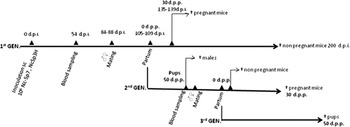
BALB/c mice were infected with 106 tachyzoites of 2 different N. caninum isolates that displayed significant virulence differences in previous studies (Regidor-Cerrillo et al. Reference Regidor-Cerrillo, Gómez-Bautista, Del Pozo, Jiménez-Ruiz, Aduriz and Ortega-Mora2010; Pereira García-Melo et al. Reference Pereira García-Melo, Regidor-Cerrillo, Collantes-Fernández, Aguado-Martínez, Del Pozo, Minguijon, Gómez-Bautista, Aduriz and Ortega-Mora2010; Caspe et al. Reference Caspe, Moore, Leunda, Cano, Lischinsky, Regidor-Cerrillo, Álvarez-García, Echaide, Bacigalupe, Ortega Mora, Odeon and Campero2012). Nc-Spain 7 is a highly virulent isolate characterized by a high TT rate to the offspring (79%), high morbidity rates in dams (30%) and pups (98%), a high mortality rate in transplacentally infected pups (95%) and fetal death and abortion in cattle. Conversely, Nc-Spain 3H, when employed at the same dosage, is a low-to-moderate-virulence isolate; clinical signs have been observed in only 10% of pups, while mortality rates were 8% in pups and 0% in dams. Interestingly, 89% TT was recorded in pups born to dams inoculated with this isolate. Group 1 (G1) was inoculated with 106 tachyzoites of Nc-Spain 7 per mouse. Group 2 (G2) received 106 tachyzoites of Nc-Spain 3H per mouse, and group 3 received an injection of PBS and served as the negative control to monitor the environmental conditions. The mice of these groups represented the first generation, and the overall experimental design is shown in Fig. 1. After 54 days post-infection (p.i.), blood samples were collected and specific N. caninum antibodies were measured. At day 90 p.i., the mice were mated following synchronization of oestrus by the Whitten effect, as previously described (Whitten, Reference Whitten1957), and their pups represented the second generation. The pups were maintained until day 50 post-partum (p.p.), when the males were sacrificed and blood and tissue samples (brain and lungs) were collected. A blood sample was taken from each female's tail to identify the seropositive mice. The seropositive females were mated following the same procedure described above; their pups represented the final third generation and were sacrificed at day 50 p.p. The dams of the first and second generations were sacrificed at day 30 p.p. The non-pregnant mice in the first generation were maintained until day 200 p.i. to assess the progression of the N. caninum infection. Any mice exhibiting clinical signs of infection were euthanized in a CO2 chamber.
Experimental design. †Animals sacrificed. sc, Subcutaneously; d.p.p., days post-partum; d.p.i., days post-infection

Data regarding the fertility rate, litter size, post-natal mortality and clinical signs of dams and pups were collected throughout the experiment. The fertility rate was calculated as the percentage of female mice that became pregnant after being housed with males. Post-natal mortality was calculated as the number of pups that died between days 3 and 50 p.p. All of the mice were euthanized in a CO2 chamber. The brains and lungs were aseptically collected from non-pregnant mice, dams and pups and frozen. Some samples from dead animals were lost due to cannibalism. Serum samples were also collected and frozen until analysis. Parasite presence was investigated by PCR in the brain and lungs. All of the brains were analysed by PCR, whereas the lungs were only processed when parasites were not detected in the brain. Lastly, specific antibodies were measured in the sera.
Neospora caninum detection by DNA extraction and PCR techniques
Genomic DNA from the lungs and brains of the mice was extracted using a commercial Maxwell® 16 Mouse Tail DNA Purification Kit, developed for the automated Maxwell® 16 System (Promega, Wisconsin, USA), following the manufacturer's instructions. For the detection of parasite DNA, a nested-PCR procedure based on the internal transcribed spacer 1 (ITS1) region of N. caninum was carried out as previously described (Buxton, Reference Buxton1998). DNA from Nc-1 tachyzoites was also extracted as a PCR control.
Analysis of the humoral immune response
Total N. caninum-specific IgG, IgG1 and IgG2a antibodies were measured by ELISA using tachyzoite soluble antigen (0·25 μg per well). Specific antibody responses directed against NcSAG4 and NcGRA7 were measured in recombinant protein-based ELISAs (0·1 μg per well) (Collantes-Fernández et al. Reference Collantes-Fernández, López-Pérez, Álvarez-García and Ortega-Mora2006; Aguado-Martínez et al. Reference Aguado-Martínez, Ortega-Mora, Álvarez-García, Rodríguez-Marco, Risco-Castillo, Marugán-Hernández and Fernández-García2009b). Anti-N. caninum total IgG, rather than specific IgG1 or IgG2a isotypes, was measured at day 54 p.i. (first generation) and at day 50 p.p. (second generation before mating) due to the low volume of serum obtained from blood samples collected from the tails. Neospora caninum soluble protein antigen was prepared as previously described (Álvarez-García et al. Reference Álvarez-García, Pereira-Bueno, Gómez-Bautista and Ortega-Mora2002), and the recombinant proteins were produced and purified as previously described (Alvarez-Garcia et al. Reference Álvarez-García, Pitarch, Zaballos, Fernández-García, Gil, Gómez-Bautista, Aguado-Martínez and Ortega-Mora2006; Fernández-García et al. Reference Fernández-García, Risco-Castillo, Zaballos, Álvarez-García and Ortega-Mora2006). The serum samples were diluted 1:100, and the secondary antibody was horseradish peroxidase-labelled rabbit anti-mouse IgG (1:5000 in PBS-0·05% Tween 20; Sigma, St Louis, MO, USA). The absorbance was measured at 405 nm in an electronic plate reader (Multiskan RC version 6.0, Thermo Labsystems, Helsinki, Finland).
Data analysis
The post-natal morbidity and mortality rates were analysed using the Kaplan-Meier survival method to estimate the percentage of animals without clinical signs and the percentage of surviving individuals at each time-point (days p.p.). To compare the survival curves between infected groups, the log-rank statistical test was applied (Bland and Altman, Reference Bland and Altman2004). A one-way ANOVA test followed by Duncan's multiple range test was employed to compare the neonate body weights and serum anti-N. caninum IgG. The differences in parasite detection by PCR and vertical transmission were analysed using the Chi-squared and Fisher's exact tests. The non-parametric Kruskal-Wallis test was used to analyse differences in the severity of lesions. When significant differences were found, a non-parametric multiple comparison test was employed to examine all possible pairwise comparisons. A value of P < 0·05/ [k × (k − 1)/2] was considered statistically significant, with k corresponding to the number of groups. When statistically significant differences were obtained using the Kruskal–Wallis test but were not detected by the multiple comparison test, the results obtained by the Kruskal–Wallis test were preferred, as indicated by Morrison (Reference Morrison2002). All of the statistical analyses were carried out using Statgraphics Plus v.5.1 (StatPoint, Inc., Herndon, VA, USA) and GraphPad Prism 5 v.5.01 (San Diego, CA, USA) software.
RESULTS
First generation
Data on the fertility rates, litter size and mortality rates are summarized in Table 1. Mice from G1 (Nc-Spain 7) developed clinical signs such as anorexia, rough coat, and inactivity followed by nervous signs (rounded back, pelvic limb weakness and walking in circles). In contrast, less severe clinical signs were observed in mice from G2 (Nc-Spain 3H), in which only 1 mouse showed serious nervous signs and was euthanised before mating. A high mortality rate was also recorded in G1 (P < 0·0001; χ 2); almost 30% of these mice died before mating on day 84 p.i., and a mortality rate of 44·4% was recorded at the end of the experiment. Conversely, a mortality rate of only 1·8% was observed in G2. Regarding the fertility rates, fewer mice from G1 became pregnant than from G2 (P < 0·05; Fisher's exact test).
Fertility rates, litter size and mortality rates in mice

* No. of mice in the first generation (including pregnant and non-pregnant mice) that were sacrificed due to the severity of clinical signs occurring before mating/no. of mice in the group (percentage).
a No. of pregnant mice in each generation/no. of females in each generation (percentage).
b Average number of pups born ± standard error.
c No. of pups (males and females) that died between days 3 and 50 p.p./no. of pups born alive (percentage).
d No. of litters in which at least 1 pup died between days 3 and 50 p.p./no. of litters in the group (percentage).
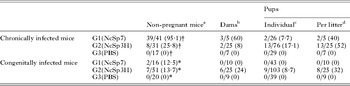
Parasite DNA was detected in 95·1% of non-pregnant and chronically Nc-Spain 7-infected mice, versus 25·8% in mice infected with Nc-Spain 3H (G2) (Table 2). Parasite detection rates were significantly lower in dams analysed at day 30 p.p. (day 135 p.i.) than in non-pregnant mice in both groups (P < 0·0001; χ 2; Table 2). Only 8% of the pregnant mice were PCR-positive in G2. Moreover, a clear difference in the percentage of positive dams was observed between the infected groups (higher in G1 than in G2; P < 0·05; Fisher's exact test). Interestingly, 1 negative dam from G1 and 7 negative dams from G2 transmitted the parasite to their pups (second generation).
Parasite presence in chronically infected dams and their pups (first and second generations, respectively) and in congenitally infected dams and their pups (second and third generations, respectively)

† Mice that died or were sacrificed due to the presence of clinical signs prior to mating (several samples were lost due to cannibalism) together with non-pregnant mice that were sacrificed at the end of the experiment.
* Males and non-pregnant females from the second generation.
a No. of non-pregnant mice positive by nested-PCR/no. of non-pregnant mice in the group (percentage).
b No. of dams positive by nested-PCR at day 30 p.p./no. of dams in the group (percentage).
c No. of pups positive by nested-PCR (from day 3 p.p. to the time of sacrifice)/no. of pups (from day 3 p.p. to the time of sacrifice) in the group (percentage).
d No. of litters positive by nested-PCR/no. of litters in the group (percentage).
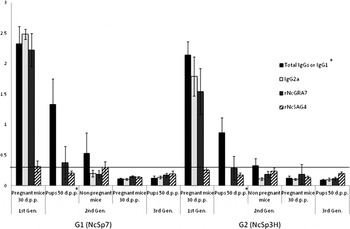
A higher humoral immune response (IgG1, IgG2a and anti-rNcGRA7 levels) was observed in Nc-Spain 7-infected mice (G1) compared to the group inoculated with Nc-Spain 3H (G2) before mating (P < 0·0001; one-way ANOVA). High levels of anti-rNcSAG4 antibodies were detected on day 54 p.i. and maintained until day 200 p.i. in non-pregnant mice (data not shown). After pregnancy, the dams maintained high levels of IgG and anti-rNcGRA7 antibodies in both infected groups. The anti-rNcSAG4 antibodies were barely detectable at day 30 p.p. in both groups (Fig. 2).
Specific anti-Neospora caninum immunoglobulins (total IgGI, IgG1 and IgG2a isotypes against tachyzoite soluble extract antigen) and antibodies specific for the recombinant proteins rNcGRA7 and rNcSAG4 found in the 3 generations studied. The bars represent the average O.D., and the error bars represent the standard deviations for each group. Horizontal lines represent the cut-off point for specific anti-rNcSAG4 antibody levels (0·26) calculated by adding 2 standard deviations to the mean sera A405 value from non-infected mice. Note that the immune response against N. caninum decreases in subsequent generations regardless of the isolate employed. *A blood sample from each mouse's tail was collected at day 50 p.p. (second generation). Only total IgG against tachyzoite soluble extract antigen and antibodies directed against rNcGRA7 and rNcSAG4 were analysed

Second generation
Low morbidity rates were recorded in the second generation in both infected groups (G1 and G2), and only 1 pup inoculated with Nc-Spain 3H maintained a low body weight (data not shown; 1/75; 1·3%). No differences were observed between the groups regarding post-natal mortality (P > 0·05; χ 2; Table 1).
Vertical transmission was recorded in almost 50% of litters in both infected groups (P > 0·05; Fisher's exact test). However, the individual TT rates were low in both groups, and parasites were only detected in an average of 1 pup per litter in G1 and 1·2 pups per litter in G2 (7·7% versus 17·1%; P > 0·05; χ 2; Table 2).
All survivor female mice from the second generation showed antibodies specific to N. caninum at day 50 after birth and were mated 60 days after birth. No significant differences were observed in the fertility rates between the groups (P > 0·05; χ 2; Table 1). As occurred in G2 in the first generation, 9 PCR-negative dams from this second generation transmitted N. caninum to at least 1 pup per litter.
Regarding the humoral immune response, all of the survivor pups (including males and females) from G1 showed higher levels of specific IgG antibodies than those from G2 at day 50 after birth (P < 0·05; one-way ANOVA). Moreover, the levels of anti-rNcGRA7 antibodies were lower than the levels of IgG antibodies in both groups, in contrast to the specific IgG and anti-rNcGRA7 levels developed by the first generation. No antibodies against rNcSAG4 were observed in these pups (P > 0·05; one-way ANOVA).
The specific antibody levels (IgG1, IgG2a and anti-rNcGRA7) were barely detectable in the dams from both G1 and G2, whereas detectable levels remained in non-pregnant mice from this generation until the time of sacrifice (Fig. 2).
Third generation
Neither pups from G1 nor pups from G2 developed specific clinical signs, and the body weights were similar in all groups (data not shown). The post-natal mortality rates were negligible in all groups. Moreover, no vertical transmission was observed in the pups from G1 (Nc-Spain 7), and low rates were detected in G2 (8·7%): 32% of the litters were positive by PCR (an average of 1 infected pup per infected litter; Table 2). Concerning the humoral immune response, neither pups from G1 nor pups from G2 developed antibodies by day 50 p.p. (Fig. 2).
DISCUSSION
In the present work, the reactivation of N. caninum infection was studied during the gestation of chronically infected dams and, for the first time, in their congenitally infected pups. However, although the TT rates per litter were moderate (almost 50%) in the first generation, the individual TT rates were low. Experimental models are essential to test the efficacy of different vaccine formulations developed against neosporosis (Reichel and Ellis, Reference Reichel and Ellis2009). In particular, appropriate experimental models in which EnTT may be induced are needed because EnTT is the principal natural route of infection and is responsible for maintaining the parasite within the population (Trees and Williams, Reference Trees and Williams2005; McCann et al. Reference McCann, McAllister, Gondim, Smith, Cripps, Kipar, Williams and Trees2007). Unfortunately, it has not been possible to induce EnTT in experimentally infected cattle. Traditionally, cerebral mouse models have been used, and congenital mouse models have been developed more recently (Collantes-Fernández et al. Reference Collantes-Fernández, López-Pérez, Álvarez-García and Ortega-Mora2006; López-Pérez et al. Reference López-Pérez, Risco-Castillo, Collantes-Fernández and Ortega-Mora2006); these models are representative of chronic and primo-infection during gestation, respectively, and have been widely employed to evaluate the efficacy of different vaccine formulations (Aguado-Martínez et al. Reference Aguado-Martínez, Álvarez-García, Fernández-García, Risco-Castillo, Marugán-Hernández and Ortega-Mora2009a; Rojo-Montejo et al. Reference Rojo-Montejo, Collantes-Fernández, Rodríguez-Marcos, Perez-Zaballos, López-Pérez, Prenafeta and Ortega-Mora2011; Jiménez-Ruiz et al. Reference Jiménez-Ruiz, Álvarez-García, Aguado-Martínez, Salman, Irache, Marugán-Hernández and Ortega-Mora2012). However, these experimental models may be less useful for testing the efficacy of vaccine formulations to prevent EnTT and, in particular, vaccines based on bradyzoite stage-specific antigens that may be involved in reactivation. This hypothesis is supported by the recently reported lack of efficacy obtained with whole inactivated tachyzoite-bradyzoite extract (Rojo-Montejo et al. Reference Rojo-Montejo, Collantes-Fernández, Rodríguez-Marcos, Perez-Zaballos, López-Pérez, Prenafeta and Ortega-Mora2011) and with recombinant rNcSAG4, rNcBSR4 and rNcSRS9 bradyzoite stage-specific proteins tested in the mouse models mentioned above (Aguado-Martínez et al. Reference Aguado-Martínez, Álvarez-García, Fernández-García, Risco-Castillo, Marugán-Hernández and Ortega-Mora2009a; Jiménez-Ruiz et al. Reference Jiménez-Ruiz, Álvarez-García, Aguado-Martínez, Salman, Irache, Marugán-Hernández and Ortega-Mora2012). The success of previous attempts to induce the reactivation of N. caninum infection in chronically infected mice has been limited (Cole et al. Reference Cole, Lindsay, Blagburn and Dubey1995; Omata et al. Reference Omata, Nidaira, Kano, Kobayashi, Koyama, Furuoka, Maeda, Matsui and Saito2004; Rettigner et al. Reference Rettigner, De Meerschman, Focant, Vanderplasschen and Losson2004; Kano et al. Reference Kano, Masukata, Omata, Kobayashi, Maeda and Saito2005). This is the first study where a total of 3 consecutive generations of mice were studied, involving 2 pregnancies and 2 different infection scenarios, first in the chronically infected dams (post-natal infection) and second in their congenitally infected pups (congenital infection). As it is well known that individual isolates greatly influence the outcome of the infection, we used both the highly virulent Nc-Spain 7 isolate as well as the low-to-moderate-virulence Nc-Spain 3 isolate. Both of these isolates caused high rates of vertical transmission (Pereira García-Melo et al. Reference Pereira García-Melo, Regidor-Cerrillo, Collantes-Fernández, Aguado-Martínez, Del Pozo, Minguijon, Gómez-Bautista, Aduriz and Ortega-Mora2010; Regidor-Cerrillo et al. Reference Regidor-Cerrillo, Gómez-Bautista, Del Pozo, Jiménez-Ruiz, Aduriz and Ortega-Mora2010). Additionally, the outcome of the infection was evaluated by measuring the same parameters in dams and, for the first time, in their pups; these parameters included morbidity, mortality, parasite presence and the humoral immune response.
We found that chronic infection could be established at approximately day 90 p.i., based on the specific antibody response detected and the results obtained in previous studies. In these previous studies, the authors reported that after day 30 p.i., parasites are only present in the brain, and tachyzoite to bradyzoite conversion takes place during the late chronic phase of infection, as NcSAG4 mRNA levels peak between days 32 and 64 p.i. in parallel with decreasing tachyzoite loads in the brain (Collantes-Fernández et al. Reference Collantes-Fernández, López-Pérez, Álvarez-García and Ortega-Mora2006; Aguado-Martínez et al. Reference Aguado-Martínez, Ortega-Mora, Álvarez-García, Rodríguez-Marco, Risco-Castillo, Marugán-Hernández and Fernández-García2009b).
The reactivation of N. caninum was studied during pregnancy and evidenced by TT of the parasite from the dams to the pups. The success of attempts to induce reactivation was limited. Vertical transmission was recorded in almost 50% of the litters from the second generation in both infected groups, taking into account that parasite burden is expected to be low during the chronic stage of infection (Collantes-Fernández et al. Reference Collantes-Fernández, López-Pérez, Álvarez-García and Ortega-Mora2006; Aguado-Martínez et al. Reference Aguado-Martínez, Ortega-Mora, Álvarez-García, Rodríguez-Marco, Risco-Castillo, Marugán-Hernández and Fernández-García2009b). However, vertical transmission did not occur in every pup from positive litters, in accordance with the results reported by Omata et al. (Reference Omata, Nidaira, Kano, Kobayashi, Koyama, Furuoka, Maeda, Matsui and Saito2004). Interestingly, this author reported a higher number of infected litters when the dams became pregnant between days 28 and 45 p.i. One explanation for the high transmission rate during early chronic infection could be the presence of tachyzoites at this stage. In fact, Aguado-Martínez et al. (Reference Aguado-Martínez, Ortega-Mora, Álvarez-García, Rodríguez-Marco, Risco-Castillo, Marugán-Hernández and Fernández-García2009b) suggested that even during the late chronic infection, there are significant numbers of tachyzoites or intermediate zoites within parasitized mouse brains, as evidenced by the presence of NcSAG1 mRNA in the late chronic period. In our study, although reactivation was observed from the first to the second generations, it was almost absent from the second to the third generations. The morbidity, mortality, parasite presence and immune response all decreased with subsequent generations. A tendency toward decreasing TT in subsequent generations was also reported by Cole et al. (Reference Cole, Lindsay, Blagburn and Dubey1995) and Rettigner et al. (Reference Rettigner, De Meerschman, Focant, Vanderplasschen and Losson2004) in serial re-breeds of the same dams. The mechanisms of latent infection reactivation during a cow's pregnancy are not yet fully understood but are thought to be related to the immunological and endocrinal modifications that take place during gestation (Innes et al. Reference Innes, Wright, Bartley, Maley, Macaldowie, Esteban-Redondo and Buxton2005). Indeed, some authors reported that the type 1 response was consistently down-regulated in mice infected during pregnancy, resulting in a high rate of vertical transmission (Omata et al. Reference Omata, Nidaira, Kano, Kobayashi, Koyama, Furuoka, Maeda, Matsui and Saito2004; Kano et al. Reference Kano, Masukata, Omata, Kobayashi, Maeda and Saito2005). In contrast, Rettigner et al. (Reference Rettigner, De Meerschman, Focant, Vanderplasschen and Losson2004) asserted that neither hormones associated with pregnancy nor the modulation of the immune response during pregnancy are responsible for the reactivation of chronic N. caninum infections because a TT rate of only 14·6% was reported in a mouse model. Given this finding, reactivation could be the result of an occasional cyst rupture that could occur naturally during the course of a chronic infection. However, these studies are not necessarily comparable because oestrus was not synchronized, different isolates were employed in the inoculations and the morbidity and mortality rates were not evaluated in the pups. Indeed, TT rates vary in mice depending on the term of gestation during which inoculation is performed (López-Perez et al. Reference López-Pérez, Risco-Castillo, Collantes-Fernández and Ortega-Mora2006, Reference López-Pérez, Collantes-Fernández, Aguado-Martínez, Rodríguez-Bertos and Ortega-Mora2008) and are isolate-dependent (Regidor-Cerrillo et al. Reference Regidor-Cerrillo, Gómez-Bautista, Del Pozo, Jiménez-Ruiz, Aduriz and Ortega-Mora2010). On the other hand, the high number of mice employed and the vertical transmission percentage observed in our study did not support the theory of a reactivation mediated only by the occasional spontaneous rupture of a cyst in chronically infected dams. In fact, the presence of parasite DNA in 50% of the litters (7·7 and 17·1% of pups were positive by PCR in G1 and G2, respectively) suggests that, in this case, reactivation of N. caninum infection is likely to be the result of both events: the immunomodulation during pregnancy and the spontaneous cyst rupture.
Regarding the immune response, specific antibody levels (anti-N. caninum total IgG, IgG1, IgG2a and anti-rNcGRA7 and anti-rNcSAG4 IgG) correlated with parasite presence. Antibody levels were high in chronically infected mice, as expected based on previous experiments with mouse models (Aguado-Martínez et al. Reference Aguado-Martínez, Ortega-Mora, Álvarez-García, Rodríguez-Marco, Risco-Castillo, Marugán-Hernández and Fernández-García2009b). The high levels of anti-NcGRA7 antibodies correlated with high levels of N. caninum-specific IgG1 and IgG2a. Moreover, high levels of rNcSAG4-specific antibodies were also detected at day 54 p.i., primarily in G1, indicating that a chronic infection had been established (Aguado-Martínez et al. Reference Aguado-Martínez, Álvarez-García, Fernández-García, Risco-Castillo, Arnaiz-Seco, Rebordosa-Trigueros, Navarro-Lozano and Ortega-Mora2008, Reference Aguado-Martínez, Ortega-Mora, Álvarez-García, Rodríguez-Marco, Risco-Castillo, Marugán-Hernández and Fernández-García2009b). These antibody levels were maintained until day 200 p.i. in the cerebral mouse model, similar to the findings reported by Aguado-Martínez et al. (Reference Aguado-Martínez, Ortega-Mora, Álvarez-García, Rodríguez-Marco, Risco-Castillo, Marugán-Hernández and Fernández-García2009b), where these levels were maintained until day 155 p.i. However, both the humoral immune response and parasite presence were significantly diminished in the second and third generations, regardless of the isolate employed in the inoculations. This finding, together with the higher antibody levels observed in non-pregnant mice compared to dams, supports the hypothesis that only mice without clinical signs and parasite loads too low to induce a significant humoral response became pregnant; this may also explain the differences observed between the inoculated groups. Indeed, in the case of G1 inoculated with the Nc-Spain 7 isolate, there was less vertical transmission to the pups than expected and an absence of clinical signs and mortality in both the second and third generations. The differences observed between the isolates in terms of the TT rates in consecutive pregnancies are probably due to the fact that only healthier mice with a low parasite burden in the brain became pregnant at this point (average fertility rates of 16·6% in G1 versus 43·4% in G2), whereas in previous congenital mouse models, pregnant dams were inoculated directly with tachyzoites, facilitating the crossing of the placental barrier by the parasite. This hypothesis is also supported by the high morbidity and mortality rates detected in the females before pregnancy, as a higher parasite presence was observed in non-pregnant mice compared to dams after pregnancy in this first generation.
Regarding G2 (inoculated with the Nc-Spain 3H isolate), vertical transmission was observed, although at rates lower than those reported in ExTT by Regidor-Cerrillo et al. (Reference Regidor-Cerrillo, Gómez-Bautista, Del Pozo, Jiménez-Ruiz, Aduriz and Ortega-Mora2010). Despite the progressive clearance of infection in subsequent generations, even dams with low parasite loads are able to transmit the parasite to their offspring because PCR-negative dams delivered PCR-positive pups. The opposite scenario was also observed, where PCR-positive dams delivered PCR-negative pups (5 congenitally infected dams out of 25). Consequently, the absence of clinical signs in pups from the second and third generations and the absence of specific antibody titres against N. caninum may be explained by a low parasite burden that was probably localized only in immunoprivileged tissues such as the brain and was unable to induce pathology or detectable antibody levels.
Surprisingly, the low EnTT rates observed in mice are in contrast to the high TT rates observed in naturally infected cattle (Dubey and Schares, Reference Dubey and Schares2011). It has been postulated that the placenta may play a key role in the pathogenesis of neosporosis (Innes et al. Reference Innes, Wright, Bartley, Maley, Macaldowie, Esteban-Redondo and Buxton2005; López-Perez et al. Reference López-Perez, Collantes-Fernández, Rojo-Montejo, Navarro-Lozano, Risco-Castillo, Pérez-Pérez, Pereira-Bueno and Ortega-Mora2010). The parasite may exploit different pathways to cross the placenta depending on the particular isolate involved (Collantes-Fernández et al. Reference Collantes-Fernández, Arrighi, Álvarez-García, Weidner, Regidor-Cerrillo, Boothroyd, Ortega-Mora and Barragán2012). Furthermore, the haemochorial placenta in mice permits closer contact between the fetal and maternal tissues, in contrast to the synepitheliochorial placenta in cattle that does not permit transmission of maternal antibodies to the fetus (Entrican, Reference Entrican2002). In this sense, rodent pups acquire maternal antibodies both placentally and in the milk (Appleby and Catty, Reference Appleby and Catty1983), and these antibodies may be protective against infection in utero. In support of this idea, it has been shown previously that maternal antibodies against Plasmodium transferred to the pup suppress the growth of the parasite (Stanisic et al. Reference Stanisic, Martin and Good2003).
In conclusion, we have explored an experimental reactivation mouse model with 2 different isolates under 2 different situations: post-natal infection in a first generation and congenital infection in subsequent generations. Because only mice without clinical signs and low parasite loads became pregnant, reactivation of the infection was more successful in mice infected with the low-to-moderate-virulence Nc-Spain 3H isolate. However, infection seems to gradually decrease in subsequent generations. According to the results obtained, an improvement of this experimental mouse model could be achieved with an increase in the number of healthy but chronically infected dams, which is a key point favouring a higher TT to their offspring. This is a complex issue because a highly virulent isolate caused a decrease in fertility rates; in contrast, a low parasite burden may increase TT rates. To overcome this difficult balance, further efforts should be made to increase the number of congenitally infected litters or pups within each litter in an acute congenital mouse model by employing low-to-moderate-virulence isolates followed by the breeding of the infected offspring.
ACKNOWLEDGEMENTS
We gratefully acknowledge Carmen Cuevas and Laura Hinojal for their excellent technical assistance.
FINANCIAL SUPPORT
This work was supported by the Ministerio de Economia y Competitividad (M.I.N.E.C.O., grant number AGL2010-22191/GAN). E. J.-R. was supported by a fellowship from M.I.N.E.C.O. (grant number BES-2008-005403).