INTRODUCTION
This article presents the first results of a radiocarbon dating study of the Middle Bronze Age palatial site of Tel Kabri in the western Galilee region of modern Israel. During the Middle Bronze Age, Tel Kabri was one of the major political centers in the southern Levant, and most likely the capital of a significant polity in western Galilee during the Middle Bronze IIFootnote 1 period (Yasur-Landau et al. Reference Yasur-Landau, Cline and Pierce2008, Reference Yasur-Landau, Cline and Goshen2014). The palace of Tel Kabri, which existed from the Middle Bronze I into the Middle Bronze II, occupied an area of 4000–6000 m2, of which approximately 2000 m2 have been excavated. It yielded Aegean (or Aegean-style) frescoes (Cline et al. Reference Cline, Yasur-Landau and Goshen2011), elaborate palatial architecture (Yasur-Landau et al. Reference Yasur-Landau, Cline, Goshen, Marom and Samet2012), and storerooms for wine (Koh et al. Reference Koh, Yasur-Landau and Cline2014). The stratigraphic sequence from the palace provides a robust ceramic record as well as relative chronology for much of the Middle Bronze Age (Samet Reference Samet2014; Yasur-Landau et al. Reference Yasur-Landau, Cline and Goshen2014).
In this paper, we present an analysis of a new set of 14C data from Tel Kabri. Our results are important in assessing the absolute calendar date of the site and its stratigraphic phases. They also have wider regional significance, as they challenge current absolute dating schemes proposed for the Middle Bronze Age in the southern Levant and indicate support for a higher chronology. After discussing the site and its stratigraphy, we compare the 14C results to (a) current chronological frameworks and (b) other available Middle Bronze Age 14C data for Middle Bronze Age sites, especially Tell el-Dabca (Egypt), Tell el-Burak (Lebanon), and Tel Ifshar (Israel).
BRIEF STRATIGRAPHY OF THE PALACE OF KABRI
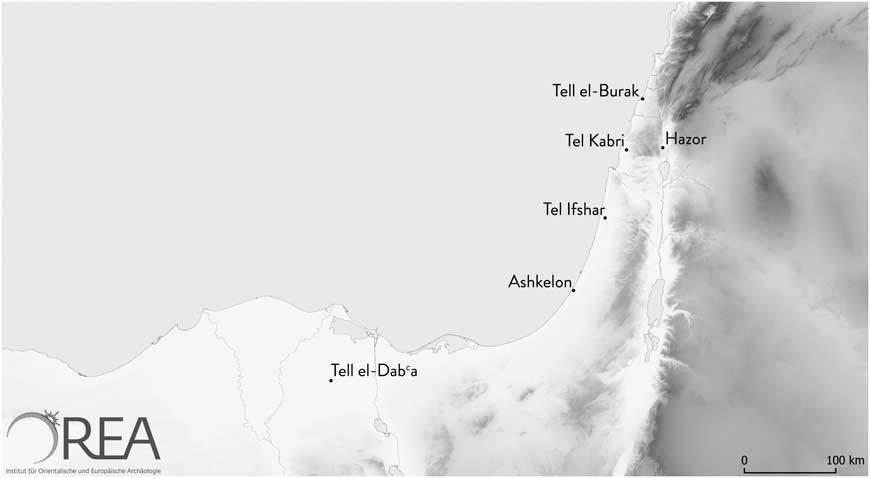
The site of Tel Kabri is located in western Galilee, about 5 km inland from the Mediterranean shore and about 12 km north-northeast of the town of Akko (Figure 1). With an area of 34 ha, it is the third largest Middle Bronze Age site in Israel, behind only Hazor and Ashkelon. The first extensive excavations of the Middle Bronze Age palace that inter alia uncovered the first fragments of Aegean (or Aegean-style) wall paintings and a painted plaster floor were conducted between 1986 and 1993, directed by Aharon Kempinski and Wolf-Dietrich Niemeier (Kempinski Reference Kempinski2002). Renewed excavations directed by Eric Cline and Assaf Yasur-Landau started in 2005 and were accompanied by a regional survey of western Galilee in 2006 and 2007 (Cline and Yasur-Landau Reference Cline and Yasur-Landau2007; Yasur-Landau et al. Reference Yasur-Landau, Cline and Pierce2008, Reference Yasur-Landau, Cline, Goshen, Marom and Samet2012, Reference Yasur-Landau, Cline and Goshen2014; Cline et al. Reference Cline, Yasur-Landau and Goshen2011; Goshen et al. Reference Goshen, Yasur-Landau and Cline2013; Samet Reference Samet2014; Yasur-Landau and Cline Reference Yasur-Landau and Cline2014).
Map of the southeastern Mediterranean region with sites mentioned in the text

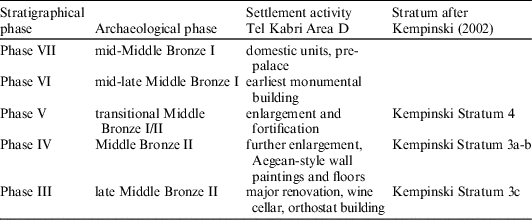
Five phases of Middle Bronze Age settlement could be distinguished based on the results of current excavations in Area D (the area of the palace), ranging from Phase VII, the early/mid Middle Bronze I, to Phase III, the late Middle Bronze II (see Table 1). For the very early part of Middle Bronze I, no evidence for settlement has been found so far in Area D (Yasur-Landau et al. Reference Yasur-Landau, Cline and Goshen2014). Elsewhere on the Tel, this phase is represented only by tombs that were excavated by Kempinski (Kempinski et al. Reference Kempinski, Gershuny and Scheftelowitz2002).
Stratigraphic overview of Middle Bronze Age phases at Tel Kabri.

Phase VII represents the first settlement remains excavated in Area D-West. These remains are domestic units that precede the first palatial structures, and can be dated to the early/mid-Middle Bronze I, approximately contemporary with the Middle Bronze I Phase 2 at Aphek according to the pottery (Samet Reference Samet2014: 367–71; Yasur-Landau et al. Reference Yasur-Landau, Cline and Goshen2014: 356–7).
The earliest palatial structure can be attributed to Phase VI in D-West. This monumental building replaced the area’s earlier domestic units. Based on the pottery, the construction of this phase dates to mid/late-Middle Bronze I, approximately contemporary with Middle Bronze I Phases 2-3 at Aphek (Samet Reference Samet2014: 371–81; Yasur-Landau et al. Reference Yasur-Landau, Cline and Goshen2014: 357).
During Phase V, the palace was considerably enlarged to the west and the south, and the site was fortified with a large earthen rampart. This phase roughly corresponds to Kempinski’s Stratum 4 and is dated to the Middle Bronze I–II transition (Samet Reference Samet2014: 381–3; Yasur-Landau et al. Reference Yasur-Landau, Cline and Goshen2014: 357–9).
Phase IV corresponds approximately to Kempinski’s Strata 3a-b and is dated by pottery to the Middle Bronze II period. In this phase, the palace was enlarged again, reaching the extent that can be currently seen in Areas D-North and D-South (Samet Reference Samet2014: 383–5; Yasur-Landau et al. Reference Yasur-Landau, Cline and Goshen2014: 360–1). Additionally, the palace was furnished with Aegean-style frescoes for the walls and floors at this time (Cline et al. Reference Cline, Yasur-Landau and Goshen2011).
The final phase of the palace was Phase III, corresponding to Kempinski’s final palatial Stratum 3c. During this phase, the palace underwent massive renovation, which included the addition of a two-room complex lined with orthostats and a storage wing in which wine was stored (Yasur-Landau et al. Reference Yasur-Landau, Cline, Goshen, Marom and Samet2012; Koh et al. Reference Koh, Yasur-Landau and Cline2014).
The palace was destroyed at the end of Phase III. According to the pottery, this is datable to the end of the Middle Bronze II period. No pottery types typical of Middle Bronze III have been found in this phase at the palace of Tel Kabri, such as Bichrome ware or canonical Chocolate-on-White (Samet Reference Samet2014: 387; see also Kempinski Reference Kempinski2002: 70). The later part of the Middle Bronze III period at Tel Kabri is represented only in Tomb 902, excavated by Kempinski, which includes Black Lustrous Wheel-made jugs and Chocolate-on-White bowls (Samet Reference Samet2014: 388).
RADIOCARBON DATING EVIDENCE
Most of the samples analyzed for 14C dating in this study come from the last phase of the Middle Bronze Age palace, Phase III (Kempinski’s 3c), and should thus date to the late Middle Bronze II period. From earlier phases, few short-lived samples were available; thus, charcoal samples were also dated. Since wood charcoal (particularly from long-lived species) can yield dates that are considerably older than their contexts, we use these sample dates to provide termini post quos for the strata. Charcoal from Kabri is unfortunately extremely fragmentary, and wood samples containing bark and the outermost (most recent) tree rings (which would minimize inbuilt age bias) were not found. However, two of the selected charcoal samples (OxA-26517 and OxA-26516) are from small-diameter branches; thus, dates on these samples should have relatively small inbuilt age biases.
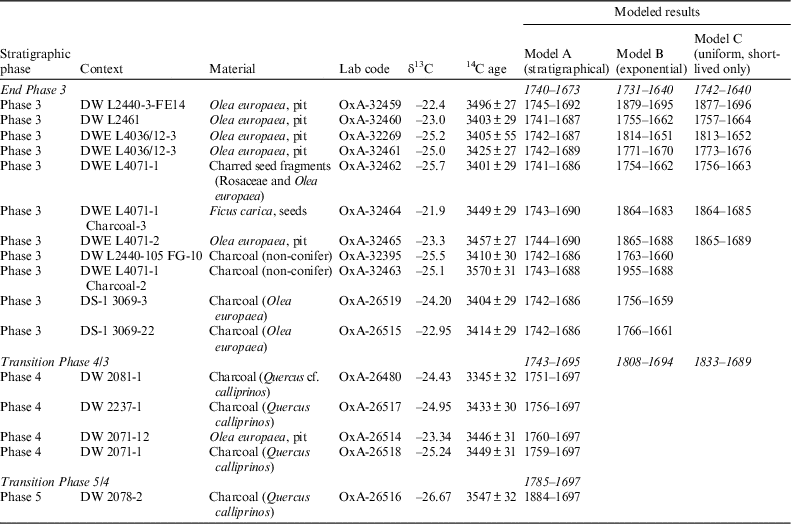
Samples were selected in 2011 and 2014 by Felix Höflmayer and were studied in the framework of the CINEMA-project.Footnote 2 In total, 16 samples (short-lived seeds and wood charcoal) have so far been analyzed at the Oxford Research Accelerator Unit (see Table 2). Results have been calibrated with OxCal v 4.2 using the IntCal13 14C calibration curve interpolated to yearly intervals (Resolution=1) (Bronk Ramsey Reference Bronk Ramsey2009a; Reimer et al. Reference Reimer, Bard, Bayliss, Beck, Blackwell, Bronk Ramsey, Buck, Cheng, Edwards, Friedrich, Grootes, Guilderson, Haflidason, Hajdas, Hatté, Heaton, Hoffmann, Hogg, Hughen, Kaiser, Kromer, Manning, Niu, Reimer, Richards, Scott, Southon, Staff, Turney and van der Plicht2013).
Radiocarbon dates for Tel Kabri and results of Models A, B, and C.

Unfortunately, no suitable samples have so far been uncovered from the first construction of the palace (Phase VI). Furthermore, from Phase V (first expansion of the palace at the transition from Middle Bronze I to II), only one charcoal sample was available (OxA-26516).
Phase IV (second enlargement, Aegean-style frescoes, Kempinski’s Stratum 3a-b, (early) Middle Bronze II) is represented by one short-lived botanical sample (OxA-26514) and three wood charcoal samples (OxA-26480, OxA-26517, and OxA-26518), one of which (OxA-26480) resulted in a surprisingly young date, incompatible with the other 14C determinations. It should be noted, though, that OxA-26480 comes from a small context excavated as a probe and that some contamination by younger material cannot be ruled out completely. On the other hand, this sample returned a much lower pretreatment yield than the others in this group (14% by weight versus average of 58%), which suggests it might contain a significant quantity of exogenous material (younger humic acids), which also could be an explanation for the unexpectedly young date (but note that it has been found that in general humic acids are reliable for dating in this region: Wild et al. Reference Wild, Steier, Fischer and Höflmayer2013).
The last palatial phase (Phase III, Orthostat Building, wine cellar, corresponding to Kempinski’s Stratum 3c, dated to late Middle Bronze II) is represented by 11 dated samples. Four of these are wood charcoal (OxA-26519, OxA-26515, OxA-32395, and OxA-32463), and seven are short-lived botanical samples.
The samples come from several well-defined deposits of the latest palace phase. OxA-32269, OxA-32461, OxA-32462, OxA-32463, OxA-32464, and OxA-32465 come from the large Hall 1434 located in the eastern part of the palace, on and in the vicinity of a hearth. OxA-32459, OxA-32460, and OxA-32395 come from the floor of the wine-storage room in the western part of the palace excavated in 2013. OxA-26515 and OxA-26519 come from a surface, probably an open courtyard, in the southern part of the palace.
The results are, in general, consistent. Only two samples resulted in dates that are older; one is OxA-32463, a charcoal sample that gives only a general terminus post quem for the stratum, and the other is OxA-32459, an olive pit that seems to be residual.
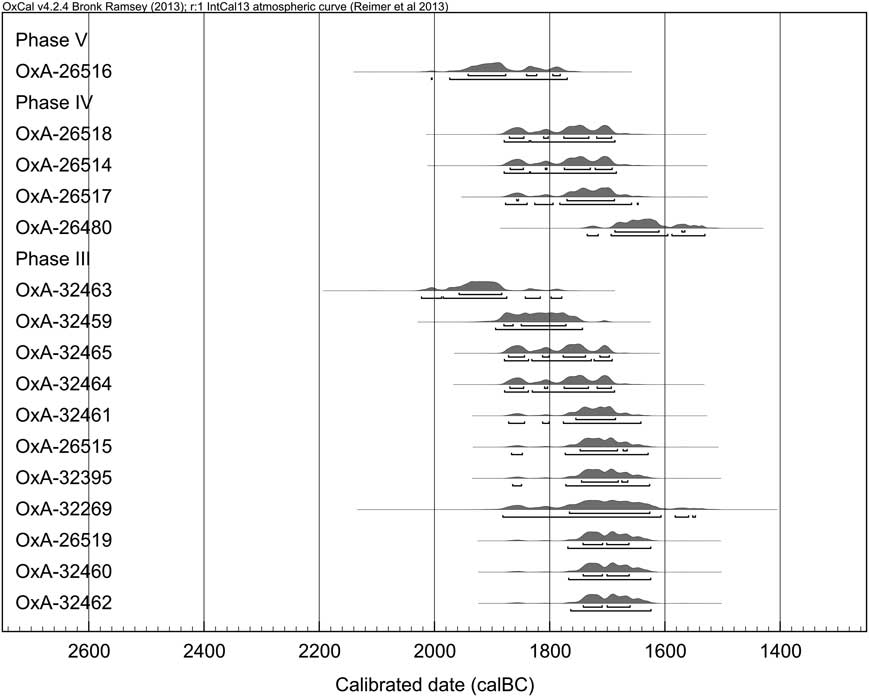
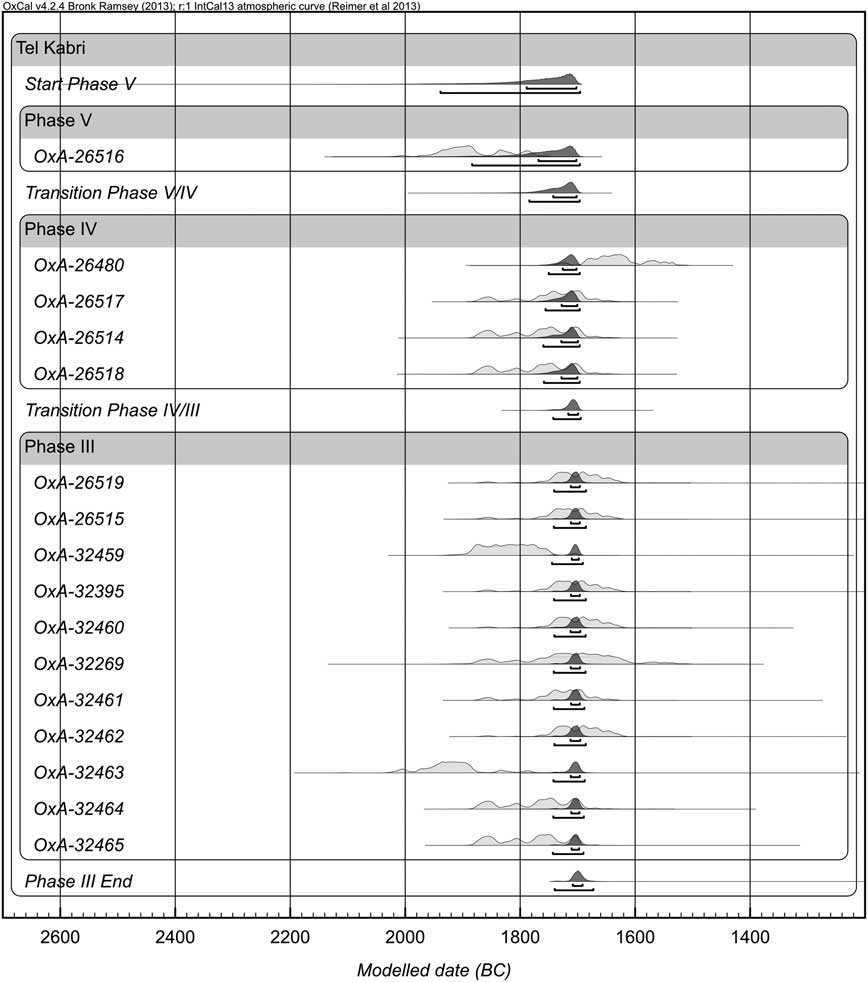
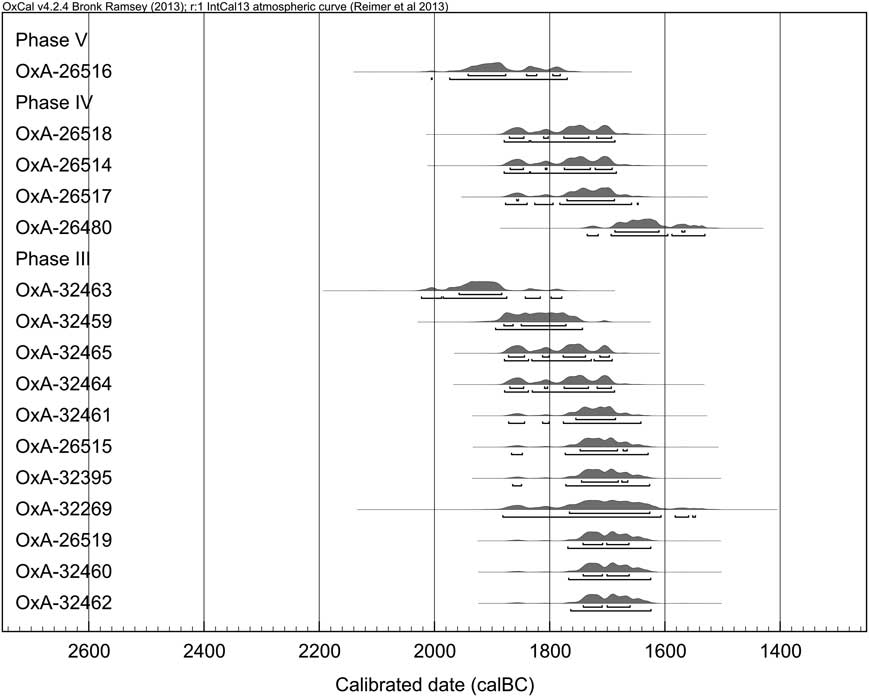
In this paper, we will concentrate on the results of Phase III, as this is the only phase from which a substantial number of short-lived samples were available. Samples from Phases V–IV are used as additional information, primarily for providing a terminus post quem for Phase III. Overall, the individual calibrated 14C dates for Phase III, according to probability distributions, generally range from ~1850 to 1650 BC (Figure 2).
Individual calibrations of 14C determinations from Phases V–III of Tel Kabri
However, in order to increase the precision of the calibrated results, a Bayesian probability approach can be applied. Bayesian analysis allows additional information to be taken into account, such as the sequence of the samples based on archaeological stratigraphy. This additional information is called prior information, since it is derived from sources other than, and prior to, 14C analysis in the laboratory (Buck et al. Reference Buck, Kenworthy, Litton and Smith1991; Weninger et al. Reference Weninger, Steier, Kutschera and Wild2006; Bronk Ramsey Reference Bronk Ramsey2009a). Based on the prior information and the 14C measurements, a posterior probability for each individual sample (and each additional event in the model, such as transitions between phases) is calculated, i.e. the probability for the age of a sample based on its individual calibration combined with all additional information included in the model.
Usually one would have to assume that all 14C determinations are representative for their respective contexts and stratigraphic phases. In practice, however, residual material is often present in the archaeological record, especially in cases where one has to rely on samples that do not come from closed contexts (e.g. from a sealed storage jar where only minimal or no residuality at all can be assumed). Samples that are too old and thus do not “fit” the model based on stratigraphic evidence are usually excluded by hand, a process that is often highly subjective. In order not to “hand-pick” and exclude any samples a priori, we instead employed the outlier analysis of OxCal, using the General model for short-lived samples and the Charcoal Plus model for the charcoal samples (Bronk Ramsey Reference Bronk Ramsey2009b; Dee and Bronk Ramsey Reference Dee and Bronk Ramsey2014).
Outlier analysis detects which individual samples do not fit the prior information (e.g. the sequence) and the overall model. Based on their agreement with the model, their impact on the model’s result is weighed accordingly. This means that outlying dates have very little impact on the final results (the posterior probabilities). The Outlier index shows the expected (prior) chance of a sample being an outlier and the real (posterior) value based on the model. For the General model, short-lived samples are expected to be representative for their respective contexts and are given only a 5% prior chance of being an outlier. However, the posterior probability of the result actually being an outlier, which is also calculated by the program, may be quite different. For example, OxA-32464 was given a 5% chance of being an outlier at the start but, after the model had run, it was allocated only a 2% chance of being one. On the contrary, OxA-32459 was given a 5% prior probability of being an outlier but, based on the modeling, its actual chance was calculated to be 6%.
For the Charcoal Plus model, every date is given a 100% prior probability of being an outlier, because it is known a priori that the age of the context it comes from is certain to be younger than the biological age of the material. At the same time, the Charcoal Plus model also allows a minute probability for the presence of intrusive material (for details, see Bronk Ramsey Reference Bronk Ramsey2009b; Dee and Bronk Ramsey Reference Dee and Bronk Ramsey2014).
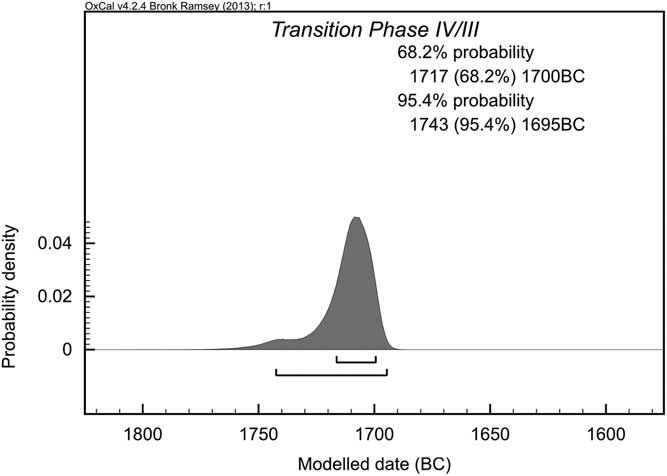
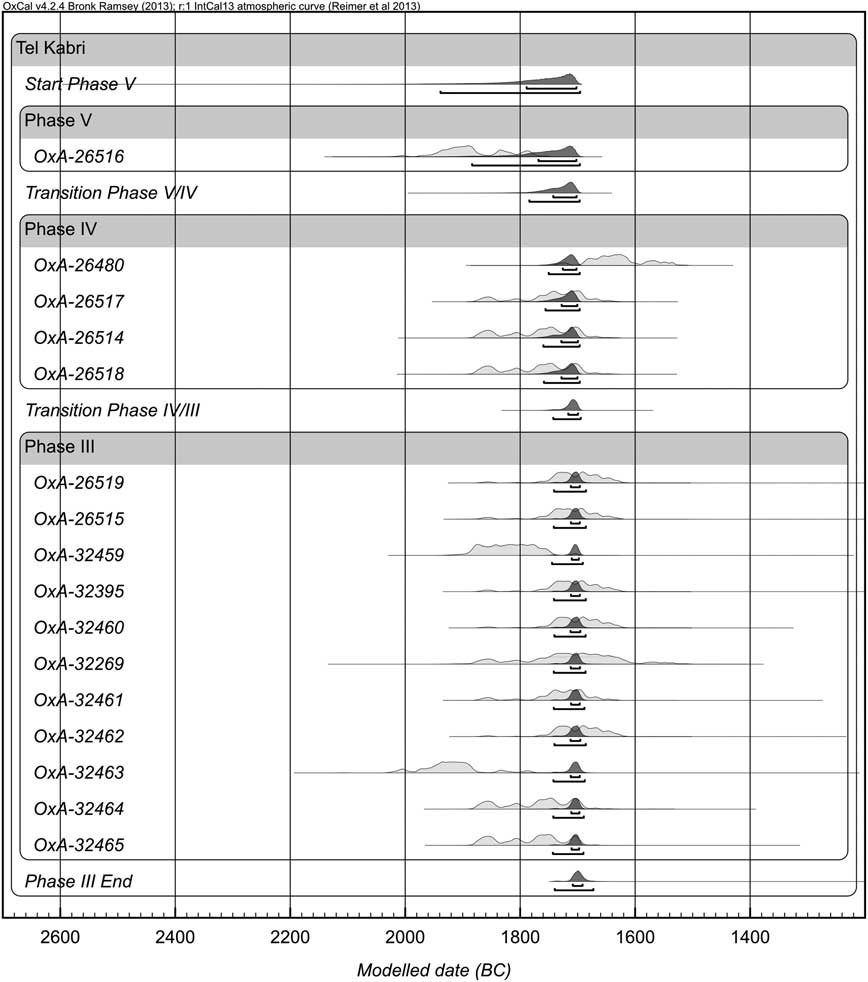
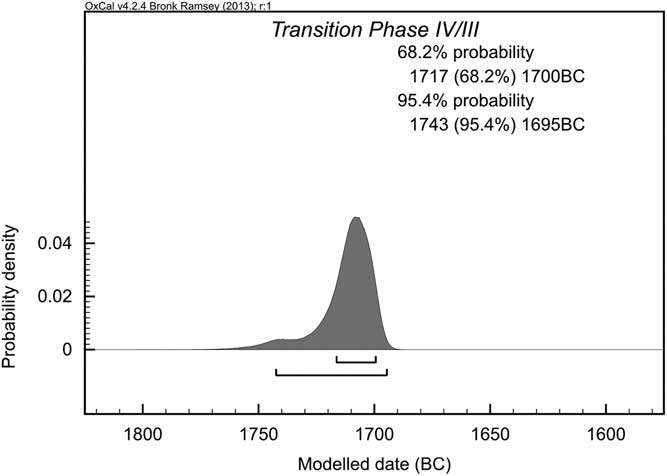
Three models (Models A, B, and C) were created for Tel Kabri, all of which concentrated on dating the beginning and end of Phase III. For Model A (stratigraphical model), it was assumed that all short-lived samples were representative of the archaeological phases in which they were found and that all archaeological phases were in their correct chronological order (i.e. Phase V is older than Phase IV and Phase IV is older than Phase III). Within each archaeological phase, the chronological order of the individual samples was taken to be unknown. Samples originating from any of these stratigraphic phases were grouped together using the Phase function of OxCal (being an unordered group of events with a uniform distribution), separated by boundaries (reflecting the transitions between these phases). Results for Model A are shown in Figures 3–5 and in Table 2; they indicate that the transition from Phase IV to Phase III falls in the late 18th century BC, with a 68.2% probability that it took place between 1717 and 1700 BC and a 95.4% probability that it took place between 1743 and 1695 BC (Figure 4).
Modeled probability ranges for each individual sample and “boundaries” based on Model A. Light shaded areas represent individual calibrated 14C determinations (without prior information); dark shaded areas represent modeled calibrated 14C determinations (posterior probabilities) based on the prior information entered into the model.
Modeled probability range for the transition from Phase IV to Phase III of the Middle Bronze Age palace of Tel Kabri based on Model A.
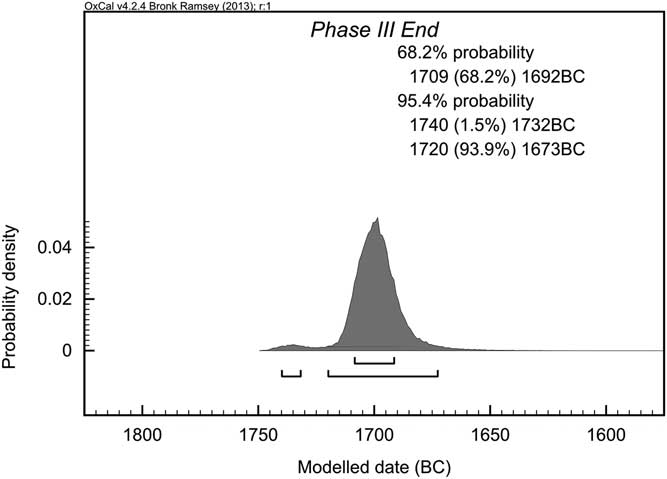
Modeled probability range for the end of Phase III of the Middle Bronze Age palace of Tel Kabri based on Model A.
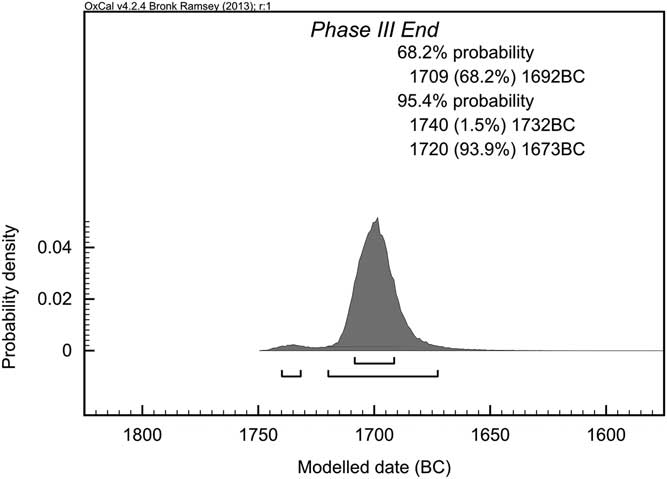
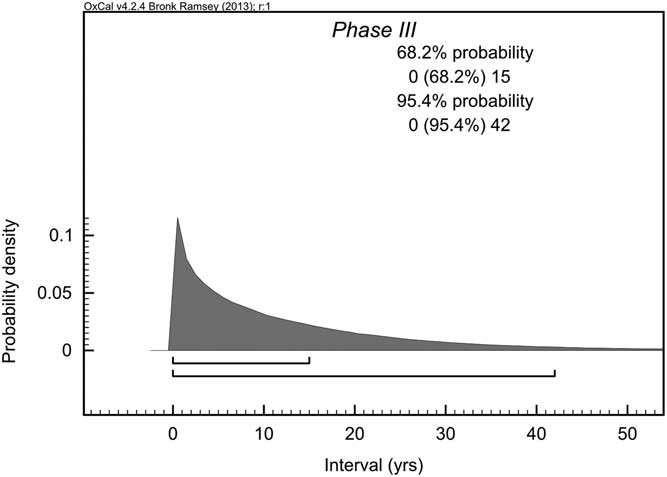
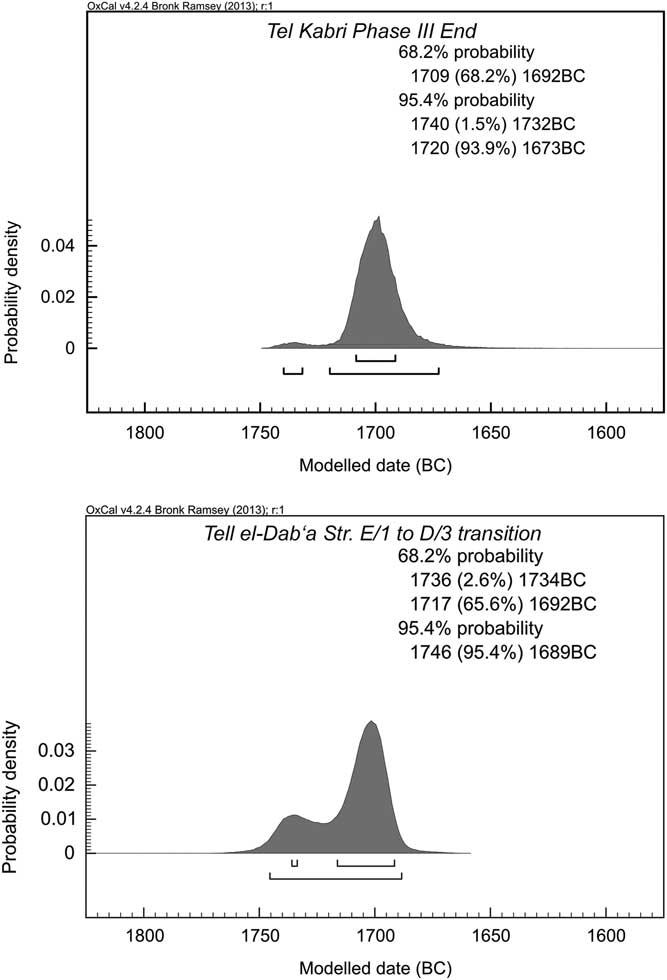
The end of Phase III would date around 1700 BC according to this model, somewhere between 1709 and 1692 BC at 68.2% probability or between 1720 and 1673 BC at 95.4% probability (Figure 5). Furthermore, according to this model and based on this somewhat limited number of dates, Phase III at Tel Kabri would have lasted only a few decades, up to about 40 yr at most, as shown in Figure 6.
Calculated span for Phase III of the Middle Bronze Age palace of Tel Kabri based on Model A.

We note again that the end of Phase III has already been dated by ceramic material to the late Middle Bronze II period and that there is no direct evidence for Middle Bronze III pottery from the palatial phases (see above). If Model A is correct and the end of Phase III at Kabri dates to around 1700 BC, this will also give a result for the end of Middle Bronze II that is approximately 50 yr higher than the traditional chronology date of ~1650 BC for the transition from Middle Bronze II to Middle Bronze III (e.g. Dever Reference Dever1992, Reference Dever1997). These results are also considerably higher—by about a century—than the low Middle Bronze Age chronology, in which the transition from Middle Bronze II to Middle Bronze III is dated to ~1590 BC (Bietak Reference Bietak2013), even when the most recent range of the 95.4% probability distribution in our model is considered.
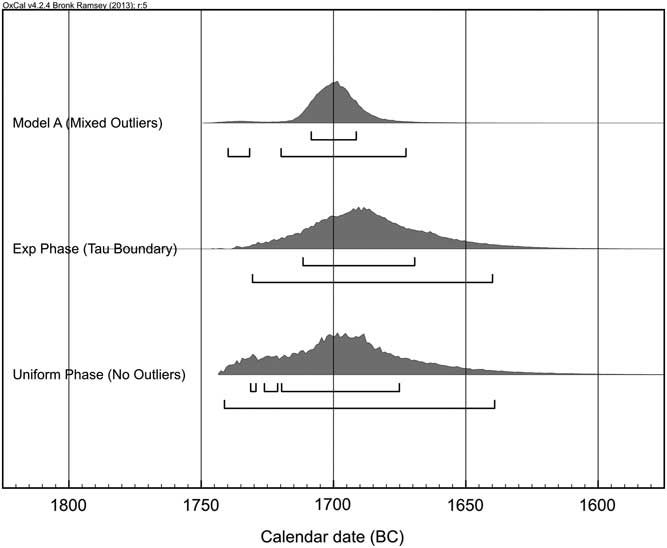
Our end date for Phase III is thus 50–100 yr higher (older) than expected, at least according to current chronological frameworks. Therefore, we wanted to test how low (i.e. how young) the end date for Phase III theoretically could be. For Model B (Exponential Model), we considered the samples only from archaeological Phase III and assumed that their dates are distributed exponentially towards the end of the use of the building, using a Tau_Boundary paired with a Boundary in OxCal. This essentially tests how recent the end of the Middle Bronze Age palace of Kabri could possibly be, given the 14C data. For Model C (Uniform Phase), we eliminated all samples with potential inbuilt age (i.e. wood charcoal samples) and only considered short-lived samples from archaeological Phase III and assumed that their dates are uniformly (rather than exponentially) distributed throughout the Phase. Figure 7 shows the results for the end of archaeological Phase III for Models A (stratigraphical model), B (exponential), and C (uniform).
Modeled probability ranges for the end of Phase III of the Middle Bronze Age palace of Tel Kabri based on Model A (stratigraphical), Model B (exponential), and Model C (uniform).

According to Model B (exponential), the end date for Phase III still falls around 1700 BC, but with a slightly larger error margin that now also includes the first half of the 17th century BC, between 1712 and 1670 BC at 68.2% probability, or between 1731 and 1640 BC at 95.4% probability. Model C (uniform) also places the end date for archaeological Phase III around 1700 BC, again with a slightly larger error margin compared to Model A (stratigraphical). According to Model C (uniform), archaeological Phase III ends between 1732 and 1676 BC at 68.2% probability, or between 1742 and 1640 BC at 95.4% probability.
However, we note that Models B and C disregard the site’s stratigraphic evidence (using samples of earlier stratigraphical phases as termini post quos) and were only created to test how low (young) the end of Phase III could technically be, given the 14C data. We regard Model A as representative for the site and conclude that the palace (and Phase III) at Kabri ended around 1700 BC, thus 50–100 yr earlier than expected based on current chronological models for the Middle Bronze Age Levant.
INITIAL IMPLICATIONS OF THE TEL KABRI 14C DATA
There are several potential implications of these new 14C dates from Tel Kabri.
Tell el-Dabca
Tell el-Dabca (ancient Avaris, located in the eastern Nile Delta) currently serves as one of the key sites for the low Middle Bronze Age chronology (e.g. Bietak Reference Bietak2002, Reference Bietak2007, Reference Bietak2013; Ben-Tor Reference Ben-Tor2004; Bietak et al. Reference Bietak, Kopetzky, Stager and Voss2008; Stager and Voss Reference Stager and Voss2011).
Within the stratigraphic sequence of Tell el-Dabca, the Middle Bronze I–II transition was linked to Stratum F, and the transition from Middle Bronze II to III to the beginning of Stratum D/3 (Bietak Reference Bietak2013). The transition from Str. E/1 to D/3 was dated by the excavator to ~1590 BC (Bietak Reference Bietak2013). However, the 14C dates for Tell el-Dabca are significantly higher (less recent) (Kutschera et al. Reference Kutschera, Bietak, Wild, Bronk Ramsey, Dee, Golser, Kopetzky, Stadler, Steier, Thanheiser and Weninger2012). Nevertheless, if the proposed links in pottery sequences between the stratigraphic sequence of Tell el-Dabca and the Levantine Middle Bronze Age were to be accepted, and assuming that this transition happened more or less around the same time in the southern Levant and adjacent regions, the end of Phase III at Tel Kabri should be more or less contemporary with the transition from Tell el-Dabca Str. E/1 to D/3.
In Figure 8, we show the probability distributions dating the end of Phase III at Tel Kabri and the probability distribution dating the transition from Str. E/1 to D/3 at Tell el-Dabca. Indeed, the 14C results are in almost perfect agreement. While the end of Phase III at Tel Kabri likely occurs during the decades around 1700 BC, the highest probability for the transition from Str. E/1 to D/3 at Tell el-Dabca occurs around 1700 BC as well (1717–1692 BC at 65.6% probability), although a slightly earlier date in the second half of the 18th century BC cannot be ruled out completely.
Modeled results of the end of Phase III at Tel Kabri based on our Model A (above), and modeled date range for the transition from Tell el-Dabca Str. E/1 to D/3 based on the model as published by Kutschera et al. (Reference Kutschera, Bietak, Wild, Bronk Ramsey, Dee, Golser, Kopetzky, Stadler, Steier, Thanheiser and Weninger2012).

These results demonstrate (a) that from a 14C point of view the transition from Middle Bronze Age II to III dates to approximately the same time at both Tell el-Dabca and Tel Kabri, i.e. to ~1700 BC, and (b) that the high 14C dates from Tell el-Dabca, which challenge the excavator’s proposed calendar dates for the site, can be replicated at other sites as well.
Middle Bronze I to II Transition
The possibility of raising the transition from Middle Bronze II to III to ~1700 BC, as indicated both by the dates from Tell el-Dabca and now also by the new dates from Tel Kabri, also pushes back the date for transition from Middle Bronze I to II, currently dated to ~1750 BC (Dever Reference Dever1992; Sharon Reference Sharon2014) or to ~1710–1680 BC (equivalent to Bietak’s date for Tell el-Dabca Str. F: Bietak Reference Bietak2013).
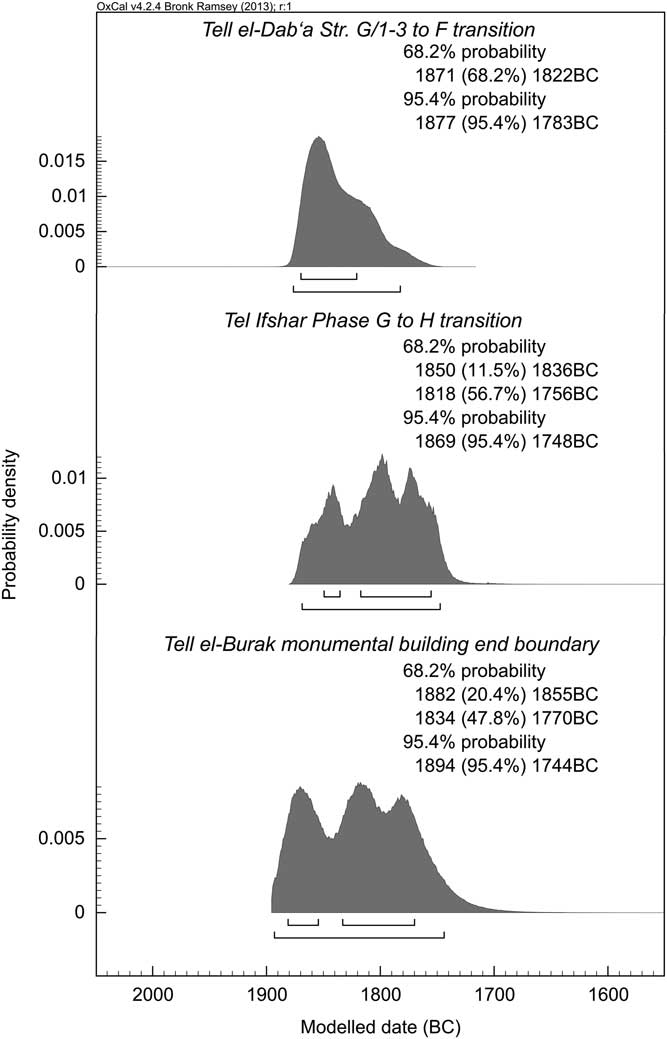
Three 14C data sets for the later Middle Bronze I and the transition to II are currently available: dates from Tell el-Dabca itself; dates for the later phases of Middle Bronze I Tel Ifshar in the Sharon Plain (Marcus Reference Marcus2013); and dates for the late Middle Bronze I or Middle Bronze I/II transitional monumental building at Tell el-Burak (Lebanon) (Höflmayer et al. Reference Höflmayer, Kamlah, Sader, Dee, Kutschera, Wild and Riehl2016). In fact, the 14C evidence for all three sites is in favor of a higher chronology for the Middle Bronze I/II transition than has been proposed before now. Figure 9 shows (1) the results for the transition from Tell el-Dabca Str. G/1-3 to F (thus very late Middle Bronze I); (2) the transition from Tel Ifshar Phase G to H that, according to Marcus (Reference Marcus2013), should be contemporary with the Tell el-Dabca Str. G/1-3 to F transition; and (3) the end date for the Tell el-Burak monumental building that should be more or less contemporary (i.e. late Middle Bronze I or transitional Middle Bronze I/II) (a detailed discussion of the respective models can be found in Höflmayer [Reference Höflmayer2015]).
Modeled date ranges for the transition from Str. G/1-3 to F (late Middle Bronze I) at Tell el-Dabca based on Kutschera et al. (Reference Kutschera, Bietak, Wild, Bronk Ramsey, Dee, Golser, Kopetzky, Stadler, Steier, Thanheiser and Weninger2012) (upper); the transition from Phase G to H (late Middle Bronze I) at Tel Ifshar based on Marcus (Reference Marcus2013) and slightly adapted as outlined in Höflmayer (Reference Höflmayer2015) (middle); and end date for the Middle Bronze Age monumental building dated to late Middle Bronze I or Middle Bronze I/II transition based on Höflmayer et al. (Reference Höflmayer, Kamlah, Sader, Dee, Kutschera, Wild and Riehl2016).

These results are thus in line with the high 14C dates for Phase III at Tel Kabri. While the results lack the precision of the Middle Bronze II/III transition around 1700 BC presented for Kabri above, it may well be that the late Middle Bronze I and Middle Bronze I/II transition is considerably earlier than previously expected, perhaps as early as the 19th century BC, although we must keep in mind that the Middle Bronze I/II transition may not have been completely contemporary throughout the southern Levant.
CONCLUSIONS
In this paper, we have presented results of a 14C dating study of the Middle Bronze II palace at Tel Kabri. Based on the models, we suggest that the late Middle Bronze II destruction of the Phase III palace should be dated to approximately 1700 BC. This date is slightly higher than conventional estimations for the Middle Bronze II/III transition, usually described as ~1650 BC, and considerably higher than the low date of ~1590 BC, which is based on the archaeological-historical dates for the Tell el-Dabca stratigraphic sequence. The suggested ~1700 BC date for the end of Middle Bronze II is also in line with 14C evidence from Tell el-Dabca, which dates the Middle Bronze II/III transition (at the same time the transition from Str. E/1 to D/3) to ~1700 BC (or the second half of the 18th century BC). At the same time, 14C dates for late Middle Bronze I phases at Tell el-Dabca, Tel Ifshar, and Tell el-Burak also require a higher Middle Bronze Age chronology than originally proposed.
The historical implications of raising the Middle Bronze Age chronology can only briefly be discussed within this paper. An example of one such implication, to be further explored in a separate article, concerns the chronology of the polity immediately to the east of Kabri in the Middle Bronze II: the large and powerful polity of Hazor (see e.g. Marom et al. Reference Marom, Yasur-Landau, Zuckerman, Cline, Ben-Tor and Bar-Oz2014). Hazor was not a fortified city in the Middle Bronze I, and only in the Middle Bronze Age II was the acropolis (Stratum XVII) as well as the huge lower town (Stratum 4) fortified for the first time. Redating the Middle Bronze II in a region close to Hazor may impact the chronology of the rise of “Greater Hazor,” the largest metropolis of the southern Levant, which may have occurred earlier than previously estimated. The mention of this city in the Mari texts forms the most important synchronism between the Middle Bronze Age southern Levant and Mesopotamia of the Old Babylonian period (Horowitz and Wasserman Reference Horowitz and Wasserman2000; Ben-Tor Reference Ben-Tor2004, Reference Ben-Tor2016: 69–73). Yadin (Reference Yadin1972: 200) placed the foundation of the lower town and the mention of the city in the 18th–17th centuries BC. Ben-Tor (Reference Ben-Tor2016: 57–63), however, argued for a slightly lower date, placing the rise of Greater Hazor at ~1700 BC, after the transitional period between Middle Bronze I and Middle Bronze II. If 1700 BC is indeed the transition date between Middle Bronze II and Middle Bronze III, then the foundation of Greater Hazor should be raised into the 18th century BC, perhaps to a date somewhere between the suggestions of Yadin and Ben-Tor. As the study of the material culture remains from Kabri continues, the full implication of the absolute chronology of this site and its interconnections with other sites at the Levant and beyond is only beginning.