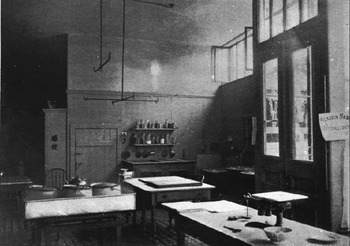
On January 24, 1890, Ellen Richards and Mary Hinman Abel opened the doors to the first New England Kitchen (NEK), and for the next five years, neighborhood tradesmen and urban working-class families came to fill jars with hot, inexpensive beef broth, vegetable soup, pea soup, corn mush, boiled hominy, oatmeal, cracked wheat, and spiced beef to bring home to eat with their families on Boston's south side.Footnote 1 The NEK was tiny, no more than a few hundred square feet, but visitors would surely have been struck by how open, well-lit, and organized the space was. Large windows along the top section of two walls flooded the space with sunlight and ventilated the busy kitchen. Canisters and dishes of varying sizes filled open shelves on one wall, and three big, barrel-shaped ovens occupied a spot in the corner. A small gas table for quick cooking took center stage, flanked by three tables, forming an L-shaped counter where customers watched kitchen staff hurry about preparing food.
The NEK was not, however, simply a place to buy prepared food; within this small space, four reformers attempted to change working-class eating habits and, through this effort, change working-class people. Richards, a chemist at the Massachusetts Institute of Technology (MIT) who would later lead the home economics movement, ran the NEK with Abel, a domestic scientist whose time in Germany provided new models of social reform. Joining them were Wilbur Olin Atwater, a chemist at the US Department of Agriculture (USDA) who spearheaded nutrition science in America, and Edward Atkinson, a prominent laissez-faire Boston businessman. Each had specific interests in the NEK, but all believed that dietary reform was the most effective route to broader social reform. The NEK's reform effort ended in late 1894, having largely failed in its mission to significantly change local working-class diets—a failure that has been well-documented by historians.Footnote 2
Focusing on the failure of the NEK, however, obscures a much more interesting story about the intersection of food and ideas and how the relationship between food and bodies assumed new meanings in this historical moment—a story that complicates how historians have thought about the Progressive Era more generally. Historians of the Progressive Era have embraced the multiplicity of efforts and thinking that defined the era, even as many of those same historians lump Progressive Era reformers into neat groupings based on their reform ideas and goals.Footnote 3 While they have recognized how different reform ideas existed side by side in different efforts, these historians have missed this multiplicity playing out within the same reform efforts. Individual reformers were not internally consistent as they struggled to answer fundamental questions, such as why people were the way they were. Historians have framed answers to this question according to a binary: More progressive reformers believed they could reform people and their behavior through social remedies, while more conservative reformers believed real change was not possible and that biological and racial qualities predetermined social realities.Footnote 4 Richards and her colleagues at the NEK complicate this genealogy of American reformist thought. They negotiated this emerging-but-not-yet-solid binary of biological and social explanations of behavior by focusing on eating and diets, concluding that both explanations were true, though sometimes in tension. As this article demonstrates, reformist thought was not only defined by plurality across reform efforts; it was contradictory and internally inconsistent, and, above all, it was messy—a work in progress.
This article examines where intellectual history and food history intersect, exploring how food and ideas were inextricably connected for some historical actors, especially in relation to bodies and their role in the production of knowledge. Emerging work on the history of the senses, food history, and the history of science shows a growing interest in how visceral experiences connected to, were influenced by, and shaped thinking.Footnote 5 Focusing on the NEK allows us to explore the emergence of granular ideas from concrete encounters with food—encounters that took place through the act and concept of eating. Following the work of Kyla Wazana Tompkins, this article uses eating—as well as the refusal to eat—as a way of understanding food, bodies, and ideas in this historical moment, as well as a way of producing knowledge.Footnote 6 By thinking about eating and its relationship to thinking, I want to suggest an intimate link between bodies and ideas, a link that may be especially generative at this point in history when food, ideas, and bodies began to meet in new ways.
Through their efforts at the New England Kitchen, these reformers came to understand food as a tool with which they could potentially shape bodies and behaviors. As these reformers tried—and largely failed—to change working-class diets, they grappled with the question at the heart of most reform movements: Were people's behaviors determined by biological or social factors? In other words, to what extent could people change? As they thought about eating and what eating “right” meant, these reformers formed four rough conceptions of the body, which I refer to as the caloric body, the changing body, the citizen body, and the managed body. Respectively, these conceptions focused on science's ability to maximize the body's potential; the possibility of diet to change the body, physically as well as intellectually and morally; the potential to produce better citizens by shaping the child's body; and the potential to manage bodies as a natural resource for the common welfare. All these conceptions share two important features. First, they are all future-oriented, focusing on the body's potential and on the process of becoming. Second, they each, at first glance, appear to be metaphorical, but are in fact concrete and visceral ways to think about real flesh-and-blood bodies. These conceptions of the body are not mutually exclusive or neatly demarcated; they are fluid and slippery, each containing their own tensions between biological and social explanations for human behavior. What emerges across these conceptions is a more biopolitical way of thinking about the relationship between food and bodies in social discourse—a way of thinking that foregrounded the possibility of shaping and managing life and bodies.Footnote 7
The ideas that took shape at the NEK had consequences for broader discourse as they spread throughout networks of other thinkers and reformers. In 1893, Richards ran a replica of the NEK at the Chicago World's Fair, showcasing its work and disseminating its ideas among millions of visitors. In 1894, the NEK secured a contract to supply Boston schools with lunches—the country's first organized school lunch program. After leaving the NEK, Richards founded the American Home Economics Association, bringing her knowledge and experience from the NEK into her leadership of this national movement for food, science, and education, shaping how generations of Americans would learn about food in the twentieth century.Footnote 8 Atwater, as head of the USDA's Storrs laboratory for human nutrition, set the agenda for American nutritional science and helped Richards and Abel proliferate their ideas through USDA publications. The work of the NEK was influential beyond its five years of activity in Boston, and it was precisely this thinking about food and bodies that worked its way into broader discourse.
A Shared Belief
What brought these four very different individuals together was a shared belief that a scientific approach to diets could lead to profound social change. Much of their thinking about the relationship between food and bodies changed through their time at the NEK, but this shared belief held constant. Atwater learned this in Munich in 1886 when he encountered Carl von Voit's foundational work on nutrition science and his technique of separating food into protein, carbohydrates, fat, and water. Atwater used Voit's technique to better understand the relative nutritional components of cheap and expensive foods, discovering that working-class Americans were wrong to think that more expensive foods were inherently more nutritious.Footnote 9 Atkinson already had the desire to reform the working class in order to stem labor agitation, and from Atwater's research, he came to believe that science and dietary reform might be the solution. Atkinson reached out to Atwater, who confirmed his hope that the working class could improve their living conditions without raising wages if they ate more efficiently.Footnote 10 Richards had by this time established herself as an emerging public intellectual at MIT, where she collaborated with Atkinson—who was a trustee—on scientific research. Abel, like Atwater, learned about scientific food's potential for social reform in Germany, through Berlin's Volksküchen, or “People's Kitchen,” which provided inexpensive food for the poor. She wrote about these public kitchens in an essay that won the 1888 American Public Health Association's Lomb Prize, for which Richards served on the jury.Footnote 11 What Richards saw in Abel's essay was the potential for concrete social reform, so she reached out to suggest that they work together to implement that reform, using the Volksküchen as a model while amplifying its reform potential.
On January 24, 1890, the doors to the initial branch of the New England Kitchen opened. Richards controlled the NEK, Abel oversaw practical work, Atwater contributed new research from his USDA post, and Atkinson contributed ideas and financial backing through a network of elite philanthropists, including Andrew Carnegie and Pauline Agassiz Shaw, the latter of whom saw this experiment as a key to promoting temperance.Footnote 12 Customers who came from the surrounding neighborhood were mostly German, Irish, Nova Scotian, and American. A later branch was opened in Boston's North End, nestled among Russian, Portuguese, and Italian neighborhoods, and another one in the West End in a predominantly African American neighborhood.Footnote 13 Unlike saloons, where many working men procured lunches and which generally did not allow women to enter, the NEK was frequented by both men and women.Footnote 14 Maria Parloa, a prominent Boston cooking teacher, called the New England Kitchen an “inestimable blessing” to working women and their families because it provided convenient, nutritious food for women who worked and were still expected to provide meals for their families.Footnote 15 From the NEK, these women might bring home soups and stews, dense breads, and cheap cuts of meat that had been cooking all day—foods that were heavy and bland but generally more filling than the sugar-laden pastries many workers and children purchased from pushcarts.Footnote 16
These reformers believed the NEK should teach by example, demonstrating to its customers the principles of scientific efficiency that undergirded the whole endeavor. These demonstrations began as soon as customers walked through the door. According to Abel, the NEK was “a silent teacher of cleanliness, intelligent methods, and a uniform and good result in cookery.”Footnote 17 Customers entering this space were supposed to learn how to conduct their own kitchens by watching the NEK's staff prepare nutritious food in an efficient manner. The space inside the kitchen was small but designed with the intention of maximizing efficiency and of being entirely exposed to the gaze of customers (figs. 1–2). Here, customers were supposed to learn that the beef sold at the NEK was better than the nicer cuts of meat they aspired to because it had the same nutritional value at a lower cost, and they were expected to replace their staple bread with that available at the kitchen because it was more filling, despite being incredibly dense. Customers could not only purchase prepared food to take home to their families, they could also learn cooking techniques almost as if by osmosis while they were in the physical space.
“The New England Kitchen, Pleasant Street, Boston” from Mary Hinman Abel, “The Story of the New England Kitchen, Part II (The Rumford Kitchen Leaflets No. 17)—A Study in Social Economics,” in Ellen Richards, Plain Words About Food: The Rumford Kitchen Leaflets (Boston: The Home Science Publishing Company, 1899), following 134.

“The New England Kitchen, Pleasant Street, Boston” from Mary Hinman Abel, “The Story of the New England Kitchen, Part II (The Rumford Kitchen Leaflets No. 17)—A Study in Social Economics,” in Ellen Richards, Plain Words About Food: The Rumford Kitchen Leaflets (Boston: The Home Science Publishing Company, 1899), following 132.

The NEK was also an experimental laboratory, gathering data for fellow reformers about what the working class ate and what impact the NEK had on local diets. And observation was mutual: Customers were supposed to observe and learn from the NEK staff while the staff observed and gathered information about their customers. Richards believed one of the NEK's most significant contributions was its collection of “trustworthy facts” about the eating habits of the community with which to inform future work.Footnote 18 The reformers wanted to know what their customers ate, what they could persuade customers to eat, and what customers refused to eat. They had, for example, always heard that “Americans will not eat soups,” but they found that soups were quite popular as long as they were hearty and had meat and vegetables; pea soup, for example, became a fast favorite once pork was added.Footnote 19 Indeed, the reformers spent their first six months gathering information on what the community was actually eating so their work would be more effective, since they believed reform and charity work too often wasted resources for want of sufficient information.Footnote 20
The Caloric Body
Richards and Atkinson used the NEK to think about the potential for a scientific approach to food and cooking, an approach that centered on the caloric body—science's ability to maximize the body's potential. This approach involved both discerning the fundamental, innate qualities of food and determining how those qualities related to human bodies and behaviors. The caloric body was more concerned with understanding food and bodies than in necessarily changing bodies. A year before the NEK opened, Atkinson wrote to Richards, referring to what he saw as the “missing science in domestic cookery.” While the cookery would ultimately be “domestic,” he insisted experiments in nutrition could only be done in a laboratory.Footnote 21 He believed they could discover this science through careful research and analysis until “the ultimate rule” was found, “a rule, safe, sure and simple.”Footnote 22 This effort to find a scientific rule to guide their work was about making cooking efficient and predictable. It was also about producing homogenous food and diet.
These experiments—conducted in the labs at MIT and in parallel to Atwater's USDA research—determined the calories in a given food as well as the relative amounts of fat, carbohydrates, protein, and water. Any food under consideration for the NEK's menu first underwent testing in Richards's chemistry lab at MIT. Richards conducted twenty experiments on the beef broth alone before it reached the kitchen counter.Footnote 23 Bodies were nowhere involved in these experiments (except those carrying out the tests), and taste was conspicuously absent from any examination of food. Standardized procedure was the basis for the scientific method these reformers utilized, making uniformity the gold standard of food production.
Richards's desire to reduce food and cooking to calories and scientific efficiency, however, sometimes clashed with how others—even those who worked with these reformers—understood food. After the original NEK opened, philanthropists and reformers opened several other similar public kitchens in Boston, Providence, and New York City. These functioned effectively as independent franchises since Richards did not have control over them, though she frequently visited them to dispense advice. During one visit to a branch, Richards tried to analyze the cook's soup, but “the cook threatened to leave if her soup was to be analyzed—she knew how to cook and she was not going to stand it,” as Richards recounted the incident to Abel.Footnote 24 The cook, whose social background is unclear, trusted her own knowledge—derived from her own experiences—over what she may have felt was the overemphasis on scientific principles and constant testing Richards demanded. Whether intended or not, the NEK reformers’ emphasis on laboratory-based scientific cooking simultaneously delegitimated women's culinary traditions and reproductive labor. Richards dismissed any cooking—and housework more generally—not guided by the scientific principles these reformers promoted.
Science at this time understood food in terms of calories and nutritional components, and these reformers used their scientific research to maximize nutritional intake per dollar amount, seeing calories as interchangeable fuel for the body. As Atwater had learned while in Munich, all foods could be broken down into specific ratios of nutritional components, which at the time meant protein, fat, and carbohydrates; other components, like vitamins, would not be isolated until the 1910s. And since the protein in a cheap cut of meat was nutritionally the same as that of a sirloin steak, every individual could secure the necessary nutritional components, regardless of their income, as long as they understood the science behind the food. “So this is nature's democracy,” Abel remarked, “food is food, for a’ the wit of cooks!”Footnote 25 What the individual needed to know—and this was why uniformity was key at the NEK—was that a certain quantity of beef broth always contained a certain quantity of protein and fat. Thus informed, consumers could make rational decisions about their diets to ensure they secured the nutrition they needed without spending more money than necessary.
Many customers refused to order their eating choices according to this logic of efficient calories and instead chose foods based on taste, a quality that was anathema to the concept of the caloric body. A cheap cut of meat and a sirloin steak may be nutritionally identical, but they did not taste the same. The NEK reformers believed too many of their customers chose foods based only on subjective taste rather than on rational understandings of nutrition, which is to say that explanations for dietary decisions based in biology seemed stronger than those based in social learning and rationality. As Abel lamented, “The person who said, ‘I don't want to eat what's good for me, I'd rather eat what I'd rather,’ represents a large class.”Footnote 26 This person, in Abel's mind, represented the “unlearned man” because he judged food only by its taste and was, therefore, irrational. What she and the other reformers sought to cultivate was the scientific man—enlightened and rational and who looked “behind the husk of the wheat” to see beyond taste.Footnote 27 Rejecting taste as a measure of “good” food further delegitimized women's culinary traditions, since those traditions taught that food should taste good.
The caloric body, as a model of rational eating, could not incorporate sensory experience and questions of taste. For all their talk about eating, an interesting question emerges: Did these reformers ever taste their own food? It seems possible they never did, or at least that they were simply uninterested.Footnote 28 Their conspicuous refusal to discuss taste, however, suggests something more revealing about the precariousness of their authority. It makes sense that these reformers would highlight scientific research while disregarding taste; the richest sources for understanding what happened at the NEK are reports to their philanthropic funders—individuals who were quite literally invested in the NEK being a fundamentally new approach to social reform, one guided by scientific research rather than sentimentality. In other words, both their authority and their funding depended on their denial of taste, and their denial of the subjectivity of and variation between individual bodies. In framing their approach to reform, Richards and her colleagues positioned their efforts as superior to previous reform efforts because of their scientific research and understanding of the human body and its needs.
Rather than entertain the notion that taste could matter in diet, these reformers doubled down on scientific rationality and efficiency, while trying to figure out how to counter their customers’ assertions that taste mattered. For example, once the NEK opened, customers petitioned alterations in the food based on their own preferences, such as dumplings for the soup. To Richards and Abel, dumplings were “gray balls of that old-fashioned abomination, whose sodden name is enough to condemn it, and our scientific authority even forbade its manufacture.” Eventually, they realized how strong popular demand was and compromised by using macaroni as a substitute for dumplings, which they could make uniformly, cheaply, and without too much labor, thus not undermining their “scientific authority.”Footnote 29 These reformers had particular criteria for what eating right meant, and taste was not a factor; instead, nutritional and scientific efficiency reigned with a scientific authority that gave these reformers a sense of moral superiority.
The Changing Body
Eating “right” was essential to the NEK reformers because they believed that what someone ate determined what they would become—physically, but also intellectually and morally—and these reformers sought a way to produce better bodies through the idea of the changing body. In his scientific treatise on nutrition, for example, Atkinson described the diets of working-class people in countries around the world. He noted that many of these diets consisted primarily of carbohydrates (i.e., maize, rice, and potatoes) and lacked protein. This, he concluded, led those populations to “suffer physically, intellectually, and morally thereby.”Footnote 30 In this liminal historical space between the advent of nutrition science and the refinement of that science that would come with a better understanding of physiology, these reformers understood that food played a role in the functioning of the body, but grappled at the edge of understanding what, exactly, that role was. Even as they framed their science as modern and new, these reformers held onto beliefs that resembled early modern humoral theories in which bodies changed according to the four humors (how dry, wet, cold, or hot someone was). Just as early modern Spanish conquistadors believed their bodies could deteriorate from prolonged exposure to food and other environmental factors in the Americas, so too did Richards and her colleagues believe the “right” foods could improve bodies.Footnote 31 To these reformers, calories and nutrition provided a modern scientific way to explain the changing body.
Among all the foods these reformers surveyed, they believed regional New England foods best fulfilled the body's physical, intellectual, and moral needs, and they used their scientific authority to press these foods upon their customers. Their vision of New England food included hearty soups and stews, boiled hominy, cracked wheat, and other bland foods that could be cooked over a period of hours. Sanctifying so-called New England food, however, was also about elevating certain foods as inherently superior. This was especially true in a historical period when notions of whiteness were under construction in the midst of continued immigration and the perceived threat from otherness. These reformers held up this food as “the perfect dietary,” against which they could judge their customers’ eating practices.Footnote 32 This “aggressively Yankee cuisine,” as historian Hamilton Cravens so aptly described the NEK's fare, positioned “New England-ness” as something toward which these working-class families should strive—a notion of progress that had in mind a definite destination.Footnote 33
Eating New England food was about working class-individuals adopting customs and practices marked as desirable by reformers, but it also raised questions about the potential for transformation rather than just adoption. Could the NEK's customers “become” New Englanders by consuming the NEK's food? Could they “become” white? This process of imposing American or New England foods on immigrant populations was part of the much broader effort at Americanization during this period, the attempts—sometimes piecemeal, like the NEK, and sometimes systematic, like government programs for naturalization—to assimilate immigrants and other marginalized groups into American culture and society, to force groups to abandon their cultural identities in order to “be” American.Footnote 34 But while the majority of these efforts hinged on the adoption of customs rather than the transformation of bodies, the NEK reformers explored the gray space of whether it was possible to actually shape bodies themselves. For them, it was about making bodies conform to ideals by feeding those bodies according to ideals. The logic was best captured by an incident in which a customer pushed back against these reformers and their food. Abel recounted the “national feeling” that led one Irish boy to respond to an Indian pudding by exclaiming, “Oh! You can't make a Yankee of me that way!”Footnote 35 The Irish boy instinctively understood that eating Indian pudding—a baked custard that was closely linked in the public imagination with New England—meant becoming more like New Englanders, or Yankees, whether superficially or at a deeper level. This moment of insight went to the heart of these reformers’ mission: change the diet, change the people—assimilation at a visceral level.
Many customers resisted, understanding on a gut level this aim of the NEK, and this resistance pushed the reformers to explain why some people were more amenable to changing their food practices than others. Abel explained that “successful” kitchens were in neighborhoods of Germans, English, Catholics, and Protestants, while kitchens in communities of Italians, Russians, African Americans, and Jews “failed to gain any foothold.”Footnote 36 Among certain communities, there was a refusal to eat the NEK's food. Rather than explain these failures in ways that acknowledged the limitations of the NEK's food or mission, the reformers placed the responsibility on those who refused to eat their food. There seemed to be something innate about some people that made them amenable or not to the kitchen's food; they blamed the bodies of the potential customers rather than the kitchen's food or mission.
The refusal to eat what the reformers saw as the “right” foods was what prompted the dilemma of the changing body: was diet learned or innate? To what extent could they change people, be it their behaviors or their bodies? Was there something innate in certain people—maybe even something biological—that explained their inability to change? In this historical moment, the binary between biological and social explanations for behavior had not yet coalesced, though it was emerging as part of the proliferation of evolutionary theories in the wake of Darwin's work. This was well before what we today recognize as the nature-nurture debate. And, while eugenics would capture the minds of US social reformers in the next decade, the 1890s was characterized by the porous boundaries between biological and social explanations for behavior—certainly more than any hardened binary that juxtaposed the two.Footnote 37 For intellectuals like Richards, evolutionary theories, ecological concepts, and the broader biological sciences provided new ways to think about society and people. In the aftermath of Darwin's theory of evolution, many social thinkers imported biological thinking into their attempts to understand society, especially with the birth of new disciplines such as modern sociology and psychology. Albion Small and George Vincent, two of the founders of American sociology, understood society as fundamentally shaped by biological laws. Their groundbreaking 1894 textbook, An Introduction to the Study of Society, they argued, should be paired with the latest findings in biology to best understand social dynamics through explorations of social anatomy and social physiology.Footnote 38 Rather than nature or nurture, intellectuals were trying to understand the relationship between the two, and determine what they could and could not change.
The dilemma of the changing body was not framed in absolute terms; both Richards and Atkinson believed diets were at least partially innate, determined by evolutionary adaptation. Atkinson especially leaned on this more biologically deterministic line of thinking, arguing that “[e]ach race, each country, and almost each section of each country, through a process of natural selection,” had arrived at a stable diet that resisted change, though it remained to be seen how much impact new scientific research might have on those diets.Footnote 39 Atkinson's thinking was steeped in a conservative strain of social Darwinism, emphasizing innate characteristics that could only be changed when compelled by social competition—biological explanations for behavior held primacy, though social pressure could compel change if strong enough. The problem with their reform strategy, Atkinson informed Richards, was that they assumed the poor to be intelligent enough to adopt their ideas. As he put it, “It is their lack of intelligence, their lack of initiative and their lack of power of application which stand in the way.” The only way they could reform the poor, he argued, would be by first reforming the wealthier classes, leaving the poor to reform themselves “partly by imitation and partly through emulation of their betters.” As his model for this imitation, Atkinson told Richards about capitalist competition on farms in the western United States. Once the USDA experimental stations were established, he argued, the owners of “ill-conducted farms” were forced to “mend their ways or to move on” due to the competition of the well-conducted farms.Footnote 40 By the same logic, Atkinson believed the working class could either eat as their peers ate or “move on.” Capitalist competition was the foundation of both Atkinson's economic ideas and his food reform ideas: It pressured targets of reform to take the initiative for self-improvement or to perish in a dietary version of survival of the fittest.
While Richards also believed diet was, to a certain extent, innate, she believed there was more potential for change than Atkinson recognized, and she used the dilemma of the changing body to think through how they might promote that change. Richards worked from a neo-Lamarckian view of social change, believing that individuals could learn and adapt—that behavior was more explainable by social influence than biology, and could thus be changed. She eventually created a new science—euthenics, or “the science of the controllable environment”—that encapsulated this belief in the individual's malleability and the importance of the environment. At its core was the notion that the key to improving the wellbeing of people was to improve their environment. Acquired traits could also be passed down, whether through heredity or education, though the former would be disproven by the rediscovery of Mendelian genetics by the time Richards founded euthenics in 1910.Footnote 41 For Richards, eating was the key to transforming taste. This was, after all, the driving belief behind the New England Kitchen—that getting people to eat the “right” foods taught them to incorporate those foods into their diets. While Richards had been vehement in denying taste a place in their reformist thought, she understood as their experiment went on that taste could be used to change diets; that is, if people had the “right” taste, they would eat the “right” foods. Taste was an entry point into the change the reformers desired to create: Shaping taste led to shaping bodies.
The Citizen Body
In thinking about the possibility of shaping future citizen's bodies, Richards came to understand the child's body and diet as the most susceptible to change and as having the greatest possible future payout for investment. Richards believed that what an individual considered “good food” was simply the food they were accustomed to as a child; “good” was not a judgment of the food's nutritional qualities, but rather a matter of taste formed through habit. Once a child acquired a habit or taste, they resisted change, and any change would first require unlearning those habits and tastes, as the difficulty in changing the dietary habits of adult customers demonstrated.Footnote 42 Unfortunately in the eyes of Richards and Abel, many of the children they met had acquired tastes contrary to their scientific principles; these children subsisted on tea, baker's bread, cake, and vinegar pickles.Footnote 43 On the positive side, at least from the viewpoint of the reformers, if they could introduce the “right” foods to the child while they were still determining what “good food” was, they could make sure that “good food” and “right food” were one and the same.
Learning how to eat properly was fundamental to the education children were supposed to acquire in their homes, education that shaped what kind of citizens they would become. “Is not the purpose of the family,” Richards wondered, “education in all that makes for character, for citizenship; are not all the qualities that serve the highest purposes in the world developed in the family life when it is taken seriously?”Footnote 44 Like many other Progressive Era reformers—those in settlement houses and the Children's Bureau, or those working to end child labor—Richards believed society would move forward insofar as family homes cultivated children into a sound, responsible generation of citizens.Footnote 45 More specifically, for Richards, it was the family table within the home that was so crucial for this education. Richards believed the table to be “an educational factor of greatest importance to the children,” for it was at the table where the individual acquired “the virtues of self-control, self-denial, regard for others, good temper, good manners, [and] pleasant speech.”Footnote 46 Through eating at the family table, children learned the values necessary to become virtuous citizens—consuming the right foods in the right way turned the child into the right citizen.
Eating “right” meant becoming a virtuous citizen and eating “wrong” meant becoming a part of society's ills—a judgmental logic most explicit in the perceived relationship between diet and alcohol. Richards told “Temperance Women” that they should not “grumble at the saloon” until they have “put some soup in its place.”Footnote 47 As she saw it, only those who ate malnourishing food consumed alcohol. Atwater also followed this logic, though emphasizing taste more than Richards, arguing that it was the wife's responsibility to prevent her family from consuming alcohol by providing food that was both wholesome and nutritious. “Or she may ignore both flavor and appearance,” Atwater argued, “and if her husband does not like the food she sets before him, and other things about the home are not attractive, he will very likely go to the ‘poor man's club’ otherwise known as the saloon.”Footnote 48 In their logic of right food decisions, these reformers placed the burden of responsibility on women—the fate of their families came down to their ability to make food decisions informed by scientific understandings of nutrition and how eating particular kinds of foods produced particular kinds of people, for better or worse.
Richards began to see children as essential to the emergent social theory she cultivated through her work at the NEK because the child's body was the most open to change and because the family home was central to the social welfare of the community. This interconnectedness also meant that molding the behaviors of one household could shape the behaviors of community members. The home was, for Richards, “the meeting point for all movements,” where all social scientists and social reformers should begin if their work was to have lasting effect.Footnote 49 The family home, she believed, was the vehicle by which society moved forward.Footnote 50 The logic was straightforward: A good home produced better children who improved society by being responsible citizens and by becoming models for community members to emulate.
This emergent social theory that centered on the family home and its production of citizen bodies was part of a broader historical development of racialized bodies and notions of whiteness. In thinking about the family home, Richards drew upon “students of human evolution” and their belief that “what is represented by the term ‘home’ is the germ of Anglo-Saxon civilization, the unit of social progress.” She believed the aim of the twentieth century must be to maintain “the Anglo-Saxon ideal of home life,” requiring mothers to use their homes to produce “the best-developed men and women” since those men and women would influence the forces of social evolution.Footnote 51 Just as Richards drew on evolutionary theories to inform her ideas about eating and diets, she drew on these theories to think about homes, families, and social progress. Richards—and many other intellectuals during this period—used theories of social progress that were thoroughly racialized, informed by the notion that evolution would result in the perfection of the most civilized race, which most often specifically meant Anglo-Saxons.Footnote 52 This belief was similar to the idea that “New England” food was innately superior—a constructed social discourse used to elevate one group and racialize others. The “Anglo-Saxon ideal” and New England food were, for Richards, both grounded in what people ate, both projects of shaping bodies according to some racialized ideal. Women and food were central to the project of whiteness at this moment. And while questions around whiteness were being worked out, there remained the possibility, at least to Richards, that one could “become” white by exploiting the relationship between diets and bodies. While Richards seemed to have a fluid sense of race in this moment, though, it is doubtful she would have believed this to extend beyond people of European descent, and certainly not to African Americans.
This dynamic also applied to class and how these reformers understood the social positions of their customers. Both Atkinson and Richards believed working-class families could improve their positions by emulating the middle class. These families could not, however, become middle class because of entrenched systems of power such as the economic theories Atkinson promoted. Instead of allowing for class fluidity, this dynamic highlighted class difference. And because working-class families could never live up to the expectations of these reformers—either in terms of diet or the family home—these reformers inevitably dismissed their customers as a waste of their time and energy.
As Richards focused on women's responsibility to raise better children, she shifted her thinking from the working-class bodies the NEK sought to reform to the middle-class women who could implement systemic social reform by approaching food and the family home with managerial principles. While it may seem paradoxical that Richards believed the private, family home to be the keystone of progress when her reform efforts were through a public kitchen—thus removing cooking from that home—Richards had always meant the NEK to serve as an educational model for processes that customers could emulate in their homes. It was mostly working-class families who bought from the NEK and middle-class women running the kitchen. Put bluntly, middle-class women were responsible for shaping working-class bodies by influencing what and how those bodies ate; through this dietary work, those middle-class women could solve society's seemingly intractable problems. As Abel put it, “the social question is largely a question of the stomach.”Footnote 53 Social problems were reducible, according to these reformers, to the poor nutrition of individuals, to the visceral work of everyday eating. While the changing body made space for the potential to shape bodies, it was the managed body that held the potential for shaping other people's bodies and behaviors and for making this an intentional project.
The Managed Body
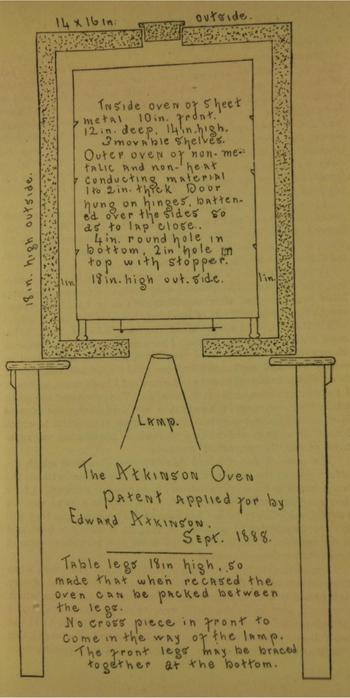
The managed body encompassed a set of ideas about the body and the management of resources that most directly related to labor unrest and the dilemma of changing diets. As a laissez-faire economist, Atkinson believed in the Iron Law of Wages—the idea that any intervention to change wage levels would ultimately only upset the delicate natural balance and plunge society into poverty.Footnote 54 The way around this, then, was for working-class families to maximize nutrition for minimal money by, for example, using cheaper cuts of meat and cooking them longer. It was for this reason that Atkinson invented and developed the Aladdin Oven, the first slow-cooking oven, which resembled an insulated chafing dish that used steam to slowly cook foods (fig. 3). Atkinson believed the Aladdin Oven fit perfectly within the schedule of the typical working-class family: They could put “meat stews, oatmeal, brown bread, and many kinds of puddings” into the cooker before going to sleep and wake up to “a better and more nutritious breakfast.” Likewise, they could prepare dinner during the morning and prepare bread over the lunch break to cook while the family worked.Footnote 55 Regardless of whether these families utilized his invention or not (likely not since it cost $25), Atkinson believed the act of efficiently managing the family income—buying inexpensive, nutritious foods and cooking them correctly—would save that family money, freeing more of the income to spend on better living conditions, and thus eliminate the need for higher wages.
Diagram of the Aladdin Oven from Edward Atkinson, “The Art of Cooking,” Popular Science Monthly 36 (November 1889): 15.

Managing income, time, and nutrition constituted a process of disciplining workers’ bodies, of producing bodies that could work more. Atwater cited recent studies on the living conditions of American and European workers and argued that the American workingman was far superior to his European counterpart. He insisted that their superior level of nourishment was the reason the American workingman regularly turned out more work than his European counterpart.Footnote 56 Atkinson believed society was governed by a “common law” whereby everyone had equal opportunity and equal access to the resource of time, so if someone did not succeed, it was their own fault—due, Atkinson argued, to a lack of intelligence and mental resources. “The very poor are poor,” he argued, “in consequence of their own lack of mental energy and not because of any outside influence.”Footnote 57 Atkinson's view, which was common among some reformers during this period, was what historian Daniel Horowitz aptly described as a “bourgeois emphasis on self-help and personal discipline,” thinking that the problems working-class families faced would be solved if only they helped themselves, whether through education or discipline.Footnote 58 As with his views on food decisions and income management, Atkinson placed responsibility on the individual, ignoring the ways in which the working class was disadvantaged because of the very nature of these social systems and sets of relationships.
The managed body, like the citizen's body, was not an isolated unit, but rather existed within a web of social relationships, making resource management central to how Richards imagined social welfare. Central to these ideas of resource management were the concepts of oikos, or “the household,” and, œconomie, or “household government,” the basis of economy, although a more expansive concept than “the economy.” Widely used in the eighteenth century, œconomie was understood as a process of stewardship, through which resources were cultivated to improve the general welfare of both household and community.Footnote 59 Richards used these concepts, along with the work of the German scientist Ernst Haeckel, to coin the word “œcology” in 1892. She defined this word (which she hoped would be the base of a science, although natural scientists took “ecology” in a different direction) as “universal house” or “household of nature,” emphasizing the interaction of organisms, including humans, with their environments.Footnote 60 Richards saw the NEK's work—and the world generally—through the lens of “œcology,” believing effective social reform came through understanding society as an interconnected organic system with resources to be cultivated intelligently. The idea of managing bodies as natural resources through œcology was the most striking intellectual takeaway from Richards's work at the NEK, and this idea expanded the range of possibilities of how social thinkers and organizations related to bodies, both individually and in aggregate.
When she and Abel agreed to launch the New England Kitchen, Richards seems not to have been thinking about the nature of society and how, exactly, eating fit into social theory. But through her work with that food and her daily encounters with the customers who consumed—or resisted—that food, Richards and her fellow reformers grappled with questions of whether and to what extent diets—and bodies—could be changed. At this point, biological and social explanations for behavior were porous and certainly not mutually exclusive, though they would coalesce into a more solid binary over the coming decades. For Richards and her colleagues and their quest to understand the relationship between food and bodies, the boundary between these explanations was a sliding scale, shifting depending on circumstances. Richards and her colleagues negotiated competing explanations for people's food practices and what those practices had to do with why people were the way they were. Their work in this food reform experiment did not offer clear and satisfying answers to these questions, but it nonetheless generated new ideas and theories about how food and eating could be used to shape bodies, and about how reformers could think of food and bodies differently than they had before.
Conclusion
The end of the NEK's experimental reform at the close of 1894 would have also meant the end of this thinking about the relationship between bodies and food and how bodies could be managed as natural resources, but this thinking worked its way into broader discourse at the opening of the twentieth century. Richards carried it with her in her subsequent work with the home economics movement, beginning with the annual Lake Placid Conferences in 1899 and into the formation of the American Home Economics Association in 1909, which she led until just before her death in 1911. This thinking also spread beyond Richards through her relationships with key reformers and intellectuals of her time, such as Atwater, and also Julia Lathrop and Jane Addams at Hull House in Chicago. Lathrop later became the inaugural chief of the US Children's Bureau, in 1912, and used Richards's theories—in the form of the latter's science of euthenics—in the bureau's work.Footnote 61
The idea of managing bodies as a natural resource would have been particularly resonant with the Children's Bureau, since its main advocates, Lillian Wald and Florence Kelley, framed the urgent need for a federal bureau for children in terms of human conservation and cultivation. There is a legend about how the idea for the Children's Bureau came about, which begins in 1903 with Wald and Kelley eating breakfast, reading letters asking them if they could explain why more children died during the summer. Kelley then read a news article stating that the federal government was sending the Secretary of Agriculture to investigate damage done to cotton crops by the boll weevil. Frustrated, Wald purportedly asked, “If the Government can have a department to take such an interest in what is happening to the cotton crop, why can't it have a bureau to look after the nation's child crop?”Footnote 62 Likening children to the crops in which the government was already investing significant funds was a rationale that proved generative in the early twentieth century. Atwater and others also used this rationale to convince the federal government to begin a division for human nutrition within the USDA after they had had success applying scientific research to growing better crops and raising better livestock.
Richards and her colleagues at the NEK did not cause Kelley and Wald to think of children as a crop to be cultivated, but the parallel is unmistakable. The NEK predated Wald and Kelley's breakfast revelation—and the Children's Bureau—by over a decade, but rather than suggest causality, I believe these analogies are suggestive of a new kind of thinking that emerged in this broader historical moment. Wald and Kelley were not the only ones to consistently analogize children and agricultural resources. Many other reformers, agriculturalists, and high-profile politicians, such as President Theodore Roosevelt himself and New York Governor John Dix, frequently described citizens—and children in particular—as natural resources to be effectively managed and conserved. This was especially true when the government, through the USDA, was investing resources in scientific agriculture and better livestock management while investing little to none in child welfare, prompting numerous cartoons comparing healthy, pampered pigs to neglected children working in factories.Footnote 63 This thinking reframed human bodies in terms of cultivation and resource management, arguing that experts could use scientific advances to improve those bodies in the same way science had been used to improve agriculture in the latter half of the nineteenth century.
This work on bodies as fundamental to the shaping of social thought at the NEK opens up space for rethinking the histories of the organizations and individuals who took up this discourse about bodies at the turn of the twentieth century. Histories of the Children's Bureau and the USDA explore ideas and research, social programs, education, and policy and legislation, but neglect the bodies so often at the heart of these two organizations, even when those leading the organizations spoke emphatically about bodies and their potential when seen as natural resources for the country.Footnote 64 These histories have all been important to understanding these influential organizations, but centering bodies in these histories raises different questions about the nature of these organizations. How did these administrators, policymakers, and researchers conceive of bodies? (For the USDA, were animal bodies the same as human bodies?) What implications did their principles of management—especially viewing bodies as natural resources to be cultivated—have for the research these organizations conducted, the legislation they sought, and the information they disseminated to their public audiences? What role did scientific and social scientific research have in this evolution of social management discourse and how that discourse encompassed bodies? These organizations were trying to make sense of and manage real flesh-and-blood bodies as they related to that organization's line of work, and critically examining those bodies is the first step to understanding their importance in discourse and action in this historical moment.
At the beginning of this article, I said these four conceptions of the body—caloric, changing, citizen, and managed—were concrete rather than metaphorical, and while this has been mostly true, at times the distinction between the two becomes blurry. This is one of the difficulties of this work: Language is slippery, and the line between rhetorical strategy and firm belief is often nonexistent, or at least in flux. But this is also an opportunity for thinking about the relationships between bodies and ideas, a field of inquiry that requires sharpened focus on the ambiguity and complexity of ideas and language. By embracing the messiness of this kind of history and by foregrounding the ambiguous boundaries between bodies and ideas, the visceral and the conceptual, historians can gain richer insight than would be gained from seeing those discourses about bodies as solely metaphorical.