Research on the development of antisocial behavior (AB) is important because of the direct cost of AB to society not only in terms of damaged property and disruption of normal patterns of living but also because of the difficulty of treating delinquent youth and the potential emergence of later adult criminality, substance use, and other disorders (Odgers et al., Reference Xue, Leventhal, Brooks-Gunn and Earls2008; Shaw, Hyde, & Brennan, Reference Shaw, Hyde and Brennan2012). Studies suggest that most antisocial youth can be classified into one of two groups: youth with onset in early childhood (i.e., early-starters), and youth with an onset in adolescence (i.e., late-starters). Children with the early-starting pattern of conduct problems (CP) have been found to show high rates of AB in the elementary school years and beyond (e.g., Campbell, Pierce, Moore, Marakovitz, & Newby, Reference Campbell, Pierce, Moore, Marakovitz and Newby1996; Shaw et al., Reference Shaw, Hyde and Brennan2012) and a higher risk of continued AB and other problem behaviors in adulthood relative to late-starters (Moffitt, Caspi, Harrington, & Milne, Reference Moffitt, Caspi, Harrington and Milne2002). This is particularly the case for boys, for whom early patterns of CP take on more serious forms of AB (Brame, Nagin, & Tremblay, Reference Brame, Nagin and Tremblay2001; Stevenson & Goodman, Reference Stevenson and Goodman2001).
In the past two decades investigators have employed person-oriented, growth mixture modeling to identify different patterns of growth and factors that discriminate trajectories of early-emerging CP (NICHD, 2004; Shaw, Gilliom, Ingoldsby, & Nagin, Reference Shaw, Gilliom, Ingoldsby and Nagin2003; Tremblay et al., Reference Tremblay, Nagin, Seguin, Zoccolillo, Zelazo and Boivin2004). However, growth mixture modeling studies have been somewhat limited by focusing primarily on boys, using normative samples, and typically relying on passive, nongenetically-informed, longitudinal designs. The current study seeks to take advantage of an experimental, genetically-informed, longitudinal trial using a sample of 731 low-income toddlers screened based on socioeconomic, family, and child risk.
Developmental Transitions: The Toddler Period
Our current theoretical perspective emphasizes the unfolding of disruptive behavior during key developmental periods, accounting for critical developmental challenges for children and parents (Shaw & Bell, Reference Shaw and Bell1993). These key developmental transitions are marked by biological transformations in the child's cognitive and physical functioning that have critical implications for the child's socioemotional functioning and present challenges to parents coping with their child's newfound status (Shaw et al., Reference Shaw, Hyde and Brennan2012). The toddler period represents one of these critical developmental transitions, marked by the child's increased physical mobility but immature cognitive and regulatory abilities. Stressors generated from individual differences in child characteristics, parental well-being and caregiving skills, as well as community-level factors, might be exacerbated during the toddler period when parents and children are often struggling in negotiating a toddler's increasing physical mobility and need for greater autonomy. In part, because of stressors associated with the “terrible twos,” recent research has suggested that toddlerhood is an age period when parents are open to feedback and implementing more effective parenting management strategies (Dishion et al., Reference Dishion, Shaw, Connell, Gardner, Weaver and Wilson2008; Shaw, Dishion, Supplee, Gardner, & Arnds, Reference Shaw, Dishion, Supplee, Gardner and Arnds2006).
Within the family, aspects of caregiving have been highlighted as central causal factors in the development of early-starting CP, as postulated by social learning and attachment theorists (Greenberg & Speltz, Reference Greenberg, Speltz, Belsky and Nezworski1988; Patterson, Reid, & Dishion, Reference Patterson, Reid and Dishion1992). From a social learning perspective, parenting management practices that model and reinforce disruptive behavior are hypothesized to be associated with increasingly frequent and severe CP that begin during the terrible twos and escalate during the preschool and school-age years (Campbell et al., Reference Campbell, Pierce, Moore, Marakovitz and Newby1996; Shaw et al., Reference Shaw, Winslow, Owens, Vondra, Cohn and Bell1998). Conversely, parents who demonstrate high levels of responsivity, involvement, and/or proactive anticipation during early childhood have children with low levels of early-starting CP (Dishion et al., Reference Dishion, Shaw, Connell, Gardner, Weaver and Wilson2008; Gardner et al., Reference Gardner, Shaw, Dishion, Supplee and Burton2007; Wakschlag & Hans, Reference Wakschlag and Hans1999). However, longitudinal follow-up typically has been limited to the preschool or early school-age period, with only a few studies on parenting and antisocial outcomes that have spanned from early childhood to adolescence (Aguilar, Sroufe, Egeland, & Carlson, Reference Aguilar, Sroufe, Egeland and Carlson2000; Caspi et al., Reference Caspi, McClay, Moffitt, Mill, Martin and Craig2002; Fergusson & Woodward, Reference Fergusson and Woodward1999; Shaw et al., Reference Shaw, Hyde and Brennan2012).
Aside from caregiving quality, perhaps the most consistent family predictor of problem behavior during early childhood has been maternal depression, including both clinical and subclinical symptoms (Goodman et al., Reference Goodman, Rouse, Connell, Broth, Hall and Heyward2011). Maternal depression is thought to increase risk of child CP directly through genetic transmission and compromised caregiving quality, the latter by increasing harshness and critical behavior but also reducing involvement and activity level with the child. Results from a plethora of studies document associations between maternal depressive symptoms and early-starting CP (Aguilar et al., Reference Aguilar, Sroufe, Egeland and Carlson2000; Shaw et al., Reference Shaw, Gilliom, Ingoldsby and Nagin2003, Reference Shaw, Hyde and Brennan2012; Webster-Stratton, 2000), relations that persist longitudinally through adolescence and young adulthood (Gilliam et al., Reference Gilliam, Forbes, Gianaros, Erickson, Brennan and Shaw2015).
In terms of child characteristics, in addition to toddler levels of oppositional and aggressive behavior (Tremblay et al., Reference Tremblay, Nagin, Seguin, Zoccolillo, Zelazo and Boivin2004), negative emotionality (Sanson, Oberklaid, Pedlow, & Prior, Reference Sanson, Oberklaid, Pedlow and Prior1991), language skills (Moffitt, Reference Moffitt1990), and callous-unemotional behavior (Hyde et al., Reference Hyde, Shaw, Gardner, Cheong, Dishion and Wilson2013; Willoughby, Mills-Koonce, Gottfredson, & Wagner, Reference Willoughby, Mills-Koonce, Gottfredson and Wagner2014), fearlessness or low behavioral inhibition (Shaw et al., Reference Shaw, Gilliom, Ingoldsby and Nagin2003; Waller, Shaw, & Hyde, Reference Waller, Shaw and Hyde2017) and IC (Olson, Choe, & Sameroff, Reference Olson, Choe and Sameroff2017) have been consistently linked to early-starting CP. In both cases, fearlessness and low IC are thought to be directly associated with later CP and indirectly influential by eliciting more hostile and inconsistent care from caregivers.
In addition to child-level characteristics, meta-analytic findings from twin and adoption studies suggest that CP is moderately to highly heritable (Rhee & Waldman, Reference Rhee and Waldman2002).
There is also extensive literature linking single candidate genes to aggression, violence, and other forms of CP through both direct and interactive associations with environmental risk (e.g., Burt & Mikolajewski, Reference Burt and Mikolajewski2008). However, single genetic polymorphisms typically account for a small amount of variance in CP. Rather, complex traits and behavior are thought to have an underlying polygenic architecture in which multiple genetic variants account for differences in behavior (Wray et al., Reference Wray, Lee, Mehta, Vinkhuyzen, Dudbridge and Middeldorp2014). More clearly, polygenic risk scores aggregate across multiple single nucleotide polymorphism to create cumulative measures of genetic predisposition. Polygenic risk scores are often generated based on summary statistics from an existing genome-wide association study (GWAS). Accordingly, the current study capitalizes on advances in molecular genetic techniques by including a polygenic risk score created from a recent meta-GWAS of aggression in middle childhood (Pappa et al., Reference Pappa, St Pourcain, Benke, Cavadino, Hakulinen, Nivard and Tiemeier2016). Based on prior research suggesting that comparable polygenic risk scores based on the aforementioned meta-GWAS are predictive of early-starting CP (Elam, Chassin, & Pandika, Reference Elam, Chassin and Pandika2018), we used a polygenic risk score for aggression to test whether it discriminated higher and more persistent trajectories of CP from early childhood through adolescence.
Outside of the family and the child, there are contextual factors associated with poverty that have been consistently linked to emerging child CP and more serious forms of AB (Brooks-Gunn, Duncan, & Aber, Reference Brooks-Gunn, Duncan, Aber, Brooks-Gunn, Duncan and Aber1997; Sampson, Reference Sampson1997), particularly as children move into middle childhood and adolescence and experience greater autonomy from parents. However, as prior research with predominantly low-income samples has found neighborhood deprivation independently related to child CP for children as young as age 3 (Supplee, Unikel, & Shaw, Reference Supplee, Unikel and Shaw2007; Xue, Leventhal, Brooks-Gunn, & Earls, Reference Xue, Leventhal, Brooks-Gunn and Earls2005), we investigated the possibility of effects for neighborhood deprivation in the current sample of low-income families beginning between children ages 2 and 3.
The Family Check-Up
One preventive intervention that has been used with some success during the toddler period, particularly in engaging families in nontraditional settings for preventive mental health, is the Family Check-Up (FCU; Dishion & Stormshak, Reference Dishion and Stormshak2007; Shaw et al., Reference Shaw, Sitnick, Brennan, Choe, Dishion, Wilson and Gardner2016). Consistent with this Special Issue's focus on the contributions of Tom Dishion, the FCU was developed by Dishion (Dishion & Kavanaugh, Reference Dishion and Kavanagh2003; Dishion & Stormshak, Reference Dishion and Stormshak2007) as a preventive intervention for emerging adolescents at high-risk for maladaptive outcomes. As noted in the Introduction to the Special Issue, the FCU likely will be one of Tom's most lasting contributions to the fields of prevention science and more broadly, developmental psychopathology. The FCU emphasizes and supports parenting practices that are empirically linked to children's growth in problem behavior. It was designed to motivate parents to maintain their skillful efforts to promote positive child adjustment and to engage in interventions services for parenting practices that need attention.
Subsequent to its use with adolescents and their families, Dishion and Shaw adapted the FCU for early childhood (Dishion et al., Reference Dishion, Shaw, Connell, Gardner, Weaver and Wilson2008; Shaw, Dishion, Supplee, Gardner, & Arnds, Reference Shaw, Dishion, Supplee, Gardner and Arnds2006) and tested its validity in Women, Infants, and Children Nutritional Supplement (WIC) programs in the US. In two independent samples using a randomized control trial design, families screened on the basis of socioeconomic, family (e.g., maternal depression), and child (e.g., conduct problems) risk were found to show improvements in parenting (Dishion et al., Reference Dishion, Shaw, Connell, Gardner, Weaver and Wilson2008) and reductions in later problem behavior during preschool (Dishion et al., Reference Dishion, Shaw, Connell, Gardner, Weaver and Wilson2008; Shaw et al., Reference Shaw, Dishion, Supplee, Gardner and Arnds2006). Using the larger of these two cohorts, the current sample has shown improvements in CP at home and school through middle childhood (Dishion et al., Reference Dishion, Brennan, McEachern, Shaw, Wilson and Weaver2014; Shaw et al., Reference Shaw, Sitnick, Brennan, Choe, Dishion, Wilson and Gardner2016), with collateral effects on maternal depression and child emotional problems (Shaw, Dishion, Connell, Wilson, & Gardner, Reference Shaw, Dishion, Connell, Wilson and Gardner2009) and co-occurring child CP and emotional problems (Connell et al., Reference Connell, Bullock, Dishion, Shaw, Wilson and Gardner2008).
Following up on prior research suggesting the FCU to be effective in preventing early-starting CP through the preschool (Dishion et al., Reference Dishion, Shaw, Connell, Gardner, Weaver and Wilson2008) and school-age periods (Dishion et al., Reference Dishion, Brennan, McEachern, Shaw, Wilson and Weaver2014; Shaw et al. Reference Shaw, Sitnick, Brennan, Choe, Dishion, Wilson and Gardner2016), we sought to examine whether random assignment to the FCU would discriminate membership in more versus less elevated and persistent trajectories of CP. In addition, consistent with the premise of differential susceptibility theory (Belsky & Pluess, Reference Belsky and Pluess2009), we were also interested in examining potential polygenic moderation of intervention effects, such that intervention might prove more efficacious for genetically susceptible individuals than others. Accordingly, we expected intervention effects to be most visible between genetically susceptible children in the intervention and the control groups, the latter of whom we expected to be at higher risk for persistently high trajectories of CP than other children in the control group.
The Current Study
In the current study, we sought to advance our understanding of early-starting patterns of CP and genetic, child, family, and neighborhood factors that discriminate such trajectories from one another. We expected that predictors of early-starting AB would be identifiable during early childhood from these multiple domains, discriminating persistently high from persistently low or decreasing trajectories of CP. We were also interested in whether previous variable-centered findings from this study documenting intervention effects on child CP would continue to be found following middle childhood (Dishion et al., Reference Dishion, Shaw, Connell, Gardner, Weaver and Wilson2008, Reference Dishion, Brennan, McEachern, Shaw, Wilson and Weaver2014). Specifically, we expected those children in persistently low and initially high then desisting trajectories to be overrepresented in the FCU intervention group. In addition and consistent with a differential susceptibility perspective, we expected that any intention-to-treat intervention effects would be qualified by genetic susceptibility, such that those children with greater genetic susceptibility would respond more favorably to the intervention than those children at lower genetic susceptibility. A final goal was to validate parent-reported trajectory group patterns of CP to youth and teacher reports of more serious AB at age 14.
Methods
Participants
Participants included 731 caregiver–child dyads recruited between 2002 and 2003 from WIC programs in and around Pittsburgh, Pennsylvania, Eugene, Oregon, and Charlottesville, Virginia (Dishion et al., Reference Dishion, Shaw, Connell, Gardner, Weaver and Wilson2008; Shaw et al., Reference Shaw, Sitnick, Brennan, Choe, Dishion, Wilson and Gardner2016). Families were invited to participate if they had a child between 2 years 0 months and 2 years 11 months of age, following a screening to ensure that they met study criteria by having family, socioeconomic, and/or child risk factors for future behavioral problems. Families were eligible to participate if they scored at least one standard deviation above the normative mean in at least two of the three domains of risk: (a) familial risk (e.g., maternal depressive symptoms; (b) socio-demographic risk (e.g., low parental education); and (c) child risk (e.g., CP).
Recruitment
Of the 1,666 families who had children in the appropriate age range and were approached at WIC programs across the three study sites, 879 met eligibility requirements (52% in Pittsburgh, 57% in Eugene, and 49% in Charlottesville). Before the first home assessment at age 2, families were randomly assigned to the FCU or control conditions, the latter receiving WIC services as usual. At the time of recruitment, primary caregivers across sites self-identified as European American (50%), African American (28%), biracial (13%), and other groups (9%; e.g., American Indian, Native Hawaiian), and 13.4% of the sample reported being Hispanic American. The primary caregivers who participated in the assessment tasks at age 2 were predominantly biological mothers (96%), and in all other cases, were biological fathers, grandmothers, or other nonmaternal custodial caregivers. The sample was primarily of lower socioeconomic status, with more than two-thirds of the families enrolled in the project reporting an annual income less than $20,000. Forty-one percent of the primary caregivers had a high school diploma or general education diploma (GED), and an additional 32% had 1 to 2 years of post-high school training. For more information about sample characteristics, see Dishion et al. (Reference Dishion, Shaw, Connell, Gardner, Weaver and Wilson2008).
Retention
For the current study, analyses were limited to those participants with available genetic data at age 14, which resulted in 515 participants, which was 86.7% of the sample retained for home assessments at age 14. Among those who participated at age 14, there were no significant differences between youth who provided genetic samples versus those who did not with respect to intervention status, project site, parental education, race, gender, parental depression, behavioral inhibition, IC, or child CP at age 2.
Procedures
All assessments were conducted in the home at ages 2 to 14 with primary caregivers and children. Assessments were identical for control and intervention group participants and involved structured and unstructured play activities for the target child and caregiver. During these assessments, parents completed questionnaires regarding sociodemographic characteristics, parenting, neighborhood conditions, and child behavior. The first 50 to 55 minutes of the age 2 assessment began with a series of parent–child observation tasks, varied in stress level (e.g., free play, clean-up, teaching), with all tasks videotaped for later coding. Relevant to the current study are coded measures of parenting and behavioral inhibition. Parental written consent was obtained for all families, and assent was obtained from participating children beginning at age 14. Participants were compensated for their time at each age, and all study protocols were approved by the University of Pittsburgh's Institutional Review Board.
The Family Check-Up
The FCU is an annual, brief three-session intervention that is individually tailored to the needs of children and families based on results obtained via an ecological assessment. The three meetings include an initial contact session, a home-based multi-informant ecological observational assessment session, and a feedback session (Dishion & Stormshak, Reference Dishion and Stormshak2007), which followed the same order and structure each year of the current trial. During the assessment session, a parent consultant explores parent concerns, focusing on family issues that are critical to the child's well-being. Feedback emphasizes parenting and family strengths, yet draws attention to possible areas of change. During the current trial, FCUs were offered to families when children were ages 2 to 5 and 7.5 to 10.5 annually, with engagement rates ranging from 77% at age 2 to 45% at age 10.5.
Measures
Polygenic risk scores
Polygenic risk scores were based on a recent meta-GWAS of aggression in middle childhood (Pappa et al., Reference Pappa, St Pourcain, Benke, Cavadino, Hakulinen, Nivard and Tiemeier2016). Summary statistics including single nucleotide polymorphisms reference number, risk allele, and p-value were drawn from this meta-GWAS. Polygenic risk scores were created using PRSice v2 (Euesden, Lewis, & O'Reilly, Reference Eusden, Lewis and O'Reilly2015) and PLINK v1.9 (Purcell et al., Reference Purcell, Neale, Todd-Brown, Thomas, Ferreira and Bender2007) from overlapping SNPs in the meta-GWAS and those genotyped in the current sample and included 1200 SNPs at the p < .01 threshold. In the current score, SNPs were coded additively and unit weighted such that greater values reflected greater predisposition for aggression.
Population admixture
We conducted a principal components analysis of all autosomal SNPs to represent population admixture using PLINK. We extracted the first 20 components, with the first component (PC1) having an eigenvalue of 28.84 and differentiating European-American and Latino groups from African-American groups, with most biracial participants falling in the middle. The second component (PC2) had an eigenvalue of 5.62 and differentiated non-Latino participants (European and African American) from Latino participants. The remaining components had eigenvalues ranging from 1.45 to 1.21 and were excluded from these analyses.
Behavioral inhibition
At age 2, child behavioral inhibition was coded based on reactions to an approach by an adult stranger (2 minutes) and two novel objects (2 minutes each): a tunnel and a mechanically-operated robot. Based on a system developed by Kochanska (Reference Kochanska1991) and adapted by Shaw et al. (Reference Shaw, Gilliom, Ingoldsby and Nagin2003), approach and proximity to caregivers, avoidance or wary response to examiner, playing with free play toys, and approach to novel objects were each coded in 30-second intervals on a 4-point scale. In addition, coders assigned one global rating for the child's level of inhibition (kappas ranged from .68–.83). Each item was standardized and summed to generate a total score for inhibition, with higher scores indicating greater inhibitory behavior (α = .63).
Inhibitory control
The 13-item Inhibitory Control subscale of the Children's Behavior Questionnaire (CBQ; Rothbart, Ahadi, Hershey, & Fisher, Reference Rothbart, Ahadi, Hershey and Fisher2001) was used to measure children's ability to suppress immediate behavioral reactions at age 2. Primary caregivers indicated the extent to which statements were true of their child over the past six months using a 7-point scale (α = .76).
Maternal depressive symptoms
At age 2, primary caregivers (98% mothers) rated their depressive symptoms using the 20-item Center for Epidemiological Studies of Depression Scale (CES-D; Radloff, Reference Radloff1977). Caregivers reported how frequently they experienced depressive symptoms during the past week on a 4-point scale. Items were summed to create an overall depressive symptoms score (α = .74).
Harsh Parenting
Harsh parenting at age 2 was assessed using a composite index (α = .75; see Moilanen, Shaw, Dishion, Gardner, & Wilson, Reference Moilanen, Shaw, Dishion, Gardner and Wilson2009) formed from three duration proportions from the Relationship Process Code (RPC; Jabson, Dishion, Gardner, & Burton, Reference Jabson, Dishion, Gardner and Burton2004) and five items from the Coder Impressions Inventory (COIMP; Dishion et al., Reference Dishion, Shaw, Connell, Gardner, Weaver and Wilson2008). For more information on specific items used, the reader is referred to Moilanen et al. (Reference Moilanen, Shaw, Dishion, Gardner and Wilson2009).
Positive behavioral support
Positive behavioral support at age 2 was assessed using a composite index formed from the RPC, COIMP, and the Home Observation for Measurement of the Environment inventory (HOME; Bradley, Corwyn, McAdoo, & Garcia-Coll, Reference Bradley, Corwyn, McAdoo and Garcia-Coll2001). This index of positive behavior support included measures of parental involvement, positive reinforcement, engaged parent–child interaction time, and proactive parenting (see Dishion et al., Reference Dishion, Shaw, Connell, Gardner, Weaver and Wilson2008 for more information on how this score was computed).
Neighborhood deprivation
Neighborhood deprivation was ascertained by geocoding residential addresses using 2000 U.S. Census data when children were age 2. Block-level data, the smallest unit for which all census data are available, were used to approximate families’ immediate neighborhood. Scores were created for each block group from eight items selected in large-scale studies of public health outcomes and principal component analyses of 20 census items (Messer et al., Reference Messer, Laraia, Kaufman, Eyster, Holzman, Culhane and O'Campo2006). Each item was transformed into a z-score, and an overall mean score was computed (α = .81).
Child CP and AB
At each assessment from ages 2 to 14, a measure of child oppositional and aggressive behavior was created from the Child Behavior Checklist (CBCL) for ages 1.5–5 and ages 6–18 (Achenbach & Rescorla, Reference Achenbach and Rescorla2001). The eight items for the oppositional-aggressive (Opp-Agg) factor that appeared on both versions of the CBCL were chosen based on their ability to map on to DSM-IV criteria for oppositional defiant or conduct disorder (e.g., gets in many fights, is defiant). Internal consistencies for primary caregiver reports on the Opp-Agg scale ranged from .71 at age 2 to .84 at age 14 (M = .80). A similar Opp-Agg scale was generated from the Achenbach Teacher Report Form (TRF; Achenbach & Rescorla, Reference Achenbach and Rescorla2001) and completed by teachers when youth were age 14 (α = .89). Youth also reported on the 33-item Self-Report of Delinquency at age 14 (SRD, Elliott, Huizinga, & Ashton, Reference Elliott, Huizinga and Ageton1985), which assesses the frequency with which an individual has engaged in aggressive and delinquent behavior, including alcohol and drug use, during the prior year (α = .85).
Data Analytic Plan
In the first step of analyses, we estimated a single-class latent growth curve model of CP based on parent-report on the CBCL from ages 2 through 14 (Jung & Wickrama, Reference Jung and Wickrama2008). Next, a series of growth mixture models estimating 1–5 classes were generated. Linear, quadratic, and cubic models were fit to the data, and the cubic model provided the best model fit. Thus, a cubic growth model was estimated to allow trajectory shapes to change across time, and quadratic and cubic variances were fixed to zero within groups to allow for model estimation (Jung & Wickrama, Reference Jung and Wickrama2008). Selection of the most optimal trajectory group model was guided primarily by the sample-size adjusted Bayesian Information Criterion (Adj. BIC; Schwarz, Reference Schwarz1978), with lower BIC values indicating better model fit. Other criteria for selecting the optimal number of classes included a high entropy value, high posterior probabilities for class membership, and no less than 5% of participants in each group (Andruff, Carraro, Thompson, & Gaudreau, Reference Andruff, Carraro, Thompson and Gaudreau2009; Jung & Wickrama, Reference Jung and Wickrama2008). After discerning trajectories of CP and classifying each individual into a distinct group based on posterior probabilities, class assignment data were transferred to SPSS 23. Chi-square tests and analysis of variance (ANOVA) with Bonferroni post hoc tests were performed to examine associations between trajectory group membership and all potential discriminator variables. Associations were also examined between group membership and both youth and teacher report of antisocial behavior at age 14. Next, the 3-step approach (Vermunt & Vermunt, Reference Vermunt2010) was implemented in MPlus 7.3 to investigate the unique effects of each risk factor on CP group membership, also controlling for other predictors in the model and study site, parental education, child race, child gender, and the first two ancestry principle components (PC1 and PC2). After identifying the optimal number of trajectory groups (i.e., step #1) and saving group membership (i.e., step #2), multinomial logistic regression was used to regress group membership on intervention status and genetic, child, family, and neighborhood risk factors at age 2 (step #3). We also included a product term representing the interaction between polygenic score and intervention status. In this final step, logit values for misclassification error rates from step #1 were manually fixed. By accounting for the degree of uncertainty in classification, the three-step approach ensures that class membership is not affected by the inclusion of covariates, in contrast to the one-step approach, which can result in substantial changes to the number and shape of identified trajectories once covariates are introduced into the model.
Results
Identification of CP Trajectories
First, CP trajectories were estimated from ages 2 to 14 using a cubic growth model. Model fit indices for 1–5 groups are reported in Supplemental Table S1, which shows that the four-group model had lower AIC and sample-size adjusted BIC scores relative to the three-group model. Despite improved BIC and AIC scores, the five-group model resulted in a group consisting of less than 5% of the sample; hence, the four-group solution was retained as the best fitting model. The posterior probabilities for groups 1–4 were 91.9, 86.1, and 83.0%, respectively, well above the lower recommended threshold for assignment of 0.70 (Nagin, Reference Nagin2005).
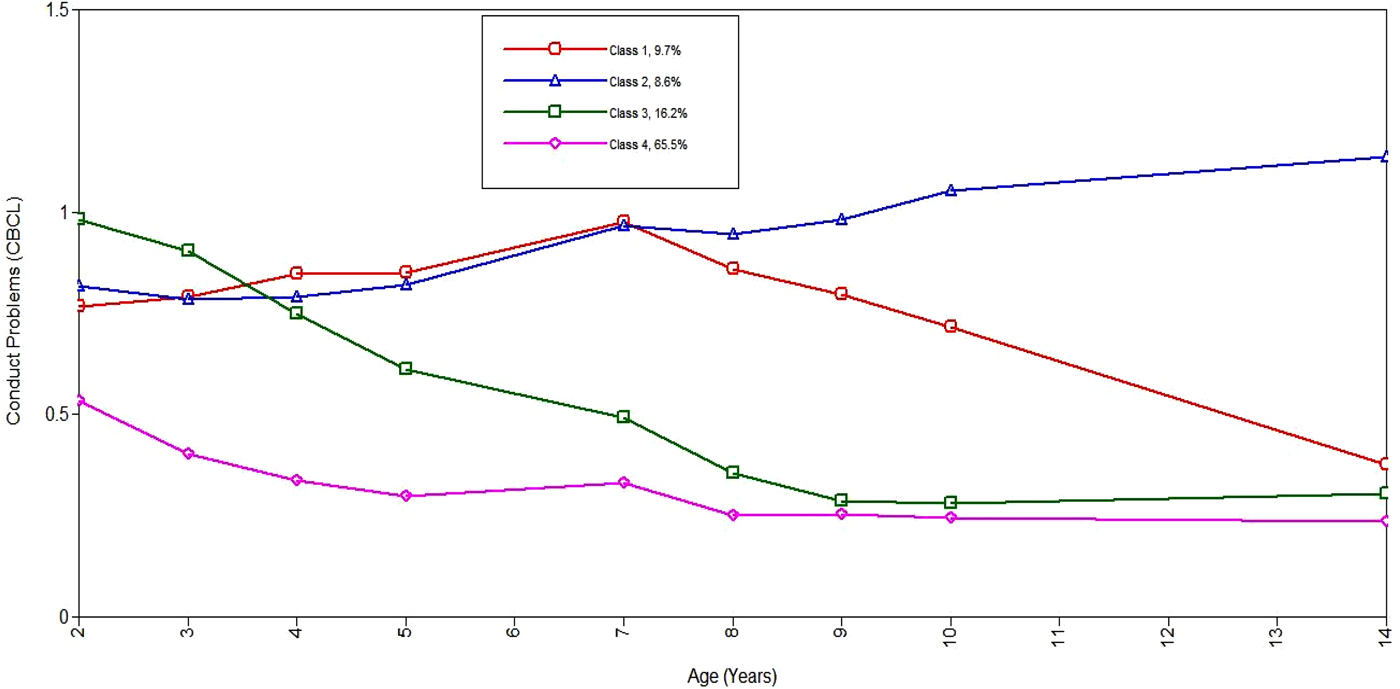
Figure 1 depicts the trajectories of CPs for the final four-group model. Class 4, which we term the “Persistently Low Group,” accounted for 65.5% of the sample and consisted of children who had persistently low levels of CP from ages 2 to 14. The second largest group, Class 3 (16.2%), which we term the “Initially High-Quickly Desisting Group,” included children with the highest CP at age 2, but immediately and consistently declining symptoms from ages 2 to 9.5, and then consistently low levels from ages 9.5 to 14. In the third largest group, Class 1 (9.7%), which we term the “Initially High-Late Desisting Group,” CP measures were initially high and increasing from ages 2 to 7.5, but subsequently declined from ages 7.5 to 14 (i.e., late desisting). Finally, Class 2, which we term the “Persistently High Group,” accounted for the smallest proportion of the sample (8.6%). These children showed initially high symptoms that gradually increased from ages 2 to 14, with by far the highest rate of CP at age 14 compared to all other groups.
Trajectories of conduct problems from ages 2 to 14.

Risk Factors and Outcomes for CP Trajectory Membership
After establishing the trajectories of CP, chi-square tests were computed to examine whether study covariates were associated with trajectory group membership. While the four groups did not differ on intervention status, significant group differences in geographic location and gender composition were evident. The Persistently Low Group consisted of a greater percentage of girls and had greater representation from non-Pittsburgh sites compared with all other groups. Further, the Persistently High and the Initially High-Late Desisting Groups included more children from Pittsburgh compared with the other groups.
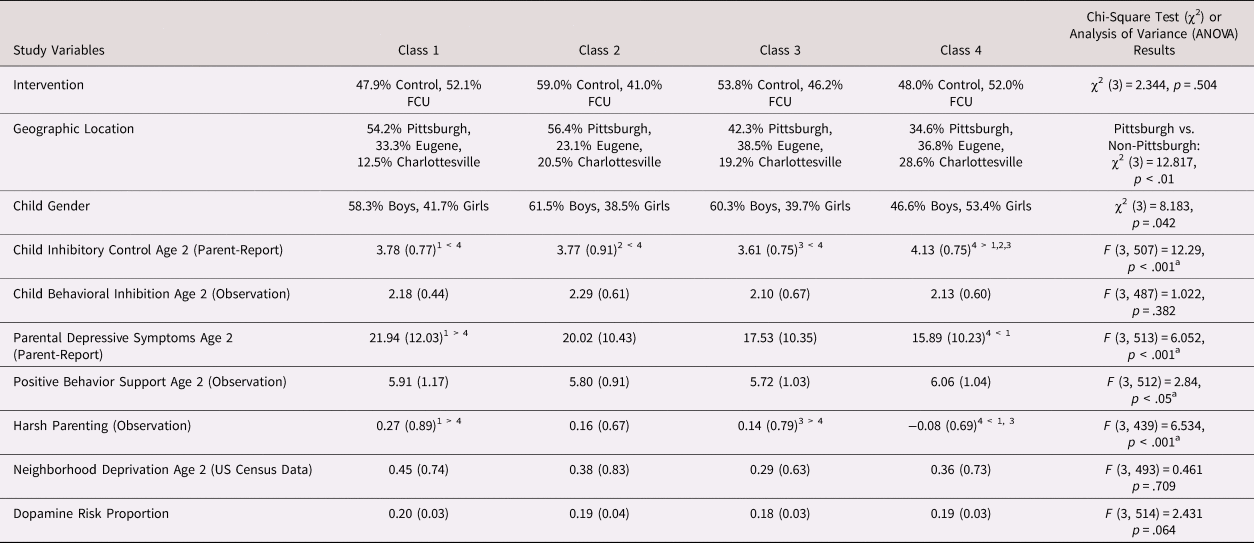
After examining group differences with respect to study covariates, a series of one-way ANOVAs were performed to test associations between trajectory group membership and child, family, and neighborhood risk factors at age 2. As shown in Table 1, there were significant associations between group membership and parent-reported IC, maternal depression, and observed positive behavior support and harsh parenting. Finally, significant associations were identified between trajectory group membership and teacher- and youth-reported AB at age 14 (see Supplemental Table S2). Specifically, according to teacher and youth reports, children in the Persistently High group demonstrated significantly greater AB at age 14 compared with the Persistently Low and Initially High-Quickly Desisting groups. Teachers also reported children in the Initially High-Late Desisting group as having more AB than children in Persistently Low and Initially High-Quickly Desisting groups.
Child, family, and neighborhood differences across trajectory groups of conduct problems from 2 to 14 years (N = 515)

Note: FCU = Family Check-Up; Means (standard deviations) are provided in columns with corresponding F-tests. Superscript numbers denote significant differences in mean scores between conduct problems classes, ps < .05.
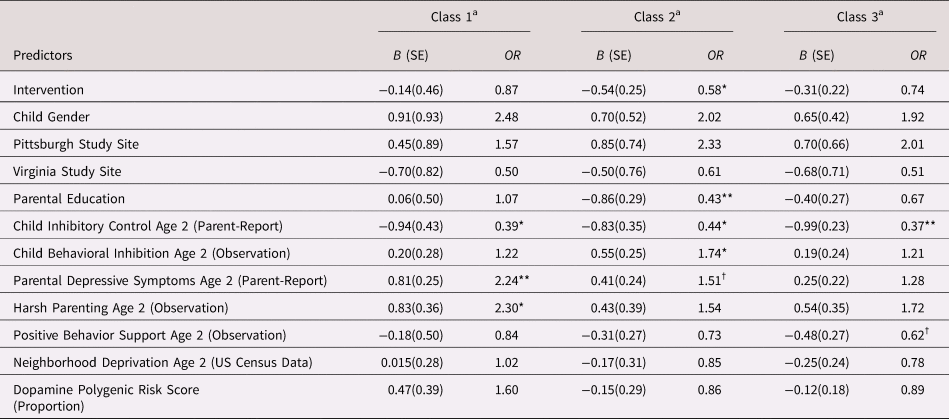
Next, to examine the unique contributions of child, family, and neighborhood risk factors in discriminating CP trajectories, a multinomial logistical regression was computed in which group membership was regressed on all early childhood risk factors (see Table 2). When comparing the Persistently High group with the Persistently Low group, intervention status, parental education, child IC, and behavioral inhibition significantly discriminated group status in expected directions. Specifically, children had a higher probability of belonging to the Persistently Low group than to the Persistently High Group if they were less behaviorally inhibited, had higher levels of IC, and had parents with more education. There was also evidence of an intervention effect, as those assigned to the FCU had a higher probability of belonging to the Persistently Low group than to the Persistently High Group compared with youth in the control group. Despite no evidence of genetic main effects on group membership, the aggression polygenic score interacted with intervention status to discriminate the Persistently Low group from the Persistently High group. At low polygenic scores (i.e., 1 SD below the mean), individuals assigned to the FCU and control conditions did not differ with respect to trajectory group membership. However, at high polygenic scores (i.e., 1 SD above the mean), individuals assigned to the FCU had a higher likelihood of being in the Persistently Low group, whereas individuals in the control group were more likely to follow a Persistently High trajectory.
Multinomial logistic regressions predicting conduct problems trajectory membership

Note: Intervention (Control = -1; Family Check-Up Intervention = 1); Child Gender (Girls = 0; Boys = 1); Pittsburgh Study Site (Non-Pittsburgh = 0; Pittsburgh = 1); Virginia Study Site (Non-Virginia = 0; Virginia = 1). aThe Persistently High group is used as the reference group.
†p < .10. *p < .05. **p < .01.
Discussion
This study sought to examine trajectories of CP from ages 2 to 14 and to examine predictors and outcomes of these trajectories. Consistent with prior research on early- and late-starting patterns of AB, four groups were identified (Broidy et al., Reference Broidy, Nagin, Tremblay, Bates, Brame and Dodge2003; Moffitt, Reference Moffitt, Cicchetti and Cohen2006; Nagin & Tremblay, Reference Nagin and Tremblay1999; Shaw et al., Reference Shaw, Gilliom, Ingoldsby and Nagin2003). However, based on the high-risk nature of the sample, the inclusion of boys and girls, the initiation of the study during the terrible twos, and the study's experimental design, some atypical variation in the patterning of trajectory groups was evident compared with studies of lower-risk samples including only boys and/or using passive longitudinal designs (Nagin & Tremblay, Reference Nagin and Tremblay2001; NICHD ECCRN, 2004; Shaw et al., Reference Shaw, Gilliom, Ingoldsby and Nagin2003). Similar to other studies of early-starting CP, we identified persistently high and persistently low groups. These two groups were complemented by initially-high-late-desisting and initially-high-quickly-desisting groups. These two initially high and desisting groups could have been anticipated based on requiring high levels of child CP and initiating the study during the toddler period, as well as including girls, who show faster levels of desistance in aggression and oppositional behavior from the toddler to school-age period than boys (Brennan & Shaw, Reference Brennan and Shaw2013).
Turning to early discriminators of trajectories, results confirm past research suggesting the importance of children's gender, IC, maternal depression, harsh parenting, and parental education in discriminating early-starting and persistent CP (Aguilar et al., Reference Aguilar, Sroufe, Egeland and Carlson2000; Moffitt & Caspi, Reference Moffitt and Caspi2001). All of the aforementioned predictor variables discriminated early-starting from persistently-low trajectories in both univariate and multivariate analyses.
Perhaps the three most striking findings were evident in comparing the persistently high group with the persistently low group. Children in the persistently high group stood out because of their initially high and further ascending trajectory of CP. First, in relation to the persistently low group, persistently high children demonstrated less parental education, IC, and a trend for greater maternal depressive symptoms, as well as an unexpectedly higher level of behavioral inhibition, the latter perhaps reflecting co-occurring externalizing and internalizing concerns. Second, intervention effects were evident, corroborating and extending previous research with this sample documenting FCU intervention effects on child CP and IC through preschool and middle childhood (Chang et al., Reference Chang, Shaw, Dishion and Wilson2014; Dishion et al., Reference Dishion, Shaw, Connell, Gardner, Weaver and Wilson2008, Reference Dishion, Brennan, McEachern, Shaw, Wilson and Weaver2014; Shaw et al., Reference Shaw, Sitnick, Brennan, Choe, Dishion, Wilson and Gardner2016), as well as maternal depression (Shaw et al., Reference Shaw, Dishion, Connell, Wilson and Gardner2009) during early childhood. Third, this intervention effect was qualified by an interaction involving polygenic risk for aggression. Specifically, among youth with low polygenic scores, those children assigned to the FCU and control conditions did not differ with respect to their trajectory of CP from ages 2 to 14. However, at high polygenic risk for aggression, children in the FCU group were significantly more likely to be in the Persistently Low versus Persistently High group, whereas control children were more likely to follow a Persistently High trajectory. Polygenic scores moderated FCU effects on trajectory class membership. This pattern of results is consistent with Differential Susceptibility Theory (Belsky & Pluess, Reference Belsky and Pluess2009), such that the intervention was efficacious for genetically susceptible individuals but not for others.
There are less than a handful of studies that have considered polygenic moderation of intervention effects with polygenic scores based on results from large discovery GWASs in order to provide valid indices of genetic variation that create multiple small genetic effects. Of these studies, Keers et al. (Reference Keers, Coleman, Lester, Roberts, Breen, Thastum and Nauta2016) and Lemery-Chalfant, Clifford, Dishion, Shaw, and Wilson (Reference Lemery-Chalfant, Clifford, Dishion, Shaw and Wilson2018) focused on the outcome of internalizing problems in middle childhood, and Musci, Masyn, Uhl, Maher, Kellam, and Ialongo (2016) and Musci et al. (Reference Musci, Fairman, Masyn, Uhl, Maher, Sisto and Ialongo2018) examined onset of smoking tobacco and cannabis use in adolescence. In our previous study with the Early Steps Multsite sample, we used a polygenic score that indexed susceptibility to the environment (i.e., genetic variants in this score predicted identical twin differences in emotional problems in middle childhood in a discovery GWAS) (Lemery-Chalfant et al., Reference Lemery-Chalfant, Clifford, Dishion, Shaw and Wilson2018). We reported a significant Polygenic × Intervention interaction, such that genetically susceptible children in the FCU condition had fewer internalizing symptoms than those in the control condition. Regions of significance indicated that these differences were significant beginning at approximately half a standard deviation above the mean on polygenic susceptibility, or for about 25% of the sample. Together, our findings suggest that psychosocial interventions such as the FCU likely have large effects on some individuals but rather than small effects on everyone, and this field could benefit from taking a personalized medicine approach and providing multiple interventions tailored to individual differences.
Unanticipated null findings also need to be acknowledged for neighborhood risk and formal G × E interactions. Null findings for neighborhood risk were not surprising based on prior research indicating that such effects do not begin to emerge until at least ages 3 or 4 even in low-income urban samples (Brooks-Gunn et al., Reference Brooks-Gunn, Duncan, Aber, Brooks-Gunn, Duncan and Aber1997; Supplee et al., Reference Supplee, Unikel and Shaw2007). In the current sample, neighborhood effects on CP at school have been reported as children move from early to middle childhood (Shaw et al., Reference Shaw, Sitnick, Brennan, Choe, Dishion, Wilson and Gardner2016). Traditional G × E interactions were not found between polygenic risk and intervention or between polygenic risk and family or community risk, although there was a trend for a direct effect of polygenic risk. These null G × E findings are inconsistent with both diathesis stress and differential susceptibility models. Although one might expect to find evidence of genetic susceptibility to contextual risk only (diathesis stress) or susceptibility to both contextual risk and protective factors (differential susceptibility), especially during early childhood (Galan & Shaw, 2018), actual support for these forms of G × E interactions have not been universally found (Belsky & Pluess, 2013).
Finally, with the untimely passing of our dear colleague, Tom Dishion, the subject of this Special Issue, we would be remiss not to acknowledge his brilliance in developing the Family Check-Up as a way to engage and improve child and adolescent outcomes. The current intention-to-treat findings spanning 12 years after the initiation of the FCU in this ethnically diverse, low-income sample, albeit qualified by genetic moderation, represent another testament of the FCU's efficacy in promoting long-term functioning among low-income samples of high-risk youth. The current findings echo similar intervention effects found for the current sample on problem behavior during the preschool (Connell et al., Reference Connell, Bullock, Dishion, Shaw, Wilson and Gardner2008; Dishion et al., Reference Dishion, Shaw, Connell, Gardner, Weaver and Wilson2008) and school-age (Dishion et al., Reference Dishion, Brennan, McEachern, Shaw, Wilson and Weaver2014; Reuben et al. Reference Reuben, Shaw, Brennan, Dishion and Wilson2015; Shaw et al., Reference Shaw, Sitnick, Brennan, Choe, Dishion, Wilson and Gardner2016) periods. In addition, similar long-term intervention effects on multiple types of problem behavior have been evident for the FCU using a large cohort of at-risk youth when initiated in early adolescence (Caruthers, Van Ryzin, & Dishion, Reference Caruthers, Van Ryzin and Dishion2014; Connell, Klostermann, & Dishion, Reference Connell, Klostermann and Dishion2011; Stormshak, Connell, & Dishion, Reference Stormshak, Connell and Dishion2009). Although Dr. Dishion is no longer with us, the influence of his Family Check-Up lives on and will likely increase in the coming years and decades.
Limitations
Despite having several methodological strengths, including the long-term follow-up of an experimental trial of the FCU using a large sample of low-income, ethnically-diverse girls and boys from urban, rural, and suburban communities and the use of multiple methods and informants, the study is not without methodological limitations. First, the extent to which the findings would generalize to other samples, particularly children from different ethnic/racial backgrounds or higher income households, might be limited. Second, we relied heavily on primary caregiver reports to measure trajectories of child CP and multiple discriminators of trajectory groups, including maternal depression and child IC, and parental education, all of which discriminated persistently high versus persistently low groups. Parental informant and method bias might have inflated these associations, and they should be interpreted with more caution than discriminators such as intervention status, harsh parenting (observed), and child gender that were not subject to reporting or method bias and also were found to discriminate trajectory group status. In terms of relying on primary caregiver reports of child CP from age 2 to 14, it should be noted that differences in CP were generally corroborated by youth and teacher reports at age 14. Finally, cell sizes for three of the four trajectory groups were relatively small (<10%), including persistently high and initially high then desisting groups, making it challenging to detect group differences on predictors among these initially high groups.
Conclusions
The present study extends previous research that has used person-oriented, latent growth modeling to identify different trajectories of early-starting CP with a high-risk community sample and largely corroborates child and family discriminators of early-starting persistent patterns. Importantly and novel to the current study, by accounting for genetic risk and employing an experimental design, findings revealed an intervention effect for the FCU between children with persistently high and persistently low trajectories.
Acknowledgments
The research reported in this paper was supported by grants to the first, fourth, and sixth authors from the National Institute on Drug Abuse (R01 DA25630 and R01 DA26222), and the National Institute on Drug Abuse and National Institutes of Health: Office of the Director, and Office of Behavioral and Social Sciences Research to the fifth author (K01 DA042828). We are grateful to the staff of the Early Steps Multisite Project for their years of service, and to our study families for making the research possible.