Introduction
In urban, peri-urban and rural areas of Togo and Benin, production of cabbage, Brassica oleracea L. (var. capitata) (Brassicaceae), is an important income-generating activity for smallholder farmers that provides quick cash income over short periods, and also contributes to food security in West Africa (James et al., Reference James, Atcha-Ahowé, Godonou, Baimey, Georgen, Sikirou and Toko2010). However, production is constrained by the damage caused by a range of insect pests, particularly the diamondback moth, Plutella xylostella (L.) (Lepidoptera: Plutellidae), a cosmopolitan insect considered the most important pest of brassica crops worldwide (Sarfraz et al., Reference Sarfraz, Keddie and Dosdall2005; Zhou et al., Reference Zhou, Huang and Xu2011). Severe attacks have been reported in Africa (Kahuthia-Gathu, Reference Kahuthia-Gathu2011; Legwaila et al., Reference Legwaila, Munthali, Obopile and Kwerepe2014). Application of synthetic insecticides remains the most common control strategy (Grzywacz et al., Reference Grzywacz, Rossbach, Rauf, Russell, Srinivasan and Shelton2010). In Togo and Benin, cabbage yield losses have been reported to exceed 30% despite frequent applications of synthetic insecticides (Martin et al., Reference Martin, Assogba-Komlan, Houndete, Hougard and Chandre2006; Agboyi et al., Reference Agboyi, Ketoh, Martin, Glitho, Ogendo, Lukhoba, Bett and Machocho2013), predominantly organophosphates and pyrethroids (Ahouangninou et al., Reference Ahouangninou, Martin, Edorh, Bio-Bangana, Onil, St-Laurent, Dion and Fayomi2012; Agboyi et al., Reference Agboyi, Djade, Ahadji-Dabla, Ketoh, Nuto and Glitho2015).
As reported from several tropical countries (Talekar and Shelton, Reference Talekar and Shelton1993; Baek et al., Reference Baek, Kim, Lee, Chung, Miyata and Lee2005; Nyambo and Löhr, Reference Nyambo, Löhr and Hoddle2005; Ayalew, Reference Ayalew2006; Odhiambo et al., Reference Odhiambo, Gbewonyo, Obeng-Ofori, Wilson, Boakye and Brown2010; Santos et al., Reference Santos, Siqueira, Silva and Farias2011; Zhou et al., Reference Zhou, Huang and Xu2011; Legwaila et al, Reference Legwaila, Munthali, Obopile and Kwerepe2014), P. xylostella populations from Togo and Benin also appear to be resistant to a number of insecticides commonly used in different agroecosystems (Goudegnon et al., Reference Goudegnon, Kirk, Schiffers and Bordat2000; Martin et al., Reference Martin, Assogba-Komlan, Houndete, Hougard and Chandre2006; Godonou et al., Reference Godonou, James, Atcha-Ahowé, Vodouhè, Kooyman, Ahanchédé and Korie2009; Agboyi et al., Reference Agboyi, Ketoh, Martin, Glitho, Ogendo, Lukhoba, Bett and Machocho2013). As a reaction to this phenomenon, cabbage producers have entered the vicious circle of increasing both insecticide dosage rates and spraying frequencies (Ahouangninou et al., Reference Ahouangninou, Martin, Edorh, Bio-Bangana, Onil, St-Laurent, Dion and Fayomi2012), which can lead to environmental and health hazards (Pimentel et al., Reference Pimentel, Wilson, McCullum, Huang, Dwen, Flack, Tran, Saltman and Cliff1997; Gallivan et al., Reference Gallivan, Surgeoner and Kovach2001). The intensification of pesticide applications leads to a faster selection of pesticide-resistant populations, and negatively impacts on potential natural enemies that can provide substantial control, e.g. in Kenya (Nyambo et al., Reference Nyambo, Sevgan, Chabi-Olaye and Ekesi2011). Under this scenario, the bio-insecticide spinosad, which is not commonly used against vegetable pests in Togo and Benin, could be an important new compound for P. xylostella management. Spinosad is a metabolite obtained from the soil actinomycete Saccharopolyspora spinosa Mertz & Yao, and consists of two major components: the macrocyclic lactones spinosyn A (primary) and spinosyn D (secondary). It is active by contact and/or ingestion, and causes paralysis through the activation of nicotinic acetylcholine receptor and GABA receptor (Thompson et al., Reference Thompson, Dutton and Sparks2000). In recent years, spinosad has gained considerable interest in agriculture because of its high activity against insect pests and little ill-effects on beneficial insect species, especially predatory insects (Thompson et al., Reference Thompson, Dutton and Sparks2000).
The present study investigated the susceptibility of three P. xylostella populations from Togo and Benin to two synthetic insecticides commonly used in cabbage production for the control of P. xylostella, as well as the toxicity of spinosad to the same populations.
Materials and methods
Insects
Larvae of P. xylostella were collected in major cabbage production areas in the districts of Kara and Dapaong in Togo and Cotonou in Benin between September 2012 and January 2013. A population of P. xylostella obtained from Matuu in Kenya was used as a reference strain. This reference strain was collected from a cabbage growing area where the diamondback moth is under biological control by its parasitoid Cotesia vestalis (Hymenoptera: Braconidae) (Nyambo et al., Reference Nyambo, Sevgan, Chabi-Olaye and Ekesi2011). Each population of P. xylostella was mass reared separately on 4- to 5-week-old cabbage plants (var. kk-cross) in ventilated cages at 27 ± 2 °C, 75 ± 3% RH and 12:12 (L:D) at the Institut Togolais de Recherche Agronomique (ITRA) station in Dapaong, Togo. Adult moths were fed with a 10% saccharose in water solution. All insecticide toxicity tests were carried out using third instar (L3) larvae.
Bioassays
Insecticide susceptibility was evaluated using a leaf dip bioassay method (Sayyed et al., Reference Sayyed, Saeed, Noor-ul-ane and Crickmore2008) with Deltacal 25 EC (deltamethrin 25 g/l) provided by Arysta Life Science (France), and Dursban 480 EC (chlorpyrifos ethyl 480 g/l) and Success Appat 0.24 SC (spinosad 0.24 g/l) provided by Dow AgroSciences (UK). The recommended doses are 1.59 ml/l water for Deltacal 25 EC, 3.17 ml/l water for Dursban 480 EC, and 0.32 ml/l water for Success Appat 0.24 SC. Insecticide solutions were prepared with distilled water to obtain various concentrations. Six concentrations of deltamethrin (0.01, 5, 100, 500, 2000 and 10,000 mg/l water corresponding to 0.00004, 0.02, 0.4, 2, 8 and 40 ml per 100 ml water, respectively), chlorpyrifos ethyl (0.02, 5, 50, 500, 5000 and 50,000 mg/l water corresponding to 0.000004, 0.001, 0.01, 0.1, 1.04 and 10.42 ml per 100 ml water, respectively) and spinosad (0.0001, 0.001, 0.5, 2, 6 and 18 mg/l water corresponding to 0.00004, 0.0004, 0.21, 0.83, 2.5 and 7.5 ml per 100 ml water, respectively) were tested in three replications. Cabbage leaf discs (88 mm diameter) were dipped in the test solution for 20 s and then dried at ambient temperature. Control leaf discs were dipped in distilled water to check the natural mortality (Abbott, Reference Abbott1925). Each dried leaf disc was transferred to plastic Petri dishes (90 mm) containing a single moistened Whatman Grade 1 filter paper. Ten L3 larvae were released in each Petri dish and mortality was observed after 48 h for synthetic insecticides. For spinosad, the assessment of mortality was delayed until 72 h because of its slower activity compared to pyrethroids and organophosphates, which have higher initial rates of penetration through the insect cuticle than spinosad, due to its higher molecular weight (Sayyed et al., Reference Sayyed, Saeed, Noor-ul-ane and Crickmore2008; Salgado and Sparks, Reference Salgado, Sparks, Gilbert, Iatrou and Gill2005; Legwaila et al., Reference Legwaila, Munthali, Obopile and Kwerepe2014). Larvae that did not move after prodding with a fine brush were counted as dead. Surviving larvae were reared in their Petri dishes until formation of pupae, and kept until adult emergence.
Statistical analysis
Mortality data were corrected using Abbott's formula (Abbott, Reference Abbott1925) before submitting to probit analysis (Finney, Reference Finney1971) using PoloPlus 1.0 (LeOra Software, 2003) for estimating the lethal concentration (LC) values (LC10, LC50 and LC90) of each insecticide. The LC values were considered significantly different when their confidence interval (95%) did not overlap. The LCs of the reference population was used for estimating the resistance ratios (RR) of P. xylostella populations from Togo and Benin. The RR was considered significant (P < 0.05) when the confidence interval did not include the value 1.0 (Robertson et al., Reference Robertson, Russell, Preisler and Savin2007).
Results
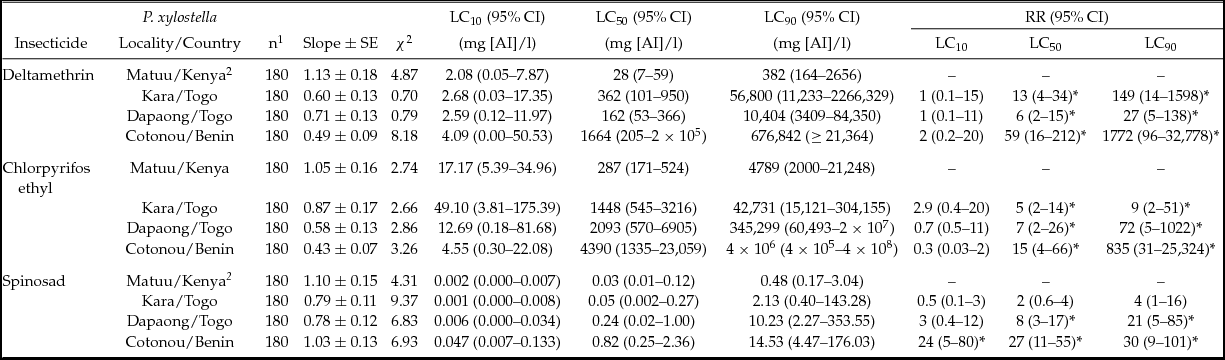
The three populations of P. xylostella showed differences in RRs to deltamethrin and chlorpyrifos ethyl (Table 1). For deltamethrin, the LC10 values recorded for P. xylostella field populations from Togo and Benin were similar to the reference strain from Kenya. From LC10 to LC50, the concentration of deltamethrin increased by 14 times for the reference population, while it increased by 63–407 times for the three other populations (Table 1). The deltamethrin LC50 and LC90 values for P. xylostella populations from Kara, Dapaong and Cotonou were significantly higher as compared to the reference strain. The RR of the three populations at LC50 and LC90 levels was also significantly higher as compared to the reference strain (Table 1). However, the RR of the Dapaong population was lower than Cotonou population at the LC50 level.
Toxicity of spinosad and synthetic insecticides to different field populations of Plutella xylostella (L3) larvae

CI, confidence interval; χ2, chi Square; SE, standard error.
1 Number of larvae of P. xylostella tested.
2 P. xylostella population from Matuu, Kenya was used as a reference.
Resistance Ratio (RR): LC value of field population/LC value of the reference population from Matuu. *Resistance ratio significant at P = 0.05 (confidence interval does not include the value 1.0).
For chlorpyrifos ethyl, the LC10 values of P. xylostella populations from Kara, Dapaong and Cotonou were similar to the reference strain (Table 1). LC50 and LC90 values of Kara, Dapaong and Cotonou populations and their RRs were significantly higher than for the reference strain. The Cotonou population showed the highest LC50 and LC90 values for chlorpyrifos ethyl with a RR of 15 and 835, respectively.
Spinosad showed a higher degree of toxicity to P. xylostella populations as compared to the two synthetic insecticides (Table 1). When compared to spinosad, the LC50 of the Dapaong population was 675 and 8720 times higher for deltamethrin and chlorpyrifos ethyl, respectively; the LC50 of Kara population was 7240 and 28,960 times higher for deltamethrin and chlorpyrifos ethyl, respectively; and the LC50 of Cotonou population was 2029 and 5353 times higher for deltamethrin and chlorpyrifos ethyl, respectively. There were no significant differences between the spinosad LCs of the Kara and Dapaong populations and the reference strain (Table 1). However, the spinosad LCs of the Cotonou population were significantly higher than for the reference strain. Compared to the reference, the RRs (24- to 27-fold for LC10s and LC50s, respectively) were significantly higher for Cotonou populations.
Discussion
A higher degree of resistance to deltamethrin and chlorpyrifos ethyl was demonstrated for P. xylostella populations from Cotonou, Kara and Dapaong, as compared to the reference strain from Matuu, Kenya. The relatively low RRs for the reference strain from Kenya can possibly be explained by the fact that it had been exposed to heavy insecticide regimes for a long time before biological control was introduced, and so still possesses some residual resistance levels (Williamson et al., Reference Williamson, Little, Arif Ali, Kimani, Meir and Oruko2003). In this area, Nyambo et al. (Reference Nyambo, Sevgan, Chabi-Olaye and Ekesi2011) carried out releases of the parasitoid C. vestalis which resulted in successful establishment, with a 50% reduction in P. xylostella damage due to the action of this biological control agent, resulting in more than 75% decrease in the use of synthetic chemicals for diamondback moth control. The population from Cotonou appeared more resistant than either population from Togo, suggesting a higher selection pressure with deltamethrin and chlorpyrifos ethyl currently used by smallholder growers (Ahouangninou et al., Reference Ahouangninou, Martin, Edorh, Bio-Bangana, Onil, St-Laurent, Dion and Fayomi2012). Cotonou is a coastal city with easy access to cheap pesticides imported from neighbouring countries compared to Kara and Dapaong in Northern Togo where insecticides are less accessible. Martin et al. (Reference Martin, Assogba-Komlan, Houndete, Hougard and Chandre2006) had reported pyrethroid resistance in field populations of P. xylostella in Cotonou, but without carrying out any toxicological studies to confirm the resistance. In urban and peri-urban vegetable cultivation areas around Cotonou, cabbage producers apply insecticides, especially pyrethroids and organophosphates, every 3 to 4 days within a 3-month period before harvesting (James et al., Reference James, Atcha-Ahowé, Godonou, Baimey, Georgen, Sikirou and Toko2010), thereby inducing a high selection pressure. The low susceptibility of field populations of P. xylostella with regard to chemical insecticides was observed in Ghana (West Africa) where Odhiambo et al. (Reference Odhiambo, Gbewonyo, Obeng-Ofori, Wilson, Boakye and Brown2010) showed high LC50 of 386–802 mg/l and 74,617–170,573 mg/l for deltamethrin and chlorpyrifos ethyl, respectively.
The non-significant difference of susceptibility to deltamethrin and chlorpyrifos ethyl at LC10 level between populations could be an indication that a small proportion of P. xylostella populations from Kara, Dapaong and Cotonou were still susceptible to the two compounds. Field populations might gradually become more susceptible to deltamethrin and chlorpyrifos ethyl if the selection pressure is suppressed, as described by Ninsin et al. (Reference Ninsin, Mo and Miyata2000), where subsequent generations of P. xylostella without exposure to acetamiprid decreased their resistance levels. The relatively higher concentration of chlorpyrifos ethyl required to achieve LC10 compared to deltamethrin could be explained by the different modes of action of the two compounds, as described by Tuzmen et al. (Reference Tuzmen, Candan, Kaya and Demiryas2008), indicating that, compared to chlorpyrifos, deltamethrin increasingly affects the antioxidant balance as well as the lipid peroxidation level.
Spinosad had a much higher toxicity to P. xylostella as compared to the two other chemical pesticides, even at low concentrations. The greater effectiveness of spinosad can be explained by its mode of action, targeting different sites such as nicotinic acetylcholine receptor and GABA receptor (Thompson et al., Reference Thompson, Dutton and Sparks2000). Our results suggest the absence of cross resistance with pyrethroid and organophosphate as observed by Oliveira et al. (Reference Oliveira, Siqueira, Oliveira, Silva and Michereff Filho2011) for P. xylostella populations, while Sparks et al. (Reference Sparks, Thompson, Larson, Kirst, Jantz, Worden, Hertlein and Busacca1995) showed that spinosad was effective against a Heliothis virescens population resistant to cypermethrin (pyrethroid) and profenofos (organophosphate). Legwaila et al. (Reference Legwaila, Munthali, Obopile and Kwerepe2014) also demonstrated that spinosad can achieve effective control of resistant P. xylostella population in Botswana.
Compared to the reference strain, the initial signs of resistance to spinosad in field populations of P. xylostella from Cotonou could result from increasing and inappropriate use of this new insecticide since it was first registered in Benin in 2008 and 2009 for cotton and vegetable crops protection, respectively (CNAC, 2012). The discovery of low levels of spinosad resistance in P. xylostella populations from Cotonou should be a cause for concern for the use of this recent and still promising biopesticide, as resistance levels will increase if indiscriminate use is unaddressed. Spinosad can be considered as a solution for the control of pesticide-resistant populations of P. xylostella in Togo and Benin, but its exclusive and intensive use could lead to resistance in P. xylostella, as reported from Pakistan by Sayyed et al. (Reference Sayyed, Saeed, Noor-ul-ane and Crickmore2008).
To maintain effectiveness of spinosad against P. xylostella, Zhao et al. (Reference Zhao, Collins, Li, Andaloro, Mau, Boykin, Thompson, Hertlein and Shelton2006) developed a proactive management strategy based on rotation between spinosad and other new insecticides, such as indoxacarb or emamectin benzoate in the US and Mexico. In this strategy, a product was withdrawn from the market when resistance was observed, to suppress the selection pressure, and subsequently reintroduced when the susceptibility had recovered. Spinosad is compatible with beneficial insects, including C. vestalis, an effective parasitoid against P. xylostella in lowlands of East Africa (Nyambo and Löhr, Reference Nyambo, Löhr and Hoddle2005; Kahuthia-Gathu, Reference Kahuthia-Gathu2011), South Africa (Kfir, Reference Kfir and Hoddle2005; Manyangarirwa et al., Reference Manyangarirwa, Zehnder, McCutcheon, Smith, Adler, Mphuru, Tenywa, Joubert, Marais, Rubaihayo and Nampala2009) and West Africa (Goudegnon et al., Reference Goudegnon, Kirk, Schiffers and Bordat2000; Arvanitakis et al., Reference Arvanitakis, David and Bordat2014). As described by Rowell et al. (Reference Rowell, Bunsong, Satthaporn and Doungsa-ard2005), the main constraint to the efficacy of this parasitoid in controlling P. xylostella in many areas, including Togo and Benin, is the excessive use of broad-spectrum synthetic pesticides. In contrast, it was demonstrated by Liu et al. (Reference Liu, Li, Liu, Feng and Tang2007) that C. vestalis could develop resistance to spinosad, indicating that this parasitoid could be promoted for wide use in combination with spinosad use without affecting its capacity to control the pest.
Conclusion
Our observations call for a three-way IPM approach based on (i) avoiding the use of pyrethroids and organophosphates, which would otherwise interfere with the activity of C. vestalis (Nyambo et al. Reference Nyambo, Sevgan, Chabi-Olaye and Ekesi2011; Sow et al., Reference Sow, Diarra, Arvanitakis and Bordat2013a); (ii) using insect net covers, a promising technology to reduce pest damage as demonstrated in Benin (Martin et al., Reference Martin, Assogba-Komlan, Houndete, Hougard and Chandre2006; Martin et al., Reference Martin, Simon, Parrot, Assogba Komlan, Vidogbena, Adegbidi, Baird, Saidi, Kasina, Wasilwa, Subramanian and Ngouajio2015); and (iii) using biopesticides such as neem extracts and the entomopathogenic fungus Beauveria bassiana (Balsamo) Vuillemin (Sarfraz et al., Reference Sarfraz, Keddie and Dosdall2005; Agboyi et al., Reference Agboyi, Ketoh, Martin, Glitho, Ogendo, Lukhoba, Bett and Machocho2013; Sow et al., Reference Sow, Niassy, Sall-Sy, Arvanitakis, Bordat and Diarra2013b).
Acknowledgements
We thank Yawo Gogovor from Crop Protection Service, Togo for providing spinosad. We are grateful to Brigitte Nyambo from the International Centre of Insect Physiology and Ecology (icipe), Kenya for providing insect material and for comments on the draft. This study was conducted as part of a doctoral research by the first author, L. K. A. at the University of Lome, with support from the World Academy of Sciences (TWAS) and the Orskov Foundation.